
On this page
- Step 1: Read the Email Before the Table
- Step 2: Compare Every Line in the Order's Units
- Step 3: Hold Each Price to the Signed Agreement
- Step 4: Find the Line the Scan Leaves Out
- Step 5: Walk Every Moved Date Into the Schedule
- Step 6: Hand the Buyer One List With the Replies Drafted
- What Checking Confirmations by Hand Costs
- Where Qvery's Agents Take Over the Reading
- How We Start on Your Purchasing Inbox
- Frequently asked questions
Your buyers send a purchase order, and the supplier answers with an order confirmation: a PDF acknowledgment, a scan, a spreadsheet, or a few lines in an email. Someone opens each one beside the order and checks the quantities, prices and dates, when there is time.
The change that matters is often in the words, while the table still shows your date. You find out when the part is missing on the assembly floor.
At the pump maker in this tutorial, that reading takes 38.5 minutes a confirmation, and 61 arrive a month: about 39 hours of a buyer's month, or $34.25 of a buyer's time per confirmation.
At Qvery, we help manufacturers cut the hours buyers spend on supplier paperwork, with custom AI agents that read every confirmation against your purchase order and draft the reply.
The company is invented: Kettleridge Fluid Systems, 235 people in Rockford, Illinois, with six supplier confirmations from early November and the files a buying team keeps beside them. We ran the agents on it end to end. This is what came back.
The steps come first. After them: what it takes to have our agents do this on your own purchasing inbox every day, and what it returns.
This is the check. Chasing a supplier who never answers is a separate job, and nothing here writes to your ERP.
Step 1: Read the Email Before the Table
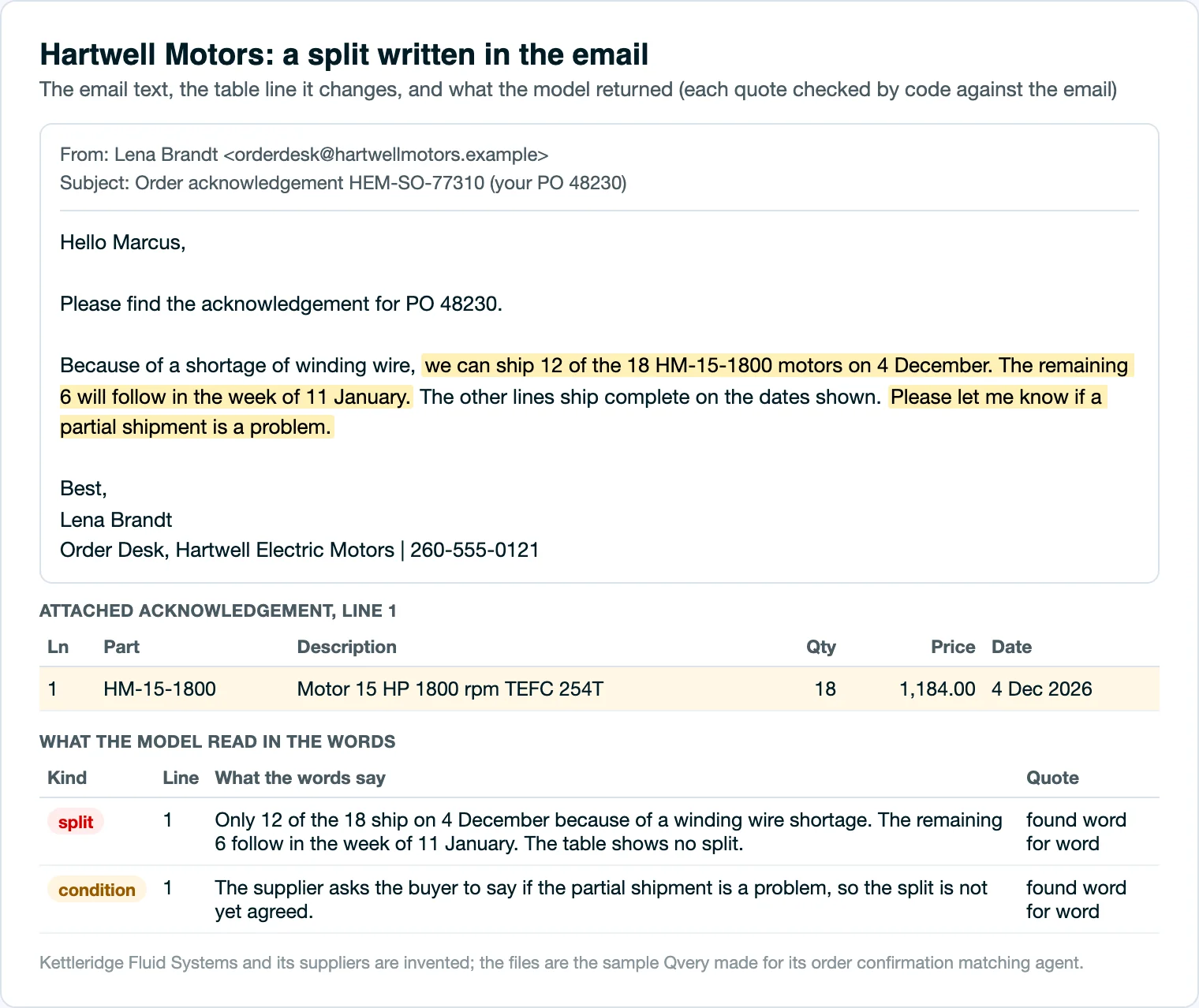
Open Hartwell Electric Motors' confirmation. The acknowledgment shows line 1, eighteen 15-horsepower motors, on 4 December, exactly as ordered. A check that reads only the table calls it a match. The email says 12 of the 18 ship on 4 December and the other 6 follow in the week of 11 January.
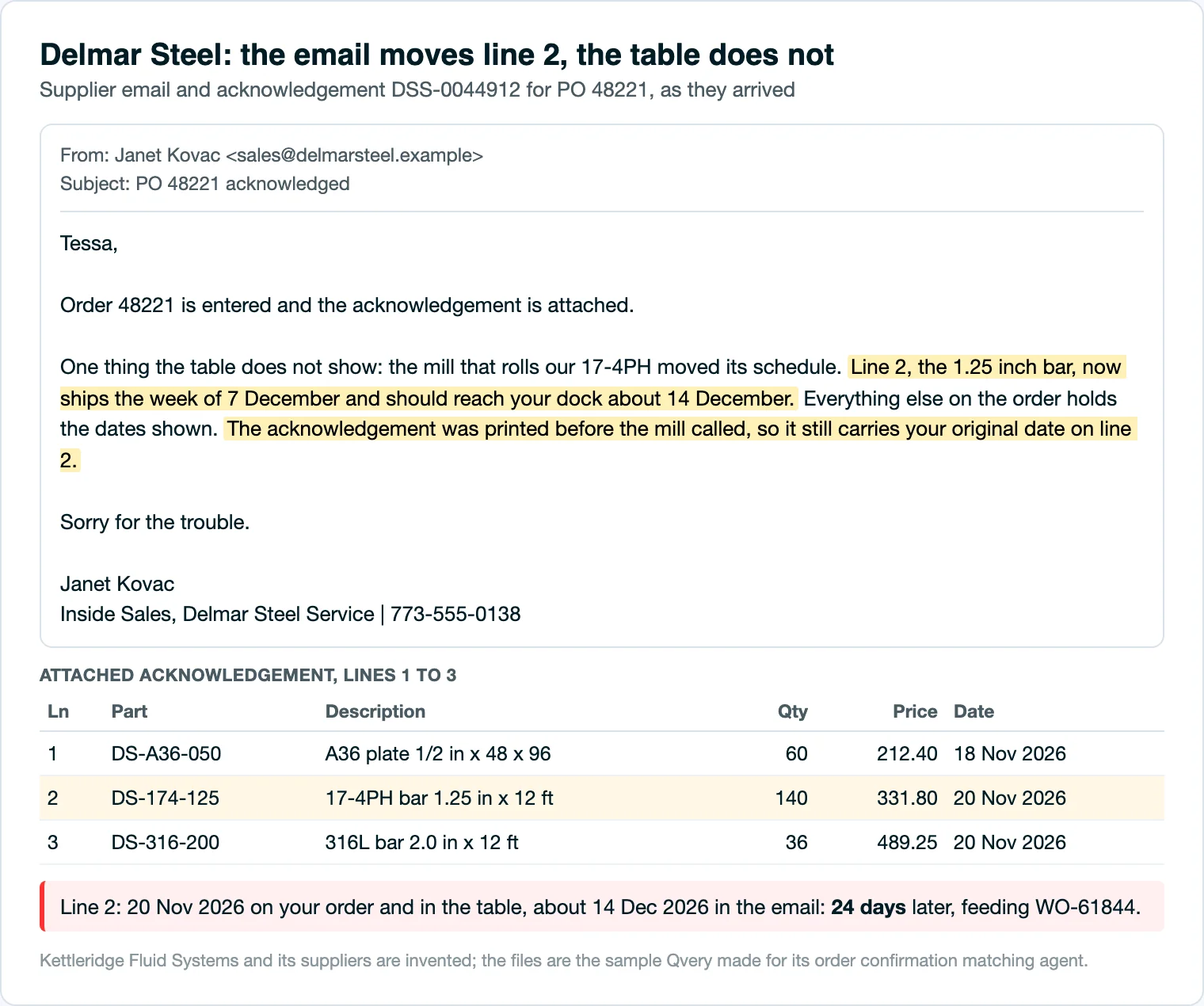
Delmar Steel's confirmation is the same pattern: the table keeps your 20 November on the 17-4PH bar, and the email moves it to about 14 December. Delmar even says the acknowledgment "was printed before the mill called".
Reading the words is the model's part of the job. It returns each change with the supplier's exact sentence, and code then checks that sentence word for word against the email.
In our run every quote was found, 13 of 13 on Claude Sonnet and 12 of 12 on Claude Haiku. A model that paraphrased a date would fail that check before any buyer saw it.
Step 2: Compare Every Line in the Order's Units
Tri-State Fasteners prices 11 of its 12 lines per 100 pieces. Your order prices them per piece. Compared as printed, every price looks like it rose a hundredfold. The agents convert first: $14.20 per 100 is $0.142 each, your price, and 11 lines match.
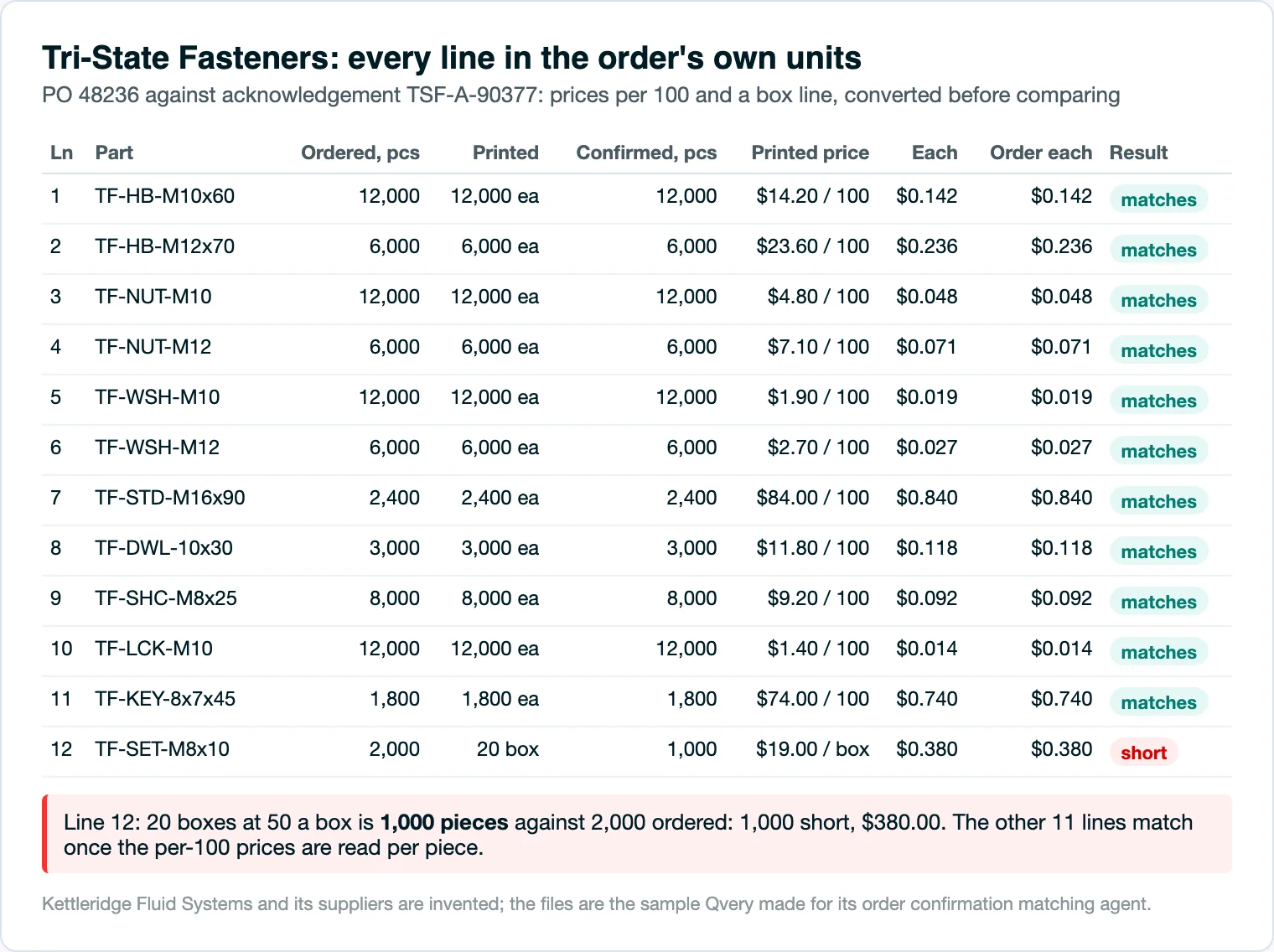
Line 12 is the one that does not. Tri-State confirms 20 boxes, and its acknowledgment says a box holds 50 set screws. That is 1,000 pieces against the 2,000 you ordered, $380.00 short.
Each line is matched by order number, line number and part number, with the suffix kept. That is how Ridgeway's volute cover shows up as revision C where you ordered revision B, instead of passing as the same part.
Step 3: Hold Each Price to the Signed Agreement
Ridgeway Castings raised four prices on its order: 2.90%, 2.88%, 2.84% and 2.79%. Each is under the 3% your procedure lets a buyer accept without anyone's approval. A buyer working to the procedure would reply "Confirmed."
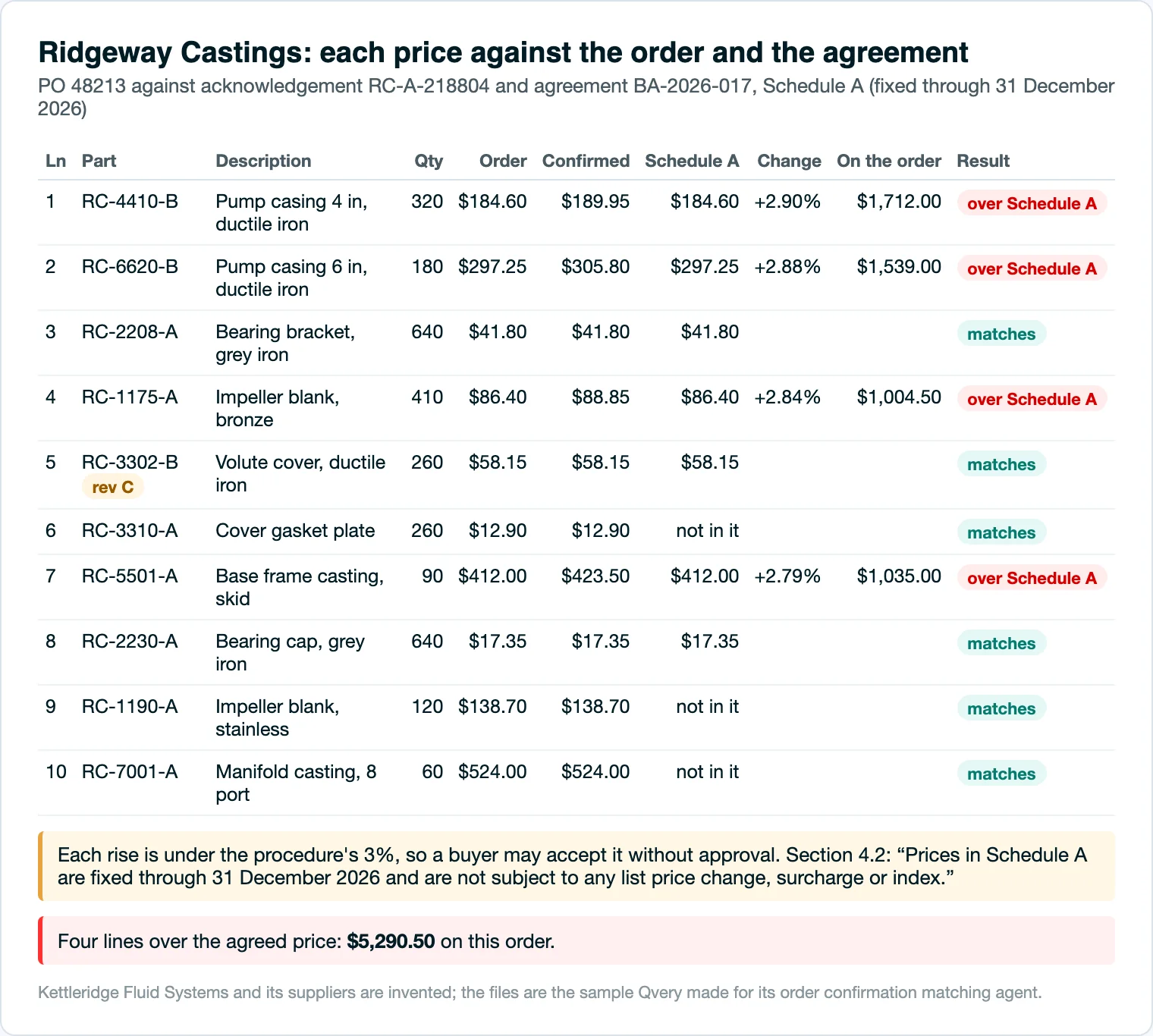
Ridgeway's own agreement, BA-2026-017, fixes those four prices through 31 December 2026, and section 4.2 says they "are not subject to any list price change, surcharge or index."
The agents set every confirmed price against the order and then against the agreement, so the four lines come back as $5,290.50 over the agreed prices on this one order. The procedure never mentions the agreement, which is how a rise like this gets accepted.
The agents do not decide what the agreement means for this order. They put the clause, the four prices and the money in front of your buyer, who decides what to send.
Step 4: Find the Line the Scan Leaves Out
Orlow Precision Machining sent its acknowledgment as a scan, with no text a program can copy. A model reads it from the image. We had two read it, Claude Sonnet and Claude Haiku, and both returned the same five lines and the same freight note, cell for cell.
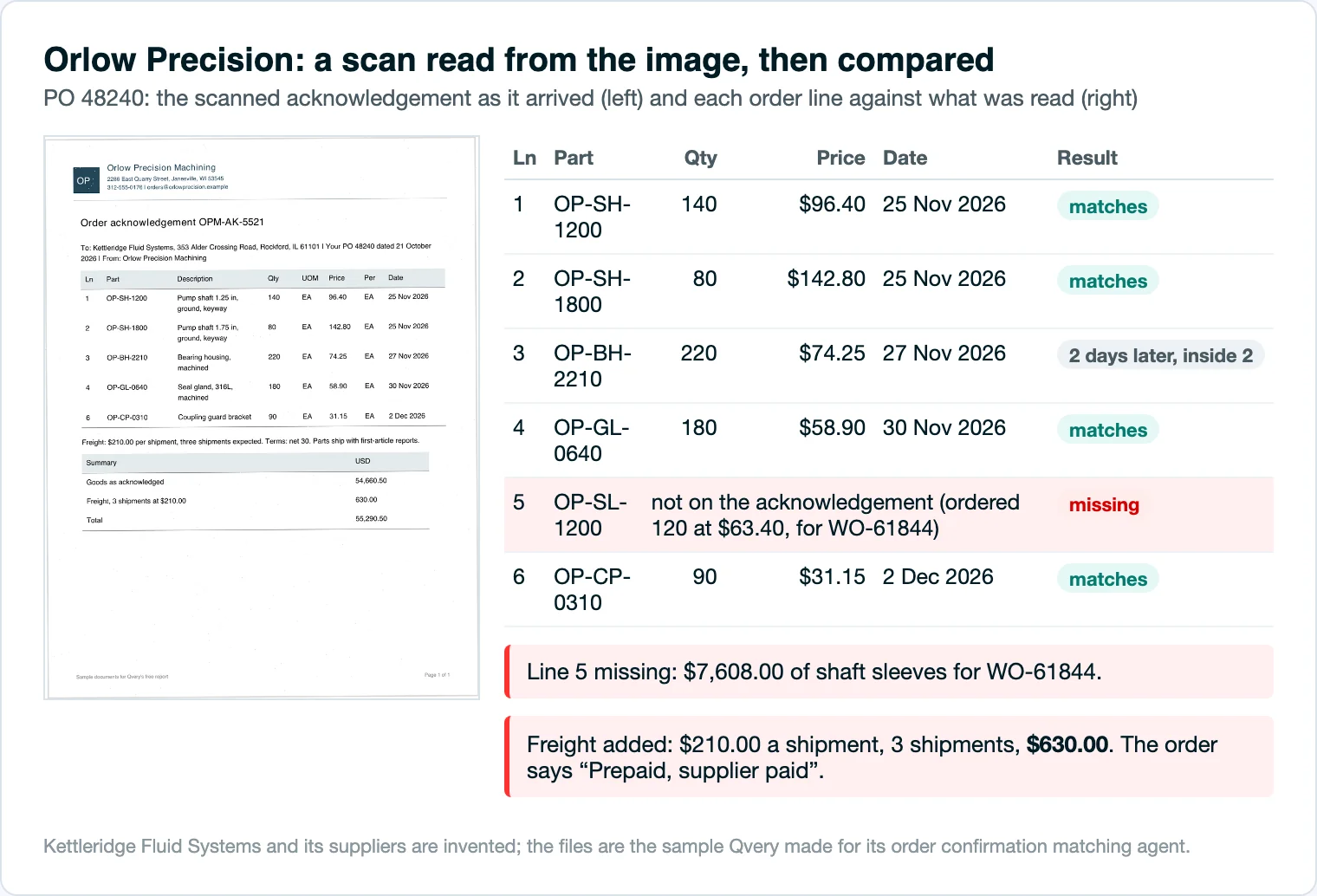
Your order has six lines. Line 5, 120 shaft sleeves worth $7,608.00, is not on the acknowledgment at all, and those sleeves go into a skid package with a customer penalty attached. The agents list it as missing. They never fill it in from a nearby row or assume the supplier meant to include it.
The scan also adds freight: $210.00 a shipment, three shipments, $630.00, on an order whose terms say the supplier pays. Your procedure says an added charge is never accepted without approval. It also leaves the approver's name blank.
Step 5: Walk Every Moved Date Into the Schedule
A moved date only costs money through the work order it feeds. So the agents take each moved line into the production schedule, find the work orders waiting on it, add the shop days to the new material date (skipping 25 December and 1 January), and count the days past the customer's ship date.
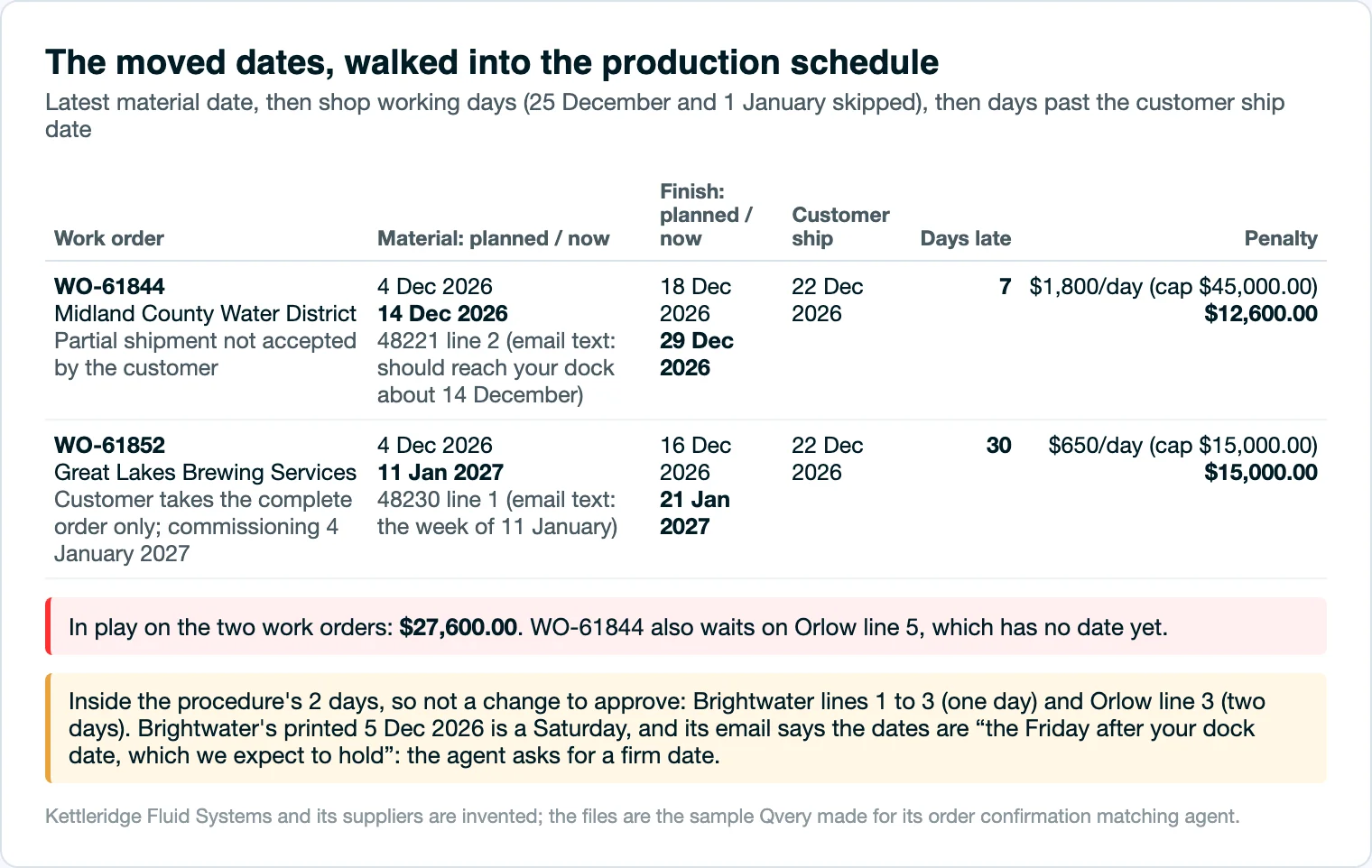
Delmar's bar moves the Midland County skid package to a 29 December finish, 7 days past its 22 December ship date, at $1,800 a day: $12,600.00. Hartwell's six motors move the Great Lakes Brewing pumps to 21 January, 30 days late, capped at $15,000.00.
That is $27,600.00 in play, and both customers take complete orders only.
Here is the same batch checked twice, once by code reading only the tables and once with the words and the scan read:
| What was checked | Code alone, tables only | With the words and the scan read |
|---|---|---|
| Delmar line 2 and Hartwell line 1 | Match | Moved: 24 and 38 days |
| Great Lakes Brewing work order | On time | 30 days late |
| Penalties in play | $10,800.00 | $27,600.00 |
| Orlow's six lines | All missing (scan unread) | Five read, line 5 missing |
| The answer key's six findings | 4 found | 6 found |
If the Great Lakes order shows on time, the email text was never read.
Some flags are fine, and the agents say so. Brightwater Coatings is one day later than ordered and Orlow's line 3 is two days later, both inside your procedure's 2 days.
Brightwater still gets a question: its printed date, 5 December, is a Saturday, and its email says the dates are "the Friday after your dock date, which we expect to hold." That is not a date your planner can use.
People who run this check by hand describe the same habit: a confirmation opens the conversation about a date rather than closing it.
Tips from Reddit
Buyers and planners on keeping confirmed dates honest
We track initial delivery performance (no change to confirmed PO) and final delivery performance (no change within 30 days of delivery date).
I also think that many of OPs "missed dates" are coming from confirmations being the end of the conversation.
It’s standard practice at my company to reach out suppliers 2 week ahead of delivery date to make sure it’s still on track.
Step 6: Hand the Buyer One List With the Replies Drafted
Each row of the buyers' list has your value and the supplier's, the money or the work order it reaches, and what your procedure allows: the buyer may accept it, or someone must approve it.
Your procedure names no approver for any of its four limits, so the list ends with eight questions for the purchasing manager about who decides.
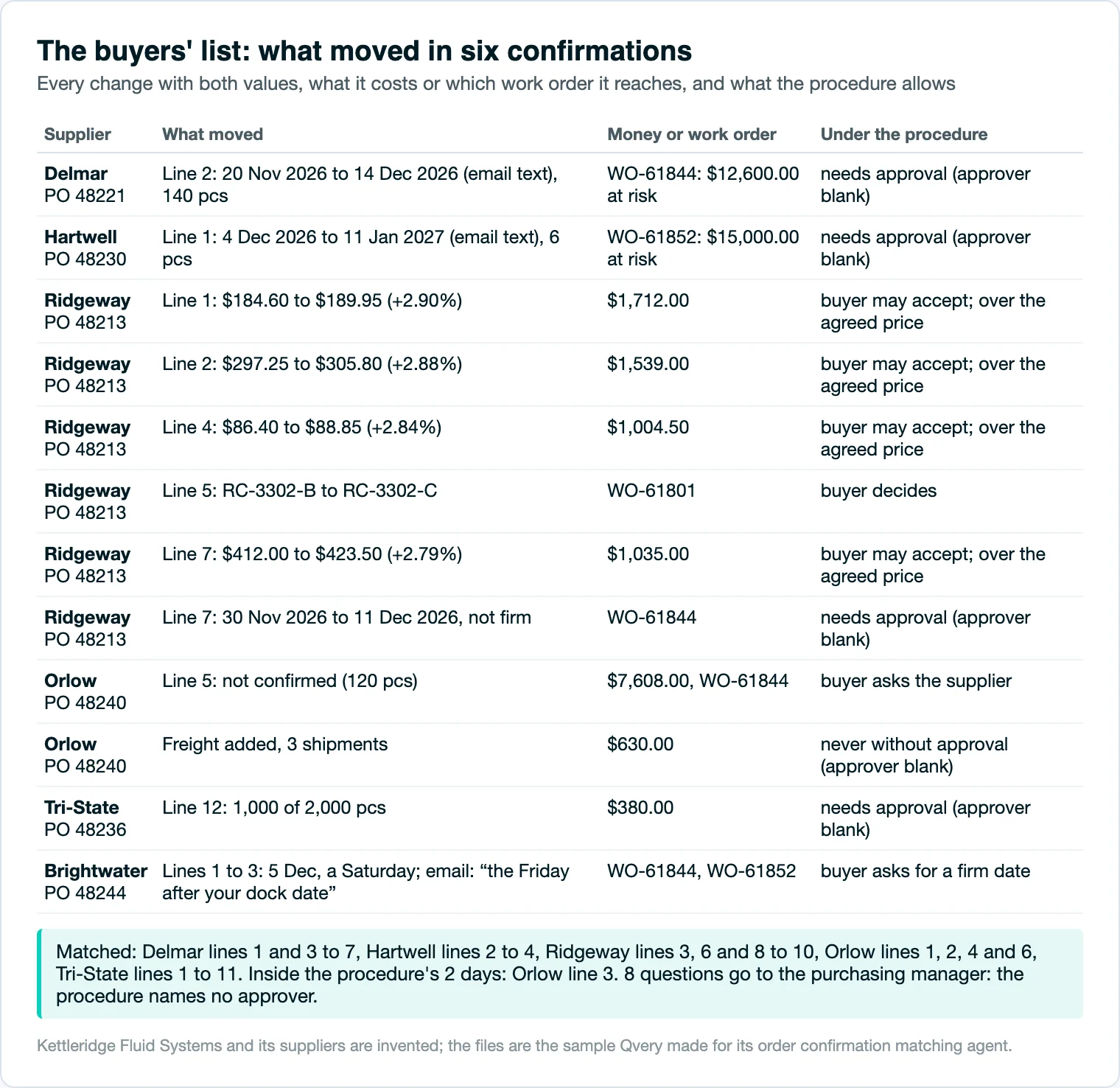
Under each confirmation sits a drafted reply. The one to Ridgeway gives both prices on each of the four lines, cites section 4.2 and asks for a corrected acknowledgment. Where a date moved, there is a note for the production planner with the work order, the new finish date and the penalty.
Nothing is sent. The buyer edits each draft and sends it, or does not.
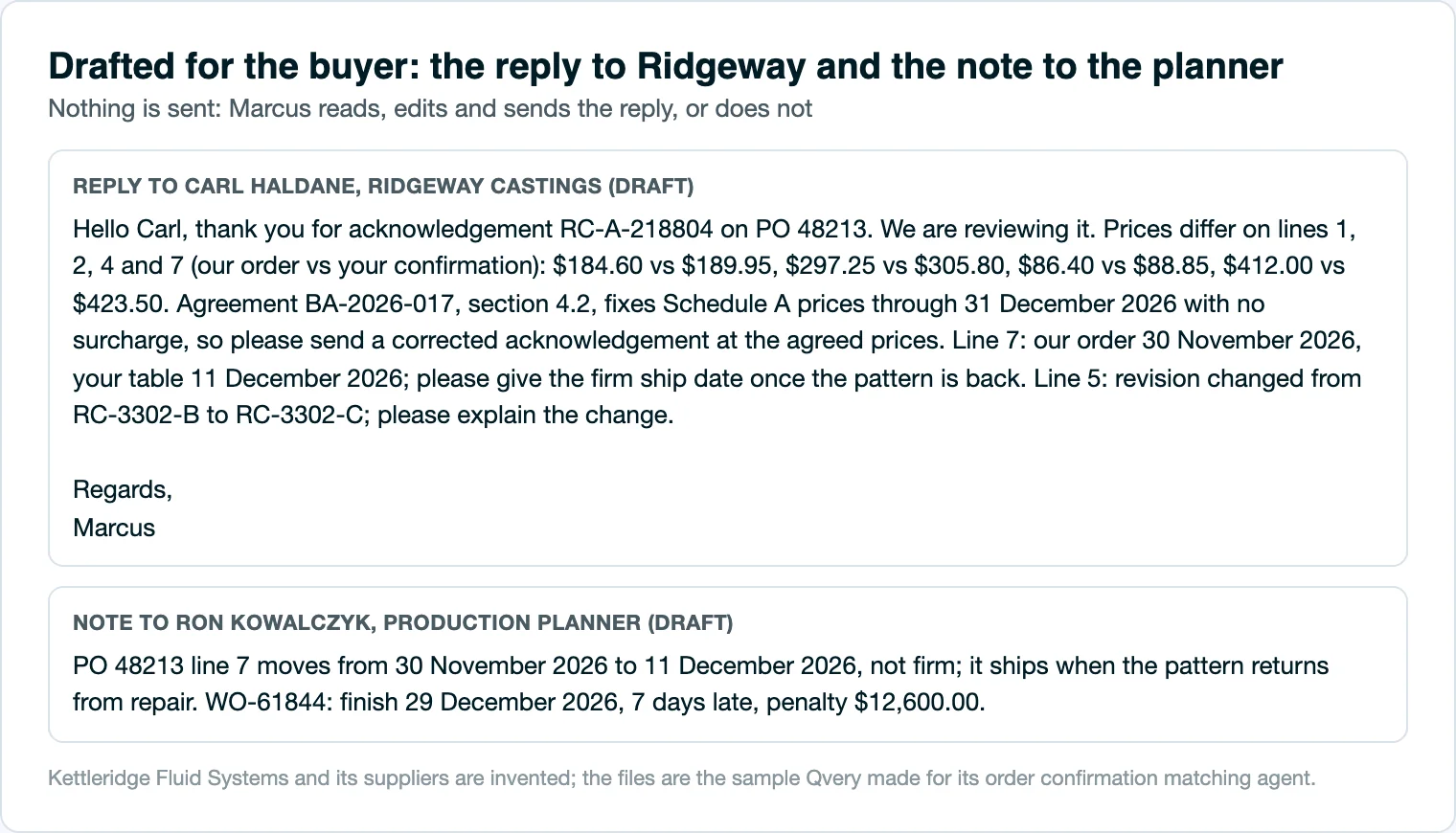
The drafts still need a reader. Both models wrote Brightwater's planner note with the $12,600.00 and $15,000.00 penalties in it, as if Brightwater's one day had caused them. Delmar and Hartwell did.
Every figure in the drafts traced back to the checks (72 of 72 on Sonnet), and the note still told the wrong story about them. A buyer reading the note before it goes out catches that, and it is the reason every message goes through a buyer.
The same check runs on your own files, and what comes back is the line-by-line table and the drafted reply.
What Checking Confirmations by Hand Costs
Take the example on the calculator below, which is Kettleridge's own month. Its log shows 61 confirmations received from 5 October to 5 November, and the 52 its buyers reviewed took 38.5 minutes each on average.
A buyer earns a median $37.36 an hour, by the Bureau of Labor Statistics' count for May 2025, and wages are 70.0% of what a private employer spends on a person, so a buyer's hour costs about $53.37.
With the agents, a buyer opens the list, decides the changes and sends the drafted replies. We assume 10 minutes a confirmation on average, counting the many that change nothing; that is the target on the agent's own scorecard.
The agents cost about $315 a month to run at this volume: about 25 cents of model usage a confirmation, plus hosting, the log of every check and upkeep of your supplier rules.
A confirmation drops from $34.25 of a buyer's time to $14.06, the agents' running cost included. The buyers get back 348 hours a year, and Kettleridge keeps $14,774 a year after paying to run the agents. Payback is 8.1 months for every $10,000 the build costs. Put your own buyers' numbers in.
Supplier Confirmation Check ROI Calculator
What Each Supplier Confirmation Costs Your Buyers, And With The Agents
Saved Per Year
$14,774
348 hours handed back, after $3,783 a year to run it
- Hours Handed Back
- 348 hours a year
- Agent Running Cost (Estimate)
- $315 a month
- Payback Per $10,000 Of Build
- 8.1 months
On these numbers, each confirmation costs $14.06 instead of $34.25, the agent saves $14,774 a year after its own running cost, and every $10,000 of the build is earned back in 8.1 months.
The calculator counts the reading. It does not count what a check catches: in this one batch, $5,290.50 of price rises against an agreement, $630.00 of freight the supplier owes, and $27,600.00 of penalties in play while there is still time to act.
Where Qvery's Agents Take Over the Reading
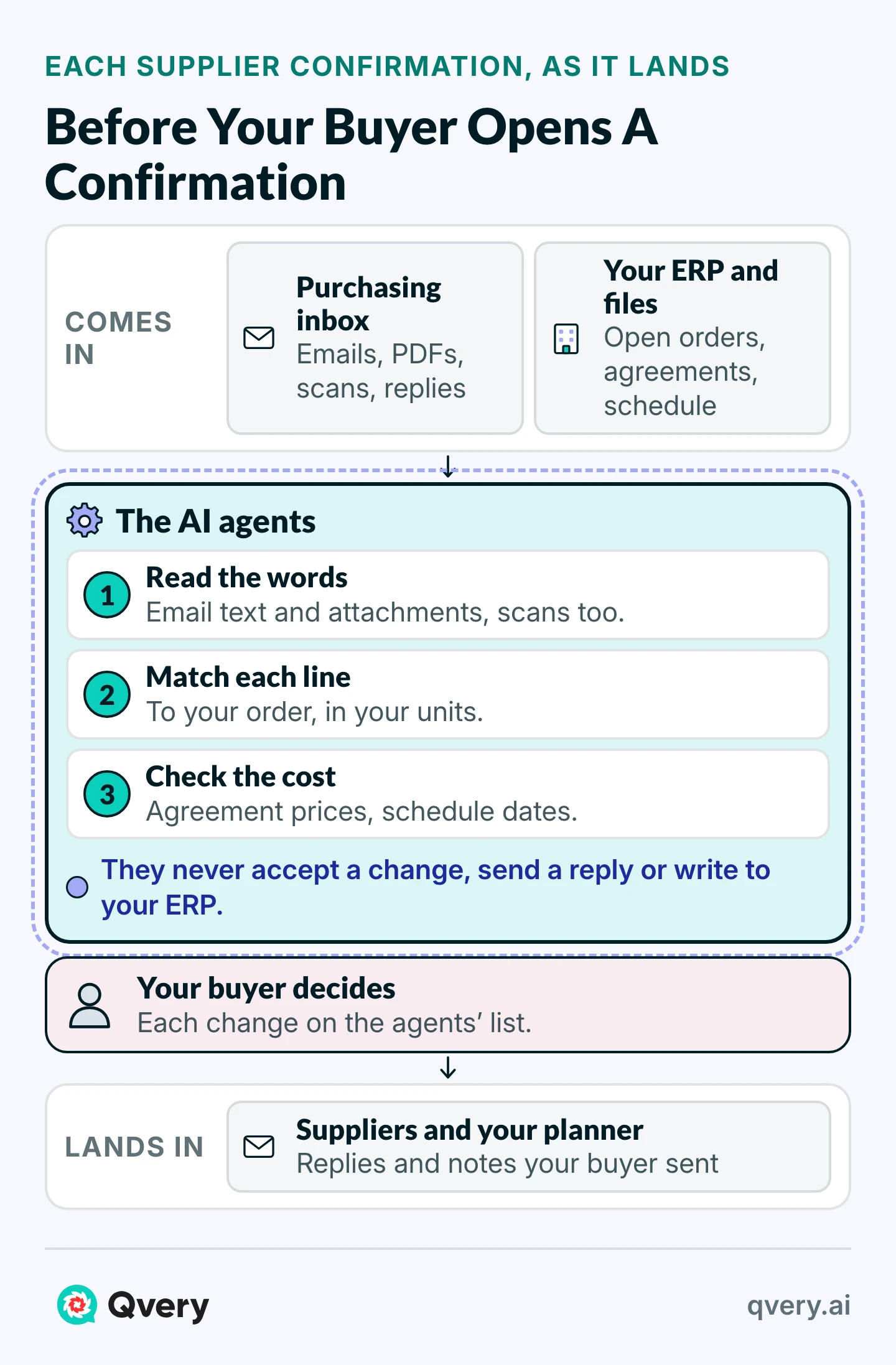
A confirmation reaches your purchasing inbox. Our agents read the email and every attachment, scans included, in the language the supplier wrote it, and pull the open order from your ERP through its API or a scheduled export.
Each line is matched and converted to your units, then set against the order, your price agreements and the procedure's limits, and every moved date is walked into the production schedule.
What comes back is the list your buyer works from, a drafted reply under each change, a note for the planner when a date moves, and a log row for every confirmation.
A confirmation that answers three purchase orders is split and checked against each one. A part the agents cannot pair, a line that is missing, and anything over a limit go to a person with both values beside them.
 Piotr BabelPartner @ Qvery
Most supplier changes live in a sentence, not in the table, so a check that reads only the table misses the expensive ones. The model reads the words; code checks every sentence it quotes against the email before a buyer sees it. Where the agents cannot pair a line or read a page, the list says so on that line instead of filling it in.
Our agents never accept or reject a change, never send a reply, and never write to your ERP; your orders stay as your buyers set them. They start with read access to the purchasing inbox, confirmations only, and to the open orders, and nothing else in finance or sales.
Every check they make is logged. Before they touch anything, we agree in writing what they may read and where the data is processed, and Qvery AI OÜ, an EU company, signs a data processing agreement. Where a supplier's price terms are under a confidentiality agreement, those terms carry into ours.
How We Start on Your Purchasing Inbox
Week one goes to learning how your suppliers confirm, from what your team already keeps. What we ask you for:
- two months of supplier confirmations, the changed ones included
- your open order export, by API or on a schedule
- read access to the purchasing inbox, confirmations only
- your review procedure and your price agreements
- the production schedule, so a moved date can be priced
- about two hours of your purchasing manager's time that week
By the end of the second week the agents are checking confirmations your buyers already handled, and you set what they found beside what your buyers caught.
In weeks three and four they run on live confirmations beside your buyers, who send every reply, and a buyer spends about 20 minutes a day with us on what to change. From week five every confirmation is checked the day it arrives, and we review the hours and the catches with you each month.
 Vlad ShvetsPartner @ Qvery
A buyer who spends the morning retyping acknowledgments is not on the phone with the foundry whose pattern is in the repair shop, and that call is what keeps a customer's ship date. We take the reading off your buyers. Every decision, every reply and every supplier relationship stays with them, because that is where the judgment already sits.
Confirmations are one of the paperwork jobs a plant runs on email. The Manufacturing Playbook works out three more for a company this size: supplier part approvals, quote requests and emailed customer orders.
Your own files will force a few decisions first, the way Kettleridge's did: who approves a date past your tolerance, a short quantity or an added charge; whether a price agreement outranks your buyers' percent limit; and who moves the schedule when a supplier moves a date. We settle those with you before any live confirmation is read.
Frequently asked questions
Is this the same as automating order confirmation emails to our customers?
No. Those are the emails a shop sends a buyer after a sale. This is the other direction: the confirmations your suppliers send back on your purchase orders, often called order acknowledgments, checked against what you ordered. The agents read what suppliers send you; they send nothing to your customers.
Our suppliers call it an acknowledgment, some say confirmation, and some just reply that the lead time is fine. Does that matter?
No. Any reply that answers a purchase order is read as a confirmation, whatever it is called. One that only says the lead time is fine, with no date, is read as no firm date, and the line stays unconfirmed on the list until the supplier gives one.
Do our suppliers have to change how they confirm?
No. They keep answering the way they do now: a PDF, a spreadsheet, a scan or a few words in the reply. The agents adapt to each supplier's format, so nobody on the other side learns a portal or fills in a form.
What happens when a supplier never confirms?
A silence gives the agents nothing to read, so they list it: every open order line with no acknowledgment after a set number of days. In Kettleridge's files that was 33 lines on 3 orders more than ten days old. Your buyer chases those first. Chasing silent suppliers is a separate job we can build on its own.
Does it update the promise dates in our ERP?
No. The agents write nothing to your ERP, so the order keeps its terms until your buyer changes them. The buyer gets the moved dates on the list, and the planner gets a note, so the schedule can move the same day. Updating the order stays where it is today.
A supplier gives a ship date, but our order asked for an arrival date. Is that caught?
Yes. When a supplier states a dispatch date against an order that asked for arrival, the gap in transit days is flagged. Where a supplier gives both, the arrival date is the one that goes into the schedule, and the dispatch date stays on the list beside it.
What happens when a supplier sends a revised confirmation?
A confirmation sent twice is read once. If the second one differs from the first, the difference is itself a change on the buyer's list, with both versions beside it, so a quiet revision to a date or a price cannot slip in as a resend.
What if the agents pair a line with the wrong order line?
Each pairing shows both sides and the page behind them, so your buyer sees a wrong one at a glance. A pairing the agents are unsure of is marked as a question, never presented as settled. When your buyer corrects one, we tune the pairing rules for that supplier, and the fix holds for its next confirmation.
Our supplier renamed a part. Will the agents treat it as a new line?
No. A renamed part shows up with the old and the new code next to each other, each with its description, and your buyer decides whether it is the same part. Nothing is paired on a guess: until your buyer answers, the line stays open on the list.
Does it work with SAP Business One, Epicor or NetSuite?
Yes, and with Infor and Microsoft Dynamics. The agents only need to read open purchase orders, through an API or a scheduled export your ERP already makes. Excel files and dates written only in an email are read too.
What about suppliers on EDI or a supplier portal?
Electronic data interchange, the direct system link some large suppliers use, and portal acknowledgments both work once your systems save them as files. A confirmation given by phone stays outside the check until someone writes it down.
Can it read confirmations in German or Spanish, or in another currency?
Yes. Confirmations in German, Spanish, Italian, Chinese and most other languages are read as they are, with no translation step for your buyer. Prices are compared in your order's currency, and a supplier who switches currency is flagged. A page too blurred to read is named, and its lines stay open.
One supplier confirms three purchase orders in one email. Does that work?
Yes. The confirmation is split by order and each part is checked against its own purchase order and reported separately, so a change on one order is never hidden by the other two.
Can we set different tolerances for different suppliers?
Yes. Your buyers set them at setup, by supplier or by part family: a fastener supplier can get looser limits than the foundry making your castings. Changes inside a tolerance show as matches with a note, so the list stays short.
Who sees our supplier prices?
The agents read only what the check needs from your open orders: part, quantity, unit price and delivery date. Access stops at the purchasing inbox and those orders, so finance and sales data stay closed. Replies leave from your buyers' own mailboxes, under their names.
