
On this page
- Manufacturers Report Gains From AI, and Half Cannot Measure Them
- Most Manufacturers Will Spend More on AI Next Year
- Who Was Asked Decides How Common AI Looks
- Few Manufacturers Have Taken AI Past the Pilot
- Pilots Fail on Data and Integration Before Anything Else
- Qvery's Agents Start at the Order Desk
- Manufacturers Say They Have the Skills, and Few Pay to Train
- What the Figures Say to a Manufacturer of 100 to 500 People
- Frequently asked questions
In a manufacturer of 100 to 500 people, AI usually arrives one desk at a time: an engineer drafting with ChatGPT, a copilot license in the office, a pilot in quality or maintenance.
The order desk still retypes customer purchase orders into the ERP, the system that runs orders, stock and production. Buyers still chase suppliers for delivery dates by email.
The surveys measure where that leaves the industry, and they disagree, because they asked different people. Here are the figures from named surveys and from the government's own counts, each with who was asked: what manufacturers say AI returns, what they spend on it, how widely it is used, why the pilots stall and what it means for the people on the payroll.
Manufacturers Report Gains From AI, and Half Cannot Measure Them
Deloitte asked 600 executives at large manufacturers, companies with $500 million or more in revenue and more than 1,000 employees, what smart manufacturing (connected machines, sensors, data and AI on the plant floor) had changed since they put it in.4 On average, they reported:
KPMG surveyed senior AI leaders at industrial manufacturers, the people who run AI rather than a cross-section of the industry.6 96% report operational and efficiency gains, and 45% measurable financial improvements.6 62% say AI has returned more than 10% on what they put in, and 31% expect a return above 30% in the next 12 months.6
AI Leaders Report Operating Gains More Often Than Financial Ones
share of AI leaders
View the data
That order is what I'd expect. Hours an agent hands back show up in a team's week long before they show up in the accounts, and only if someone counts them.
In the Manufacturing Leadership Council's survey, published in April 2026, half of respondents said they have no set of metrics for AI's effect on their operations.5 RSM's manufacturers are 98% satisfied with the value AI has delivered, and 70% very satisfied.3
McKinsey's 2026 survey, across all industries, finds profit harder to trace: 37% of respondents attribute any EBIT (operating profit) impact to AI, about the same share as a year earlier.7 Where savings do show up, its respondents name supply chain management, service operations and manufacturing more often than any other function.7
Most Manufacturers Will Spend More on AI Next Year
RSM's survey is the closest of these to a company of 100 to 500 people: 129 manufacturers with $30 million to $10 billion in revenue in the US, up to $1 billion in Canada, asked in March 2026.38 Half plan to spend at least $1 million on AI this fiscal year, 23% at least $3 million, and 84% expect to spend more next year.3
Manufacturers Most Often Put AI Money Into Software and Data Platforms
share of manufacturers
Among those spending more, 50% said the money may come out of business intelligence and analytics, 45% out of cybersecurity and 40% out of modernizing older applications.3
Cutting security to pay for AI is the trade I'd question first: an agent connected to the inbox and the ERP is one more system with access to both.
Among Deloitte's large manufacturers, 88% expect their smart manufacturing spending to hold or grow next year, and 46% rank process automation first or second for the next two years; 36% of KPMG's AI leaders already spend more than 10% of their IT budget on AI.46
Who Was Asked Decides How Common AI Looks
RSM asked managers who decide on technology at larger manufacturers: 88% say AI is at least partly built into their operations, and 32% say it runs across their core processes.3
79% use generative AI, 63% language AI, 57% prediction AI and 56% agentic AI, software that carries out a task on its own rather than only answering a question.3 More than 70% of the Manufacturing Leadership Council's respondents use generative AI products such as ChatGPT and Copilot, up from 46% in 2024.5
Government surveys, which ask every kind of manufacturer, find far less.
| Survey | Who was asked | Using AI |
|---|---|---|
| RSM, March 20263 | 129 US and Canadian manufacturers with $30 million or more in revenue | 88% at least partly built in |
| Manufacturing Leadership Council, 20265 | its manufacturing respondents | more than 70% use generative AI |
| ifo Institute, May 20269 | German industrial companies | 58.7% |
| Deloitte, 20244 | 600 large manufacturers with US operations | 29% across a plant or network |
| US Census Bureau, November 20261 | US manufacturing firms of every size | 22.4% in the past two weeks |
| Eurostat, 202510 | EU manufacturers with 10 or more employees | 17.27% |
The Census Bureau's Business Trends and Outlook Survey asks US companies every two weeks whether they used AI in any business function. In the collection of November 2 to 15, 2026, 22.4% of manufacturers said yes, up from 12.7% a year earlier, and 26.5% expect to use it within six months.1
AI Use Among US Manufacturers Rose From 12.7% to 22.4% in a Year
share of US manufacturers using AI
View the data
In the latest count, use is highest among manufacturers with 100 to 249 employees: 37.0% used AI, against 18.9% of those with one to four, and 55.5% of the 100-to-249 group expect to within six months.2 Read it as a range. The same estimate ran from 32.0% to 43.8% over the fortnights before, with a standard error of 6.19 points.2
Eurostat counts the same way for Europe, once a year. 17.27% of EU manufacturers with ten or more employees used AI in 2025, from 10.57% in 2024 and 6.79% in 2023, a little under the 19.95% for EU businesses outside farming, mining and finance.10 The share depends on what a plant makes.
EU Pharmaceutical and Electronics Makers Use AI at More Than Twice the Manufacturing Rate
share of businesses using AI
View the data
European manufacturers that use AI use it most for office work: marketing and sales (30.41% of them) and business administration (27.05%).11
In Germany, the ifo Institute's May 2026 survey found 58.7% of industrial companies using AI, against 54.5% of all companies, up from 40.9% a year earlier.9
Few Manufacturers Have Taken AI Past the Pilot
More than 75% of the Manufacturing Leadership Council's respondents rate the maturity of their AI below five on a scale of one to ten.5
In MIT Technology Review Insights' 2024 study of 300 manufacturers already working with AI, 64% were still researching or experimenting, and 35% had a use case in production.12
McKinsey's 2026 survey, across all industries, splits the answer by size. 22% of respondents at organizations under $1 billion in revenue report scaling AI agents, the same as a year before, against 40% at larger ones, up from 27%.7 For AI across the whole company, it is 54% of the larger organizations and one third of the smaller.7
Among KPMG's AI leaders, 20% call AI a core part of every department.6
 Vlad ShvetsPartner @ Qvery
The figure I'd quote to a partner is the Census Bureau's 37.0%: manufacturers with 100 to 249 people use AI more than any smaller group. Using it is not getting anything back, and half of one survey's respondents can't measure what it returns. So the first job I'd hand an agent is one where the before is already countable, the orders your desk retypes every day. If the hours don't come back in the first month, you'll know.
Pilots Fail on Data and Integration Before Anything Else
RSM asked the manufacturers whose pilots of the past two years had moderate or limited success why they fell short.3
Data Quality and Integration Top the Reasons Manufacturing AI Pilots Failed
share of respondents with pilots that fell short
View the data
The other surveys that ask point the same way. 63.2% of the Manufacturing Leadership Council's respondents name data problems, poor quality and missing context, as their biggest AI challenge, more than 20 points ahead of the skills gap.5
MIT Technology Review Insights found AI held back by data quality (57%) and data integration (54%), with about one in five manufacturers holding production data ready for AI models.12 56% of KPMG's AI leaders hit data problems on the way in.6
Security is what slows the next step. Asked what limits wider use rather than why a pilot failed, RSM's manufacturers put security and privacy first (37%), then data quality (32%), integration with older systems (27%) and skills (24%).3 And only 31.7% of the Manufacturing Leadership Council's respondents tie their AI strategy to how they govern their data.5
In a plant office, bad data usually means an order the ERP has not seen yet. The ERP is right about the parts and prices it holds; the order arrives as a PDF, a spreadsheet, a portal release or a reply to an old quote, and someone turns it into ERP lines by hand.
Integration is getting from that email into the ERP without the retyping.
What Reddit says
People who enter the orders
The biggest issue for us is that customer purchase orders don't come in the same format. Everyone uses a different PO format, even down to the file type. You could get a PDF, word Doc, Online Release and even an Excel or a phoned in PO all in the same day.
There is still no way with our current ERP system to easily load that data without some manual data entry, even though it's the same release every week.
I hate manual entry, all it does is add the chance of human error into the mix.
Qvery's Agents Start at the Order Desk
At Qvery, we help manufacturers cut the hours their order desk spends retyping, with custom AI agents that find each order in the inbox and check it against its quote.
The pilots in these surveys fail on data quality and integration; in a plant office, that is the order on its way from the inbox to the ERP, and that is where Qvery's agents for manufacturers start. They watch the order inbox and find the message that places the order, including the reply that just says "go ahead with the quantities we discussed", and the quote it refers to.
They rebuild the lines from the purchase order or the thread, compare each one with the quote for price, quantity, drawing revision and date, check that the quote is still valid and that the account passes your credit rules, and leave a draft sales order on hold in your ERP with every difference marked.
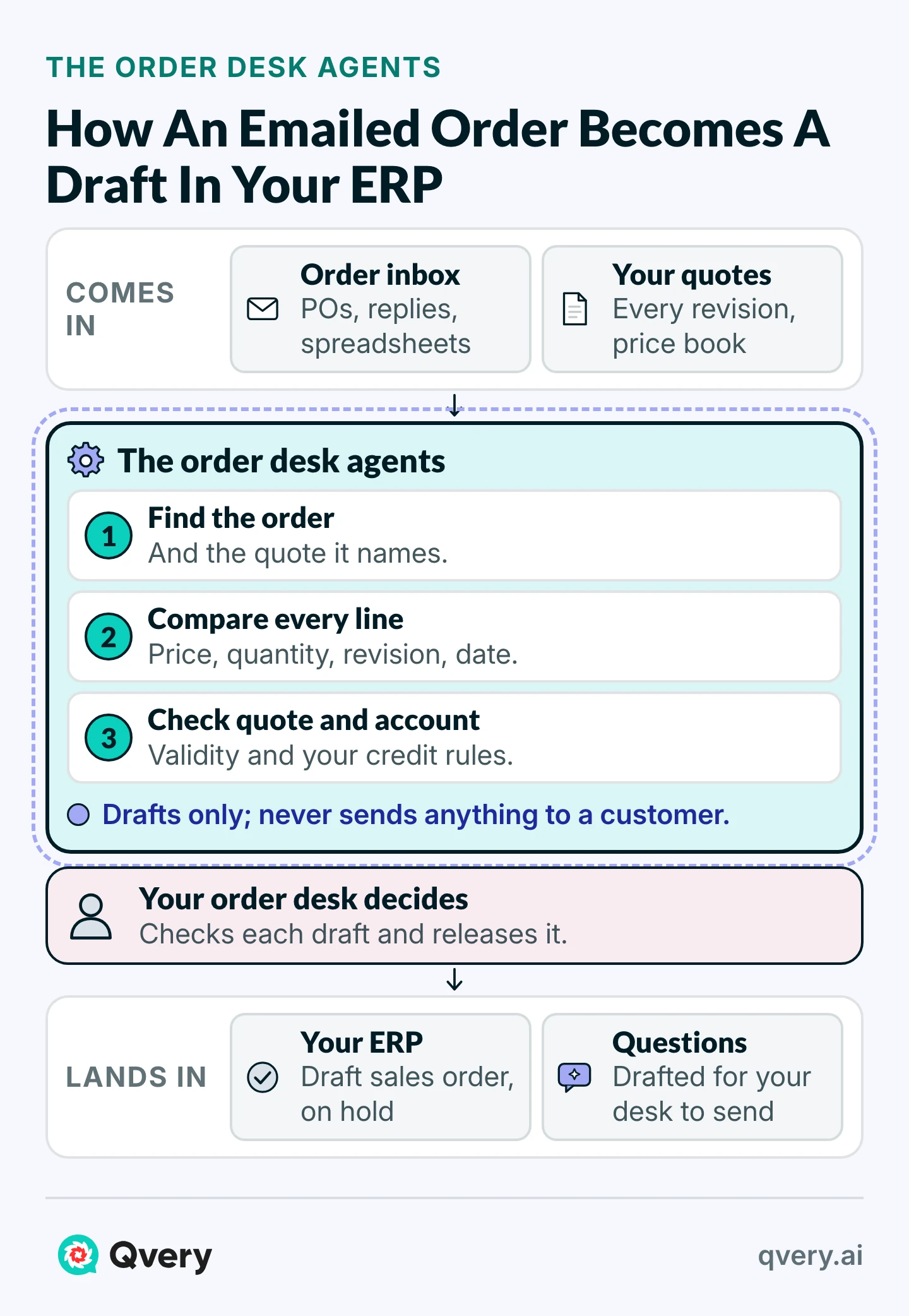
Your order desk checks the draft and releases it. The agents never send anything to a customer: where an instruction is unclear, they draft the question for your desk to send. They read only what you agree they may read, such as the order inbox, your quotes, the price book and part master, customer accounts and your order log, and every action is logged.
The first ones run within two weeks of access. Each week we count the hours handed back to your desk and the mistakes caught before an order went in. At the National Association of Manufacturers' average of $112,261 a year in pay and benefits, an hour of that retyping costs about $54.13
 Piotr BabelPartner @ Qvery
When a pilot fails on data quality, look at the order before it reaches the ERP: a PDF in a new layout, a quantity changed three emails down, a quote two revisions old. So our agents read the whole thread and the quote it names before drafting anything, and when the two disagree, they stop on that line and show your desk both.
Manufacturers Say They Have the Skills, and Few Pay to Train
RSM's manufacturers are confident about their people: 88% say they have the right AI expertise in-house, while 22% concentrate their AI spending on training their own staff.3 84% agree their executives are more enthusiastic about AI than their employees.3
The Manufacturing Leadership Council's respondents expect more change than they budget for. 47.4% expect AI to reduce the number of people working in their plants by 2030, up from 36% in 2024; 57.4% expect the people affected to be retrained or moved to other jobs; and 51.2% have no dedicated budget for AI training.5
Among Deloitte's large manufacturers, 35% name adapting workers to the "Factory of the Future" as a top concern, and 48% have trouble filling production and operations management roles.4
The hiring market is why the hours matter. In the National Association of Manufacturers' survey of August 2026, 54.93% named attracting and keeping good people among their biggest challenges, behind raw material costs (80.75%), healthcare costs (72.30%) and trade uncertainty (62.44%).14
There were 584,000 open manufacturing jobs in September 2026,13 and Deloitte and the Manufacturing Institute project 3.8 million jobs to fill between 2024 and 2033, 1.9 million of which could stay empty.15
An hour an agent hands back is worth most where the company would otherwise have to hire. Our manufacturing playbook prices three office jobs for a 200-person manufacturer: supplier part packages, quote requests and customer orders buried in email.
What the Figures Say to a Manufacturer of 100 to 500 People
For a company of 100 to 500 people, the figures come down to this:
- Manufacturers with 100 to 249 employees use AI more than smaller ones do, by the Census Bureau's count, and more of them expect to within six months.
- The gains are reported more often than they are measured.
- The pilots that fall short fail on data quality and integration before anything else.
That points at a first agent with work you can count before and after: a job your people retype or check by hand every day, with an error you can see when it reaches a customer.
Whichever job you hand over first, measure it the way most of these surveys do not: the hours before, the hours after, and the errors that stopped reaching customers.
Frequently asked questions
How many manufacturers use AI in 2026?
It depends on who is counted. The Census Bureau, which surveys US companies of every size, found 22.4% of manufacturers using AI in the two weeks before its November 2026 collection. Surveys of managers who decide on technology at larger companies find far more: 88% of RSM's manufacturers with $30 million or more in revenue say AI is at least partly built into their operations.13
Are the US and European figures comparable?
Not directly. The Census Bureau asks about the past two weeks and counts firms of every size, down to one to four employees. Eurostat counts once a year and only companies with ten or more employees. Both rose fast: the US share from 12.7% to 22.4% in a year, the EU share from 10.57% to 17.27%.110
Do bigger manufacturers use AI more?
Up to a point. In the Census count of November 2026, use was 18.9% at one to four employees, 25.1% at 20 to 49, 28.8% at 50 to 99 and 37.0% at 100 to 249. Firms of 250 or more came in at 28.5% that fortnight, an estimate with a wide margin.2
What does agentic AI mean in these surveys?
Software that carries out a task on its own, such as reading an order and preparing it for entry, rather than answering a question. 56% of RSM's manufacturers say they use it and 66% of the Manufacturing Leadership Council's respondents use it or plan to, but across all industries, 22% of respondents at organizations under $1 billion in revenue report scaling AI agents.357
Why do AI pilots fail in manufacturing?
Mostly on data. RSM's manufacturers whose pilots fell short named data quality (51%) and integration (43%) ahead of security (34%), an unclear return (30%) and resistance to adoption (30%), and the other surveys here that ask about obstacles point to data too.3
How much do manufacturers spend on AI?
Half of RSM's manufacturers plan at least $1 million this fiscal year and 23% at least $3 million. Nearly a quarter of the Manufacturing Leadership Council's respondents expect their AI spending to grow by more than 30% over two years.35
Do manufacturers expect AI to change the industry?
Most do. 61% of the Manufacturing Leadership Council's respondents expect AI to change the industry fundamentally by 2030, up from 55% in 2024, and 93% of KPMG's AI leaders expect companies that fully integrate it to gain a significant competitive edge.56
How much are manufacturers investing in digital transformation?
In the National Association of Manufacturers' survey of August 2026, 30.99% plan a significant emphasis on digitally transforming their operations over the next 12 months, 30.05% a moderate one, 28.17% a slight one and 10.80% none.14
How reliable are these AI adoption figures?
Each one is reliable for the people it asked. RSM asked managers who influence technology spending, KPMG asked the people who lead AI, and the Manufacturing Leadership Council surveyed manufacturers in its network; the Census Bureau and Eurostat ask companies whether they use AI or not. The Census estimate for one size of manufacturer moves by several points between fortnights, with a standard error of 6.19 points for firms of 100 to 249 employees, so read one reading as a range.2
How do manufacturers get the skills for AI?
Mostly by hiring. Among Deloitte's large manufacturers, 68% build digital skills by hiring new people, 53% train their executives in-house, 43% use courses from vendors or other outside providers and 40% bring in contract labor.4
Do manufacturers build AI in-house or with a partner?
Both. 84% of KPMG's AI leaders develop AI in-house, while 65% to 70% of Deloitte's large manufacturers outsource many technology, data and cybersecurity roles, AI among them, and 69% to 72% report trouble hiring for those roles.64
How many US manufacturers have 100 to 500 employees?
Few. Of 239,265 US manufacturing firms in 2022, 93.1% had fewer than 100 employees and 4,177 had 500 or more, by the National Association of Manufacturers' reading of Census Bureau data.13
Sources
- U.S. Census Bureau: Business Trends and Outlook Survey (BTOS), Sector data (2026)
- U.S. Census Bureau: Business Trends and Outlook Survey (BTOS), Sector by Employment Size Class data (2026)
- RSM US: How manufacturers are using AI in 2026 (2026)
- Deloitte: 2025 Smart Manufacturing and Operations Survey (2025)
- Manufacturing Leadership Council (National Association of Manufacturers): Survey: GenAI Adoption Surges In Manufacturing (2026)
- KPMG International: Intelligent manufacturing: A blueprint for creating value through AI-driven transformation (2025)
- McKinsey & Company: The state of AI in 2026: On the road to ROI (2026)
- RSM US: RSM Middle Market AI Survey 2026: U.S. and Canada (report) (2026)
- ifo Institute: Mehr als die Hälfte der Unternehmen nutzt Künstliche Intelligenz (2026)
- Eurostat: Artificial intelligence by NACE Rev. 2 activity (isoc_eb_ain2) (2026)
- Eurostat: Use of artificial intelligence in enterprises (Statistics Explained) (2025)
- MIT Technology Review Insights: Taking AI to the next level in manufacturing (2024)
- National Association of Manufacturers: Facts About Manufacturing (2026)
- National Association of Manufacturers: Manufacturers' Outlook Survey, Third Quarter 2026 (2026)
- Deloitte and The Manufacturing Institute: Taking charge: Manufacturers support growth with active workforce strategies (2024)
