On this page
Every month, someone at your firm turns the budget and the month's actuals into a page of variance commentary, how each line differs from budget and why, which the partners read before they decide anything.
The arithmetic takes an afternoon. The reasons take the rest of the week, because each one sits with whoever made the call: the partner who agreed a lower fee, the hiring manager whose start dates slipped, the person who coded an invoice.
An AI assistant can write that page now. It cannot know a reason nobody wrote down, so the reasons are what the agents go and get.
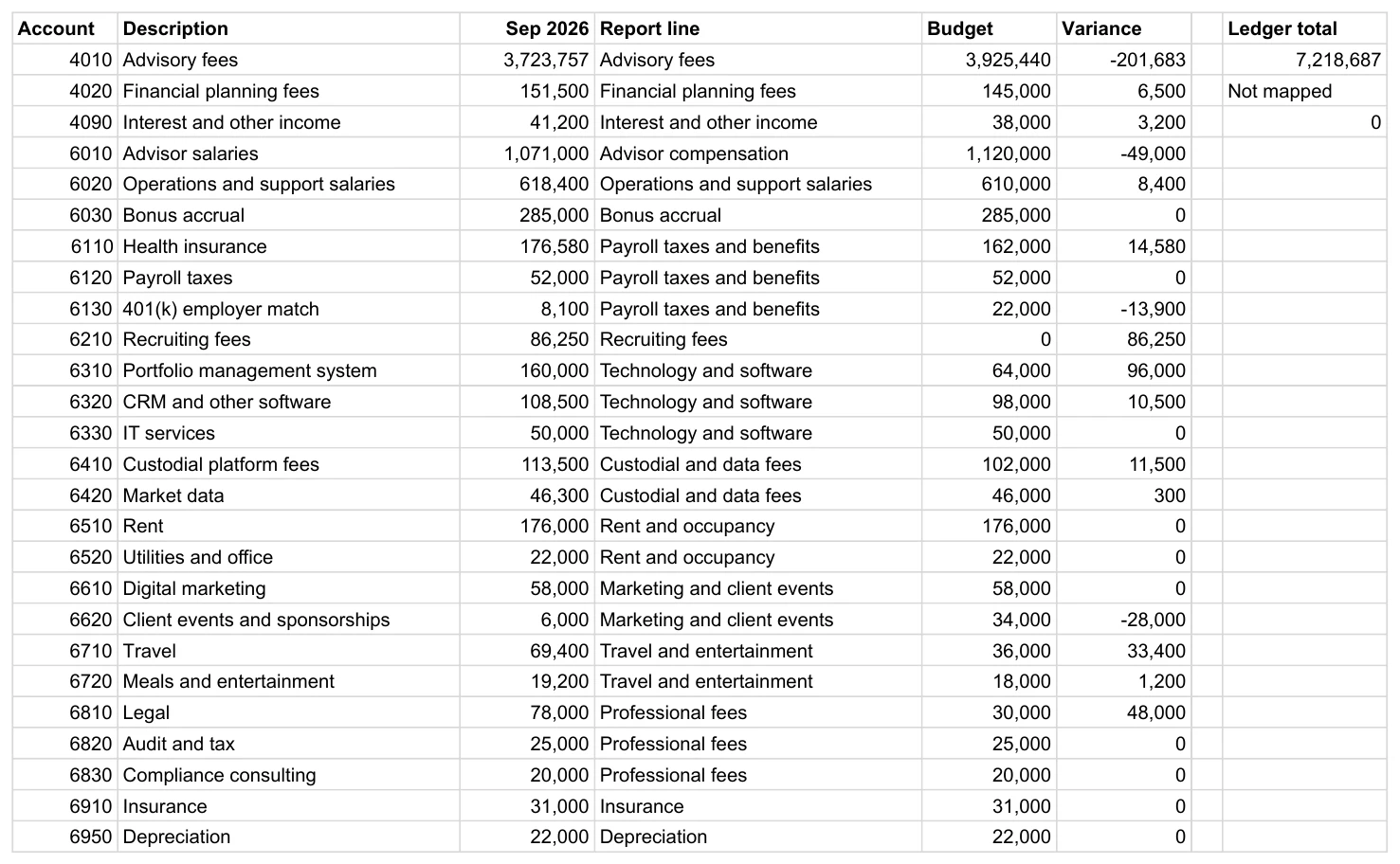
We ran this on an invented month: September at Tamberlin Wealth Partners, a made-up wealth management firm of about 180 people.
At Qvery, we help wealth and advisory firms put the monthly commentary in the partners' hands on close day and keep their finance people focused on the questions that matter, with custom AI agents that read your ledger, your billing system and your team's notes, split the fee line into what moved it, draft every reason with its source and send each open question to the person who can answer it.
The Fee Line Moves for Four Reasons, and One Is a Decision
A wealth firm's fee line is assets times a rate, so a fee miss is never one thing, and splitting it is the step that turns a variance into a decision.
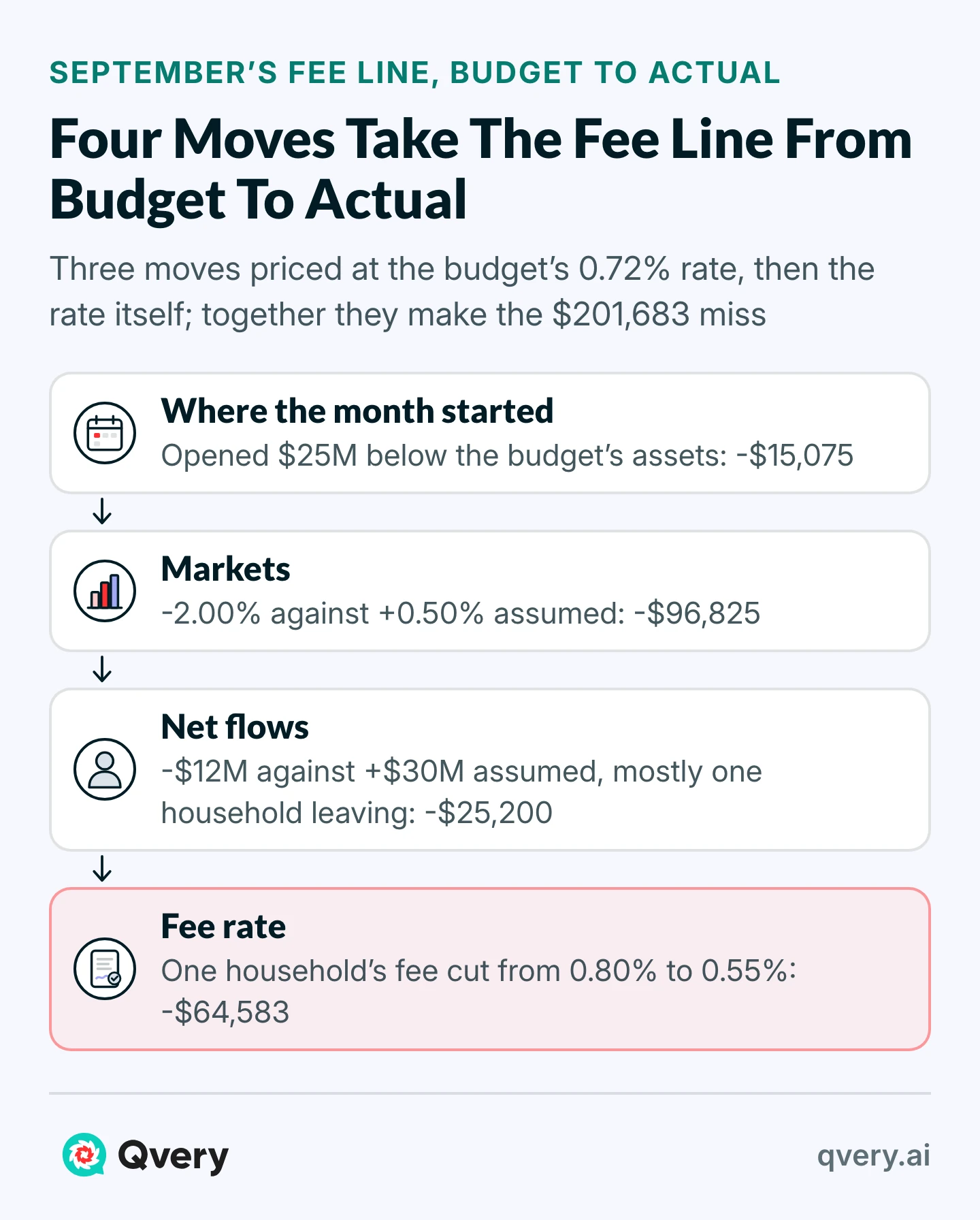
The agents split the miss into four moves that add up exactly: where the month started, markets, net flows (money clients put in minus money they take out) and the fee rate, the first three priced at the budget's rate, on the balance, rate and period your billing used (our sample bills monthly in arrears on month-end assets).
The fee rate is the one move that was a decision the firm made. In our sample, one household's fee went from 0.80% to 0.55% on about $310M from September 1, a decision made to keep the relationship. That is $64,583 a month, about $775,000 a year if nothing else changes.
The Reasons Sit in Your Team's Notes and the Ledger's Postings
Handed only the budget and the actuals, an assistant says what moved and asks for the reasons, because the files hold none. The reasons sit with your team and in the ledger's postings, and the agents read both.
Tips from Reddit
FP&A practitioners on where the why comes from
I find AI is great at the what (x rose 11%, y decreased 6%) but not the why. Who decided, what was the logic, what's the operational impact.
Completeness and accuracy, it may miss errors/omissions when reviewing variances unless you also have a granular budget piped in to help set up some flags.
Our ten notes include one that explains nothing about September (a laptop refresh moved from October to November), as real notes do. A flagged line with no note stays unexplained in the commentary, with the name of whoever should be asked; the agents never fill the gap with a guess.
Look at the Travel rows. One posting there reads "Gold sponsorship, regional advisor summit", $31,000. The budget holds that sponsorship in Marketing, and the marketing team's note says it was paid as planned.
One coding error shows up as two variances: Travel $34,600 over and Marketing $28,000 under. No note mentions the coding, and only the postings show it.
Each Line Is a Decision, Timing, an Error or a Question
The skill in variance commentary is sorting what happened, because a page where every variance reads as a problem teaches the partners to ignore the page. Three of September's lines, sorted by what they are:
| What the sheet showed | What it is | What to do | How you know it held |
|---|---|---|---|
| Fee rate, -$64,583 | a decision: the fee amendment for one household, recurring | report it as the cost of keeping the relationship, about $775,000 a year | next month's split shows the rate piece again, and the note is still the cause |
| Advisor compensation, -$49,000, favorable | timing: two hires start October 15, not September 1 | say it is not a saving; it ends when they start | if nothing else changes, October shows about half the gap and November none |
| Technology, +$106,500 | timing: a $96,000 add-on for October to December, booked in September | propose moving it to prepaid, released at $32,000 a month | after the entry, technology is $10,500 over, under the rule |
Advisor pay and marketing both came in favorable, and neither is good news: pay is under because people started late, marketing because a cost sits on the wrong line. A favorable variance with a timing or coding cause is not a saving, however good it looks on the page.
Two of the findings are errors in the books, and the agents propose the fix for both. They write each proposed entry into the workbook, with the posting reference and, for the prepaid, the monthly release; they never touch the ledger. A person posts, and a second person approves.
After the two entries, technology is $10,500 over, marketing $3,000 and travel $3,600: all three drop under the rule, and the commentary loses two paragraphs that would have explained an error as spending.
Anything that changes a client's fee, moves money, or edits a posted entry stays with people, because none of it can be undone from a spreadsheet.
Work out what the monthly commentary costs your finance team, and what the agents hand back.
The calculator opens on an example: three people on the pack, each about $146,800 a year with benefits (the Bureau of Labor Statistics' May 2025 median for financial and investment analysts, plus 30%). We assume each spends about three days of the month on it, which is that week of asking shared among three people, and that the agents take 60%: the reading, the split and the drafts.
Monthly Variance Pack ROI Calculator
What Writing The Monthly Variance Commentary Costs You, And What An Agent Saves
Saved Per Year
$36,636
562 hours handed back, after $3,000 a year to run it
- Hours Handed Back
- 562 hours a year
- Agent Running Cost (Estimate)
- $250 a month
- Payback Per $10,000 Of Build
- 3.3 months
On these numbers, the agent saves $36,636 a year after its own running cost, and every $10,000 of the build is earned back in 3.3 months.
On that example the job falls from $66,060 to $29,424 a year, the agents' running cost included (about $250 a month for model usage, hosting and upkeep). That is $36,636 a year and 562 hours back for the questions only your team can answer, and every $10,000 of the build is earned back in about 3.3 months.
Qvery's Agents Have the Pack Ready on Close Day
To have the pack waiting on close day, we build AI agents on your own ledger, your billing system and your team's notes. They start when the close is marked complete, so nobody has to remember to run them and nothing runs on half-booked numbers.
They read the ledger export, the billing system's assets report and the notes, and apply a materiality rule written before the month, which decides which differences are big enough to explain ($25,000 or 10% of budget in our sample), plus an inside check that opens any line on budget whose accounts moved against each other.
They draft every reason with its source and send each unresolved line to the person named beside it.
Then they stop for a person: someone approves every entry and the final page before anything leaves finance. Before they connect, we agree in writing what they may read and where the data is processed, every action they take is logged, and households appear by ID, never by name. Each month you see the hours from close to pack they save and the errors the review still catches.
Bring One Closed Month and Your Team's Notes
We map how your month-end runs and connect the agents to the accounting and billing systems you already use, then they draft the pack for a month you have already closed, beside the one your team wrote. The first working pack arrives within two weeks, we train whoever reviews the draft, and a person still approves and posts every entry.
Frequently asked questions
Who approves AI-written finance commentary?
A person who did not prepare the month reviews the draft against the workbook, and whoever signs the pack today still signs it. Any correcting entry is posted by one person and approved by another.
Should the assistant post correcting entries?
No. It proposes them in the workbook with the posting each one corrects; one person posts and a second approves, because a posted entry cannot be undone from a spreadsheet.
Can AI agents produce the variance pack every month?
Yes, once the month-end is settled. They start when the close is marked complete, read the ledger, the assets report and the notes, draft the commentary and the proposed entries, and stop for a person to approve. That is the work Qvery's agents do for finance teams.
Can AI write budget vs actual variance analysis?
It can do the arithmetic and draft the page, but it cannot know a reason nobody wrote down. Handed only the budget and the actuals, it found none of the causes in our test month; given the team's notes and the ledger's postings, it found all of them.
Why does a wealth firm's fee variance need splitting?
Because the fee line is assets times a rate, so a miss is never one thing. Split it into where the month started, markets, net flows and the fee rate; only the fee rate is a decision the firm made.
What did the fee rate decision cost in the example?
One household's fee went from 0.80% to 0.55% on about $310M from September 1, to keep the relationship: $64,583 a month. Report this component of the fee miss as the cost of keeping the relationship, about $775,000 a year if nothing else changes.
Where do the reasons for budget variances come from?
From your team's notes and the ledger's postings. As one FP&A practitioner on Reddit put it, AI is great at the what but not the why: who decided, what the logic was, what the impact is.
How can a coding error show up in variance analysis?
As two variances. In the example, a $31,000 summit sponsorship posted to Travel instead of Marketing made Travel $34,600 over and Marketing $28,000 under. No note mentioned it; only the postings showed it.
Is a favorable budget variance always good news?
No. In the example, advisor pay came in under because people started late, and marketing because a cost sat on the wrong line. A favorable variance with a timing or coding cause is not a saving.
How should variance lines be sorted?
Into a decision, timing, an error or a question. A page where every variance reads as a problem teaches the partners to ignore it, so each line says what it is and what to do.
What is a materiality rule in variance commentary?
A rule written before the month that decides which differences are big enough to explain: $25,000 or 10% of budget in the example. After the two correcting entries, three lines dropped under it.
What happens to a variance with no note behind it?
It stays unexplained in the commentary, with the name of whoever should know. The agents send each unresolved line to that person instead of guessing a reason.
What does the monthly variance pack cost a finance team?
In this post's example, three people at about $146,800 a year with benefits spend about three days of the month on it: $66,060 a year. With the agents, about $250 a month to run, it falls to $29,424, and 562 hours come back.
How is client data handled by variance analysis agents?
Households appear by ID, never by name. Before the agents connect, the firm and Qvery agree in writing what they may read and where the data is processed. Every action the agents take is logged.
How do you start with monthly variance agents?
Bring one closed month: the ledger export, the billing system's assets report and your team's notes. The agents draft the pack for that month beside the one your team wrote.
How long does the first AI variance pack take?
The first working pack arrives within two weeks. Qvery maps month-end and connects the agents to the accounting and billing systems already in use. The agents draft a closed month beside the team’s pack, and Qvery trains whoever reviews the draft.
What did the lines look like after the correcting entries?
After the two entries, technology was $10,500 over, marketing $3,000 and travel $3,600: all three dropped under the rule, and the commentary lost two paragraphs that would have explained an error as spending.
What did the September advisory-fee miss add up to?
$201,683 in the example month, split into four moves that add up exactly: where the month started, markets, net flows and the fee rate, the first three priced at the budget's rate.