
On this page
Many tenants now write to their property managers with ChatGPT. A two-line repair request arrives as a page of statutes and lease sections: some from another state, some invented, a few exactly right.
Each of those letters costs a manager the better part of an hour. They read it, pull the lease, the ledger (the record of what the tenant has paid and owes) and the open work orders, look up every citation for that building’s state and city, and write a careful reply.
Some decide it’s nonsense and send nothing.
Take a company running 8,000 apartments that gets 120 of these letters a month, at 40 minutes each. That is 960 hours of property managers’ time a year, about $55,200.
Security deposit disputes take up a lot of time because there’s a lot of research that has to happen to prove the deduction, even though we’ve already done it through photo documentation.
That research is the part worth handing over, because a manager can’t tell which citation matters without checking all of them.
At Qvery, we help property management companies spend less time on tenant disputes, with custom AI agents that test each letter against the lease and the law and draft the reply.
The Citations That Are Right Cost the Most
Most of what these letters cite falls apart quickly. Managers describe city codes quoted out of context, statutes from a state the building isn’t in, and rules that don’t exist anywhere, like a law that makes a landlord accept rent in whatever form the tenant chooses.
One tenant, asked for the lease clause behind his request, sent back a lease ChatGPT had written and insisted it was the one he signed.
Setting that aside is the easy part. The expensive letter is the one whose rule is real, and it looks exactly like the others. Three of four common demands rest on real law, under California’s detailed and recent rules and the federal guidance on disability.
| What the letter asks for | What the rule says | What a miss costs |
|---|---|---|
| Receipts and photos behind each deposit deduction | Due with the itemized list, 21 days after move-out, or 14 days after a request | Up to twice the deposit if a court finds bad faith, on top of returning it |
| A repair, framed as a habitability claim (the home isn’t fit to live in) | Notice can be oral; after 30 days, presumed reasonable, the tenant may repair and deduct | Repairs off the rent; a rent rise or eviction within 180 days invites a retaliation claim |
| An exception to a rule because of a disability, in any words | No special words needed; an undue delay in answering can count as a refusal | A fair-housing complaint, a discrimination claim under federal housing law |
| A lease clause nobody signed, a law that doesn’t exist | Nothing | Nothing, unless the reply concedes it |
A manager who ignores these letters will sooner or later ignore one with a deadline, and one who argues every citation spends the hour anyway. Filtering the inbox for words like “deposit” or “repair” doesn’t help either: the accommodation request, the one that carries a federal complaint, needs no particular words, so only reading the whole letter finds it.
What works is checking every claim against that tenant’s signed lease and the rules where the building stands. If you manage in more than one state, each state and city keeps its own deadlines, and the check becomes a lookup your managers repeat on every letter.
 Vlad ShvetsPartner @ Qvery
Sorting tenant letters by how they read is the mistake: the padded, angry letter and the one carrying a real 14-day deadline look the same on the page. Sort them by what checking costs instead. At 120 letters a month and 40 minutes each, a company pays about $55,200 a year to check by hand, so what an owner decides is who runs that check on every letter, because skipping it is how a deadline gets missed.
California’s rules are the example here, quoted as written, not legal advice; your counsel decides how they read for your buildings.
Many of these letters begin as a repair request that took too long. Our real estate playbook puts a number on that desk and on the other two where property managers lose the most hours: forged rental applications and leasing inquiries.
Qvery’s Agents Test Every Citation in the Letter
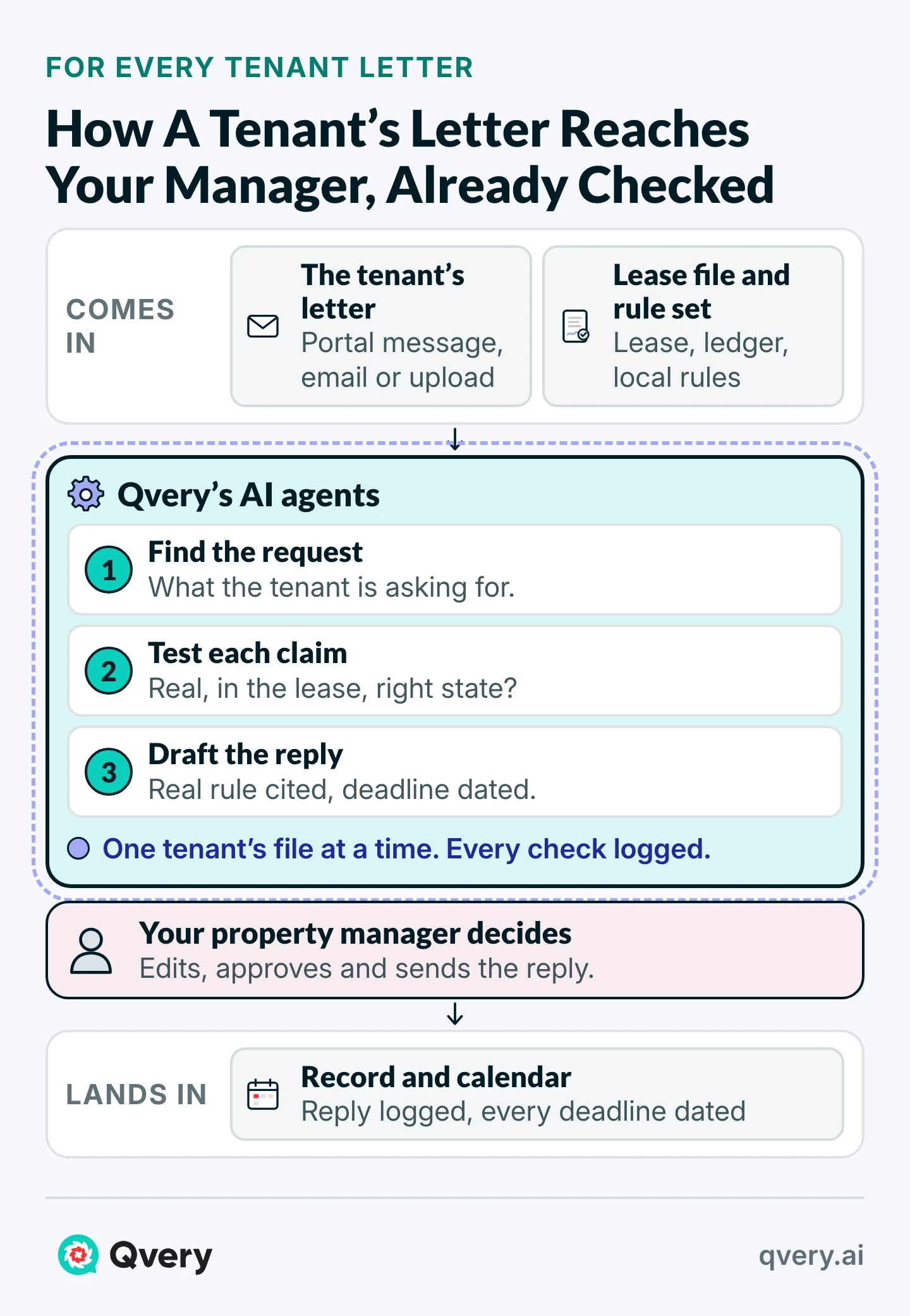
At Qvery, we build these agents around the systems your managers use. When a tenant’s message lands in the portal or the shared inbox, the agents pull that tenant’s signed lease, ledger and work orders from your property management system, and the building’s state and city rules from a rule set your counsel has approved.
They write down what the tenant is asking for, which is sometimes one sentence on page two. Then they test each citation: does this law exist, does it apply to this building, does the lease say what the letter claims.
What comes back to the manager is one screen: the request, a verdict on each claim, a reply that answers the request and cites the real provision, a work order (the repair ticket) where a repair is due, and a dated deadline wherever a rule starts a clock.
The manager reads, edits if needed, and sends. A letter that reads as an accommodation request, a habitability claim, or a threat to sue or to stop paying rent arrives flagged, and goes on to counsel wherever your own rules send it.
 Piotr BabelPartner @ Qvery
The letter I build these agents around is the accommodation request: it needs no particular words, so a keyword filter never sees it. The agents read every tenant letter whole, flag anything that could be one even when they are unsure, and show the manager the sentence that raised the flag. In the first weeks they send nothing, and your managers compare each flag with what they would have caught.
A tenant who moved out three weeks ago writes that the $1,140 kept from her deposit is illegal. This letter is a typical example, not a client’s, and it makes five claims.
- “You owe me my full deposit within 14 days under Civil Code 1950.5.” Wrong number: the itemized list was due in 21 days, and it went out on day 17.
- “You must send me the receipts and photos behind every charge.” Right: California wants them with the list, move-out photos included since April 2025, and on a request like hers, within 14 days. The draft attaches the carpet vendor’s bill, the cleaning invoice and the move-out photos, and the deadline goes on the manager’s calendar.
- “Section 8 of my lease bans charging for normal wear and tear.” Her lease has no section 8 on deposits, but California law says the same thing, so the reply shows that each charge is damage or cleaning, not wear.
- “Keeping my deposit is a criminal offense.” The deposit statute’s remedy is damages in a civil case; the reply doesn’t argue the point.
- “The unit was already dirty when I moved in.” A question of fact: the agents attach the move-in photos and inspection report on file, and leave the call to the manager.
That letter takes the manager minutes instead of most of an hour, and the one claim with a deadline gets answered inside it.
Drafting is the part your property management software may already do: AppFolio’s Realm-X Messages suggests replies, and Buildium’s Write with AI drafts tenant emails and texts. A polished reply that concedes an invented rule or misses a 14-day clock is still the wrong reply, and the check against the lease and the rules is what our agents add.
What Checking Every Letter Saves
Put in your own numbers: the letters your managers answer in a month, the minutes each one takes now, and what an hour of their time costs.
Tenant Dispute Letter ROI Calculator
What Answering Tenant Dispute Letters Costs You, And With AI Agents
Saved Per Year
$39,696
768 hours handed back, after $4,464 a year to run it
- Hours Handed Back
- 768 hours a year
- Agent Running Cost (Estimate)
- $372 a month
- Payback Per $10,000 Of Build
- 3 months
On these numbers, each letter costs $10.77 instead of $38.33, the agent saves $39,696 a year after its own running cost, and every $10,000 of the build is earned back in 3 months.
On the example, 120 letters a month at 40 minutes each come to 960 hours a year: $55,200 at $57.50 an hour.
That $57.50 starts from the federal wage survey: property, real estate and community association managers earned a mean $40.25 an hour in May 2025, and benefits add 30% of what a private employer pays.
With the agents’ summary, verdicts and draft in front of them, the same letters take about 8 minutes each: 192 hours, $11,040, plus $4,464 a year to run the agents.
That hands back 768 hours and saves $39,696 a year. Each letter costs $10.77 instead of $38.33, so 3 months of letters repay each $10,000 spent building the agents.
What Reddit says
Property managers and renters on tenants’ ChatGPT letters
Huge emails repeating themselves in different ways and citing incorrect clauses. The time involved to reply and put them straight is so wasteful!!
I recently had a resident who used chatgpt to argue their move out costs dispute. … This back and forth went on for MONTHS while they consulted their bot.
Even if these tenants are using AI (people love to bring that up), you’re still required to provide an itemized list of what was deducted.
The 8 minutes is an average and an assumption: most letters need a read and an approval, and a flagged one needs half an hour of a manager’s judgment. The running cost is our estimate: about 60 cents a letter in model usage, plus $300 a month of hosting and upkeep.
The calculator counts hours and leaves out the letter nobody answered in time. In California, one deposit kept in bad faith can cost up to twice the deposit on top of returning it, and an accommodation request left waiting is how a fair-housing complaint starts.
If a dispute reaches small claims court, the judge reads the file, and the agents leave one for every letter: what was claimed, which rule was checked, what was sent and when.
The same record shows where the letters come from, and a run of them from one building points at what to fix there. The hours your managers get back pay off best on work you would otherwise hire for: renewals, inspections, the residents who call.
The Agents Read One Tenant’s File at a Time
A tenant’s letter can carry a payment history, a medical condition or the first step toward a lawsuit, so what the agents may open is settled before they open anything.
Accommodation requests stay with a person every time. Under the federal guidance, a wrong refusal and a late answer are both a failure to accommodate, so the agents flag the request, gather the lease and the history, and leave the reply to your manager.
Working With Qvery on Your Tenant Inbox
The work begins with how your managers answer today. We read a month of their letters and replies, your lease templates and the list of states and cities you manage in, and we build the rule set with your counsel, because their positions are the ones the agents cite.
Then the agents are linked to your property management system and your inbox. For the first weeks they run alongside your managers and send nothing: every letter gets its verdicts and a draft, and your managers compare it with what they would have written. We show them how to read a verdict and when to overrule one.
Within two weeks of access, the agents are checking the letters in your live inbox. From then on, each week’s count shows the letters that came in, the manager hours they no longer take, and the deadlines your replies met.
Frequently asked questions
Should we tell a tenant their letter was written by AI?
No. Some landlord attorneys recommend calling it out, but the label changes nothing the law requires and gives the tenant something new to argue about. The reply that ends the exchange answers the request and cites the lease or the rule that decides it.
What if a tenant sends the same letter again and again?
The agents recognize a repeat, link it to the answer already sent and draft a short reply that points to it. Your manager approves it in a minute, and the log shows every round in order, which is what a judge or a housing agency will want to see if the dispute goes further.
How many of these letters does a company like ours get?
Nobody publishes a count for American property managers. In New Zealand, eight in 10 of Bayleys’ property managers told their firm that tenants are using AI, and six in 10 said it turns routine problems into disputes. Your own count is easier: the agents tally the letters from the first week, by building and by kind of claim.
Can the agents answer tenants on their own?
At first, no: every reply waits for a manager. Once you trust the verdicts, you choose which routine replies go out on their own, such as confirming a booked repair or sending a lease clause a tenant asked for. Anything that answers a claim, refuses a request or touches money stays with a manager.
What if the tenant’s citation is right?
Then the reply says so and does what the rule asks, on time. Sending the receipts within the 14 days takes minutes; a bad-faith finding can cost twice the deposit. The agents put the deadline on the manager’s calendar the day the letter arrives, with the documents already attached to the draft.
What if the letter cites a law from another state?
The reply cites the rule that governs the building and leaves the other state’s law alone. Arguing a statute that doesn’t apply only invites the next round; stating the one that does, with its section number, gives the tenant nothing new to answer.
Should we make our replies harder to paste into ChatGPT?
Nadav Zohar, a landlord attorney in Los Angeles, suggests it: replies sent as images, watermarks, letters by mail, anything that slows the next generated round. That slows your own team and your record too, and leaves the tenant’s request unanswered. The exchange ends sooner when the first reply answers the request and cites the rule, leaving a chatbot little to argue with.
Will tenants know an AI agent drafted the reply?
The reply comes from your manager, who read and approved it, in your company’s voice and with their signature. Whether your replies mention the tools behind them is your policy to set, and the agents follow it.
Do the agents replace our attorney?
No. Your counsel approves the rule set, and the replies cite their positions. The agents give tenants no legal advice: a reply states your company’s position and the provision it rests on, and your manager sends it. Letters that threaten a lawsuit, claim discrimination or ask for an accommodation go to the people your policy names, counsel included.
What happens with a letter that threatens to stop paying rent?
It arrives flagged, with the history pulled: when the condition was first reported, what the work order shows and whether a vendor has been out. In California a tenant’s right to deduct a repair from rent turns on notice and a reasonable time, so the date of the first report often decides it.
Who handles our tenants’ records once the agents connect?
The agents work inside the property management system and the inbox or portal you already run, and nothing changes there for your managers or tenants. Where the records are processed is written into the contract first, and Qvery AI OÜ, incorporated in Estonia inside the EU, signs a data processing agreement for tenant data.
How do the agents know our state’s rules, and what happens when one changes?
From a rule set for the states and cities where you manage, approved by your counsel, each rule with its source and the date it was last checked. When a law changes, as California’s deposit photo rules did in 2025, the rule is updated and dated, and later letters are checked against the new text.
Do we have to answer a letter whose citations are all invented?
Answer the request, not the citations. A lease clause nobody signed or a law that doesn’t exist obliges you to nothing, unless your reply concedes it, but the repair or refund the letter asks for may still be due. The agents pull that request out, sometimes one sentence on page two, and the draft answers it.
Won’t tenants’ AI letters get better at this?
Probably, and better letters will cite more real rules, so more claims will carry a deadline. Sarina Gibbon, who runs Tenancy Advisory in New Zealand, calls AI “an amplifier, not an equaliser”: it makes a case with merit stronger and a weak one louder. Both land in your managers’ inbox, and checking each claim is how you tell them apart.