
On this page
A property management company answers two kinds of people all day: people who want to rent one of its homes, and residents who want something in theirs fixed.
For the first group, the big platforms now sell AI leasing assistants, and the pitch comes with the days they take off a vacancy.
The second group usually reaches a coordinator with a phone, whose day fills with the chasing around each repair: the vendor who hasn't confirmed, the resident who wants a date, the ticket nobody closed.
Hand your first AI agent the follow-through on every work order: the receipt, the vendor's confirmed slot, the update when the date slips, and the check that the job is done.
Residents rank poor maintenance just behind rent among their reasons to leave, and the loop around each repair is work your coordinators still do by hand.
Leasing AI is sold as a feature of the big property management systems. Switch it on, but don't spend your first AI project on it.
Two kinds of portfolio should start elsewhere: a building still filling for the first time has no residents to keep yet, and a portfolio whose residents already rate its maintenance well and leave over rent should look at leasing and pricing first.
Residents Leave Over Repairs More Often Than Their Managers Think
Ask property managers why residents don't renew, and they name life: a new job, a house, a move. Ask residents and the list changes.
In Zego's 2026 surveys of 602 multifamily property managers and 1,037 renters, renters put rent first and poor maintenance service second. Managers put maintenance seventh. Where managers and renters disagree, I'd believe the renters.
| Rank | What renters say | What managers say |
|---|---|---|
| 1 | Rent is too expensive | Life changes |
| 2 | Poor maintenance service | Buying a home |
| 3 | Safety concerns | Management communication and responsiveness |
| 4 | Poor property upkeep | Rent is too expensive |
| 7 | Issues with neighbors | Poor maintenance service |
Rent still comes first, and no AI agent sets your rent.
But two of the renters' top four reasons are about how the place is looked after, and both depend on how you run it.
Residents Lose Patience With the Silence Around a Repair
A bad repair is a problem for your technicians, and no AI agent fixes it. What residents also hold against you is everything around the fix.
In Buildium's 2026 survey of 1,500 renters, the top improvement they asked for, at 39%, was better follow-through on maintenance requests. Buildium reads the trouble as delays nobody explains, missing updates and the calls a resident makes to chase.
 Vlad ShvetsPartner @ Qvery
Residents don't expect a burst pipe fixed in an hour. They expect to know what happens next, and a resident who hears nothing for a week starts to wonder whether to stay. That's why I'd give the first AI agent the updates, not the diagnosis: it's dull work, every step of it is checkable, and it's what residents remember when the renewal letter arrives.
Inside the office, that loop is a string of small jobs. Your property management system holds the work order, but the chasing happens in email, texts and calls around it.
What Reddit says
The follow-up loop, in property managers' words
appfolio is great for accounting but a lot of teams end up duct-taping the maintenance workflow together outside the platform. the issue usually isn’t the work order itself. it’s the follow-up loop (vendor check-ins, tenant updates, reminders, scheduling, etc.).
We do have the Maintenance Performer product that replaced Smart Maintenance. There are a few reminders that can be set to ask contractors for certain information if nothing has been done on a work order, but the lack of a good reminder/task manager tool is still troubling.
Most of that loop is messages, dates and confirmations. The judgment calls (getting into a unit, an owner's approval, an upset resident) stay with a person; the rest AI agents can run end to end.
But an Empty Unit Costs Rent Every Day
The best case for leasing first: an empty unit loses rent daily, shows up on every owner report, and leasing AI arrives with a number. AppFolio says customers using its lead follow-up fill empty units 5.2 days faster, a figure from its August 2025 poll of 129 of them. The maintenance surveys above measure what residents say, not what they sign.
That's fair, and across a portfolio the days add up. At Zillow's typical U.S. asking rent of $1,932 a month in September 2026, a day empty costs about $64.
Say 1,000 leases come up this year: at RealPage's national share of apartment residents who sign again, 55.1% in the year to June 2025, about 450 residents move out, and 5.2 days on each is about 2,340 empty days, about $150,000 of rent if AppFolio's figure holds for you.
So take the days. Turning on the leasing AI your platform already sells is a software decision, not a project.
Now price one move-out. The faster fill saves about $330 of it. A renewal saves the whole empty stretch: if your units sit a month between residents (put in your own number, less any rent a new lease would add), that's about $1,930, before the paint, the cleaning and the leasing team's hours.
Per move-out, one renewal is worth about six faster fills.
On those 1,000 leases, each extra percentage point of residents signing again is 10 fewer move-outs and about $19,000 of rent.
Your platform may sell a maintenance assistant too, and if it runs the whole follow-through with your vendors and residents, start with it. Where it stops (vendors who answer by text, owners' spending limits, the renewal calendar), the work falls back on your coordinators. That's where your first AI agent belongs.
Follow-through is one of several weekly jobs in a property company; our real estate playbook maps the rest and which suit an AI agent.
The Agents Take Repair Follow-Up Off Your Coordinators
For a property company, we build AI agents that own the follow-through on its repairs.
The moment a work order opens in your property management system, they send the resident a receipt saying what happens next, confirm a slot with the vendor or your technician, and text the resident the date.
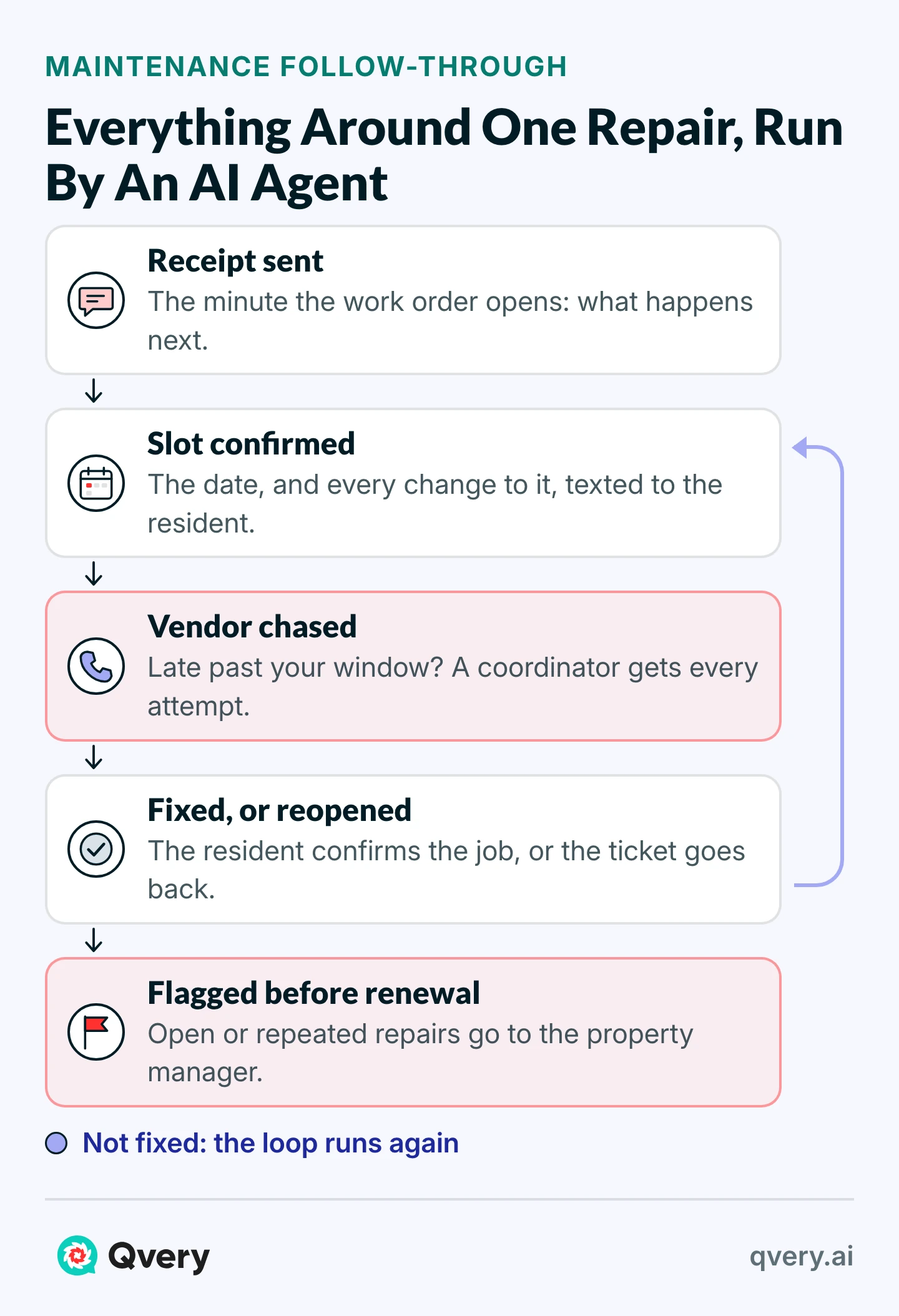
When a vendor goes quiet past the window your team sets, they chase them. If that fails, they put the work order in front of your coordinator with every attempt listed. When a part is on order or a visit moves, the resident hears it the same day.
After the job, they ask the resident whether it's fixed, and reopen the ticket if it isn't. Ahead of each lease's renewal date, they hand the property manager every resident with an open or repeated repair, so it gets dealt with before the renewal offer goes out.
They never lower an emergency a resident reported, approve spend over an owner's limit, or promise a date nobody gave them.
Say a property manager's six coordinators handle about 3,000 work orders a month and spend 60% of their week on this chasing. At about $78,200 a year each with benefits, the mean pay of dispatchers who schedule repair crews and vendors, that is $281,520 a year.
Say the agents take 65% of it: 4,867 hours a year back, $172,188 after about $900 a month to run them, and every $10,000 of build comes back in 0.7 months. Put in your own portfolio's numbers:
Repair Follow-Up ROI Calculator
What Following Up On Work Orders Costs You, And What An Agent Saves
Saved Per Year
$172,188
4,867 hours handed back, after $10,800 a year to run it
- Hours Handed Back
- 4,867 hours a year
- Agent Running Cost (Estimate)
- $900 a month
- Payback Per $10,000 Of Build
- 0.7 months
On these numbers, the agent saves $172,188 a year after its own running cost, and every $10,000 of the build is earned back in 0.7 months.
We begin by learning how your coordinators work: which vendors answer by text, what each owner lets you spend, who is on call. We wire the agents into your property management system, vendor inbox and resident texting, and train the coordinators who run them.
Bring Us a Month of Work Orders
Switch on the leasing assistant your software already has, and put your first AI project on repair follow-through.
The agents run on your own work orders within two weeks of access, and a coordinator sees each message before it goes at first. Every week you see the hours of chasing and the errors caught.
Frequently asked questions
How do the AI agents handle maintenance emergencies?
They never lower the urgency a resident reported, and anything on your emergency list goes straight to whoever is on call. Write that list before the agents start. Our guide to repair requests shows how to write one and try it against a month of real requests.
What do our maintenance coordinators still do?
They handle what needs judgment: emergencies, vendors who don't answer, repairs that cost more than an owner allows, and residents who are upset. The AI agents take the receipts, reminders, status texts and close-out checks, and pass every exception to a coordinator with its history attached.
Which systems do the AI agents connect to?
The ones your team already uses: your property management system, the inbox where vendors reply, and the texting tool residents hear from. We study how your coordinators work first, then hook the agents up to those systems, so nobody moves to a new platform to use them.
What should we measure before and after?
Count the status calls and messages your coordinators handle each week, the work orders that ran past the date a resident was given, reopened tickets, and tickets closed without the resident confirming. Then compare how often residents with a broken ticket sign again against those without one.
Do residents mind getting maintenance updates from AI agents?
Buildium's 2026 renter survey found maintenance is the area where renters are most open to automation. Residents want a fast receipt, a date and an update when it moves. They still need a person for an emergency or a complaint, so the AI agents hand those to your team.
Why do residents not renew their leases?
Rent first, and poor maintenance service second, according to Zego's 2026 survey of 1,037 renters. Property managers in the same study put maintenance seventh and named life changes first. Where the two disagree, believe the renters.
What do renters most want from maintenance?
Better follow-through on their requests: 39% named it as the top improvement in Buildium's 2026 survey of 1,500 renters. The trouble is delays nobody explains, missing updates and the calls a resident makes to chase.
Should property managers start AI with leasing or maintenance?
Maintenance, for most portfolios. Switch on the leasing AI your platform already sells, since that is a software decision. Spend your first AI project on repair follow-through, the work your coordinators still do by hand.
When should a property manager start with leasing AI instead?
When the building is still filling for the first time and has no residents to keep, or when residents already rate the maintenance well and leave over rent. Those portfolios should look at leasing and pricing first.
How many days does leasing AI save on a vacancy?
AppFolio reports 5.2 days faster fills with its lead follow-up, from its August 2025 poll of 129 customers. At Zillow's typical U.S. asking rent of $1,932 a month in September 2026, each empty day costs about $64.
Is a lease renewal worth more than a faster fill?
In the post's example, a renewal saves about six faster fills at $1,932 monthly rent and a month's vacancy. That excludes paint, cleaning and leasing hours. Use your own vacancy period and deduct any additional rent a new lease would bring.
What is one more point of renewals worth?
On 1,000 leases coming up, an extra percentage point renewing means 10 fewer move-outs. At the example's $1,932 monthly rent and a month's vacancy, that's about $19,000. Substitute your rent and vacancy period, less any additional rent a new lease would bring.
How soon can maintenance AI agents run on our work orders?
The agents run on your work orders within two weeks of access. Bring a month of work orders and your vendor list. At first, a coordinator sees each message before it goes out.
Should we use the maintenance AI our property platform sells?
Start with your platform's maintenance assistant if it runs the whole follow-through with vendors and residents. Custom agents belong where it stops, such as vendors answering by text, owners' spending limits or the renewal calendar.
What do AI agents do before a lease renewal?
Ahead of each lease's renewal date, they hand the property manager every resident with an open or repeated repair, so it gets dealt with before the renewal offer goes out.
How much can AI agents save on repair follow-up?
Say six coordinators spend 60% of their week chasing about 3,000 work orders a month, $281,520 a year. With agents taking 65%, that is 4,867 hours back and $172,188 a year after about $900 a month to run them.