On this page
- Most Property Management AI Went to Messages, and Replies Got No Faster
- Leasing Replies Are a Setting in Software You Already Pay For
- Repair Requests Are the Paperwork Your Residents Write
- Write the Emergency List Down, and Make It the AI Agent's Rules
- The AI Agent Qvery Builds Around Your Emergency List
- Resident Messages and Bills Come Second, for Different Reasons
- Run Intake for a Month With a Coordinator Releasing Every Work Order
- Frequently asked questions
A property management office takes in four kinds of written work: repair requests, resident messages, inquiries from people who want to rent, and the bills.
Repair requests fall on the maintenance coordinator, who turns each one into a work order by hand, whatever hour the resident wrote it: close to 280 hours a month at 4,000 homes.
The error that costs is an emergency read as routine: water still running or a gas smell left in the morning queue, while the resident who heard nothing calls again.
Which of the four should a company managing a few thousand homes hand to an AI agent first?
We wrote 36 repair requests the way residents write them and ran them through two AI assistants, with and without a written emergency list.
My answer: start with maintenance intake, the job of turning every repair request into a complete work order and putting the emergencies in front of a person at once.
Switch on the leasing replies your software already sells. Let resident messages and the bills wait until intake has shown you where an AI agent goes wrong.
And write the emergency list first. With it, both assistants caught every emergency; without it, one missed half.
The requests are invented and written to be hard, so read the results as a stress test of your list, not as a rate you will see.
This page prices the job, shows the emergency list we tested, and lays out the custom AI agent Qvery builds for property companies, which runs intake on autopilot while coordinators release the work.
Most Property Management AI Went to Messages, and Replies Got No Faster
Among AI users in the 2025 survey of property management professionals by IREM and AppFolio whose job includes the task, 46% use AI to write to current residents and 43% to prospects. Only 17% use it for maintenance coordination, the lowest share of any task except rent collection.
Property Managers Use AI Least for Maintenance
% of AI users whose duties include the task
View the data
| Label | Value |
|---|---|
| Reputation management | 47% |
| Writing to current residents | 46% |
| Writing to prospects | 43% |
| Document analysis | 40% |
| Writing to owners and investors | 40% |
| Market analysis | 34% |
| Operational reporting | 31% |
| Entering bills | 28% |
| Renewals | 25% |
| Financial reporting | 22% |
| Maintenance coordination | 17% |
| Rent collection | 13% |
AI users said they answer 80% of current residents' inquiries the same day, and non-users said 81%; for prospects it was 77% against 81%. Writing a work order took AI users 8.9 minutes and non-users 6.5.
The survey cannot say why, and AI users tend to work at larger companies, so read it as a warning, not a verdict: using AI is not the same as giving it a job.
Most AI users (85%) work in general-purpose assistants, which help one person write faster and take no job off the team.
Here are the four first jobs, and where each one's mistakes land:
| Job | How often it arrives | What your system holds | Who sees a mistake first | When a person steps in |
|---|---|---|---|---|
| Repair requests | About 3.3 a year per home | Homes, residents, past work orders, vendors | Your coordinator | Emergencies, entry, costs over a limit |
| Resident messages | Every day, on every subject | The lease, the ledger | The resident | Disputes, lease changes, notices |
| Leasing inquiries | With every vacancy | Listings, rents, showing times | The prospect | Applications, exceptions |
| Bills and invoices | With every vendor visit | Vendors, owners, approval limits | The owner, or the bank | Payments, new vendors, bank details |
The frequency comes from Hemlane, a rental software platform, whose count of 193,000 requests put tenants at 3.3 requests per home per year in 2024.
Read the fourth column first. Three of the four jobs put the AI agent's first mistake in front of a resident, a prospect or an owner. Only one puts it in front of your own coordinator.
Leasing Replies Are a Setting in Software You Already Pay For
Leasing is where the vendors who sell leasing AI tell you to start, and the case for it is fair: the questions repeat, the answers sit in your listings, and the faster reply wins the prospect.
You may not have to build anything either. Two thirds of AI users in the survey already use AI built into their core property management software, and leasing replies are one of the features that software sells.
AppFolio's August 2025 survey of 129 users of its workflow tools reports that those using its lead follow-up filled vacant units 5.2 days faster on average. That is a vendor measuring its own product, so take it as the best case.
Check for the two failures operators describe.
The first is the answer that misses the question: a leasing bot asked whether the building offers garages replies with its one-, two- and three-bedroom units. The second is the follow-up that will not stop, with some prospects emailed or texted three or four times by morning.
Cap the follow-up, keep the answers to what your listings say, and have someone read a week of conversations every month.
Then treat every reply as your company's own words. The Fair Housing Act forbids any statement about renting a home that indicates a preference based on race, religion, familial status or another protected class, and a reply your software sends is a statement your company made.
Repair Requests Are the Paperwork Your Residents Write
The rule for a first AI agent is to give it paperwork, where its mistakes reach a colleague before a customer. A repair request is a document: a home, a problem, when it started, a way in.
The resident writes it, but the work order it becomes goes to your coordinator, and the AI agent's only words to the resident are a receipt and a few fixed questions.
Price it with your own numbers. Coordinators in the survey who do not use AI took 6.5 minutes to write a work order and 8.7 to schedule it. For a company managing 4,000 homes (put in yours), the job today is 279 hours a month, about 1.6 coordinators:
| Step | Each | A month |
|---|---|---|
| Repair requests, at 3.3 a home a year | 1,100 | |
| Writing the work order | 6.5 minutes | 119 hours |
| Scheduling it | 8.7 minutes | 160 hours |
| The job today | 279 hours | |
| Checking a work order the AI agent drafted | 2 minutes (assumed) | 37 hours |
An AI agent takes the writing: it drafts each work order the moment a request arrives, and your coordinator checks it.
Say your coordinator needs two minutes to check each draft; that is our assumption, so time it.
Writing then drops from 119 hours to 37, and 82 hours a month come back, half a coordinator, before anyone touches scheduling.
Hold the survey's other number beside it. AI users took 2.4 minutes longer per work order than non-users, which at 1,100 requests is 44 hours a month.
Nobody knows the cause, but it sets the test for your first month: if minutes per work order do not fall below your own baseline, the design is wrong.
If your coordinators start each morning by turning last night's messages into work orders, that is the AI agent to build first.
Write the Emergency List Down, and Make It the AI Agent's Rules
The one mistake that matters in intake is an emergency treated as routine.
The fix exists on paper in offices that run on-call rotas: a short written list (water flowing where it should not, a gas smell, smoke or sparks, no heat or no cooling past a temperature line, no power, sewage coming up, a door that will not lock, someone stuck in an elevator).
And three questions for anything the list does not name. Is anyone unsafe? Is the property being damaged right now? Can the resident stay in the home?
What Reddit says
Property managers on sorting repair requests after hours
It mis-sorts urgent communications as non-urgent, Whereas before a person would triage, or it would trust the form input for severity. Now there is property damage.
Honestly the thing that helped me most wasn't a list. I framed it as "is anyone unsafe, is the property getting damaged overnight, or can you not stay in the unit?" if no to all 3 it waits till morning
Of our 36 test requests, 14 were emergencies, several written to be missed: a rotten-egg smell that was “probably nothing”, a leak described in Spanish, a hissing stove mentioned at the end of a note about a closet door.
We ran them through OpenAI's and Anthropic's assistants, with the list and without it, and through a word filter set to the obvious words.
With a Written Emergency List, Both Assistants Caught All 14 Emergencies
emergencies put in front of a person at once, of 14
View the data
| Label | Value | Note |
|---|---|---|
| OpenAI assistant, no list | 7 of 14 | Ranked no heat at 21 degrees outside, sewage in a tub, a door that would not lock and no cooling with a newborn as 24-hour jobs. |
| Word filter | 9 of 14 | Also sent 5 ordinary jobs to the person on call. |
| Claude, no list | 12 of 14 | Missed no power in the unit and the only toilet. |
| OpenAI assistant, with the list | 14 of 14 | Both runs. Also raised two arguable requests. |
| Claude, with the list | 14 of 14 | Both runs. Also raised two arguable requests. |
Without the list, the OpenAI assistant put 7 of the 14 emergencies in “within 24 hours”: among them no heat at 21 degrees outside, sewage coming up in a bathtub, a front door that would not lock, and no air conditioning at 97 degrees with a newborn in the apartment.
Claude missed two: no power in the unit, and the only toilet. Given the list, both caught all 14, in every run.
A word filter, the rule a request form can run, is the weak fence. It caught 9. It missed water “coming through” a ceiling, the rotten eggs, the leak in Spanish and the funny smell by the stove, because residents describe a situation, not the words a filter looks for.
It also sent five ordinary jobs to the person on call, a chirping smoke detector and “no gas smell” among them. Added to an assistant that already had the list, it caught nothing extra.
Both assistants, given the list, also raised two requests I had marked for the morning: a damp ceiling bubble that “got bigger since yesterday”, and an inch of rain water in the garage.
Both are arguable, and that is the design working: when the AI agent is unsure, a person decides, and it costs them a minute.
So the list belongs inside the AI agent's rules, written by the person who answers the phone at night.
One more rule belongs outside the model: the AI agent may raise a request above the urgency the resident chose on the form, and never lower it: a floor, not a detector, that keeps a request the resident marked urgent in front of a person.
Around it go three settings a person owns: who is on call this week, how many minutes they have to acknowledge an emergency before it goes to a backup, and the receipt every other request gets overnight.
Write your legal clocks into the same tiers. Washington's landlord-tenant law, for example, says repairs must begin within 24 hours when a tenant has lost hot or cold water, heat or electricity, or a condition is imminently hazardous to life.
They must begin within 72 hours for a refrigerator, a range and oven, or a major plumbing fixture, and within 10 days otherwise, counted from the tenant's written notice. Find your state's version, and do not let a written request sit unread.
With the list and those clocks as its rules, the AI agent gives each request one of four urgencies (at once, within 24 hours, within 72 hours, or routine) and its reason in one line, whatever words or language the resident used.
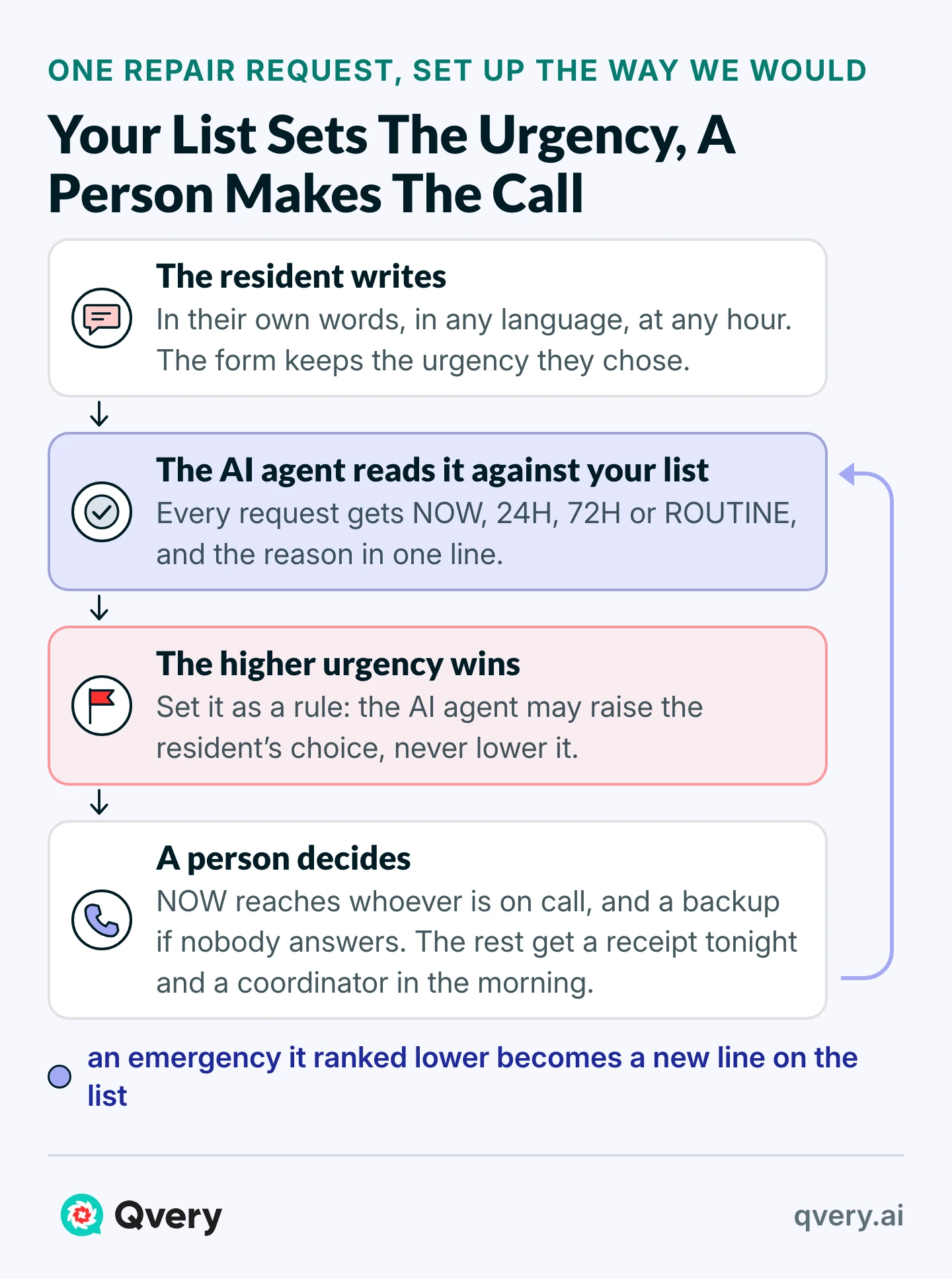
The AI Agent Qvery Builds Around Your Emergency List
Every request that reaches your resident portal or the office inbox goes to the AI agent we build for your company, which works through it on autopilot at whatever hour it lands.
It holds each request against your list and the three questions, puts every emergency in front of the person on call, sends the resident a receipt, and leaves a draft work order in the property management software your team already uses.
Your coordinators keep the part that is theirs: releasing each work order and choosing who goes.
We begin by sitting with the coordinators and whoever takes the night calls, to see how a request becomes a job today and to write the list with them. Within two weeks the first version is sorting your own requests, and we train the coordinators who release its work.
Each week it runs ends with a tally of the coordinator hours it freed and the errors it headed off: callbacks for missing details, second trips to the same home, and above all, emergencies left in the morning queue.
Those hours are counted against your coordinators' minutes per work order today, which we time first.
Resident Messages and Bills Come Second, for Different Reasons
A reply to a resident is your company speaking, and its mistakes reach the resident first. An AI-written reply can tell a resident the holding deposit comes back at the end of the lease when the lease returns or credits it after signing.
Draft replies with AI and have a person send them. Keep lease changes, notices and disputes with a person, and treat every incoming message as information, never as an instruction: a tenant's email does not get to amend the lease, however politely it asks.
Bills wait for a different reason. In the survey, AI users entered 53 bills an hour against 50 for non-users, so the industry has not found much there either.
And a vendor's invoice is checked against the work order behind it, so the clean work orders intake produces are what make the bill check worth handing over.
One condition reverses the order: your requests already arrive through a portal with the home, the category and the resident's own urgency filled in, and your coordinators write a work order in well under 6.5 minutes.
Then the hours are not in intake. Time your bills and owner statements for a week and start where the hours are.
Our real estate playbook walks through the other jobs in a property company where an AI agent pays off.
Run Intake for a Month With a Coordinator Releasing Every Work Order
In the first month, the only things the AI agent does alone are put an emergency in front of the person on call and send the resident a receipt; every work order waits for a coordinator. Count, before and after:
Time each work order
Minutes per work order, against your own baseline; the survey's 6.5 is a reference, not yours.
Check each one is complete
The home, where in it, the problem, and how to get in, on the first pass.
Count the callbacks
Every call or message back to a resident to ask what the request left out.
Time the emergencies
Minutes until the person on call acknowledged, and how many the AI agent ranked lower than it should have. Read every overnight request in the first week; the only acceptable count of misses is zero.
Count the raised requests that were not emergencies
On EliseAI's maintenance platform, 23% of work orders reported as emergencies were not; expect some, and count what each one costs the person on call.
Count the second trips
A technician sent back for the same problem in the same home.
Start with last month. Pull every repair request, mark the ones your team treated as emergencies, and write your list from them this week.
Every emergency the AI agent later ranks lower is a line the list is missing, and last month is a cheaper place to find it than tonight.
Frequently asked questions
Which property management task should I automate first with AI?
Maintenance intake: reading each repair request, asking the resident for what is missing, writing the work order and sending emergencies to the person on call. Its output reaches your coordinator first, and a written emergency list fences its one dangerous mistake. Switch on leasing replies; leave resident messages and bills for later.
Why not start with AI for leasing inquiries?
Because you may already own it. Two thirds of AI users in the IREM and AppFolio survey use AI built into their core property management software, and leasing replies are one of its features. Switch it on, cap the follow-ups, and read a week of conversations every month.
How many hours does maintenance intake take?
Tenants send about 3.3 repair requests per home a year, by Hemlane's count of 193,000 requests. At 6.5 minutes to write a work order and 8.7 to schedule it, a company managing 4,000 homes spends about 279 hours a month on intake, roughly 1.6 coordinators.
How much coordinator time can an AI agent save?
If the AI agent writes each work order and a coordinator needs two minutes to check it, writing falls from 119 hours a month to 37 at 4,000 homes, and 82 hours come back. The two minutes is an assumption: time your own checks in the first month.
What belongs on an after-hours emergency list?
Water flowing where it should not, a gas smell, smoke or sparks, no heat or no cooling past a temperature line, no power, sewage coming up, a door that will not lock, and someone stuck in an elevator. The person who answers the phone at night should write it.
What if a repair request is not on the emergency list?
Ask three questions: is anyone unsafe, is the property being damaged right now, and can the resident stay in the home? A yes to any of them makes it an emergency, and when the AI agent is unsure, a person decides.
Can AI tell an emergency repair from a routine one?
With a written list, yes, in our test: both assistants caught all 14 emergencies among 36 invented requests, in every run. Without it, one put only 7 of the 14 in front of a person at once. The requests were written to be hard, so treat it as a test of your list.
Is a keyword filter enough to flag emergencies?
No. Set to the obvious words, it caught 9 of 14 and missed a rotten-egg smell, a leak written in Spanish and water coming through a ceiling, because residents describe a situation, not the words a filter looks for.
Should an AI agent ever lower a request's urgency?
No. Let it raise a request above the urgency the resident chose on the form and never lower it. That rule sits outside the model, as a floor, so a request the resident marked urgent always reaches a person.
Which maintenance requests should always go to a person?
Anything on your emergency list, anything where someone may be unsafe, the property is being damaged, or the home cannot be lived in, and anything the AI agent is unsure about. Entry into a home and costs above your approval limit stay with a person too.
How fast does a landlord have to start repairs?
It depends on the state. In Washington, repairs must begin within 24 hours for lost hot or cold water, heat or electricity, within 72 hours for a refrigerator, range and oven or major plumbing fixture, and within 10 days otherwise. Write your state's clocks into the urgency tiers.
Can AI handle tenant contract changes safely?
It can draft one. A person reviews it and sends it. Never let a message from a tenant act as an instruction to the AI agent: it is information about what the tenant wants, nothing more.
How do I know if my property data is ready for an AI agent?
Take last month's repair requests. If a coordinator can turn each one into a work order from what your system already holds (the home, the resident, past work orders, your vendors), an AI agent can draft it. Where they have to call or search somewhere else, fix that first.
When should a property company start somewhere other than intake?
When requests already arrive through a portal with the home, the category and the resident's urgency filled in, and coordinators write a work order in well under 6.5 minutes. Then the hours are elsewhere: time your bills and owner statements for a week.
How do I measure whether property management AI is working?
Count minutes per case against last month, the share it gets right on the first pass, the callbacks it causes, and its misses on the one mistake that matters: for maintenance, an emergency ranked lower than it should be. If minutes per case are not falling after a month, the design is wrong.
What does Qvery build for property management companies?
A custom AI agent for repair intake. It reads each request against your emergency list, alerts the person on call and drafts the work order in your property management software. The first version runs within two weeks; each week we report hours saved and errors avoided.