
On this page
- Last Month's Finished Work Is the Answer Key for Your First Agent
- Have an Agent Check Every Load's Delivery Paperwork Before the Invoice Goes Out
- A Customer-Facing Agent Has More Ways to Be Wrong, and the Customer Sees Them First
- But Nobody Will Notice an Agent That Checks Paperwork
- Start With the Job Your Team Does Most and Talks About Least
- Frequently asked questions
If you run a company of a few hundred people, your first AI agent has to do two things: take real work off your team, and earn the next agent its budget.
The candidates that look like progress are the ones customers see: a chat on your website, an agent that answers support tickets, a follow-up for every new lead. The ones that cost the most hours are the paperwork your team checks by hand all day, and they rarely come up.
We build AI agents for companies this size, and I'd start yours on the paperwork.
Give your first agent the most boring job your team does at volume: one kind of document, one person who owns the result, a check your team applies the same way every time.
It's the cheapest to prove, because last month's finished work is an answer key. It's the cheapest to check, because a person confirms a match instead of redoing a judgment. And it's the easiest to price, because minutes saved on thousands of documents add up to hours you can count.
An agent that answers your customers is harder to prove and harder to check, and when it's wrong, the customer finds out first.
Dull isn't enough on its own: if a rule or a system you already pay for can do the job without reading anything that varies, you don't need an agent, and a job that comes up a few dozen times a year won't pay for one.
Last Month's Finished Work Is the Answer Key for Your First Agent
Every job your team repeats by hand leaves a record of the calls it made and lived with: the delivery packets billing accepted and the ones it sent back, the invoices finance matched and the few it flagged. Those calls aren't all right, but they're an answer key, and you already own it.
So run the agent on last month's work before it touches this month's, and compare its calls with your team's. Where the two disagree, someone opens the document and the question settles: the receiver signed the page or didn't, the total matches the order or doesn't.
Open a sample of the agreements too, since a clerk and an agent can miss the same thing.
A customer conversation can be replayed the same way, but a disagreement there doesn't settle by opening a page. Grading a reply means judging tone, policy and intent, one conversation at a time, which is the judgment you hoped the agent would take off your hands.
That agent is much harder to prove before your customers meet it.
 Vlad ShvetsPartner @ Qvery
Before you trust an agent with a job, ask what you'd compare its work against. If the answer is your customers' complaints, start somewhere else.
The same property keeps the paperwork agent cheap to check once it's live. A clerk confirming a clean match spends seconds; a person checking a drafted reply has to read the whole conversation it answers.
Have an Agent Check Every Load's Delivery Paperwork Before the Invoice Goes Out
At a freight brokerage, the invoice can't go out until the signed delivery paperwork is in, and somebody has to check it first. They open each packet (photos from a driver's phone, scans, PDFs with the pages out of order) and hold it against what that customer requires.
Requirements differ by customer: one broker's customer wants every page "signed by receiver and dated", in PDF, the same day. Yours will include things like the load number, the piece count and any note of "short" or "damaged". When a packet checks out, the clerk attaches it and marks the load ready to bill.
Getting the paperwork in isn't the agent's job. Brokers handle that with a clause on the rate confirmation: one who deducts from the rate when paperwork is later than 24 hours gets it "right away for about 90% of carriers".
If your transport system already reads and checks the driver's photos, that job is done; pick the next one. If it doesn't, the reading is the agent's part.
What it reads: each packet as it lands in the billing inbox or your transport system's document folder, with the load record and that customer's paperwork rules. Nothing outside your own systems.
The rule it checks: each customer's requirements, written down once: a receiver's signature and date on every page, numbers that match the load, the piece count, any exception note. When a customer changes a requirement, you change the rule, not the agent.
What it hands back: for each load, either ready to bill, with the page it checked, or needs a person, with the reason.
What a person keeps: the billing clerk releases the ready loads in a batch and works the flagged ones. The agent never sends an invoice and never calls a carrier.
How you prove it: on last month's packets, against the clerk's calls. Where a customer disputed a load over its paperwork, look twice: some of those are calls your team got wrong, and they're worth counting on their own.
What to set up first: one place where all the paperwork lands, each customer's requirements in writing, and last month's loads with the clerk's decisions.
The failure to watch for is a blurry photo read as clean. Until the agent misses problems no more often than your clerk did last month, counting the costly misses (an unsigned page, an unnoted shortage) on their own, the clerk still opens every packet, and the agent saves nothing.
After launch, keep opening a sample of the clean ones every week.
Now the price. Say your team bills 3,000 loads a month and 85% of the packets are clean. By hand, a clean packet takes a clerk three minutes and a problem packet six.
With the agent, a clean one takes twenty seconds to confirm in a batch (a look at the page it checked), and a problem packet still takes six: the agent saves time on the clean packets and none on the rest.
| Packets | By hand | With the agent |
|---|---|---|
| Clean: 2,550 | 3 minutes each: 127.5 hours | 20 seconds each: 14.2 hours |
| Problem: 450 | 6 minutes each: 45 hours | 6 minutes each: 45 hours |
| All 3,000 | 172.5 hours | 59.2 hours |
That's about 113 hours a month back. At the median U.S. billing clerk's wage, $23.32 an hour in May 2025, those hours are worth about $2,640 a month in wages, roughly $31,700 a year. It's time, not payroll: the clerk spends it on other work.
Every clean packet the agent flags by mistake costs the full six minutes, so each 5% of clean packets flagged wrongly takes about 12 hours off that number. Whatever the agent costs to set up, connect, run and check has to fit under what's left, over the time you'll run it, with room to spare.
Billing the day the paperwork lands, and catching a shortage when it arrives instead of at month-end, may be worth more than the hours. This arithmetic leaves them out.
Vlad ShvetsPartner @ QveryIn that example the whole saving sits in the clean packets. If most of your paperwork arrives broken, fix the paperwork rule with your customers and carriers before you build anything.
The same shape fits a property manager reading each vendor's insurance certificate against the contract, a law firm checking each signed engagement letter against the intake record, and a finance team matching customer remittances to open invoices.
You can build it three ways: switch on a feature of a system you already pay for, set up a document-reading tool yourself, or have someone build the agent around your systems.
The last one is our work at Qvery: we build custom agents, connect them to the systems your team already uses, and train the people who release their work.
If one desk in your company spends its day on one kind of document, that's where your first agent goes.
A Customer-Facing Agent Has More Ways to Be Wrong, and the Customer Sees Them First
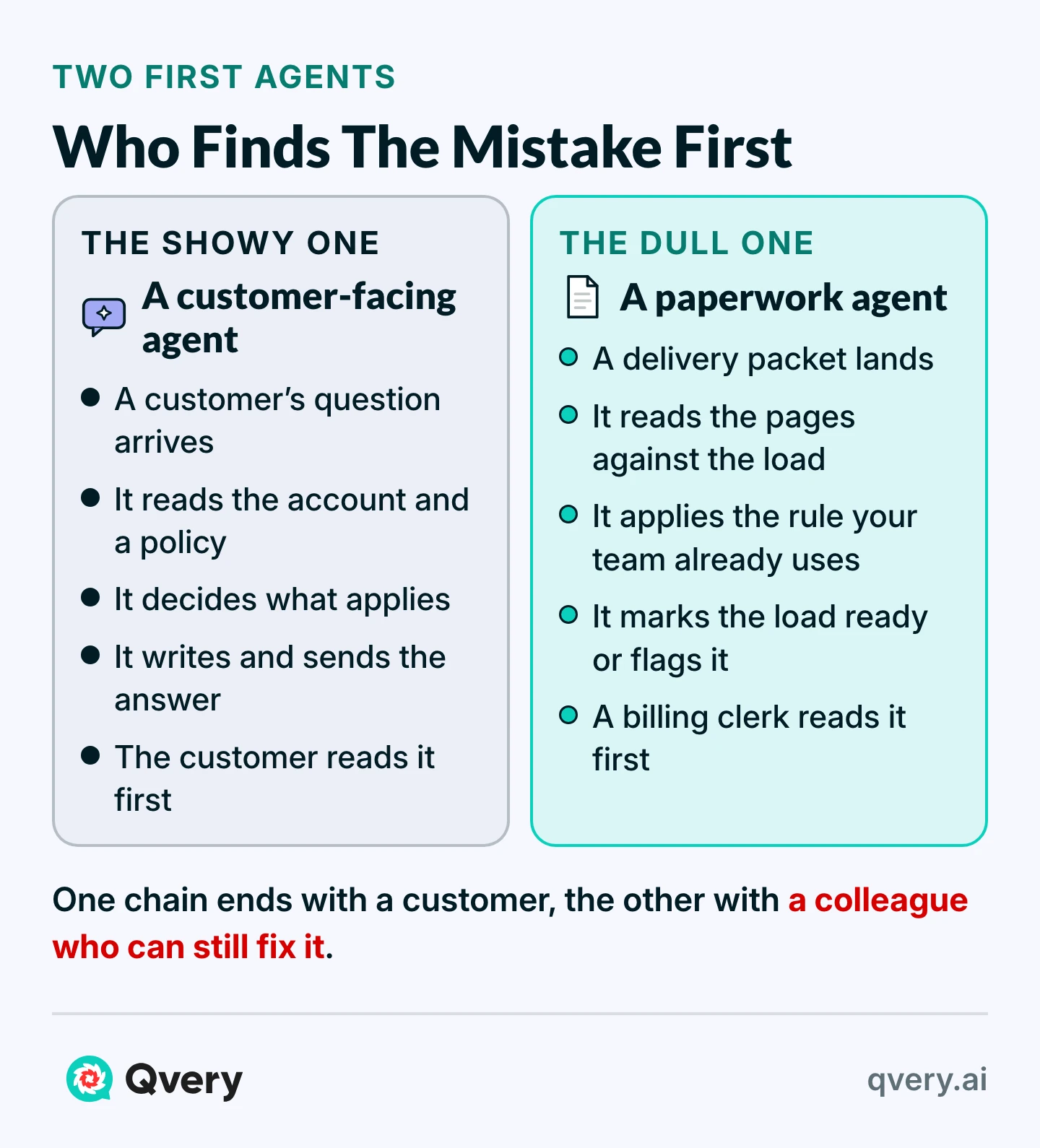
The paperwork agent repeats one short step: read this packet, check it against that rule. An agent that answers customers runs a chain. A customer asks something, and the agent reads the account, looks up a policy, decides what applies, writes the answer and sends it. Each link is a place to be wrong.
Where this has been measured carefully, longer tasks mean less reliable agents. METR, a research group, times how long software and research tasks take skilled people and runs AI agents on the same tasks.
It reports two lengths per model: the task an agent completes half the time, and the one it completes four times in five. For every model in the chart, the second is four to six times shorter.
The researchers' reading is that models which sometimes succeed at hard tasks still cannot reliably perform tasks of moderate length.
An Agent Reliable Four Times in Five Handles Tasks About a Fifth as Long
minutes of skilled human work
View the data
| Label | Completed half the time | Completed four times in five |
|---|---|---|
| Claude 3.7 Sonnet (Feb 2025) | 60.4 min | 12.1 min |
| o3 (Apr 2025) | 119.7 min | 30.0 min |
| GPT-5 (Aug 2025) | 203.0 min | 38.3 min |
| Claude Opus 4.5 (Nov 2025) | 293.0 min | 49.4 min |
| GPT-5.2 (Dec 2025) | 352.2 min | 66.0 min |
Read it as direction, not as minutes for your business: METR's tasks are cleaner than real work by its own account, and its agents did much worse on messier ones.
My reading, not METR's measurement, is that an agent checking one document against one rule sits at the short end of that chart, and one that carries a customer from question to answer sits further out.
And whatever a customer-facing agent says, the company has said. In 2022 a customer whose grandmother had just died asked Air Canada's website chatbot about bereavement fares. It told them they could apply for the discount after they'd flown, and the airline's own bereavement page said the opposite.
When they claimed the refund, Air Canada argued it couldn't be held liable for what its chatbot said. British Columbia's small-claims tribunal called that "a remarkable submission" and ruled that the airline "is responsible for all the information on its website. It makes no difference whether the information comes from a static page or a chatbot."
Air Canada was ordered to pay $812.02 (Canadian). The money is small and the ruling is one tribunal's, in one province. What carries over is the order of events: the airline learned of the wrong answer from the customer's screenshot, months later. The paperwork agent's mistakes reach a colleague first.
But Nobody Will Notice an Agent That Checks Paperwork
The second of those, earning the next agent its budget, is the best case against starting dull, because money goes where results are easy to show. When MIT's NANDA researchers asked executives to split a hypothetical $100 of AI budget across their business, sales and marketing took the largest share.
The report's own reading of that choice is "easier metric attribution, not actual value": sales and marketing outcomes are easy to count, and what legal, procurement and finance gain is hard to surface.
And the best evidence that AI pays at work comes from a front line. Erik Brynjolfsson, Danielle Li and Lindsey Raymond followed 5,179 support staff at a Fortune 500 software company as an AI assistant rolled out.
Productivity rose, most of all for the newest and least skilled, and customers asked to speak to a manager almost 25% less often.
Look at how that assistant worked, though. It never spoke to a customer: it suggested replies to the person handling the chat, who decided whether to use them, a design the authors say makes it less likely that "off-topic or incorrect outputs" reach customers.
It stayed quiet where it had too little history, and it was trained on a large archive of the firm's past conversations, labeled by how each one ended. So the front-line success ran on conditions the paperwork job has from day one: a person releasing every output, and a record of past outcomes to learn and test against.
That's why a drafting assistant for customer replies makes a good second agent and a poor first one. The first agent is where your company learns to prove that an agent works, and that's cheaper to learn on documents than on conversations.
The first agent should be the one you can prove on last month's work, before any customer sees what it does.
As for being noticed, take the MIT report at its word: money follows what's easy to attribute. Time the dull job before the agent and again after, and you have a number nobody has to take on trust: hours, on a job everybody knows.
Whether back-office agents pay back faster than front-office ones is a different claim, and the MIT report calls its own breakdowns directional, so test it on your own job. Mine is narrower: the dull job is cheaper to prove, check and price.
Start With the Job Your Team Does Most and Talks About Least
So give your first agent the dullest job you have, and let the ones customers see wait until your company can prove an agent on its own work. This week:
List the paperwork jobs your team repeats
Rank them by how many times a month they happen.
Strike any a rule, a template or a system you already pay for could handle
Those need automation, not an agent.
Strike any too rare for the minutes to add up
A few dozen a year won't cover the build.
Strike any whose output goes straight to a customer
They can wait for the second agent.
Time the top one for a week and pull last month's finished work
That's what the job costs today, and the answer key you'll grade the agent against.
An empty list is an answer too: you don't need an agent yet. Whatever sits at the top of yours, with a week of timings and last month's finished work beside it, is the brief for your first agent.
Frequently asked questions
What should my first AI agent do?
A high-volume document job your team already does the same way every time, with one owner: delivery paperwork before billing, insurance certificates against contracts, remittances against open invoices. Its output should wait for a person, and you should be able to test it on last month's finished work before it goes live.
Should I use ordinary automation or an AI agent?
Use a rule, a template or a feature of a system you already pay for when the input is the same every time. Use an agent where the input varies and has to be read: scans, photos, emails, documents in different layouts. Most jobs need both: automate the chase, give the agent the reading.
How do I know whether the agent works?
Test it before it goes live: run it on last month's work, compare its calls with your team's, and open every disagreement, counting on their own the cases where your team turned out to be wrong. After it goes live, count minutes per item and errors against the same numbers from before you started.
Which tasks should stay with a person?
Anything that would reach a customer without review, any decision a rule assigns to a named person, and the exceptions the agent flags. In the delivery-paperwork example, the clerk releases every invoice and works every flagged load.
Is ChatGPT an AI agent?
Not the way most teams use it. ChatGPT answers when someone asks it something. An AI agent is software that handles a task the way a trained employee would: it picks up each document as it arrives, does the check and hands over the result without anyone typing a prompt. The same models can sit underneath both.
Should our first AI agent talk to customers?
Not the first one. A customer-facing agent is graded reply by reply, on judgment calls, and a tribunal in British Columbia held a company responsible for what its website chatbot told a customer. A drafting assistant on customer replies, with a person sending each one, makes a good second agent.
How much does a first AI agent need to save?
Use your own numbers: items a month times the minutes saved on each, counting the exceptions and false flags the agent can't help with, times what an hour of your team's time costs. The agent's build and running cost has to fit under that. If it doesn't, pick a bigger job or wait.