
On this page
- A Prompt Course Didn't Help People Catch the AI's Mistakes
- Train One Task Each Role Already Owns, on a Copy of Its Own Files
- Four Roles, Four Tests
- Managers Decide Whether Any of It Survives the First Month
- Write the Rules Once, Before Anyone Practices
- How Qvery Trains a Team on Its Own Work
- After Four Weeks, Count Three Things
- Start With One Role's Task Whose Mistakes You Can Catch
- Frequently asked questions
In a company of a few hundred people, AI training usually arrives after the licenses: a session on what the assistant can do and a shared list of prompts. A month later most people work the way they did before.
The ones who use AI often send its drafts unchecked, on tools nobody trained them on: 78% of people who use AI at work bring their own tools, by Microsoft and LinkedIn's 2024 survey of 31,000 workers. Nobody can say whether the licenses gave back an hour.
The best evidence on what changes that points away from the course.
Train one task each role already owns, on its own files, until every person passes a test built from the mistake AI makes in that job.
Below is that curriculum for four roles, the rules they share, what to count after four weeks, and how we train a team on its own work and build the agent its most repeated task can become.
The curricula are proposals built from that evidence and from practitioners' accounts, not programs measured across companies, and your own jurisdiction decides the legal points.
A Prompt Course Didn't Help People Catch the AI's Mistakes
That evidence is a field experiment published by Harvard Business School and run with Boston Consulting Group. 758 consultants did realistic work with no AI, with GPT-4, or with GPT-4 plus a prompting course of videos and documents.
On the tasks the AI handled well, the AI users completed 12.2% more tasks and finished them 25.1% more quickly, with better quality. Then came one task built so the AI would struggle: a business case whose answer sat in the details of a spreadsheet and a set of interviews.
The people who had taken the course did no better than the others with AI, and both groups did worse than the consultants working alone. A prompting course teaches how to ask; it doesn't show where the tool goes wrong on your kind of work.
The AI-assisted answers were also rated more coherent and persuasive, right or wrong, which left their readers less to go on.
That's one experiment and one task, and it describes the error a reviewer misses: a draft that is fluent, and wrong in a way nobody downstream can see.
BCG's 2025 survey of more than 10,600 employees found regular use sharply higher among people with at least five hours of training plus in-person coaching. Only a third said they had been properly trained.
Train One Task Each Role Already Owns, on a Copy of Its Own Files
Training for any role runs the same way:
Pick one task
Something the role does every week, whose right answers already sit in past files, and whose mistakes you can catch before they reach a customer.
Practice on its own files
Ten or twenty real examples from last month, worked inside the AI tool your contract covers, names and account numbers removed.
Write one test
The mistake AI makes in that task, written down so a pass is checkable: every date in the draft appears in the thread, every figure ties to the ledger, every case says what the draft claims. Spotting a draft that should never have gone to AI counts as a pass; sending a fluent wrong one is a fail.
The person who does the task best shows it once on a real file. Everyone works through the set, and that person marks the misses. The test is a fresh batch nobody has seen.
Pass, and the person uses AI on that task from Monday, checking every output the same way. Fail, and they keep doing it by hand and retest the next week.
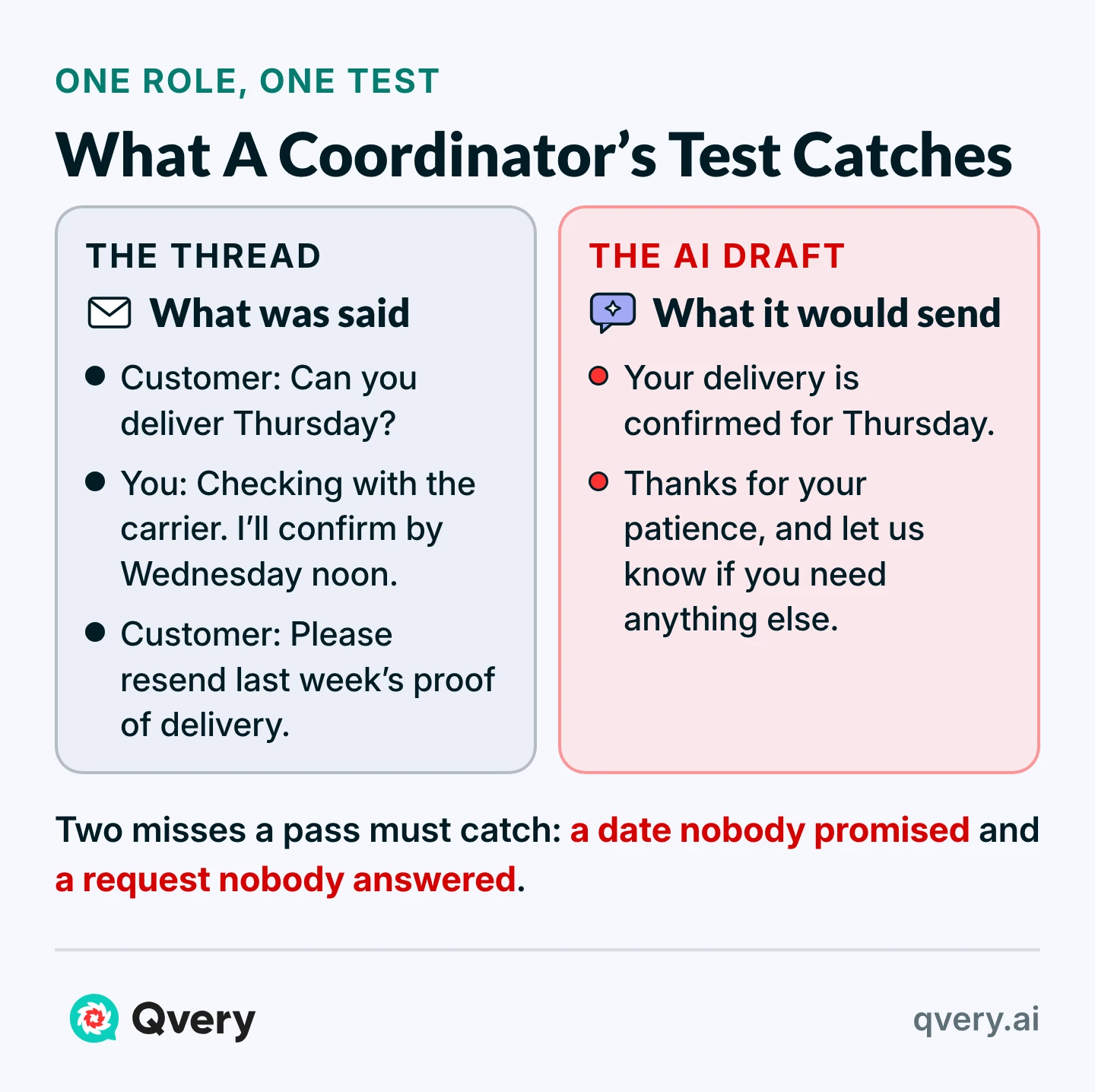
Say ten coordinators each write 30 updates a week at eight minutes each: 40 hours of the team's week. If a drafted update takes three minutes to check against its thread, that's 15 hours, so 25 hours come back every week for about half a day of practice per person, once.
Those are assumptions. Time your own task first, and you have the baseline the training is judged against.
 Vlad ShvetsPartner @ Qvery
Most companies measure AI training by attendance: who sat through the session, who opened the course. That number pays nothing. The one that pays is whether a person can take an AI draft of their own weekly task and tell, before it leaves the building, whether it is right, needs fixing, or should never have gone to AI. Train until the answer is yes on files they have not seen, then stop.
Four Roles, Four Tests
The curriculum for the four roles every company this size has:
| Role | Practice on | A pass catches |
|---|---|---|
| Operations coordinator | Customer, carrier or tenant updates from last month | A promise the thread never made, or one the update drops |
| Accountant or AP clerk | Variance commentary and work papers from a closed month | A figure that doesn't tie, or a procedure nobody performed |
| Attorney or paralegal | File summaries and letters from a closed matter | A case cited for what it doesn't say, or client details in an unapproved tool |
| Manager | Team drafts seeded with each role's typical mistakes | Every seeded mistake, on every test the team takes |
Two rows need more than a cell can hold.
Accountants: Keep the Reconciliation Deterministic
If a reconciliation already runs as a macro or a script, don't redo it in a chatbot each month. Accountants asked to do exactly that make the case themselves: a language model isn't built to run the same steps the same way every time, and a macro is.
AI writes or extends the script; the monthly run stays deterministic.
Train accountants where judgment varies instead: the commentary on why a line moved, the write-up of what was tested. An AI-written work paper can list procedures nobody performed, so the test checks every procedure against what was done.
Attorneys: Read the Case, Not Just the Citation
For lawyers, the test is whether the authority says it, not whether it exists. AI research returns invented cases and real ones that don't hold what it claims, so practitioners read every case before it's cited.
ABA Formal Opinion 512 describes the same check: a lawyer who has tested a tool's summaries by hand on a smaller set of documents need not re-read every document behind its later summaries. That hand check, run on a closed matter, is the training.
Tips from Reddit
Someone embedded in the team who knows what they really need and figures out how an AI tool can help with that.
I generally require that all cases must be read before they're cited, even boilerplate ones, to make sure they're accurate.
you dont need ai to do the work, but to use ai to build the tools to automate the work
Managers Decide Whether Any of It Survives the First Month
New hires learn AI the way they learn everything at work, by copying whoever they shadow. If the people beside them paste chatbot answers into client calls, that's the training, whatever the course said.
In BCG's survey, the share of employees who feel positive about AI rose from 15% to 55% with strong leadership support, and only about a quarter of frontline employees said they had it.
Managers approve the one task for each role, take the same tests their team takes, review drafts against the test rather than their taste, and coach on the misses. The question they ask each week is whether this week's drafts passed the check, not whether people are using more AI.
Write the Rules Once, Before Anyone Practices
A ban with no training doesn't stop the use; it hides it. Lawyers at firms with blanket bans describe colleagues uploading files to whatever tool they like.
If your company uses AI in the EU, or its use affects people there, the AI Act already requires you to build your staff's AI literacy. The duty has applied since February 2, 2025, and national authorities have been able to enforce it since August 2, 2026.
The European Commission says no certificate is needed and you can keep an internal record of trainings, but asking staff to read the tool's instructions may not be enough, and even staff who use ChatGPT for routine writing should know its risks, such as hallucination.
For US law firms, Opinion 512 has managing lawyers set clear policies on AI and supervising lawyers make sure lawyers and nonlawyers are trained on the tools they use.
How Qvery Trains a Team on Its Own Work
We start where this page does, with how each role's work gets done. We set up the team's AI tools on the systems it already uses, build the practice sets and tests from your own files, and train your people beside whoever does each task best.
Where one task repeats every day, we build a custom agent that runs it on its own, on autopilot, connected to the same systems, and the people who passed the test are the ones who check its output.
A first working result arrives in two weeks, and we measure every agent in hours saved and errors avoided, every week it runs.
If one of your teams has a weekly task that eats hours and a mistake you can name, that is where we would start.
After Four Weeks, Count Three Things
Time the task by hand before training starts. Four weeks after the tests:
- Use: is the trained task done with AI every week, by everyone who passed?
- First-pass rate: what share of drafts pass the check without correction?
- Minutes per item: the check included, set against the baseline.
A task whose check takes as long as the work is retrained or dropped. And rerun the test whenever the tool, the model or the task changes: a pass on last year's model isn't a pass on this one.
Start With One Role's Task Whose Mistakes You Can Catch
Pick the role whose most repeated task has mistakes you'd catch before a customer does. Pull last month's twenty examples. Then write one sentence: the mistake in this task that would cost you most. That sentence is the test, and the training is whatever it takes for that role to pass it.
Frequently asked questions
How do I train employees to use AI without wasting their time?
Skip the general course and pick one task per role that people do every week. The person who does it best shows it once on a real file, everyone practices on last month's examples, and the test uses unseen files. Plan on half a day per person.
What AI training does an accountant need?
Practice on variance commentary and work-paper write-ups from a closed month, with every figure tied back to the ledger. They also need to know what not to hand AI: a reconciliation already running as a macro or script stays that way, with AI helping to write the script.
Should every employee get the same AI training?
Only the first hour. Everyone gets the same one page of rules and the same lesson on what never goes into a tool. After that, training splits by role, because a coordinator's typical AI mistake and an accountant's are different, and so are their tests.
Is AI training worth it for a company our size?
Count it in hours. In this article's example, ten coordinators spend 40 hours a week on updates; with AI drafting and a person checking, about 15. Half a day of practice each pays back inside two weeks. Time your own task before deciding.
What AI training should a law firm give its staff?
Train lawyers and paralegals on file summaries and routine letters from closed matters, with one rule tested hard: every authority is read at the source before it's cited. In 8am's 2026 survey of over 1,300 legal professionals, fewer than half of firms trained on responsible use.
How do I know an employee is competent with AI?
Give them a fresh batch of their own task's files and check the output against the mistake AI makes in that task. Competent means they catch it every time and know when a draft should never have gone to AI. A generic course certificate tells you none of that.
Do we need an AI policy before training staff?
Yes, but one page is enough. Name the approved tools your contract covers, the data that never goes anywhere else, the rule that every output is checked against its source, and the fact that the sender owns what goes out. Training then teaches people to work inside it.
Does the EU AI Act require AI training?
If your company uses AI in the EU, or its use affects people there, Article 4 requires measures to build your staff's AI literacy. It has applied since February 2025, with national enforcement from August 2026. No certificate is needed; an internal record of trainings will do.
Should we build a prompt library for the team?
Not as the training. A shared prompt helps once a person has passed the test for their task, because by then they know what a wrong answer looks like. Handed out first, a prompt list teaches people to ask without teaching them to check.
Who should run AI training in a company without a training department?
The person on each team who does the task best, with a manager who takes the same test. They know what a right answer looks like in your files, which no outside course can. A partner can build the practice sets and tests; the teaching works best from inside.
How long should AI training take?
For one task, plan on half a day of practice per person, then a test on unseen files. BCG's 2025 survey found regular use sharply higher among employees with at least five hours of training plus in-person coaching. Add the next task once the first is routine.
What should employees never put into an AI tool?
Client, tenant, employee and account identifiers belong only in tools your contract covers for confidential data. Practice files are cleaned of names and numbers even there. When in doubt about a tool, treat it like a stranger's inbox: if you wouldn't email the file to a stranger, it doesn't go in.
What if an employee keeps failing the test?
They keep doing that task by hand, which costs you nothing compared with an unchecked AI draft. Look at what they miss; if it's one kind of error, ten more examples of it are the fix. Some people are faster without AI on some tasks, and that's a fine result.
How does Qvery train a team?
We learn how each role's work gets done, set up the AI tools on the systems the team already uses, build the practice sets and tests from your files, and train your people. Where a task repeats daily, we build a custom agent for it, checked by the people we trained.