
On this page
- Replacing Shadow AI Costs Less Than Banning or Ignoring It
- The List of Tools Your Teams Use Is Also a List of Jobs
- Most Shadow AI Belongs on a Company Account of the Same Tool
- Where Qvery’s Agents Take Over the Candidate Submittal
- Every Recruiter Gets Close to Four Hours a Week Back
- A Candidate’s CV Stays in Your Systems
- The Company’s Account Has to Be the Easier One
- Your Teams’ Answers Are Where We Start
- Frequently asked questions
In most businesses with a few hundred staff, part of the daily work already runs through AI accounts the business never opened. Someone copies a client’s file into a personal chat window, takes the draft it writes and pastes it back into the company’s own system.
The work goes faster. The file now sits in an account nobody at the company can see, search or close when that person leaves.
- A personal ChatGPT, Claude or Gemini tab open beside the client file.
- A free note-taker that joins client calls and emails the transcript to whoever installed it.
- A browser add-on that reads every page a person opens, your own systems included.
- A spreadsheet pasted into a chat window because asking for the formula was quicker than writing it.
That is shadow AI: AI tools used for work outside what the company has approved.
Take one job that runs this way in a staffing firm. A recruiter pastes a candidate’s CV and the notes from the screening call into ChatGPT to write the profile the client reads, then pastes the result into an email.
Done by hand, that writing costs a firm with 40 recruiters about $457,000 a year of their time. That’s why the chat window is open.
The CVs of people who never agreed to it go with the draft.
Replacing Shadow AI Costs Less Than Banning or Ignoring It
An owner who finds out has three answers, and each one has a price.
| The answer | The hours people save | The client files |
|---|---|---|
| Ban it | Lost, or moved to phones and home laptops | Still go out, on devices you never see |
| Leave it | Kept | In personal accounts you can’t search or close |
| Replace it | Kept | In company accounts and your own systems |
A ban mostly changes who can see the use. In Microsoft and LinkedIn’s 2024 survey of 31,000 knowledge workers, 78% of those using AI brought their own tools to work, 80% at small and medium-sized companies, and 52% were reluctant to admit using it for their most important tasks.
Tips from Reddit
IT people on what a block does, and what works instead
People are going to use ai at work even if you block it. Heck half our it team was using ChatGPT back when it first launched in secret on their phones because it was blocked nearly instantly.
If you ban the tools across the board, you will force employees to find ways to access them behind ITs back. If you sanction corporate tools with proper data protection tools, you can mitigate most of the risks
We dont have a Data processing agreement with them except their Terms and Conditions & Privacy Policy. So they can do a lot with our data and more importantly customer data of people who did not agree to have their data be known by ChatGPT.
Leaving it alone has a measured price. In IBM’s 2025 study of 600 breached organizations, one in five reported a breach due to shadow AI. Where shadow AI ran high, the breach cost an average of $670,000 more, and personal data was exposed in 65% of shadow AI incidents against 53% overall.
Replacing it keeps the hours, which are the reason people went around the company in the first place. It costs business accounts for the general use and agents for the few jobs that repeat with client files.
The List of Tools Your Teams Use Is Also a List of Jobs
When we start with a company, we ask each team which AI tools they use for work, what for, how often and which files go in. We also read what the company’s own accounts record: sign-ins with a work email, AI subscriptions on expense claims, add-ons on company browsers.
People answer plainly when the question comes before any ban.
The answers sort three ways, and most of them land in the first two.
- General drafting, summaries and research on material that isn’t a client’s: the same tool, on the company’s business account, set up and taught.
- Free note-takers on client calls and add-ons that read every page: switched off, with an approved replacement where people need one.
- Repeated jobs that move client files between systems: agents built for that job and connected to those systems.
The third group is short, and it’s where the money is. Those are jobs your people have already decided are worth automating, and the list tells you how often each one runs.
 Vlad ShvetsPartner @ Qvery
Every unapproved AI tool in a company is a job somebody decided was worth automating and didn’t wait for permission. I’d read that list as a backlog, not a list of offenders. The jobs on it that touch client files go to agents first, because those are the ones where a copied file costs you most. Most of the rest only needs a company login and some training.
Most Shadow AI Belongs on a Company Account of the Same Tool
ChatGPT, Claude and Gemini each sell a plan for companies, and each vendor’s own pages say what changes when a person moves off the plan they use at home.
| Assistant | On a personal account | On the company’s account |
|---|---|---|
| ChatGPT | Free, Plus and Pro chats may train OpenAI’s models unless the person opts out | Business plans don’t train models by default; admins control access |
| Claude | Free, Pro and Max chats train new models when the setting is on, kept five years | Team plans run under commercial terms, outside that change |
| Gemini | With Keep Activity on, chats improve Google’s models; reviewers read some | Under Workspace, chats aren’t reviewed or used for training outside your company |
The assistant may already sit inside a system you pay for. Gemini comes with most Google Workspace editions, Copilot Chat with a Microsoft work account runs under Microsoft’s data protection terms, and some industry systems now carry their own.
Moving people onto those accounts is most of the work. We set up the company accounts, connect them to sign-in with each person’s work email and train every team on what may go in.
Where Qvery’s Agents Take Over the Candidate Submittal
A chat window is fine for a one-off draft.
It’s the wrong place for a job each recruiter repeats ten times a week with someone’s personal data in it, because every pass is copy, paste, reformat and paste back, and none of it leaves a record in your systems.
In a staffing firm the clearest case is the submittal, the short profile a recruiter sends a client about a candidate. It joins the CV, the call notes and the client’s job order (the brief for the role) in the firm’s template, phone and email taken out so the client comes back through the firm.
The agents we build for staffing firms work inside your applicant tracking system (ATS), the system where every candidate, job and note lives. When a recruiter shortlists a candidate for a job, the agents read the CV, the call notes and the job order and check each must-have against what the record shows.
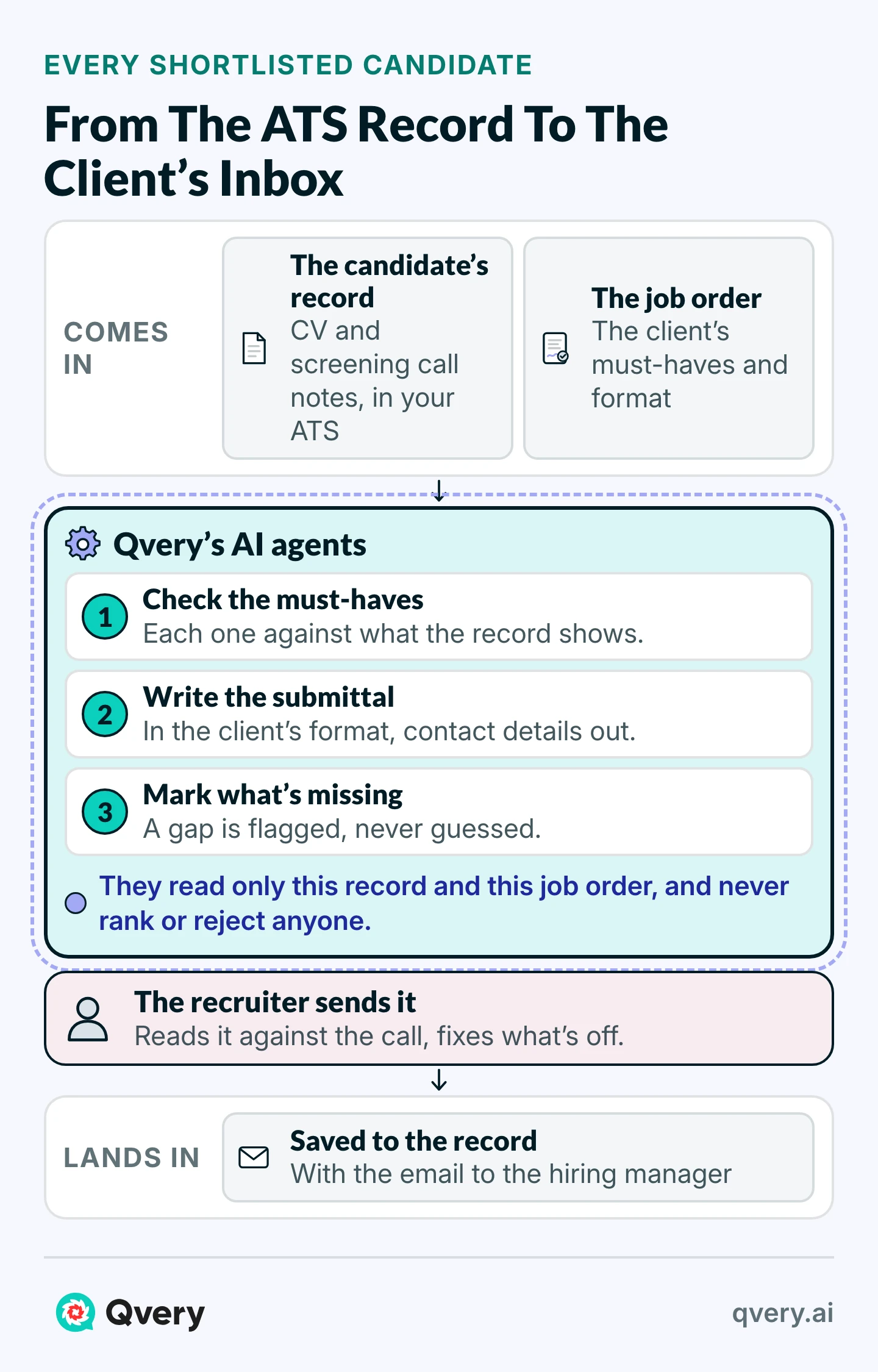
Then they write the submittal in the client’s format, with the contact details removed. Anything the record doesn’t show, a certification or a salary figure, is marked as missing rather than guessed.
 Piotr BabelPartner @ Qvery
The step that decides whether a submittal can be trusted is the must-have check. The agents hold each must-have in the job order against what the candidate's record shows, so a certification mentioned on the call but never written down comes back as missing, not as met. A client should never read a claim your ATS cannot back. When drafts keep arriving with the same gap, the fix belongs in how the call notes are taken.
The draft lands on the candidate’s record with an email to the hiring manager ready to go. The recruiter reads it against the call, fixes what’s off and sends it. The agents never rank or turn down a candidate; who goes forward stays the recruiter’s call.
The same shape fits a freight broker’s carrier packets or an insurance agency’s renewal comparisons: a document, the notes around it, and a format someone outside the company reads.
Every Recruiter Gets Close to Four Hours a Week Back
Our example firm has about 200 people and 40 recruiters, each sending 10 submittals a week, about 1,600 a month. By hand, a submittal takes about 30 minutes, our assumption: a survey of more than 50 agencies, run by a maker of CV-formatting software, put formatting alone at 15 to 45 minutes a CV.
Recruiters are counted as human resources specialists in government statistics, and in staffing firms they earned a mean $69,330 in May 2025. Benefits are 30% of what a private employer pays, so an hour of a recruiter costs about $47.61.
That is $457,056 a year of recruiter time, about $23.81 a submittal. With the agents drafting and a recruiter spending 6 minutes to read and send each one, it falls to $98,851, the agents’ running cost included.
Candidate Submittal ROI Calculator
What Each Candidate Submittal Costs You, And With AI Agents
Saved Per Year
$358,205
7,680 hours handed back, after $7,440 a year to run it
- Hours Handed Back
- 7,680 hours a year
- Agent Running Cost (Estimate)
- $620 a month
- Payback Per $10,000 Of Build
- 0.3 months
On these numbers, each submittal costs $5.15 instead of $23.81, the agent saves $358,205 a year after its own running cost, and every $10,000 of the build is earned back in 0.3 months.
The difference is $358,205 a year and 7,680 hours. At that rate, the saving covers $10,000 of build in about ten days.
Those hours earn the most when they go to work the firm would otherwise hire for: more screening calls, more clients answered the same day. Our staffing playbook prices the write-ups that pile up after those calls: first interviews written up, finalist interviews replayed and nurse packets checked page by page.
A recruiter who already uses a chat window may be faster than 30 minutes today. Put that number in, and the agents still take the copying, the template and the contact details off their desk.
A Candidate’s CV Stays in Your Systems
A CV is the personal data of someone who agreed to apply for a job, not to have a chatbot company read it. EU data protection law expects a written contract with any service that handles personal data on a company’s behalf, and a personal chat account comes with none.
- The agents read the candidate’s record and the job order they were asked about, and nothing else in your ATS.
- Which records they open, and where the processing happens, is set in writing before the first CV goes through, under a data protection contract we sign as an Estonian company bound by EU law.
- Every draft and every change is logged on the candidate’s record.
If a client or a candidate asks where a CV went, the record answers.
The Company’s Account Has to Be the Easier One
Nobody gets shadow AI to zero, and the UK’s National Cyber Security Centre doesn’t ask anyone to. Its guidance is to reduce the risk rather than assume it can be eliminated, and to understand why people use these tools so the secure option meets the need.
We don’t know of a company this size that has stopped it with a block.
People who are told no keep the phone in their pocket. What moves them is a company account they’re already signed into, knowing exactly what may go in it, and someone to ask when they aren’t sure.
Your Teams’ Answers Are Where We Start
We begin with what your teams told you, or we ask them ourselves, then move the general use onto company accounts and train each team on what may go in.
Then come the agents for the job your people repeat most with client files, for a staffing firm the submittal, working inside your ATS. Two weeks after we get access, they are drafting on your own candidates’ records.
From then on, each week shows the recruiter hours the agents handed back and the gaps they marked before a client saw a draft. We agree the price for that before any build starts.
Frequently asked questions
What is shadow AI?
AI tools people use for work without the company’s approval, most often a personal ChatGPT, Claude or Gemini account, plus free note-takers and AI browser add-ons. It’s the AI form of shadow IT. The tool may be a good one; the problem is the account, which the company can’t see, search or close.
How do I find out which AI tools my employees use?
Ask each team which tools they use, for what and with which files, before announcing any rule. Then check what your own accounts record: sign-ins with work email, AI subscriptions on expense claims and browser add-ons on company machines. Asking first gets truer answers than blocking first.
Is it safe to let staff use ChatGPT for work?
On a company account, for most work, yes. ChatGPT’s business plans are not used to train OpenAI’s models by default, and the company controls who has access. On a personal Free, Plus or Pro account, chats may train the models unless the person opts out.
Is ChatGPT Business or Claude Team enough on its own?
For general drafting and summaries, usually yes, once people are trained on what may go in. On their own they don’t work inside your recruiting system, apply each client’s format or log what was done on the candidate’s record. Those repeated jobs are where agents come in.
What happens to client files already in personal accounts?
The company can’t reach them, so ask people to delete client material from their own chat histories. Deleting doesn’t undo everything: Google keeps chats a reviewer read for up to three years, and Anthropic keeps chats used for training five years.
Can we block personal AI accounts?
Partly. A company can block AI sites on its own network and on the devices it manages. A block can’t reach a personal phone, and without an approved account to use instead it mostly moves the use there.
What should we do about free AI note-takers on client calls?
Switch them off on company calendars and replace them with one the company approves, if people need notes. A free note-taker records whoever is on the call and sends the transcript to the person who installed it, outside anything the company keeps.
How much does shadow AI cost a company?
In IBM’s 2025 study of breached organizations, those with high levels of shadow AI paid an average of $670,000 more per breach than those with little or none. The average breach in that study cost $4.44 million worldwide and $10.22 million in the US.
What if our recruiting system already has AI?
Use it for what it does well. Bullhorn’s assistant, for one, writes a short candidate summary from the CV on request. Agents take the work around it: joining the CV, the call notes and the job order, the client’s format, the contact details, and the draft email.
Do the agents decide which candidates go to a client?
No. They draft the submittal for the candidate a recruiter shortlisted and mark what the record doesn’t show. They never rank, score or turn down a candidate, and nothing goes to a client until the recruiter sends it.
Will recruiters trust a draft they didn’t write?
A draft is easy to trust when it’s quick to check. Every draft shows which lines came from the CV, the call notes or the job order, and marks missing facts instead of filling them in. Recruiters read it against their own call and send it.
Can we use AI on candidates’ CVs under EU data protection law?
Yes, with a written contract with every service that handles the CVs on your behalf, which the law expects and a personal chat account does not offer. Keep the CV in your ATS, let the service read it there, and log what was done with it on the candidate’s record.
How long until the first agents run?
The first ones work on your own files within two weeks of getting access to your systems. Moving people onto company accounts and training each team come first, so the agents arrive at a desk that already knows what may go in.
Does this work outside staffing?
Yes, wherever a team repeats a job that joins a document, the notes around it and a format someone else reads: a freight broker’s carrier packets, an insurance agency’s renewal comparisons, a property manager’s lease summaries. Only the systems change.
Should we write an AI policy before we know what people use?
A short one helps, and it can follow the inventory: which tools are approved, what may go in each and whom to ask. Written before you know what people use, a policy tends to cover tools nobody opens and miss the ones they do.
Who should decide which AI tools are approved?
The owner or whoever runs operations, because it’s a decision about the work, not about software. The list of approved tools stays short and has a named person people can ask. We set up the accounts and train the teams once it’s decided.
