
On this page
- A Shopify Merge Fixes One Store's Customer List
- Checkout Makes the Next Duplicate
- Keep One Customer List and Check Each New Record Against It
- What Qvery's Agents Do With Each New Customer Record
- Checking 250 Suspected Duplicates a Month Costs About $33,500 a Year
- Your First Groups Come From Last Month's Customers
- Frequently asked questions
Each of your brands has its own online store, and each store keeps its own customer list. A shopper who buys from two of your brands, checks out once with her work email and gives her phone number at a till is, in your systems, three or four customers.
That shows up as a customer count nobody trusts, a first-order discount sent to someone who has bought from you for years, and support staff who can't find last spring's order.
Whoever owns the customer list spends part of every week finding these people and merging them by hand. In our example, a group of about 200 people with three brands, that hand work costs about $33,500 a year.
| Where | What the record says | What it costs you |
|---|---|---|
| Brand A's store | A Gmail address, six orders, unsubscribed from email | Your loyal customer, seen as one of many |
| Brand B's store | A work email, one order with a first-order discount | A "new customer" and a welcome offer she didn't need |
| Brand A's shop till | A phone number typed with dashes, two purchases | Sales nobody links to her |
| Brand B's email account | Two profiles, one for each email | Two profiles counted on the email bill |
The fix usually arrives as a choice: merge the duplicates in Shopify, store by store, or keep one list downstream in a data platform. Each fixes part of it.
What holds takes a piece of each: one customer list as the record of who is who, every new record checked against it as it's created, and a merge inside a store only when a person on your team has approved it.
A Shopify Merge Fixes One Store's Customer List
Shopify's merge works. It folds two profiles into one, with the orders, addresses, gift cards and discounts of both. It does that inside one store.
Even inside one Shopify organization, the setup that puts a group's stores under one login and one bill, each store keeps its own separate customer data. Merging Maria in Brand A's store leaves Brand B's store, its email account and your loyalty list exactly as they were.
Shopify's own rules turn each merge into a decision someone has to make with the other brands' records open.
- It can't be undone. Shopify's merge is permanent, and the customer isn't told. Two people merged by mistake stay one profile.
- Consent rolls up. As Shopify's help reads in November 2026, if one profile is subscribed to email or text marketing and the other isn't, the merged profile is subscribed. A shopper who unsubscribed under one email can be subscribed again by the merge.
- Some profiles won't merge. Shopify refuses when either profile has store credit, a saved card, a subscription (now or in the past) or a link to a wholesale account. Those stay two customers, and the credit stays on the old one.
So the person who merges needs to see the other brands' records, the consent on each and what Shopify will refuse, before clicking. A store's admin shows none of that, and the person merging in Brand A's store can't see Brand B's at all.
Checkout Makes the Next Duplicate
A cleaned list starts filling up again the next morning. Shopify can sign shoppers in with a six-digit code sent to their email. When someone signs in with an email it hasn't seen, Shopify creates a new customer profile on the spot.
The usual reasons are plain: a forgotten email, or another go at the first-order discount.
Your email platform matches on its own rules. Klaviyo, for example, merges two profiles only when an email and a phone arrive together on one checkout or form, and its own help says never to merge profiles that belong to different people.
A coupon on the profile Klaviyo removes doesn't move to the one it keeps. Its plans are also priced by active profiles, every contact you can market to, so a duplicate is counted twice on the bill.
Tips from Reddit
Merchants on duplicate customers, stuck credit and consent
First you need to decide what is your master in customer data? Would choose it based on the processes connected to it. Then you write code and sync all the other systems into it.
We had a similar issue where customers had multiple accounts from different email addresses and the credit was just stuck on the old one. Ended up having to manually gift card it over which is not scalable at all.
For me, I'm more worried about accidentally "re-subscribing" somebody who once unsubscribed, because I would feel suuuuuper spammy if that happened!
Tell them it creates duplicate profiles that they will have to pay for, now that active profiles are charged.
A data platform downstream, the warehouse or customer data platform that collects records from all your tools, can join the reports and stop a campaign from mailing one person twice. It can't stop the next profile at checkout.
Its matching rules also decide who counts as one person. Segment's own documentation tells its users to block placeholder values such as "null" and "anonymous", because records carrying them once merged large numbers of different customers into one.
A list cleaned once describes last month. The check has to happen when each record is created, in whichever store or till creates it.
Keep One Customer List and Check Each New Record Against It
The ruling for a group your size: one customer list for the whole group, where every store's profile, every till record and every email profile points to one customer.
It lives outside the stores, because no store can see the others. Each new record is checked against it when it's created, and a merge is made in a store only after a person approves it.
| Route | What it fixes | What it leaves |
|---|---|---|
| Merge in each Shopify store | That store's order history and profile | The other brands, the email accounts, the next duplicate |
| A data platform downstream | Reports and duplicate sends | Checkout, and the stores' own records |
| One list, checked as records arrive | The group's view of each shopper, early | Profiles Shopify refuses, which are linked instead |
Someone has to own that list, and in a group of 200 people it belongs to operations: whoever runs customer service or the customer list for every brand. A brand's ecommerce lead looks after one store; the list has to serve support, marketing and finance across all of them.
What a person decides stays short: every merge, because none can be undone; every group where the records disagree on consent; every shared address or phone, because a household is often two customers.
One list says who a person is. It never moves her marketing consent from one brand to another: she agreed to hear from Brand A, and that's all Brand A's record says. Whether your brands may share identity at all is a question for your counsel, settled before anything is connected.
When the ruling reverses: one brand, one store, a handful of duplicates a month. Shopify's merge, done by whoever runs the store, is enough, and the store's own list can be the record.
 Vlad ShvetsPartner @ Qvery
A customer list is how a group remembers a shopper. When one of your brands welcomes her as a new customer after three years with another, it's because no one owns the list across brands. Give it one owner, and every merge becomes a decision made with the evidence in front of someone, instead of a fix nobody can undo.
What Qvery's Agents Do With Each New Customer Record
Our agents read the customer lists of each brand's store, the tills and each email account. When a store reports a new customer, they put her phone, email and address in one format.
Then they look for her across the group's list: the same phone typed another way, a work email with the same name and address, a till record with the number she gave at the counter.
Records that look like one person go to your team as a group, with the evidence beside each: the fields that match, the ones that conflict, the consent on every record and anything Shopify will refuse to merge.
Systems that don't report new customers as they happen, an older till or a marketplace export, are checked each night instead.
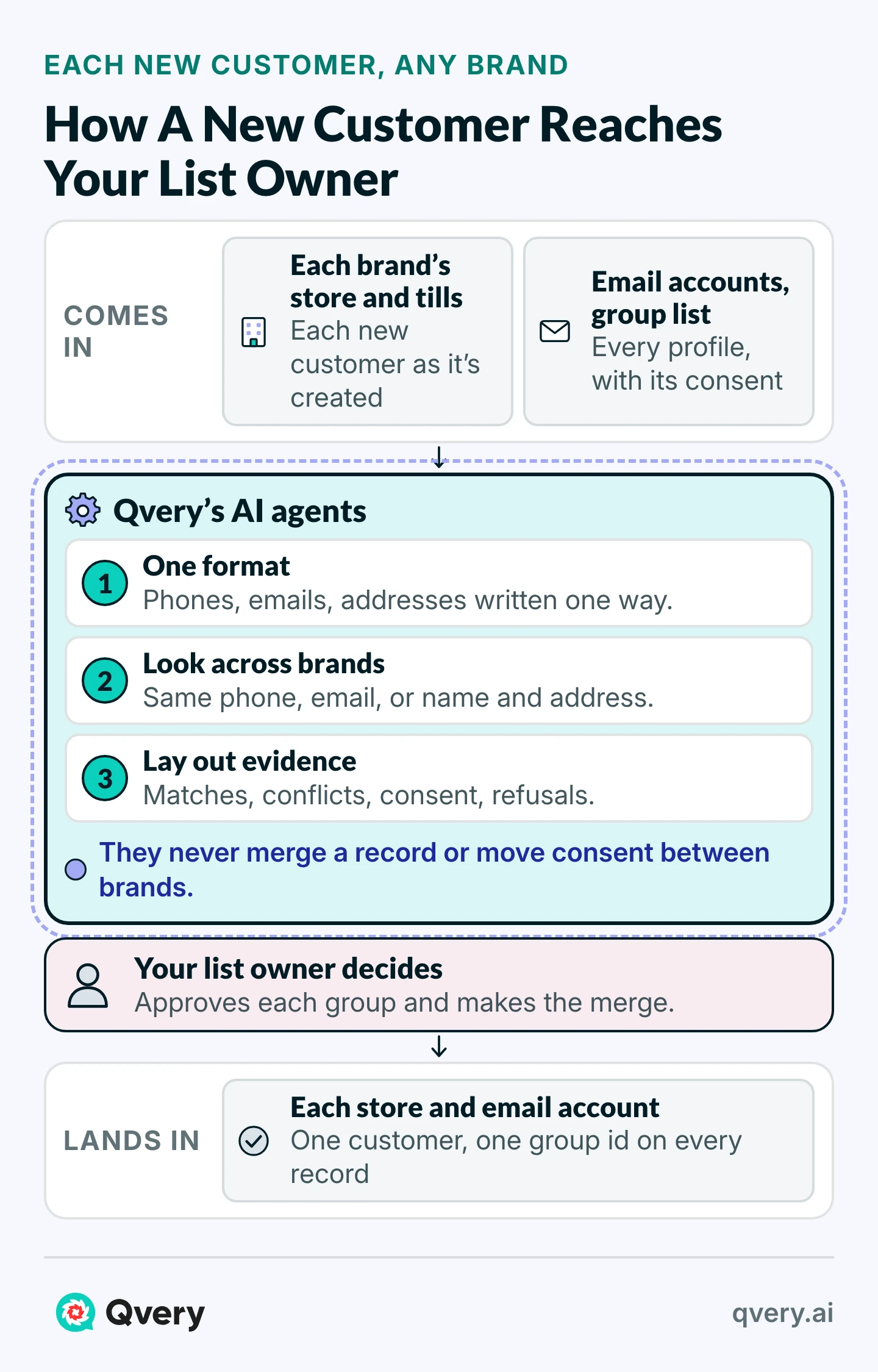
Your team approves or rejects each group and makes the merge. The agents never merge a record on their own: they prepare it, with the fields to keep and the consent to check, so the merge takes a minute.
With your approval, they also write the group's customer id onto each store's record, so support finds one customer from any brand.
 Piotr BabelPartner @ Qvery
A phone number is stronger evidence than a name, and an address is the weakest, because families share one. So our agents group records on what they can show and put that evidence in front of your team. A household stays open until a person decides, and when the evidence is thin, the agents stop and say so instead of guessing.
Customer lists hold names, emails, phones and addresses, so the access is agreed first, in writing: what the agents may read (customer records, never payment details), what they may write (the group's customer id, until you decide otherwise) and where that data is processed.
They start with read access to customers alone. Every match, approval and change goes into a log your team can read, and Qvery AI OÜ, an EU company, signs a data processing agreement with you.
Drop in an export from one of your stores and see which customers come back grouped.
Checking 250 Suspected Duplicates a Month Costs About $33,500 a Year
Take the example group: three brands, about 60 suspected duplicates a week, 250 a month. Checking one by hand means opening both profiles in each store, comparing orders, addresses and phones, checking consent and what Shopify allows, then merging and moving any credit.
Call it 15 minutes a pair, or 750 hours a year. One merchant described piecing a single customer together as fifteen minutes and five browser tabs.
Marketing specialists and market researchers at clothing retailers earned a mean $31.29 an hour in May 2025 (federal wage survey), and pay is 70 cents of every dollar a private employer spends on a person. So an hour costs about $44.70, and the hand checking $33,525 a year, $11.18 a pair.
With the agents' evidence in front of them, a person reads the group, approves it and makes the merge in about 5 minutes: 250 hours, $11,175. The agents cost about $250 a month to run at this volume, $3,000 a year. Together that's $14,175, or $4.73 a pair.
The difference is $19,350 a year and 500 hours of your list owner's time, and every $10,000 of build pays back in about 6 months of that saving. Those hours pay most on work you'd otherwise hire for: campaigns, segments and a loyalty program run on a list you trust.
Every figure here but the pay is our assumption, so type your own over them.
Duplicate Customer Records ROI Calculator
What Checking Duplicate Customers Costs You, And With The Agents
Saved Per Year
$19,350
500 hours handed back, after $3,000 a year to run it
- Hours Handed Back
- 500 hours a year
- Agent Running Cost (Estimate)
- $250 a month
- Payback Per $10,000 Of Build
- 6.2 months
On these numbers, each suspected duplicate costs $4.73 instead of $11.18, the agent saves $19,350 a year after its own running cost, and every $10,000 of the build is earned back in 6.2 months.
The calculator counts only the checking. The welcome offers that go to shoppers who already buy from you, the duplicates on the email bill and the support calls about missing orders aren't in it, and they stop where the check runs: when the record is created.
Your First Groups Come From Last Month's Customers
You bring read access to each brand's store and email account, a till export if your tills aren't Shopify's, and the person who will own the list. The agents' first run is last month's new customers across the brands, set against everyone already on file.
Your team approves the first groups, and their answers teach the agents which evidence your team trusts: whether a shared address ever counts, how each store writes phone numbers.
Two weeks after the access is in place, the agents are checking each new customer as the stores report it. Every week we count the groups your team approved and the minutes each one took.
Duplicate customers are one of three jobs our playbook for retail groups prices. The other two are the same product listed under different codes and supplier invoices checked by hand.
The book prices each job for a group like the one in this example.
Frequently asked questions
Can Shopify merge customers across our brands' stores?
No. Each store keeps its own customer list, even when the stores share one Shopify organization. Apps or an ERP, the system that runs stock and finance, can copy some data between stores, but a merge still happens one store at a time. Seeing one shopper across brands takes a list outside the stores.
Can the agents stop a returning shopper from getting a second welcome offer?
They flag her as soon as the store reports the new profile, so your team can decide before a second welcome offer goes out. Holding the welcome email until that decision is a rule your email platform can apply. The agents don't send or stop any email themselves.
What happens to store credit and loyalty points when two profiles are merged?
Shopify refuses to merge a profile with a store credit account, so the credit stays on the old profile until someone moves it, often as a gift card. Loyalty points live in the loyalty app, under its own rules. The agents flag both before your team approves, so nothing is left behind unnoticed.
Two people share an address or a phone. Will the agents merge them?
No. A shared address is weak evidence, because families and flatmates share one, and a shared phone can be a parent's. The agents mark the group as a possible household and show what matches and what conflicts. Your team decides, and a shared address alone never makes one customer.
We already have a data platform. Do we still need this?
Your data platform joins reports and stops duplicate sends, and the agents can read from it and write the group's customer id back into it. It doesn't check each new profile when a store creates it, or show your team the consent before a merge. The agents add that step.
What about customers who only buy at the till?
A till record with a phone number is matched on that number, in one format, against every profile in the group. When the same number sits on an online profile, the two are grouped for your team. A till sale with no phone and no email can't be matched, and the agents leave it alone.
Can a wrong merge be undone?
Not in Shopify and not in Klaviyo: both make a merge permanent. That's why every merge waits for a person and the evidence comes first. Two people merged by mistake are separated by hand, record by record, which costs far more than the check.
What happens to a customer's order history after a merge?
In Shopify, the orders of both profiles move to the one that remains, with the addresses, gift cards and discounts, so support sees her whole history in that store. Her orders with your other brands stay in their own stores. The group's customer id is what lets support find them from any brand.
How many groups will our team review each week?
The first run, on last month's customers and the backlog behind them, is the large one. After it, your team sees only new records that match someone already on file. In our example that's about 60 a week across three brands, a few minutes each.
Who on our team should approve the groups?
Whoever owns the customer list across the brands, in operations or customer service. They need to see every brand's records and know the consent rules, which a brand's ecommerce lead, looking after one store, doesn't. A second person covers holidays, because new customers keep arriving.
Which records do the agents never touch?
Payment details, order amounts and anything outside the customer records. They read customers and, with your approval, write one field: the group's customer id. Merges, deletions and consent changes stay with your team.
What happens when a customer asks us to delete their data?
The deletion runs in each store and email account as it does today, and the agents remove the customer from the group's list as well. Shopify won't merge a profile while a data request is in progress or after it's redacted, and the agents skip those records.
Does this work if one of our brands isn't on Shopify?
Yes. The agents read any store or till that exports its customers. Where the system reports each new customer, the check runs when the record is created; where it only exports a file, it runs each night.
