
On this page
- A Certificate of Insurance Proves Less Than It Shows
- Most of the Hours Go to the Certificates That Come Back Wrong
- The Costly Miss Is a Vendor Still Getting Work Orders
- What Your Software and the COI Services Already Do
- Qvery's AI Agents Hold the Work Order Until the Certificate Is Right
- 250 Certificates a Month Give Back 1,200 Hours
- Your First Two Weeks Start With the Vendor List
- Frequently asked questions
Every vendor who works on one of your properties owes you a certificate of insurance, a COI: a one-page summary of their policies, filled in by their insurance agent on a standard industry form, the ACORD 25. So does nearly every commercial tenant, under the insurance clause of its lease.
Someone in your office reads each certificate against that contract or lease, writes back for what's missing, reads the corrected one and types an expiration date into your property management system. Most of their time goes to the certificates that come back wrong.
Take a property manager with about 1,800 vendors and commercial tenants on file. That's around 250 certificates a month, counting renewals, new vendors and the corrections sent back, at about 30 minutes each: 1,500 hours a year, $48,855 of an administrator's time.
That figure leaves out the larger risk: a vendor whose cover lapsed in March and who still gets work orders, and checks, in May, because your system only knows the date someone typed.
At Qvery, we help property managers spend less chasing insurance certificates, with custom AI agents that read each one against its contract and hold new work until it's fixed.
A Certificate of Insurance Proves Less Than It Shows
The certificate is a summary, and the form says so at the top: it "confers no rights upon the certificate holder" and doesn't change the policies it lists.
Being the certificate holder, the name in the box at the bottom, only means the certificate was addressed to you. Being an additional insured means the vendor's liability policy covers you too, so a claim that comes from the vendor's work goes to the vendor's insurer, with a defense for you.
If you're meant to be an additional insured, the form itself says the policy has to carry that, in its own wording or in an endorsement (a page added to the policy), and a line typed on the certificate doesn't count in its place.
| On the certificate | What it suggests | What decides it |
|---|---|---|
| Additional insured, ticked or typed in the description | You're covered for the vendor's work | The endorsement, or a blanket clause for any party a written contract names |
| The certificate holder | You'll hear about any change | Nothing on the form: notice goes out under the policy's own terms |
| Waiver of subrogation ticked | The vendor's insurer won't come after you once it pays a loss | The waiver in the policy; it's what a contract asks of workers' comp |
| The policy dates | Covered until the expiration date | The policy, which can end sooner |
One risk consultancy audited the policies of hundreds of contractors working for a single client, in a review published in 2015. Every certificate showed the contract's insurance in full. Read against the policies themselves, more than 9 in 10 fell short in a material way, most often on additional insured status.
Insurance agents explain part of it themselves: an endorsement can cost their client a premium, so some type "additional insured" into the description box and hope it passes. Asked for the endorsement page itself, most send it.
Most of the Hours Go to the Certificates That Come Back Wrong
Reading one certificate against one contract is quick. But a roofer's contract asks for more than a cleaner's, and an anchor tenant's lease (the large store a center is built around) has its own insurance article, so there's no single checklist to hold each certificate against.
Each certificate that falls short is an email to the vendor or its insurance agent, a wait, a second certificate and a second read. At a large retail owner-developer, the person reviewing tenants' vendors described the job as back-and-forth email until every box was checked and every line of additional insured wording was right.
When someone does check, most vendors fall short.
Evident, a company that sells insurance verification, measured the third parties its own customers check.
Evident's figures come from large organizations in trades like transportation, retail and construction, so read them as a direction, not a measure of your vendors.
Our example assumes 30 minutes a certificate on average, across clean renewals and the ones that need a second round. At 250 a month that's 1,500 hours a year, about three-quarters of one administrator's year.
The Bureau of Labor Statistics puts administrative assistants in real estate at $22.80 an hour, and benefits are 30% of what private employers spend on pay, so about $32.57 an hour with them: $48,855 a year. Put in your own certificates, minutes and pay.
Cost Per Insurance Certificate ROI Calculator
What Each Insurance Certificate Costs You To Check, And With AI Agents
Saved Per Year
$34,884
1,200 hours handed back, after $4,200 a year to run it
- Hours Handed Back
- 1,200 hours a year
- Agent Running Cost (Estimate)
- $350 a month
- Payback Per $10,000 Of Build
- 3.4 months
On these numbers, each certificate costs $4.66 instead of $16.29, the agent saves $34,884 a year after its own running cost, and every $10,000 of the build is earned back in 3.4 months.
The calculator also shows the same work with AI agents doing the reading and the chasing, at about 6 minutes of your administrator's time a certificate instead of 30.
The Costly Miss Is a Vendor Still Getting Work Orders
A certificate tells you what was true the day it was issued.
The policy can be cancelled or left to lapse before the date on the form, and the form promises you no notice beyond what the policy itself provides.
Your property management system keeps whatever date someone typed and warns when it passes. A warning is a box a coordinator clicks past when a unit is flooding at nine at night.
Some systems can refuse a vendor's invoice once its insurance has expired, and the setting isn't always on: one multifamily manager's accountant found theirs off.
The managers who've closed this gap tie the status to the two things a vendor cares about, the next job and the next payment.
Tips from Reddit
Property managers and a claims adjuster on what makes certificates hold
Current = can be dispatched and paid clean. Expiring within 30 days = can finish a job already started, no new starts. Expired = no dispatch, and no invoice release until the renewal is in hand.
Fix it once at onboarding: have the vendor tell their agent, in writing, to send you certificates and renewals directly.
all you need to do is ask "is policy #_____ an active policy for _____ company? I'm hiring them for a job and need to confirm active coverage". That's it.
The insurance clause in a vendor contract exists to send a claim from the vendor's work to the vendor's insurer. When the cover has lapsed, the claim comes back to you and your own insurer to sort out.
Fixing it in time costs the vendor little: an additional insured endorsement rarely runs more than $100 to $250, by one commercial insurance agent's account.
Certificates also get forged. The form is a fillable PDF, and insurance agents report clients typing in coverage they don't have. A certificate that comes straight from the vendor's insurance agent is harder to fake than one the vendor forwards.
Forged paperwork reaches the leasing office too. Our real estate playbook prices that job, rental applications with forged documents, along with repair requests keyed in by hand and leasing inquiries.
Tenants are a different case. A tenant whose cover lapses is in breach of its lease, and the notice and the time to cure are the property manager's call, not a hold.
What Your Software and the COI Services Already Do
Your property management system and the COI tracking services on the first page of any search each do part of this job well, and each leaves part of it with your team.
| Tool | What it does | What stays with your team |
|---|---|---|
| Buildium | Stores each vendor's insurer, policy number and expiration; warns when it has run out | Reading the certificate, chasing the fix, typing the date |
| AppFolio's vendor portal | Lets vendors upload their own documents and flags them as they expire | Reading what was uploaded against the contract |
| Yardi TenantShield, full service | Yardi's insurance experts score each tenant certificate against a checklist you set | Notices and cures under each lease |
| COI tracking services | Read certificates with AI and people; several ask the vendor's insurance agent | Usually, acting on their results in your own work orders and payments |
If a service already reads your certificates well and your team acts on every alert, it may be enough. Where the hold has to happen inside your own systems, by your own rule, on every work order and every payment, that's the part our AI agents take.
 Vlad ShvetsPartner @ Qvery
Before you buy anything for certificates, ask where the hold happens. Reading certificates well is half the job; the other half is stopping the next work order and the next payment, and an alert a coordinator clicks past at nine at night stops neither. If your team acts on every alert today, keep what you have. If vendors with lapsed cover are getting new work, the hold belongs inside your own work orders and payments.
Qvery's AI Agents Hold the Work Order Until the Certificate Is Right
The AI agents we build for this sit between your certificates and the two moments that matter: a work order going out, and a payment being released.
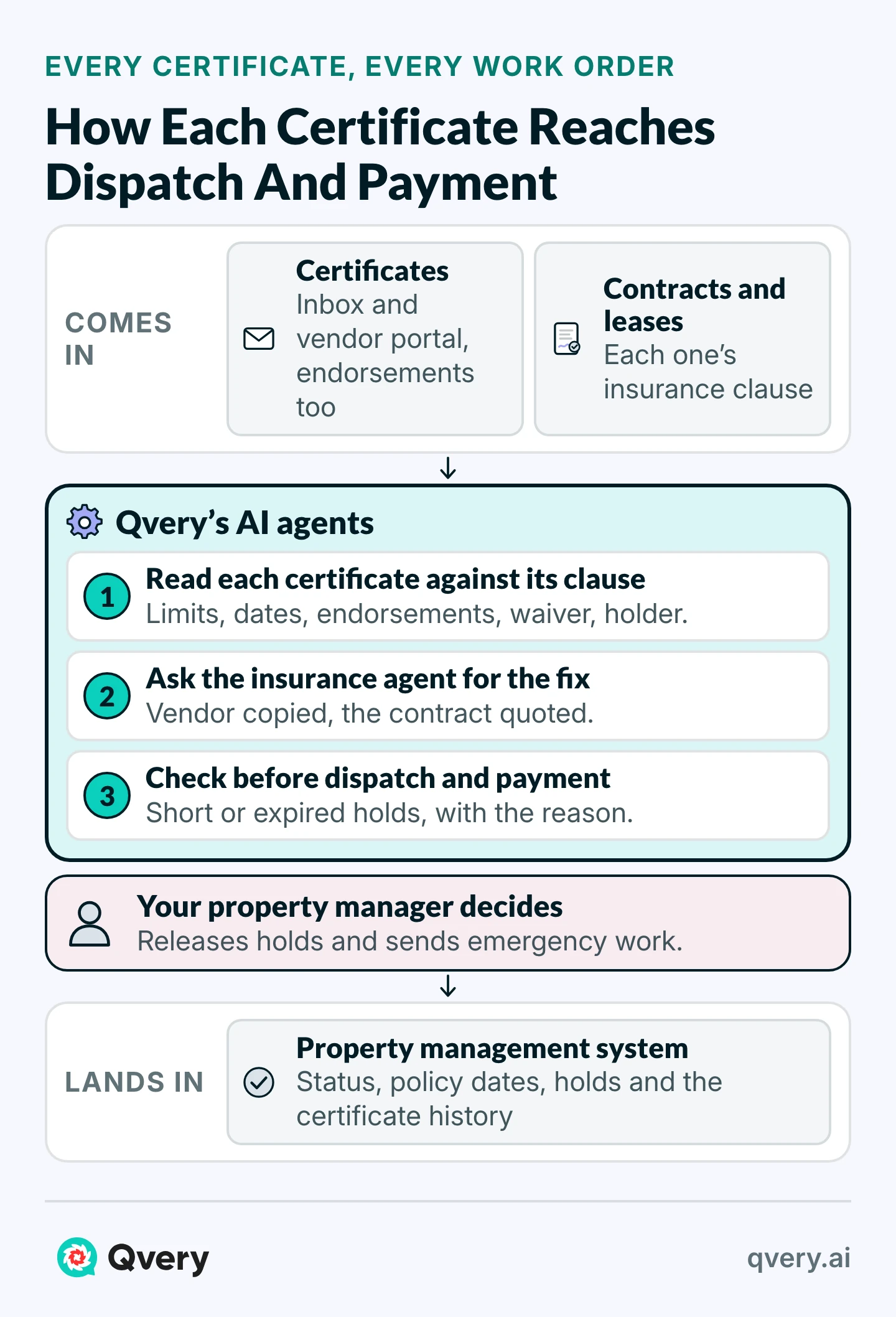
They read each certificate as it arrives, with its endorsement pages, against the insurance clause of that vendor's contract or that tenant's lease. The clause is read once from the signed document and kept with its page, so the roofer is held to the roofer's contract and the anchor tenant to its own lease.
They check what that clause asks: each policy's limits and dates, additional insured status for the right entity by endorsement or blanket wording, the waiver, the holder's legal name.
 Piotr BabelPartner @ Qvery
A ticked box on a certificate proves nothing, so the AI agents read the endorsement page behind it and hold it to the insurance clause of that vendor's own contract, read once from the signed document and kept with its page. Where they can't be sure, a page they can't read or a clause open to two readings, they list it for your property manager instead of guessing a value. That list shows you exactly what they couldn't settle.
Where something's short, they write to the vendor's insurance agent with the vendor copied, name exactly what's missing, quote the contract, and read the corrected certificate when it comes back.
They write the status and each policy's dates into your property management system and keep every certificate by date. Before a work order goes to a vendor, and before an invoice is released, they check it.
Say a landscaper's renewal arrives on a Monday. The limits match. The additional insured box is ticked, but the endorsement behind it names your management company and not the owner entity the contract lists, and the umbrella policy the contract asks for, an extra layer of liability cover above the others, isn't there.
By the time your coordinator opens it, the AI agents have asked the landscaper's insurance agent for both, and the landscaper shows as short for new work orders at that property. The mowing already under way this week goes ahead, because your rule lets started jobs finish.
A wrong hold costs a delay, and your manager clears it and notes why. A true emergency goes out on the manager's release, with a date for the certificate to arrive.
250 Certificates a Month Give Back 1,200 Hours
On the calculator's example, your administrator spends those 6 minutes reading what the AI agents found and deciding the holds. That's 300 hours a year, $9,771, plus the AI agents' running cost of about $350 a month, $4,200 a year.
Against $48,855 today, the company keeps $34,884 a year and hands back 1,200 hours, which go to the vendor work you'd otherwise hire for. At that rate $10,000 of build is covered in about 3.4 months.
The running cost is our estimate: about 40 cents of model use a certificate and $250 a month to host, monitor and maintain the AI agents. The 30 and 6 minutes are our assumptions for a company of this size, and the pay is the Bureau of Labor Statistics figure with benefits.
The calculator counts hours only. It doesn't count the lapsed vendor stopped before the next work order instead of found after a claim.
Your First Two Weeks Start With the Vendor List
Working with us starts with what your team already keeps.
- The list of vendors and tenants, and who answers for each one's insurance.
- The insurance clauses of your contracts and leases.
- Access to the inbox where certificates land and to your property management system.
- Your hold rule: what waits, who releases it, what counts as an emergency.
We learn how your coordinators handle a short certificate today, write down the AI agents' access, and connect them.
Within two weeks of connecting, they've read every certificate you hold against its contract, and your team has the list of who's short, the vendors with open work orders first.
After that, each new certificate is read the day it lands, your coordinators learn to work the holds beside the AI agents, and each week shows the certificates fixed, the hours handed back and the jobs a hold stopped before they went out.
Frequently asked questions
What is a certificate of insurance?
A one-page summary of a business's insurance policies, written by its insurance agent, usually on the ACORD 25 form. It lists each policy, its limits and its dates. It doesn't change the policies, and the form says it confers no rights on the person holding it.
Is the certificate holder the same as an additional insured?
No. The certificate holder is the party the certificate is addressed to. An additional insured is covered by the vendor's liability policy for claims that come from the vendor's work. Only the second protects you, and it has to be in the policy or an endorsement, not just on the certificate.
What is an additional insured endorsement?
A page added to the vendor's liability policy that names or describes you as an insured. A blanket version covers any party the vendor's written contract requires, so your contract has to say it. Our AI agents ask for the endorsement page, not the ticked box.
Can a workers' compensation policy add us as an additional insured?
No. Workers' compensation and professional liability policies don't offer additional insured status. What a contract usually asks of workers' comp is a waiver of subrogation, where the insurer gives up its right to recover from you after paying a claim. The AI agents check for it where your contract asks.
Do all vendors need a certificate of insurance?
Every vendor whose work could hurt someone or damage a property should, and your contracts decide the amounts. A cleaner and a roofer won't carry the same requirements. The AI agents read each vendor's own contract, so a light requirement isn't held to a heavy checklist.
Should the owner or the management company be the additional insured?
Whichever your management agreement and the vendor contract name, and often both, with the owner entity spelled the way it's registered. A certificate naming the management company when the contract names the owner is one of the gaps the AI agents flag.
Can a certificate of insurance be fake?
Yes. The ACORD 25 is a fillable form, and insurance agents describe clients typing in coverage they don't hold. A certificate sent by the vendor's insurance agent is harder to fake, so our AI agents request it there. Confirming a policy with the insurer stays with your team.
What happens if a vendor's insurance expires in the middle of a job?
Your rule decides. A common one: a job already started may finish, new work orders wait, and invoices wait until the renewal arrives. The AI agents apply it, and your property manager can release any hold, with the reason logged.
Do tenants need to send certificates too?
Commercial tenants usually do under their lease, often naming the landlord as additional insured. A lapse there is a lease matter, so the AI agents send it to the property manager with the lease clause and leave the notice and the cure period to them.
Can the AI agents read scanned or photographed certificates?
Yes. They read PDFs, scans and photos, and the endorsement pages that come with them. A page they can't read is listed by name, and your team asks the vendor for a clean copy. They never guess a value.
Do we have to replace our property management system?
No. The AI agents work in the system you run today, reading vendor records and writing statuses and dates back. They also read the inbox and the vendor portal where certificates already arrive.
What does reading a certificate with AI agents cost?
About 40 cents of model use a certificate, plus hosting and upkeep: roughly $350 a month at the example's 250 certificates, against 30 minutes of an administrator's time for each one read by hand.
Who decides when a vendor is blocked?
You do, once, in the hold rule, and your property managers do case by case. The AI agents apply the rule and mark the reason; releasing a hold and reading an unclear clause belong to your managers.
Where are our contracts and certificates processed?
Under a data processing agreement with Qvery AI OÜ, an EU company, signed before the AI agents open a file. They open only the inbox, portal, contracts and vendor records this job needs.
Which vendors should we check first?
The ones with open work orders. The first pass reads every certificate you hold against its contract and lists who's short with those vendors at the top, because a lapsed policy can hurt you on their jobs this week.
