
On this page
- Match Every Call to What Happened in the Schedule
- Write Out Each Call With the Time of Every Line
- List What Each Caller Said and What Happened
- Check the Call Against Your Booking Script
- Give the Manager the Week by Reason
- Call Scoring Gives Each Call One Reason and a Grade
- What Qvery Builds for Your Phone Desk
- Replaying 280 Calls a Month Costs About $25,700 a Year
- What Your Manager Sees in the First Two Weeks
- Frequently asked questions
Every call your phone desk answers was paid for, by a search ad, a Google listing, a truck wrap or a customer who remembered your name. Your customer service reps (CSRs), the people who answer and book the job, turn some of those calls into visits. The rest end without one.
In data from ServiceTitan, the scheduling and dispatch software many trade shops run on, shops with 25 or more technicians booked 59% of their calls in June 2022. About four calls in ten ended with no visit, and the only record of why is the recording.
Your service manager replays a few of those each week and coaches from that handful. In our worked example, that costs a company of about 200 people roughly $25,700 a year of a manager's time.
Even then it covers only a sample: the software maker's own advisors say few shops can listen to every call.
An AI agent reads every call that ended without a job and writes down what the caller said and what happened, each with its minute, without grading anyone.
At Qvery, we help home service companies free up their service managers for coaching, with custom AI agents that read every unbooked call and list each objection with its minute.
We ran that review on one invented week: sixteen calls to Larkmoor Heating & Plumbing, a heating and plumbing company that does not exist, voiced by synthetic speech and filtered to sound like a phone line, with a one-page booking script. We wrote down the right answers before any AI heard a call.
The five steps below are the job as the agents do it, on that week. Each runs the same on your own recordings.
This reviews calls after they end. It does not answer the phone, call anyone back or rate the person who answered.
Match Every Call to What Happened in the Schedule
Sort from the schedule, never from the tag. A call booked if a job was created for the caller's number after it; everything else did not, whatever the rep picked from the menu when the call ended.
On our week, the sort did two things the tags could not. Call 11 ended with "let me see what my schedule looks like, and I'll call you back". She did, the next morning, and booked, so she never reaches the review.
The rep tagged call 07 as a price shopper, not a lead, and call 10 as abandoned. Both callers needed a visit, and both tags take them out of the booking rate, the share of calls that turn into a booked visit.
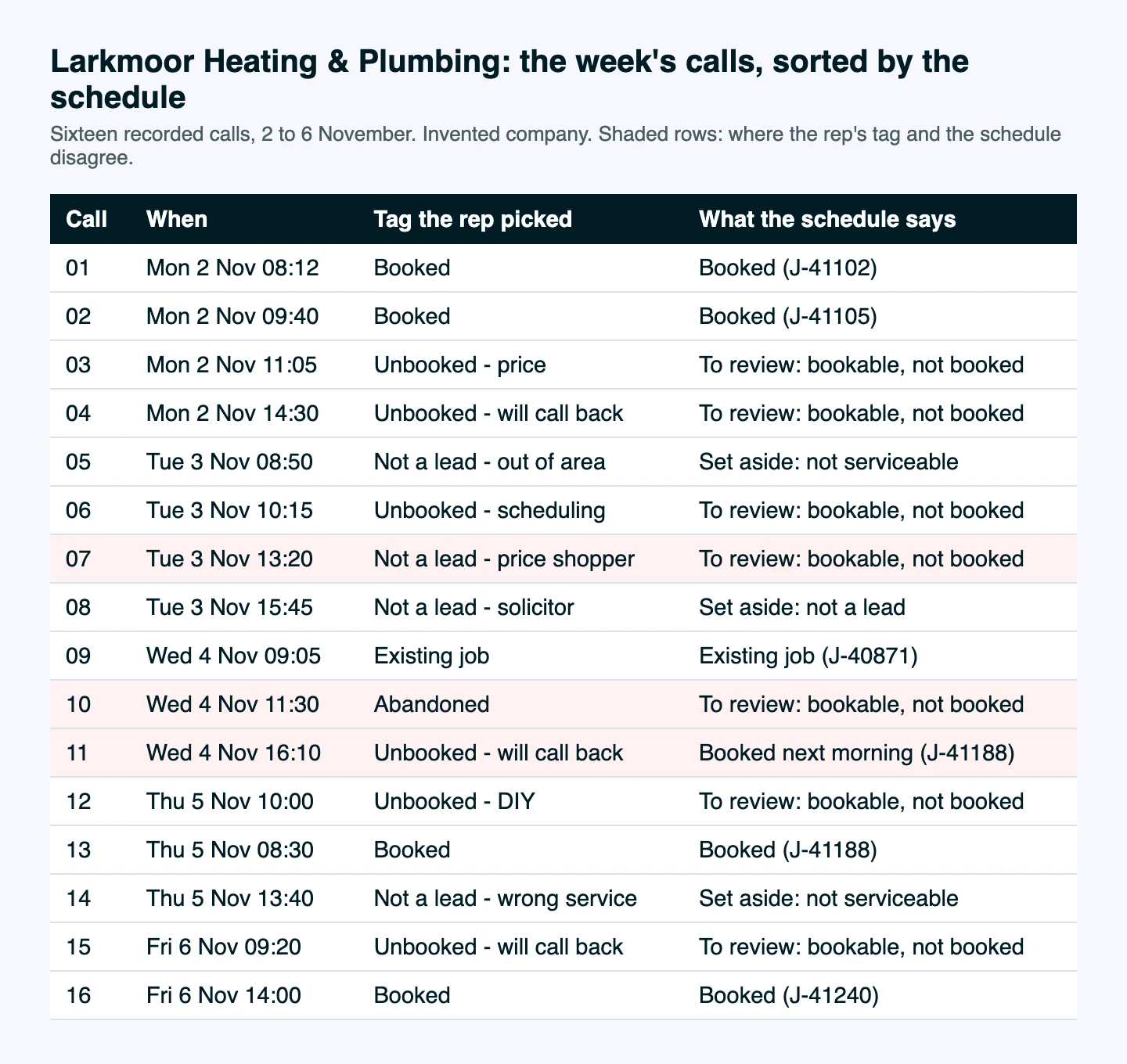
Before anything reads a word, check that every booked row carries a job number and every callback lands on the earlier call's number.
The miss to expect is a caller who rings back from another phone, a spouse's or a work line. Match on the service address too, or that caller reaches the review as lost.
Write Out Each Call With the Time of Every Line
Speech-to-text turns each recording into lines with times. We ran whisper-small on a laptop, and it wrote most of the week cleanly. It failed in three ways, each with a check that catches it.
A broken signal
Call 12's caller spoke for about ten seconds under static. The transcript skips them without a mark, as if nothing was said. A check on the audio's loudness marks the stretch unheard.
A silent hold
Call 10's transcript stops at 0:35. The call ran 3:17, the rest of it on hold. Only the call length from your phone system shows that.
No speakers
The transcript never says who spoke, and on four of the ten calls it ran the rep's words into the caller's. Recording each side on its own channel keeps them apart; without it, the review has to say when it is unsure.
On call 12, the marked line is that loudness check at work:
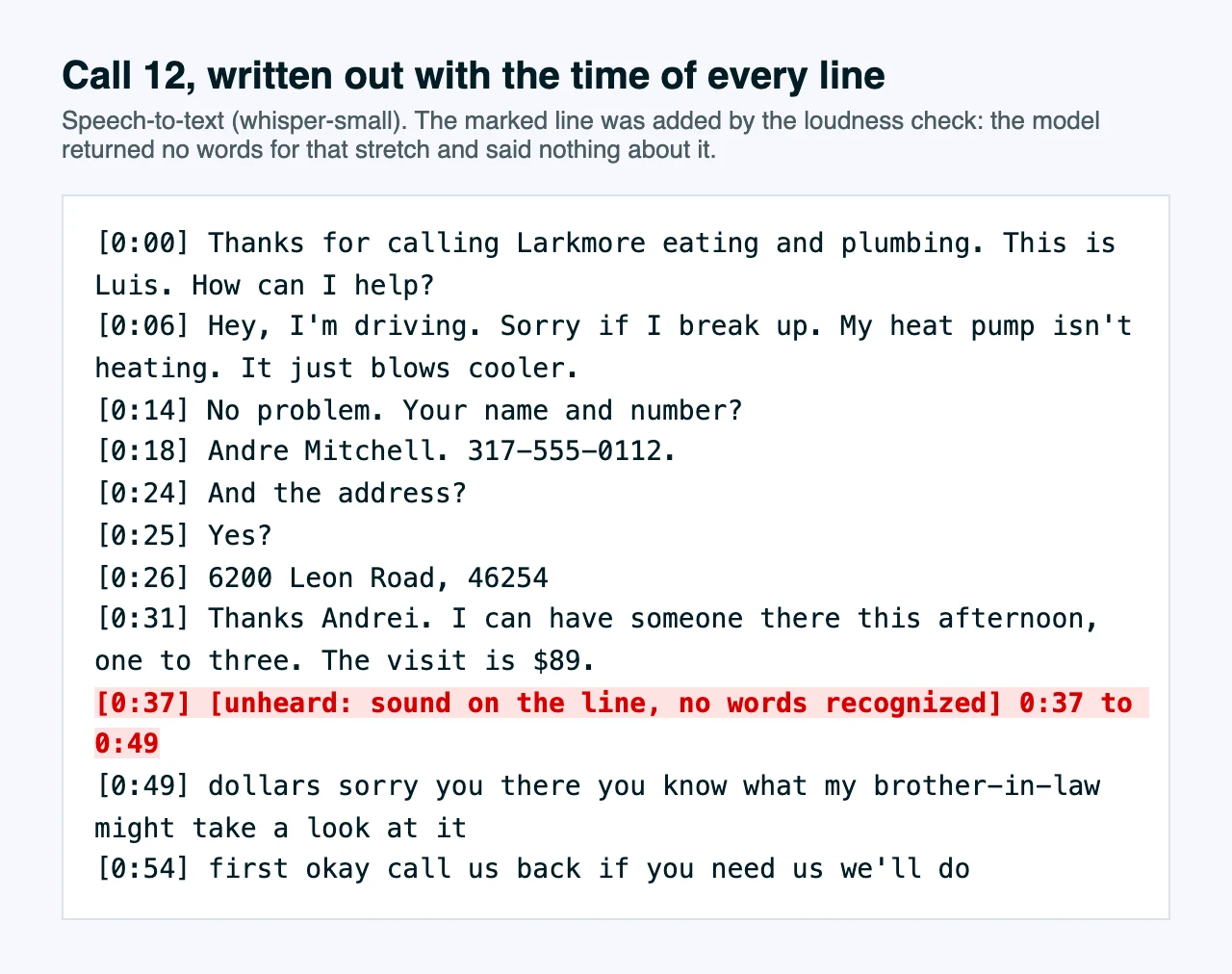
One garble shows why that last rule matters. Whisper wrote "I have rented between 1 and 3" where the rep said "I have Monday between one and three". Read carelessly, that is a renter, and none of the three models we ran took it for one.
Switching to a general AI model does not fix the first failure. Asked to transcribe call 12, Gemini 3.8 Flash marked the broken stretch "[unintelligible]", which is right, and put the next line eight seconds early, which a manager replaying that minute would notice at once.
 Piotr BabelPartner @ Qvery
Speech-to-text fails quietly. On a bad line it skips what it cannot hear and hands you a clean transcript with a hole in it, and a model reading that transcript will happily explain the hole. So the first check runs on the audio, not the words: where the line was loud and no words came back, the review says unheard and sends the manager to that minute.
List What Each Caller Said and What Happened
This is the one instruction the review needs. Give it the transcript, the call length from your phone system and your booking script, and it returns the same parts for every call.
You review recorded phone calls for a heating and plumbing company. Each call below ended with no job booked. You get
the transcript (speech-to-text, no speaker labels, times from the start of the call) and the company's booking script.

For each call, write:

KIND: one of "bookable, not booked" (a service need the company does, in its area), "not serviceable" (outside the
area or a trade the company does not do), or "not a lead" (a vendor, a wrong number, a question about a job already
booked).

STATED BY THE CALLER: every objection, hesitation or request the caller said out loud, quoted in their words, with the
time it was said. A worry said twice is listed once, at the first time.

MOMENTS: what happened on the call that shaped it, with the time: a fee or window quoted, a hold, the caller renting
rather than owning, an address outside the area, a promise made to the caller, the call ending. Facts only.

UNHEARD: every stretch marked unheard, with its times. Do not guess what was said there, and do not read meaning
into the words just before or after it.

SCRIPT: for each script step the call reached, "followed", "said differently" (and how), or "not heard". If no script
is given, write "no script given".

WORTH A CALL BACK: yes when the caller did not turn the company down for good (still deciding, waiting on someone
else, wanting another time or a price in writing, or the call ended without a no); no when they declined for good,
chose someone else, or were never a customer. Quote the caller's words that decide it.

Use only times printed in the transcript. Never give a reason the call did not book that nobody said. Never score,
rank, praise or judge the person who answered. If you are unsure who said a line, say so.
On call 03 it returned this, set in a sheet:
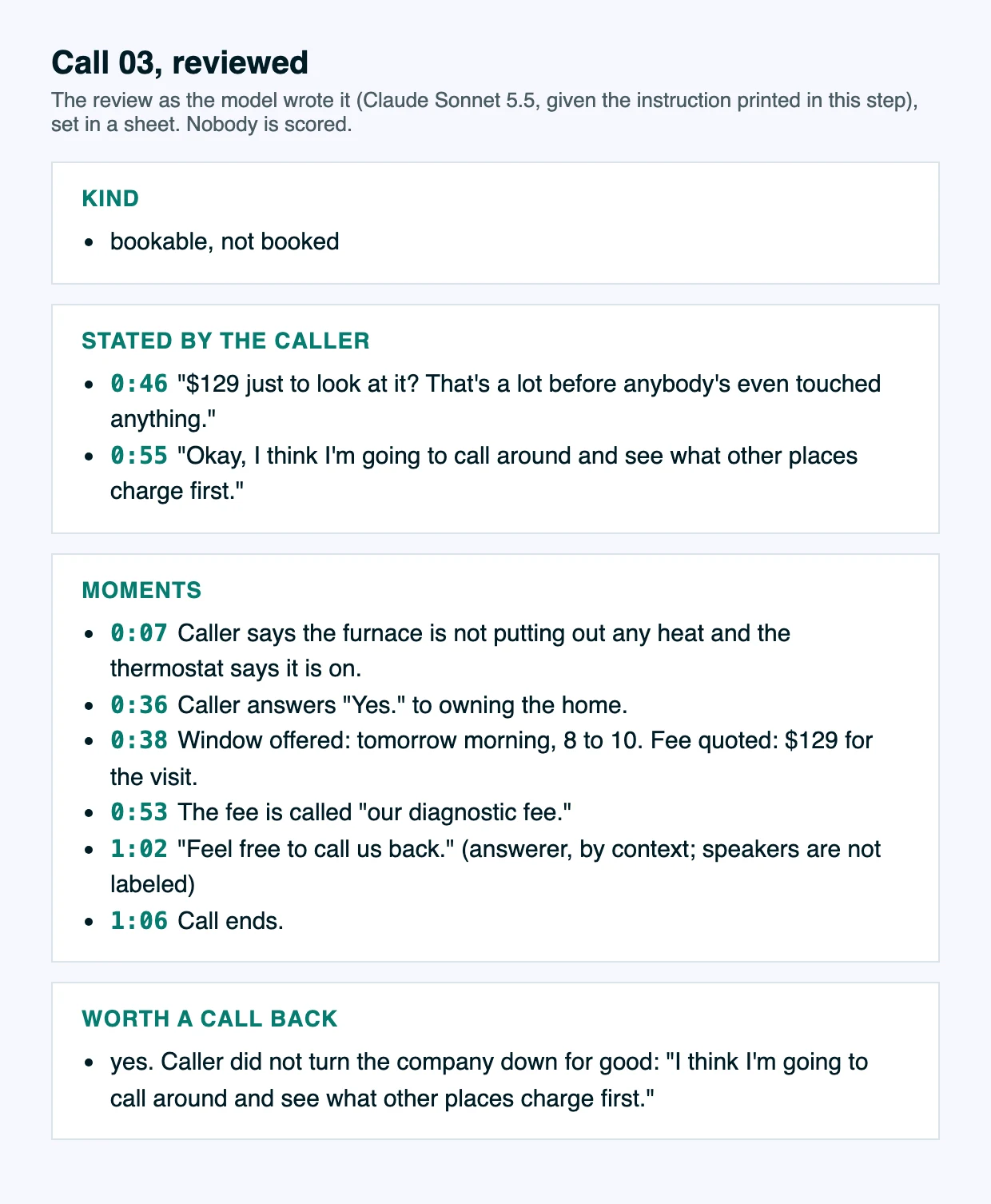
Call 03 shows the pattern. The rep quoted $129 for a Monday morning visit; at 0:46 the caller said "$129 just to look at it?", and at 0:55 he said he would call around first. The list holds both objections, each with the moment to replay, and nothing he did not say.
| Part | What it holds | What your manager does with it |
|---|---|---|
| Stated by the caller | The caller's own words, with the time | Replays that minute and decides: coaching, script or schedule |
| Moments | Facts: a fee quoted, a hold, a renter, a promise made | Checks the promise was kept, like the price text promised on call 15 |
| Unheard | Stretches nobody could make out | Replays them; never reads meaning into the gap |
| Worth a call back | Yes when the caller did not say no for good | Hands the number to a rep today |
| Set aside | Out of the area, the wrong trade, a vendor | Nothing: calls 05, 14 and 08 were never jobs you could book |
The first version of this instruction was shorter, and it went wrong in three places. We ran both versions on the same ten calls, on three models, and scored them against the answer key by code.
| Line in the first version | What went wrong | Line now |
|---|---|---|
| CALLBACK: yes or no | Read two ways: did the caller promise to call back, or is the caller worth phoning? | WORTH A CALL BACK, with what yes means |
| Do not guess what was said there | Haiku read the word "dollars", just after call 12's gap, as the fee | The same, and no meaning read into the words beside the gap |
| Nothing on times | Gemini printed times that exist on no clock, 0:80 to 0:83, on call 04 | Use only times printed in the transcript |
On who to call back, agreement with our answer key went from Sonnet: 8, Haiku: 5 and Gemini: 7 calls of 10 to 10, 10 and 9. Haiku stopped guessing at the gap.
Then check the times before anyone reads a list. Every time the review prints has to be one the transcript holds, a few lines of code. After the fix, that check still caught three made-up times from Gemini, one of them at 1:00 on a call that lasted 39 seconds.
Two things held in all six runs: no model gave a reason for the call that went quiet on hold, and none scored, ranked or judged a rep.
Run the same review on one of your own recordings, with your booking script if you have one.
Check the Call Against Your Booking Script
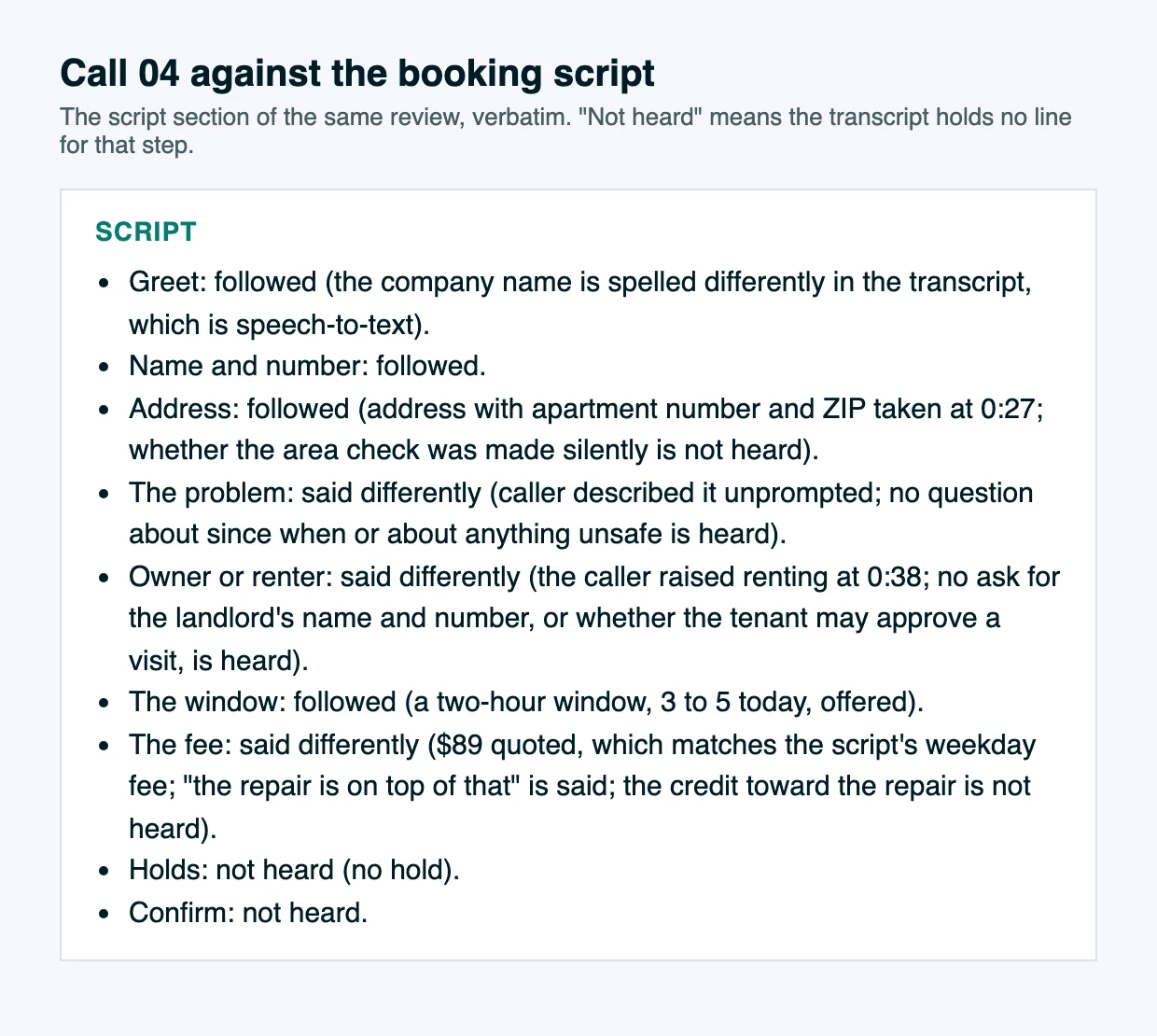
Each step of the script comes back as followed, said differently or not heard. Without a script, that part says no script was given, and the rest of the review runs the same.
On the sample, most misses are a minute of coaching:
Call 04's script section shows how each step reads:
Call 07 is different. The rep did exactly what the script says: no replacement price by phone, a free in-home estimate instead. The caller answered "I just want a ballpark. I don't want a salesman sitting in my kitchen for an hour" and hung up.
That is a question for whoever owns the script, not a coaching point, and a grade on the rep would have hidden it.
Give the Manager the Week by Reason
The last step runs in plain code. Each caller's words go under a label your manager agreed before the run, counted once per call, with the call and the minute to replay.
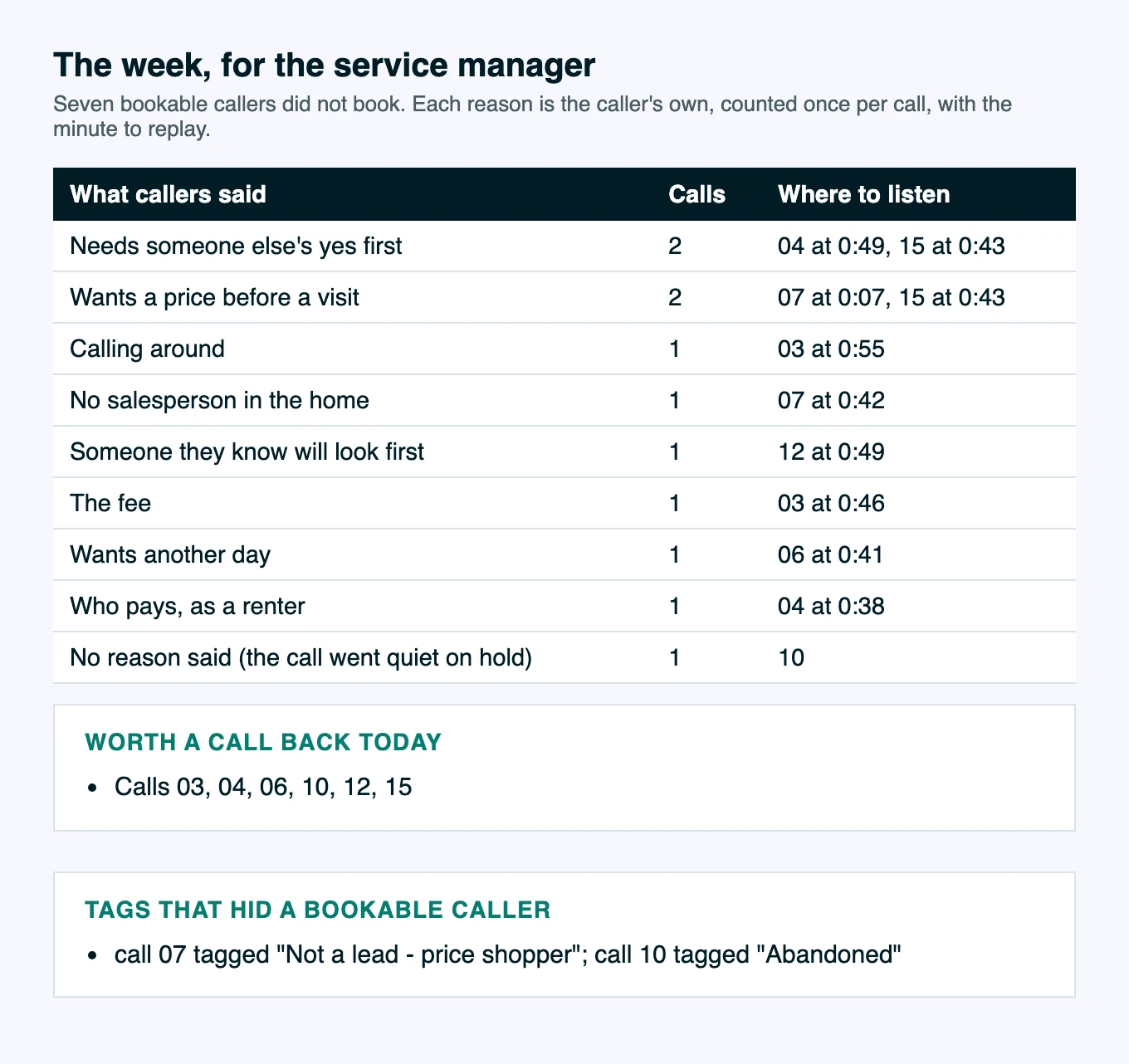
Two reasons came up twice, and neither is about the reps: two callers needed someone else's yes first, a landlord and a husband, and two wanted a price before anyone came out. Six of the seven callers are worth a call back today.
Your manager decides what happens next: who gets a call this afternoon, which moment becomes a coaching point, which goes to the owner as a script question. The list names calls and minutes, never who answered.
Tips from Reddit
People who take calls and review them, on recordings and scores
Unless the homeowner gives the go ahead, you can't work on that property. Doesn't matter if the renter is paying the bill, the liability still falls on the homeowner if something were to happen.
Managers were supposed to listen to every call that AI scored low to confirm accuracy. However, with the number of calls that AI was flagging it was literally impossible to do.
I just think it's dumb if statistically I'm doing great to pick the ONE call where it went wrong.
Frankly, I do take out time to listen to recordings, at 1.5x.
Call Scoring Gives Each Call One Reason and a Grade
If your shop runs on ServiceTitan, part of this may already be within reach. Its Voice Intelligence is in early access, switched on through your customer success manager.
It reads every recorded call, marks it bookable or not, gives a bookable call that did not book one objection type, grades the call from A to F and ranks agents on a leaderboard.
A coaching product sold to the trades works the same way: a score out of 100 for each call, a breakdown by rep, and one reason for each unbooked call.
That design answers a different question: how each rep is doing. One label drops the second reason (calls 03 and 15 each had two), and a grade puts the rep on trial before anyone has looked at the script or the schedule.
 Vlad ShvetsPartner @ Qvery
If your software already grades calls, keep it for what it does well. The question an owner has to answer is a different one: which reasons keep coming back, and whether each is a coaching point, a script question or a scheduling gap. That needs every reason with its minute, every week, and nobody on trial, so the people on the phones help fix what the list shows instead of arguing with a score.
What Qvery Builds for Your Phone Desk
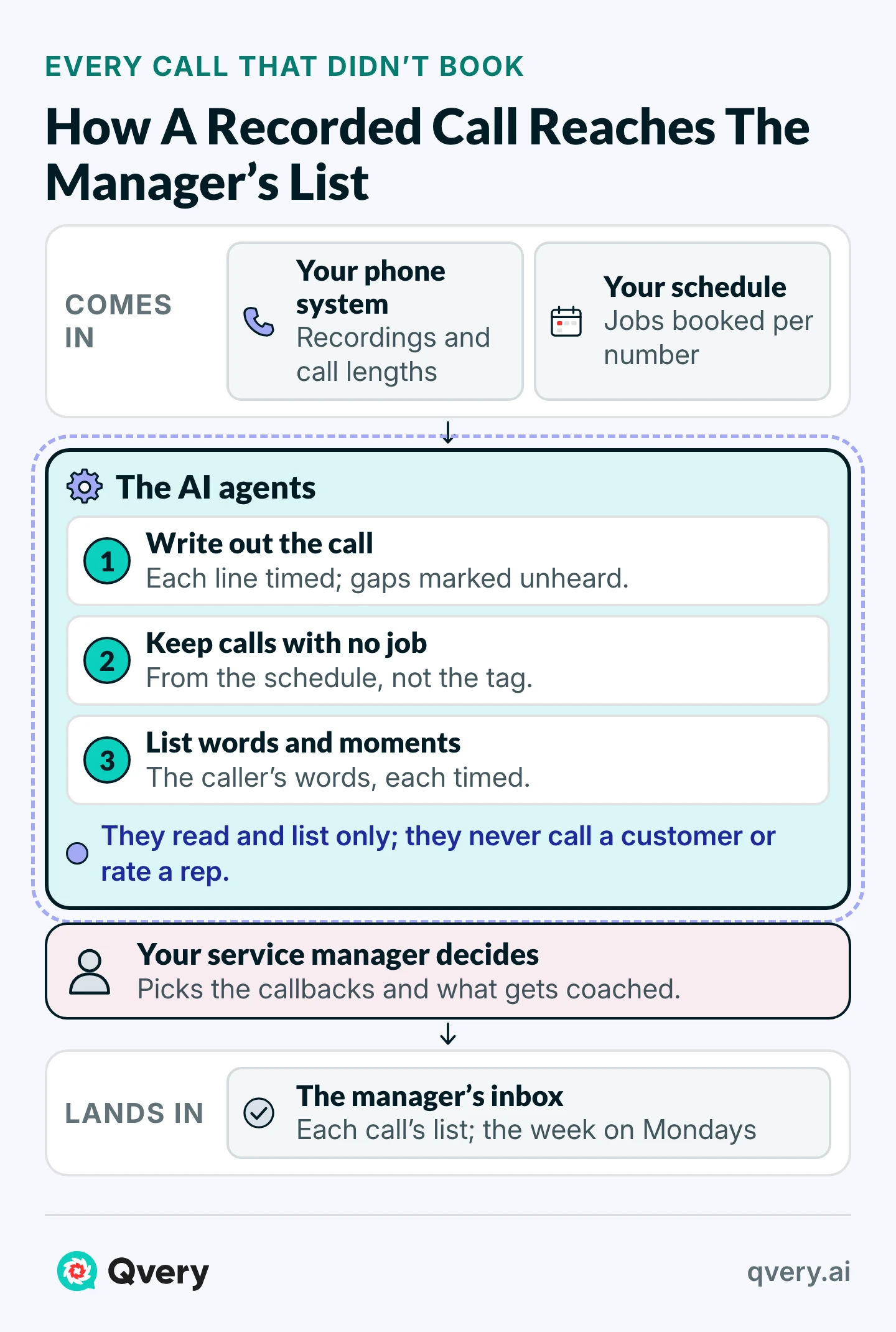
The custom AI agents we build for this job start when your phone system saves a recording. They write it out, mark every stretch with sound and no words, check the call length for silent holds, look up the caller's number in your schedule, and review only the calls that reached no job.
Each review lands where your manager already works, in the inbox or as a note on the customer in your field service software, and the week arrives as one list every Monday.
The manager decides who gets a call back and what gets coached. The agents never call a customer and never rate anyone.
Recordings hold names, addresses and sometimes card numbers. Before anything is connected, we agree in writing what the agents may open, who at Qvery may hear a recording and where the audio is processed. Card numbers are masked in the copy your manager reads, and the audio itself stays in your phone system.
Recording rules differ by state, so your counsel decides what your greeting says before anything is connected.
Unbooked calls are one of three jobs our playbook for home service companies prices. The other two are calls that come in after hours and finished jobs billed short.
Replaying 280 Calls a Month Costs About $25,700 a Year
Take a company of about 200 people with eight reps on the phones and one manager who replays about eight calls a week for each of them: 280 calls a month.
At nine minutes a call, to find it, hear it and write down what happened, that is 504 hours a year.
Office and administrative supervisors at plumbing, heating and air-conditioning contractors earned a mean $35.73 an hour in May 2025, by the federal wage survey. Pay is 70 cents of each dollar a private employer spends on a person, so the hour costs about $51.04, and the replays about $25,724 a year.
With the agents' list, a call takes about two minutes: read it, replay the one minute marked. The agents cost about $350 a month to run, under $100 of it speech-to-text and model reading for some 2,000 calls.
That leaves $15,808 a year, 392 hours of your manager's time, and every $10,000 of the build back in 7.6 months.
The volume, the minutes and the running cost are our assumptions. Put your own numbers in.
Booking Call Review ROI Calculator
What Replaying Calls Costs Your Manager, And With The Agents' Lists
Saved Per Year
$15,808
392 hours handed back, after $4,200 a year to run it
- Hours Handed Back
- 392 hours a year
- Agent Running Cost (Estimate)
- $350 a month
- Payback Per $10,000 Of Build
- 7.6 months
On these numbers, each call costs $2.95 instead of $7.66, the agent saves $15,808 a year after its own running cost, and every $10,000 of the build is earned back in 7.6 months.
The calculator counts only the replays. Every other call that ended without a booking gets the same list, which no sample reaches, and each caller won back from the call-back list is a service call at your average ticket.
That money comes from your manager's calls, not the agents', so it stays out of the sum.
What Your Manager Sees in the First Two Weeks
Bring a month of recordings, the jobs from your schedule and your booking script if you have one. We build the agents on those calls first, and your manager tells us where a label is wrong.
The first two weeks run like this:
| When | What your manager gets |
|---|---|
| The first days | Lists for last month's calls, which they still remember, to check our labels against |
| By the end of week two | The agents reviewing your own recent calls, with labels in your manager's words |
| From then on | Each new call reviewed the day it is saved, and the week's list every Monday |
None of it changes how your reps answer the phone.
Frequently asked questions
We already have ServiceTitan's call analysis. What does this add?
Voice Intelligence gives each unbooked call one objection type, grades the call and ranks your agents. Our agents keep every reason the caller gave with its minute, add what happened, check the call against your script and grade nobody. Where its transcripts already exist, the agents can read those.
Which phone systems can the agents read calls from?
Any phone system that saves recordings you can export. Most hosted and call-tracking systems do, and the route is settled before the build; a daily folder of audio files works too. Whether a call booked comes from your field service software, never from the phone system.
Will our reps feel watched?
The list names calls and minutes, never the person who answered, and carries no score. Reps can read the same list, so coaching starts from what a caller said, not from a grade. A moment that came from your script goes to whoever owns the script.
Does it work on calls in Spanish?
Speech-to-text services handle Spanish and dozens of other languages, and the review reads each transcript in its own language. The list can come back in English for your manager, with the caller's words kept as said beside a translation. Calls that switch languages halfway are worth testing on your own recordings first.
What about calls that were never recorded?
The agents review what was recorded and nothing else. If a line or an after-hours forward does not record, its calls never reach the list. Each week's list shows how many calls your phone system logged against how many recordings arrived, so a gap shows up as a number rather than as silence.
Do callers have to be told they are being recorded?
It depends on the state. Federal law allows a call to be recorded with the consent of one party to it; California's penal code requires every party's consent for a confidential call, and other states set their own rules. Your counsel decides what your greeting says before anything is connected.
Does it replace our call tracking or field service software?
No. The agents read from both and put their lists beside them. Your reps keep answering and booking the way they do now, and the schedule stays the record of what booked.
What happens on a bad cell signal or a loud job site?
A stretch where the line had sound but no words came back is marked unheard, with its times, and nobody guesses at it. A mostly unheard call goes to a person to replay in full. An objection spoken inside that stretch can be missed, and the list says so.
We have no written booking script. Can we still run this?
Yes. The script part of the review says no script was given, and everything else runs the same. A one-page list of the steps your manager wants on every call is enough to start, and last month's calls can be checked against it once it exists.
Can it review the calls our answering service takes after hours?
If those calls are recorded and you can get the recordings, yes, with the same list. An answering service usually follows its own script, so the review checks those calls against that one or says no script was given.
How much does the review cost to run each month?
About $350 a month at some 2,000 recorded calls, by our estimate. Speech-to-text and the model reading come to under $100 of that, and hosting and upkeep are the rest. The usage part grows with the minutes recorded, so a desk twice the size pays about twice the usage, not twice the total.
How long are recordings and transcripts kept?
As long as you decide, agreed in writing before anything is connected. The audio stays in your phone system, transcripts and lists are kept only for the period you set, and card numbers spoken on a call are masked in the copy your manager reads.
Can we see which ads the unbooked callers came from?
If your phone system or call tracking tags each call with the number or campaign it came in on, the list carries that tag. The week can then be read by source: which ad brings callers who want a price first, which brings renters. The agents read the tag and never touch your campaigns.
Can the reasons be in our own words?
Yes. The labels are set with your manager before the first run, and a correction to a label changes how later calls are filed. The caller's own words always stay beside the label, so nothing is lost when a label turns out too broad.
