
On this page
- Technicians Do Not Agree Where the Line Is
- Gas and Carbon Monoxide Calls Belong to 911 First
- Write the Emergency List in Three Parts
- The After-Hours Fee Is a Separate Rule
- A Loose List Costs You Night Hours at Overtime Pay
- Qvery’s Agents Answer Every Night Call Against Your List
- What the Agents May Open
- Your Night Calls Are Where We Start
- Frequently asked questions
When a heating, cooling and plumbing company has never written down which night calls are emergencies, the person who answers decides.
A gas smell, a ceiling dripping into a kitchen and a thermostat that went blank all reach that person after closing: the answering service, the on-call technician or the owner’s own cell. Call by call, they decide whether a truck goes out tonight.
In the example this page works through, a company of about 200 people with two technicians on call each night, those calls and the drives they start come to about 1,350 hours a year paid at overtime, close to $66,000.
The technicians who carry that phone say much of it goes to calls that could have waited for the morning.
At Qvery, we help heating, cooling and plumbing companies spend less on night callouts, with custom AI agents that answer every after-hours call and book what can wait.
The owner can make that decision once, on paper. Written down, it becomes a rule Qvery’s agents apply to every call, so a technician is woken only for what is on it.
Technicians Do Not Agree Where the Line Is
Ask the people who run night calls what counts as an emergency and the answers split two ways. One camp draws it tight: gas, water coming through a ceiling or onto a floor, fire, and a home with a newborn, an elderly or a medically fragile person and no heat or cooling.
One technician says 90% of on-call calls are not emergencies by that standard.
The other camp says the customer decides by paying. If the caller accepts the night rate and the company sells night visits, the technician goes, whatever is wrong.
Tips from Reddit
Technicians on where the after-hours line sits, and a dispatcher’s question that holds it
Families with newborns, disabled residents, elderly residents. Anything else is either not an emergency or needs to be handled by 911, not you
Your employer dictates whether they offer it, or if you work “on call” “after hours” or “emergency “ calls. After that, it’s up to the customer. If they want to pay the extra price, and your employer offers it, you’re going.
When someone calls for after hours service we have a couple questions asked by our dispatcher. One of the questions is "have you checked the batteries in your thermostat". I added that question about 7 or 8 years ago because it seemed like once a month we would go out and the batteries are bad.
Both camps are right about something. The tight list protects the technician’s night and the caller at real risk; the paying view keeps revenue the company has earned.
Neither is a rule that a half-asleep technician, or an operator reading someone else’s script, applies the same way twice.
Only the owner can turn the two into one.
Gas and Carbon Monoxide Calls Belong to 911 First
The public safety agencies have already answered two kinds of night call, and in both the caller’s first move is to leave the house:
A technician’s turn comes after that, to find which appliance made the carbon monoxide or where the gas escaped.
So a night call about gas or carbon monoxide starts with words the caller has to hear at once, written by the company from its own gas utility’s and fire department’s instructions. What follows is a record that the call came in, and the visit once the house is cleared.
The hard stops that belong to a technician happen on site. One technician found a furnace putting out 1,100 parts per million of carbon monoxide through a cracked heat exchanger, the metal wall that keeps combustion gases out of the air in the house.
The warranty part was four weeks away in a Pennsylvania freeze. The furnace stayed off, and the technician took the customer’s anger. A decision like that is made by the person holding the meter; the list only gets the technician there.
Write the Emergency List in Three Parts
With those calls set apart, the rest of the list is the owner’s to write. This is where I would draw it for a heating, cooling and plumbing company, as a starting point to change.
| Part | The calls in it | What happens |
|---|---|---|
| 911 or the gas utility first | A gas smell, a carbon monoxide alarm sounding, smoke or fire | Your safety words and a log; a visit once responders clear the house |
| Wake the on-call technician | Water nobody can stop, sewage backing up, no heat in a freeze, a fragile person without heat or cooling in dangerous weather, a failing commercial freezer | Your technician rung, then your backup, with the caller’s answers |
| First slot in the morning | A drip, a slow drain, a noisy unit, a system running poorly, no heat on a mild night with another heat source | Booked with your visit fee, the time read back |
Who is calling can move a call up a part. A maintenance-plan member, a commercial account whose contract promises a night response, or a system you installed this year may earn a night visit the list would otherwise send to the morning.
One company runs night calls only for maintenance customers, installs less than a year old, and a house whose only system is fully down.
What sorts most calls is a handful of questions, each one a caller can answer in a sentence:
- Can the water be shut off, and has it stopped? A water heater leaking onto the floor can wait once its cold supply valve and its breaker are off.
- Who is in the home? An infant, an elderly or medically fragile person, or someone who cannot leave moves the call up.
- How cold or hot is it outside, and is there another heat source? Technicians describe 2 a.m. no-heat calls in houses with a second furnace or a fireplace already going.
- Is it the only system in the house?
- Have the thermostat batteries been changed? Dead batteries are one of the night calls technicians describe most, and the cheapest to settle on the phone.
Each answer puts the call in one part of the list. That is what lets a person at 2 a.m., or an agent, apply it the same way every time.
The After-Hours Fee Is a Separate Rule
The paying camp has a point the list leaves out: a night visit the caller is glad to pay for is good work.
Fees technicians report range widely. One company charged $289 after 6 p.m. and on weekends until it began waiving the fee; a weekend call there is now almost always $69. Another starts at a $785 minimum, labor only, for a customer within half an hour of the office.
Said before anyone drives, the fee settles many calls by itself. A plumber whose answering service quotes the emergency rate first says it scares most people away.
But a fee cannot decide the first two parts of the list. A caller who smells gas is not choosing a price, and a hospice patient with no heat in January is on the list whatever the family can pay.
 Vlad ShvetsPartner @ Qvery
An emergency list is two decisions that usually live in people’s heads: which calls are worth a technician’s night, and what a night visit costs the caller. Put both on paper and the night phone stops depending on who happens to answer it. That is the first thing we write down with you, before any agent picks up a call.
So I would write the fee as a second rule beside the list. The list says who wakes a technician regardless of price; the fee says what a caller off the list can buy at night, if you sell night visits at all.
A company that sells them keeps that revenue. Its technician drives because the visit pays, not because someone called it an emergency.
A Loose List Costs You Night Hours at Overtime Pay
Every call that reaches the on-call technician is paid time. Federal wage rules count the drive of an employee called out at night to a customer’s emergency job as working time; waiting at home with the phone is not work by itself.
Pay plans differ from there: technicians describe call fees, two- and four-hour minimums, and pay from the driveway and back.
Here is the example this page works through: a company of about 200 people with about 60 technicians, the size Qvery’s Home Services Playbook prices, with two technicians on call each night, one for heating and cooling and one for plumbing. The volumes are our assumption; yours are in your phone log.
| What | The example |
|---|---|
| Calls reaching the after-hours phone | About 80 a week |
| Passed to the two technicians on call | About 40 a week: 20 each |
| Each technician’s night hours | 13 a week: 20 callbacks at 10 minutes, 4 callouts at 2.5 hours |
| Cost of an overtime hour | $48.71 |
| A year, both technicians, 52 weeks | 1,352 hours: $65,856 |
The hourly cost is federal survey data for May 2025, from the Labor Department’s statistics bureau: at heating, cooling and plumbing contractors, heating and cooling mechanics earned a mean $30.42 an hour and plumbers $34.52. Their average is $32.47, and time and a half on it is $48.71.
Bigger companies carry more of it. ServiceTitan’s platform data puts 15.7% of calls at businesses with 50 or more technicians outside business hours, against 11.8% at shops with ten or fewer.
The figure leaves out the people. Technicians name nights and weekends on call among the reasons people leave the trade or never join it, and one plumbing company owner with a staff of about 15 wrote that none of them wanted to go out after hours.
The Home Services Playbook prices the call-taking side of the same phone for a company this size: the dispatcher time on after-hours and overflow calls, and what our agents give back.
Qvery’s Agents Answer Every Night Call Against Your List
This is the work our agents do. When the office closes, or every line is busy, your phone system forwards the call to them. They answer in your company’s name and say in the first sentence that they are an automated assistant.
They take the caller’s name, number and address, and check the address against the towns or ZIP codes you serve. Then they ask your questions, worded as you wrote them, and set each answer against your list. A question the caller does not answer is written down as not given, never guessed.
A gas smell or a carbon monoxide alarm gets your safety words first, read as written, and the call is logged. A call in the second part rings your on-call technician, then your backup, with the caller’s answers written out; only a person accepting it counts.
Everything else gets the first open slot your rules allow, with your visit fee, read back before the call ends. If you sell night visits, the night window and its fee are offered the same way.
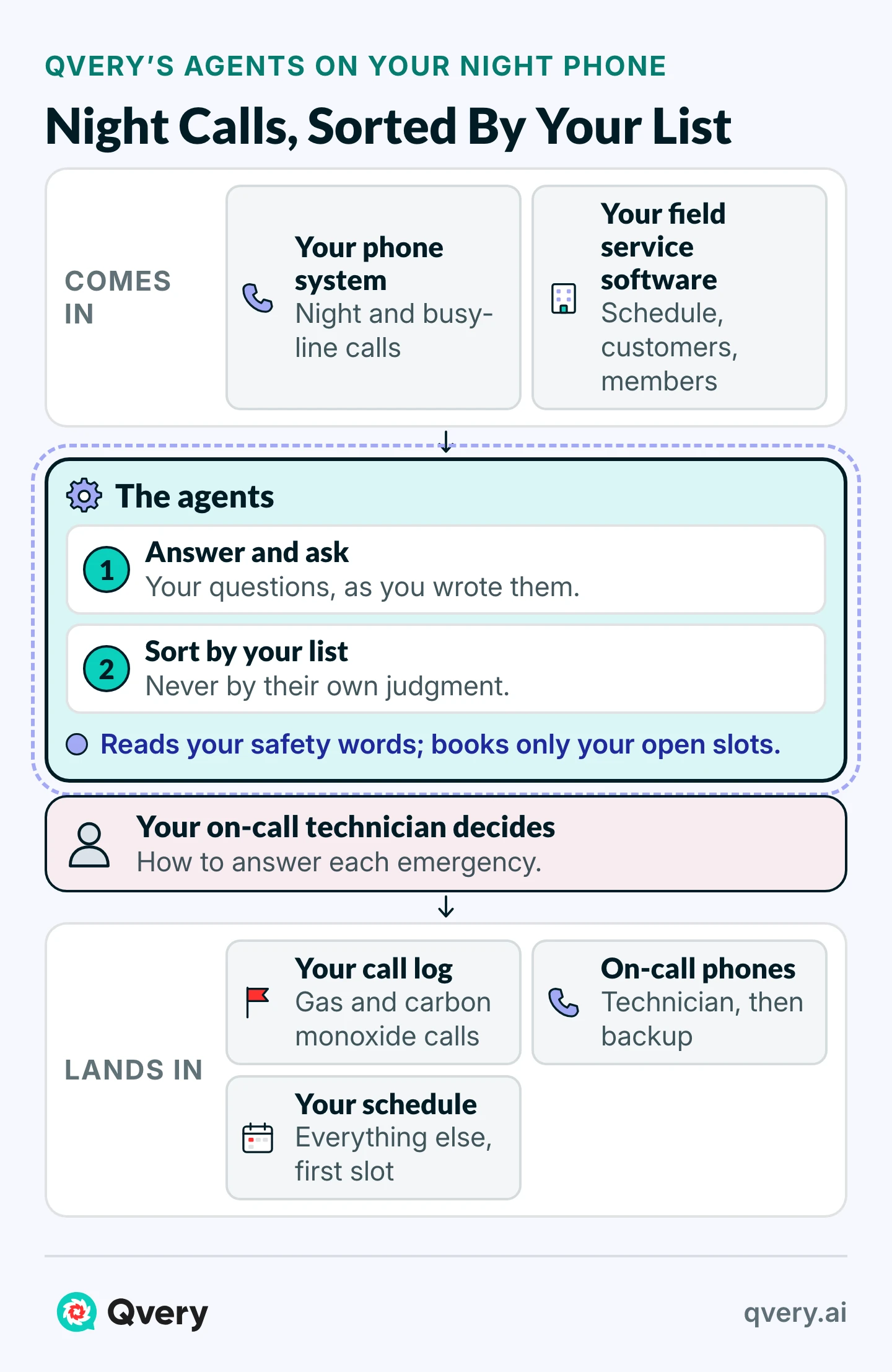
The agents never move a call up or down the list on their own judgment, and a call that fits no rule cleanly goes to a person. They never tell a caller a technician is on the way, and they give no repair or safety advice beyond your own words.
Your service manager owns the list. A change made in the morning applies that night, and every change is dated, so you can see which list applied on any night.
 Piotr BabelPartner @ Qvery
Our agents carry no idea of an emergency of their own. They hear water on the floor, ask whether the main is off, and file the answer under your words. When a caller describes something your list never mentions, the call goes to your technician, and that night’s transcript shows us the rule your list is missing.
If your list lives in a desk manual or an answering service’s script, you can hear what our agents do with it on test calls first.
On the example, the agents take half of those night hours. Our assumption is that of the 20 calls passed to each technician, the written list books 14 for the morning, so nobody calls those back at night, and that two of the four callouts went to such calls.
Every call on your list, every caller who buys a night visit, and every call the list does not fit still reaches your technician.
Running the agents costs about $850 a month, our estimate for those 80 calls a week, some 350 a month: voice minutes, texts, model use, hosting and upkeep. Put in your own technicians, weeks, night hours and pay:
On-Call Night Hours ROI Calculator
What Your Night Line Costs In On-Call Hours, And What The Agents Take Off
Saved Per Year
$22,728
676 hours of overtime handed back, after $10,200 a year to run it
- Overtime Hours Handed Back
- 676 hours a year
- Agent Running Cost (Estimate)
- $850 a month
- Payback Per $10,000 Of Build
- 5.3 months
On these numbers, the agent takes 676 hours of overtime off your technicians a year, saves $22,728 after its own running cost, and every $10,000 of the build is earned back in 5.3 months.
On those numbers, the night phone costs $65,856 a year in on-call hours today and $43,128 with the agents, their running cost included: $22,728 a year back and 676 hours off your technicians’ nights. Every $10,000 spent on the build is earned back in about 5.3 months.
What the Agents May Open
Before the build, we settle on paper which systems they reach: your phone’s forwarding rule, your schedule in the field service software, your on-call rotation and your list.
Where the software lets an outside agent add a job, they book there; where it does not, each booking waits in your dispatcher’s inbox as a record ready to enter.
A caller’s name, address and words go only to your schedule and your on-call technician. Recording, and the notice a caller hears, follow the rules where you work, and your counsel confirms them before the agents take a real call.
Qvery AI OÜ is an EU company and signs a data processing agreement with you. You choose which steps run on their own, and how to answer each emergency stays with your technician.
Your Night Calls Are Where We Start
Bring what your night phone runs on today: the desk manual or the answering service’s script, a month of night calls with the ones that went wrong, and your on-call rotation.
Write the list from your own calls
In the first week we listen to 30 of those calls with your dispatchers and write the list with your service manager: the three parts, the questions and the fee.
Test it on the calls that worry dispatch
In the second week the agents answer a test number and book into a test calendar, and your dispatchers ring it with a gas smell, a tenant who is not the owner, a caller who will not give a street.
Move the night phone over
Once your on-call technician has seen the alerts the agents send, your forwarding rule points the night phone at them, weekends first if you prefer, with your answering service behind them.
From then on we count, week by week, the night hours handed back and every call that landed in the wrong part of the list. The rule behind each one is fixed the same day.
Frequently asked questions
Is no heat an after-hours emergency?
It depends on who is home and the weather. No heat in freezing weather, or with an infant, an elderly or medically fragile person in the house, usually goes on the list for tonight. No heat on a mild night, with a fireplace or a second system running, can take the first morning slot.
Is a leaking water heater an emergency?
Only while the water is still running. Once the cold supply valve is closed and the heater’s breaker is off, plumbers advise booking it for the morning. Water coming through a ceiling, or a leak nobody can stop, wakes the on-call plumber.
Is no air conditioning an emergency?
In mild weather it can wait until morning. The usual exceptions are dangerous heat with an elderly, sick or very young person at home, and a house whose only system is down in a hot climate. Your list draws that line, and the agents apply it the same way every time.
What counts as a plumbing emergency at night?
Water you cannot stop, sewage coming back into the house, and a leak through a ceiling. A drip, a slow drain or a running toilet waits for the morning once the fixture’s own valve is closed. A gas smell near a water heater goes to 911 or the gas utility first.
Is a gas smell an emergency for a heating and cooling company?
It is an emergency, but the first call belongs to 911 or the gas utility. Your agents read the caller your own safety words, written from your utility’s instructions, and log the call. The technician’s visit comes after the responders have cleared the house.
Do the agents tell callers the after-hours fee?
Yes, before anything is booked. They quote the fee your rules set for that call, member pricing included, and a caller who does not want to pay it gets the first morning slot instead. A caller on your emergency list reaches your technician either way; whether the fee applies there is your rule.
What if the on-call technician does not pick up?
The agents work down the list you give them: your on-call technician, the backup, then a third name. Only a person accepting the call counts; a voicemail does not. If nobody answers, the request tops your dispatcher’s queue for the morning, with the time of every attempt.
What is an emergency service call?
A visit outside regular hours, priced above a daytime call because a technician leaves home for it. Companies charge it as a flat after-hours fee, a higher first hour, or a minimum number of hours. What qualifies is set by the company that sends the truck.
What if a caller says someone vulnerable is at home and it is not true?
The agents cannot check, and they do not try. Your list decides what a stated answer does, so a caller who says a newborn is at home is treated as your list says. The answer is written down word for word, and your technician sees it before deciding how to respond.
What if the agents put a call in the wrong part of the list?
They match the caller’s words to your list and never move a call on their own judgment, so a wrong placement traces to a rule. In the first weeks every call is reviewed the next morning. A call that fits no rule cleanly goes to a person rather than the schedule.
Do we still need our answering service?
Not for the calls the agents answer, though you can keep it as the backup for the first weeks. The agents book the routine jobs an answering service would only take a message for, and they ring your on-call technician directly for what is on your list.
Can the list change between summer and winter?
Yes. The list is yours, and the change applies to that night’s calls. A no-cooling call with an elderly caller can move up in July, and a no-heat call can move up when the forecast drops below freezing. Every change is dated.
Do commercial customers get a different list?
They can. A restaurant cooler or a supermarket freezer often belongs in the second part, and a contract that promises a night response moves that account up whatever the problem. The agents look up the caller in your field service software to tell which rules apply.
What happens to a caller outside our service area?
The agents check every address against the towns or ZIP codes you serve, never guessing from a nearby street. A caller outside them hears plainly that you do not cover their town, and no job is created. Work you do not do is turned down in your own words too.
