
On this page
- All Four Jobs Read Something You Already Keep
- Two of the Jobs Come In Through Your Phones
- The Other Two Live in the Job Record
- A Fifth of Seventeen People’s Week Goes to This Reading
- The Agents Read Far More Than They Change
- Qvery Starts From the Rules Your Office Already Follows
- Frequently asked questions
At a heating, cooling and plumbing company of about 200 people, the technicians earn the money and four office jobs decide whether all of it arrives. Each turns on something the company already holds that has to reach the place where it pays. Sound familiar?
- At 9:40 at night a homeowner with water on the floor reaches voicemail, not your on-call technician.
- A caller asks what a visit costs and hangs up, and the recording sits in your phone system unplayed.
- The technician notes a new capacitor and 45 extra minutes, and the invoice never shows either.
- A compressor fails under warranty, and its serial stays in a photo on the job past the maker’s deadline.
In the example this page works through, those four jobs take a fifth of the week of 17 people in the office: close to $236,000 a year in pay and benefits, before a single missed job, unbilled part or lapsed claim is counted.
At Qvery, we help home services companies spend less on office work, with custom AI agents that answer after-hours calls, check invoices against technicians’ notes and prepare warranty claims.
All four are reading: a call, a recording, a technician’s note or a photo, set against a rule your office already wrote. That reading is what Qvery’s agents do, from the phone system and the field service software you already run.
All Four Jobs Read Something You Already Keep
The call that comes in after hours, or while every line is busy, is read against your desk manual: the towns you serve, your fees, your emergency list. Your on-call technician decides how to respond.
The call that did not book is a recording, read against your booking script. Your customer service manager decides what to coach.
The finished job is the technician’s notes, time and parts, read against the invoice lines and your pricebook (the price list your office bills from). Your billing office decides what to add.
The warranty job is the job record and a photo of the rating plate, the label with the unit’s model and serial number, read against the maker’s claim form and its deadline. Your warranty coordinator files.
Your field service software (ServiceTitan, Housecall Pro, Jobber and the like) already holds the jobs, notes and invoices, and your phone system holds the calls. What runs short is the hours to do the reading.
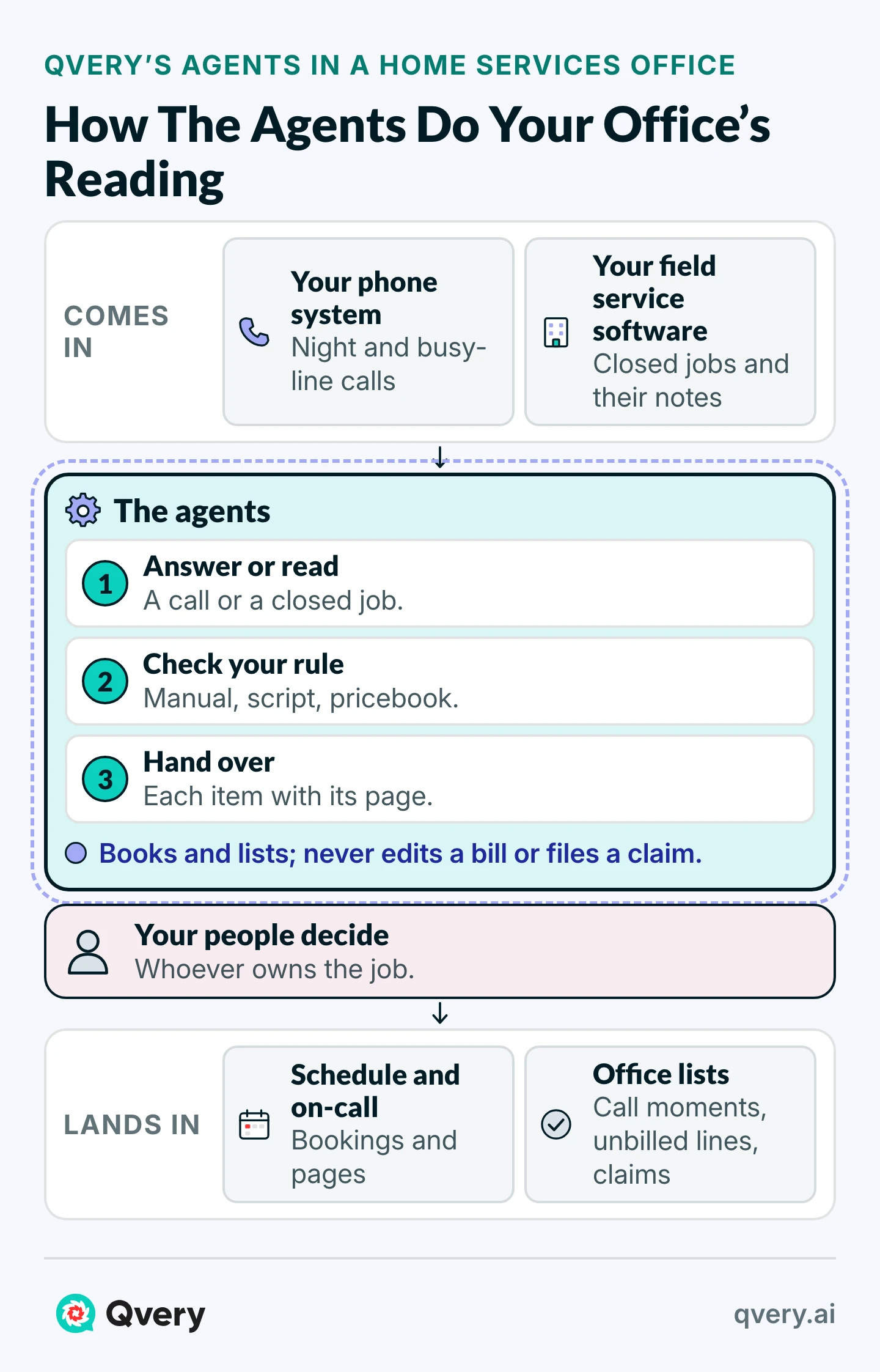
Two of the Jobs Come In Through Your Phones
After hours, or when every line is busy, your phone system forwards the call to our agents. They say on the first line that they are an automated assistant, in your company’s name. Then they check the address against the towns or ZIP codes you serve, and a caller outside them hears plainly that you do not cover their town.
Next come your urgency questions, exactly as your desk manual words them. A routine job goes into your schedule, or, when the schedule cannot be reached overnight, waits as a request your dispatcher sees first thing. Anything on your emergency list rings your on-call technician, then the backup, then a third name, with the caller’s answers written out.
Only a person accepting the call counts. A voicemail does not.
That emergency list has to be yours, word for word, because the trade does not agree on one.
Ask three technicians and you get three rules.
Tips from Reddit
Heating and cooling technicians and owners on what counts as a residential emergency
In residential there are inconveniences, not emergencies. In all seriousness, if the home has a newborn or elderly person with medical needs or at home hospice care and the heat/ac is completely down. Or if there is a Gas smell, or water leaking from ceiling.
I charge a hefty after hours fee regardless of nature of situation. If they agree then I know it’s an emergency to them and I will do everything I can to get their system working
No heat in freezing temps in the north qualifies too. Electric space heaters only go so far
The agents never say a technician is on the way, and they give no repair advice of their own. A booking tool that guesses the fault sets the homeowner’s expectation before anyone has looked. A caller told it is probably the compressor expects a compressor bill, and the fault can be a thermostat wire cut while trimming the vines.
The handoff to a person is where AI answering often falls apart. In Pied Piper’s 2026 study of 31 of the largest US home services brands, 27% of AI interactions were handled start to finish. The rest needed a person, and a third of those handoffs failed, after 93 seconds with the AI on average.
Ours are built around the handoff: they finish the routine work and pass everything else to a named person, in the order you set.
If your desk manual is in a drawer somewhere, you can run it through the after-hours agent yourself and see what it does with your own rules.
The second job is the call that rang, was answered and did not book.
ServiceTitan’s own data put a typical shop at 42% of calls booked in June 2022, and shops with 25 or more technicians at 59%. The rate tells your manager how many callers did not book. It never says why, and the software maker’s own advisers concede that few businesses can listen to every call.
If your phone system records calls, our agents read every recording that ended without a booked visit. They list what each caller objected to, in the caller’s words, with the minute it was said, and where the call departed from your script: a fee quoted differently, a window not offered. Wrong numbers, vendors and calls about existing jobs are set aside.
They never give the reason a booking fell through, because that is your manager’s conclusion to draw, and they never score, rank or name the person who took the call.
People in this trade push back hard on tools that record and grade them, and they are right to. A list of moments, each with its minute, is something a manager can coach from.
 Piotr BabelPartner @ Qvery
An agent is only as reliable as the record it checks against. For a warranty claim that is the plate photo, for an invoice your pricebook, for a night call your emergency list. When the record it needs is missing or too faint to read, it says so on that job and stops. A short list of honest gaps beats a full claim with a guessed serial.
The Other Two Live in the Job Record
When a job closes, our agents read the technician’s notes, the time log and the parts issued, then set each part, hour and fee against the invoice lines and your pricebook rules: what a visit includes, what a bundle covers, which trip zone applies. Whatever has no line is listed in the technician’s own words for your billing office, before the invoice goes out.
They also list finished jobs that have no invoice at all. They never change, hold or send an invoice, and a finding names the job and the note, never the person who wrote it. Over a month the list shows which parts most often go unbilled, which often points at a work order that needs fixing, not at a technician.
Warranty work runs on deadlines, and each maker sets its own.
| Maker | File the claim within | And also |
|---|---|---|
| Trane (residential) | 90 days of the failure | |
| Lennox | 45 days after the part failed | A failed compressor back within 45 days |
| Daikin (since January 2026) | 45 days of the repair | Parts received within 30 days of the claim, or the whole claim is denied |
When a warranty job closes, our agents fill that maker’s claim fields from the job record, the notes, the invoice and the plate photo, each with the page it came from. They list what is still missing, give the last day to file, and flag failed parts whose return has not shipped.
Denials tend to turn on exactly this paperwork: equipment never registered, a diagnosis the notes do not show, a part the maker wants back.
Your coordinator checks the claim and files it. The agents never file, contact a maker or decide coverage.
A Fifth of Seventeen People’s Week Goes to This Reading
Here is the example: a home services company of about 200 people, the size the Home Services Playbook prices, and the office people these four jobs touch.
| Job | Who does it today | Share of their week |
|---|---|---|
| After-hours and overflow calls | 10 call takers and dispatchers | 20% |
| Calls that did not book | 1 customer service manager | 25% |
| Invoices against technicians’ notes | 5 billing office staff | 20% |
| Warranty claims | 1 warranty coordinator | 20% |
The shares are our assumptions, a yearly average: summer and the first cold snap carry more.
Pay is the Labor Department’s 2025 national median (O*NET): $21.53 an hour for customer service representatives, $23.32 for billing clerks and $33.41 for office supervisors. Benefits make each dollar of pay cost a private employer about $1.43, by the Bureau of Labor Statistics. Across the seventeen, that averages about $68,000 a year each.
Our agents take the routine part of each job: 40% of the call handling, since emergencies and anything outside your rules stay with dispatch, and 70% of the call review, since the manager still replays and coaches.
They take 30% of the invoice checking, since the office rules on every flag, and half the claim building, since the coordinator still checks and files. That is 41% across the seventeen, an assumption until they run on your work.
Running all four costs about $3,360 a month at this size, an estimate: voice minutes and model use on some 2,300 calls a month, transcription of the recordings, every closed job read, hosting and upkeep.
Put your own office in: the people on these jobs, what each costs you a year, the share of their week, and how much of it you would hand over.
Home Services Office ROI Calculator
What Answering And Reviewing Calls, Checking Invoices And Building Claims Costs You, And What An Agent Saves
Saved Per Year
$56,368
2,958 hours handed back, after $40,320 a year to run it
- Hours Handed Back
- 2,958 hours a year
- Agent Running Cost (Estimate)
- $3,360 a month
- Payback Per $10,000 Of Build
- 2.1 months
On these numbers, the agent saves $56,368 a year after its own running cost, and every $10,000 of the build is earned back in 2.1 months.
On the example, the four jobs cost $235,824 a year today. With the agents they cost $179,456, their running cost included: $56,368 a year back, and 2,958 hours, close to the work of one and a half people. Every $10,000 of build is earned back in about two months of that return.
The hours count most when you grow. A shop with 50 or more technicians runs about seven of them per customer service representative or dispatcher, by ServiceTitan’s count, so the next trucks you add bring the next desk hire with them.
The hours handed back are a hire you can put off.
Not in the calculator: what the work itself brings back.
That is the night jobs that would have gone to voicemail, the noted work added before the invoice goes out, the credit claimed inside the maker’s window and the answering service’s bill. Each depends on your own call log, invoices and claim register, so we count it from those, never from a rate.
The Home Services Playbook works through three of these jobs for a company of about 200 people: what each costs, what our agents do and what they give back.
The Agents Read Far More Than They Change
| Where | What our agents read | What they may change |
|---|---|---|
| Your phone system | Calls forwarded after hours and on busy lines; recordings of calls that did not book | Nothing; the audio stays there |
| Your field service software | Closed jobs: notes, time, parts, invoices, plate photos | Routine jobs added to the schedule, once you agree in writing |
| Your paging tool | The on-call list and its order | A page to the on-call technician, then the backup |
| The makers’ portals | Nothing | Nothing; your coordinator files every claim |
Before our agents touch a system, you and we sign off on what they may read and do, and on where your data is processed. Everything else in your field service software stays read-only, they start on a test number and a test calendar, and every action is logged.
At first nothing reaches a customer until one of your people has seen it.
You decide which actions run on their own. Qvery AI OÜ is an EU company, and the agreement names everyone at Qvery who can open a recording and how long recordings are kept. Where a record is missing, a blurred ticket or an unregistered unit, the agents name the gap; they never fill it.
Recording law differs by state. Federal law allows a call to be recorded when one party consents; California requires the consent of every party to a confidential call. Your counsel confirms what applies to you before anything is connected, and the original audio stays in your phone system.
 Vlad ShvetsPartner @ Qvery
An office that reads every call, every note and every plate photo by hand grows one hire at a time with the trucks. Our agents take the reading, so your call takers spend the morning on the homeowners who need a person and your billing office sends today’s invoices today. That is the return I would count first.
Qvery Starts From the Rules Your Office Already Follows
Five things from your office are enough to begin:
- Your desk manual and emergency list.
- A month of recorded calls, the ones that went wrong included.
- Your pricebook and billing rules.
- Each maker’s claim form and filing rule.
- Read-only access to your field service software.
In the first week the people who own each job spend a few hours with us: your dispatchers on thirty night calls, your service manager on thirty recent calls that did not book, your billing manager on thirty closed jobs, your coordinator on twenty claims already filed.
By the second week the first agents are answering a test number and reading last month’s closed jobs. Your people check every result against what they remember.
From there the agents run on their own beside your team, a wrong answer fixed the day it shows up. Every week we count what they handed back and what they stopped: the hours, the calls booked or handed over, the lines added, the claims ready before their deadline.
For a company like yours the first agents we build usually take the calls after hours.
Frequently asked questions
Do homeowners hang up on an AI receptionist?
Some do. In Housecall Pro’s 2025 survey of US homeowners, 53% said they were comfortable with AI handling a first inquiry. What loses callers is a bot that cannot hand over, and in Pied Piper’s 2026 mystery shop a third of AI handoffs failed. Ours say they are automated on the first line and put anything outside your rules through to a named person.
Is there an AI answering service built for HVAC companies?
Several. Housecall Pro, ServiceTitan and Jobber each sell an AI receptionist inside their own software, and standalone services sell one too. Ours are built for one company: your desk manual, your emergency list, your paging order and your service area, connected to the field service software you already run. HVAC is heating, ventilation and air conditioning, and the same agents answer for plumbing and electrical work.
Can the agents book straight into ServiceTitan or Housecall Pro?
Where your field service software lets an outside agent read the schedule and add a job, they book there directly; we check what yours permits before the build. Your phone number stays as it is, with a forwarding rule for nights and busy lines. Where the schedule cannot be reached, each booking lands in your dispatcher’s inbox as a record ready to enter.
What will they not book without a person?
Whatever your rules keep for a person: a full system quote, a commercial job, a caller who wants a firm price on the phone. Those become leads for the morning, written up but not booked. A returning customer is found by phone number, so an open job gets a note instead of a second visit.
Can they handle Spanish-speaking callers?
Spanish can run beside English, with your urgency questions asked in both. When the agents miss a street name, they ask again and spell the answer back; after a second miss, they take a callback number and flag the request for a person.
Will the agents call back customers who did not book?
No. The call review lists the callers who said they would decide later or wanted a quote by text, each with the minute it was said, so one of your people can phone them. The agents never call a customer or change a booking.
What if our invoices are finished in QuickBooks?
The invoice check reads them there and ties each one back to its job number. Where a system cannot be reached directly, a nightly export of closed jobs works as well, and parts logged from truck stock are read beside the notes.
What does running the agents cost?
For the after-hours calls, roughly $1,700 a month at some 2,300 calls, rising about $45 for every extra 100 calls in a heat wave or a freeze. The call review runs about $410 a month, the invoice check about $900 and the warranty claims about $350, at a company of about 200 people. The build is a fixed price we agree with you before any work starts.
Do we still need our dispatchers and call takers?
Yes. They keep the emergencies, the schedule changes and every caller who wants a person. What goes is the overflow, the routine night bookings and the morning callbacks of last night’s messages, so the same desk carries more trucks before you hire the next person.
What if the invoice check flags a job we did for free?
Your billing office marks it free and it drops off the list, and each ruling becomes a rule, so the same item on later jobs comes pre-marked. Before your pricebook and flat-rate rules are loaded, every unmatched item shows as a possible charge, so the first lists run longer.
What if another company installed the unit?
The claim is still built from your repair: the failed part, the model, the serial and your dates. Install details come from the registration or the homeowner’s paperwork, or are listed as missing. Whether the maker pays your labor on someone else’s install is its decision, and the agents never guess it.
How accurate is the call review on a noisy job site?
Clear calls come through cleanly; a loud site or a weak signal costs words. Each unclear stretch keeps its time, so your manager can listen at exactly that point, and a call that is mostly unheard is marked for a person to play in full. The review never claims it found every objection.
