
On this page
- Your Customer Decides What a Quote Request Looks Like
- The Template Camp Is Right About One Thing
- The Requirements That Change Your Price Live in the Notes
- Qvery’s Agents Read Every Request the Day It Lands
- 720 Estimator Hours Come Back Each Year
- Keep the Form for Your Regulars and Read the Rest
- Frequently asked questions
A request for quote (RFQ) reaches a contract manufacturer in whatever shape the buyer had on hand. Your estimators open each one and read all of it before they price anything, because the requirements that change the price are rarely in the email. They sit in drawing notes, quality clauses and terms, and what the reading misses, the shop pays for after the order.
- A drawing PDF whose notes carry the inspection and packaging requirements.
- A spec package that runs past a hundred pages beyond the drawing, much of it not about your part.
- A photo, a screenshot or a mesh file where you asked for a model.
- A government solicitation that only accepts quotes through its own system.
- A package whose section 4 asks for 304 stainless and whose section 35 forbids nickel.
At a manufacturer of about 200 people, say 120 requests a month at about 50 minutes of an estimator’s reading each. That is 1,200 hours a year, about $64,500 at an estimator’s loaded cost, spent before anyone has priced a part.
At Qvery, we help manufacturers spend less on quoting and keep estimators pricing, with custom AI agents that read every quote request and list what changes the price.
The usual fix is to make customers send better requests on your own template. My verdict: keep the template for the customers who will use it, and stop counting on it for the rest.
The packages that eat your estimators’ week, and hide the requirements that move your price, come from buyers who quote in their own format: government agencies, large customers with their own portals and quality clauses, requests from lead lists, the engineer with a mesh file and no drawing. No supplier’s form changes how those buyers work.
The part your shop controls is reading every request as it lands, and that reading is the first job an agent should take.
Your Customer Decides What a Quote Request Looks Like
Buyers tell suppliers to reply in the buyer’s format, in the buyer’s spreadsheet, with fields nobody may skip. The side placing the order sets the paperwork, and on an RFQ that side is your customer.
Even buyers who build their own portals do not get them used. A buyer who runs bids through one says that more often than not, bidders send their own documents and the team compiles them by hand.
Another, who buys for a public authority, draws the line at frequency: a platform works with suppliers who quote four or five times a year, and not with the rest. Suppliers who want the order still skip the buyer’s form. A customer who can send the same request to other shops has even less reason to fill in yours.
What Reddit says
Suppliers and buyers on whose format a quote request follows
We collect information through website forms. Interestingly, even our long - standing customers tend to submit inquiries via the website rather than sending them directly to us. Additionally, although we’ve clearly stated the recommended format, we still receive documents like pictures.
Yes, that’s exactly what we do. Firstly, it will take more time. Secondly, during the process of follow - up inquiries, some customers may stop responding and be lost. That’s why I’m worried.
We use a bidder portal we give access to all bidders where they input all of the information where we can then export that to a compiled excel document once the bid has closed. More often than not though bidders send in their own documents and we compile manually
The shop in that first quote already does what the template camp recommends: a web form with the recommended format stated. It still gets pictures, and when it chases customers for better files, some stop answering.
The hardest case is one buyer many machine shops quote for. The Defense Logistics Agency accepts quotes on its automated requests only through its bid board, DIBBS, and says that quotes sent by fax or email will not be considered for award.
Its master solicitation, which every automated request points to, counts only quotes in exact compliance: taking exception to the packaging, the inspection requirements, the shipping terms or the quantity makes a quote ineligible for the automated award.
| The customer | What they send | Template or read |
|---|---|---|
| Regulars who quote with you several times a year | Your form, if you ask them | Template, and read the files anyway |
| New inquiries through your website | Your form’s fields, then whatever file they have | Form for the fields, read the files |
| Large customers with portals and supplier manuals | Their portal, their clauses, their terms | Read |
| Government solicitations | Their solicitation, through their system | Read |
| Lead-list and one-off requests | A drawing, a photo or a mesh file | Read, or decline fast |
Even the last row takes a read. Deciding to decline a request is a reading job too, and it is cheaper done the day the request lands than after an estimator has spent an hour on it.
The Template Camp Is Right About One Thing
No amount of reading recovers a tolerance or a material that was never written down. A form that asks for the material, the quantity, the tolerances and a native model file catches that gap before an estimator spends an hour on the package.
The shops that defend templates ask for little to get it: put the file formats on your web form, and remind your established customers how a clean request gets them a faster price. Keep all of that: it works for the customers in the first two rows of the table. Asking on the form is cheap; chasing a customer who ignored it is what costs you.
What a template cannot do is find the gap in a package that ignored it. Finding a gap takes reading: someone has to notice that the drawing calls for an inspection level the email never mentions, or that the spec and the drawing disagree.
The template’s checklist is a list of what to look for, and that list is exactly what an agent can read every package against, the day it lands, with the question to the customer drafted while the buyer still remembers the job.
The Requirements That Change Your Price Live in the Notes
A template captures the fields a customer is willing to type: quantity, material, due date. The requirements that move a price sit in the buyer’s own documents, and the agency’s solicitation shows how much they weigh: an exception to packaging or inspection is one of the exceptions that cost a quote its automated award.
The reading is not short. An engineer who quotes custom fabrication describes packages with more than a hundred pages beyond the drawing and the RFQ itself, much of it not applicable to the part. The work is finding the few lines that are.
A buyer describes asking a supplier for the complete requirements at the production part approval stage (PPAP, the approval package a customer signs off before production) and finding nobody had read the rest of the documents: a “scope change” and a commercial fight. An engineer who quotes large weldments writes down every assumption and still hears from sales that something was missed.
Your emailed orders and supplier approval packages run on the same kind of reading. The manufacturing playbook works out all three jobs, quote requests included, for a company of about 200 people.
Qvery’s Agents Read Every Request the Day It Lands
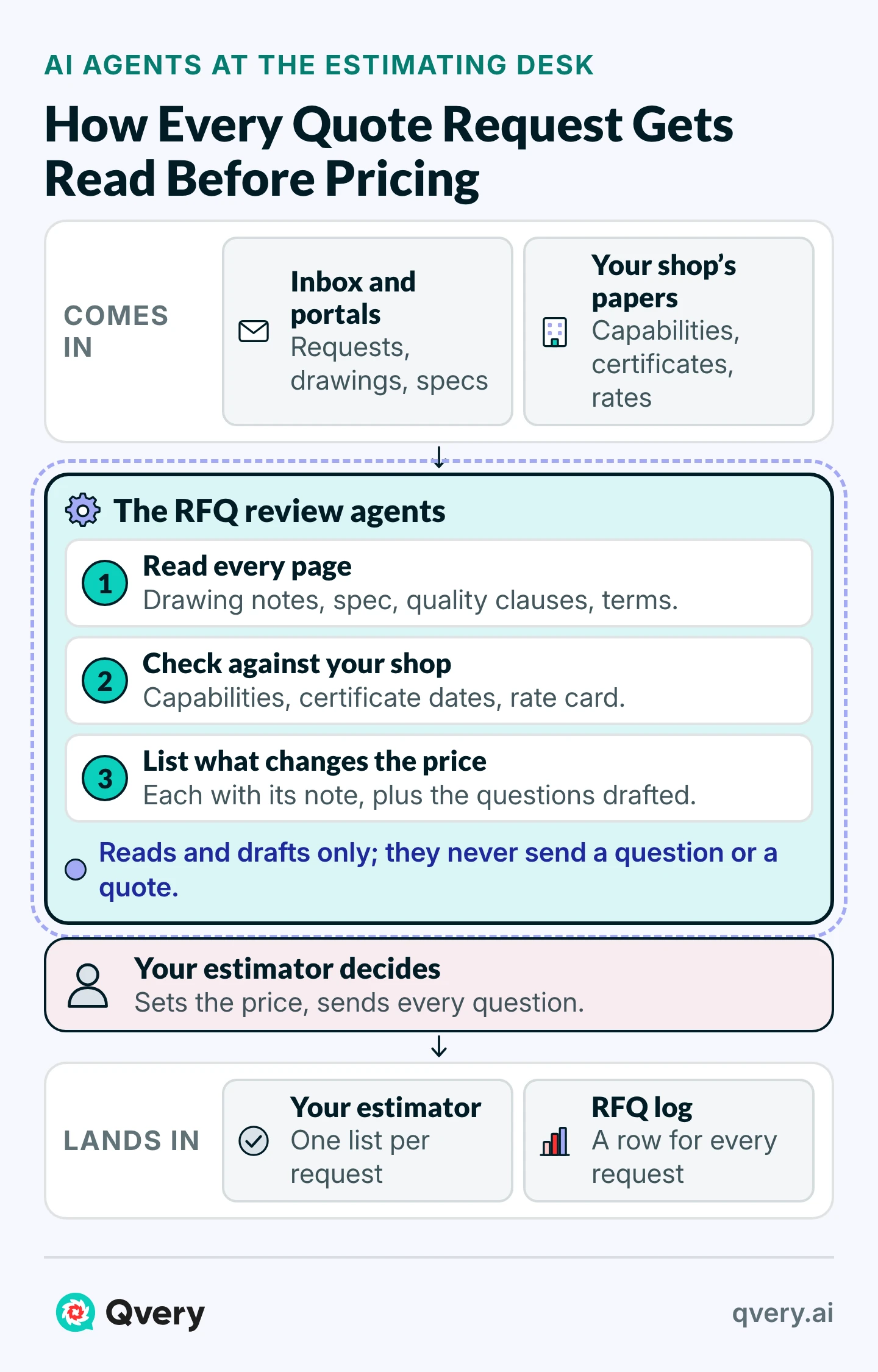
A request arrives in your quoting inbox, the shared folder, or a download from a customer’s portal. The agents we build for your estimating desk read every written page of it: the drawing notes, the spec sections, the quality clauses, the terms, the schedule and release dates.
They set each requirement against what you have told them about your shop: your capability list, your certificates and their end dates, your rate card, your standard terms and your RFQ log.
What your estimator opens is a short list: the requirements that change the price, each with the note or clause it came from and priced from your rate card where it can be; every place two documents ask for different things; the certificates that would lapse before a delivery date; and the questions for the customer, drafted and waiting. Every request gets a row in the log.
If you want to see what that list looks like on your own work, run one of your requests through it.
Your estimator still sets the price and sends every question and every quote. A conflict goes to the estimator to ask the customer; a requirement your papers do not cover goes to a person; terms outside your standard go to your estimating manager.
The agents read the written notes and clauses, not the model geometry, so a request that is only a model still needs your engineer, and they quote a liability clause as written instead of interpreting it. A requirement they miss is the failure that matters, so it is the one we count: every quote with a requirement found later goes into the log and the monthly review with us.
 Piotr BabelPartner @ Qvery
An agent reading a quote request is only as good as what it reads against. So before it opens a customer’s package, we load your capability list, your certificates with their end dates and your rate card. When a note asks for something those papers do not cover, it says so on that request and leaves the call to your estimator instead of guessing.
Drawings are your customers’ property, and some carry export controls or a confidentiality agreement that decide whether they may be processed outside your systems at all.
So before the agents read a single one, we agree in writing which folders they may read, where the data is processed, and which customers’ requests stay with your people entirely. They start with read access to the quoting folder and log every document they open.
720 Estimator Hours Come Back Each Year
Take the shop from the opening: 120 requests a month, about 50 minutes of an estimator’s reading each, at $53.78 an hour (cost estimators in fabricated metal manufacturing earned a median $35.98 an hour in May 2025, and across manufacturing, pay is 66.9% of what an employer spends per hour worked). Each request costs $44.82 to read, which comes to 1,200 hours and $64,536 a year.
Say that with the agents reading first, the estimator spends about 20 minutes on each request: reading the list, checking the flagged clauses, sending the questions. Add about $450 a month to run the agents (hosting, logging and model usage at this volume, an estimate), and each request costs $21.68.
The difference is $33,322 a year and 720 estimator hours, and each $10,000 of build comes back in about 3.6 months. Put your own requests, minutes and estimator cost in.
Quote Request Reading ROI Calculator
What Reading Each Quote Request Costs Your Estimators, And With The Agents
Saved Per Year
$33,322
720 hours handed back, after $5,400 a year to run it
- Hours Handed Back
- 720 hours a year
- Agent Running Cost (Estimate)
- $450 a month
- Payback Per $10,000 Of Build
- 3.6 months
On these numbers, each quote request costs $21.68 instead of $44.82, the agent saves $33,322 a year after its own running cost, and every $10,000 of the build is earned back in 3.6 months.
The $33,322 is estimator time at what it costs you, not cash out of the bank. It becomes money when those hours price requests that used to wait, or put off the next estimator you would otherwise hire.
Volume decides it. At 40 requests a month, the same minutes return about $8,700 a year and each $10,000 of build takes about 14 months to come back; a desk that reads a few requests a week is better served by a form and a careful estimator.
The calculator leaves out the requirement found after the order, because nobody publishes what one costs a shop your size; your own job-cost reviews know that number better than any study.
Keep the Form for Your Regulars and Read the Rest
 Vlad ShvetsPartner @ Qvery
A template is a request, and the customer decides whether to honor it. The buyers who send the hardest packages have the least reason to change for you: an agency with its own bid board, a large account with its own portal, a stranger from a lead list. Keep the form for your regulars. For everyone else, have every package read against your own capabilities and rates the day it arrives, before anyone prices it.
Working with us on it starts from how your estimators already price, so the first thing we ask for is your own history.
Send Us a Year of Requests
Twelve months of requests with what you quoted on each, your capability list and certificates with their end dates, your rate card and your standard terms.
Show Us How You Price
In the first week we learn how your estimators price and where your main customers’ terms differ from your standard.
Check the Agents Against Your Own Quotes
Within two weeks of having access, the agents read requests you already quoted, and you set their lists beside what your estimators priced.
Put Them Beside Your Estimators
Then they read live requests the day they arrive while your estimators keep quoting in the tools they use today, and every week we count the hours handed back and the requirements caught before a price went out.
Frequently asked questions
What should an RFQ include?
From a shop’s side: the part number and revision, quantity and any release schedule, material, finish, tolerances, the inspection and certification requirements, packaging, the delivery date, and a native model file with a PDF drawing. Ask for these on your form, and expect the important ones to show up in the drawing notes and the customer’s terms instead.
What does RFQ stand for?
Request for quote, sometimes request for quotation: a buyer’s invitation to price a defined part or job. It differs from a request for proposal, where the supplier also proposes how to do the work.
What is an RFQ response template?
The buyer’s version of the same idea: a spreadsheet or portal form the buyer asks every supplier to fill in, so quotes can be compared line by line. On an RFQ, your customer, not your shop, decides which template is used.
Should we stop asking customers to use our form?
No. Keep it, and keep it short. It helps with regulars and website inquiries. Just do not treat a request that ignores it as your customer’s problem; the price still has to be right.
Can an AI agent read engineering drawings?
Ours read what is written on them and around them: notes, title blocks, callouts, the spec and the clauses. They do not measure geometry from a model or a mesh, so a part that needs a manufacturability review still goes to your engineer.
Can’t we paste requests into ChatGPT instead?
You can, one request at a time: someone pastes each package, adds what the chat needs to know about your capabilities and rates, and checks what comes back. The agents do that reading on every request as it arrives, against your capability list, certificates and rate card, and log each one.
Do the agents send questions or quotes to customers?
Never. They draft the questions and list the requirements; your estimator decides what goes out and sends it.
Can the agents read DIBBS solicitations?
They can read a solicitation and its technical documents once someone downloads them into the folder the agents watch, and list the packaging, inspection and first article requirements against your rate card. Quoting stays in DIBBS, done by your people.
What about drawings under export control or a non-disclosure agreement?
Export rules and your customers’ confidentiality terms decide whether a drawing may leave your systems, not us. Requests they cover stay out of the agents’ folder unless your own compliance review clears them, and we agree in writing where everything else is processed.
What if a request comes in with no model file?
The agents read what came and list what is missing and what that changes, with the question to the customer drafted. The missing model becomes a question on the day the request arrives, before the price is set.
How long until the agents read live requests?
The first working result comes within two weeks of having access to your requests, rate card and capability list; before that, they read requests you have already quoted so you can check them against your own prices.
Do the agents check our certificates against the order?
Yes. Each certificate on your list carries its end date, and the agents set it against the delivery dates in the request, so a certificate that would lapse before the last delivery shows up on the list before the price goes out.
What happens when the agents miss a requirement?
Before they read live requests, their lists are set beside requests your estimators already priced, so a miss shows up there first. After that, every line names the note or clause it came from, and any requirement found after a quote goes into the monthly review with us, where the rules the agents read by change.
Do we have to change the system that runs our orders?
No. The agents read the folder or inbox where requests arrive and write their list and a log row; your estimators keep pricing in the order system or spreadsheet they use today. Connecting the log to your quoting system is something we decide together, not a condition for starting.
