
On this page
- Most of Collections Is Saying What the Ledger Already Knows
- Where Your Managers Take Over From the AI Agents
- The Rules on Texting Residents Come With the AI Agents
- What Qvery Builds Around Your Late List
- What the Follow-Up Costs Now and With the AI Agents
- Start From the Collections Policy You Already Run
- Frequently asked questions
Every month your community managers and assistant managers work the late list between tours, move-ins and work orders.
Once the grace period ends, the few days a lease allows before the late fee, each late resident needs a reminder, an answer about the balance, a payment link, and a promise to pay written down and checked on the day it falls due.
Say your company runs 8,000 apartments and 400 of them are late in an ordinary month. At 45 minutes of follow-up per late account across the month, that's 3,600 hours a year of site-team time, about $162,000 at a manager's pay with benefits, before a dollar of rent is written off.
At Qvery, we help apartment operators get site teams' hours back from late rent, with custom AI agents that follow up on every late account and flag what needs a person.
AI should go all the way on the reminders, answers and follow-ups, and not one step into the decisions. Anything your ledger and your written policy already decide can go out on its own; anything that changes what a resident owes, or starts a legal step, waits for a person.
Most of Collections Is Saying What the Ledger Already Knows
Look at what a late account asks of your team across a month. The resident's ledger, the record of every charge and payment on their lease, already says what's owed and since when.
The lease sets the fee. The payment portal has the link. The only new fact in most of these conversations is the date the resident says they'll pay.
Each of those messages still waits for someone with time to send it. Managers describe several contacts a week per late resident, with the follow-up call made when the day allows.
The messages that slip are the ones that would have kept a balance small, and a notice sent late can reach a resident who paid that morning.
Late rent repeats. In the bureau's data, just over half of first-time late renters are back on time in the months after, and by the fifth month 4 in 100 have a write-off, a balance the landlord stops expecting to collect.
The records come from a payment-data vendor and don't stand for every renter, but managers say the same about their own lists: the same names come up every month. A promise to pay that nobody rechecks costs more than it looks.
 Vlad ShvetsPartner @ Qvery
Late rent comes back. In Consumer Financial Protection Bureau data, 42% of renters late for the first time were charged a late fee again the next month, and managers see the same names on every late list. Those accounts take the same reminders, balance answers and promise checks month after month, and the ledger already decides each one. That is the work I would hand to AI agents first, and its hours are the number to price it on.
Where Your Managers Take Over From the AI Agents
Ask one question of each step: does it change what a resident owes, or start a legal step? If not, the AI agents do it on their own. If so, a person decides, and the AI agents hand that person the account's history instead of a name on a list.
| Step | The AI agents | A person |
|---|---|---|
| A reminder before rent is due | Send it in the channel the resident answers | Sets the schedule once per property |
| "What do I owe?" | Answer from the ledger, charge by charge | Fixes a charge that's wrong |
| A promise to pay | Write it down with its date, check the ledger that day, follow up if it's missed | Reads the list of promises kept and missed |
| Before any notice | Recheck the balance, so nobody who paid gets one | Sees every account the recheck stops |
| A plan your written policy allows | Offer it and record the resident's agreement | Writes the policy |
| A plan outside the policy, a waived fee, a hardship | Prepare the file and the history | Decides |
| Part of the rent, once a notice is out | Hold it for a person | Decides, with counsel's rule for that state |
| A notice to pay or quit, an eviction filing | Prepare the file | Decides, signs and sends |
Some collection tools let their AI set up payment plans by itself. I wouldn't let software agree to terms nobody approved.
A written rule is another matter, and some properties already keep one: no more than two plans a year, in writing, finished before the next month's rent, with a stated source for the money. The AI agents can offer that rule word for word, and anything else waits.
Property managers put the person's half of the job plainly.
Tips from Reddit
The first part of collections is figuring out what the issue is instead of spamming calls and requesting money.
Be careful with payment arrangements. I managed one property where I did that, but I had rules. No more than 2 per year, had to be in writing, had to be completed before the next month was due and they had to have a reasonable plan for where the money was coming from
Treat everyone the same, which can be hard sometimes because we definitely like some tenants more than others.
Taking part of the rent can be a decision too. In Arizona, a landlord who accepts a partial payment keeps the right to proceed only if the resident agrees in writing, at the time, to its terms. So when a resident pays $400 of a $1,450 balance after a notice, keeping it is a person's call.
Consistency is the other reason the schedule belongs to software. Managers admit that treating every resident the same is hard when they like some residents more than others.
The Fair Housing Act forbids treating residents differently in the terms of their tenancy because of race, color, religion, sex, familial status or national origin. When software sends the same schedule to everyone, the exceptions become decisions a person makes and logs, and each one can be explained later.
The Rules on Texting Residents Come With the AI Agents
A landlord collecting its own rent isn't a debt collector under the federal collection law, which covers people collecting debts owed to someone else and leaves out rent that wasn't yet late when a manager took on the account. The rules on automated messages still apply, and that's where hand-typed texts slip.
Your counsel decides the rules for each state you operate in. The AI agents apply them the same way every time, and the log shows they did.
What Qvery Builds Around Your Late List
Your property management system, the software that holds your leases and ledgers, probably already sends scheduled reminders, takes autopay and posts the late fee by rule, and some now ship a delinquency workflow. The AI agents leave that alone. What's left takes reading and writing: the replies, the promises, the rechecks and the file a person needs.
We build those AI agents for your portfolio. They read each resident's ledger and the collections policy for that property, send the reminder or the answer by text or email, write down every promise and check it on its date, and add a note to the resident's record after each contact.
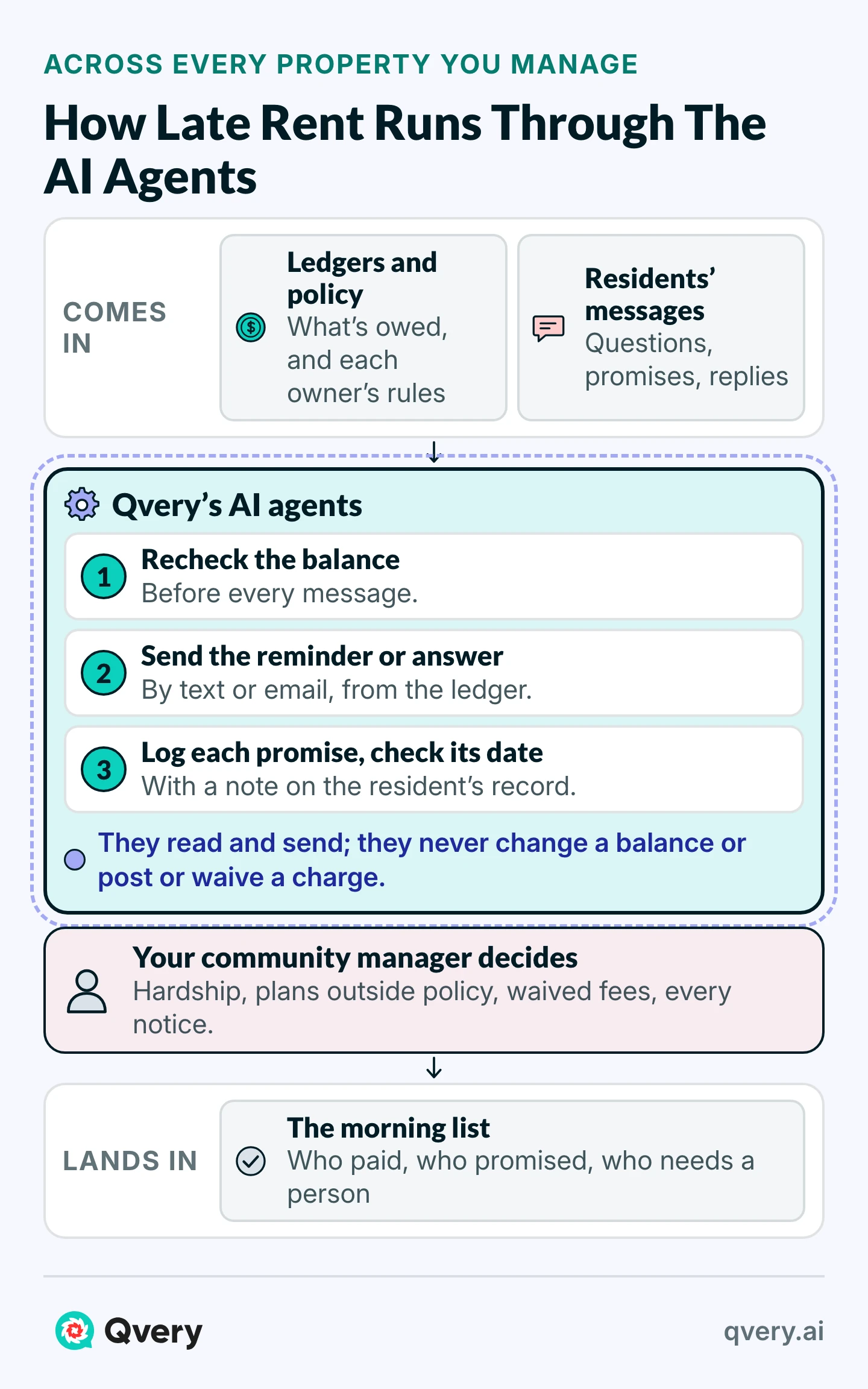
Every morning your community manager gets a short list: who promised and paid, who didn't, and who needs a person, with the history attached. If you manage for several owners, each owner's rules travel with their buildings, and the AI agents work across every system your owners use.
 Piotr BabelPartner @ Qvery
Whether residents trust these messages comes down to the balance in them. So the AI agents read the ledger again right before every send, and when a payment is pending but not yet posted, they send nothing and put that account on your manager's morning list with the reason. A reply they can't place, a hardship or a disputed charge, lands on the same list, so the accounts they won't handle are the first thing your manager sees each day.
They read ledgers, leases and each owner's policy, and they send messages. Changing a balance, posting a charge or waiving one is outside what they can do, and every message and hand-off goes into a log beside the resident's record.
Your managers read each new kind of message before the first one goes out, and after that you choose which kinds the AI agents send on their own.
What the Follow-Up Costs Now and With the AI Agents
Back to the example: 400 late accounts a month, 45 minutes each across the month by hand, and about $45 an hour for a site manager.
That hourly figure starts from the Bureau of Labor Statistics' median for property managers in real estate, $30.91 in May 2025, grossed up for benefits, which are 31.5% of what a full-time worker costs.
With the AI agents, a person spends about 10 minutes per late account: reading the morning list, and working the minority of accounts that need them. Type your own numbers over ours.
Late Rent Follow-Up ROI Calculator
What Each Late Account Costs You To Follow Up, And With AI Agents
Saved Per Year
$120,000
2,800 hours handed back, after $6,000 a year to run it
- Hours Handed Back
- 2,800 hours a year
- Agent Running Cost (Estimate)
- $500 a month
- Payback Per $10,000 Of Build
- 1 month
On these numbers, each account costs $8.75 instead of $33.75, the agent saves $120,000 a year after its own running cost, and every $10,000 of the build is earned back in 1 month.
On those numbers each late account costs $8.75 to work instead of $33.75, and the AI agents save $120,000 a year after their own running cost of about $500 a month. At that rate a $10,000 build pays for itself in about a month, and the 2,800 hours go to leasing and residents, work you'd otherwise hire for.
The calculator counts the hours because they're the part you can be sure of. Steadier follow-up should also mean fewer write-offs and fewer filings, but the figures vendors print for both come without a baseline or an independent check. We measure that part on your own ledger, before and after, instead of promising it here.
Start From the Collections Policy You Already Run
The policy comes first, because the AI agents follow it. Where one lives in a regional manager's head, we write it down with them, and it's worth having either way. Within two weeks of connecting your system and texting line, the AI agents are working this month's late list, starting with reminders, balance answers and promises.
Your managers learn the hand-offs on their own accounts, and each week they see the tally: hours handed back, promises made and kept, and every account that went to a person and why.
Late rent isn't the only hand-typed work on a site team's week. Our real estate playbook prices three more of those jobs: rental applications with forged documents, repair requests keyed in by hand, and leasing inquiries.
From your side, the work needs four things.
- Your collections policy for each owner, with the grace periods and fees your leases set
- Read access to your property management system
- The texting number your residents already know
- A few months of delinquency reports
Frequently asked questions
Should AI send rent reminders to residents?
Yes, as long as each reminder says only what the ledger and the lease already decide: what's owed, since when, the fee and how to pay. Those messages gain nothing from a person typing them, and they go out late when a person has to. The schedule should be the same for every resident.
Can an AI agent negotiate a payment plan with a resident?
Only inside a plan your written policy already allows, such as splitting a balance across two paydays before next month's rent. The AI agents offer it and record the agreement. A plan outside the policy, or any change to what a resident owes, goes to a person who decides and logs why.
When should a person take over a late account?
When the resident mentions a hardship, disputes a charge, asks for a plan outside the policy or a waived fee, misses a promise, or the account reaches the date for a notice. The AI agents pass it on with the ledger and every message so far, so nobody starts from scratch.
What happens when a resident says they lost their job?
The reminders stop for that account and it goes to your manager the same day, with its history. If you keep a list of local rental assistance programs, the AI agents can send it. Whether to offer a plan or more time is your manager's decision, and it's logged.
Can the AI agents send a notice to pay or quit?
No. A notice to pay or quit, the formal notice that comes before an eviction filing, has content, timing and delivery rules set by each state, and sending one is a decision about someone's home. The AI agents prepare the file and recheck the balance; a person signs and sends it.
Is it legal to text residents about late rent?
Generally yes, with the resident's consent and a way to opt out that works. Automated texts and AI voice calls fall under the federal robocall law, and a "stop" reply has to be honored within ten business days. Late fees and notices vary by state, so your counsel sets the rules the AI agents follow.
Will a resident who already paid get a late notice?
Not from the AI agents. They recheck the ledger right before every message, so a payment posted that morning stops the notice. A payment that's pending but not yet posted holds the account for a person instead of triggering a message it shouldn't.
Do the AI agents call residents?
No, they text and email. A late resident's phone call is often the conversation that needs a person, so your managers make the calls, and the AI agents tell them who to call and why.
Does this work with our property management system?
Yes. The AI agents read ledgers and leases in the systems you already use and write their notes back there. If your owners use different systems, the AI agents work across them with each owner's rules.
Doesn't autopay fix late rent?
Autopay helps residents who sign up and have the money on the day, and does nothing for the rest. The AI agents can invite residents to autopay as part of the schedule, and they work the late accounts autopay leaves behind.
Will this lower our bad debt?
It may, because promises get checked on their date and no late account sits untouched. How much is not yet measured independently, and the figures in vendors' marketing come without baselines. So we count the hours for certain and compare your write-offs before and after on your own ledger.
What does running the AI agents cost per late account?
In the example, about $500 a month for 400 late accounts: roughly 50 cents of model usage per account, plus hosting and upkeep. By hand, the same account takes $33.75 of a manager's time.
Will the AI agents post or waive late fees?
Neither. Your property management system keeps posting the fee by the lease's rule, and waiving one is a manager's decision. The AI agents tell residents what the fee is and when it applies under each state's rule: in Massachusetts, not before rent is 30 days overdue.
How is this different from the reminders our software already sends?
Your system sends the same reminder on a set date. The AI agents read what comes back: a question about a charge, a promise for Friday, a payment that landed an hour ago. They answer from the ledger, check the promise on its date and tell your manager which accounts need a person.
What if a resident disputes a charge?
The account stops getting reminders about that charge and goes to your manager with the ledger lines, the lease clause and the resident's message. Fixing or keeping the charge is a person's call. The AI agents send nothing about the disputed amount until someone has decided.
Who is responsible for our residents' data?
Your company, under a data processing agreement with Qvery AI OÜ, an Estonian company bound by EU data law. The AI agents read only what the job needs: ledgers, leases and each owner's policy.
How soon do the AI agents run on our properties?
Within two weeks of connecting your system and texting number, on that month's late list. A policy that isn't written down yet gets written first, since the AI agents follow it word for word.