On this page
In a personal injury, immigration or family practice, new matters arrive by phone and web form, and the phone rings when nobody is at the desk: at night, on weekends, the hour after a crash or an arrest.
By day the calls go to an intake specialist, a receptionist or paralegals who hold back part of their day for them, and many of those callers were never going to be clients. When a research firm called and emailed 500 law firms with a new inquiry for Clio in 2024, only 40% of the firms picked up, and 48% stayed unreachable by phone even after the callers left messages.
| Item | Today |
|---|---|
| Hours a day each, held for new calls | 2.5 |
| Hours a week, the three together | About 37 |
| Share of their week | About 31% |
| What that costs a year | About $92,628 at paralegals' mean pay with benefits |
At Qvery, we help law firms stop paying paralegals to hold the afternoon for first calls and stop losing the callers who ring after hours, with custom AI agents that answer every call and form, run the conflicts search and book the consultation, and hand everything else to your intake lead.
With the agents taking about 60% of those hours, the routine first calls and forms, at about $400 a month to run (model use for each call, hosting and upkeep), about 1,161 hours a year come back, about $50,777 after that running cost.
The hours are the smaller number. The calculator prices the callers a firm loses by not answering: it opens on 300 new calls and forms a month, a quarter missed or returned late, mostly evenings and weekends, 8% of those answered at once becoming clients, most callers being no fit, and $1,500 of margin on each.
All four are our assumptions, to replace with your own; your practice area moves the last one most.
Missed Intake Calls ROI Calculator
What Unanswered First Calls Cost You, And What An Agent Wins Back
Won Per Year
$103,200
72 more clients a year, after $4,800 to run the agent
- New Clients A Year
- 72
- Agent Running Cost (Estimate)
- $400 a month
- Payback Per $10,000 Of Build
- 1.2 months
On these numbers, answering every inquiry at once wins 72 more clients a year, worth $108,000, $103,200 after the agent's running cost, and every $10,000 of the build is earned back in 1.2 months.
On the example, answering at once wins 72 more clients a year, $108,000 of margin, which is $103,200 after the agents' running cost, and every $10,000 of the build is earned back in about 1.2 months.
What Reddit says
Intake staff on the first call and the hours it takes
One thing I’ll always say on the phone: “I understand you have a lot of questions and information to tell me, but I can’t give you any legal advice, and you’ll just end up repeating yourself to the attorney. So let’s try and make this quick.”
We are also a small firm and intake can be a time suck. I am the Senior paralegal so I do not take them anymore. I have 3 paras under me and each has a 2.5 -3 hour block each day.
Answering Is the Easy Part
Answering is the easy part; the screen that follows is where the rules are. An example night shows the order:
2:04 a.m.
A caller rings after a crash. The agents say what they are, take the caller's name and the other driver's and insurer's, and run the conflicts search, the check that the firm doesn't already act for someone on the other side.
2:06 a.m.
No hit. They ask only what decides fit, the state, the date, whether someone was hurt, and book a consultation for the morning.
8:00 a.m.
Your intake lead reads the night's conversations: who gets the first callback, what the agents flagged, anything they should not have said.
Take Who and Against Whom Before Anyone Hears the Story
Say both spouses in a divorce call your firm the same week. If intake took the whole story from the first, the firm may be unable to take the second.
So the first contact runs in this order:
Say what it is
The firm's AI agents, not a lawyer; the firm has not agreed to take the matter yet, so share only what it asks for.
Take the names
The caller, and everyone on the other side: the other driver, the insurer, the spouse or the other parent, the employer.
Run the conflicts search
Any hit or near match goes to a person. After hours, it waits for the morning.
Ask only what decides fit
Practice area, state, the date it happened, whether someone was hurt or has a hearing, whether another lawyer already has it. Stop at the first reason to decline.
Book the consultation
The lawyer hears the story there, and a caller who starts on it early is told so, politely.
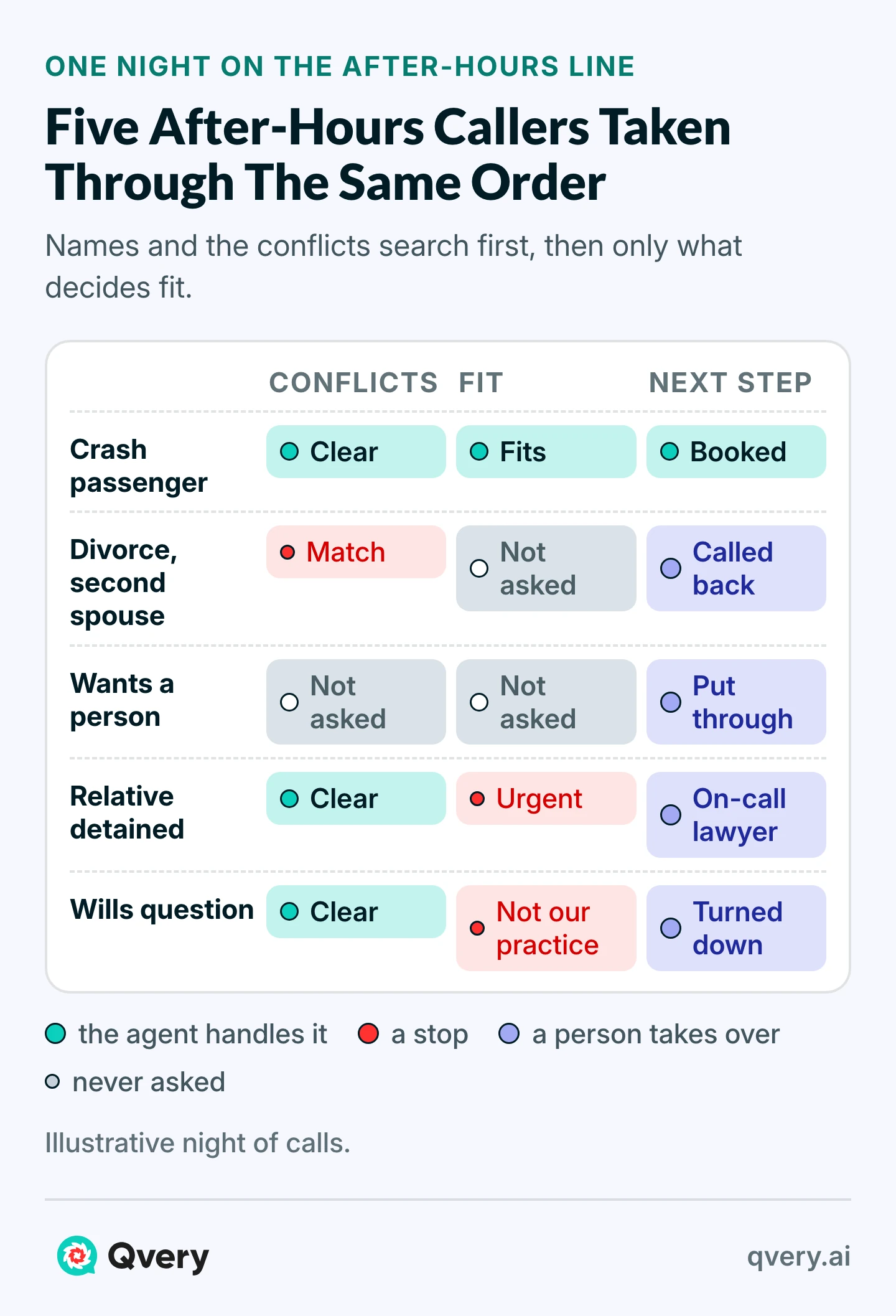
The agents run the screening, and the lawyer hears the story.
The Agents Talk About the Firm, Never the Case
The hard part is the moment a worried caller asks for advice. The answer to each question is written before launch:
| The caller asks | The agents say |
|---|---|
| Do I have a case? | A lawyer decides that at the consultation. I can book you for tomorrow morning. |
| What is it worth? | Only a lawyer can talk about value, after reading your documents. |
| How long do I have to file? | Deadlines can be short, so I'm marking your call for the first callback. |
| Should I talk to the insurance company? | A lawyer can advise you on that. I'm flagging it for your callback. |
| Will you take my case? | A lawyer decides after checking we can help. You'll hear from the firm either way. |
A Person Takes Every Crisis, Every Request for a Human, and Every No
| The agents | A person |
|---|---|
| Put the caller through at once: a request for a person, the first time; danger or distress; a court date, hearing or deadline this week | Takes the call; after hours, whoever is on call. If nobody picks up, the agents take a callback number, mark the call urgent and tell anyone in danger to call 911 |
| Book the consultation | A lawyer approves and sends any engagement letter or retainer, the agreement that makes the caller a client |
| Never turn a caller down | Turns a caller down, in writing, saying the firm is not acting for them and that time limits may apply |
| Keep one record per person across phone, web form, text and chat | Reads the night's conversations each morning |
The agents are built never to advise, sign anyone up or turn anyone down. At first any email or text that leaves the firm waits for a person; your firm decides later, in writing, which the agents send alone.
Each week we report the hours handed back, the calls answered that would have gone to voicemail, and the errors caught: duplicate records, stories taken before the conflicts search cleared, lines from the do-not-say list.
What the agents may read and do is set in a written agreement, your data is processed where that agreement says, and every action the agents take is logged.
Your First Weeks With Qvery on the After-Hours Line
Bring last month's missed calls and your intake questions. We set the order and the do-not-say list with your intake lead; first the agents run on last month's calls beside your team's notes, and they take the after-hours line within two weeks once access is in place.
Frequently asked questions
Will callers hang up on AI agents at a law firm?
Some will. Tell callers at the start what they are talking to, let them reach a person the first time they ask, and read the first weeks' conversations to see where callers drop.
Do the intake agents have to say they are AI?
Say so at the start of every call and chat, and put disclosure in your AI policy: the firm answers for what its agents say.
What should an AI intake agent never say?
Anything about the caller's case: whether they have one, what it is worth, how long they have to file, what to tell the insurer, and whether the firm will take it. It talks about the firm, books the consultation and flags urgent questions for the first callback. A lawyer answers the rest.
Can the agents run the conflicts check?
They take the names and search your conflicts records in the firm's matter database before they ask anything else. A person clears any hit or near match; after hours, it waits for the morning.
How much should intake ask before the firm decides to take a case?
Only what decides whether it can and will take it: who, against whom, what kind of matter, where, when, and whether another lawyer has it. The story waits for the lawyer.
Can the agents send the retainer agreement?
No. A lawyer approves and sends any engagement letter or retainer; the agents book the consultation and stop there.
Does a website chat create an attorney-client relationship?
It can create duties to a prospective client. Limit what intake asks to what decides fit, and stop at the first reason to decline; the lawyer hears the story at the consultation.
What happens to the intake team when AI answers the phones?
They stop holding blocks of the day for first calls and take the parts that need a person: the transfers, the callbacks, the judgment calls on fit, and every turn-down. Each morning they read the night's conversations and fix the script.
Can the agents call or text potential clients back?
Calling back is outbound, and the federal rule on automated calls sets its own consent requirements. Keep the agents inbound, and have counsel review texting and call recording before they contact anyone.
How do we tell whether AI intake is working?
Compare a month against the month before: the share of calls and forms answered, the minutes to a first answer, consultations booked and kept, and stories taken before the conflicts search cleared, which should be none.
What happens to the conversations of callers we turn down?
They stay protected: a firm may not use or reveal what a prospective client told it, even when it never takes them. That is one more reason the agents ask only what decides fit.
Which practice areas need the most care?
The ones where callers are in crisis: family law with safety at stake, immigration with a detained relative, criminal defense after an arrest. The agents transfer those at once.
Do the agents work with our phone system?
Yes. They answer on the numbers, web form and chat you already use, and write each call into the firm's matter database as one record per person.
Can the agents speak Spanish?
Yes, in the languages your intake lead sets up, with the same order, the same do-not-say list and the same handoffs in each.
What does the intake lead see each morning?
The night's conversations, the consultations booked, every call the agents flagged and why, and anything they should not have said, so the first callback goes to the right person.
What happens when the agents can't make out a caller?
They say so, take a callback number and pass the call to a person rather than guess at what the caller said.
Who keeps the recordings and transcripts?
Your firm. They sit in your systems beside the matter, and your intake lead decides how long they are kept.