
On this page
Before one client's demand goes out, all of this has to arrive:
- the records and the itemized bill (the bill that lists each charge) from each provider, matched one to the other;
- the imaging, the pharmacy records and the ambulance run, which often come from another department;
- the records from before the crash, which the defense will want anyway.
A personal injury demand can't go out until the records and bills behind it are in, read and totaled. In many practices that is a paralegal's week: requests with the client's signed releases, calls to records departments, reading what arrives, and building the chronology (the dated list of every visit and treatment) and the medical specials (the medical bills and costs the demand claims) the demand rests on.
What slips through comes back as a lower offer. An account nobody requested, a date of service typed wrong, a gap in treatment nobody explained: each gives the adjuster a reason to discount, and each starts in the records.
| Item | A month |
|---|---|
| Demands sent | 30 |
| Records hours a file, chasing and reading | About 20 |
| Records hours in all | About 600 |
| Paralegals on it | Five, at about 70% of their week |
| What that costs a year | About $344,700 at paralegals' mean pay with benefits, $958 a demand |
At Qvery, we help injury firms cut paralegal hours and get demands out sooner, with custom AI agents that chase every medical record and build the chronology.
The Letter Is the Short Part of a Personal Injury File
A file with eight providers waits on eight answers, and the demand on the slowest. A tool that writes the letter in minutes saves the smaller number and leaves the wait where it was. Where complete files sit waiting only for the letter, a drafting service may be the right tool, and for a practice with few, thin files it often is.
The records are one wait in an injury file. Our legal playbook prices three more jobs a firm repeats on every case: client updates written from scratch, court dates docketed by hand and time entries reconstructed from memory.
What the Agents Keep Track Of
The AI agents we build read each set of records and each bill as it lands in your case management system, check it against the providers on the intake and the client's treatment questionnaire, and keep the list that is hardest to keep by hand: what's still missing, including pages that can't be read and gaps in treatment.
 Piotr BabelPartner @ Qvery
The agents can only chase providers they know about, so the list starts from the intake and the client's treatment questionnaire, and a provider neither names stays invisible. Everything else shows up as an open line: a bill with no record, a page nobody can read, a gap in treatment. A fact with no source page never reaches the demand, so a missed record shows as a missing line, not a wrong one.
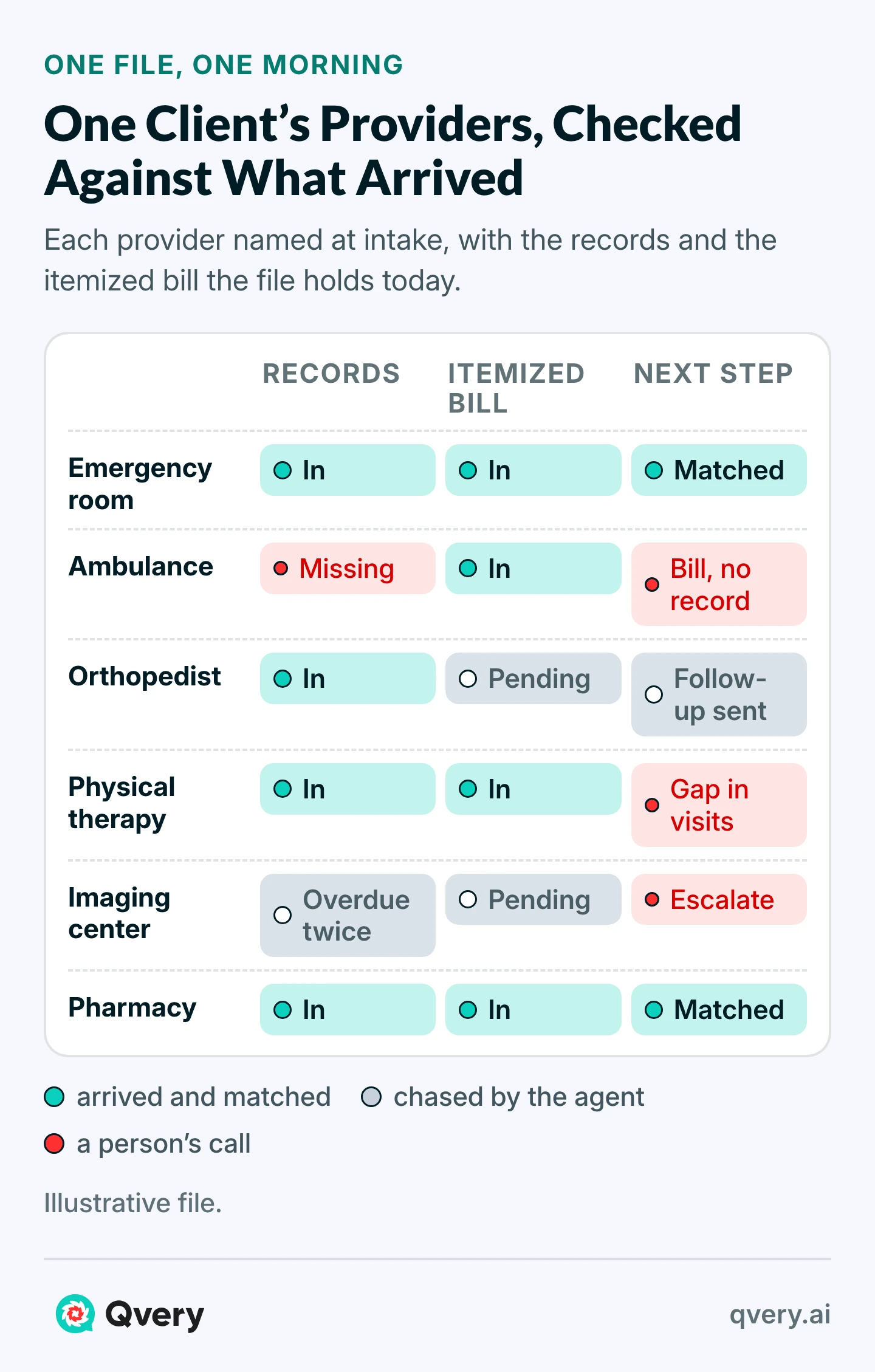
Each morning they send the follow-ups due, log every answer to the file, and hand a person only what needs a decision: a provider overdue twice, a bill with no record, a gap the client has to explain. At first every request to a provider waits for a paralegal; your firm decides later, in writing, which the agents send on their own.
Run one of your own signed authorizations, with your list of open provider requests, through the agent below.
What Reddit says
Personal injury paralegals on how provider records arrive and get tracked
Make sure to check that medical and billing are same place. Sometimes you request medical and later on you get it with no billing and have to do the rounds again.
They are the worst. My only suggestion is to create and have a chart/table where you can keep track of your requests and progress.
We farm out medical records. It is still time consuming and you will of course miss records. Your tracking and follow up system is important.
How the Chronology Gets Checked
| The work | Who does it | What a person checks |
|---|---|---|
| Requests, follow-ups, what is still missing | The agents | Overdue providers, gaps to explain |
| Chronology and the ledger of bills, with pages | The agents | Each line against its page |
| The story of the treatment, and the medical bills claimed | The agents draft | The paralegal, line by line |
| Who is at fault, whether the crash caused the injuries, and the amount | The attorney | Signs before it goes |
The agents never write about a record you lack, because a demand that describes treatment the file can't prove hands defense counsel a question. The attorney keeps liability, causation, the pre-existing condition, the gap and the number.
 Vlad ShvetsPartner @ Qvery
The hours are the smaller number in an injury practice. An adjuster discounts the offer for an account nobody requested or a date of service typed wrong, and no calculator counts that. Measure the agents on demands that go out complete and on time, and keep the number itself with the attorney, who argues liability, causation and the pre-existing condition.
The calculator prices the records work per demand: 30 a month at about 20 hours of chasing and reading each, at $47.88 an hour, paralegals' mean pay with benefits (about $99,600 a year), so $958 a demand by hand.
With the agents taking about half of it, the chasing, matching and first read, a demand costs $499, about $600 a month to run them included (model use for each record set, hosting and upkeep): $165,168 a year and 3,600 hours saved, and the build repays each $10,000 in about 0.7 months.
The hours a demand and the running cost are our assumptions, to replace with your own.
Medical Records Cost Per Demand ROI Calculator
What The Records Behind Each Demand Cost You, And With The Agents
Saved Per Year
$165,168
3,600 hours handed back, after $7,200 a year to run it
- Hours Handed Back
- 3,600 hours a year
- Agent Running Cost (Estimate)
- $600 a month
- Payback Per $10,000 Of Build
- 0.7 months
On these numbers, each demand costs $499 instead of $958, the agent saves $165,168 a year after its own running cost, and every $10,000 of the build is earned back in 0.7 months.
It leaves out the lowered offer a missing bill or a wrong date brings; the calculator counts only the hours. Each week we report the hours handed back and the mistakes caught before a demand leaves.
The agents read only the case files your firm opens to them, and every request, follow-up and answer is logged on the file it belongs to.
How Your First Month With Qvery Starts on Real Files
Working with us starts from a few closed files and the providers you chase most. The agents first run on last month's files beside your paralegals, one practice group at a time, and by the end of two weeks with access they are chasing records on your live files. We train the paralegals who check their chronologies.
Frequently asked questions
Can AI write a personal injury demand letter?
It can write a solid first draft: the treatment narrative, the medical specials table and your firm's structure. It can't argue liability, causation or a pre-existing condition well, so have it draft from a checked file and let the attorney write the argument and set the number.
How should a reviewer check an AI medical chronology?
Make every line carry its page, then read the date, provider, diagnosis and amount against that page. Watch for treatment the records never document, an error that looks as finished as the rest. A line with no page leaves the demand. Then check that every bill matches a record and every record has its bill.
Where do AI agents save the most time in a personal injury file?
In the records. Chasing and reading them takes many times the hours of drafting the letter, and the providers set the calendar, so the records are where AI agents hand back the most time.
Which calls on a records file stay with the paralegal?
They make the calls the agents shouldn't: whether a gap needs a record or an explanation, which overdue provider to escalate, whether a bill belongs to this claim at all. They check the chronology line by line and the draft before the attorney sees it. The chasing and the first read move to the agents.
What belongs in a complete set of records before a demand?
For each provider, the records and the itemized bill, matched to each other. Then the imaging, pharmacy records and the ambulance run, which often come from separate departments, and the records from before the incident. The agents track all of it against the intake's provider list and flag any page nobody can read.
Should a personal injury firm buy a demand service (a company that drafts the letter for a fee) or build agents?
Count first. If your files wait weeks for records, agents on the records work pay before a letter tool does. If complete files sit waiting for a letter, or you send few demands on thin files, a per-demand service can be the right first purchase. Many practices end up with both.
How should a firm test AI agents on its files?
Use closed files your team charted by hand, where the right answers are known. Run the agents, compare their chronology and bills with yours, and count the misses and the details they filled in.
Do the agents contact providers directly?
At first every request waits for a paralegal to approve it. Your firm decides later, in writing, which follow-ups the agents send on their own; the signed releases always come from the client's file.
What happens when a provider never answers?
The agents keep the request on schedule and put the provider in front of a paralegal after the second miss, so the decision to call, escalate or send the demand without it stays with a person.
Do the agents work with our case management system?
Yes. They read the records and bills as they land in the system you already use and write the chronology and the ledger of bills back into the file.
Can the agents read handwritten or scanned records?
They read what is legible and flag every page they can't, so a person looks at it before a fact from it goes into the chronology.
What does the attorney see before a demand goes out?
The checked chronology and the ledger of bills, each line with its page, the list of anything still missing, and the paralegal's draft of the treatment narrative and specials.
Does this change how we request records?
No. The requests go out with the client's signed releases as they do now; the agents keep the schedule, log each answer and flag what is late.
How do we know the agents caught every bill?
Every provider on the client's intake list has to show both its records and its bill, every bill has to match a record and every record its bill. A provider with neither, or one without the other, goes to a paralegal before the demand is drafted.
