
On this page
An immigration case reaches your attorney after someone has read all of it. A family-based green card case arrives as a stack from several people: passports, birth and marriage certificates, the sponsor's tax returns, earlier visas, and a translation of everything not in English. Before the attorney opens the file, a paralegal holds every page against the attorney's checklist for that case type.
- The passport scan with glare across the expiry date.
- A birth certificate from abroad with no certified translation, or the short version that names no parent.
- A birth date that reads one way on the form and another way on the passport.
- The sponsor's tax return for the wrong year, and the page the client promised last week.
Then come the emails to the client, the wait, and a second read when the new pages arrive. For a firm handling about 250 packets a month, at 80 minutes for each first read, that's 4,000 hours of paralegal time a year, about $185,000 in pay and benefits, before anyone has written a word of argument.
Since August 5, a page the read misses can end in a denial. US Citizenship and Immigration Services (USCIS), the agency that decides these cases, may now deny a filing that lacks a required document instead of asking for it first.
The Check Behind the Forms Is Still Done by Hand
Most of the AI sold to immigration firms writes. Case management systems turn one client questionnaire into every form the case needs, and drafting tools produce support letters and first versions of responses.
None of that holds the finished form against the passport. A questionnaire answer becomes a form field exactly as the client typed it. If the client wrote the birth date in the European order, the form now disagrees with the passport, and nothing on the screen says so.
General immigration AI tools will list every name and date in a stack of PDFs if someone asks. Someone still has to ask on every packet and read the answer against the checklist, which is the same job in a different window.
A Missing Document Can Now Mean a Denial
Until August, a packet missing a required document usually came back with a request for evidence (RFE): a notice listing what USCIS needs, with a deadline to send it. The policy USCIS issued on August 5, 2026 lets an officer deny that filing instead, without an RFE first.
RFEs were already part of every practice's week, as USCIS's own figures for work visas show. These are the shares of petitions decided from October 2025 through June 2026 that drew one.
Most of those turn on whether the evidence proves eligibility, which is your attorney's argument to make. The ones a missing or mismatched page invites are the avoidable ones. Every RFE, avoidable or not, is a second packet your team assembles against a deadline of at most 12 weeks, and a reply that misses it can be denied as abandoned.
If your team dockets deadlines like that one by hand, our legal playbook prices that work, along with client updates written from scratch and time entries written from memory.
| What slips | What USCIS can do | What it costs |
|---|---|---|
| A page from an old form edition, a missing signature, the wrong fee | Reject the filing | The filing date, and a rejection can't be appealed |
| A required document missing from the packet | Deny the filing, since August 5, 2026 | A new filing, and fees are generally not refunded |
| A document that's there but deficient: no certified translation, no parent named | Send an RFE or deny | Weeks of waiting and a response packet |
| A name or date that differs between documents | Ask your side to resolve it with outside evidence | A response built around the mismatch |
Editions don't sit still either. Form I-485, the green card application, had two new editions in September, and the USCIS fee schedule four in October.
The First Read Is Where Your Paralegals' Hours Go
The read is slow because the checklist is long and the packet arrives out of order. Couples who assemble their own marriage-based packets describe them at a few hundred pages and past a thousand, most of it financial statements.
At your firm those pages reach a paralegal who carries anywhere from 100 to 230 open cases, by the counts business immigration paralegals give for their own desks. They read the packet against the checklist, write to the client, and read the corrections when they arrive.
What Reddit says
Immigration paralegals on the work that reaches the attorney
Fees keep going up, applications take longer, forms change with short notice, ridiculous RFEs, it’s all terrible.
I do literally everything myself including initiation, case strategy, editing testimonial letters, fully drafting support letter/forms, sorting exhibits, etc etc... My attorney just reviews.
Attorney just removed one review step from the process which means everything is that much more on me.
Here is the example firm in numbers. It handles about 250 packets a month, and the first read of each, with the note to the client, takes 80 minutes; both are our assumptions.
Federal wage data puts paralegals in law firms at a mean $32.45 an hour (Bureau of Labor Statistics, May 2025). Add benefits, which run to 30% of a private employer's compensation bill, and a paralegal's hour costs $46.36. Type your own figures over the example.
Immigration Packet Review ROI Calculator
What The First Read Of Each Packet Costs You, And With AI Agents
Saved Per Year
$119,390
2,750 hours handed back, after $8,100 a year to run it
- Hours Handed Back
- 2,750 hours a year
- Agent Running Cost (Estimate)
- $675 a month
- Payback Per $10,000 Of Build
- 1 month
On these numbers, each packet costs $22.02 instead of $61.81, the agent saves $119,390 a year after its own running cost, and every $10,000 of the build is earned back in 1 month.
On those numbers the read costs $61.81 a packet and $185,440 a year. With the agents' list in hand, a paralegal spends about 25 minutes on a packet: reading the list, opening each flagged page, waving through the harmless differences, editing the request.
The packet then costs $22.02, running the agents included, and the firm keeps $119,390 a year and 2,750 hours. On the panel, the payback line reads 1 month for each $10,000 of build. The hours matter most at a firm that was about to hire another paralegal to keep up.
 Vlad ShvetsPartner @ Qvery
Since August 5, the price of a missed page is no longer an RFE and a few weeks of waiting; it can be a denial, a new filing and fees that are generally not refunded. The $119,390 a year of paralegal time is the smaller part of this example. Decide which case types your packets fail most often, and put the agents on those first, before an officer finds the gap your team missed.
How Qvery's Agents Read Every Packet Before Your Attorney Does
The agents work from the case folders your firm already keeps, in a case management system or on a shared drive. When a packet lands, they sort it by person and by document, so a spouse's records never count toward the principal's, and the front and back of one certificate read as one record.
Then they match each row of the attorney's checklist for that case type to a page, and compare every name, birth date, place and passport number across the forms, the documents and the translations.
 Piotr BabelPartner @ Qvery
Where a read like this fails is quiet: a birth date typed in the European order on the questionnaire, or a spouse's record counted as the principal's. That is why the agents sort the packet by person before comparing anything, and show both values and both pages for every difference. A requirement your checklist does not name is marked unknown, never guessed, so a gap in the checklist shows up as a gap.
The paralegal starts from a list like this one.
- Every checklist row marked found, missing or unreadable, with its page.
- Every name, date or number that differs between two documents, with both values shown together.
- Each translation held against its original, down to the dates and numbers it carries.
- A single request to the client covering everything outstanding, drafted for your paralegal to edit and send.
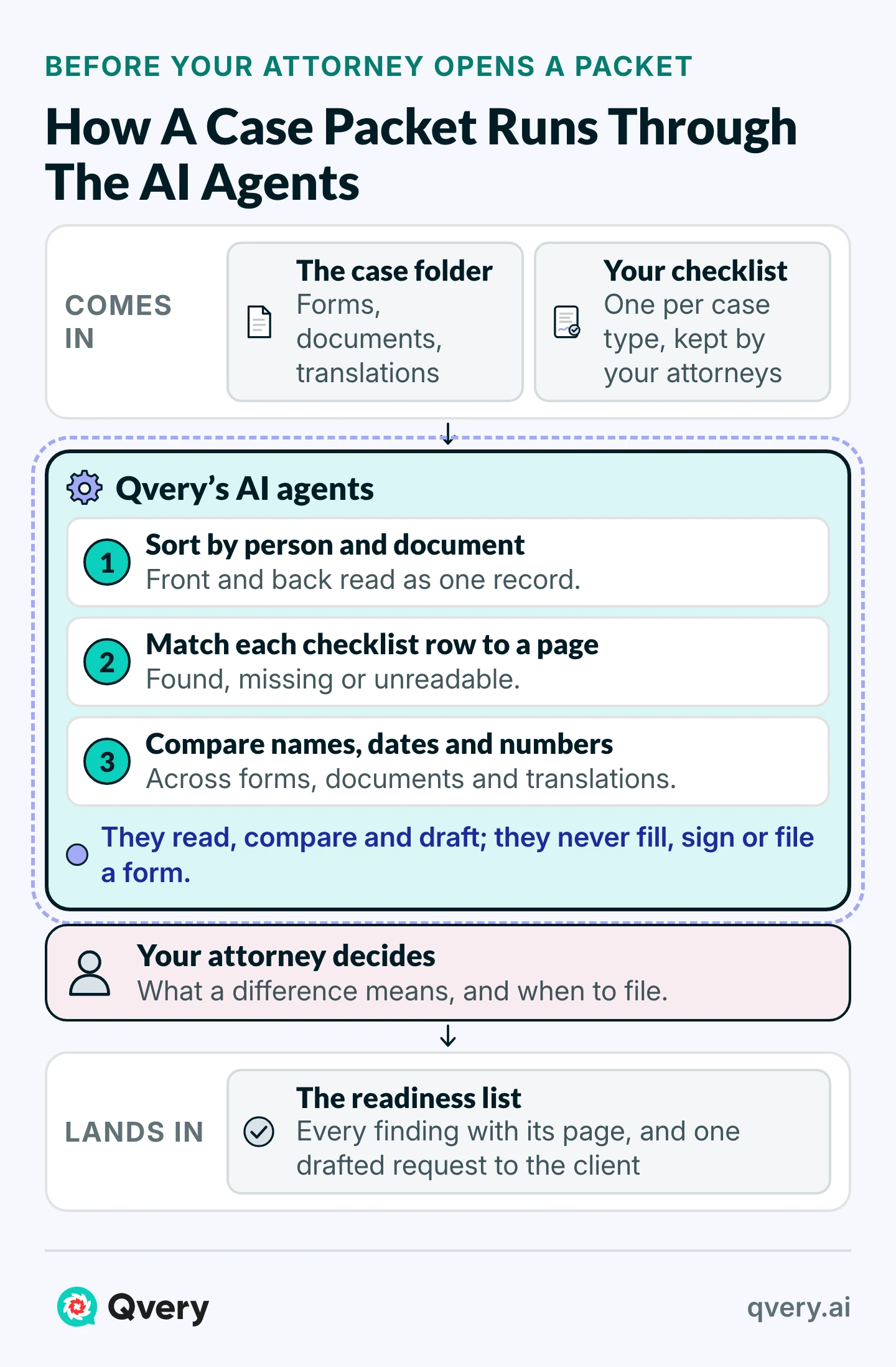
The list is where the paralegal starts, not a ruling. Found means the document is in the packet, not that it meets the requirement: if your checklist says the birth certificate must name a parent, one that names none is flagged. A requirement the checklist doesn't name is never guessed, and whether a listed difference matters is your attorney's call.
Run one of your own packets, with the checklist it was filed against, through the agent below.
The same agents check the response to an RFE. Your attorney turns the notice into a checklist that follows the officer's numbering, and the agents read the response packet against it before it goes back: what it still lacks, which pages are hard to read, where a new document disagrees with the original filing.
They work out no deadline unless your firm gives them the rule, and they never say whether a response will satisfy the officer.
Running them costs about $675 a month at 250 packets, most of it the model reading the pages.
What the Agents May Open
Packets hold passports, birth records and tax returns, so the first questions are about where they go and who acts on them.
| The agents | Your people |
|---|---|
| Open only the case folders your firm links to them | Choose those folders and change them any time |
| Read, compare and list, with every page they open logged | Read that log whenever they want |
| Draft the request to the client | Decide whether it goes out, and send it |
| Check finished forms against the documents | Prepare, sign and file every form |
| List the differences between pages | Decide what a difference means for the case |
Before the build, our contract spells out which folders the agents open, what they may do there, and which services and countries your files pass through. No message reaches a client before one of your people has read it.
The checklist is your attorneys' legal judgment, so keeping it current is theirs. When USCIS publishes a new edition or changes a fee, they update the checklist, and the next packet is read against it. A firm without written checklists drafts them with us during setup, from packets it has already filed.
The signature on a filing certifies, under penalty of perjury, the request and every piece of evidence filed with it. That's why the agents write no argument: every line on their list points to a page your paralegal can open and check. What we don't know yet is how often officers will use the new discretion to deny. The policy is three months old.
We Start on Cases You've Already Filed
You send the checklists your attorneys use and read access to a few months of closed cases. Once we have that access, the agents are reading those packets inside two weeks, and your paralegals compare the agents' lists with what they found at the time, one case type at a time.
Misses and false alarms both get fixed before a live packet goes near them, and the closed cases show you where your own gaps tend to come from. Then each new packet is read the day it lands. We train the paralegals who work beside the agents, and a weekly report shows the hours they got back and the gaps caught before filing.
Frequently asked questions
Can AI fill in USCIS forms for us?
Your case management system already does that from the client's questionnaire. Our agents check the finished forms against the client's documents and flag a name spelled differently from the passport or a birth date that doesn't match the certificate. Preparing, signing and filing every form stays with your team.
Does USCIS mind if we use AI on a filing?
What USCIS holds the signer to is the content. The signature certifies, under penalty of perjury, that the request and all its evidence are true and correct. Our agents don't write the filing. They check it against your client's documents, so every fact still comes from those documents and your attorney's review.
Which languages can the agents read?
Printed documents in Spanish, Portuguese, French, Chinese, Arabic, Russian and other common languages, compared with their English translations. A translation still needs the translator's own certification that it is complete and accurate. We confirm the languages your packets hold on your own files during setup.
What happens with phone photos and blurry scans?
They are read like any scan. A photo with glare across a date is listed with its page, and only that page goes on the client's request. A number cut off at the edge of a photo is flagged, never filled in, and two photos of the same page are read once.
Who keeps the checklists up to date?
Your attorneys do, because the checklist is the firm's legal judgment. When a form edition, a fee or an evidence rule changes, they edit it and the next packet is checked against the new version. Until a checklist covers a case type, the agents mark those requirements as unknown.
Does it work for employment cases too?
Yes. Each case type has its own checklist, so a petition for a specialty occupation worker is checked against different rows than a marriage case. Exhibit-heavy petitions, where support letters and evidence run to hundreds of pages, are where the page references save the most time.
Will the agents tell us a case is ready to file?
No. They list what is missing, unreadable or inconsistent, each with its page. They never say a case is ready, eligible or likely to be approved. Your attorney decides when it is filed, and nothing changes in who signs.
Will it work with our case management system?
Your system stays where it is. The agents read the folders, documents and exports it already produces, whether that is an immigration system such as Docketwise or a plain shared drive. Where your system lets an outside tool post a note on the matter, the findings appear there too. That is settled before the build.
What changed for us with the August policy?
Since August 5, 2026, USCIS may deny a filing that lacks required initial evidence without sending an RFE first, and it treats any reply to an RFE, even a partial one, as a request for a decision. Both raise the price of a gap that reaches the officer. The read before filing is where that gap gets caught.
Do our attorneys need to change how they review?
No. Your attorney still opens the file after the paralegal does. What changes is what arrives with it: the checklist marked row by row, the differences with both values and both pages, and the request the client already got. Review can start from the open questions instead of page one.
Can the agents compare a packet with earlier filings?
Yes, when the earlier filing is in the case folder. A date or a name that differs from what the client filed years ago is worth knowing before the officer finds it, because your side must resolve an inconsistency with outside evidence, not with an explanation alone.
Where do our clients' documents go?
Only through the services and countries our written agreement with your firm names, settled before the build starts. You contract with Qvery AI OÜ, registered in the EU, and the data processing agreement sits in the same contract.
What does reading 250 packets a month cost to run?
In the example, about $675 a month, most of it the model reading the pages, plus hosting and upkeep. It rises and falls with the pages your packets hold, and the calculator above shows the payback per $10,000 of build on your own numbers.
Can a short-staffed firm keep up without another hire?
The hours go back to client calls, RFE responses and the next filing. Firms short of people feel it first, because the backlog shrinks without a new hire. Your paralegals keep every conversation with clients and settle everything the agents flag.
How soon could the agents read our live packets?
They start on your closed cases inside two weeks of the access being set up. Once your paralegals have checked their lists against what they found on the same files and the misses are fixed, each new packet is read as it lands.