
On this page
At an immigration firm, someone reads every page of a case packet before an attorney signs off: passports, birth and marriage records, translations, the signed forms.
Since August 5, 2026, US Citizenship and Immigration Services (USCIS) may deny a filing that lacks required initial evidence without first sending a request for evidence (RFE), so whatever that read misses may now draw a denial instead of a request.
The six case systems below fill the forms, track the deadlines and hold the documents. Two of them, CampLegal and CaseBlink, now also check the packet before it is filed, so they come right after our own entry, and the other four follow by what their pages and their users show.
Entry one is our own work, so count it as our pick.
1. Custom AI agents by Qvery: The Packet Read Against Your Own Checklist
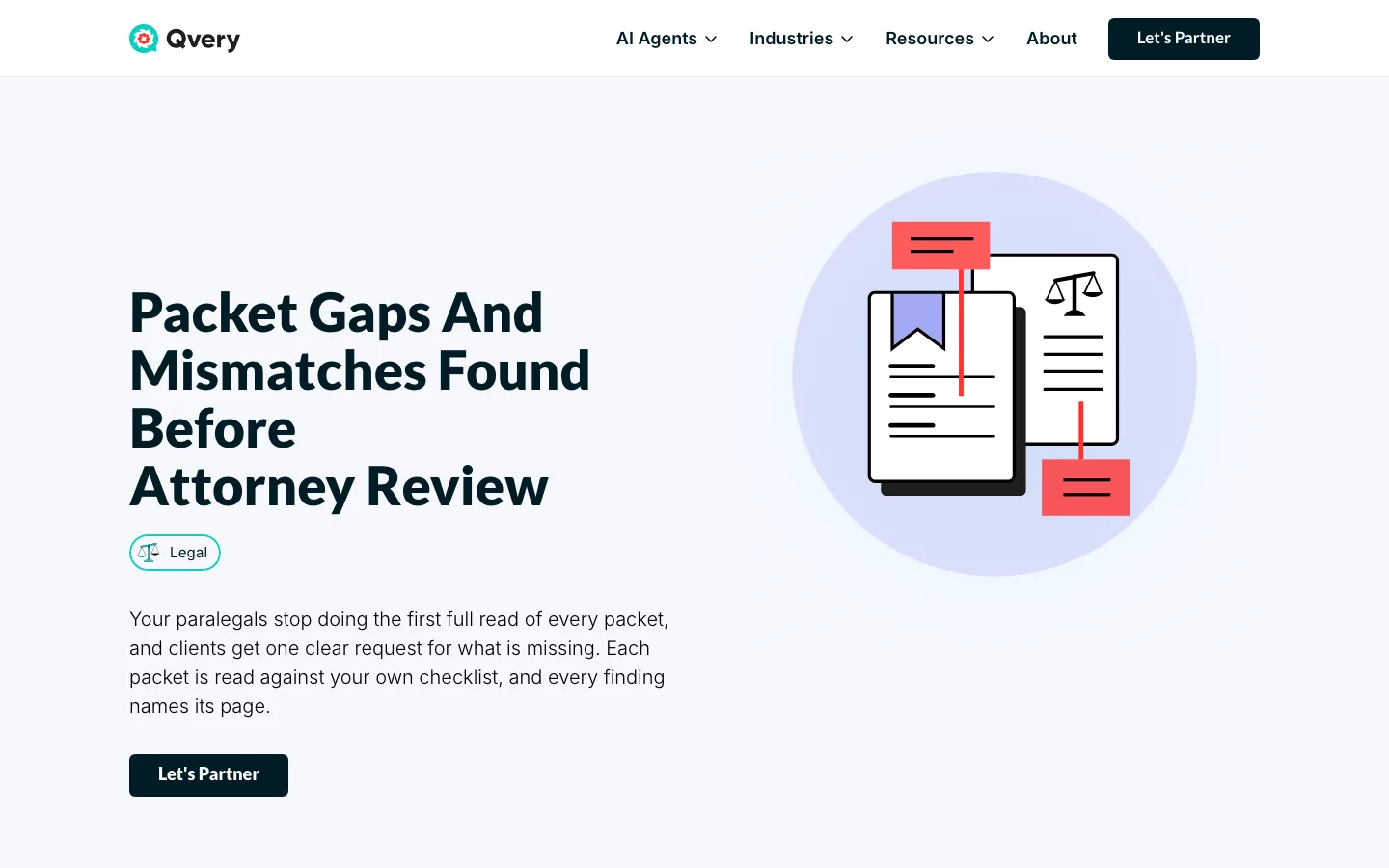
Our agents are not a case management system and do not replace yours. They work beside it: when a packet lands in a case folder your firm gives them access to, they read every page of it, scans and phone photos included, against your attorney's checklist for that case type.
Your paralegal gets one list: each checklist item for each person marked found, not found, different or unreadable, with the page. Names, birth dates and places that disagree across documents and translations are listed with both values, and a request to the client is drafted for everything missing or blurry.
The checklist is your firm's, so a requirement it does not name is never guessed, and the agents fill no form and file nothing. Your attorney still decides when a case is ready.
- Reads every document in the case folder, one long PDF or forty phone photos
- Checks each checklist item for each person, conditional items included
- Compares names, dates, places and passport numbers across documents and their translations
- Flags pages too blurry to read and pages sent twice
- Drafts one request to the client, with the page behind each item
Pros
- Works beside the system you already run
- Held to your firm's own checklist
- Reads phone photos and translations
Cons
- Built for one firm, not a product you license
- Fills no forms and leaves deadlines to your case system
- Needs a written checklist per case type, drafted with you if you have none
2. CampLegal: The Case System With a Pre-Filing Check Built In
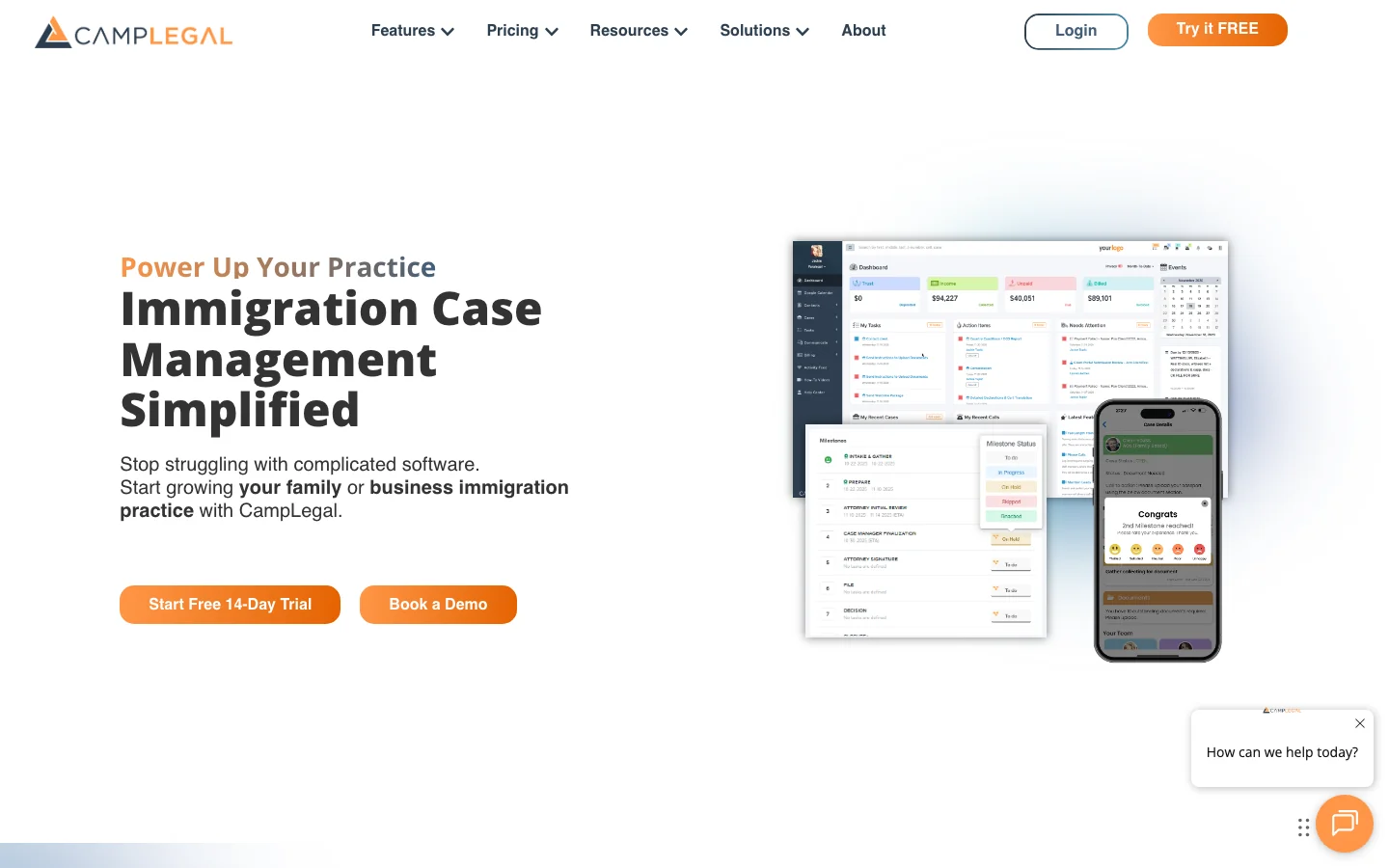
CampLegal is case management built for family and business immigration firms, and its AI Features Suite is the clearest pre-filing check any system on this list describes.
CampLegal says it reviews the completed case package against filing requirements for the visa category and common RFE triggers, checks forms against support letters and evidence for consistency, and flags duplicate or out-of-date documents. An email add-in checks client attachments for missing pages and unclear scans as they arrive.
The requirements are filing requirements by visa category, as CampLegal describes them, and its time estimates are built on employer cases: H-1B visas for a specialty occupation and L-1 transfers within a company. CampLegal says plainly that its AI cannot tell whether a case holds enough evidence: that judgment stays with the attorney.
- Pre-filing quality control: completeness by visa category and cross-document consistency
- Document processing that identifies more than 50 immigration document types, with confidence scores
- Forms filled from one record, with cross-form consistency checks
- USCIS case-status monitoring, and a client app on iOS and Android
- Templates in 18 languages
Reddit has little on CampLegal: four independent mentions in four threads, too few to score. On Capterra, a reviewer in September 2025 named the catch: "The onboarding wasn't perfect and can be expensive. We lost some information in the transition."
Pros
- A pre-filing check inside the case system
- Published prices
- Migration included
Cons
- Works on cases kept in CampLegal
- Its AI time estimates assume employer petitions
- Few independent reviews yet
3. CaseBlink: AI Agents That Run the Case From Intake to Packet
CaseBlink calls itself a system of record for immigration matters, built for agents to run.
Its agents read the documents that land on a case, flag evidence that is absent or stale and draft the request to the client for your approval, fill forms on current editions with the source of every field shown, and assemble the packet for review. When an RFE arrives, they map each request in it to the evidence already on file.
It is a different kind of system from the others here: the work is done by agents and checked by your team, rather than typed by your team, and it suits a firm ready to keep its matters in it.
- Agents that flag absent or stale evidence and request it with your approval
- Forms filled from the record on current editions, with fields checked before signing
- Packets assembled from the case, every claim cited to its document
- RFE notices broken into requests and mapped to the evidence on file
- Expiry watch on passports, visas and work permits, dependents included
G2 lists no CaseBlink reviews so far, and Reddit barely mentions it.
Pros
- Agents do the preparation, your team reviews
- Current form editions, with the source of each field
- RFE responses mapped to the record
Cons
- Your matters live in it, as their system of record
- Highest published per-seat price here
- No G2 reviews yet
4. eImmigration: Forms, Portals and AI Helpers on Every Plan
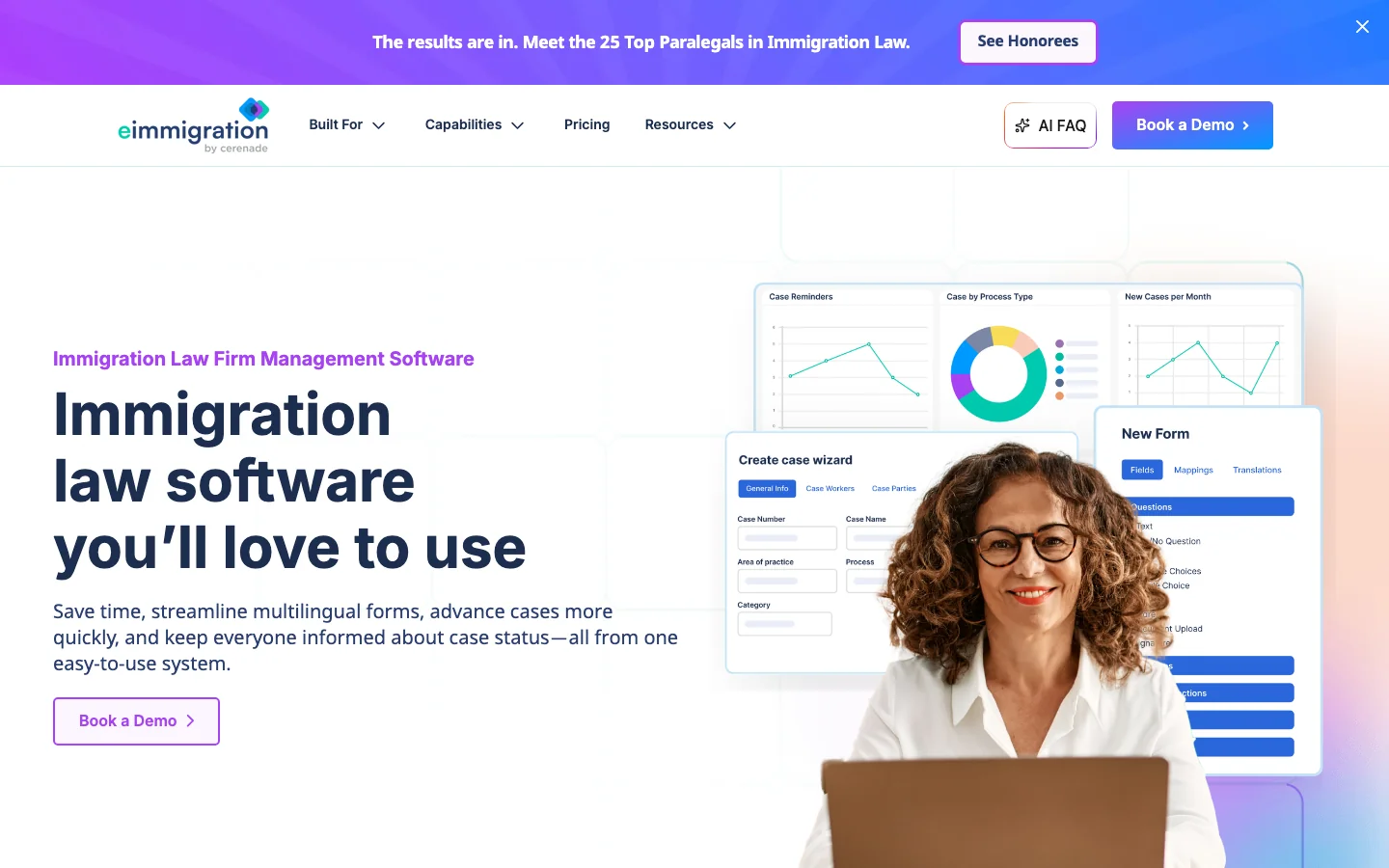
eImmigration, from Cerenade, puts a lot into every plan: more than 300 immigration forms, more than 120 case templates, client and HR portals, branch management and two AI helpers. The Extractor pulls data from passports, receipts and PDFs into the case, and the Summarizer condenses long documents.
Its Translator puts questionnaires and forms into 13 languages, and drafting runs through an integration with Visalaw.ai.
Its users say the depth comes with setup work: custom intake and case processes take staff time to build.
- 300+ forms with version control, and 120+ case templates
- Extractor and Summarizer AI on every plan
- Questionnaires and forms in 13 languages
- Client and HR portals, branch management
- Drafting through Visalaw.ai
What Reddit says
Split, and too thin to score: eight independent mentions in seven threads, 2021 to 2025
it even notifies us when an application is out of processing times so that we can follow up with CIS.
they tell you how fantastic and customizeable it is, which it may be, but i do not have time to dedicate a full time person to tweaking and building forms and case processes etc.
Pros
- Forms, portals and AI helpers on every plan
- Highest G2 score on the list
- Branch management and HR portal included
Cons
- Customization takes staff time
- Premium features priced one by one
- No packet check described
5. 8am DocketWise: Forms First, With Prices on the Page
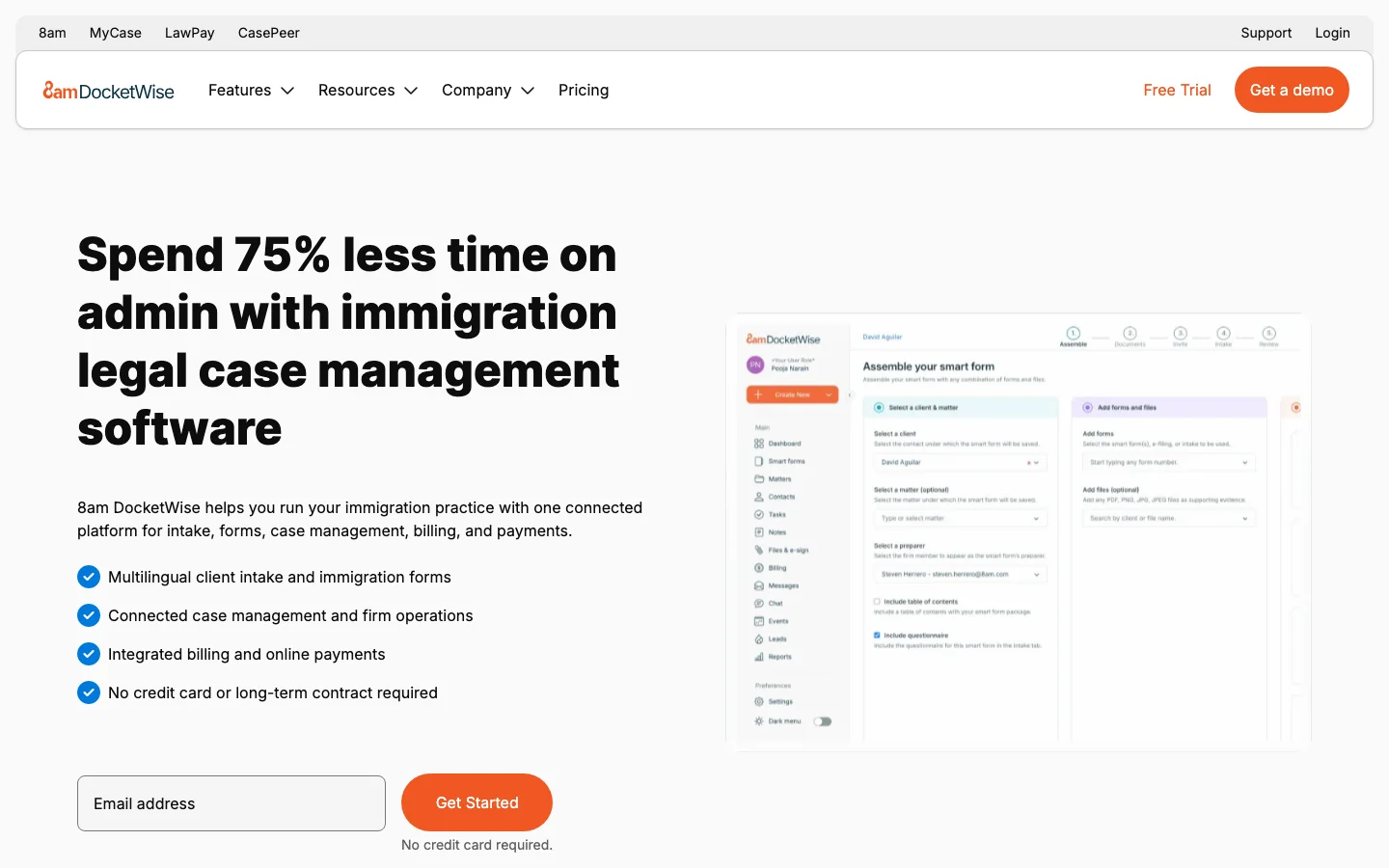
DocketWise, now part of 8am, starts with forms: one questionnaire, in the client's language, fills every form the case needs, and forms and supporting documents assemble into one filing package for e-filing.
Case tracking, priority dates (an applicant's place in the green card line), a client portal, billing and a lead tracker sit around it. Its AI, 8am IQ, captures data from uploaded passports, green cards and arrival records into the forms, and edits and translates client messages between English and Spanish.
Its Advanced plan adds multiple branches and permission groups, which a firm with several offices will want.
- One multilingual questionnaire fills every form in the case
- Forms and supporting documents assembled into one filing package
- Case status and priority-date tracking from USCIS
- 8am IQ: data capture from identity documents, and a writing and translation assistant
- Multiple branches and permission groups on Advanced
What Reddit says
56.3 / 100
16 independent mentions in 12 threads, 2022 to 2026
Docketwise is going to be the starting place because it's a jack of all trades (but master of none).
We use Docketwise, switched from INSzoom, and I really like it.
these “smart” forms don’t always fill things in correctly.
We currently use Docketwise and do not find its AI features satisfactory.
Pros
- Prices published for every plan
- Forms from one questionnaire
- Branches and permissions on Advanced
Cons
- AI described for data capture and writing only
- Some users find its smart forms unreliable
- No packet check described
6. LollyLaw: New Form Editions Within the Hour
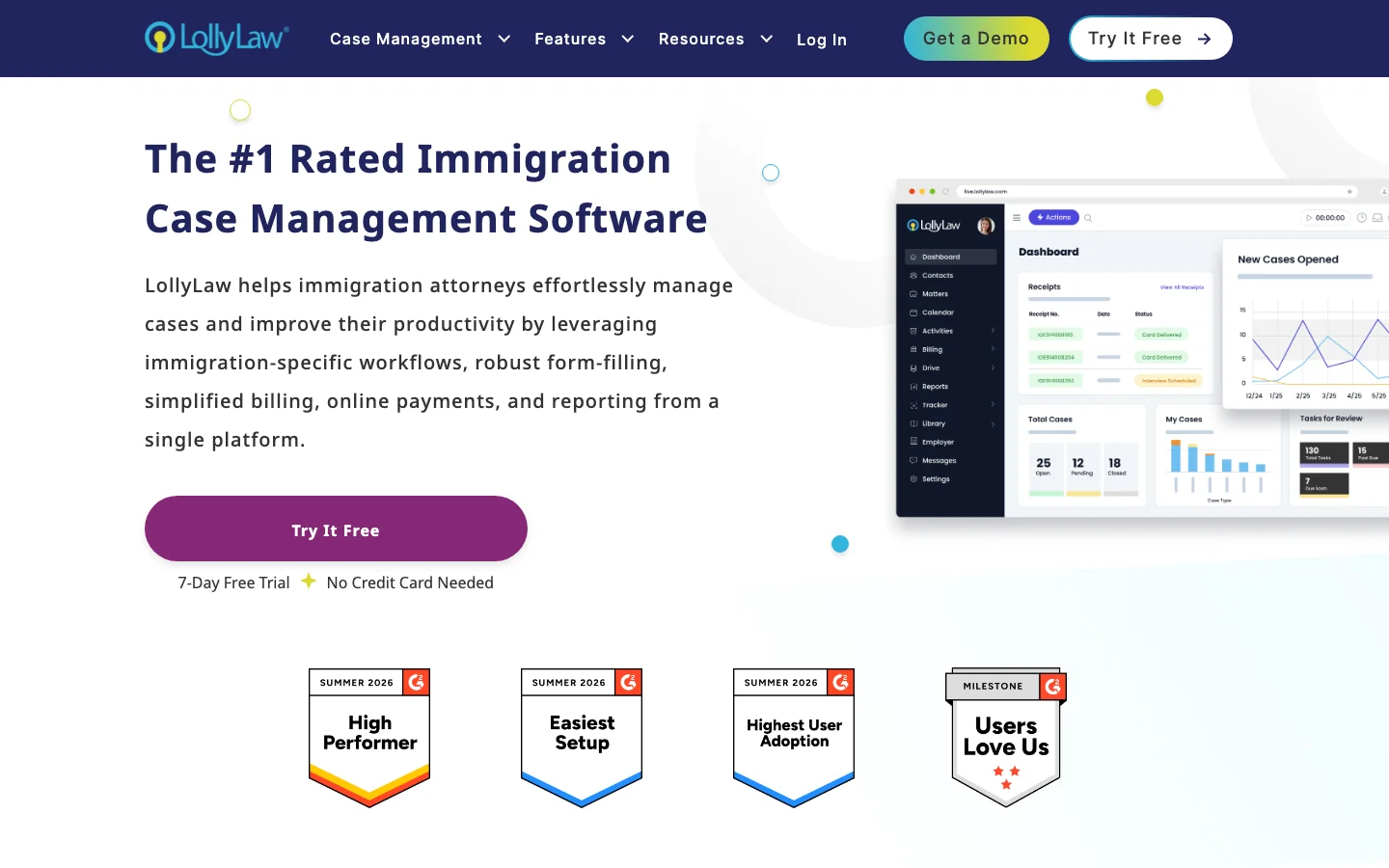
LollyLaw's strongest claim is speed on form editions: new versions reach its library within an hour of release, and a case moves to the new edition with one click. That matters because USCIS can reject a paper form whose pages are missing or come from different editions of that form.
Around it sit more than 100 questionnaires in 20+ languages, live form completion with the client, document storage and payments.
Its users are split sharply: some switched to it and are glad, others say it overpromised.
- 125+ forms from USCIS, the Justice Department, the immigration courts and the FBI
- New editions in the library within an hour, upgraded with one click
- 100+ questionnaires in 20+ languages
- Forms completed live with the client
- Document storage and payments built in
What Reddit says
Split hard, and too thin to score: nine independent mentions in four threads, 2021 to 2025
We recently switched to Lollylaw and it’s going great so far.
Lollylaw is fairly good for the form filling part, but I am not a fan of their case management.
Lollylaw. Overpromised, underdelivered.
Pros
- Fastest stated form-edition updates here
- Questionnaires in 20+ languages
- Most G2 reviews on the list
Cons
- No price on its pages
- Users split hard
- No packet check described
7. Mitratech INSZoom: For Global and Corporate Immigration Programs
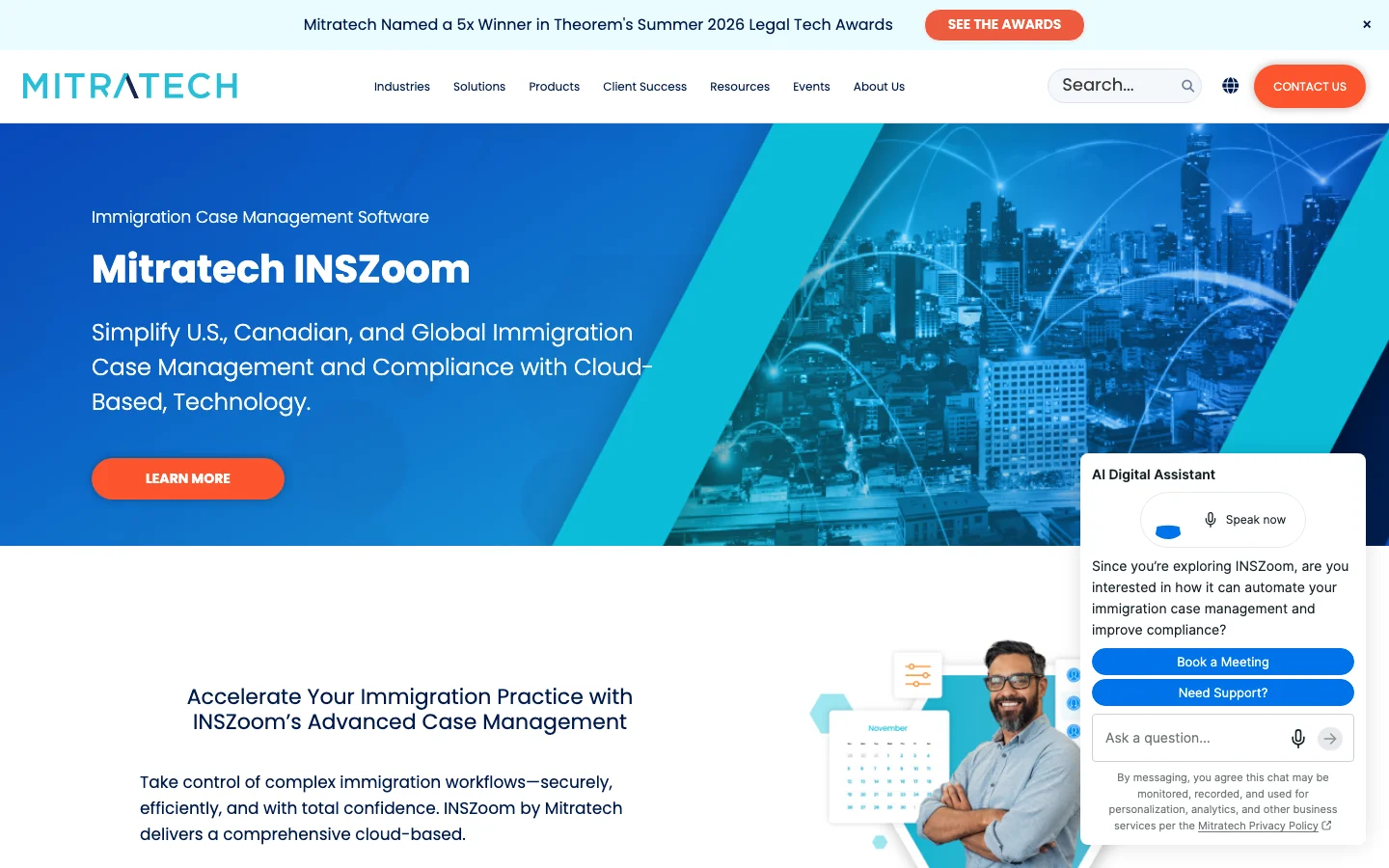
INSZoom, owned by Mitratech, is built for firms whose clients are employers moving people across countries: more than 2,500 forms and questionnaires across 90+ countries, workflows by country and petition type, HR portals, and links to Workday, ADP, SuccessFactors and PeopleSoft.
It tracks the documents each filing requires and reads receipts and government notices into the case on its own. Mitratech says more than 1,500 immigration practices use it.
In November 2026 Mitratech took its hosted INSZoom offline after detecting what it called potentially suspicious behavior. Firms reached their case files through a limited-access environment from November 6, and as of November 12 Mitratech said it had found no compromise of customer data and had given no date for full service.
- 2,500+ forms and questionnaires across 90+ countries
- U.S. forms updated within 48 hours of release
- Tracks the documents each filing requires
- Reads receipts and government notices into the case
- Links to Workday, ADP, SuccessFactors and PeopleSoft
What Reddit says
15.0 / 100
10 independent mentions in 8 threads, 2018 to 2026, almost all from firms using it
However, they can be worth it if you are ok to invest into a full-on immigration software, just know that your firm's processes will be very heavily tied and relied on the software.
I used INSZoom until a year ago at this job and at a former job, and found it quite clunky - especially the reporting functions - and unstable.
our immigration practice relies heavily on INSZoom for tracking client data, questionnaire intake, and deadlines.
Pros
- Built for global and corporate programs
- Links to the HR systems employers run
- 2,500+ forms and questionnaires in 90+ countries
Cons
- November 2026 outage
- Lowest user scores on the list
- No price on its pages
The Check Before Filing Is Where These Systems Differ
| System | What it checks before filing | Start with it if |
|---|---|---|
| Custom AI agents by Qvery | Every page against your own checklist, beside your current system | You keep your system and want every packet read on arrival |
| CampLegal | Completeness, consistency, duplicates and unclear scans, by visa category | You want the check inside a new case system |
| CaseBlink | Absent or stale evidence and current form editions, by agents | You are ready to move the caseload onto agents |
| eImmigration | Data read into the case; no packet check described | You want forms, portals and AI helpers on every plan |
| 8am DocketWise | Data captured into forms; no packet check described | Forms are your bottleneck and you want prices up front |
| LollyLaw | Current form editions; no packet check described | Edition changes and client languages decide it |
| Mitratech INSZoom | Required documents tracked; no read of their contents described | Your clients are employers with global programs |
On forms, deadlines and portals the six case systems overlap, with different plans and limits. The difference that changes your paralegals' week is the check before filing: CampLegal and CaseBlink describe one, and it runs on the cases kept in them.
| System | Price | Reviews |
|---|---|---|
| Custom AI agents by Qvery | One price for the build, then a monthly running cost | Not applicable: a custom build |
| CampLegal | $69 to $99 a user a month | Capterra: 5.0 from 5 |
| CaseBlink | $200 a seat a month | None on G2 yet |
| eImmigration | $55 to $110 a user a month | G2: 4.8 from 55 |
| 8am DocketWise | $80 to $140 a user a month | G2: 4.6 from 46 |
| LollyLaw | No price on its pages | G2: 4.5 from 119 |
| Mitratech INSZoom | No price on its pages | G2: 3.6 from 16 |
So the decision is less which system has the best forms than whether you move your cases into a new system to get the check.
A firm with years of matters, workflows and staff habits in DocketWise, eImmigration or INSZoom pays for that move in migration and retraining; a firm already planning to switch can get the check with the new system.
 Vlad ShvetsPartner @ Qvery
Questionnaires fill the forms now. The read of the packet can still take hours on a family case: every page, every translation, and the second round when a client resends a blurry scan. If that is where your hours go, the check before filing is what you are buying, and it can be added without moving a single matter.
Where Qvery Fits Beside the System You Keep
Say a firm of about 200 people, an example rather than a client, keeps its cases in a system it has run for years. A marriage case lands as one 90-page PDF and thirty phone photos the client sent from home.
Qvery's agents sort the pages by person and by document and hold them against the attorney's checklist for that case type. The paralegal's list shows four things before your attorney opens the file:
- The spouse's birth certificate translation cites a different page number than its original
- The passport photo has glare across the birth date
- The child's birth certificate the checklist requires is not in the packet
- Two photos are the same page
A request to the client is drafted with the page behind each item; the paralegal edits it and sends one email instead of three.
At Qvery, we help immigration firms spend fewer paralegal hours on each filing, with custom AI agents that read every packet against your checklist and draft the client's request.
The agents open only the case folders your firm links to them, and every page they open is logged where your firm can read it.
Before the build, the contract names every outside service that handles the files and where they are stored, and no outside AI model learns from your clients' documents. Nothing goes to a client, and nothing is filed, without a person.
 Piotr BabelPartner @ Qvery
The checklist is your attorneys' legal judgment, not ours. During setup we turn the lists they use into rules, or draft one with them from packets they have filed, and until a case type has one the agents mark its requirements unknown instead of guessing. When a form edition or an evidence rule changes, your attorney edits the list and the next packet is read against it.
To see it on your own file, drop one case packet and its checklist into the agents below. The readiness list comes back by email: what is found, missing, different or unreadable, page by page.
The build starts with three packets your firm has already filed, one with an RFE if you have it, read with your paralegals until the checklists are rules.
By the end of the second week the agents check closed packets beside your paralegals' own lists, and the gaps they miss or raise wrongly are fixed before any live case.
Then each new packet is read before an attorney opens it, one case type at a time, and every month we review the paralegal minutes per packet and the days to the first client request with you.
Your forms and deadlines stay in the system you run. The agents add one thing: the read of every page before your attorney's.
Frequently asked questions
What is immigration case management software?
Software that runs an immigration firm's cases: it fills USCIS and State Department forms from the client's answers, tracks receipts, deadlines and priority dates, keeps the documents, and gives clients a portal. Most systems here add billing, and some add AI that reads documents into the case.
Which of these systems check a packet before it is filed?
CampLegal and CaseBlink, on cases kept in them. CampLegal checks completeness by visa category, consistency across forms and evidence, duplicates and unclear scans; CaseBlink's agents flag absent or stale evidence and fill forms on current editions. Qvery's agents read packets from the case folders you link to them, against your own checklist.
Can software make sure USCIS never sends a request for evidence?
No. An RFE can turn on eligibility and the strength of the evidence, which an attorney judges, and CampLegal says as much on its own pages. What a check before filing can catch is the missing page, the blurry scan and the date that disagrees, which matter more now that USCIS may deny for missing initial evidence without asking first.
Which works for a firm of 100 to 500 people?
If your firm runs several offices, needs permissions by role or serves employers with HR systems, these are the features to compare. DocketWise's Advanced plan adds branches and permission groups, eImmigration includes branch management and an HR portal on every plan, INSZoom is built for global programs and links to HR systems, and CaseBlink offers custom annual contracts for larger firms.
How do they keep up with new form editions?
LollyLaw says new editions reach its library within an hour, INSZoom within 48 hours for U.S. forms; eImmigration has form version control and CaseBlink fills forms on current editions. It matters because USCIS may reject a paper form whose pages are missing or come from different editions of that form.
Can clients answer in their own language?
LollyLaw offers questionnaires in 20+ languages, CampLegal templates in 18, eImmigration's Translator 13, and DocketWise translates messages between English and Spanish. Qvery's agents read documents in Spanish, Portuguese, Chinese, Arabic, Russian and other common languages, and compare each translation with its original.
What does switching systems cost?
eImmigration charges $1,000 for a standard import from a supported system, CampLegal includes migration, and DocketWise includes it on a yearly Advanced plan. Beyond the import, rebuilding workflows takes staff time, so keeping your system and adding the check can be the cheaper move.
Which of them e-file with USCIS?
DocketWise on its Pro plan and above, CampLegal on Pro, eImmigration as a premium feature, and INSZoom for USCIS and Labor Department forms. Qvery's agents file nothing: they read the packet before your team files it from the system it already uses.
How long does a new system take to set up?
INSZoom puts account setup at two to five business days, plus the time to migrate data and configure it. CampLegal includes implementation and migration, and eImmigration sets up the account with two hours of onboarding training. Moving years of matters adds to that, and it is the cost to weigh.
Can Qvery's agents check an RFE response too?
Yes, the same way. Your attorney turns the request into a checklist, in the officer's numbering if you like, and the agents check the response packet against it before it goes back: what it still lacks, which pages are hard to read, and where new documents disagree with the original filing. They never say whether the response will satisfy the officer.
What happened to INSZoom in November 2026?
Mitratech took its hosted INSZoom offline on November 3 after detecting what it called potentially suspicious behavior. Firms used a limited-access environment from November 6, and as of November 12 Mitratech said it had found no compromise of customer data and gave no date for full service.
Do Qvery's agents fill in or file the forms?
No. Your team prepares, signs and files the forms in your case system. The agents check the finished forms against the client's documents and list any name or date that differs, before filing.
What if our checklists are out of date or not written down?
Your attorneys own them. During setup we draft them with your attorneys from packets they have already filed, and a case type without a checklist is marked unknown until one covers it.
What would we hand Qvery first?
Your checklist for each case type and the attorney who owns it, read access to the case folders in your system, your fee worksheet, three filed packets and the languages they hold. In time: three hours of your case management director's week one, then thirty minutes of a paralegal's day in weeks three and four.