
On this page
New matters still reach a consumer law firm by phone, often when nobody is at a desk. In a study published in early 2026, researchers rang 1,000 personal injury firms in 25 US cities after hours, and 40.9% did not answer. The authors are affiliated with a company that sells AI intake, so read it as their measurement.
The calls that are answered, or left as voicemails, become recordings someone on intake replays to type up the name, the story and the date that matters. Legal intake software carries an inquiry from that call to a signed client, and in 2026 several of these systems also pick up the phone.
The seven below are the intake systems a firm with a busy intake desk would shortlist, ranked on how much of that path each runs and what it does with the recorded call. We build what sits in first place, so read it as our pick; the six after it are judged on their own pages and their users' words.
1. Custom AI agents by Qvery: Your Own Intake Form, Filled From the Recording
Qvery sells no intake platform, and nothing on this list has to go. Our agents start where the phone system stops: when a caller hangs up or leaves a voicemail, the recording your system already saves is passed to them and written out with the minute each person speaks.
They fill your firm's own intake questions from what the caller said, each answer tied to its minute so anyone can check it in seconds. What the call never covered is marked as not said and goes on the callback list, and two answers that disagree, like two phone numbers, are both kept and flagged.
Every person and business the caller named is listed for your conflict check, spelled the way they said it. Your firm runs and clears the check. The agents clear no one, never tell a caller whether they have a case, and never speak to a caller at all.
- Fills your intake questions from each recorded call or voicemail, with the minute behind every answer
- Lists what the caller never said, for the callback
- Lists every name for your conflict check, in the caller's spelling
- Pulls a hearing date, a letter that needs a reply or a recent accident to the top
- Writes the lawyer a short callback script that asks only what is still open
- Reads Spanish calls, web forms, chats and emailed inquiries the same way
Pros
- Works beside the intake system you keep
- Your form, your questions, your conflict fields
- Every answer checkable against its minute in the call
Cons
- Works after the call, so it answers no one live
- A build, not a subscription switched on today
- Needs read access to your phone system's recordings
2. Lead Docket by Filevine: Calls That Fill the Lead, Inside Filevine
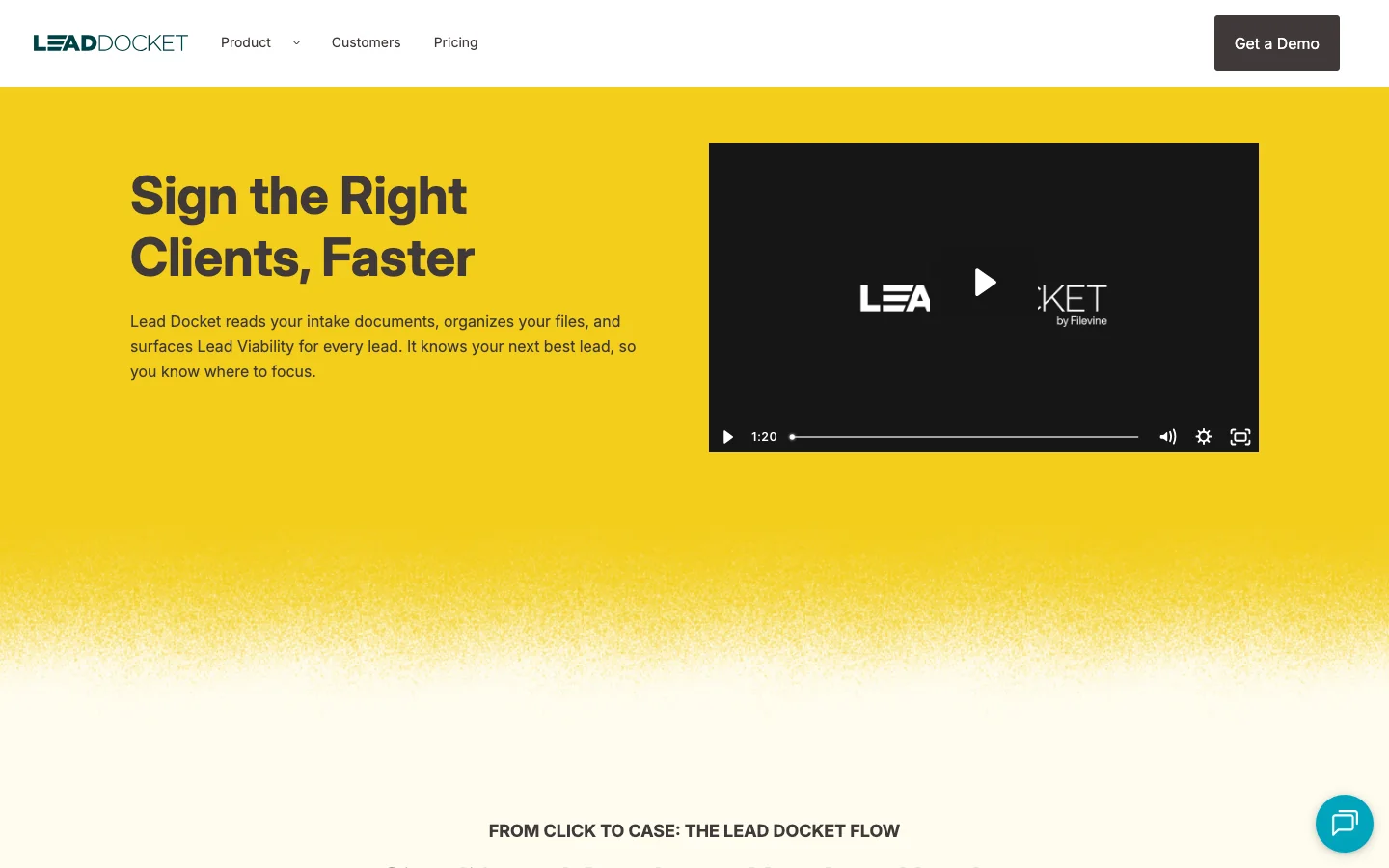
Lead Docket is Filevine's intake system. Intake forms, follow-ups by text and email, document collection and e-signature cover the road to a signed retainer, and a consultation fee or deposit can be taken by card or bank transfer (ACH) before the caller hangs up.
The phone call is where it pulls ahead of the other platforms here: through Filevine's LOIS Voice, its own pages describe filling the intake fields from a recorded call, even one your own staff answered. The catch, on the same pages, is that LOIS Voice connects to no case management system but Filevine's.
- AI voice agent that asks your Lead Docket intake questions in English, Spanish or French
- Notes taken on calls your own staff answer, with the recording and transcript on the lead
- Intake fields filled from the call when its questions were imported from Lead Docket
- Uploaded intake documents read as they arrive, scans and photos included
- Fees and deposits collected by card or ACH during intake
- Leads pushed into Filevine with their documents and folders
What Reddit says
59.4 / 100
16 independent mentions in 10 threads, 2021 to 2026
Our firm uses LeadDocket which I think works well, but we are large enough to where the cost makes sense.
It works really well but I chose not to use it because of the cost. It’s really expensive and (my feeling is) it is set up for higher volume firms.
Lead docket should do all of that stuff. The only problem is they’re owned by filevine which can become difficult to work with.
Pros
- Fills intake fields from recorded calls
- Takes notes on calls your staff answer
- Signed leads flow straight into Filevine
Cons
- Call features work only with Lead Docket and Filevine
- Base price by quote
- Users describe it as built for high lead volume
3. Lawmatics: Rule-Driven Intake Automation, Once Someone Builds It
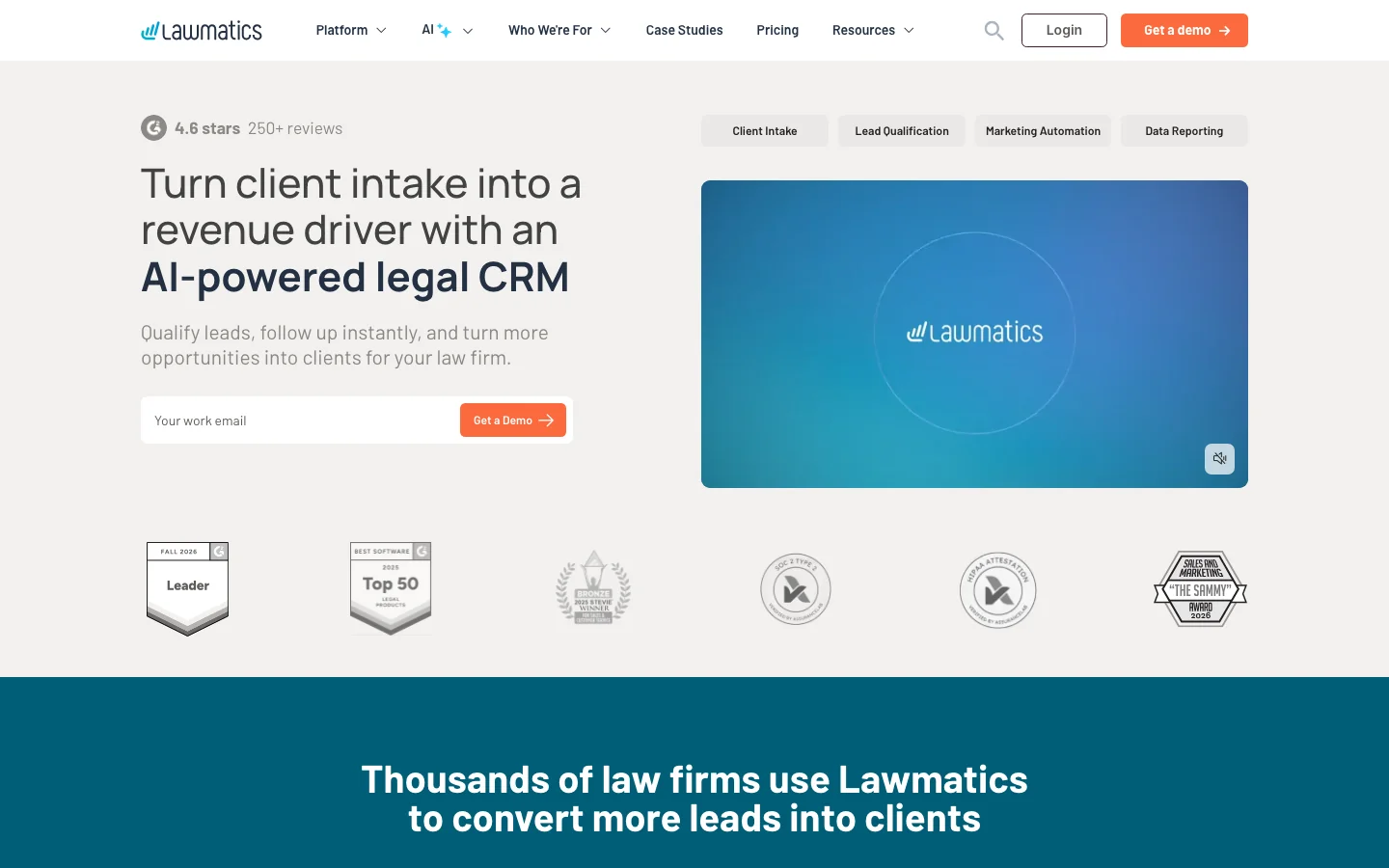
Lawmatics is a legal CRM, the client-records system that tracks every lead from first contact to signed client, built around intake and marketing automation. Every plan carries intake forms, e-signature, calendaring and task management, and the automations can run a lead from inquiry to retainer on rules your firm writes.
Its AI layer is called Merlin. Merlin Qualify scores each lead against criteria your firm sets, shows the reasons, and can fire the next step, from a follow-up to the retainer agreement.
Merlin Engage, its agent for calls and messages, is in beta and marked coming soon, as is Merlin Copilot. Until Engage arrives, calls reach Lawmatics through phone integrations, and its pages describe no step that fills the intake fields from a call.
- Intake forms, e-signature, calendaring and tasks on every plan
- Lead scoring against your own criteria, with the reasons shown
- Automations that send follow-ups and retainer agreements on a score
- Call logs, recordings and AI transcripts through the CallConnector.ai integration
What Reddit says
65.9 / 100
22 independent mentions in 13 threads, 2020 to 2026
if you really dive into it and learn how to automate things and learn the functions of workflows, it’s an incredible software.
I love the Lawmatics automations HOWEVER, the reporting is absolutely terrible.
We have used Lawmatics and Clio Manage since 2020 and are very happy with it.
Pros
- Deep, rule-driven intake automation
- Lead scores that show their reasons
- The most-reviewed tool here on G2
Cons
- Quoted prices and a 3-user minimum
- Setup takes real work
- Its own call agent still in beta
4. Clio Grow: Intake Where Your Matters Already Live
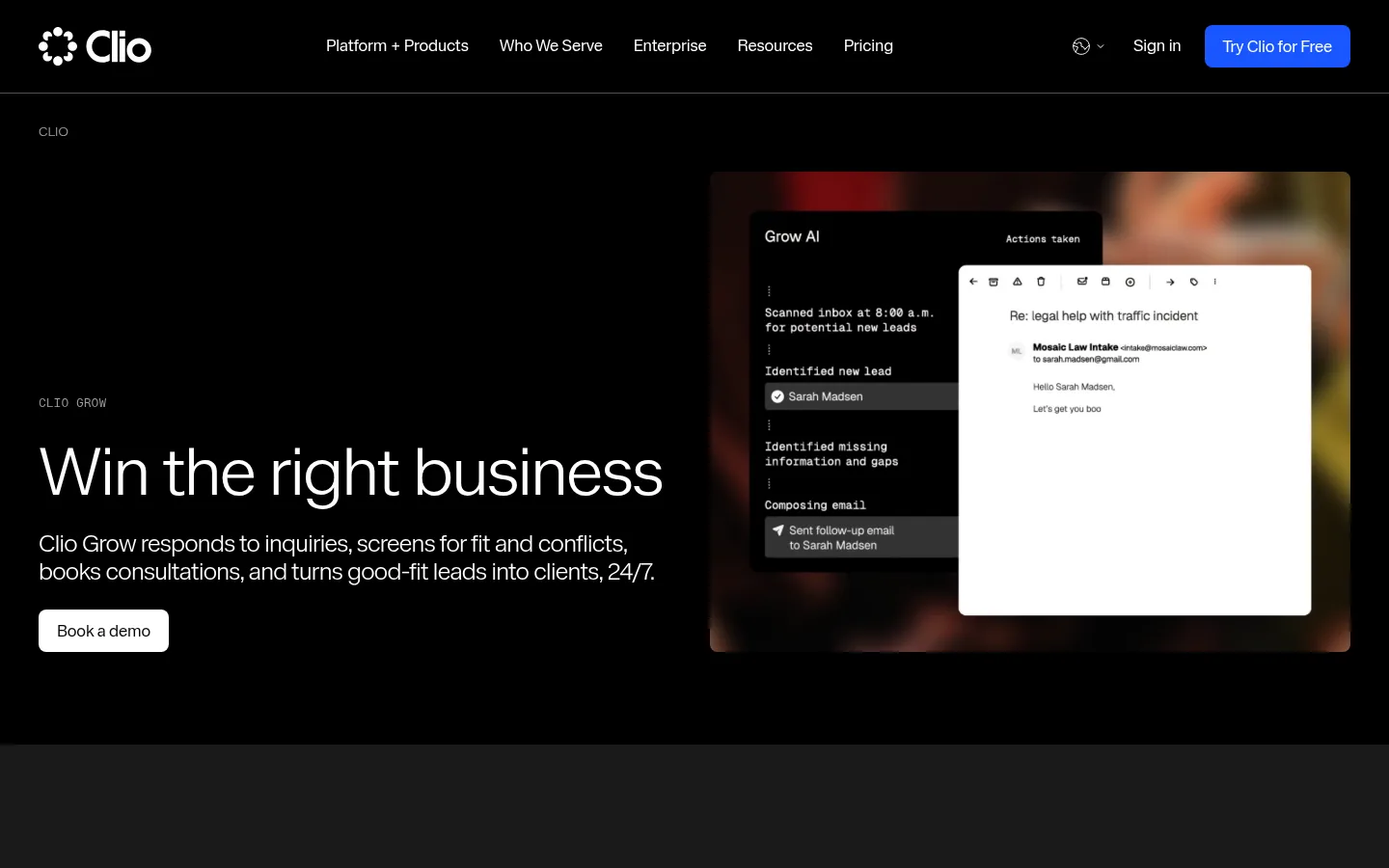
Clio Grow is the intake side of Clio: a lead inbox, intake forms in five languages, online booking and consultation payments, fee agreements sent for e-signature, and a conflict check that searches every contact and matter already in Clio. For a firm on Clio Manage, that conflict search is the reason to look here first.
Grow AI is Clio's answer for the calls nobody picks up. It is available to US firms and billed $25 for each matter it helped with that your firm marks hired, with a monthly target that pauses it once met.
- Conflict search across every contact and matter in Clio
- Intake forms in English, Spanish, French, German and Portuguese
- Grow AI voice agent for after-hours and busy-line calls, in the US
- Online booking, consultation payments and e-signed fee agreements
- Intake answers carried into the matter in Clio Manage without retyping
What Reddit says
32.8 / 100
29 independent mentions in 19 threads, 2020 to 2026, most before Grow AI
Clio Grow is basically the pre-matter side of Clio: lead tracking, intake forms, consults, and getting someone from “potential client” to signed matter in Manage.
The attorneys are okay with Clio Manage, its Clio Grow that has us living out of spreadsheets.
Clio grow does not allow you to schedule video calls through their booking platform, you have to go into manage and add the link to the invite and re-send it.
Pros
- Conflict check across all of Clio
- The AI billed only per hired matter
- One system from lead to matter
Cons
- Clio Grow priced on request
- Voice agent covers missed calls, US only
- Users report clunky automation
5. Law Ruler: A Dialer and Transcripts Built Into Intake
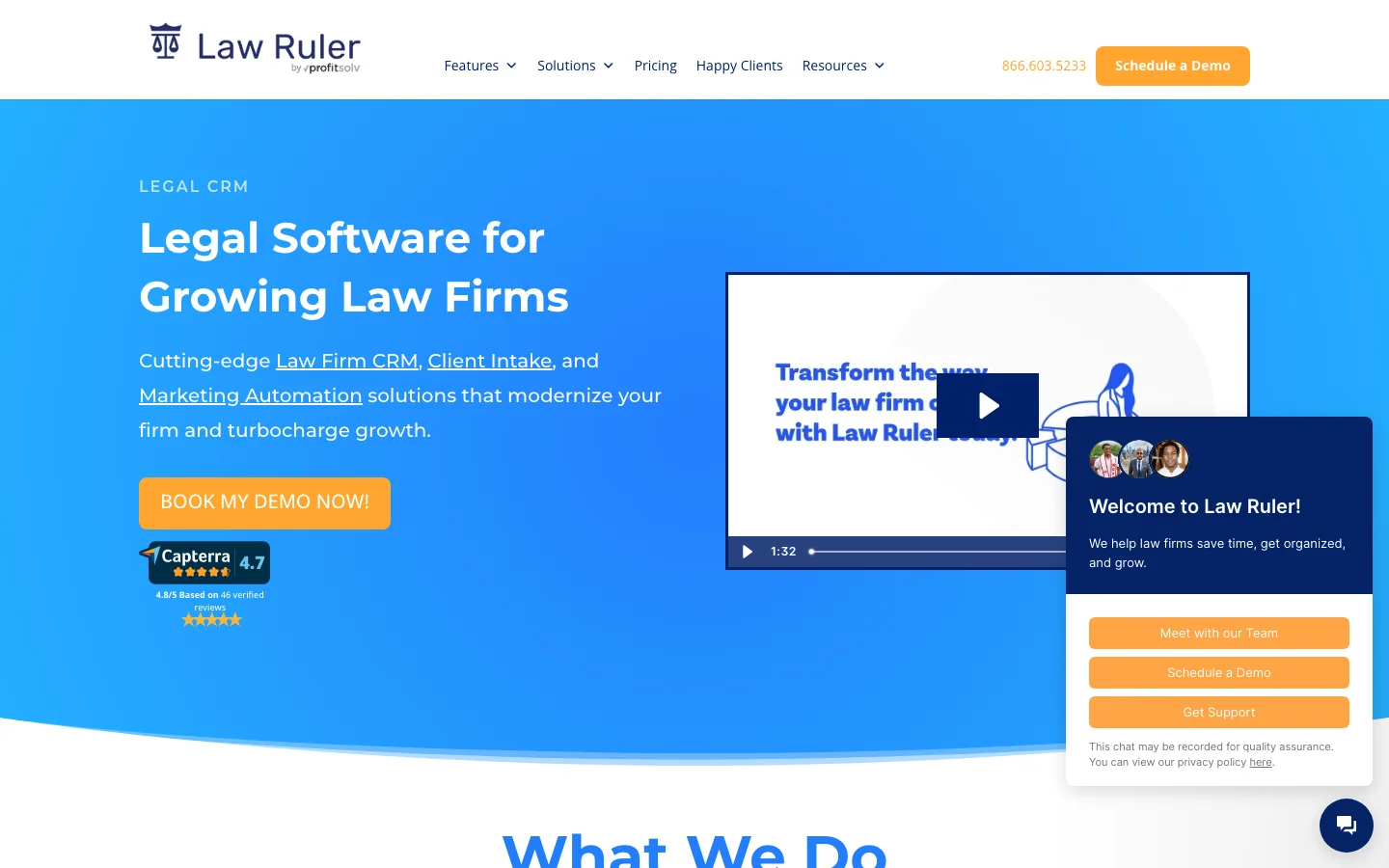
Law Ruler, part of ProfitSolv, is an intake CRM with its own phone. A built-in softphone dialer, call tracking and recording on inbound and outbound calls, and two-way texting sit beside intake forms that score each lead from its answers, document automation and e-signature.
That makes it a natural fit for an intake team that works the phones all day, and its transcripts spare someone the replay. Law Ruler's pages describe no step that moves the caller's answers into the intake form.
- Built-in softphone dialer with call tracking and recording
- Transcript and summary from stored MP3 call recordings
- Lead scores from weighted intake form answers
- Two-way texting, document automation and e-signature
Reddit says little about Law Ruler, five independent mentions since 2018. On Capterra, a partner who has run it for three to five years wrote that its dialer "has continued to improve over the years allowing us to sign more clients for less money", and that "The system operates slow, too frequently."
Pros
- Phone, texting and intake in one system
- Transcripts and summaries from stored calls
- Well reviewed on Capterra
Cons
- Quoted prices, plus an onboarding fee
- No transcript-to-form step described
- Little independent discussion
6. Smith.ai: Every Call Answered, Priced by the Call
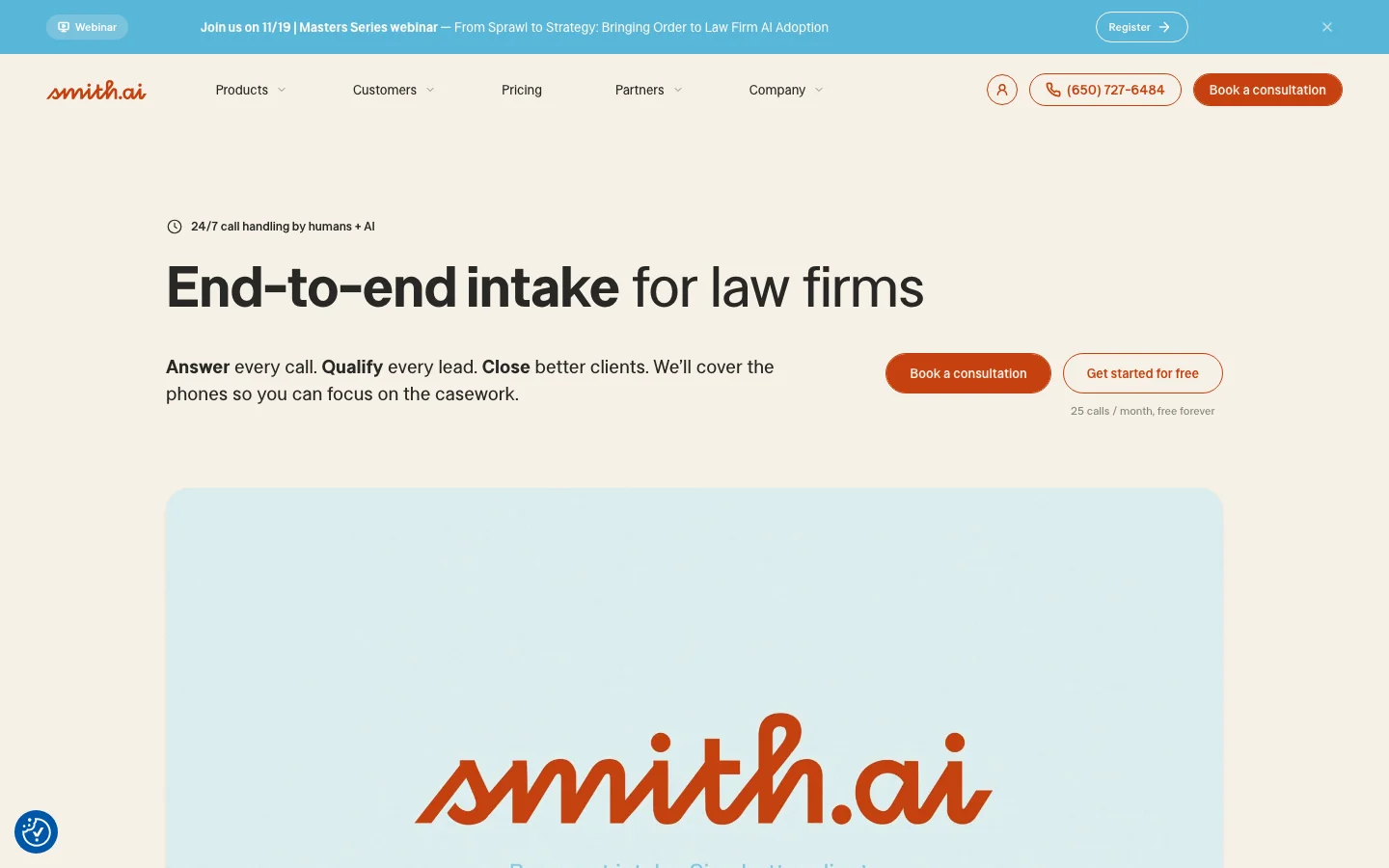
Smith.ai answers your phone rather than running your pipeline. Its AI Receptionist picks up around the clock, screens each caller by matter type and books consultations into your case management system, and live receptionists can be added per call.
It connects natively to Clio Grow and Clio Manage, as well as Salesforce and HubSpot, so it can sit in front of one of the systems above rather than replace it. Its plan prices are on its own page, which is rare on this list.
- AI Receptionist answering day and night, in English and Spanish
- Screens by matter type and books into your calendar or case system
- Every call recorded and transcribed, with a structured summary after it
- Native connections to Clio Grow, Clio Manage, Salesforce and HubSpot
- Live receptionists as a per-call add-on
What Reddit says
65.2 / 100
23 independent mentions in 12 threads, 2022 to 2026, most about its live receptionists
ALL calls to the firm go through to them. If it’s a current client they’ll buzz me and ask me if I want it or not. They get rid of telemarketers. They do intake.
You have to be watchful of things like a lead needing urgent help and calling 5 times. That’ll cost you $50 plus.
I don't use smith.ai because they wouldn't send retainers if asked and did not integrate the way I wanted with my CMS.
Pros
- Plan prices published
- Answers routed calls day and night
- Plugs into Clio and the major CRMs
Cons
- Per-call billing adds up on repeat callers
- Covers only the calls it answers
- Users report uneven receptionist quality
7. Intaker: Chat and Text That Hand You the Caller
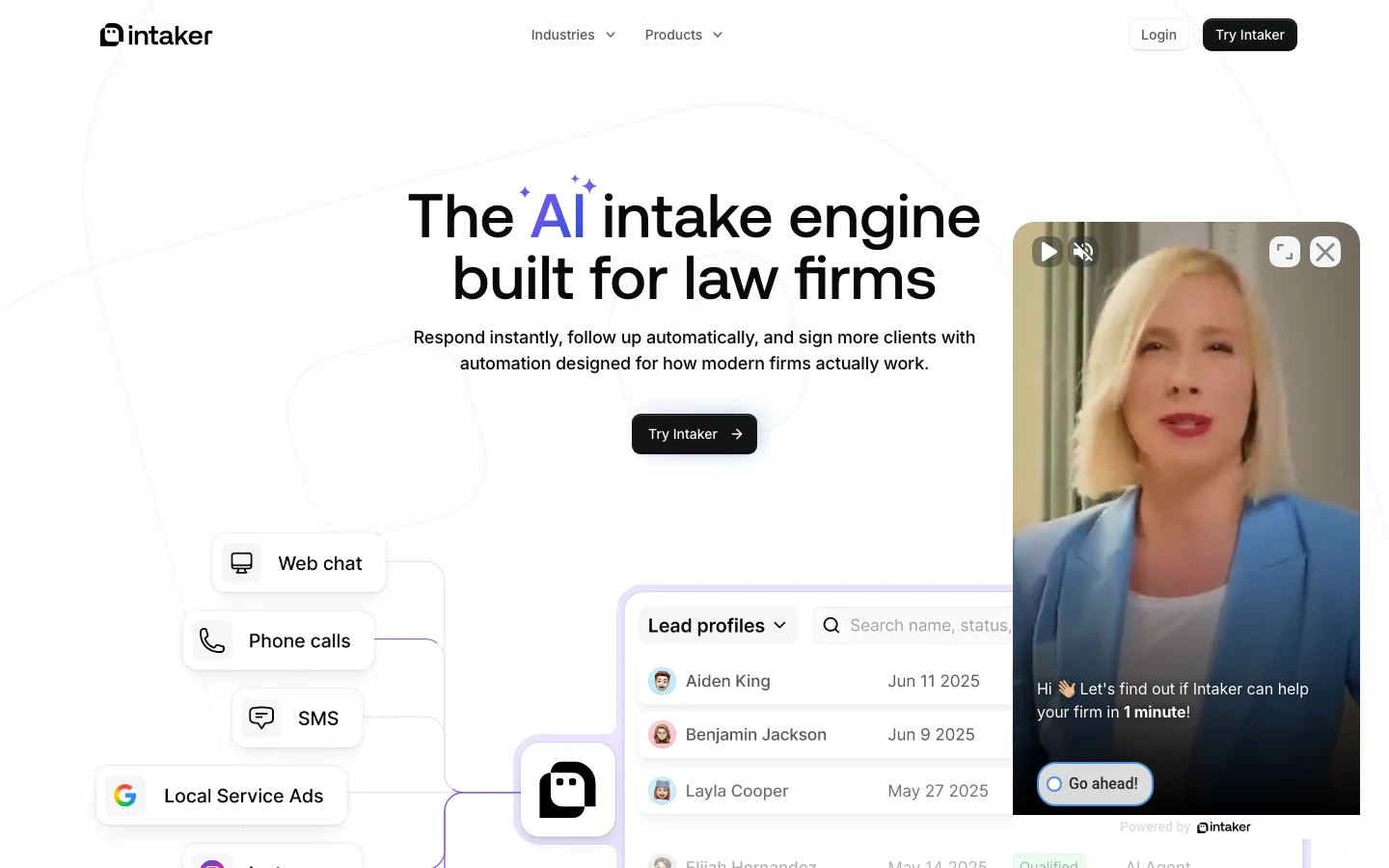
Intaker works the website and the text thread: video chat on your pages, AI agents that qualify leads over text and on calls from Google's Local Services Ads, one inbox for chat, texts, calls and tasks, and workflows that follow up on their own.
It suits a firm whose inquiries start on the website. Intaker publishes no price, and with two reviews on G2 and three on Capterra, the review sites have too little to read.
- Video chat on your website that qualifies and books
- AI agents for text and for Google Local Services Ads calls
- One inbox for chat, texts, calls and tasks
- Retainers sent for e-signature when a lead qualifies
What Reddit says
Three independent mentions, all in one 2024 thread about website chat: too few to score
Intaker is the best in my opinion, but is pricier than most.
Truth be told, our firm still sees far more engagement with forms and calls than the chat services.
Pros
- Strong website chat and text intake
- Retainers out for e-signature on qualification
- Fast handoff to a live person
Cons
- No published price
- Built around chat and text more than calls
- Too few reviews to judge
The Difference Between Them Is What Happens to the Call
| System | What it does with an inquiry call | Start with it if |
|---|---|---|
| Custom AI agents by Qvery | Writes each recorded call into your own form, open questions and conflict names listed | Your people answer the phones and your intake system stays |
| Lead Docket | Answers with AI or takes notes on staff calls, and fills Lead Docket's fields | You run Filevine, or are moving to it |
| Lawmatics | Logs calls and transcripts that phone integrations send | You want rule-driven automation and will invest in the setup |
| Clio Grow | Its AI agent answers missed calls, screens and books (US) | Your matters already live in Clio Manage |
| Law Ruler | Records calls in its own dialer; transcript and summary on request | Your intake team works the phones all day from one screen |
| Smith.ai | Answers the calls routed to it, then records, transcribes and summarizes them | You need every call answered without adding staff |
| Intaker | Rings your team when a chat lead qualifies | Most of your inquiries start on your website |
On forms, follow-ups, booking and e-signature these systems overlap. Several now take calls with AI: Clio's Grow AI when your team is busy, Smith.ai on the calls routed to it, Filevine's LOIS Voice on every line pointed at it, Intaker's agent on calls from Google's ads.
What each one heard lands where that product sends it: a Lead Docket lead, the Clio Grow inbox, Smith.ai's summary and the CRM it is wired to.
What Happens to the Calls Your Own People Answer
If your firm records its calls, it already owns the pieces: a phone system that saves them, an intake form, a conflict check, and people who answer because the first conversation matters. Between them sits the write-up. Someone replays the recording, types the answers into the form, works out what nobody asked and copies the names into the conflict search.
That write-up is the job our agents take, and the table below follows one voicemail, invented for illustration, from the call to the file.
| On the call | In the intake file |
|---|---|
| The caller spells her last name | Her name as spelled, with the minute |
| A truck hit her car last Thursday | The incident and its date, as she said them |
| She names the company the driver works for | The company listed for the conflict check; the driver's name added to the callback list |
| She mentions a hearing next week | Moved to the top for the lawyer on duty |
| Nothing about insurance or treatment | Marked not said, and both added to the callback list |
When the lawyer walks out of court, that file is waiting with a short script that asks only the open questions. The lawyer edits it and makes the call, and whether to take the matter stays their decision.
At Qvery, we help law firms spend less on intake and call inquiries back sooner, with custom AI agents that write up recorded calls and list names for conflict checks.
The agents open only the recordings your firm agrees to in writing, before anything is connected, and that agreement names every outside service that touches the audio and where files are stored. A log shows each recording opened. No caller's recording trains a model serving another customer, and you decide how long recordings are kept.
 Piotr BabelPartner @ Qvery
We start from your intake manual and your form, not ours, and turn them into rules the agent follows: what counts as an answer to each question, and what it writes when the caller never said it. Then we run your closed calls beside your team's own notes, and new calls go to the agents only when the two agree.
To see what one of your own calls becomes, drop a recorded inquiry call or voicemail, with your intake form if you have one, into the agent below. The filled file comes back by email.
The Hours After the Call Are the Cost to Count
Intake software is priced by the seat, a service like Smith.ai by the call, Clio's Grow AI by the matter hired. None of those prices covers the hours your people spend after the calls they answer themselves.
Paralegals and legal assistants earned a median $62,890 a year in May 2025, by the Bureau of Labor Statistics' national count. If four people on your intake desk spend a quarter of their week replaying and typing up calls, an assumption to swap for your own count, that is one full-time person's work, about $62,890 a year at that median.
 Vlad ShvetsPartner @ Qvery
Before you replace an intake system, count the hours after the call: the replays, the typing, the names copied into the conflict search. If that number is small, buy the software that answers more calls. If it adds up to a salary, the system you have is probably fine, and the write-up is the job to hand over.
Working with us on intake starts with what you already have. We take your intake manual, your conflict-check fields and a set of closed inquiry calls, the messy ones included, and the first files come out within about two weeks, written beside your team's own notes until they match.
Once the files match what your team would write, new calls and voicemails flow to the agents as your phone system saves them. Your callers notice nothing different, and your intake desk spends its hours on the live calls instead.
Frequently asked questions
What is legal intake software?
Software that carries a new inquiry from first contact to a signed client: it captures the lead from the phone, a web form or chat, asks the intake questions, prepares the conflict check, books the consultation and sends the engagement letter for e-signature. Smith.ai and Intaker sit in front of it, on the phone and the website.
Does Clio include intake software?
Clio Grow is Clio's intake product: lead inbox, intake forms, booking, fee agreements for e-signature and a conflict search across Clio. It is included in Clio's Elite plan and sold as an add-on for Core and Signature, priced on request, and Grow AI's phone, web and email agents are billed $25 per hired matter.
How is intake software different from practice management software?
Intake runs the time before a matter exists; practice management runs the matter itself, with its calendar, documents and billing. Clio pairs Clio Grow with Clio Manage, and Filevine pairs Lead Docket with its case management. MyCase builds intake forms and a legal CRM into its Pro plan rather than selling them separately.
How much does legal intake software cost?
Lawmatics, Lead Docket and Law Ruler quote each firm, and Intaker publishes no price. Clio starts at $49 a user a month, with Clio Grow priced on request and Grow AI at $25 per hired matter. MyCase's Pro plan, intake included, is $100 a user a month billed yearly or $120 monthly. Smith.ai charges $0 for 25 calls a month, $150 for 75 and $500 for 300.
Can intake software run a conflict check?
Clio Grow searches every contact and matter in Clio before the consultation, and MyCase includes conflict check tracking on every plan. Qvery's agents list every name a caller gave, spelled as said, and leave the check itself to your firm.
Can AI answer a law firm's intake calls?
Yes. Clio's Grow AI answers the calls your team misses, in the US; Filevine's LOIS Voice answers for firms on Lead Docket; Smith.ai's AI Receptionist answers every call it is given, and Lawmatics' Merlin Engage is in beta. Each asks your intake questions, screens the caller and can book the ones who qualify, then puts what it heard into its own system or the one it is wired to.
Is AI intake allowed under the ethics rules?
The American Bar Association's first guidance on generative AI, Formal Opinion 512 of July 2024, applies the rules lawyers already follow: competence, confidentiality, which extends to prospective clients, communication and reasonable fees. State bars may add their own guidance, so the firm's counsel reads it for the states it practices in.
Do callers need to be told the call is recorded or handled by AI?
Some states require every party to agree before a call is recorded. Filevine's voice agent announces recording by default, and Clio tells firms to check their jurisdiction's rules on disclosing AI. Qvery's agents work only on recordings your firm already makes, under the notice your callers hear today.
Can intake software fill the intake form from a call?
Lead Docket can, through LOIS Voice, when the agent's questions were imported from Lead Docket. Law Ruler and Smith.ai write transcripts and summaries, and Lawmatics stores the transcripts its phone integrations send. Qvery's agents fill your own form, in whatever intake system you keep, and list what the caller never said.
What happens to inquiry calls that come in after hours?
In the early-2026 study of 1,000 personal injury firms, 40.9% did not answer after hours. Clio's Grow AI takes those calls by forwarding, Smith.ai answers around the clock, and Filevine's voice agent can handle an after-hours call normally or take a message. Intaker texts back missed accident calls.
Can intake software handle Spanish-speaking callers?
Filevine's voice agents speak English, Spanish and French, Smith.ai's AI Receptionist speaks English and Spanish, and Clio Grow builds intake forms in five languages. Law Ruler transcribes in English, French or Spanish. Qvery's agents write a Spanish call out as spoken and return the file in English, with the caller's own words beside each answer.
Do Qvery's agents answer the phone?
No. They work after the call, on the recordings and voicemails your phone system saves, so your people or your answering service still take the call. A firm that also wants every call answered can put an answering route in front and let the agents write up what it records.
What if a call is hard to hear?
A stretch too muffled or crossed to make out is marked with its time, and that question goes on the callback list instead of being guessed. A bad line costs the lawyer a question on the callback, never a wrong answer in the file.
Will the agents score callers or turn anyone away?
No. They never rate a matter, score a caller, quote a fee or say whether someone has a case. The file holds what the caller said, what they left out and who they named, and your lawyers decide.