
On this page
An injury demand waits on the medical records and bills behind it. Take an injury firm of about 200 people: getting them can mean around a thousand records requests a month, the example this page works through.
Each request the firm sends for a client needs a signed HIPAA authorization, the release form the client signs, in a shape the provider will accept. It has to reach the provider the way that provider takes requests: a portal, a fax, or the outside company it uses.
Then someone has to know when the reply is due, and follow up when it isn't there.
Most of that lands on paralegals. When the desk falls behind, the choice looks like a retrieval company that charges by the request, or another records clerk on the payroll.
| Route | Who pays | One request costs |
|---|---|---|
| Your paralegals, by hand | The firm | $30.91 of staff time |
| Your paralegals, with our AI agents | The firm | $20.02, the agents' running cost included |
| A retrieval company at its published fee | The client, from the settlement | $45, before your staff's own time on it |
On numbers like those, outsourcing doesn't make records cheaper. It moves the cost from your payroll onto every client's settlement, at a fee higher than the request costs your own people, and the requests still wait on the same hospitals.
Keep the requests in your office and give the checking, the log and the follow-ups to AI agents. The cost per request falls, no clerk joins the payroll, and the client's bill doesn't grow.
The case is weaker for a small office with nobody on records and a handful of requests a month, where a vendor's fee is small money. And a provider that takes requests only through an outside platform gets them that way, whatever you decide.
At Qvery, we help law firms spend less on medical records, with custom AI agents that check each authorization before it goes and track every request to its due date.
A Retrieval Company Charges More Than the Request Costs You
Every route pays the provider's own charge for the copies, and many states cap what a provider may bill a law firm. The question is who does the work around the request, and what that work costs.
Retrieval companies price that work by the request, and some publish it. Software for doing it yourself is priced by the seat.
RRS, LlamaLab and Arctrieval pricing pages (November 2026)
Volume firms negotiate below those rates, and some vendors price by the case. On your own side, the work is counted in minutes.
Take the example firm's 1,000 requests a month, with 40 minutes of a paralegal's time on each over its life. That covers checking the authorization, sending it the way that provider wants, logging it, working out when it's due, the calls and follow-ups, and checking what came back. The minutes are our assumption.
The Labor Department's pay survey for May 2025 puts paralegals and legal assistants in legal services at a mean $67,500 a year, and benefits run to 30% of what private employers pay in total. Over a 2,080-hour year that's about $46.36 an hour, and a 40-minute request costs the firm $30.91.
A vendor's $45 is more than that, before the minutes your people still spend on each request it handles.
With our agents taking the logging, the due dates and the written follow-ups, the same request takes 25 minutes of a paralegal on our assumption and costs $20.02, the agents' running cost included. Put your own volume, minutes and pay in.
Medical Records Request Tracking ROI Calculator
What Each Records Request Costs Your Firm, And With The Agents
Saved Per Year
$130,680
3,000 hours handed back, after $8,400 a year to run it
- Hours Handed Back
- 3,000 hours a year
- Agent Running Cost (Estimate)
- $700 a month
- Payback Per $10,000 Of Build
- 0.9 months
On these numbers, each request costs $20.02 instead of $30.91, the agent saves $130,680 a year after its own running cost, and every $10,000 of the build is earned back in 0.9 months.
On the example, the desk's year falls from $370,880 of paralegal time to $240,200, about $130,680 less, and the agents pay back each $10,000 of build in 0.9 months.
That's cash where the 3,000 hours handed back stand in for a hire: roughly a clerk and a half the firm doesn't add as its caseload grows.
If your cost per request by hand comes out above a vendor's fee, the vendor is the cheaper way to get the work done, whoever pays, and this argument loses.
A file clerk on the mean $22.06 an hour clerks earn in legal services, about $31.51 with benefits, makes your side cheaper still: $21.01 a request.
The Best Case for a Vendor Is Who Pays
A vendor's invoice names the client and the matter, so it's a case cost the firm advances and takes back from the settlement. A paralegal's afternoon on hold is overhead, and the American Bar Association's ethics opinion 93-379 says a lawyer may not charge a client for the overhead of staffing an office.
So a vendor takes the work off the firm's payroll, and its cost rises and falls with the caseload instead of sitting in salaries through a slow quarter. Paralegals who use a good one describe a records clerk they never had to hire.
What Reddit says
Paralegals and lawyers on retrieval companies and in-house requests
It’s like having a dedicated records clerk. It saves so much time for basic record and bill requests.
None are great and all require follow up
I stopped using the third-party vendors for my requests and started submitting directly to the source anytime I could. Once in a while I'd run into one that required it. My results improved immensely, but it was a bit more work
This is why we have a dedicated records clerk, two of them.
That much holds. If the only number you watch is the firm's payroll, a vendor can beat the agents on it, and for an office with nobody on records it settles the question.
The client still pays. On a client treated by eight providers, $45 a request is $360 out of their check before a page is copied, and the firm carries it until the case resolves.
Across the example's 12,000 requests a year, $45 each would put $540,000 on clients' files before a single provider's charge.
The bar's model rule lets a lawyer make repayment depend on the outcome, so on a case that loses the cost can stay with the firm. One vendor offers credit back on cases a firm drops.
 Vlad ShvetsPartner @ Qvery
A vendor's invoice feels free because the client repays it at settlement. It's still $45 or more a request on the client's side of the ledger, and the forms only your client can sign again still come back to your paralegals. If your own cost per request is lower, keep the requests and give your team AI agents for the tracking. Send a vendor only the providers that force you to.
Speed is the claim to test on your own providers. Many hospitals hand records requests to outside release-of-information companies, the firms a hospital pays to answer them, and a vendor's request waits on the same ones yours does.
One vendor advertises records back in four days on average. The co-founder of another, who ran a hospital's release department for 12 years, says no company can make a provider release records faster than it is willing or able to.
What the fee surely buys is someone else's calls and a status page. Your people still decide what to order, get the client's new signature when a form comes back, and check that what arrived is complete.
The Rejections Only Your Firm Can Fix
Whoever sends a request, it goes out on the authorization your intake produced. Federal rules list what a valid one must show, and a form missing any of it is not valid.
- The records, described specifically
- Who may release them, and who may receive them
- What they're for
- An expiration date or event
- The client's signature and the date, and a representative's authority if someone signed for them
- The required statements: the right to revoke, whether care depends on signing, and that the records may be shared again
Some rejections are the provider's misreading. One release company read a client's signature date as the expiry; another said a redisclosure statement was missing when it was item four. A paralegal on the phone fixes those.
Others start in the firm. One paralegal took over a case where three rounds of subpoenas to more than 60 providers had all come back with no records, because of a misspelled name, a wrong date of birth, and forms nobody had dated or signed.
A vendor can't fix those without you. A new signature means a call to your client, and only your firm has that relationship.
So the check belongs before the request leaves, on every form, against your own list. At 1,000 requests a month, that check is a job of its own.
 Piotr BabelPartner @ Qvery
An agent checking authorizations is only as good as the checklist it compares them with, so we start from yours: the elements your attorneys require, the forms the large providers insist on, and the rules that set each due date. When a request has no rule behind it, the agent marks it unknown on the chase list rather than inventing a deadline your team would then trust.
What Qvery's AI Agents Do With Each Request
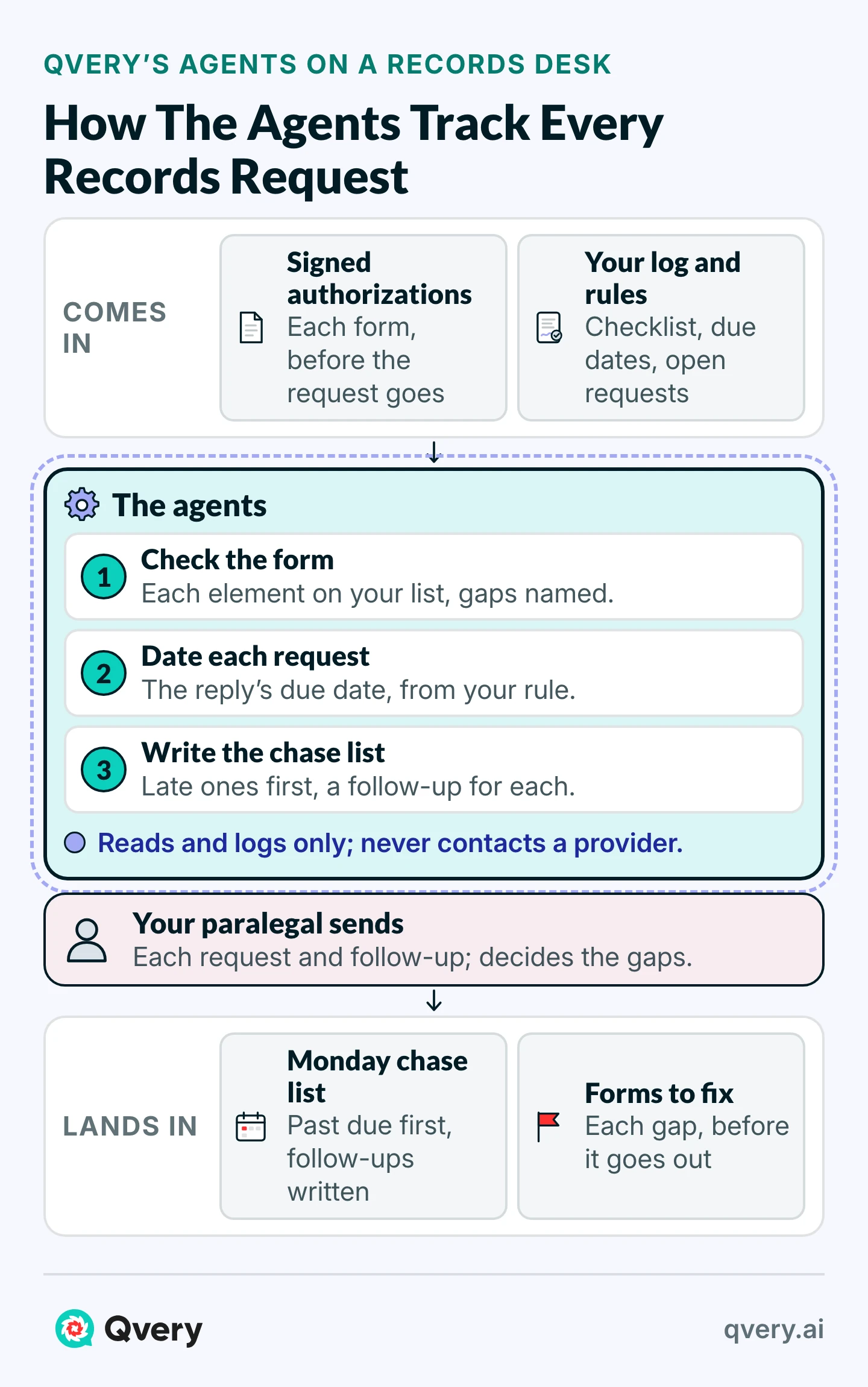
Our agents start before the request leaves. Each signed authorization is read against your firm's own checklist, and a form missing an element goes back to the paralegal with the line it's missing.
Every request is then logged with its provider, its route and the date it went, and the agents work out when each reply is due from your rules.
Every Monday your paralegals get the week's chase list, late requests first, each with its follow-up written for that provider's route: the portal message, the fax cover, the letter.
For a client's own request for their records, federal rules give the provider 30 days from receiving it, plus one 30-day extension if it says why in writing.
For a request on an authorization, federal rules set no deadline: the date is whatever your state sets, or the follow-up target your own policy uses. Where no rule gives one, the agents say so instead of guessing.
| The agents | Your paralegals and attorneys |
|---|---|
| Check each signed authorization against your checklist | Decide whether a form with a gap will do |
| Log every request with its provider, route and date | Send every request and every follow-up |
| Work out each reply's due date from your rules | Call, resend or subpoena |
| Write the Monday chase list and the follow-ups | Check that what came back is complete |
The agents never contact a provider.
If your team already uses request software for the forms and the follow-up notices, the agents work beside it, and beside your case system: they read each signed form against your checklist and each open request against your rules.
These are your clients' medical records. Before the agents open your case system, your firm signs off on which records they may read and where that data is kept.
They start on a copy of your request log, every check and date they write is logged, and nothing reaches a provider until a paralegal sends it.
The quickest test is the last authorization a provider sent back to your desk: the check shows whether the gap was on the form or in the provider's reading of it.
Keep the Requests in Your Office
A firm of this size, sending hundreds of requests a month, should keep them in its own office and give the checking and the tracking to AI agents. It should pay a retrieval company only for the providers that take requests no other way, and for sworn certifications its team doesn't produce.
A retrieval company doesn't make your records cheaper. It moves the bill from your payroll to your client's settlement, at a higher price than your own team costs you.
A small office with nobody on records can buy the vendor's calls, or a seat of software, and should.
Working with us on it starts with your request log as your team keeps it, your authorization checklist and the person who owns it, and your rules for when each provider owes a reply. In the first week we turn those rules into a table with your records manager.
Within two weeks the agents write a chase list beside the one your team builds by hand, and your records manager compares the two line by line. In weeks three and four they check every new authorization beside your paralegals.
From the fifth week, once your records manager is satisfied with the lists, they run on every request. Each month we count with you the hours your paralegals got back and the bad forms that never went out.
At closing, the difference shows on the settlement statement: the providers' charges are still there, and the retrieval fees aren't.
Frequently asked questions
How much do medical records retrieval services charge?
Most charge a service fee per request, with the provider's own copy charges passed through on top. RRS publishes $45 a request, and LlamaLab $50 a facility request plus $150 a case. Others quote by firm, and volume firms negotiate. Request software is sold by subscription, from $155 a month for one user at Arctrieval.
Can a law firm pass records retrieval costs on to the client?
A vendor's invoice for a client's matter is a case cost the firm can advance and recover from the settlement, as the retainer allows. Staff time is overhead, which the American Bar Association's ethics opinion 93-379 says a lawyer may not bill to a client. Your state's rules apply on top.
How long does a provider have to send medical records?
When the client asks for their own records, federal HIPAA rules give the provider 30 days from receiving the request, plus one 30-day extension with a written reason. A law firm's request on a signed authorization has no federal deadline: state law sets one where it does, and your firm sets its own follow-up targets.
Can clients request their own records to save money?
A client's own request carries the patient fee limits: for electronic copies kept electronically, a provider may charge a flat fee of up to $6.50. Since a 2020 federal court ruling, those limits don't apply when the client directs the records to a third party such as your firm. The records go to the client.
What does a release-of-information company do?
It's the outside company a hospital or clinic group pays to answer records requests and bill for the copies. Many hospitals use one, so a request from your firm and a request from a retrieval company both wait in the same queue, under the same state fee rules.
What if a provider insists on its own authorization form?
The agents check each form against your checklist, which can carry the forms particular providers require. When a provider asks for its own form or a fee, the request goes on a paralegal's list with what the provider asked for. Getting the client's signature on a new form is your firm's job.
Do the AI agents send the requests or call the providers?
No. They check each authorization, log every request, work out its due date and write the follow-ups. A paralegal sends every request and every follow-up, and your attorneys decide whether to resend, call or subpoena.
What happens when a provider answers that it has no records?
The answer goes in the log with its date, and the request stays on the chase list until a paralegal closes it or sends it again. Your paralegal decides which: a misspelled name or a wrong date of birth on the request is worth checking first.
Can the agents tell whether the records that came back are complete?
Not in this job. Whether a set of records is complete depends on the case, and that judgment stays with your paralegal. The agents log the date the records arrived and keep the request open until the paralegal marks it done.
Do billing records need their own request?
Often. A provider can keep its bills in a different department, or with an outside billing company, so medical records and bills from one provider can be two requests. The agents log and date each one separately, and a vendor that charges by the request bills each one too.
Does it work with our case management system?
The agents start on a copy of your request log, the way your team keeps it today, so nothing in your live system changes while your records manager compares their chase list with the team's. Read access to your case system comes next, once your firm has signed off on what they may read.
How much do the agents cost to keep running?
In the example, about $700 a month at 1,000 requests: $300 of hosting, logs and upkeep, and about 40 cents a request of model usage, our estimate. It follows your volume. The build is priced once, with what it delivers written down, before any work starts.
Should we keep a retrieval company at all?
Keep one for the providers that take requests only through an outside service, and for sworn certifications and affidavits your team doesn't produce. Send it that short list, and the agents track those requests beside the rest.
How soon do the agents run on our requests?
The first working agents write a chase list beside your team's within two weeks of access to a copy of your log. In weeks three and four they check every new authorization beside your paralegals, and from the fifth week, once your records manager is satisfied with the lists, they run on every request.