On this page
An estate planning practice drafts the same set for most clients: a revocable trust (a trust the client can change), a pour-over will (a will that sends anything left over into it), powers of attorney for money and health care, and a health care directive. Someone adapts the firm's forms to each family, and an attorney re-reads every page before the signing.
Say your practice signs 40 plans a month. Each set takes about three hours to draft and an hour and a half of attorney review: 180 hours a month, about $161,000 a year at the Bureau of Labor Statistics’ mean pay for paralegals and lawyers with benefits.
At Qvery, we help law firms cut what drafting and re-reading estate plans costs and put their attorneys back on the clients' decisions, with custom AI agents that assemble each plan from your approved clauses, prepare the state-law checks and keep trust funding on a list until it is closed.
Each document is only as good as one state's law lets it be. It has to follow the state that governs the plan, as that law stands on the day of signing, in language the firm has approved, and it has to be signed the way that state requires.
When one of those slips, the mistake can sit unnoticed through the signing and surface at incapacity or death, when the client can no longer fix it and the firm answers for it.
What the Agents Assemble and What an Attorney Clears
The source of every draft is the firm's approved wording, kept in one place, and the agents' job is assembly inside it, never writing from what a model remembers.
The agents take a matter the day its intake is complete, assemble the set, run the check that shows every change from the approved text, fill the check table and attach the governing state's signing sheet.
| Check | What it catches | What the agents prepare | What the attorney clears |
|---|---|---|---|
| Which state governs | The wrong state's rules | Every fact pointing to another state | The governing state |
| Is the law current | A statute or figure that moved | Each clause's statute and approval date | Nothing changed since |
| Is it the approved wording | Text added, dropped or reworded | The check against approved text | Each change outside a field |
| How this state requires signing | A plan that fails at signing | The state's signing sheet | Each line, at the signing |
The state the client lives in is the start, not the end. A house in a second state, or a client about to move, can bring a second state's law into the plan; the agents list every such fact from the intake and the attorney decides what follows.
Signing differs too: New York, for one, wants the will signed at the end and signed by at least two witnesses within one thirty-day period.1
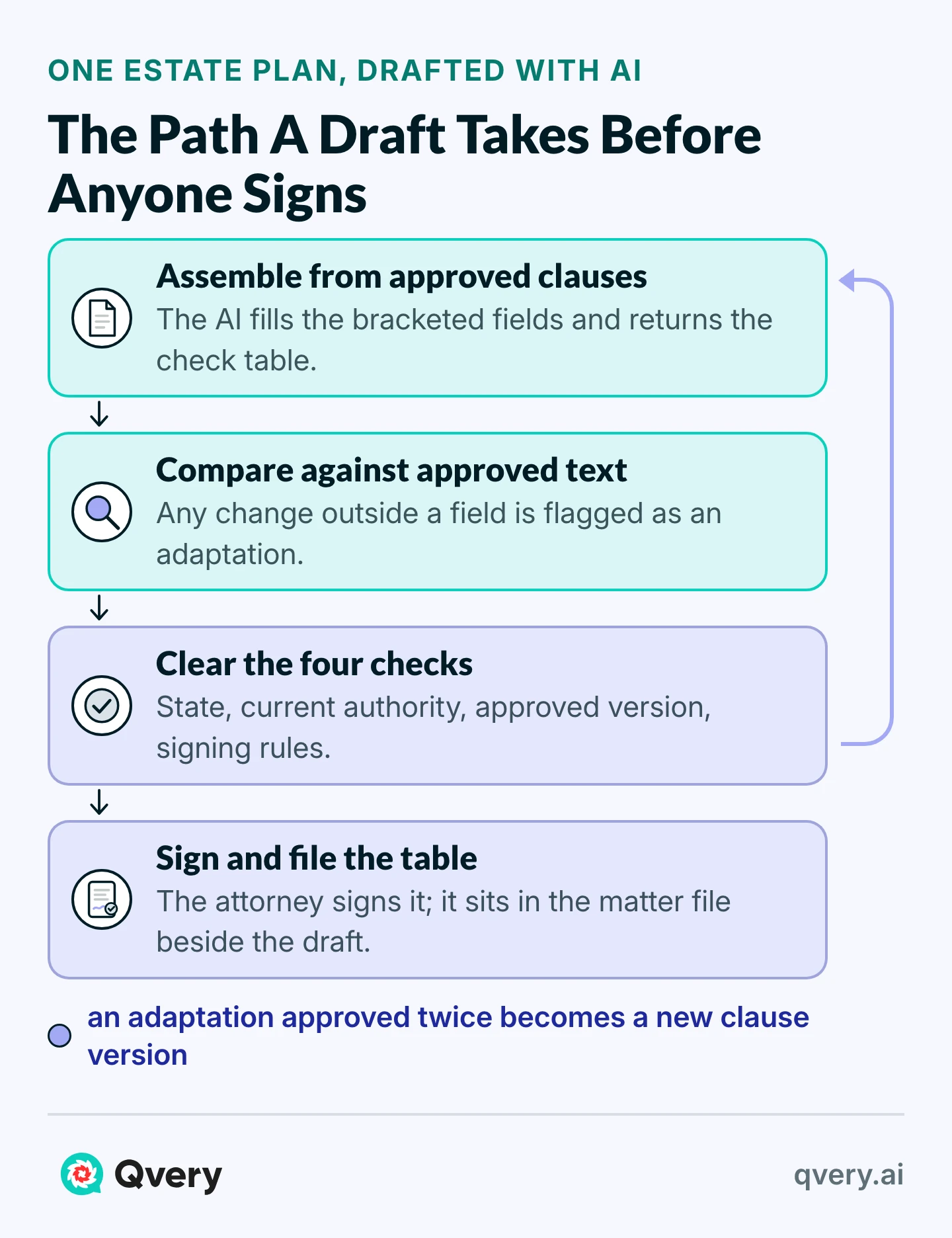
Nothing goes to a client from the agents. The attorneys keep the decisions: they clear each check and sign the table, which becomes the matter file's record of who confirmed what. What the agents may read and do is set in a written agreement, your data is processed where that agreement says, and every action the agents take is logged.
Nobody Owns Trust Funding After Signing
A revocable trust controls only what is titled to it; anything not moved into the trust's name before death, and passing by no beneficiary form, will likely have to pass through probate, the court process for settling an estate.2 Most of the moving is in the client's hands, so the firm hands over instructions at signing, and the follow-through belongs to nobody.
From the day of signing, the agents read the asset schedule from the intake and the signed plan, draft the letter for each institution (which the attorney reviews before it goes out) and the deed request, and report every week which rows are still open. A person closes each row from the institution's own statement, never from a date the agents inferred.
| Asset | What moves it | Who acts | Closed by |
|---|---|---|---|
| The home | A deed naming the trustee, who manages the trust3 | Attorney | The recorded deed |
| Bank and brokerage accounts | The institution's ownership forms | Client, from the firm's letter | A statement naming the trustee3 |
| Retirement accounts and annuities | Usually not retitled; beneficiary forms per the plan4 | Client, on the attorney's instruction | The administrator's confirmation |
| Life insurance | A beneficiary form naming the trust, where the plan says so3 | Client | The insurer's confirmation |
| Anything acquired later | The same decision, each time2 | Client tells the firm | The next plan review |
The calculator prices the drafting for that practice: one paralegal at about 120 hours a month, about 69% of the year. At about $99,600, the Bureau of Labor Statistics’ mean pay for paralegals with benefits, that is about $68,724 a year.
With the agents bringing drafting from about three hours a plan to one, about 67%, at about $400 a month to run, it costs about $27,479, saving about $41,245 a year and 962 hours; $10,000 of build pays back in about 2.9 months.
Review against the table also falls from about an hour and a half to an hour and a quarter a plan, about $15,300 a year of attorney time on top. Each figure is our assumption, to replace with your own.
Estate Plan Drafting ROI Calculator
What Assembling Estate Plans From Approved Clauses And Preparing The State-Law Checks Costs You, And What An Agent Saves
Saved Per Year
$41,245
962 hours handed back, after $4,800 a year to run it
- Hours Handed Back
- 962 hours a year
- Agent Running Cost (Estimate)
- $400 a month
- Payback Per $10,000 Of Build
- 2.9 months
On these numbers, the agent saves $41,245 a year after its own running cost, and every $10,000 of the build is earned back in 2.9 months.
Every week the agents run, your partners see attorney review minutes per plan and mistakes caught ahead of a signing, from a clause reworded outside its brackets to a second state's property nobody flagged.
What the First Two Weeks Look Like for Your Estate Group
Bring a sample of the sets you draft most and your approved clauses. We spend the first days with the people who draft and review today, have the agents running real plans within two weeks once access is in place, and train the attorneys who clear their checks.
Frequently asked questions
Can AI draft a will or trust correctly for my state?
It can assemble one from clauses your firm has approved for that state and flag everything that depends on state law. Whether the document is valid turns on the governing state's law and how it is signed, which an attorney confirms. Treat the output as a draft until the four checks are cleared.
Which estate planning documents can AI draft?
The set most practices draft for most clients: a trust the client can change, a will that sends anything left over into it, powers of attorney for money and health care, and a health care directive. The agents assemble each from the firm's approved wording; what the family wants stays with the attorney.
Why shouldn't AI draft from what it already knows?
A general model writes from its training data, which can be incomplete or out of date for one state's law. And a model told only to fill in a precedent can add and drop definitions while the result still reads well.
How do we build a clause library if we don't have one?
We build it with your senior trusts-and-estates attorney: AI reads a few dozen of your signed plans for one state and lists every distinct version of each clause together, and the attorney picks the approved wording and owns it from then on.
What should an attorney check in an AI-drafted estate plan?
Which state's law governs, whether the authority behind each state-dependent clause is current, whether every clause matches the firm's approved text, and the governing state's signing requirements. Have the AI hand over each as a table, so the attorney confirms instead of searching.
How do we know the AI kept our approved wording?
Don't ask the AI. The check that shows every change from the approved text does it: every change should sit inside a bracketed field, and anything else is an adaptation the attorney approves or sends back.
When does a second state's law enter an estate plan?
The state the client lives in is the start, not the end. A house in a second state or a client about to move can each bring another state's law in. The agents list those facts from the intake; the attorney decides what follows.
Do will signing requirements differ by state?
Yes, in ways a clean draft never shows. New York, for one, wants the will signed at the end and signed by at least two witnesses within one thirty-day period. Keep one signing sheet per state you draft for, and have the agents attach the right one to every plan.
Can clients paste their trust documents into ChatGPT?
Nothing stops them, and it carries a privilege risk. Your engagement letter should list what never goes into a public AI tool: names, amounts, family conflicts and drafts.
Can AI track trust funding after signing?
Yes, as a list. The agents read the asset schedule, draft the institution letters and the deed request, and report open rows every week. A person closes each row from the institution's own statement, and the deed stays the attorney's work.
Do the agents send anything to the client?
No. Nothing goes to a client from the agents. Every letter is reviewed by the attorney before it goes out, and the attorneys clear each check and sign the table.
What does Qvery build for an estate planning practice?
We help law firms cut what drafting and re-reading estate plans costs. The custom agents we build assemble each set from the firm's approved wording, run the check against the approved text, fill the check table and attach the signing sheet, and we report attorney review minutes per plan and mistakes caught before a signing every week.
Sources
- New York State Senate: Estates, Powers and Trusts Law § 3-2.1: Execution and attestation of wills (2026)
- Illinois State Bar Association: Your Guide to a Living Trust (2017)
- The Florida Bar: The Revocable Trust in Florida (2026)
- Oregon State Bar: Revocable Living Trusts (2020)