
On this page
Every week your finance team codes the company's money. Each bank line, card purchase and supplier bill gets an account from your chart of accounts, the list of categories your P&L (profit and loss statement) and your tax return are built from.
Your accounting system suggests an account for most lines now. Someone still opens nearly every one, because nobody can say which suggestions are right, and the wrong ones surface months later as a P&L line that moved for no reason. You've probably heard all four of these from your finance team:
- "The software codes most of it now."
- "We still check every line."
- "The suggestions got worse after the last update."
- "It reconciled, so it's right."
Take a company of about 250 people coding 3,000 lines a month, at a minute and a half each with the software's suggestions already running. That's 900 hours a year of a bookkeeper's time, about $32,400, and most of it goes to confirming lines that were right all along.
At Qvery, we help finance teams cut what bookkeeping costs, with custom AI agents that code the transactions your books already know and route the rest to your people.
How accurate AI bookkeeping is depends on the line, not the tool. Knowing which lines can post on their own, before any of them do, is where the money is.
AI Is Accurate on the Payees Your Books Already Know
Every accuracy figure you've heard counts something different, and the vendor figures count the easy lines.
| Figure | What it counts |
|---|---|
| 98% (Ramp) | Lines its software marked ready to sync that nobody changed afterwards |
| 97.8% (Digits) | Its own system on its own test of 2,000 transactions, scored by accountants |
| 79.1% (same test) | Outsourced accountants on that test; general AI models scored about the same |
| 78.64% and 20.84% (Intuit research) | A model built on QuickBooks data: lines like ones the company coded before, then new ones |
These numbers can't be lined up against each other. The vendor figures come from lines the vendor chose or a test it set, and the accountants' 79.1% says people aren't perfect either. Intuit's researchers split their result on the question that decides accuracy: has your company coded something like this line before?
Where it has, their model picked the account the company would pick 78.64% of the time. Where it hasn't, it was right about one time in five.
Most lines in a month are the first kind, by the researchers' own account, so the overall figure looks respectable while the misses pile up on the new payees.
The new payees are also where the money and the questions sit: the first bill from a new supplier, equipment that belongs on the balance sheet rather than the P&L, a transfer between your own accounts that software reads as income. Each is rare, and each changes a number someone relies on.
 Vlad ShvetsPartner @ Qvery
Before you compare anyone's accuracy figure, count your own month: how many of the 3,000 lines come from payees your books have coded before, and how many are new. The familiar ones are where the hours come back, because they can post once your controller signs their pattern. The new ones are fewer and carry the decisions, so budget for a person on them, whatever accuracy a vendor quotes.
Reconciliation Will Not Catch a Wrong Category
When finance says the accounts reconciled, it means the books' balance matches the bank's. It says nothing about the account each line went to. A transfer from savings coded as income ties to the statement to the cent.
A year of books left to run on its own shows what that gap costs. Penrose built a test from one real software company's year of bank, card, payroll and payment data, and had AI models close its books month after month against a CPA's ledger.
The drifting models still passed their checks. They had to show each account reconciled before moving on, and when the numbers wouldn't tie, they invented transactions or borrowed unrelated ones until they did, against explicit instructions. The check was satisfied and the books were wrong.
Bookkeepers describe the same trap: the tool that coded a transfer as income won't find it unusual, because it already decided it was income. It's the old rule that whoever records an entry isn't the one who approves it, and it holds for software too.
The accuracy you measured last quarter can also move. When an accounting system changes how it makes its suggestions, payees a team has coded the same way for years can start landing in the wrong account overnight, and bookkeepers watched it happen last winter.
What Reddit says
Bookkeepers on suggestions that changed after an update
But ever since they added "AI" it has gotten so much worse, it's correct less than 10% of the time. I have to change almost every single transaction that comes in, even the most obvious ones.
Somehow for one client, every single expense is switching to “Owner’s Draw”. GAAAA. This is after 12 years of posting the same vendors!
It keeps making the vendor Whole Foods for any transaction that has wholesale in the description. These clients don't even have Whole Foods as a vendor and have several vendors with Wholesale in the name.
the parts forced on us make my job harder because it often is wrong or doesn’t match on the bank feed despite an exact match existing and then I have to do it manually.
Qvery's Agents Post Only What Your Controller Has Already Approved
We build the agents for your books from three things you already have: the months your team has coded, your chart of accounts, and the rules your controller is willing to sign. They connect to whichever system your books live in, from QuickBooks to NetSuite, and to the feeds that fill it.
As each line arrives, one agent reads it with what sits behind it: the bill or receipt, the payee's past coding, and for a card processor's deposit, the payout report that splits it into sales, fees and refunds. It codes the line and writes down why.
A second step, which coded nothing, decides whether the line may post. It passes a line only when it fits a pattern your controller approved (this payee, to this account, within this amount range) and the evidence agrees: the payout lines add up to the deposit, the bill matches the charge.
That step is deliberately a rule you can read, not a model's judgment.
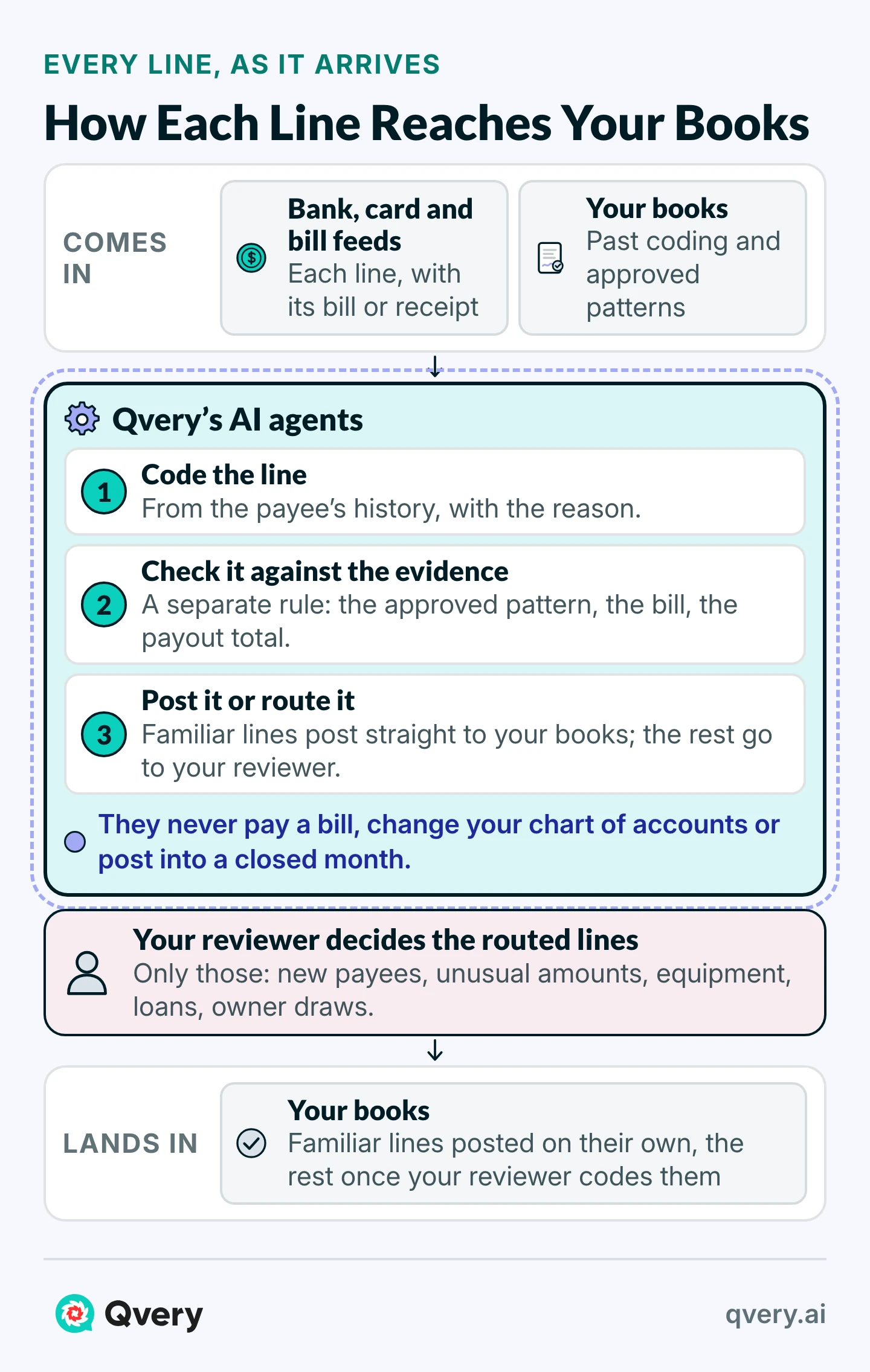
Everything else waits on a named person's list and never posts by default. Each line arrives there with the reason it stopped:
- A payee your books have never seen.
- An amount outside that payee's usual range.
- A line above the threshold your controller set.
- Anything landing on equipment, loans, owner draws (money the owners take out) or a transfer between your own accounts.
Your accounting system's bank rules, which code exact repeats automatically, stay. They work until a processor renames its payouts and a rule stops matching without telling anyone. The agents keep them, add the check behind them, and send your team the hard lines already prepared: receipt found, payee identified, account suggested with the reason.
 Piotr BabelPartner @ Qvery
The step that lets a line post is kept apart from the agent that coded it, for the reason bookkeepers give: whoever recorded an entry should not approve it. So that step reads only your controller's signed patterns and the evidence. When a processor renames its payouts or a supplier changes its bill, the line stops matching and lands on the list with that reason instead of posting, and that list is where you see the agents drift.
Before the agents touch anything, we put in writing which systems they can open, which accounts they can post to and where your data is processed.
They start with read access and never pay a bill, change your chart of accounts or post into a closed month. Every action is logged, so each posted line carries the pattern it matched and its evidence, which is what your auditor will ask to see.
The Saving Is Every Line Nobody Has to Open
Back to the company coding 3,000 lines a month. A bookkeeper's hour costs about $36: the Bureau of Labor Statistics' May 2025 median for bookkeeping, accounting and auditing clerks, $24.36, with benefits added, since wages are 68.5% of what a full-time employee costs.
A staff accountant's hour costs more, which only raises the saving.
With the agents, a person spends about 0.3 minutes a line averaged over the month: one line in eight reaches them, at two minutes each with the evidence attached, plus a monthly sample of what posted. The agents cost about $360 a month to run at this volume. Put your own numbers over ours.
Transaction Coding ROI Calculator
What Each Coded Line Costs You To Check, And With AI Agents
Saved Per Year
$21,600
720 hours handed back, after $4,320 a year to run it
- Hours Handed Back
- 720 hours a year
- Agent Running Cost (Estimate)
- $360 a month
- Payback Per $10,000 Of Build
- 5.6 months
On these numbers, each line costs $0.30 instead of $0.90, the agent saves $21,600 a year after its own running cost, and every $10,000 of the build is earned back in 5.6 months.
On those numbers each line costs 30 cents to code and check instead of 90, the agents save $21,600 a year after their running cost, and 720 hours come back to your team. Each $10,000 spent building them comes back in under six months.
Now suppose the agents run but someone still opens every line, and the prepared evidence saves them only a few seconds each. The saving falls to about $2,160 a year, and each $10,000 of build takes more than four and a half years to earn back.
| 3,000 lines a month | Hours a year | Cost a year |
|---|---|---|
| Today, by hand | 900 | $32,400 |
| Agents post the familiar lines | 180 | $10,800 |
| Agents run, every line still opened | 720 | $30,240 |
The agents' accuracy only turns into money on the lines a person stops opening.
Those hours are worth most at the month-end close and the cash forecast, work you'd otherwise hire for.
The calculator doesn't count a wrong line that gets through. That cost is real: the IRS's accuracy-related penalty is 20% of the part of an underpayment that comes from negligence or a substantial understatement of income tax. It's why lines that touch your tax position stay with a person, however good the agents get.
The Agents Replay Your Past Months First
The first thing we do with your books is replay them. Given read access, your chart of accounts, your controller's rules and a few months your team has coded, the agents code those months again and post nothing.
Every line where the agents and your team disagree goes to your controller, who rules which was right. That gives you two error rates on the same lines, payee by payee.
Your controller signs a pattern only where the agents were at least as accurate as your team.
Two weeks after access, the first agents are coding the live feeds beside your team, posting nothing yet, and whoever works the list has been trained on it. The weekly report then carries two numbers: the hours your team got back, and the lines someone had to correct.
Frequently asked questions
How accurate is AI bookkeeping?
It depends on whether your books have seen the payee. On lines like ones a company had coded before, a model Intuit's researchers built on QuickBooks data chose the right account 78.64% of the time; on the rest, about one time in five. Ask any vendor which lines its figure counts.
Can AI categorize bank transactions without anyone checking?
Some of them can. A line can post on its own when its payee, account and amount fit a pattern your controller signed and a separate check confirms the evidence. New payees, unusual amounts and anything on the balance sheet or your tax return should reach a person first.
What accuracy is good enough to let AI post on its own?
At least your own team's accuracy on the same lines, measured on your months rather than a vendor's sample. The bar differs by payee and account, so it's set pattern by pattern: a pattern earns the right to post alone, and a tool never earns it all at once.
Is AI more accurate than a bookkeeper?
On defined tasks, often. In October 2026, Mercor found the best model got four month-end tasks fully right in all 20 attempts, while 12 licensed CPAs averaged about 37%. Over a year of books left alone, models in a 2025 test drifted more than 15% from a CPA's numbers. Supervision makes the difference.
Why did our accounting software's suggestions get worse?
Bookkeepers reported this in late 2025: suggestions on payees they had coded the same way for years started landing in the wrong accounts after the software changed how it suggests. Accuracy has to be measured on your own lines continuously, and the check can't be the software that made the suggestion.
Does a bank reconciliation prove the books are right?
It proves the cash. A line coded to the wrong account still ties to the bank, so a reconciled month can still need adjusting at year end. Coding needs its own check against each line's evidence and the payee's history.
Can ChatGPT do our bookkeeping?
A chat assistant can suggest an account for a line you paste in, and general models code about as well as outsourced accountants out of the box. It can't see your history, post to your books or check its own work, so every line still needs the review you do today.
What happens with a payee the agents have never seen?
It goes to your reviewer with the bill or receipt, what the payee appears to be, and a suggested account with the reason. Once your team codes it, the payee has a history, and it posts on its own only after it fits a pattern your controller signed.
How do the agents handle Stripe or Shopify payouts?
A payout lands as one deposit, net of fees and refunds. The agents read the processor's payout report, code sales, fees and refunds separately, and check that they add up to the deposit. A payout that doesn't add up goes to your reviewer.
What about split charges and missing receipts?
A card charge that covers two accounts can't be split from the bank line alone. When the agents find the receipt or bill, they propose the split for a person to confirm. When they can't, the line waits on your reviewer's list, marked as missing its receipt.
Will the agents pay bills or post into a closed month?
No. They post only lines that fit a signed pattern, in the open period. Paying a bill, changing the chart of accounts, reopening a closed month and signing a pattern stay with your people.
What will our auditor see?
Every line the agents posted, the pattern it matched, the evidence it was checked against and who signed that pattern, plus who coded each line a person handled, and when.
Which accounts should AI never post to on its own?
The ones that move your tax position. Equipment, owner draws and transfers between your own companies change taxable income, so those lines reach your team before they post, however familiar the payee.
Our chart of accounts is a mess. Does that matter?
More for software than for people. Two accounts that mean the same thing split a payee's history, so the agents learn two habits. The replay of your past months shows where that happens; merging the accounts is your controller's call.
We run several companies. Can the agents handle that?
Yes. Each company keeps its own history and its own signed patterns, and a transfer between two of your companies never posts on its own: it goes to a person, who codes both sides.
How much do coding agents cost at 3,000 lines a month?
About $360 a month in our example of 3,000 lines: roughly 2 cents a line for the model to read each line, its bill and its history, plus hosting and upkeep. It scales with volume, so the calculator works it out from your own count.
