
On this page
A guest who writes to your hotel before booking rarely asks one thing. They want to know if there’s a room for their dates, what it costs, whether breakfast is in, whether they can arrive late and what happens if their plans change.
Someone on your reservations desk, or at the front office of each hotel, answers between phone calls and arrivals. What slips through is the part of the email nobody had time to look up.
| What the guest asked | What the reply said |
|---|---|
| Do you have a room for two adults and a six-year-old, May 15 to 17? | The family room’s nightly rate, and nothing on whether it’s free those nights |
| Is breakfast included? | Yes |
| We land late at night. Can we still check in? | Nothing |
| Can we cancel if our flight moves? | Nothing |
A guest who writes before booking is usually still choosing. After a reply like that one, they go quiet, book the same room through an online travel agency that keeps a commission on it, or write again and hand your desk the same email twice.
For a hotel group of about 200 people with 500 booking emails a month, say 15% of guests go quiet after a reply that skipped a question, and three in ten of them would have booked with a full answer. That is 270 bookings a year, $45,360 of margin, from emails your desk already answered.
At Qvery, we help hotel groups recover lost bookings, with custom AI agents that find every question in a booking email and answer each one from your own rates and policies.
A faster inbox doesn’t close this gap. In a software vendor’s 2026 study of 2 million hotel emails, the replies that booked best answered every question and asked for the booking, and the fastest ones were not the best.
Most Replies Leave a Question Out
The clearest count I know comes from southern Brazil. Researchers at a university in Porto Alegre wrote to 116 hotels and inns in 2004 as a couple with a six-year-old, asking four things: is there a room for the weekend, can our child sleep in our room, what’s the rate, and how do we book.
Two thirds replied within 13 days. Of the 77 replies, 18 answered all four questions. The average reply answered 2.7.
Replies Quoted the Rate and Left Out Whether There Was a Room
% of replies
View the data
| Label | Value | Note |
|---|---|---|
| What’s the rate? | 88.3% | 68 of the 77 replies |
| Can our child sleep in our room? | 79.2% | 61 of the 77 replies |
| How do we book? | 57.1% | 44 of the 77 replies |
| Is there a room for the weekend? | 49.4% | 38 of the 77 replies said so in so many words |
| All four questions | 23.4% | 18 of the 77 replies |
The rate is the answer nearly every reply carried, 88.3% of them. Whether there was a room at all, the question the guest needed answered first, was stated in 49.4%. A rate with no room behind it leaves the guest to guess.
That was one region, twenty years ago. A larger test from the same years wrote to 1,733 hotels in Austria: 82.1% replied, in under a day on average, and only 33.3% of the hotels answered every question in the email.
The study that ties replies to bookings comes from a vendor: Altek AI, which sells software that answers hotel email, read 2 million emails at 48 hotels in Europe. Guests who got a reply within 15 minutes booked 37% of the time; guests who waited 15 to 60 minutes booked 46%.
What moved bookings was the content. Replies that said whether a room was free, recommended one, answered every question and asked for the booking were linked to a 58% booking rate, and replies that did none of it to 4%.
About one reply in eight did all four. Altek calls these links, not proof, and so do I.
 Vlad ShvetsPartner @ Qvery
Response time is what reservations desks get measured on, because it’s the easy number to count. Guests don’t book on a timestamp. They book when the reply tells them there’s a room, what it costs, and that their late flight and their six-year-old are fine. I’d count the questions a reply answered before I’d shave another minute off it.
Each Answer Lives in a Different Place
Look at where your desk goes to answer that one email. Each question sends someone to a different place.
- A room and rate: your reservation system, the software that holds every room and rate.
- Breakfast: the rate plan (the terms a price is sold under), or a package’s own terms.
- A late arrival: the hotel’s front office rules.
- Cancellation: the terms of the rate the guest would book, and each rate has its own.
The rate is the one answer the reservation system shows on a single screen. It is also the answer nearly every reply carries.
A group multiplies the lookups. Each hotel keeps its own rules for arrivals, children and pets, often in its own document, and a central desk answering for five hotels needs the right version of each.
Canned replies, the saved templates most desks rely on, answer the question that comes up most and nothing the guest adds to it.
Desks also keep replies short for a good reason: front desk staff say guests skip anything long, then ask again at check-in. A reply can be short and still carry one line for every question the guest asked.
The half answer is what a careful person writes with one screen open and the phone ringing. More templates or a faster inbox leave the lookups exactly where they were.
What Half Answers Cost a Group Your Size
Here is the cost on a typical group, an example and not a client: about 200 people, several hotels, a central reservations desk, 500 booking emails a month. Put your own in: emails a month, the share that go quiet, the share that book and what a stay leaves you.
Booking Email Replies ROI Calculator
What Half-Answered Booking Emails Cost You, And What The AI Agents Win Back
Won Per Year
$40,560
270 more bookings a year, after $4,800 to run the agent
- New Bookings A Year
- 270
- Agent Running Cost (Estimate)
- $400 a month
- Payback Per $10,000 Of Build
- 3 months
On these numbers, answering every inquiry at once wins 270 more bookings a year, worth $45,360, $40,560 after the agent's running cost, and every $10,000 of the build is earned back in 3 months.
On the example, 15% of guests go quiet after a reply that skipped a question, and 30% of booking emails become a stay when every question is answered. With every question answered, the group books 1,800 stays a year from its email instead of 1,530: 270 more, worth $45,360.
Running the agents costs about $400 a month, so the group keeps $40,560 a year, enough to cover each $10,000 of the build in about 3 months.
Both shares are our assumptions. Altek’s hotels booked between 19% and 55% of their email enquiries, hotel by hotel, and 34% of their guests went quiet after an offer for every reason, not only a missing answer.
The $168 a booking is three nights at last year’s US average room rate of $160.54, at the 34.8% gross operating profit margin CBRE measured across 2,216 US hotels. A room that would otherwise sit empty keeps more than that, so the figure is the cautious one.
The calculator counts bookings and nothing else, so three costs of a half answer sit outside it.
| What it leaves out | What it costs the group |
|---|---|
| Guests who book the same room through an online travel agency | The agency’s commission on each of those stays |
| Your desk’s time on every reply | Some 500 hours a year, about $15,600 |
| Guests who write again to ask what the reply skipped | A second email to read, look up and answer |
The hours come from one software vendor’s count at a ten-hotel group: 5 to 10 minutes of lookups and writing for a priced reply. At 7 minutes, 500 emails take about 700 hours a year; checking a draft that already answers everything takes about 2.
The $15,600 prices those hours at $31.23 each: the $21.86 mean wage of reservation agents at US hotels in the federal government’s May 2025 wage survey, with wages at 70% of what an employer spends on a person.
The hours pay off most where they go to calls and to guests who need a person, work you would otherwise hire for.
The second emails are not rare. Lobby, which sells software that automates hotel booking work, found nearly 12% of the email reaching hotels came from guests asking again for something they had already asked, though it hasn’t published how many hotels it read.
Booking emails are one of the travel jobs our playbook prices for a company this size, beside quotes built from rate sheets.
Qvery Writes a Line for Every Question the Guest Asked
At Qvery, we build these agents around the inbox your desk already works in and the files each hotel already keeps.
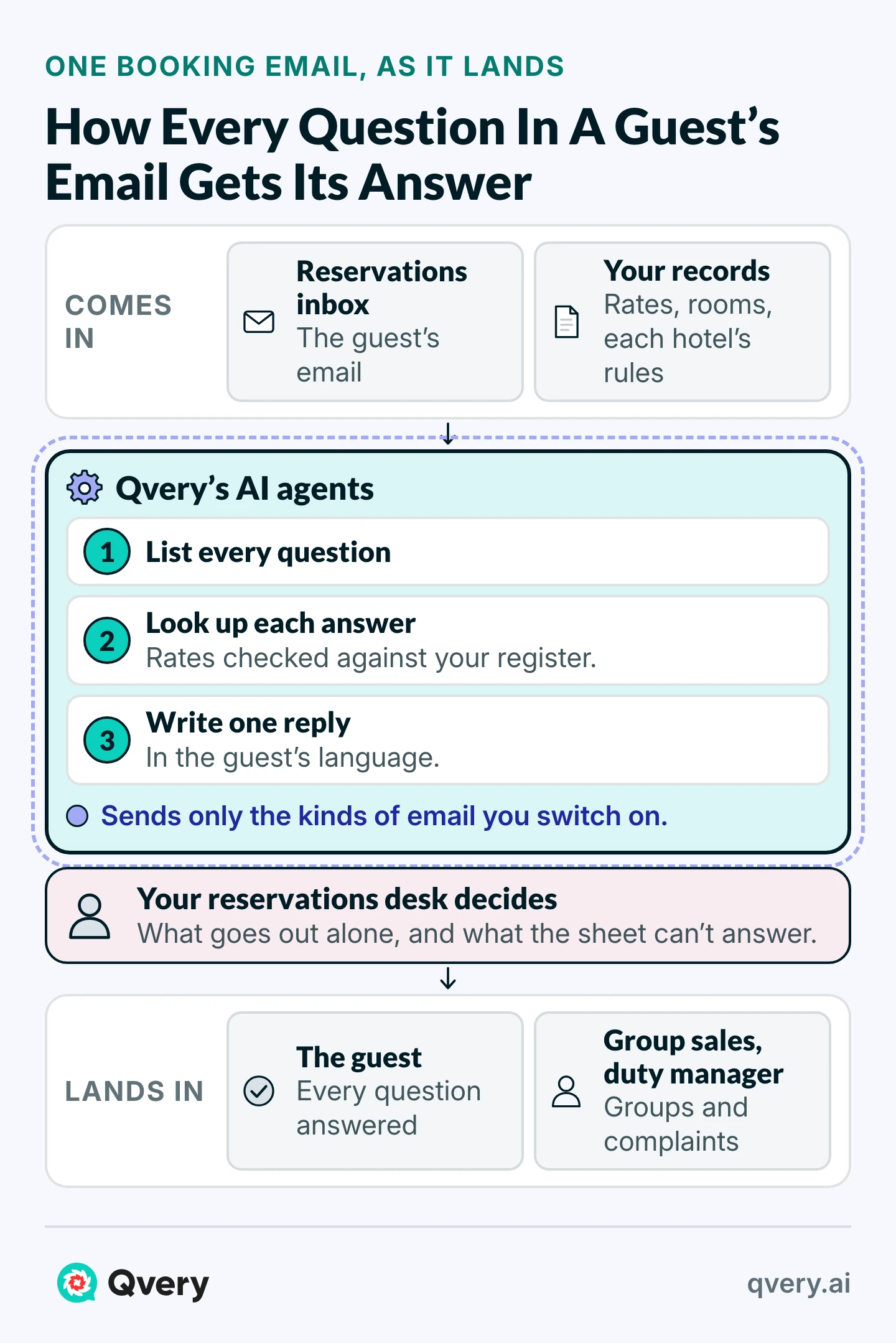
They run on their own, at any hour. An email lands in the reservations inbox, and the agents read it with its thread and any attachment and list every question in it before they write a word.
They look each answer up where it lives: the room and the booking in your reservation system, every quoted rate checked against your rate register, the record your revenue team keeps of what each room sells for. Breakfast, arrival rules and cancellation terms come from your rates and policies sheet.
Then they write one reply in the guest’s language, a line for each question, every sentence tied to the line of the sheet it came from. Here is the opening’s email, answered that way.
| What the guest asked | What the reply says | Where it came from |
|---|---|---|
| A room for two adults and a six-year-old, May 15 to 17? | The family room is free both nights, at the rate for those dates | Reservation system and rate register |
| Is breakfast included? | Yes, in this rate | Rates and policies sheet |
| We land late at night. Can we still check in? | Yes, the desk is staffed all night | The hotel’s arrival rules |
| Can we cancel if our flight moves? | Free cancellation up to two days before arrival on this rate | The rate’s cancellation terms |
A question the sheet doesn’t answer stays in the draft, marked, for your desk. Requests for ten rooms or more go to your group sales manager, and complaints and refund requests to the duty manager.
 Piotr BabelPartner @ Qvery
The sheet decides how far you can trust a reply. Before the agents write anything, we put every rate, package and policy they may quote in one place with your reservations lead, hotel by hotel, and mark who owns each line. When the sheet has no answer, the agents leave the question for your desk, and the gap tells your lead which rule still needs writing down.
To see it on your own inbox, drop in a booking email your desk answered last week, and the agents’ reply comes back to your work email.
Your desk keeps the calls, the groups and every judgment the sheet can’t make, and the lookups behind each answer move to the agents.
If your desk is answering the rate and leaving the rest, we start from the emails it has already sent.
Your Desk Decides What Goes Out Alone
A booking email carries a guest’s name, dates and sometimes a card number, so what the agents may open, and where those emails are processed, is agreed in writing before they open anything.
We start with nothing switched on. The kinds of email that go out alone are the ones your desk has watched the agents answer well.
How Your Desk and Qvery Build the Sheet Together
We start where your desk starts, with the inbox, the reservation system and the rules each hotel keeps, and we need four things from you.
- Your rates, packages and policies for each hotel, and who owns each.
- Read access to the reservations inbox, and permission to save drafts there.
- A hundred past booking emails with the replies sent, the ones that went wrong included.
- About three hours from your reservations lead in the first week, then half an hour a day from a desk lead.
In the first week we turn those into one sheet with your lead, and fix any canned reply that disagrees with it. Within two weeks of access the agents are drafting replies to your real emails, and your desk compares each draft with what it would have sent.
In weeks three and four, the kinds of email you switch on go out alone and everything else waits as a draft. From the fifth week every booking email is answered or drafted as it lands, weekends included.
Every week after that, we count three things with your lead: the questions answered, the guests who had to write again and the hours your desk got back.
Frequently asked questions
Do the agents reply in the guest’s language?
Yes. Each reply is written in the language the guest wrote in, from the same sheet, so a guest writing in Spanish gets the same answers as one writing in English.
Does it work with our reservation system?
The agents read the booking a guest refers to in your reservation system and check every quoted rate against your rate register. Which system they connect to, and with what access, is agreed in writing before the build starts.
What happens with group requests?
Requests for ten rooms or more go to your group sales manager with the email and the questions it asks listed. The agents never quote a group rate.
What if a guest asks for a refund or complains?
Complaints and refund requests go to the duty manager untouched. The agents never answer a complaint and never promise a refund, a discount or a hold.
What if a rate changed yesterday?
Every quoted rate is checked against your rate register when the reply is written. A rate the register doesn’t hold isn’t quoted, and the question goes to your desk.
What if our sheet is wrong?
The agents quote what the sheet says, so each line has an owner on your side. Each week someone on your desk reads a sample of replies against the sheet, and a reply that contradicts it is a fix to the sheet that week.
Will the agents send emails on their own?
Only the kinds of email you switch on, one kind at a time. At first none are, and every reply waits as a draft for your desk.
What about emails that arrive at night or on weekends?
Each email is answered or drafted as it lands, weekends included. A reply you haven’t switched on waits as a draft for the morning shift, already looked up.
How do we see which guests are still waiting?
Each morning the agents list the booking emails still waiting for an answer and how long each has waited, so your desk starts with the oldest.
Do we need a sheet for every hotel?
One sheet holds every hotel’s rates, packages and policies, each line marked with its hotel and its owner. A hotel’s arrival rules or pet policy can differ from the next one without confusing a reply.
What do the agents do with our canned replies?
They read them, and in the first week we fix any that disagree with the sheet, so a template stops quoting last season’s cancellation terms.
Can the agents handle card numbers guests send by email?
They never repeat a card number or an identity document in a reply. How cards sent by email are handled stays your desk’s process.
Does this replace our reservations team?
No. The hours go to the calls, the groups and the guests who need a person. Your desk still decides every reply that isn’t switched on and everything the sheet can’t answer.
How long until the agents answer live email?
Within two weeks of access they draft replies to your real emails. The kinds you switch on go out alone from about the third week, and by the fifth every booking email is answered or drafted as it lands.
What does it take to run the agents?
On this post’s example, about $400 a month: model usage of about 30 cents a booking email, plus hosting and upkeep. It moves with your volume, and the calculator above follows your own count.
How is the build priced?
At a fixed price for a defined result, agreed before any work starts. The calculator shows what each $10,000 of build returns on your numbers, so you can weigh any figure we agree.
What about emails that aren’t new bookings?
The agents first decide what each email asks: a new stay, a change to a booking, a policy question, a group or a complaint. A change is drafted against the booking in your reservation system; groups and complaints go to their owners.
Can we see where an answer came from?
Every sentence in a reply is tied to the line of the sheet or the rate register it came from, and every email and reply is logged, so your desk lead can trace any answer to its source.
What if the hotel is full for those dates?
The reply says so plainly, from your reservation system. Whether to offer other dates or a sister hotel is a rule written into the sheet; a request the sheet can’t place goes to your desk as a draft.
Who keeps the sheet up to date?
You do, line by line: each rate, package and policy has an owner on your side. When a policy changes, its owner changes the line, and the next reply carries it.
What do we review together each month?
A short scorecard: every first email answered, weekend emails answered within a day, every group request handed to sales, no reply that contradicts your sheet, replies in the guest’s language and how many guests had to write again.
