
On this page
- The Desk That Answers the Phone Is Short of Staff
- About Three Hotel Calls in Ten Don't Reach a Person
- Four Consumers in Ten Say They Hang Up Within Two Minutes on Hold
- Most Callers Say They Will Try Someone Else
- Answered Calls That Don't Book Rarely Leave a Way Back
- The Phone Still Books About as Many European Hotel Nights as Hotel Websites
- After Hours, a Quarter of the Mystery Shop's Calls Went to Voicemail
- How Qvery Answers the Calls Your Desk Misses
- What a Thousand Calls Look Like at These Rates
- Frequently asked questions
In many hotels the reservation line rings at the front desk, and whoever answers it is also checking guests in. At night it can ring at the night auditor, who covers the desk and the phone until morning.
A call that rings out shows up in the phone log, if anyone reads it, and nowhere in the booking system.
Calls to hotels and resorts reach a person 69% of the time in the 2026 data of Invoca, a call-analytics company,1 above the 64% for travel as a whole, which already tops the ten industries it measures.2 That still leaves about three calls in ten that reach nobody.
The figures below point to the desk, seen from both ends: who is free to answer, and what a caller does when nobody is.
Most of the call data comes from companies that sell phone software or call answering, so each figure names whose data it is and what it measured.
The Desk That Answers the Phone Is Short of Staff
On the payrolls of US hotels, motels and other traveler accommodation, the Bureau of Labor Statistics counted 242,020 desk clerks in May 2025, against 4,120 reservation and transportation ticket agents and travel clerks.7 That is about 59 desk clerks for every reservation agent. Chains' central reservations offices can sit on other payrolls, so the ratio describes the hotels' own staff.
Across all employers, the desk clerk's mean wage was $17.09 an hour, or $35,550 a year.7 The reservation agents and travel clerks in traveler accommodation earned a mean $21.86 an hour.7
In the American Hotel & Lodging Association's survey of 282 hoteliers, run from December 2024 to January 2025,4 65% of hotels reported staffing shortages, down from 76% in May 2024.4 9% called themselves severely understaffed, down from 13%.4
Front desk roles were the second most named shortage, by 26% of hotels, after housekeeping at 38%.4 71% had openings they couldn't fill despite active searches, six to seven per property on average.4
Front Desk Roles Were the Second Most Named Shortage in US Hotels
share of hotels surveyed
The association's chief executive put hotel employment at nearly 10% below its pre-pandemic level.4 Its next survey, of 246 hoteliers in late February 2026, gives no breakdown by role,8 but more than half still described their properties as somewhat or severely understaffed.8 65% of owners named labor costs as a financial pressure,8 and 70% were offering higher wages to hire and keep staff.8
Wherever the reservation line rings at the desk, the person answering it works in a role hotels name among their shortages, often with a guest at the counter.
About Three Hotel Calls in Ten Don't Reach a Person
Invoca averages the calls its customers track: over 70 million calls in ten industries for its 2026 benchmark.2 Across all ten, 56% of calls reach a person.2 Travel comes first, at 64%, ahead of consumer services at 60%, and telecom comes last at 51%.2
Within travel, calls to hotels and resorts reach a person 69% of the time, and calls to cruise lines 59%.1
Travel Calls Reached a Person More Often Than in Invoca's Nine Other Industries
share of calls answered by a person
View the data
Some calls that reach nobody are misdials and hang-ups in the first seconds, so Invoca also counts by length. Travel calls longer than 15 seconds reach a person 70% of the time, and calls over 30 seconds 73%.1
Even among calls long enough to be someone who meant to call, more than a quarter reach no person.
An older study of hotel brands' own lines measured a different outcome. Marchex, another call-analytics company, analyzed 5.8 million calls to 13 US hotel brands in 2017 and found a 14% failed call rate: calls unanswered, or abandoned in a phone menu, in voicemail or on hold.9 Only 5% went unanswered outright.9
So the 13 brands' lines failed about one call in seven in 2017, and the hotel and resort lines in Invoca's 2026 data reach no person on nearly one call in three.
The studies are nine years apart and count different outcomes, so I read them as a range, not a trend. My guess at the gap is who is on the other end, a brand's reservations team against a property's desk; neither study tests it.
Four Consumers in Ten Say They Hang Up Within Two Minutes on Hold
CallRail, a call-tracking company, asked 1,000 US consumers in 2025 what they do when they call a business.10 On hold, 41% said they hang up after one to two minutes, 30% wait three to five minutes, and only 18% will wait beyond five.10 Long hold times were the biggest complaint for 39%.10
Fewer Than One Consumer in Five Say They Will Hold Beyond Five Minutes
share of consumers surveyed
View the data
Those are answers about any business, not hotels, and they are what people say they do.
Quo, a business phone service, followed 16.7 million missed calls across its customers over three months.5 69% got no callback within 48 hours, and the 31% that did were nearly all returned within a day.5
Quo's own reading is that a callback that doesn't happen the same day rarely happens later. Its data covers the first 48 hours, and it counted a callback only as an outbound call to the caller's number, so a text reply isn't in it.
 Vlad ShvetsPartner @ Qvery
A missed call shows up in the phone log as a number and a time. It never shows up in the booking system, and nothing there says whether that guest booked somewhere else. That's why I'd read the phone log before the marketing budget: every call that reached nobody was someone who found your number and dialed it.
Most Callers Say They Will Try Someone Else
In the same CallRail survey, 82% said they will call a competitor if a business doesn't answer, and 21% said they immediately call another business.10 78% said they had taken their business elsewhere after failing to reach a company by phone.10
42% told CallRail they leave a voicemail, and 24% that they turn to online chat instead.10 Quo counted the voicemails themselves: of more than 18 million missed calls from July to September 2026, only 15% ended in one.11
The two don't measure the same people. CallRail asked US consumers what they do, and Quo counted the missed calls of its own business customers. For a phone line, I'd still plan on the counted figure.
For a hotel, someone else can be the property down the road, or the same room on a booking site.
Answered Calls That Don't Book Rarely Leave a Way Back
At hotels and resorts, 46% of answered calls are leads, callers who want to book, and 38% of those leads book on the call.1 On travel lead calls, booked or not, the person answering asked for the booking on 53% and took the caller's details on 50%.1
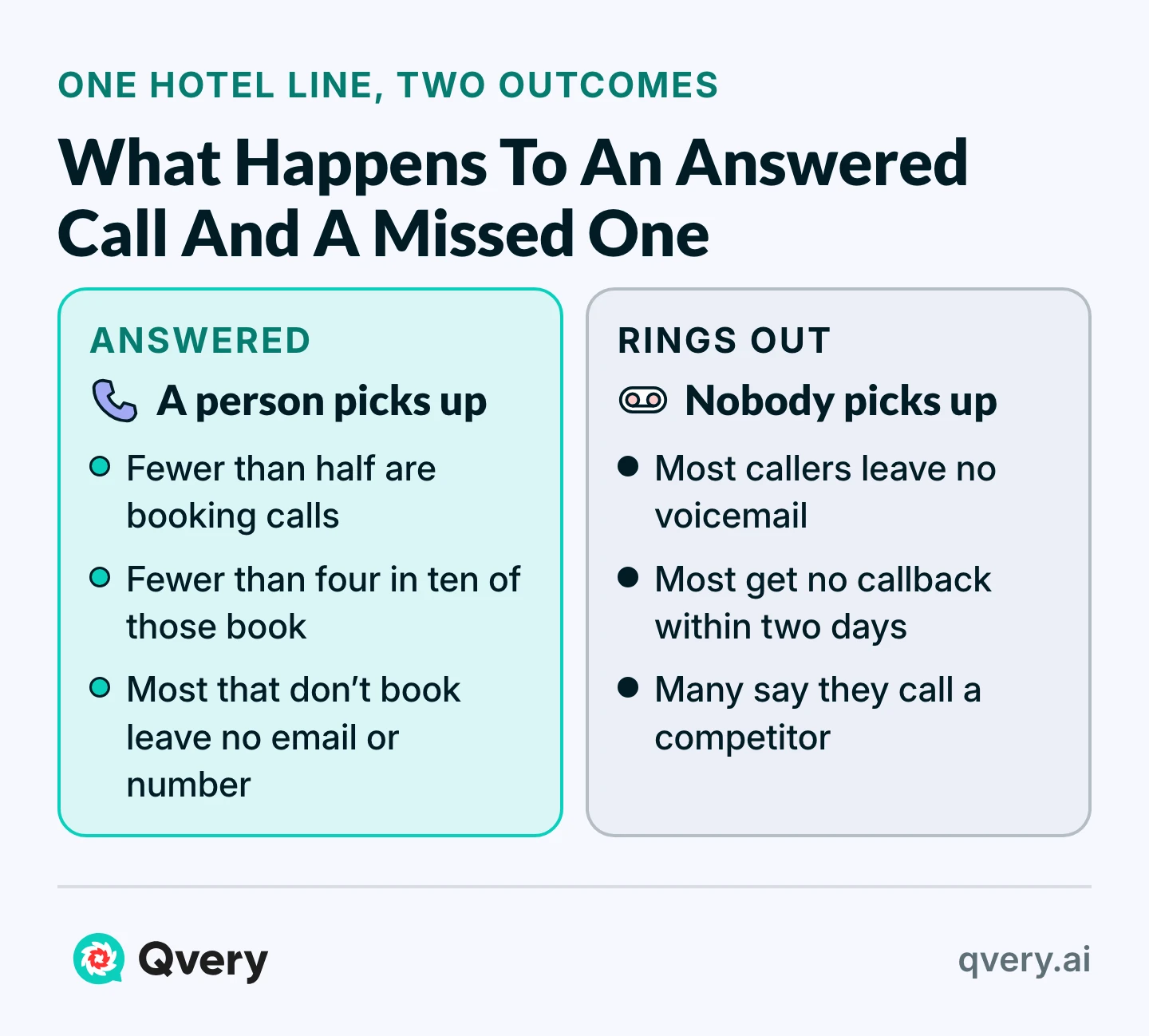
The calls a hotel would want to follow up are the ones that don't book. Revinate, which sells hotels guest-data software and reservation call services, coded those in a 2026 mystery shop: its shoppers placed 308 calls to 135 luxury and upscale hotels in North America.6
Of 258 coded calls that ended without a booking, the hotel captured an email on 4.7%, a phone number on 5.4%, and neither on 92.2%.6
Capture rates differed by who answered. When the front desk took the call, email capture was 0.0%, 0 of 55 calls; with an on-property reservations team it was 4.1%, and with an off-site or central reservations team 10.9%.6
The Front Desk Captured No Emails on 55 Shopped Calls That Didn't Book
email capture rate
View the data
The front desk asked for the reservation on 1.8% of its calls, against 53.6% for off-site teams, and asked no question about the guest's trip on 74.1%.12 Across all the shopped calls, 55.6% had no such question and 22.0% a direct ask.12
Only 41.9% of the properties had a working call recording system,12 so most had no recording to review these calls from.
The Phone Still Books About as Many European Hotel Nights as Hotel Websites
In Europe, the phone's share is measured in nights stayed. HOTREC, the European hotel association, runs a distribution study with HES-SO Valais-Wallis, a Swiss university, and its 2026 edition covers 2,713 hotels in 28 countries for 2025.3
Bookings made by phone brought in 14.1% of hotel nights in 2025, down from 20.5% in 2013.3 Real-time booking on the hotel's own website brought in 13.9%, up from 7.4% in 2013.3
Direct bookings of every kind (the website, email, the phone and walk-ins) brought in 51.3% of nights, and online travel agencies such as Booking.com and Expedia (OTAs) 29.9%.3
The Phone Lost Ground in Europe as OTAs and Hotel Websites Gained
share of hotel nights
View the data
The ten European hotel chains in the study lean on the phone more: telephone reservations brought them 17.5% of nights.3
By country, the phone brought in 19.7% of nights in France and 19.6% in Italy, against 7.2% in Spain.3
A booking taken on the hotel's own website also holds better. HOTREC's hotels reported 9.1% of their website bookings cancelled in 2025, against 11.7% on Expedia and 19.0% on Booking.com.3 On SiteMinder's booking platform, a booking on a hotel's own website was worth US$516 on average in 2025, against US$312 from an OTA.13 Neither study splits out the phone, so read these as website figures, not phone ones.
After Hours, a Quarter of the Mystery Shop's Calls Went to Voicemail
Revinate's shoppers also called after hours, and 26.3% of those reservation calls dropped into a standard voicemail box.14 Quo's logs show how little such a box catches: after hours, 14% of callers to its customers' missed lines left a voicemail, against 16% in business hours.11
US consumers are open to an automated answer. In CallRail's survey, 52% said a business that uses an AI assistant after hours gives better service, 50% would use AI to book an appointment, and 13% wouldn't use AI for any task.10
In HES-SO Valais-Wallis's survey of 1,485 European hotels in early 2025, 82% of them independents,15 reservations were the area named most often for AI, by 68%.15 Time savings was the benefit cited most, by 76%, yet only 41% were using AI at all, and 43% weren't using it.15
How Qvery Answers the Calls Your Desk Misses
A reservation line answered by whoever is free at the desk is the job these figures describe, and it is a job Qvery's agents take.
At Qvery, we help hotel groups put their front desk back on the guests at the counter, with custom AI agents that answer reservation calls and save each booking request.
The agents we build for a hotel group's reservation line pick up the calls that ring out, from the first ring, in three languages. They answer from your own rate register and desk standard: which hotel, dates and room the caller means, which rate applies, which cancellation terms. Each answer carries the line of the register it came from.
When a caller wants to book, the agents write a pending request (hotel, dates, room, guests, quoted total and contact) for your reservations manager to confirm.
A group of ten rooms or more goes to your sales team, and a complaint, a late change or anyone who asks for a person goes to your desk. Every call is transcribed, and each morning your desk gets the list of callers to return, with their language.
They never take a card number by voice, never tell a caller a room is booked, never quote a rate your register doesn't hold, and never hide that they are automated.
You can hear how the agent handles your own rules: give it your rate or policy sheet and your website, or use our sample hotel's website and booking rules.
We keep a scorecard with your desk, counted every week and reviewed with you every month: the calls that reach someone, the callers who rang out and booked on a site instead, the hours a request waits for its callback, and any wrong cancellation terms told. That is how we count the hours handed back to the desk and the errors avoided.
 Piotr BabelPartner @ Qvery
Your rate register decides how far you can trust the answers. So before the agents take a single call, we turn your desk standard and rates into rules, and every answer they give carries the line it came from. When a caller asks for something the register doesn't hold, a group rate or a late change, they take the details and hand the call to your desk instead of guessing.
The agents start on a pilot line beside your desk, and in the first weeks every call is reviewed with your team the next morning, before they take the calls that ring out across your hotels.
What a Thousand Calls Look Like at These Rates
These figures come from different studies, so the fair way to combine them is with the assumptions in plain view. Take 1,000 calls to a hotel line at Invoca's hotels and resorts rates.1 About 690 reach a person; at 46% leads and 38% of leads booking on the call, about 317 are leads and about 121 book.1
The other 310 reach no person. Assume they would have been leads, and booked, at the same rates as the calls that got through, and value each booking at the US$516 average for a booking on a hotel's own website.13
| At 69% reaching a person (hotels and resorts, 2026) | At a 14% failed call rate (hotel brands, 2017) | |
|---|---|---|
| Calls lost before reaching a person | 310 | 140 |
| Would-be leads among them | About 143 | About 64 |
| Bookings not made on the call | About 54 | About 24 |
| At US$516 a booking | About $28,000 | About $12,600 |
The 2017 column counts failed calls, unanswered or abandoned, so it is a floor from a different measurement, not the same rate nine years earlier.9 Some of these callers book later, online or on a second call, and some book the same hotel through an OTA; the arithmetic can't say how many.
Your phone report and your booking records can: the calls offered, the calls that reached a person, the missed calls returned the same day, and how many of those callers' numbers turn up in your reservations a week later. If a hotel sits well under seven calls in ten reaching a person, its line is the one to look at first.
Frequently asked questions
What share of hotel calls go unanswered?
In Invoca's 2026 benchmark of its customers' calls, calls to hotels and resorts reached a person 69% of the time, so about 31% reached no one: an unanswered ring, a phone menu or a voicemail box.1 Travel as a whole reached 64%, the highest of the ten industries it measures.2 An older study of 13 US hotel brands' lines found a 14% failed call rate in 2017, a different outcome measured nine years earlier.9
How do I measure missed calls at my own hotels?
Pull four numbers per hotel from the phone system: calls offered, calls answered by a person, the same count without the shortest calls, and missed calls returned within a day. Invoca filters by length because misdials pad the miss rate; for travel, 70% of calls longer than 15 seconds reach a person.1 Count a callback the way Quo does, as an outbound call to the caller's number.5 Then match the missed numbers against your reservations to see who booked anyway.
How long will a hotel caller wait on hold?
Not long, by what consumers say. In CallRail's 2025 survey of 1,000 US consumers, 41% said they hang up after one to two minutes on hold, 30% wait three to five minutes and 18% will wait beyond five.10 Long hold times were the top complaint for 39% of them.10 The survey covers calls to any business, not hotels alone.
Do callers leave a voicemail or call back?
Few leave a message. Quo counted 15% of callers leaving a voicemail across more than 18 million missed calls on its customers' lines from July to September 2026, and 14% after hours.11 That is far below the 42% of US consumers who told CallRail they leave one.10 The business rarely calls back either: 69% of missed calls got no callback within 48 hours in Quo's data, and almost every callback that did happen came within a day.5 Both come from businesses of every kind, not hotels.
How many hotel bookings still come by phone?
In Europe, bookings made by phone brought in 14.1% of hotel nights in 2025, in HOTREC's study of 2,713 hotels in 28 countries,3 close to the 13.9% booked in real time on hotels' own websites, and down from 20.5% in 2013.3 The study measures shares of nights stayed, not of booking transactions. The ten European chains in the same study took 17.5% of their nights by telephone.3 We found no comparable US figure.
What does a missed hotel reservation call cost?
We found no independent study that measures it; the figures we found came from companies that sell phone answering, so we left them out. Our arithmetic in the table above uses Invoca's hotel and resort rates (46% of answered calls are leads, 38% of leads book on the call) and assumes unanswered callers would have booked at the same rates.1 Per 1,000 calls, that is about 54 bookings, about $28,000 at SiteMinder's US$516 average for a hotel-website booking.13
Should the front desk or a reservations team take the calls?
The one mystery shop we found points away from the front desk. In Revinate's 2026 shop of 308 calls to 135 luxury and upscale hotels in North America,6 the front desk captured an email on none of 55 unbooked calls, and off-site reservations teams on 10.9%.6 The front desk asked for the reservation on 1.8% of its calls, and off-site teams on 53.6%.12 On US hotels' own payrolls, desk clerks outnumber reservation agents and travel clerks by about 59 to one.7
Can an AI agent take a card payment over the phone?
Ours don't. The agents we build for reservation lines never take a card number by voice and never tell a caller a room is booked. They write a pending request with the caller's dates, room, quoted total and contact, and your reservations manager confirms it and takes payment the way your desk does today.
Will guests talk to an AI on the hotel phone?
Half of US consumers say they would book with one. In CallRail's 2025 survey, 52% said a business that uses an AI assistant after hours gives better service, 50% would use AI to book an appointment, and only 13% wouldn't use AI for any task.10 The survey asked about businesses in general, not hotels. Our agents say they are automated on every call and hand anyone who asks for a person to your desk.
Sources
- Invoca: The Invoca Travel Industry Lead Conversion Benchmarks Report 2026 (2026)
- Invoca: The Invoca Lead Conversion Benchmarks Report 2026 (2026)
- HOTREC: European Hotel Distribution Study 2026 (reference year 2025) (2026)
- American Hotel & Lodging Association: 65% of surveyed hotels report staffing shortages (2025)
- Quo: Small Business Callback Statistics in 2026: Data From 16M+ Calls (2026)
- Revinate: The hidden data leak in hotel phone reservations and how to fix it (2026)
- U.S. Bureau of Labor Statistics: Occupational Employment and Wage Statistics, May 2025: hotel, motel, and resort desk clerks (43-4081) and reservation agents (43-4181) (2026)
- American Hotel & Lodging Association: Rising Cost, Staffing Challenges Persist for Hotels as Travel Demand Expected to Hold Steady (2026)
- Marchex: Marchex Institute Study Finds Hotel and Cruise Industries Lose Significant Volume of Customers Due to Poor Call Handling (2018)
- CallRail: Why businesses can't afford to miss calls (2025)
- Quo: Why Only 15% of Callers Leave a Voicemail (2026)
- Revinate: We secret-shopped 135 hotels: here's how to improve hotel sales on the phone (2026)
- SiteMinder: SiteMinder's Hotel Booking Trends (2026)
- Revinate: Hotel reservation call infrastructure: Stop losing after-hours bookings (2026)
- HES-SO Valais-Wallis: AI Adoption in European Hotels 2025 (2025)
