
On this page
A hotel’s booking line goes unanswered at predictable times: during the check-in rush, overnight when one person holds the desk, and at weekends when the shift runs short.
A caller who reaches nobody can try the next hotel on the list, or book your own room on a booking site that keeps part of the rate.
Take a group of four hotels with 2,000 booking calls a month. Say one booking call in ten rings out and the caller books another hotel, and three in ten of those callers would have booked with you. That is 720 stays a year.
A three-night stay at last year’s US average rate leaves a hotel about $168 after operating costs, so the phone is losing the group about $120,960 a year.
The usual fixes are a night hire or an outside reservation center. Both treat a routing problem as a staffing one.
For a group your size, the calls your reservations team can’t pick up belong with AI agents built on each hotel’s own rates and rules. Every booking call among them should end the same way: the caller hears their dates, room and party read back, and the request waits for your team to confirm.
Two cases sit outside it: a single hotel whose desk answers almost every call, which needs a callback habit more than a new route, and group or event enquiries, which can fill a week of rooms and should always reach a person.
At Qvery, we help hotel groups keep the bookings their phones lose, with custom AI agents that answer from each hotel’s own rates and save every request for your team.
A Booking Call That Rings Out Costs a Stay or a Commission
In call data from hotels and resorts using Invoca, a company that sells call tracking and AI voice agents, 46% of the calls a person answered came from someone looking to book, and 38% of those callers booked before hanging up.
When nobody answers, the stay goes one of two ways.
The margin is an average one, so it undercounts a stay in a room that would otherwise sit empty. The commission is the 15% of net room revenue that Best Western’s 2025 franchise disclosure document sets for its hotels on Booking.com, and 18% on the site’s preferred program.
The phone’s share is shrinking and still large. In HOTREC’s long-run study of 2,713 European hotels, the phone brought 14.1% of overnights in 2025, down from 20.5% in 2013, and 17.5% at chain hotels. How often those calls go unanswered is gathered in our hotel missed call statistics.
Every Call Should Leave Your Team a Request It Can Act On
Every route on offer promises that the phone gets answered. What separates them is what your team finds once the call is over, so I’d hold each one to three tests.
- Left behind: before the caller hangs up, their dates, room, party and a way to reach them are read back and saved where your team works.
- Answered from: that hotel’s own rates and rules, never a brand listing or a script someone wrote once.
- Cost: each call costs a small fraction of the stay it might win.
The front desk fails the first test through no fault of its own. Revinate, which sells reservation software and an outsourced reservation service, mystery-shopped 135 luxury and upscale hotels and coded the calls that ended without a booking. What a call left behind depended on who picked up.
The Front Desk Took No Emails From Callers Who Didn’t Book
% of unbooked calls with an email taken
View the data
| Label | Value | Note |
|---|---|---|
| Front desk | 0.0% | 0 of 55 coded calls |
| On-property reservations team | 4.1% | 6 of 146 coded calls |
| Off-site or central reservations | 10.9% | 6 of 55 coded calls |
A reservations agent whose whole job is the phone does better than a desk agent with a guest at the counter, and an off-site team better still. Even the best of the three let nearly nine in ten callers who didn’t book hang up without leaving an email.
| Route | What it answers from | What one call costs |
|---|---|---|
| Your front desk | the people who know the rooms, between guests at the counter | wages you already pay, and a guest kept waiting |
| A night hire | your sheet and system, on one shift | about $91,000 a year to cover eight hours every night |
| An outside reservation center | a guide written with your team | $1.25 to $1.75 a minute plus a booking fee, on one published price list |
| An AI phone product | the setup the product takes and the systems it connects to | $400 a month for a 100-room hotel, on HelloShift’s published plan |
| Agents built on your sheets | each hotel’s own sheet and reservation system | about $2.14 all in at the example’s volume, our estimate |
The night hire is one reservation agent at the May 2025 mean pay of reservation agents in US hotels, $45,460 (BLS), with benefits at 30% of an employer’s cost: about $64,900 a year. Covering eight hours on every night of the year takes 1.4 of them.
The center’s figures are Preferred Hotels & Resorts’ published fees for its overflow and after-hours service: a 4.5-minute call comes to $5.63 in English and $7.88 in other languages, before the fee per booking and a $550 setup.
Our agents’ figure is the example’s running cost, about $1,070 a month, over the 500 or so calls they take. Most of it is fixed; the voice minutes come to about 84 cents a call at 15 cents a minute, inside the $0.07 to $0.31 that Retell, a voice-agent platform, lists for its minutes.
An outside center earns its fee in one way the front desk can’t. In the same mystery shop, off-site teams asked for the reservation on 53.6% of calls, the front desk on 1.8%. Revinate’s own service books straight into the hotel’s reservation system and saves the caller’s details when they don’t book.
It answers from a guide written with your team and kept current; Revinate calls its version a RezGuide. When the guide is a brand’s listing rather than the hotel’s own sheet, the front desk meets the guest the promise was made to.
What Reddit says
We’ve had people check in with dogs because they were told we accept them, reservations made that list checks as form of payment (which we haven’t taken since roughly 1970), told that we have a restaurant on site, etc.
I can't see how someone who has never set foot in a room would know enough to give anything other than very basic info.
I always call FD. They are the ones who understand their wheelchair rooms, reservations is useless.
AI phone products now answer this line too, and each one’s own pages say what it does with a booking.
- Canary: its AI Voice books stays and changes reservations, connected to your reservation, booking and payment systems.
- HelloShift: your staff answer first; its AI books rooms on the call and takes the card by a texted link.
- Fonio: it makes room reservations once it can see your reservation system, in more than 35 languages.
- Conduit: it gives a hotel group’s agents each property’s policies and reservation details.
For one hotel with one rate card, a product like these may be all the phone needs; HelloShift publishes its price per room per month.
A group whose hotels each keep their own rates, packages and exceptions needs the answer built from every one of those sheets, and someone on your team confirming each stay the agents take down.
“Guests Who Call Want to Talk to a Person”
This is the strongest objection, and half of it is right. People who phone instead of booking online often have a reason: an accessible room, a cot, a late arrival, a rate they want to talk through.
A good reservations agent hears the hesitation and sells the better room, and the off-site teams in the numbers above asked for the booking about 30 times as often as a busy front desk.
So a person should take every call a person is free to take, and anyone who asks for one should get one.
What the agents replace is what the caller hears now when nobody is free: the ring tone, or after hours the voicemail box that more than a quarter of after-hours callers in that mystery shop reached. Your reservations people still take every call they can, and you choose how many rings they get before the agents answer.
 Vlad ShvetsPartner @ Qvery
I’d keep people on the phone wherever a person is free. They sell the better room, and they know which ground-floor room has the wide door. What I wouldn’t do is pay someone to wait for the 2 a.m. call, or pay a center by the minute to read a guide your own team wrote. Give those calls to agents, then judge them by what your team finds waiting in the morning.
The agents say at once that they’re the hotel’s automated assistant. A caller who wants a person, or calls about a complaint, a billing dispute or a change to a stay, goes to the person your rules name, or gets a callback with the call written out so nobody asks them to start again.
At 2 a.m. a caller who insists on a person still ends up leaving a message. What differs from voicemail is what that message holds: the questions the sheet could answer are answered, the request is taken, and your team reads the whole call in the morning.
What Qvery’s Agents Leave on Your Desk After Every Call
This is the job we build agents for at Qvery. Your team keeps the phone. When nobody picks up within the rings you set, our agents answer for that hotel, in Spanish, Portuguese or English, whichever the caller speaks.
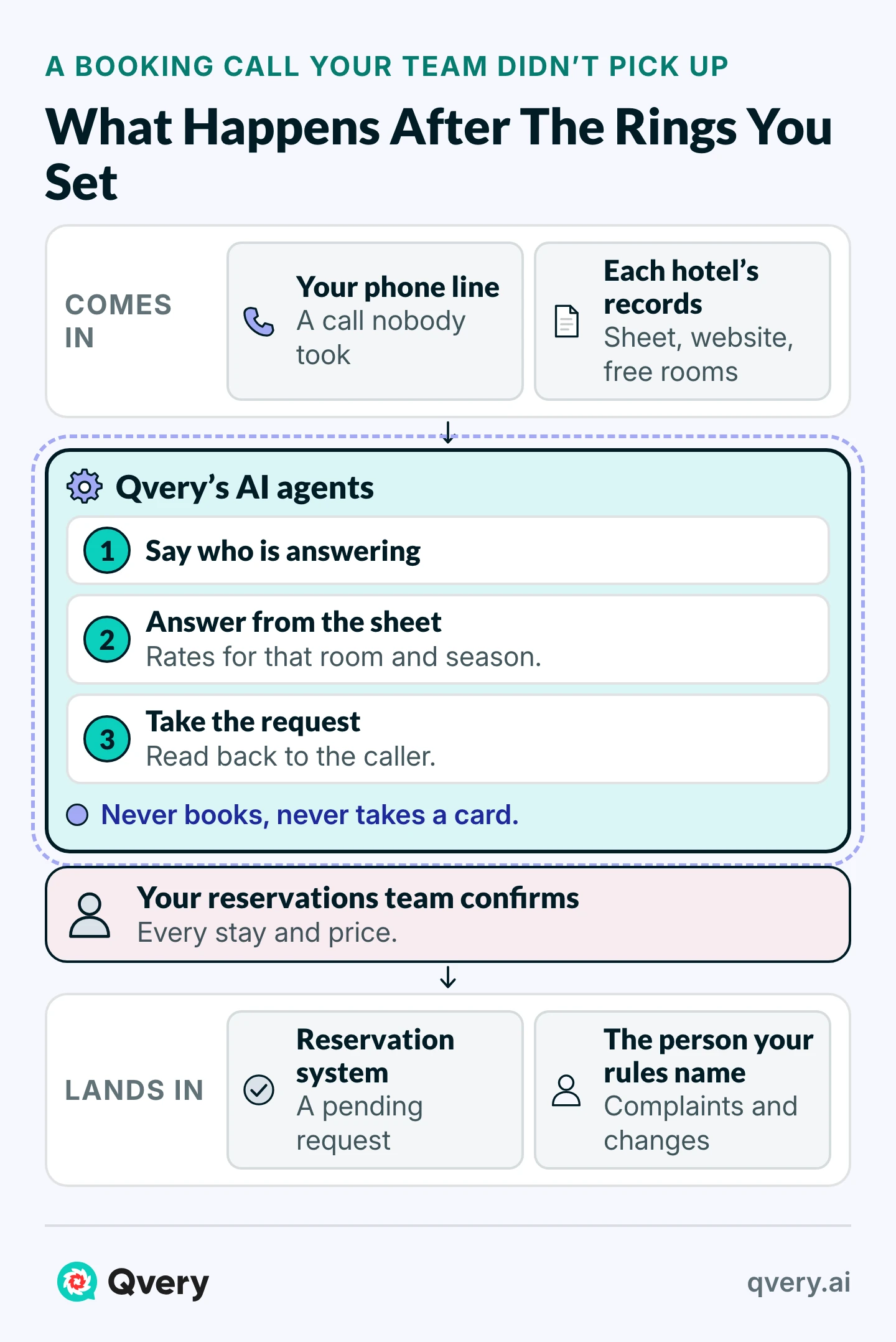
They answer from each hotel’s own fact sheet and website: rooms, breakfast, parking, check-in hours, cancellation terms, and rates only for the room type, season and party size each one was published for.
In your build they also read the reservation system for free rooms before taking a request, so a full night is never offered. Where the website and the sheet disagree, the caller hears that your team will confirm.
A booking call goes one question at a time: which hotel, the dates, the room, who’s coming, how to reach them. The agents read the dates and the party back.
The request lands in your reservation system or inbox as pending, with the call written out beside it, and your team turns it into a reservation. Payment goes through your own secure link, so no caller reads a card number aloud.
Several hotels can share one central number. The agents ask which property the caller means before quoting anything, and answer from that hotel’s facts alone.
To hear how this goes at one of your hotels, send your website and a rate or policy sheet. The free try writes out three calls the way our agents take them.
The calculator opens on the four-hotel group from the top of this page. Type your own calls, your own lost share and your own margin over it.
Hotel Reservation Calls ROI Calculator
What Booking Calls That Ring Out Cost You, And What The AI Agents Win Back
Won Per Year
$108,120
720 more stays a year, after $12,840 to run the agent
- New Stays A Year
- 720
- Agent Running Cost (Estimate)
- $1,070 a month
- Payback Per $10,000 Of Build
- 1.1 months
On these numbers, answering every inquiry at once wins 720 more stays a year, worth $120,960, $108,120 after the agent's running cost, and every $10,000 of the build is earned back in 1.1 months.
On that example the agents win back 720 stays a year, worth $120,960. Running them costs about $1,070 a month, our estimate: some $650 for the phone numbers, hosting, monitoring and upkeep, and voice minutes on the quarter of calls that ring past your team, about 21 cents for every booking call on the line.
That leaves about $108,120 a year. We agree the build price with you before any work starts, so the calculator shows the payback per $10,000 of it: 1.1 months on this example.
The agents cover their running cost from about 76 stays a year. On the example’s other inputs, that means losing about one booking call in a hundred today, so a group can check the claim against its own call logs before anything else.
Two of those inputs are kept low on purpose.
Invoca found 31% of calls to hotels and resorts reached no person; the example counts 10% as lost to another hotel, because many of those callers try again, write, or book your room on a booking site, which costs you a commission and not the stay.
It counts 30% of booking callers who reach someone as booking, below Invoca’s 38%, because our agents leave every booking for your team to confirm, and a few callers book elsewhere in between.
In writing, before the build, we set out what the agents may read and do in your reservation system. The link reads free rooms and saves requests, and it never changes or cancels a stay. Every call they take is logged with its transcript.
 Piotr BabelPartner @ Qvery
What the agents answer from decides how far you can trust them. So we start with each hotel’s sheet: every rate tied to the room type, season and party size it was published for. Where the sheet and the website disagree, the agents don’t pick one. They tell the caller your team will confirm, and the written call shows your team where the two disagree.
That sheet is the first thing we ask for.
Agents Belong on Every Call Your Team Can’t Take
For a group of several hotels, then: your reservations people answer first, and the front desk stops being the reservation line. Every call they can’t take goes to agents built on that hotel’s sheet, and no call ends without a request your team can confirm.
| If you run | Who answers | Why |
|---|---|---|
| One hotel whose desk takes most calls, one rate card | your desk, and an off-the-shelf phone product if nights ring out | the setup is small and the price is per room |
| Several hotels and a central desk that loses calls at check-in, nights and weekends | your team first, then agents built on each hotel’s sheet | each hotel’s rules differ, and a call costs about $2 all in |
| Group blocks, events, a resort where one stay is worth thousands | a person, always; the agents take the message | one enquiry can fill a week of rooms |
| Hotels whose callers mostly speak a language beyond Spanish, Portuguese and English | a person, or a product that speaks it | our agents answer in those three |
A franchised hotel whose brand already routes unanswered calls to its own central reservations has less say over its line, and the brand’s rules come first.
The sheet each hotel writes for the phone is the same one that answers guests’ booking emails. The Travel Playbook works out what those emails and tour quotes cost a travel company of about 200 people.
Working with us on the phone starts with each hotel’s rate and policy sheet, the line your calls arrive on and read access to your reservation system.
Within two weeks of that access our agents take test calls on your own line. Your staff ring them from their own phones in each language, with a noisy line and a caller who interrupts, before any guest does.
After that we count, every week, the calls the agents answered, the requests your team confirmed and the calls they handed to a person.
Frequently asked questions
What does a hotel reservations call center do?
It answers a hotel’s booking line from somewhere else, in the hotel’s name, during overflow, after hours or all day. Its agents check availability, quote rates, book into the hotel’s reservation system and pass anything else back to the property. Some belong to a hotel brand; others are outside services.
How much does an outsourced hotel reservation service cost?
Few publish a price. Preferred Hotels & Resorts lists a US$550 setup fee, US$1.25 a minute in English and US$1.75 in other languages, plus a contracted fee per voice reservation. Revinate says RezForce charges when it handles or books a call rather than per minute, and publishes no amount.
Can AI agents take hotel reservations by phone?
Yes. Several phone products say they check availability and book on the call. Qvery’s agents take the request, read it back and save it as pending, and your team confirms the stay.
Will callers know they’re talking to an AI agent?
Yes. The agents open by saying they’re the hotel’s automated assistant, then carry on in the caller’s language.
Can the agents take a card number?
No. Payment goes through your own secure link, so no card number is spoken on the call or kept in a recording.
What happens when a caller asks for a person?
They’re passed to the person your rules name. When nobody is free, the agents take a message and the best time to ring back, and whoever returns the call starts from the written transcript.
Can the agents answer for several hotels on one number?
Yes. They ask which property the caller means before quoting anything, and answer from that hotel’s sheet, rates and rules alone. Each hotel can set its own languages, its ring count and the person who takes its callbacks.
Which languages do the agents speak?
Spanish, Portuguese and English. Each language is tested on its own with your staff before guests hear it, so a weaker one can wait while the others go live.
Does it work with our reservation system?
It works with the one your team already uses, wherever that system lets the agents read free rooms and save a pending request. Groups often run OPERA, Mews or SynXis, and we test the link before we build. Without a link, each request reaches your inbox in a fixed layout your team copies in.
Can the agents double-book a room?
No, because they never book. Where your system is connected they read free rooms first. If the last room goes during a call, your team sees both requests with the time of each call and decides who gets it.
Are calls recorded?
That follows the law where each hotel sits, and your counsel confirms it before the line goes live. You choose to keep the audio or only the transcript, and for how long.
What about group bookings and events?
The agents take them as messages, never reservations: dates, numbers, what the caller wants and how to reach them, sent to your sales desk with the transcript. A person handles every group enquiry.
What do the agents cost to run?
Mostly voice minutes, billed on every call they take, including the ones they pass to a person. Phone numbers, hosting, monitoring and upkeep make up the rest. A busy season raises the bill and a quiet one lowers it.
How soon can guests call the agents?
Two weeks after we have access, the agents answer test calls on your own facts and line. Guests reach them once your team is happy with every language, and you then set the ring count.
Why not hire a night reservations agent instead?
Covering eight overnight hours every night takes about 1.4 full-time people, roughly $91,000 a year at the average pay of hotel reservation agents in the US with benefits. The seat costs the same on a quiet night as on a busy one.
Should the front desk answer reservation calls at all?
As little as it can. In Revinate’s mystery shop, front desk agents asked for the reservation on 1.8% of calls, against 53.6% for off-site reservation teams, and took an email from none of the 55 callers who didn’t book.
What do the agents say about breakfast, parking or check-in times?
Whatever each hotel’s fact sheet and website say, and nothing more. A question the sheet can’t answer becomes a message for your team.
Is a booking made on a booking site a lost booking?
No. You keep the guest and pay the site’s commission. Best Western’s 2025 franchise disclosure document puts its hotels’ Booking.com commission at 15% of net room revenue, about $72 on a three-night stay at the US average rate.
How do the agents handle a caller with an existing reservation?
They ask for the reference number and surname your rules require before discussing it. Changes, cancellations and billing questions go to a person.
What if a hotel’s rate sheet is out of date?
Where the sheet and the website disagree, the agents tell the caller your team will confirm, and the mismatch reaches your team with the call. A new rate or a new hotel joins by updating its sheet.
