
On this page
In a property company on revenue management software, the software that recommends rents from market data, the rent comes from the tool and a manager's sign-off: a revenue manager, or a regional manager where there is none, accepts or adjusts its number for each floor plan, and the renewal offers go out.
Nobody in the company can see what the tool read to produce that number, and nothing on the company's side shows who accepted it or why. Since the RealPage case, enforcers and state laws ask about exactly those two things.
At Qvery, we help property managers free up revenue managers for pricing, with custom AI agents that log who set each rent and flag rents outside your limits.
The Two Questions Enforcers Now Ask
When the Justice Department settled with RealPage in November 2025, with no money penalty, it was easy to file under the vendor's problem: the software would change, and the routine could stay.
The court orders other landlords signed since, and the state laws passed around them, ask instead who set each rent and what the tool read to set it; whether a given setup is lawful where your units sit is your antitrust counsel's call.
 Vlad ShvetsPartner @ Qvery
Nobody can promise where the courts will draw the line on shared pricing software, so keep what holds up wherever it lands: a record of who set each rent. For any tool you keep, turn auto-accept off or bound it with limits your company wrote down, let your people override without the vendor's sign-off, and log every rent with the name of the person who set it.
That record of each rent is the company's record of its decisions, not a justification owed to the vendor, and it lives on your side of the contract.
Take 2,400 units at 12 properties with 8 floor plans each, rents set once a week per floor plan, and 12-month leases, so about 200 renewal offers a month. That is about 616 rows a month, and say one row in four needs a reason. Every minute below is our assumption; put in your own.
| Path | Hours a month | At $57.50 an hour |
|---|---|---|
| Record kept by hand: 3 minutes a floor-plan row, 2 a renewal, 3 a reason | 35.2 | $2,024 |
| The agents prepare each row: 1, 1 and 2 minutes | 15.4 | $886 |
| No tool: 10 minutes a floor plan a week, row included, plus renewal rows and reasons | 83.7 | $4,813 |
The rate is a manager's pay and benefits: property, real estate and community association managers earned a mean $83,710 in May 2025, the Bureau of Labor Statistics reports; with benefits at 30% of what private employers spend, about $119,600 a year.
The record is the cheap part: about 35 hours of a manager's month by hand, about 15 with the agents preparing the rows. The expensive path is stopping the tool, roughly two working weeks a month for this portfolio.
The calculator works out what keeping the record costs a year with a revenue manager and a regional manager sharing those 35 hours (10% of each one's week), what it costs with the agents taking 57% of it, and how fast the build pays back, and it opens on that example.
Rent Record ROI Calculator
What Keeping The Record Of Who Set Each Rent And Why Costs You, And What An Agent Saves
Saved Per Year
$10,034
237 hours handed back, after $3,600 a year to run it
- Hours Handed Back
- 237 hours a year
- Agent Running Cost (Estimate)
- $300 a month
- Payback Per $10,000 Of Build
- 12 months
On these numbers, the agent saves $10,034 a year after its own running cost, and every $10,000 of the build is earned back in 12 months.
On the example, the record falls from $23,920 to $13,886 a year, running cost included: $10,034 and 237 hours handed back, and at that saving each $10,000 of build cost takes about a year to recover. The saving is modest; the value is a record behind every rent.
What the Agents Log
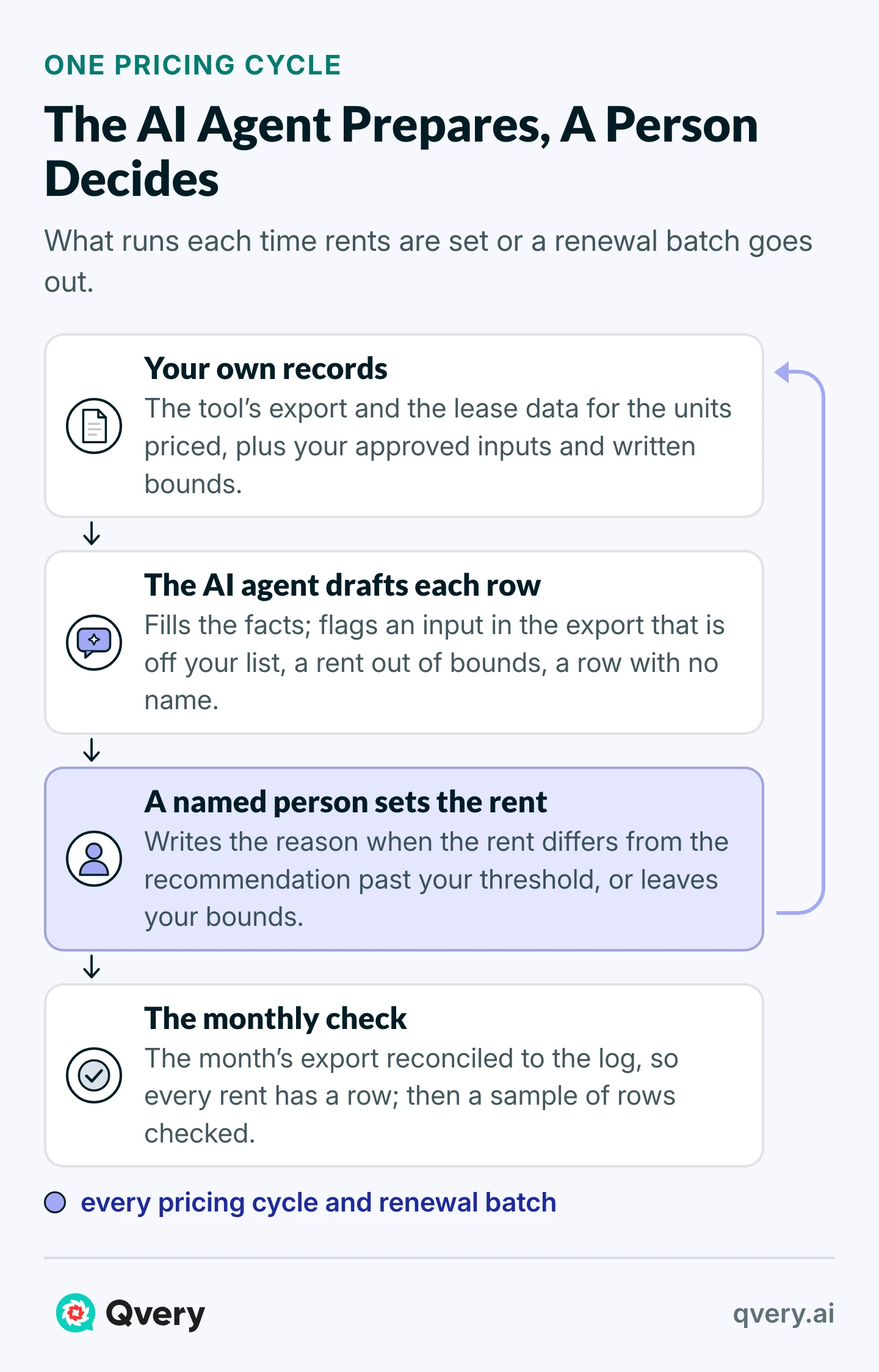
Most of each row already sits in your own systems: the recommendation in the pricing tool's export, the lease in your property management system. The agents we build for your pricing desk fill in the rest with each pricing cycle and each renewal batch, in a record kept in your company's own systems, connected to nothing else.
They draft the factual fields of every row and flag anything the export shows the tool read that is not on your approved list, any rent outside the limits you wrote down and any row without a person. What the export cannot show stays with the vendor's written answers.
| Field | Example |
|---|---|
| Property and floor plan | Building 4, two-bedroom plan B |
| Lease type and term | Renewal, 12 months |
| Date | March 2, 2026 |
| Recommendation | The tool's number, $1,840 |
| Rent set | $1,815, no concession |
| Inside the limits you wrote down | Yes |
| Set by | J. Ortiz, regional manager |
| Reason | None due: within your threshold |
| Check of what the tool reads | Nothing off the approved list |
| Owner approval | Not required by this management agreement |
The agents never recommend a rent. They read only your own systems, for each property only that owner's records, and never pool anything.
 Piotr BabelPartner @ Qvery
The first job in the build is mapping the pricing tool's export: which fields it carries for each floor plan, and which owner each property's records belong to, so no row ever draws on another owner's data. Where the export does not show what the tool read, the row says so instead of guessing. Ask your vendor now for a written list of its inputs, because the agents can flag an input off your approved list only when the export shows it.
Who Sets the Rent
A named person sets the rent, and writes the reason when one is due.
| The agents may | The agents never |
|---|---|
| Read the pricing export and your lease data | Recommend a rent |
| Draft every row of the record | Pool one owner's records with another's |
| Flag anything the tool reads that is off your approved list | Write to the pricing tool |
| Flag rents outside your limits and rows without a name | Set or change a rent |
Which owners' records the agents may open is written into the agreement before they connect, so the record itself can show that nothing was pooled.
The First Pricing Cycle
We start from the pricing tool's export and your lease data. The agents fill in last month's rows beside what your managers recorded, so you see where the two records differ before any new rent depends on them, and two weeks after access they are drafting the rows for the current cycle.
Frequently asked questions
How should we record overrides of rent recommendations?
In a record of your own, one row per rent set: the recommendation, the rent and concession offered, who set it, whether it sat inside your written limits, and a reason when it strays past your threshold. Keep it on your side of the contract.
We manage properties for several owners. What changes for us?
Trace what the tool reads owner by owner: to the rest of your portfolio, each owner's data is another owner's. The Greystar court order bars pooling occupancy, signed rents and lease terms competitors do not publish across owners; New York's law leaves out data that all comes from properties one company owns or manages.
What does Qvery build for rent pricing?
Not a pricing tool: custom AI agents, built for your company alone, that fill each row of the record from the pricing export and lease data and flag rows with no name, rents outside your limits and anything the tool reads that is off your list. A first version runs within two weeks of access, and we train the managers who use it.
Can landlords keep using rent pricing software after the RealPage settlement?
The RealPage judgment binds only RealPage. What enforcers and state laws now ask of a landlord is who set each rent and what the tool read to set it. Whether a given setup is lawful where your units sit is your antitrust counsel's call.
What did the RealPage settlement require?
The Justice Department settled with RealPage in November 2025, with no money penalty. It was easy to file under the vendor's problem, but the court orders other landlords signed since ask about each landlord's own decisions.
Should landlords turn off automatic rent acceptance?
Turn auto-accept off or bound it with limits your company wrote down. For any pricing tool you keep, those written limits govern automatic acceptance, while your people can override without the vendor's sign-off.
How many rent records does a 2,400-unit portfolio need a month?
In this post's example of 2,400 units at 12 properties with 8 floor plans each, weekly pricing and 12-month leases, about 616 rows a month, including about 200 renewal offers, with one row in four needing a reason.
How long does keeping a rent record take by hand?
About 35 hours of a manager's month in the example: 3 minutes a floor-plan row, 2 a renewal, 3 a reason. With agents preparing the rows, it falls to about 15 hours.
Is it cheaper to stop using rent pricing software?
No. Setting rents with no tool takes about 83.7 hours a month in the example, roughly two working weeks for this portfolio. Keeping the record is the cheap path.
What does keeping the rent record cost a year?
In the worked example, keeping the record costs $23,920 a year, with managers sharing 35 hours. With agents taking 57% of that work, it falls to $13,886, running cost included. The example returns $10,034 and 237 hours.
Who signs off a rent the pricing tool recommends?
A revenue manager, or a regional manager where there is none, accepts or changes the tool's number. Since the RealPage case, that sign-off is what enforcers and state laws ask about: who set the rent, and what the tool read to set it.
What if a rent pricing export does not show an input?
Use the vendor's written answers for what the export cannot show. The agents flag inputs outside your approved list only when the export shows them. Their checks depend on what that export reveals.
Where is our rent and lease data processed?
Where the agreement you sign before the agents connect says. Qvery AI OÜ is an EU company and signs a data processing agreement with you, and the record the agents keep stays in your company's own systems.
Do landlords need vendor approval to override rents?
Your people should be able to override without the vendor's sign-off, whichever pricing tool you keep. If your contract says otherwise, take it to your antitrust counsel before the next renewal batch goes out.
How should landlords check the rent log each month?
Reconcile it against the rents your property management system shows as signed, so every signed rent has its row, then read a sample of the rows that carry a reason. The agents flag rows without a name and rents outside your limits as each cycle runs, so the monthly check looks for what a flag cannot catch: a reason that does not explain the rent.
What pay should you assume for the managers keeping the record?
Property, real estate and community association managers earned a mean $83,710 in May 2025, the Bureau of Labor Statistics reports. With benefits at 30% of what private employers spend, that is about $57.50 an hour.
How fast does building rent record agents pay back?
In the worked example, about a year for each $10,000 of build cost, on the $10,034 a year it hands back with running cost included. A larger portfolio, or one with more rents that need a reason, recovers it sooner.
