
On this page
- Two Fleets That Built Their Own TMS Kept the Builder in the Family
- But Our TMS Is Bloated, and a 14-Truck Fleet Built One for $55 a Month
- The Weekly Settlement Is the Right Size for AI Agents
- Where a Lumper Receipt Goes Once the AI Agents Have It
- The Example Hands Two Clerks Back 28 Hours a Week
- Bring Us One Month of Settlements
- Frequently asked questions
Your transportation management system, the TMS that holds every load, invoice and paycheck, still leaves the work around it to your people. Every week your settlement clerks piece together each driver's pay from what the TMS doesn't hold.
Take a trucking company of about 200 people whose two settlement clerks give that work half their week. That is about $85,200 a year of their time, before a single statement goes out wrong.
AI coding tools now write working software for the price of a few subscriptions, so the next TMS renewal raises a new question: why not build our own?
Don't. Keep the TMS as the system your billing, payroll, customers and the federal leasing rules run through, and point AI at the work around it, starting with the settlement.
At Qvery, we help trucking companies cut what driver settlements cost and keep their clerks on the lines that need a person, with custom AI agents that draft every driver's settlement from the loads, fuel, advances and receipts.
The hours are in the work around the TMS, and the expensive part of any TMS is the person who keeps it working as your customers, fuel card and leases change.
One exception holds: a fleet small enough that the owner builds the tool, uses it and fixes it can make a homemade TMS pay. This page is for companies where those are three different people, and where nobody's full-time job is writing software.
Two Fleets That Built Their Own TMS Kept the Builder in the Family
The best-known case is Oberman Logistics, a 14-truck fleet in Tennessee whose drivers own their trucks and lease them to the company. Wes Oberman, who had never written code, built a TMS with ChatGPT and Claude Code, mostly to stop paying for a commercial system he found bloated and hard to use.
The one saving he itemizes came before the TMS existed. Laura Oberman, who runs the accounting, used to spend a 12-hour day every Thursday entering and checking settlements. He wrote a standalone settlement program that pulls in the numbers and does the math, and she now finishes in about an hour.
The TMS came after, and he puts the whole system's saving at about 20 hours a week. Its rate confirmation reader fills in the load fields, and a person still checks every one.
The other well-documented case, Thomasville Furniture Xpress in North Carolina, runs near 30 trucks on a system that co-owner Scott Denmark's brother, Jeff, wrote. Jeff is a computer engineer, and he is now on the payroll to keep it running. For fuel tax mileage and driver logs, the fleet still uses an established platform.
 Vlad ShvetsPartner @ Qvery
Both of these systems work for the fleets that built them. Now look at who built them: an owner, and an owner's brother on the payroll. That's the part a company of 200 people can't copy. Your builder would be an employee, and the week they leave, the system your drivers' pay runs through has nobody left who understands it.
But Our TMS Is Bloated, and a 14-Truck Fleet Built One for $55 a Month
That objection is fair, and most of it is true. Commercial systems carry modules a company never opens, they look their age, and they cost real money. AI coding tools have made a working screen cheap to build.
The $55 is the subscription bill, though. The bigger cost of a system everything runs on is the person who keeps it right when a customer changes the direct system link it sends loads through (its EDI), the fuel card company changes its export, a lease adds a deduction or a new dispatcher needs different permissions.
At Oberman Logistics that person is the owner. At Thomasville Furniture Xpress he is family, on salary. In your company it would be an employee.
A tool only one person understands was a risk long before AI (the spreadsheet macro nobody else can read is the older version), and here it carries your drivers' pay.
What Reddit says
Brokers who looked at building their own TMS
I own a freight brokerage, and don’t need 85% of the crap every TMS has. It makes them clunky, and not very user friendly.
You might get away with using AI to create a gateway to a database that’s already solid but if you let AI build the whole thing you’re opening yourself up to a level of pain that you can’t even imagine.
I wish it was around 6-7 years before we started and paid to build ours for over $1 mil
Even though it was built with ai, it had a lot of bugs and would do things it shouldn’t. You can give it a shot but for it to be production ready, you need to spend time perfecting it.
AI can write a demo of a TMS in an afternoon. It can't answer for that system in its third year, after the person who prompted it has moved on.
The Weekly Settlement Is the Right Size for AI Agents
So build small. The right first job sits between the TMS and everything outside it, repeats every week and can be checked line by line against a document. The driver settlement is all three.
Every mistake lands on a driver's paycheck. For owner-operators, the drivers who lease their own trucks to you, the federal leasing rules raise the bar.
Here is the example behind the opening figure: about 150 drivers and owner-operators, and two settlement clerks who give them half their week.
The Bureau of Labor Statistics puts the mean pay of payroll and timekeeping clerks at $59,630 for May 2025; add benefits, which by the same bureau's count make up 30% of a private employer's cost per hour, and each clerk comes to about $85,200 a year. Two clerks at half time is $85,200 a year and 2,080 hours.
If your TMS already pulls in fuel and advances on its own, your share is smaller. Mistakes cost on top: the example assumes 10 statements a month go out wrong, a missed advance or fuel charged to the wrong truck, at about $100 each to research, correct and explain, which is $12,000 a year.
A driver shorted twice also has a reason to look at other carriers, and the example leaves that out.
Where a Lumper Receipt Goes Once the AI Agents Have It
Qvery builds these AI agents around your settlement week and connects them to the TMS that already holds your loads and pay rules. The TMS stays the system everything runs through and keeps calculating pay; the AI agents fill in everything around it.
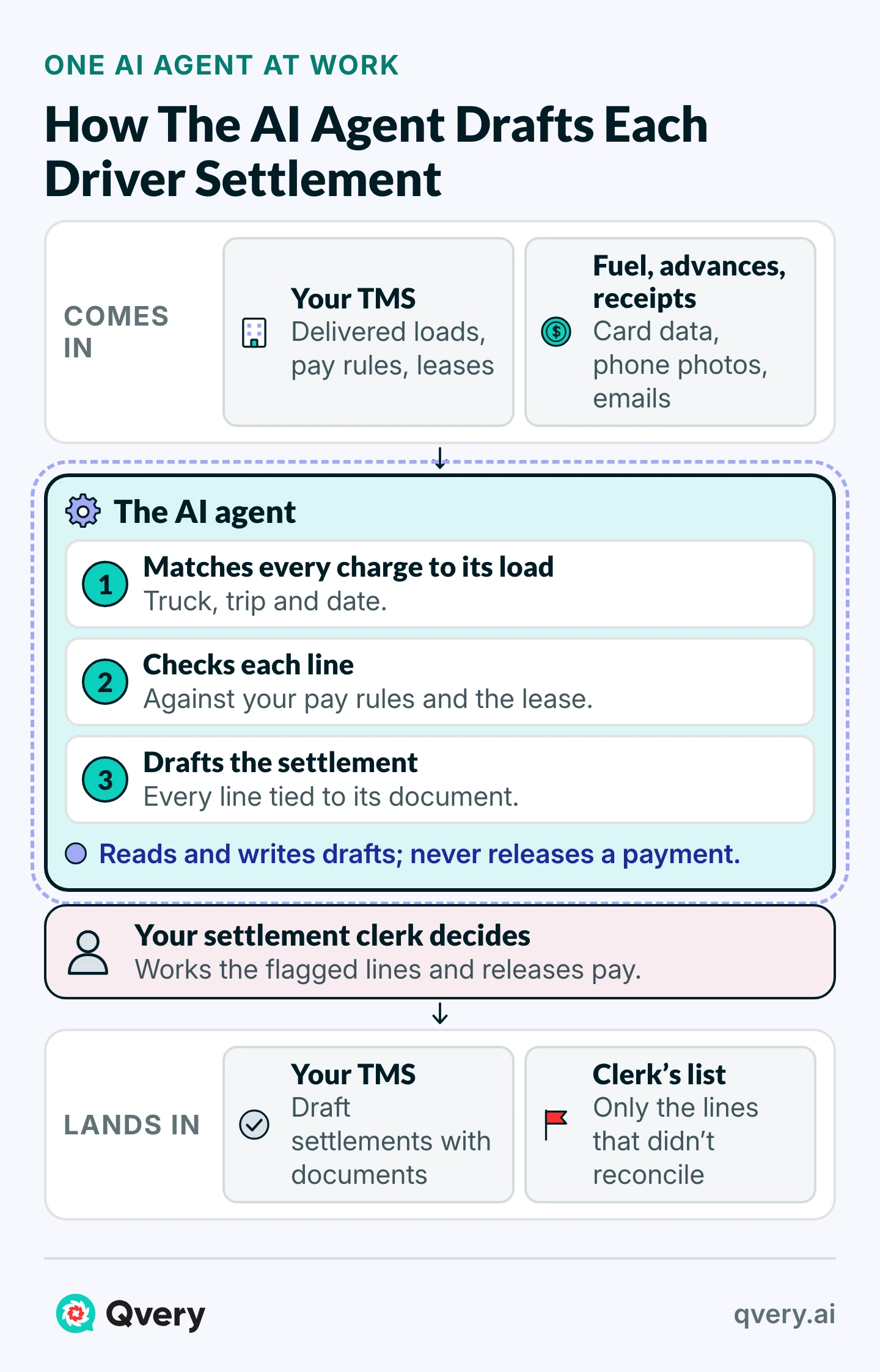
Say a driver texts a photo of a $150 lumper receipt on Tuesday morning.
The AI agents read the amount, the warehouse and the date, find the load in your TMS that delivered there that morning and the $150 advance the driver took for it the day before, and put both lines on his draft statement with the photo attached.
A fuel purchase on a truck that had no trip that day goes to your clerk instead, with the reason. Every line gets the same test: a document behind it, fuel bought by that truck on that trip, each advance taken off once, accessorial pay that someone approved, and only the deductions the lease names.
By the weekly cutoff, each driver's draft settlement sits in your TMS with its documents, and your clerk has a short list of what didn't reconcile. Releasing pay, approving accessorial pay and every driver's question about a statement stay with your clerks, and a deduction the lease doesn't name never goes on a statement.
| They may | They do not |
|---|---|
| Read loads, fuel card data, advances and receipts | Release a payment |
| Write draft settlements in your TMS | Send a driver anything your clerk hasn't seen |
| Log every read, check and write | Apply a deduction the lease doesn't name |
Their access is written down and agreed with you before they connect, and they start with the least access the job needs. Each logged step means a disputed deduction can be traced to the document behind it. Whether routine statements ever go out without a clerk's look is your decision, made in writing.
It is still software someone has to keep, and that someone is us: we keep the AI agents running. Because they only draft, and because we test the way back to the manual settlement before they go live, a week without them means your clerks build that week the way they do now.
The Example Hands Two Clerks Back 28 Hours a Week
In the example, 70% of the settlement work moves to the AI agents: every line that reconciles against a document and your rules. The 30% that stays includes your clerks reading each draft before pay goes out.
That share is less than Oberman's own program took off his wife's Thursday, about 11 hours of 12, and it hands back 1,456 hours a year, about 28 a week.
Running them costs about $600 a month, most of it model usage at a few cents for each receipt or report they read across some 150 settlements a week, the rest hosting and upkeep.
On those figures the job costs $32,760 a year instead of $85,200, a saving of $52,440, and every $10,000 of build price is earned back in 2.3 months. Type your own figures over ours:
Driver Settlement ROI Calculator
What Building Driver Settlements Costs You, And What An Agent Saves
Saved Per Year
$52,440
1,456 hours handed back, after $7,200 a year to run it
- Hours Handed Back
- 1,456 hours a year
- Agent Running Cost (Estimate)
- $600 a month
- Payback Per $10,000 Of Build
- 2.3 months
On these numbers, the agent saves $52,440 a year after its own running cost, and every $10,000 of the build is earned back in 2.3 months.
The mistakes they stop come on top. If they catch 60% of the example's ten a month before a statement goes out, that is another $7,200 a year.
Those hours are time, not payroll. They pay off when the same two clerks handle the settlements for the next 50 trucks instead of a third hire.
We agree the build with you up front: one price for one defined result, settled before any work starts. The calculator shows payback per $10,000 of it, so you can scale that to any price.
Bring Us One Month of Settlements
Vlad ShvetsPartner @ QveryThe lesson I take from Oberman isn't the $55 TMS. It's the program he wrote first, the one that turned his wife's 12-hour Thursday into an hour before any TMS existed. Small, weekly, checkable against a receipt, and boring. That's the shape of the first job I'd hand AI agents in any trucking company.
Don't spend cheap code on the one system everything else depends on. Keep the TMS, and put AI on the work around it, where the hours are, the rules are written down and every line has a document.
Bring us last month's settlements, the fuel card and advance exports, your pay rules and a lease, and read access to your TMS.
First we learn how your clerks build a settlement today. Then the AI agents draft last month's statements, and you hold their drafts against what your clerks paid, line by line, before they see a live week.
Within two weeks of access, they draft the current week. From then on your settlement lead gets two numbers from us every week, both measured against your weeks before the AI agents: the clerk hours spent on settlements, and the lines they flagged that your clerk confirmed were wrong.
After settlements, the same approach takes the next job around your TMS, such as answering brokers' status emails from your own tracking data.
Frequently asked questions
Should a trucking company build its own TMS with AI?
Rarely. It has worked at small fleets where the owner or a relative built it and is still there to keep it right. Above that size, the system that holds your loads, billing and pay needs a keeper who will still be there in three years. Buy the system everything runs through, and build the work around it.
What can non-developers safely build with AI coding tools?
Small tools nobody else depends on: a report, a spreadsheet cleanup, a check they run for themselves. Once a tool feeds payroll, billing or a customer, it needs a named owner, a shared home for its code, scheduled jobs anyone can see, and a review by someone technical before others rely on it.
Who owns a tool an employee builds with AI?
In practice, whoever understands it, whatever the paperwork says. When that person goes on holiday or leaves, a tool that runs payroll or billing turns into an outage. Settle who owns it, where its code lives and what data it touches before anyone relies on it.
How much does an AI-built tool cost to keep running?
The subscriptions are small: one 14-truck fleet runs its whole homemade TMS on $55 a month. The larger cost is the hours of whoever fixes it when an export format, a customer requirement or a pay rule changes. Both fleets above keep their builder close for that reason.
When should we buy software instead of building it?
Buy whatever other people rely on day to day: loads, billing, payroll, driver logs, fuel tax reporting. Build where your work differs from everyone else's and where a mistake is caught before it leaves the building, such as checking each settlement before your clerk releases it.
Do the AI agents replace our TMS settlement module?
No. Your TMS keeps calculating pay from the loads and stays the system everything runs through. The AI agents fill in what the TMS does not hold (fuel, advances, receipts and approved accessorials) and draft the statement inside it for your clerk to review and release.
Our TMS already imports fuel card data. Is there still work for the AI agents?
Usually. Imports bring in the transactions, but someone still matches each one to the right truck and trip, chases the missing receipts, checks accessorial pay against its approval and applies each lease's deductions. Type a lower share into the calculator if your clerks spend less of their week on it.
Do we need a different TMS for this?
Usually not. The AI agents work with the TMS you already run, through the access it allows: reading loads and writing draft settlements. How far they reach depends on your TMS, and we confirm that before any build, so your clerks keep the screens they know.
How do they handle owner-operators under the federal leasing rules?
They check every deduction against the charge-backs that owner-operator's lease names, tie the document behind each one to its line, and account for escrow on each settlement. Those are the things the rules ask a carrier to give an owner-operator, so your clerk reviews a statement that already carries them.
What if the AI agents get a deduction wrong?
Your clerk sees every draft before it is released, and a line the AI agents cannot match to a document never goes out as settled: it goes to the clerk with the reason. We count the corrections every week, and a repeated miss changes the rule they check.
Do they work for company drivers and owner-operators alike?
Yes. A company driver's pay runs on your pay rules and goes on to payroll; an owner-operator's runs on the lease and its charge-backs. The AI agents read whichever applies to each driver, so one weekly run covers both.
Will our drivers notice a difference?
They get their statement the way they do now, with each deduction tied to the receipt or record behind it, which makes a disputed line quicker to settle. How they turn in receipts stays the same unless you decide to change it.
Does our drivers' data leave the company?
We name every provider that sees your data and where it is kept, and no outside model trains on it. Qvery AI OÜ is registered in the EU, and we put a data processing agreement in place with you before the AI agents read a single statement.