
On this page
- Shortlist Answers Cite Booking Sites and Roundups; Trust Twins Pull In Reddit and Regulators
- Put a Booking Site's Name in the Question and Reddit Sits Under Three Google Answers in Four
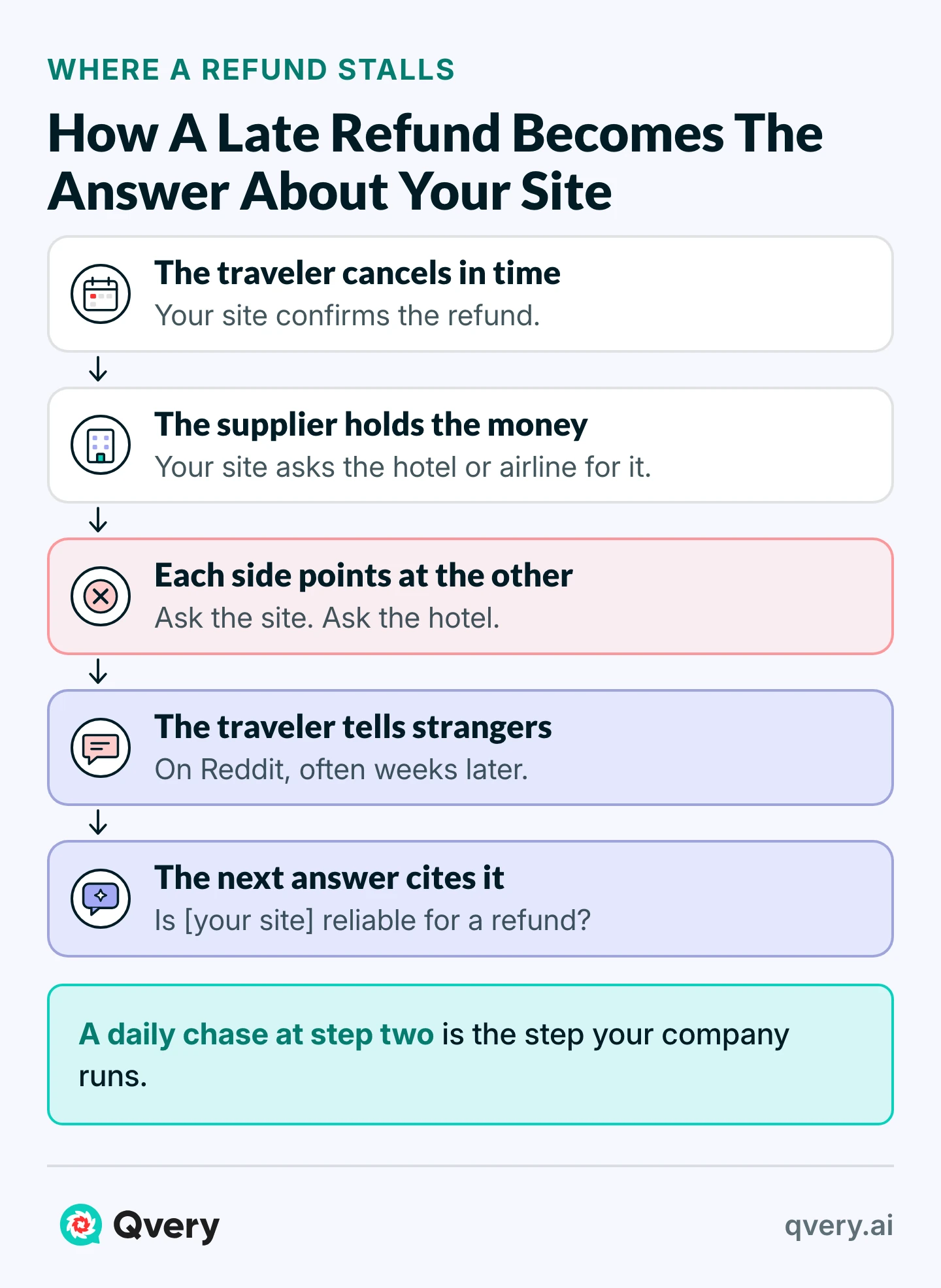
- The Threads Under Those Answers Are Refunds Stuck Between the Site and the Hotel
- Two Answers in Three Then Tell the Traveler to Book Direct
- One Engine Lets You Fix the Page; the Other Only Lets You Fix the Refund
- Put an AI Agent on Every Refund a Hotel or Airline Has Not Paid Back
- How Qvery Handles Refund Follow-Up and AI Trust
- Sort Today's Open Refunds by Days Waiting, Oldest First
- Frequently asked questions
"If getting your money back is important, booking directly with the airline or hotel is usually the safer choice." That is ChatGPT on October 20, asked whether Expedia is reliable if a traveler needs to cancel or get a refund.
Of everything an AI assistant can tell a traveler about a booking site, that is the line that points the traveler to somebody else's checkout. Some version of it closed about two answers in three when we asked ChatGPT and Google AI Mode whether a well-known booking site could be trusted.
If you run a booking platform, that advice sends a traveler away just before checkout. This page ends with how we handle the refund follow-up and AI-search work at Qvery.
The work that changes these answers sits in your refund operation and your help center, not in a posting calendar.
One boundary first: these are one day's answers, the by-name questions were about ten large sites rather than yours, and a citation is a page the answer pointed to, not a lost booking.
Shortlist Answers Cite Booking Sites and Roundups; Trust Twins Pull In Reddit and Regulators
Each trip went in as a pair: the choice ("Train ticket booking sites for budget trips?") and its trust twin ("Trustworthy train ticket booking sites for budget travel?"), the same need reworded around trust, asked from the US, the UK, Canada and Australia.
On the choice, Google AI Mode cited Reddit in 21.25% of its answers. On the trust twin it cited Reddit in 32.5%.
ChatGPT cited Reddit in none of either. That matches what our Reddit citation statistics found on a much wider set of buyer questions: ChatGPT dropped Reddit in two steps in August and has barely cited it since.
On ChatGPT, the fifth most-cited site under "which site should I book" answers was uber.com, whose blog runs best hotel booking sites and best car rental sites lists. It sat under 17.5% of those answers, ahead of Hotels.com at 13.75%.
Google AI Mode Cites Reddit More as the Question Moves Toward Trust
% of answers citing Reddit
View the data
| Label | Value | Note |
|---|---|---|
| Which site should I book on? | 21.25% | |
| Which site can I trust? | 32.5% | |
| Is [site] legit, or reliable for a refund? | 75% | 85% on the refund question, 65% on "Is it legit?" |
The trust twin changes what ChatGPT cites too, just not toward Reddit. It cited a regulator or a consumer body in 53.75% of its trust answers, against 13.75% of its choice answers.
Those were the FTC's pages on travel scams, the US Department of Transportation's page on buying a ticket, and the UK's aviation and rail regulators.
On Google AI Mode the two questions cite different sources. A reading list built from the trust answers' sources covered 54.05% of the choice answers that cited anything, and the list built from the choice answers covered 65.38% of the trust answers.
If you watch only the shortlist question, about a third of the trust answers cite nothing on your list.
Put a Booking Site's Name in the Question and Reddit Sits Under Three Google Answers in Four
Ask the question with your own name in it: "Is Expedia legit?" or "Is Kiwi.com reliable if I need to cancel or get a refund?" Those questions test trust after the traveler already knows the site.
On Google AI Mode, Reddit was cited in 75% of the by-name answers, and in 85% of the answers to the refund question. Trustpilot was cited in 52.5%, and a YouTube video, a Facebook post or a TikTok in 35%.
The site's own pages turned up in 27.5%. In 60% of Google AI Mode's by-name answers, something was cited and none of it belonged to the site being asked about.
ChatGPT's answers came from the other end. It cited the site's own pages in every one, and a help center, terms, contact or policy page in 97.5%.
Asked About a Booking Site by Name, the Two Engines Cite Different Pages
% of by-name answers
View the data
| Label | Google AI Mode | ChatGPT |
|---|---|---|
| The site's own pages | 27.5% | 100% |
| 75% | 0% | |
| Trustpilot | 52.5% | 52.5% |
| BBB | 10% | 75% |
| YouTube, Facebook or TikTok | 35% | 0% |
Ten big sites asked on one day is a sample. Which of the two answers your own name gets, and whether that holds from week to week, only shows when the same by-name questions run on both engines every day.
The Threads Under Those Answers Are Refunds Stuck Between the Site and the Hotel
I read every Reddit thread Google AI Mode cited under the by-name answers, whole, comments included.
52.5% of the distinct threads were a traveler's own account of a refund or a cancellation that went wrong after booking. Most of the rest (42.5%) were someone asking, before booking, whether the site was safe to use.
In 76.19% of those accounts, the money or the change was stuck between the booking site and the hotel, the airline or the host, each pointing at the other.
A January r/TravelHacks account described a fully refundable hotel cancellation made before the deadline: the booking site said the hotel owed the refund, while the hotel said its approving manager was absent.
The answers retell that mechanism in their own words. Google AI Mode's answer to "Is Expedia reliable if I need to cancel or get a refund?" cited three Reddit threads, that January account among them, and a post in a Facebook group, and explained:
Old threads keep getting cited: 47.5% were posted in the preceding twelve months, 27.5% before 2024. The oldest was a November 2018 r/travel discussion about Kiwi.com reliability.
Many had almost no votes: 32.5% had one upvote or none.
Two Answers in Three Then Tell the Traveler to Book Direct
The verdict at the end of those answers points the traveler elsewhere. ChatGPT advised booking directly with the hotel, airline or provider in 67.5% of its by-name answers, Google AI Mode in 62.5%.
On the refund question the shares were 75% and 70%.
The advice came after a yes. Asked "Is it legit?", every answer on both engines said the site was legitimate, and 60% of ChatGPT's and 55% of Google AI Mode's went on to recommend booking direct anyway.
What they warned about was what happens when plans change: a refund that has to travel from the hotel to the site to the traveler, and a support line that cannot overrule the hotel.
For a booking platform this is the competitor that does not show up in a rank report. The alternative these answers name is the supplier's own website, offered at the moment the traveler is deciding whether to pay you.
 Vlad ShvetsPartner @ Qvery
The trust answer about a booking site reads like a report on its refunds. I'd send it to the payments lead before marketing, because a better post cannot settle money stuck with a hotel. Give each overdue refund an owner and a date, then check the AI answers separately. We have not tested whether fewer late refunds change what the engines cite.
One Engine Lets You Fix the Page; the Other Only Lets You Fix the Refund
| Engine | Cited most | What you control |
|---|---|---|
| ChatGPT | Your terms and help pages (97.5%), BBB (75%), Trustpilot (52.5%) | What those pages say about refunds |
| Google AI Mode | Reddit (75%), Trustpilot (52.5%), your own pages (27.5%) | How the next refund goes |
Those pages are where your side of the refund question gets read. The cases travelers worry about belong on them in plain words: the hotel that refuses, the airline that refunded you but not the traveler, and what your site does then.
Every ChatGPT answer about Hopper cited the FTC alongside its help pages. The FTC's July 2 announcement described a $35 million settlement over fees.
On Google AI Mode, the cited page is mostly a customer's account, and the next account depends on what happens to the next customer's refund.
Posting your side into those rooms is the wrong fix. r/travel's rules prohibit self-promotion, including disguised promotion, and AI-written posts; r/hotels' rules prohibit posts advertising hotels, rental properties, and booking websites.
Put an AI Agent on Every Refund a Hotel or Airline Has Not Paid Back
The accounts in those threads share a shape: the money sits with one party, the promise came from another, and nobody is chasing it on a clock.
That chasing is repetitive, it runs on records the company already keeps, and a person can sign every message before it leaves. That makes it a job for an AI agent, software that handles a task the way a trained employee would.
Here is the brief I would hand whoever builds it.
Trigger
Every morning, and the moment a cancellation lands on a booking whose money a supplier holds.
Rule
Compare each open refund with the earliest deadline that applies to it: the promise shown at booking, the supplier's contracted days and, for card-paid US airfare where your site is the merchant of record, the Department of Transportation's 7 business days. Mark it on time, at risk or late.
Output
One morning queue: a drafted chaser to the supplier for every refund at risk, a drafted note to every traveler whose date has passed (who holds the money, the next date), and a decision line for every refund past your own promise.
The people
The support lead approves every traveler note one by one for the first month, then approves the standard notes as a batch each morning and reads a sample in full. The payments lead decides each late refund no rule already settles: pay it now and recover it from the supplier, or wait. Where a legal deadline applies, such as DOT's, the deadline decides. Nothing leaves the building unapproved.
What it never does
Open Reddit, Trustpilot or any review site, post anything, or promise money nobody approved.
The agent reads only your own systems: the booking records, the payment records, the supplier contracts and the support queue. Where a thread or a review needs reading, a person reads it.
Measure the job by hand before anyone builds it. Time a week of refund chasing, and pull three numbers from last quarter: days from cancellation to refund (the median and the slowest tenth), refund contacts per hundred cancellations, and chargebacks.
Set up one thing first: a refund status on every cancellation that names who holds the money and the date it is due. Without it, the agent has no deadline to check.
Whether fewer late refunds change what the answers cite is untested. Count the refunds on their own terms, and measure the answers separately.
How Qvery Handles Refund Follow-Up and AI Trust
We help you work on both the refund queue and the answers travelers read. Our GEO Agent builds topics and questions around your booking brand, its industry, and rival sites. It retains the full responses and all citations from daily runs in your chosen countries through ChatGPT and Google AI Mode.
You see which sources those answers lean on and, topic by topic and country by country, how often your site is named next to its rivals and in what tone. We read that evidence with you and work on the help pages and refund explanations it points to.
For the repeated chasing, we trace how cancellations move through your team and build a custom agent connected to your booking records and support queue. It checks deadlines and drafts supplier chasers and traveler updates on its own; your leads approve the sends.
Within two weeks, the first working version is ready for your team to use, with training on its queue and approvals. Each week after that, we count hours saved on chasing and errors avoided in refund dates and updates. Bring the unresolved cases so we can map that handoff with you.
Sort Today's Open Refunds by Days Waiting, Oldest First
Open your refund queue and sort it by days waiting. Write three things next to the top row: who holds the money, the date you promised the traveler, and the name of the person who will chase it today.
Then ask both engines one question with your own site's name in it: is it reliable if I need to cancel or get a refund? Note which pages answer it, and whether one of them is yours.
Frequently asked questions
Does Reddit decide which booking sites AI assistants recommend?
Not on the shortlist. In our October answers Google AI Mode cited Reddit in 21.25% of its answers to "which site should I book" questions and ChatGPT in none. Reddit mattered on the trust question, and most of all when the traveler named the site: 75% of Google AI Mode's by-name answers cited it.
Why doesn't ChatGPT cite Reddit about booking sites?
It stopped citing Reddit almost entirely in August 2026, across buyer questions in general, and it cited no Reddit page in any of the booking answers we collected in October. For a booking site's name it cited the site's own help and terms pages, BBB and Trustpilot instead.
What does an AI answer read when a traveler asks if a booking site is legit?
It depends on the engine. ChatGPT cited the site's own pages in every by-name answer and BBB in 75%. Google AI Mode cited Reddit in 75% and the site's own pages in 27.5%, and in 60% of its answers none of the cited pages belonged to the site.
Why do AI answers tell travelers to book direct?
Because the answers describe refunds and changes as harder through a middleman: the refund has to come from the hotel or airline through the site, and the site's support cannot overrule the supplier. Both engines said the sites were legitimate, and about two answers in three still recommended booking with the provider in some cases.
Should a booking platform post on Reddit to fix what AI answers say?
No. The communities these answers cite remove self-promotion (r/travel bans it "including any disguised as genuine discussion", r/hotels removes posts advertising booking websites), and the threads that answer the trust question are customers' accounts of refunds. What changes the next account is how the next refund is handled.
What should be on our help center for AI answers?
The refund facts in plain words: who issues the refund for each kind of booking, how long it takes, what happens when the hotel or airline refuses or delays, and how a traveler reaches a person. ChatGPT cited a help, terms or policy page of the site in 97.5% of its by-name answers.
How often should we check what AI says about our booking site?
Daily, on both engines, is what I would set. We asked ten sites' names on one day, and the two engines already disagreed on what to read; a change like ChatGPT dropping Reddit in August only shows up when the same questions run every day on both engines.
Can old Reddit threads still affect answers about our site?
Yes: 27.5% of the distinct threads cited in our by-name answers predated 2024, and the oldest was from November 2018. Treat the cited account as a record of what happened then, and check whether the same refund problem still exists in your operation.
What should a refund agent read?
Use your booking and payment records, supplier contracts, and support tickets. Each cancellation needs a refund status naming who holds the money and when it is due; a person should read any review or Reddit thread.
Who approves the refund agent's work?
The support lead approves traveler updates, and the payments lead decides late cases that no existing rule settles. The agent drafts and flags deadlines; it does not promise money nobody approved or post on review sites.
How do we tell whether refund automation helps?
Time a week of manual chasing before building the agent, then compare hours spent and errors avoided. Also track cancellation-to-refund time, refund contacts per hundred cancellations, and chargebacks, paying particular attention to the slowest refunds.
Will faster refunds improve our AI recommendations?
That link is untested in this research. Measure refund performance for its own business value, and track AI answers separately rather than treating a better queue as proof of better recommendations.