By
Vlad Shvets
First AI Recommendations for a Brand-New SaaS: What the Answers Had in Common
Your product works. Buyers who try it stay. And when someone asks ChatGPT for the best tool in your category, the answer lists five companies and none of...
Your product works. Buyers who try it stay. And when someone asks ChatGPT for the best tool in your category, the answer lists five companies and none of...
Your product works. Buyers who try it stay. And when someone asks ChatGPT for the best tool in your category, the answer lists five companies and none of...
Your product works. Buyers who try it stay. And when someone asks ChatGPT for the best tool in your category, the answer lists five companies and none of them is you.
We wanted to know what the answers that do name young companies have in common, so we ran a targeted set of queries across three SaaS categories that barely existed three years ago. What follows is what those answers looked like. It is an observation about a set of queries, not a route that produces a recommendation.
Start With a Measurement Brief, Not a Hunch About Authority
The instinct is to assume you are too small. Our published work on AI engine visibility for SaaS found that whether a brand is cited tracks with whether it gets named, and that domain strength tracked less closely. That is an association measured in one category, and it is context here rather than proof about yours.
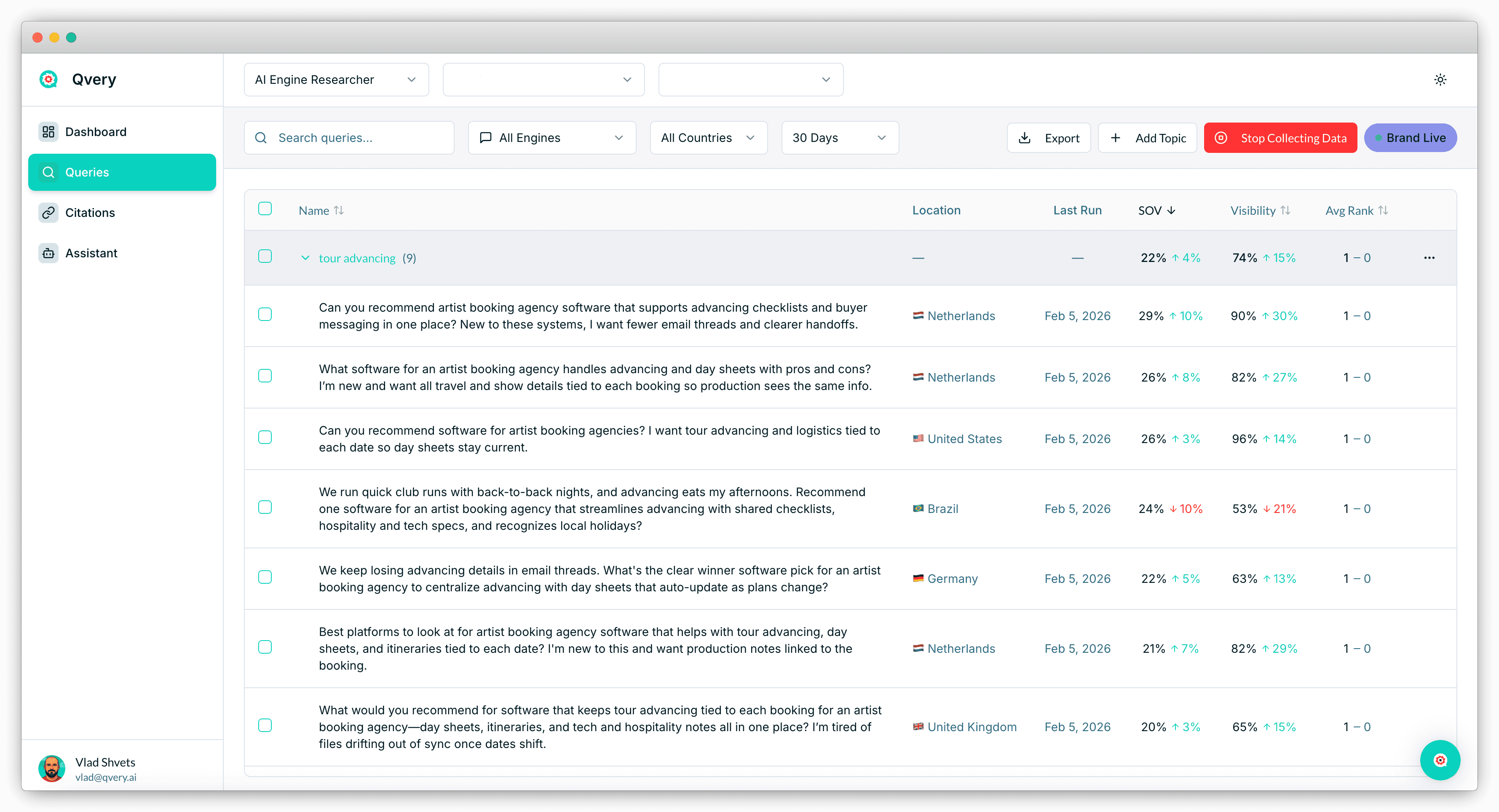
So begin with a brief instead of a theory. Write down your category as a buyer would say it, not as your positioning deck says it. Pick three unprimed head questions a buyer would type, the kind that start with best or top rather than your product name.
Then list the competitors you expect to see. Five is enough. Include the two you lose deals to and the one you think is overrated, because the overrated one is often the one the engines like.
You now have something to measure against later, which is more than most teams have when they start arguing about AI visibility. The argument usually runs on impressions of what ChatGPT said once. A frozen panel replaces that with a number.
Map the Shortlist Before You Pick a Hypothesis
We ran this across three young categories: AI meeting notetakers, AI SDR tools, and AI customer support. Across a targeted set of queries we ran on ChatGPT and Google AI Mode in August 2026, the shape of the shortlist differed sharply by category. The set is US-weighted, and every number here describes the queries we ran.
In the meeting notetaker answers, three names took 45.97% of all brand mentions, from 43 distinct brands across 99 head-query runs. Customer support was looser: 34.96% for the top three, from 83 brands across 100 runs. AI SDR was the widest, with the top three holding 25.59% of mentions across 95 brands and 99 runs.
That spread is the useful part. A category where three names own nearly half the mentions is a different problem from one where they own a quarter.
In the concentrated case you are arguing against a formed consensus, and the question is whether you have a difference worth the fight. In the loose case the answers are still being assembled, and the practical question is whether anything about you is legible enough to be picked up. Both are answerable. They are not the same work.
Newcomers followed the same ordering. Counting only companies founded in 2023 or later, and only brands named in at least three head answers, SDR carried 5 newcomers out of 41 such brands, support 4 of 35, and meeting notetakers 2 of 27. The most open category named the most young companies, and the most concentrated named the fewest. Three categories is a pattern worth noticing, not a law.
Record your own version: the three brands named most often, and which of them were founded in the last three years. Do not turn the shape into a tactic yet.
The Result That Contradicted Our Own Expectation
We expected the opposite. The standard advice is that new companies win on the narrow, qualifier-rich question, and we registered that as the hypothesis before collecting anything.
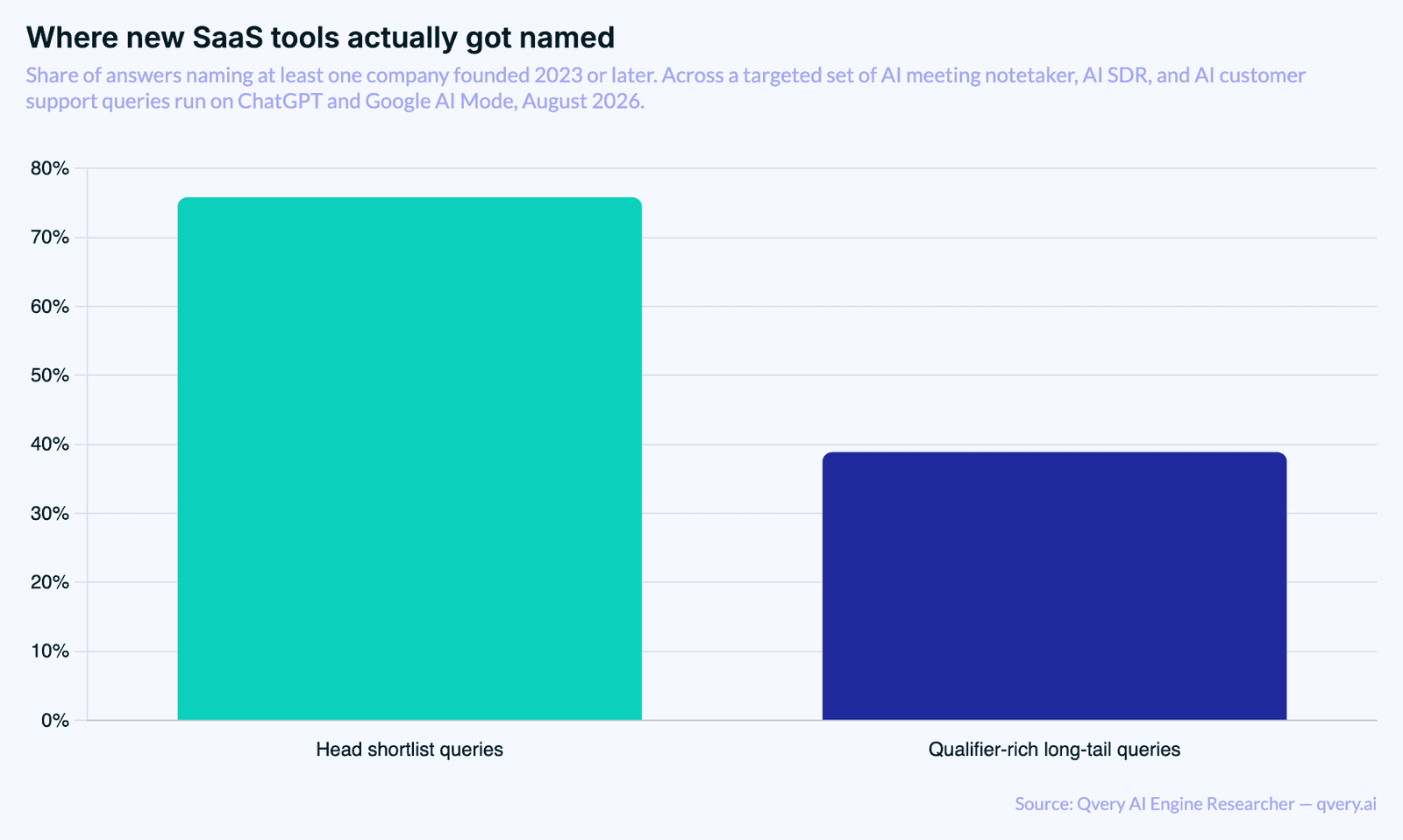
Pooled across all three categories, a newcomer was named in 75.84% of head shortlist answers, across 298 runs. On qualifier-rich long-tail queries it was 38.89%, across 144 runs. Roughly double, in the direction we did not predict.
A plausible reading is that broad shortlist answers are simply longer. They name more brands, so a young company has more room to appear. Narrower questions produce shorter answers built around whichever established name best matches the qualifier. That reading fits the numbers, and this study does not test it.
What it changes for you is where you look first. If you have been writing for the narrow question because a blog post told you to, the broad category question is worth measuring before you commit another quarter to that plan. Our published work on listicles as the most cited content type gives the wider context for why those broad answers pull from roundups.
Run both panels yourself. Keep head and qualifier-rich queries in separate columns, and never average them together, because averaging is what hides the effect.
Log the Differences You Cannot Yet Explain
Two measurement facts are worth writing down rather than acting on.
The first is engine behavior. On these queries ChatGPT returned an answer with sources 95.59% of the time across 408 runs. In the vertical studies we published in June, that figure ran between 37.3% and 48.7%. Same collection method, same setting.
We first assumed these categories were simply too new for the model to answer from memory. Then we ran the same measurement in three established verticals and saw the same thing: 98.88% in fintech, 97.44% in automotive, 93.83% on hotel questions. Fintech was not a new category in August.
So the more likely reading is that something changed in how ChatGPT retrieves, somewhere between those two collection windows. One honest caveat remains: our August query sets are narrower and more specific than the June ones, and narrower questions may prompt retrieval more often.
We are reporting the gap rather than explaining it. Treat any trigger rate you measure as a reading taken on a date, not a fixed property of the engine.
The second is where sources come from. Reddit appeared in 43.17% of answers, in line with every vertical we have measured. YouTube appeared in 20.11%, but 97 of its 109 appearances came from Google AI Mode.
Record the engine alongside every result you capture. That is context worth preserving, not a reason to move budget toward one engine.
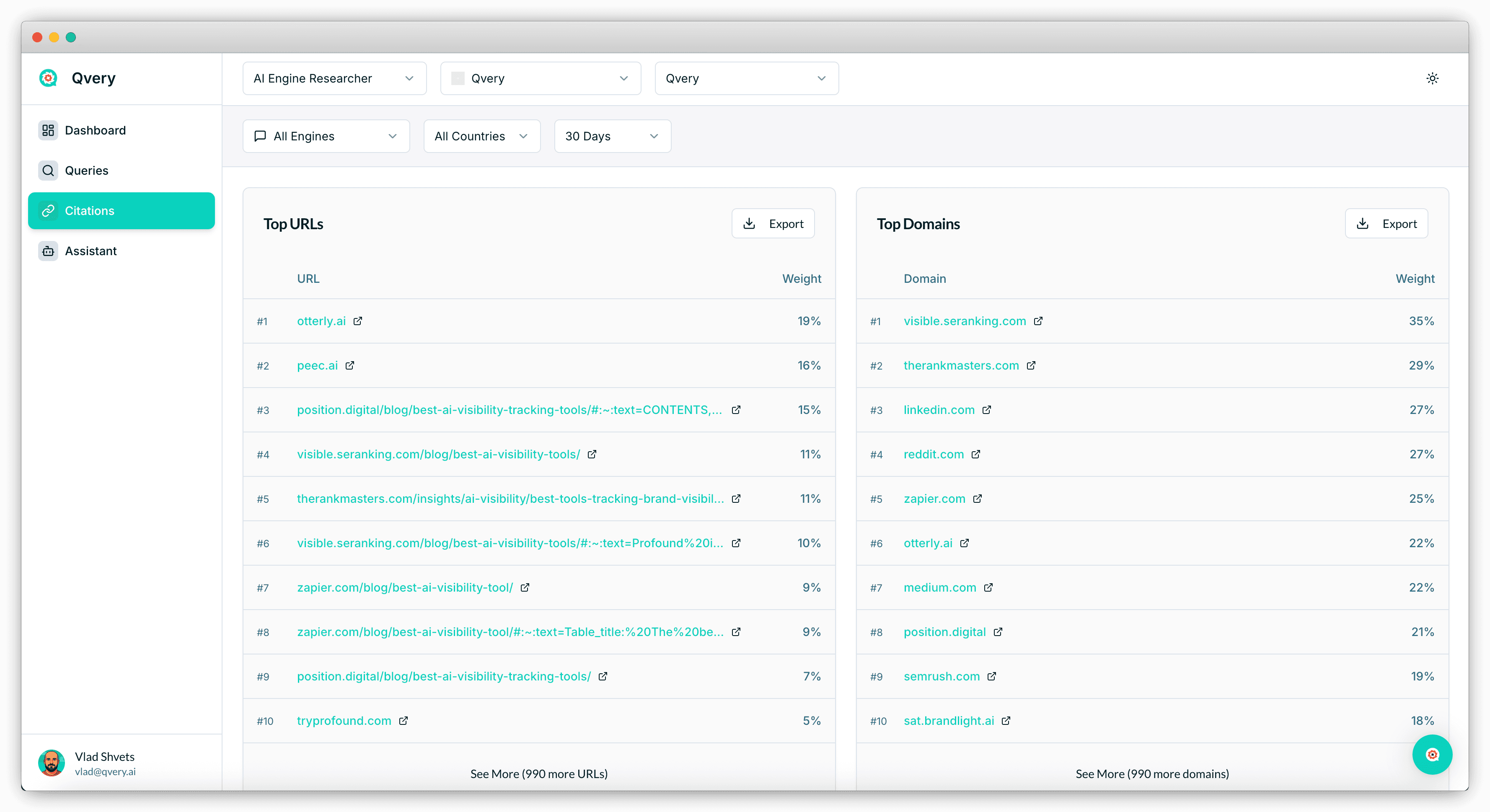
One more pattern is worth logging. Four domains most people in these categories have never heard of appeared in the top ten sources: aitechrankings.com in 11.62% of answers, honestaiguide.com in 10.89%, dupple.com in 9.23%, and toolchase.com in 8.67%.
Each was cited more often than most vendor sites in the same answers. All four appeared essentially only on ChatGPT, with no Google AI Mode appearances between them. We have seen the same shape in our published fintech and travel work, so treat it as corroboration rather than news.
What it means for your audit is narrow but real. When you inventory which sources sit behind the answers naming your competitors, the list will include places no one would have put on a media plan. Write them down anyway.
Our Judgment, Labeled as Judgment
Everything above describes what co-occurred. None of it establishes that doing something causes a naming, and we are not going to dress an observation up as a playbook.
Here is what we would do with it. If a source type keeps appearing in the answers that name your competitors, and your brand is absent from that surface, the absence is worth investigating.
The pattern does not prove direction. Being missing from the places the engines keep reading is still a poor bet either way. Our notes on building mentions for SaaS brands cover the general version of that work.
Turn it into one falsifiable hypothesis rather than a program. Pick a single surface, write down what you expect to change, note the date, and leave the query panel untouched so the comparison stays honest.
One surface, not five. If you change five things and the number moves, you have learned that something worked and you will never know which. That is how teams end up funding all five forever.
Make It Auditable Before You Change Anything
The reason most teams cannot tell whether AI visibility work paid off is that they never captured a clean starting point. Freeze your panel now: the exact query wording, the country mix, the competitors you are watching.
Then capture answers and citations on a fixed cadence and compare like with like. If you change the queries mid-flight, you have lost the ability to say anything about what moved.
Capture the citations, not only the verdict. Knowing you were absent tells you the score. Knowing which page the engine read before naming someone else tells you where the game is being played, and that is the part you can act on.
Keep the country mix fixed too. Answers differ by market, and a panel that drifts between US and UK runs will show you movement that is really just a change of audience.
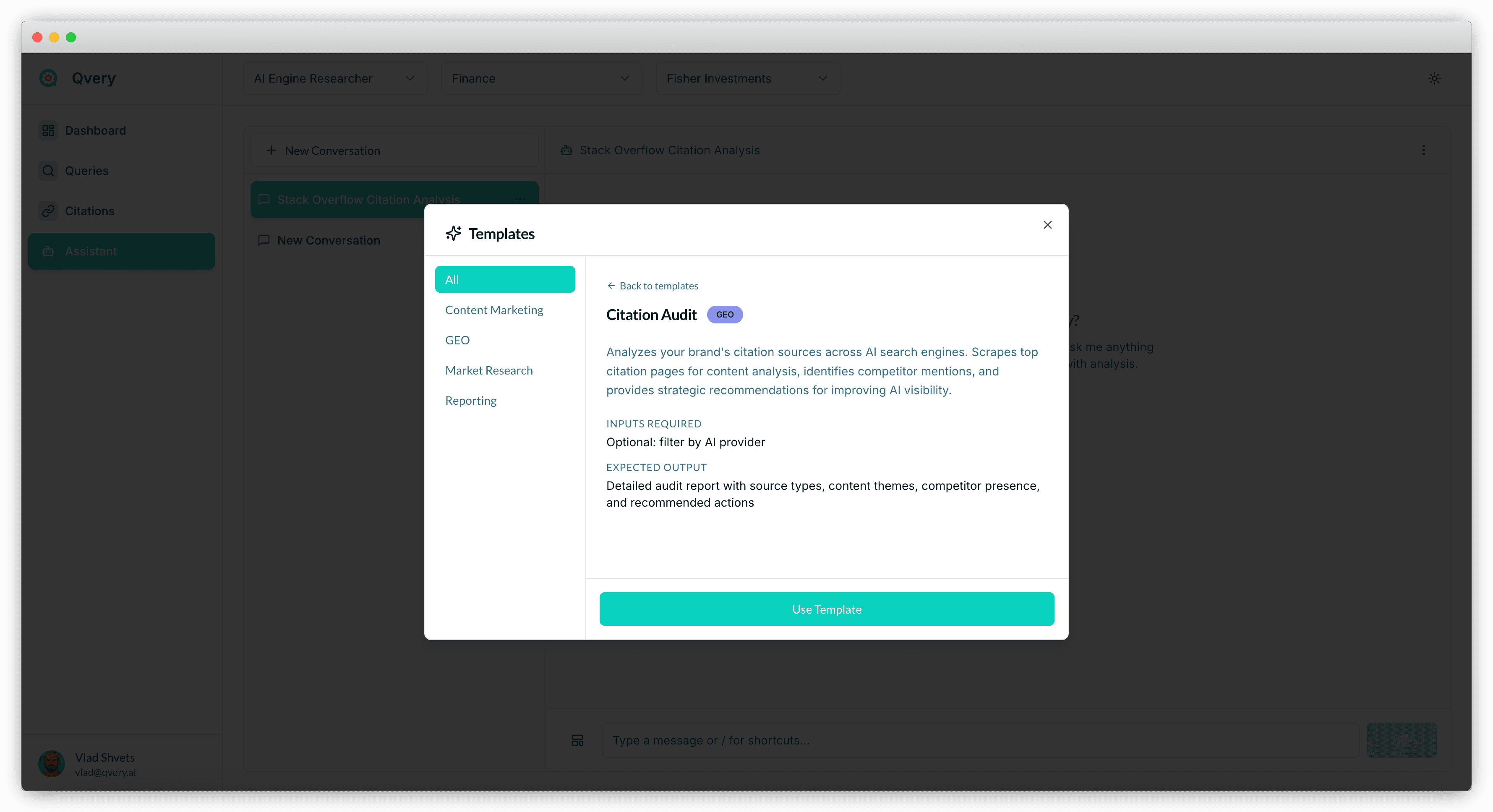
This is the part Qvery does. It runs your queries daily on ChatGPT and Google AI Mode across 200+ countries, tracks visibility and share of voice against the competitors you choose, and captures every citation tied to the query and engine that produced it. The Assistant answers questions about that data and can add queries, trigger a run, or export a report. Start a free trial at qvery.ai.
Freeze the panel first, though, whatever you use to watch it.
The Smallest Real First Step
Pick your category. Write ten head questions and ten qualifier-rich ones. Run them once, record which brands get named and what the answers cite, and note which of those brands are younger than three years old.
That is a morning of work and it replaces the argument you are currently having about whether AI visibility matters with a number you can check again in a month. Then write down one thing you believe would change it, and the date you started. The change and the re-measurement are your experiment, not something this study already answered.
Your product works. Buyers who try it stay. And when someone asks ChatGPT for the best tool in your category, the answer lists five companies and none of them is you.
We wanted to know what the answers that do name young companies have in common, so we ran a targeted set of queries across three SaaS categories that barely existed three years ago. What follows is what those answers looked like. It is an observation about a set of queries, not a route that produces a recommendation.
Start With a Measurement Brief, Not a Hunch About Authority
The instinct is to assume you are too small. Our published work on AI engine visibility for SaaS found that whether a brand is cited tracks with whether it gets named, and that domain strength tracked less closely. That is an association measured in one category, and it is context here rather than proof about yours.
So begin with a brief instead of a theory. Write down your category as a buyer would say it, not as your positioning deck says it. Pick three unprimed head questions a buyer would type, the kind that start with best or top rather than your product name.
Then list the competitors you expect to see. Five is enough. Include the two you lose deals to and the one you think is overrated, because the overrated one is often the one the engines like.
You now have something to measure against later, which is more than most teams have when they start arguing about AI visibility. The argument usually runs on impressions of what ChatGPT said once. A frozen panel replaces that with a number.
Map the Shortlist Before You Pick a Hypothesis
We ran this across three young categories: AI meeting notetakers, AI SDR tools, and AI customer support. Across a targeted set of queries we ran on ChatGPT and Google AI Mode in August 2026, the shape of the shortlist differed sharply by category. The set is US-weighted, and every number here describes the queries we ran.
In the meeting notetaker answers, three names took 45.97% of all brand mentions, from 43 distinct brands across 99 head-query runs. Customer support was looser: 34.96% for the top three, from 83 brands across 100 runs. AI SDR was the widest, with the top three holding 25.59% of mentions across 95 brands and 99 runs.
That spread is the useful part. A category where three names own nearly half the mentions is a different problem from one where they own a quarter.
In the concentrated case you are arguing against a formed consensus, and the question is whether you have a difference worth the fight. In the loose case the answers are still being assembled, and the practical question is whether anything about you is legible enough to be picked up. Both are answerable. They are not the same work.
Newcomers followed the same ordering. Counting only companies founded in 2023 or later, and only brands named in at least three head answers, SDR carried 5 newcomers out of 41 such brands, support 4 of 35, and meeting notetakers 2 of 27. The most open category named the most young companies, and the most concentrated named the fewest. Three categories is a pattern worth noticing, not a law.
Record your own version: the three brands named most often, and which of them were founded in the last three years. Do not turn the shape into a tactic yet.
The Result That Contradicted Our Own Expectation
We expected the opposite. The standard advice is that new companies win on the narrow, qualifier-rich question, and we registered that as the hypothesis before collecting anything.
Pooled across all three categories, a newcomer was named in 75.84% of head shortlist answers, across 298 runs. On qualifier-rich long-tail queries it was 38.89%, across 144 runs. Roughly double, in the direction we did not predict.
A plausible reading is that broad shortlist answers are simply longer. They name more brands, so a young company has more room to appear. Narrower questions produce shorter answers built around whichever established name best matches the qualifier. That reading fits the numbers, and this study does not test it.
What it changes for you is where you look first. If you have been writing for the narrow question because a blog post told you to, the broad category question is worth measuring before you commit another quarter to that plan. Our published work on listicles as the most cited content type gives the wider context for why those broad answers pull from roundups.
Run both panels yourself. Keep head and qualifier-rich queries in separate columns, and never average them together, because averaging is what hides the effect.
Log the Differences You Cannot Yet Explain
Two measurement facts are worth writing down rather than acting on.
The first is engine behavior. On these queries ChatGPT returned an answer with sources 95.59% of the time across 408 runs. In the vertical studies we published in June, that figure ran between 37.3% and 48.7%. Same collection method, same setting.
We first assumed these categories were simply too new for the model to answer from memory. Then we ran the same measurement in three established verticals and saw the same thing: 98.88% in fintech, 97.44% in automotive, 93.83% on hotel questions. Fintech was not a new category in August.
So the more likely reading is that something changed in how ChatGPT retrieves, somewhere between those two collection windows. One honest caveat remains: our August query sets are narrower and more specific than the June ones, and narrower questions may prompt retrieval more often.
We are reporting the gap rather than explaining it. Treat any trigger rate you measure as a reading taken on a date, not a fixed property of the engine.
The second is where sources come from. Reddit appeared in 43.17% of answers, in line with every vertical we have measured. YouTube appeared in 20.11%, but 97 of its 109 appearances came from Google AI Mode.
Record the engine alongside every result you capture. That is context worth preserving, not a reason to move budget toward one engine.
One more pattern is worth logging. Four domains most people in these categories have never heard of appeared in the top ten sources: aitechrankings.com in 11.62% of answers, honestaiguide.com in 10.89%, dupple.com in 9.23%, and toolchase.com in 8.67%.
Each was cited more often than most vendor sites in the same answers. All four appeared essentially only on ChatGPT, with no Google AI Mode appearances between them. We have seen the same shape in our published fintech and travel work, so treat it as corroboration rather than news.
What it means for your audit is narrow but real. When you inventory which sources sit behind the answers naming your competitors, the list will include places no one would have put on a media plan. Write them down anyway.
Our Judgment, Labeled as Judgment
Everything above describes what co-occurred. None of it establishes that doing something causes a naming, and we are not going to dress an observation up as a playbook.
Here is what we would do with it. If a source type keeps appearing in the answers that name your competitors, and your brand is absent from that surface, the absence is worth investigating.
The pattern does not prove direction. Being missing from the places the engines keep reading is still a poor bet either way. Our notes on building mentions for SaaS brands cover the general version of that work.
Turn it into one falsifiable hypothesis rather than a program. Pick a single surface, write down what you expect to change, note the date, and leave the query panel untouched so the comparison stays honest.
One surface, not five. If you change five things and the number moves, you have learned that something worked and you will never know which. That is how teams end up funding all five forever.
Make It Auditable Before You Change Anything
The reason most teams cannot tell whether AI visibility work paid off is that they never captured a clean starting point. Freeze your panel now: the exact query wording, the country mix, the competitors you are watching.
Then capture answers and citations on a fixed cadence and compare like with like. If you change the queries mid-flight, you have lost the ability to say anything about what moved.
Capture the citations, not only the verdict. Knowing you were absent tells you the score. Knowing which page the engine read before naming someone else tells you where the game is being played, and that is the part you can act on.
Keep the country mix fixed too. Answers differ by market, and a panel that drifts between US and UK runs will show you movement that is really just a change of audience.
This is the part Qvery does. It runs your queries daily on ChatGPT and Google AI Mode across 200+ countries, tracks visibility and share of voice against the competitors you choose, and captures every citation tied to the query and engine that produced it. The Assistant answers questions about that data and can add queries, trigger a run, or export a report. Start a free trial at qvery.ai.
Freeze the panel first, though, whatever you use to watch it.
The Smallest Real First Step
Pick your category. Write ten head questions and ten qualifier-rich ones. Run them once, record which brands get named and what the answers cite, and note which of those brands are younger than three years old.
That is a morning of work and it replaces the argument you are currently having about whether AI visibility matters with a number you can check again in a month. Then write down one thing you believe would change it, and the date you started. The change and the re-measurement are your experiment, not something this study already answered.
Your product works. Buyers who try it stay. And when someone asks ChatGPT for the best tool in your category, the answer lists five companies and none of them is you.
We wanted to know what the answers that do name young companies have in common, so we ran a targeted set of queries across three SaaS categories that barely existed three years ago. What follows is what those answers looked like. It is an observation about a set of queries, not a route that produces a recommendation.
Start With a Measurement Brief, Not a Hunch About Authority
The instinct is to assume you are too small. Our published work on AI engine visibility for SaaS found that whether a brand is cited tracks with whether it gets named, and that domain strength tracked less closely. That is an association measured in one category, and it is context here rather than proof about yours.
So begin with a brief instead of a theory. Write down your category as a buyer would say it, not as your positioning deck says it. Pick three unprimed head questions a buyer would type, the kind that start with best or top rather than your product name.
Then list the competitors you expect to see. Five is enough. Include the two you lose deals to and the one you think is overrated, because the overrated one is often the one the engines like.
You now have something to measure against later, which is more than most teams have when they start arguing about AI visibility. The argument usually runs on impressions of what ChatGPT said once. A frozen panel replaces that with a number.
Map the Shortlist Before You Pick a Hypothesis
We ran this across three young categories: AI meeting notetakers, AI SDR tools, and AI customer support. Across a targeted set of queries we ran on ChatGPT and Google AI Mode in August 2026, the shape of the shortlist differed sharply by category. The set is US-weighted, and every number here describes the queries we ran.
In the meeting notetaker answers, three names took 45.97% of all brand mentions, from 43 distinct brands across 99 head-query runs. Customer support was looser: 34.96% for the top three, from 83 brands across 100 runs. AI SDR was the widest, with the top three holding 25.59% of mentions across 95 brands and 99 runs.
That spread is the useful part. A category where three names own nearly half the mentions is a different problem from one where they own a quarter.
In the concentrated case you are arguing against a formed consensus, and the question is whether you have a difference worth the fight. In the loose case the answers are still being assembled, and the practical question is whether anything about you is legible enough to be picked up. Both are answerable. They are not the same work.
Newcomers followed the same ordering. Counting only companies founded in 2023 or later, and only brands named in at least three head answers, SDR carried 5 newcomers out of 41 such brands, support 4 of 35, and meeting notetakers 2 of 27. The most open category named the most young companies, and the most concentrated named the fewest. Three categories is a pattern worth noticing, not a law.
Record your own version: the three brands named most often, and which of them were founded in the last three years. Do not turn the shape into a tactic yet.
The Result That Contradicted Our Own Expectation
We expected the opposite. The standard advice is that new companies win on the narrow, qualifier-rich question, and we registered that as the hypothesis before collecting anything.
Pooled across all three categories, a newcomer was named in 75.84% of head shortlist answers, across 298 runs. On qualifier-rich long-tail queries it was 38.89%, across 144 runs. Roughly double, in the direction we did not predict.
A plausible reading is that broad shortlist answers are simply longer. They name more brands, so a young company has more room to appear. Narrower questions produce shorter answers built around whichever established name best matches the qualifier. That reading fits the numbers, and this study does not test it.
What it changes for you is where you look first. If you have been writing for the narrow question because a blog post told you to, the broad category question is worth measuring before you commit another quarter to that plan. Our published work on listicles as the most cited content type gives the wider context for why those broad answers pull from roundups.
Run both panels yourself. Keep head and qualifier-rich queries in separate columns, and never average them together, because averaging is what hides the effect.
Log the Differences You Cannot Yet Explain
Two measurement facts are worth writing down rather than acting on.
The first is engine behavior. On these queries ChatGPT returned an answer with sources 95.59% of the time across 408 runs. In the vertical studies we published in June, that figure ran between 37.3% and 48.7%. Same collection method, same setting.
We first assumed these categories were simply too new for the model to answer from memory. Then we ran the same measurement in three established verticals and saw the same thing: 98.88% in fintech, 97.44% in automotive, 93.83% on hotel questions. Fintech was not a new category in August.
So the more likely reading is that something changed in how ChatGPT retrieves, somewhere between those two collection windows. One honest caveat remains: our August query sets are narrower and more specific than the June ones, and narrower questions may prompt retrieval more often.
We are reporting the gap rather than explaining it. Treat any trigger rate you measure as a reading taken on a date, not a fixed property of the engine.
The second is where sources come from. Reddit appeared in 43.17% of answers, in line with every vertical we have measured. YouTube appeared in 20.11%, but 97 of its 109 appearances came from Google AI Mode.
Record the engine alongside every result you capture. That is context worth preserving, not a reason to move budget toward one engine.
One more pattern is worth logging. Four domains most people in these categories have never heard of appeared in the top ten sources: aitechrankings.com in 11.62% of answers, honestaiguide.com in 10.89%, dupple.com in 9.23%, and toolchase.com in 8.67%.
Each was cited more often than most vendor sites in the same answers. All four appeared essentially only on ChatGPT, with no Google AI Mode appearances between them. We have seen the same shape in our published fintech and travel work, so treat it as corroboration rather than news.
What it means for your audit is narrow but real. When you inventory which sources sit behind the answers naming your competitors, the list will include places no one would have put on a media plan. Write them down anyway.
Our Judgment, Labeled as Judgment
Everything above describes what co-occurred. None of it establishes that doing something causes a naming, and we are not going to dress an observation up as a playbook.
Here is what we would do with it. If a source type keeps appearing in the answers that name your competitors, and your brand is absent from that surface, the absence is worth investigating.
The pattern does not prove direction. Being missing from the places the engines keep reading is still a poor bet either way. Our notes on building mentions for SaaS brands cover the general version of that work.
Turn it into one falsifiable hypothesis rather than a program. Pick a single surface, write down what you expect to change, note the date, and leave the query panel untouched so the comparison stays honest.
One surface, not five. If you change five things and the number moves, you have learned that something worked and you will never know which. That is how teams end up funding all five forever.
Make It Auditable Before You Change Anything
The reason most teams cannot tell whether AI visibility work paid off is that they never captured a clean starting point. Freeze your panel now: the exact query wording, the country mix, the competitors you are watching.
Then capture answers and citations on a fixed cadence and compare like with like. If you change the queries mid-flight, you have lost the ability to say anything about what moved.
Capture the citations, not only the verdict. Knowing you were absent tells you the score. Knowing which page the engine read before naming someone else tells you where the game is being played, and that is the part you can act on.
Keep the country mix fixed too. Answers differ by market, and a panel that drifts between US and UK runs will show you movement that is really just a change of audience.
This is the part Qvery does. It runs your queries daily on ChatGPT and Google AI Mode across 200+ countries, tracks visibility and share of voice against the competitors you choose, and captures every citation tied to the query and engine that produced it. The Assistant answers questions about that data and can add queries, trigger a run, or export a report. Start a free trial at qvery.ai.
Freeze the panel first, though, whatever you use to watch it.
The Smallest Real First Step
Pick your category. Write ten head questions and ten qualifier-rich ones. Run them once, record which brands get named and what the answers cite, and note which of those brands are younger than three years old.
That is a morning of work and it replaces the argument you are currently having about whether AI visibility matters with a number you can check again in a month. Then write down one thing you believe would change it, and the date you started. The change and the re-measurement are your experiment, not something this study already answered.
Your product works. Buyers who try it stay. And when someone asks ChatGPT for the best tool in your category, the answer lists five companies and none of them is you.
We wanted to know what the answers that do name young companies have in common, so we ran a targeted set of queries across three SaaS categories that barely existed three years ago. What follows is what those answers looked like. It is an observation about a set of queries, not a route that produces a recommendation.
Start With a Measurement Brief, Not a Hunch About Authority
The instinct is to assume you are too small. Our published work on AI engine visibility for SaaS found that whether a brand is cited tracks with whether it gets named, and that domain strength tracked less closely. That is an association measured in one category, and it is context here rather than proof about yours.
So begin with a brief instead of a theory. Write down your category as a buyer would say it, not as your positioning deck says it. Pick three unprimed head questions a buyer would type, the kind that start with best or top rather than your product name.
Then list the competitors you expect to see. Five is enough. Include the two you lose deals to and the one you think is overrated, because the overrated one is often the one the engines like.
You now have something to measure against later, which is more than most teams have when they start arguing about AI visibility. The argument usually runs on impressions of what ChatGPT said once. A frozen panel replaces that with a number.
Map the Shortlist Before You Pick a Hypothesis
We ran this across three young categories: AI meeting notetakers, AI SDR tools, and AI customer support. Across a targeted set of queries we ran on ChatGPT and Google AI Mode in August 2026, the shape of the shortlist differed sharply by category. The set is US-weighted, and every number here describes the queries we ran.
In the meeting notetaker answers, three names took 45.97% of all brand mentions, from 43 distinct brands across 99 head-query runs. Customer support was looser: 34.96% for the top three, from 83 brands across 100 runs. AI SDR was the widest, with the top three holding 25.59% of mentions across 95 brands and 99 runs.
That spread is the useful part. A category where three names own nearly half the mentions is a different problem from one where they own a quarter.
In the concentrated case you are arguing against a formed consensus, and the question is whether you have a difference worth the fight. In the loose case the answers are still being assembled, and the practical question is whether anything about you is legible enough to be picked up. Both are answerable. They are not the same work.
Newcomers followed the same ordering. Counting only companies founded in 2023 or later, and only brands named in at least three head answers, SDR carried 5 newcomers out of 41 such brands, support 4 of 35, and meeting notetakers 2 of 27. The most open category named the most young companies, and the most concentrated named the fewest. Three categories is a pattern worth noticing, not a law.
Record your own version: the three brands named most often, and which of them were founded in the last three years. Do not turn the shape into a tactic yet.
The Result That Contradicted Our Own Expectation
We expected the opposite. The standard advice is that new companies win on the narrow, qualifier-rich question, and we registered that as the hypothesis before collecting anything.
Pooled across all three categories, a newcomer was named in 75.84% of head shortlist answers, across 298 runs. On qualifier-rich long-tail queries it was 38.89%, across 144 runs. Roughly double, in the direction we did not predict.
A plausible reading is that broad shortlist answers are simply longer. They name more brands, so a young company has more room to appear. Narrower questions produce shorter answers built around whichever established name best matches the qualifier. That reading fits the numbers, and this study does not test it.
What it changes for you is where you look first. If you have been writing for the narrow question because a blog post told you to, the broad category question is worth measuring before you commit another quarter to that plan. Our published work on listicles as the most cited content type gives the wider context for why those broad answers pull from roundups.
Run both panels yourself. Keep head and qualifier-rich queries in separate columns, and never average them together, because averaging is what hides the effect.
Log the Differences You Cannot Yet Explain
Two measurement facts are worth writing down rather than acting on.
The first is engine behavior. On these queries ChatGPT returned an answer with sources 95.59% of the time across 408 runs. In the vertical studies we published in June, that figure ran between 37.3% and 48.7%. Same collection method, same setting.
We first assumed these categories were simply too new for the model to answer from memory. Then we ran the same measurement in three established verticals and saw the same thing: 98.88% in fintech, 97.44% in automotive, 93.83% on hotel questions. Fintech was not a new category in August.
So the more likely reading is that something changed in how ChatGPT retrieves, somewhere between those two collection windows. One honest caveat remains: our August query sets are narrower and more specific than the June ones, and narrower questions may prompt retrieval more often.
We are reporting the gap rather than explaining it. Treat any trigger rate you measure as a reading taken on a date, not a fixed property of the engine.
The second is where sources come from. Reddit appeared in 43.17% of answers, in line with every vertical we have measured. YouTube appeared in 20.11%, but 97 of its 109 appearances came from Google AI Mode.
Record the engine alongside every result you capture. That is context worth preserving, not a reason to move budget toward one engine.
One more pattern is worth logging. Four domains most people in these categories have never heard of appeared in the top ten sources: aitechrankings.com in 11.62% of answers, honestaiguide.com in 10.89%, dupple.com in 9.23%, and toolchase.com in 8.67%.
Each was cited more often than most vendor sites in the same answers. All four appeared essentially only on ChatGPT, with no Google AI Mode appearances between them. We have seen the same shape in our published fintech and travel work, so treat it as corroboration rather than news.
What it means for your audit is narrow but real. When you inventory which sources sit behind the answers naming your competitors, the list will include places no one would have put on a media plan. Write them down anyway.
Our Judgment, Labeled as Judgment
Everything above describes what co-occurred. None of it establishes that doing something causes a naming, and we are not going to dress an observation up as a playbook.
Here is what we would do with it. If a source type keeps appearing in the answers that name your competitors, and your brand is absent from that surface, the absence is worth investigating.
The pattern does not prove direction. Being missing from the places the engines keep reading is still a poor bet either way. Our notes on building mentions for SaaS brands cover the general version of that work.
Turn it into one falsifiable hypothesis rather than a program. Pick a single surface, write down what you expect to change, note the date, and leave the query panel untouched so the comparison stays honest.
One surface, not five. If you change five things and the number moves, you have learned that something worked and you will never know which. That is how teams end up funding all five forever.
Make It Auditable Before You Change Anything
The reason most teams cannot tell whether AI visibility work paid off is that they never captured a clean starting point. Freeze your panel now: the exact query wording, the country mix, the competitors you are watching.
Then capture answers and citations on a fixed cadence and compare like with like. If you change the queries mid-flight, you have lost the ability to say anything about what moved.
Capture the citations, not only the verdict. Knowing you were absent tells you the score. Knowing which page the engine read before naming someone else tells you where the game is being played, and that is the part you can act on.
Keep the country mix fixed too. Answers differ by market, and a panel that drifts between US and UK runs will show you movement that is really just a change of audience.
This is the part Qvery does. It runs your queries daily on ChatGPT and Google AI Mode across 200+ countries, tracks visibility and share of voice against the competitors you choose, and captures every citation tied to the query and engine that produced it. The Assistant answers questions about that data and can add queries, trigger a run, or export a report. Start a free trial at qvery.ai.
Freeze the panel first, though, whatever you use to watch it.
The Smallest Real First Step
Pick your category. Write ten head questions and ten qualifier-rich ones. Run them once, record which brands get named and what the answers cite, and note which of those brands are younger than three years old.
That is a morning of work and it replaces the argument you are currently having about whether AI visibility matters with a number you can check again in a month. Then write down one thing you believe would change it, and the date you started. The change and the re-measurement are your experiment, not something this study already answered.

© 2026 Qvery AI OÜ