
On this page
Once you know which job should go to an AI agent, the next question is who builds it.
If you have no AI team of your own, the agent comes from an outside firm, and the worry that holds owners back is what they would be left with if that firm raised its fees, lost the person who built the agent or closed.
Take a desk every company runs: accounts payable, the team that pays your suppliers. Its clerks read each supplier invoice, check it against the order and the supplier's past bills, and key it into the accounting system.
Three clerks spending a quarter of their week on that cost about $57,375 a year of their time.
An agent that reads and checks each invoice and prepares the draft bill takes about three quarters of the work: after its own running cost it hands back $39,431 a year in clerk time, so each $10,000 you put into the build comes back within three months.
Put your own desk's numbers in:
Invoice Entry ROI Calculator
What Reading, Checking And Entering Supplier Invoices Costs You, And What An Agent Saves
Saved Per Year
$39,431
1,170 hours handed back, after $3,600 a year to run it
- Hours Handed Back
- 1,170 hours a year
- Agent Running Cost (Estimate)
- $300 a month
- Payback Per $10,000 Of Build
- 3 months
On these numbers, the agent saves $39,431 a year after its own running cost, and every $10,000 of the build is earned back in 3 months.
If the agent stops working for you, you lose about $3,286 a month of saving once you stop paying to run it, and the invoices pile back onto the clerks while a new builder relearns the job. What prevents that is less the code than most owners expect: the job written down, the desk's numbers counted first and a few lines in the contract.
Owning the Code Will Not Keep the Agent Running
The usual advice is to make sure you own the code. Ask for it, and read the contract's intellectual property clause with your lawyer. But code is the part of an agent that changes most often, and once the job is written down it is the cheapest part to replace.
An AI agent is software, built on a language model like the ones behind ChatGPT and Claude, that reads documents and acts inside your systems as a trained clerk would. The model is rented from a provider, and providers retire models on a schedule.
Anthropic's own page lists six Claude models retired between February and August 2026, warns that applications built on them may need updates to keep working, and notes that requests to a retired model fail. It gives at least 60 days' notice; OpenAI gives at least six months for its main models.
So an agent is a job someone keeps up: moved to the next model and checked again, adjusted when a supplier changes its invoice layout or you change an approval rule.
Whoever does that, the firm that built it, the next firm or your own team, needs the job itself in hand, because code alone cannot tell them whether the agent still does it. Keep these in your company's own files:
| What you hold | Where it lives | What it lets you do |
|---|---|---|
| The rules the agent runs, and what goes to a person | Your own files | Judge it, change a rule, brief a new builder |
| The written agreement on what it may read and do | Signed, a copy kept | Hand over or revoke exactly that access |
| A record of every action it takes | Exported to your systems | See what it did with any invoice, and why |
| Today's numbers and past invoices with known answers | Your files, before the build | Prove the agent still does the job |
| Clerks trained to work beside it | Your team | Run the desk on any day it is off |
Owners who have watched a builder leave describe the same thing. The automation keeps running until an odd case breaks it, and nobody inside the company knows what it was doing or why.
Tips from Reddit
Owners on what keeps an automation theirs
No documentation, no owner, no way to troubleshoot. The technical piece gets fixed eventually. The process gap underneath it usually doesn't.
What stuck for me is keeping my offers and the way I talk in files I own, so whichever model I'm using that day reads from them. I've gone back and forth between Claude and Codex this year, and switching was a small annoyance instead of starting over.
With the job written down, rebuilding an agent for one desk is a matter of weeks, the same span a first build takes once access is in place; without it, the builder starts by interviewing your clerks. A change stops being a quote you cannot judge, too: it is a line in the rules, which any builder can price.
Write Down Today's Numbers Before Anyone Builds
The other thing a firm can keep for itself is the number. If the only figure on the agent's work is the one in the firm's monthly report, you have nothing to check it against.
Owners describe vendors reporting thousands of hours saved that never showed up in payroll, and one was told for two years that a tool's errors were the AI learning, by a provider that later went out of business.
Judge an agent as you would a new clerk's first month: against the desk's own numbers, counted before anyone builds anything.
- The invoices that arrive in a week.
- The minutes each one takes, start to finish.
- The ones that come back wrong at approval.
- A set of past invoices whose right answers you already know.
 Vlad ShvetsPartner @ Qvery
Ask any firm one question before you sign: if you were gone next month, could someone else run this desk from what you leave behind? If the rules, the access agreement, the record of what the agent did and the numbers it is measured against sit in your files, another builder can stand the agent up again in weeks, and that is worth more than the code. If they live only in the firm's heads, you are renting the saving, not buying it.
Those numbers read the same whoever runs the agent. Each week shows how many invoices it took, how many hours came back to the clerks and how many errors it caught.
Running the past invoices with known answers through it again shows the failure owners fear most, which a steady weekly count can hide: the agent that keeps running and gets things wrong without anyone noticing.
They also settle what the hours are worth. The 1,170 hours the example desk gets back a year turn into money only when the clerks spend them on work you would otherwise hire someone to do, such as supplier disputes or the month-end close, and the numbers show whether they did.
What Stays With You When Qvery Builds the Agent
We start where your clerks start: the payables inbox, the accounting system and the way the desk runs now, with its numbers taken down before we build. Then we put in writing what the agent may read, what it may change and where its data is processed, and nothing is connected until that page is signed.
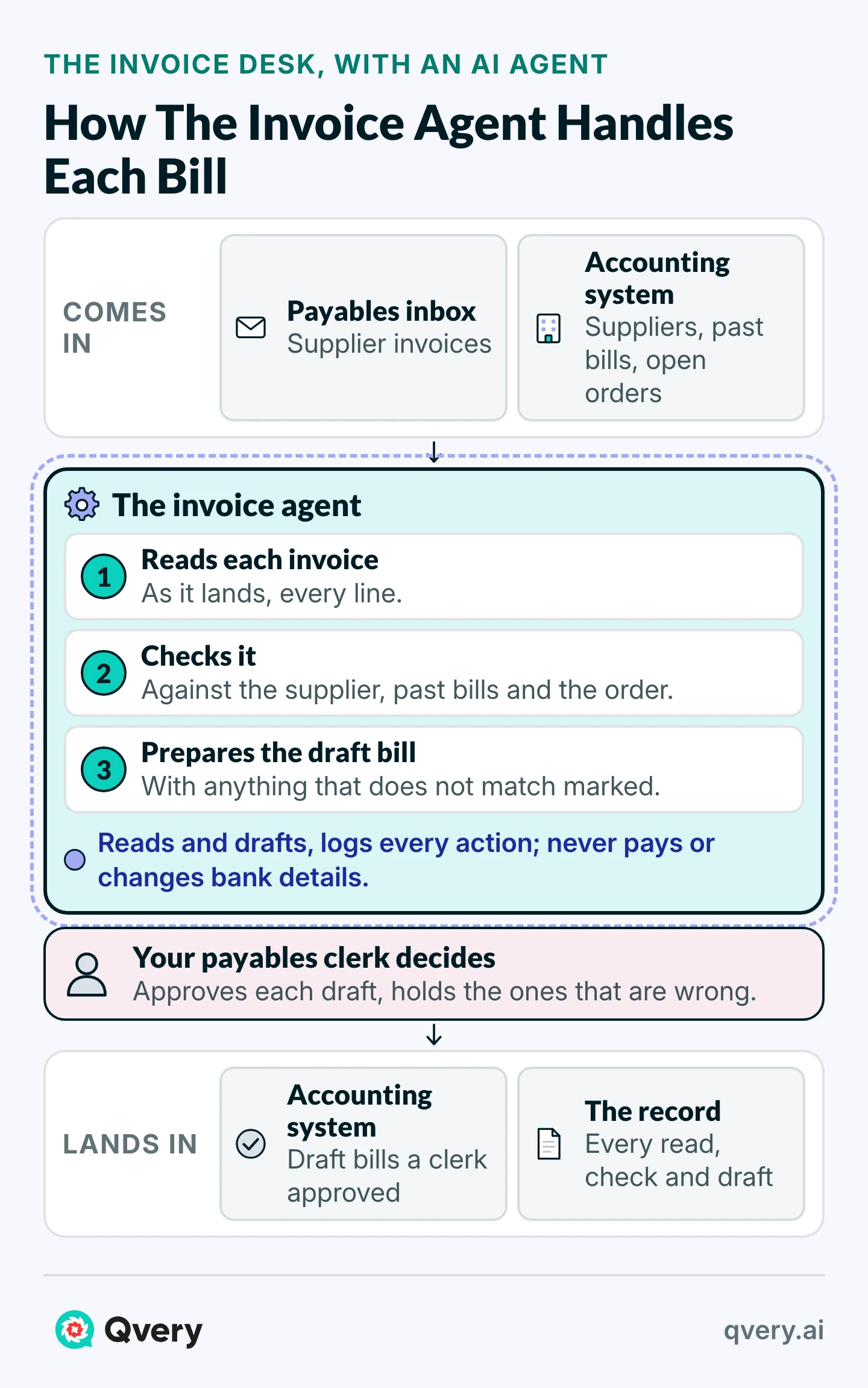
The agent is given only the access the invoice job needs, and it writes each read, check and draft to a log. For the first stretch, nothing leaves your company until a clerk has looked at it, and you choose which steps it later finishes without one.
On the invoice desk, the agent reads each invoice as it lands, checks it against your supplier list, past bills and open orders, and prepares the draft bill. Approving bills, holding the wrong ones and any edit to how a supplier is paid remain your payables team's work.
Because Qvery AI OÜ is based in the EU, the data processing agreement we sign must, by law, say that the personal data we handle for you is returned or deleted when the work ends, at your choice, and must let you or your auditor check.
You pay one price for a result we define together, agreed before we build anything. Once the agent is live, we report each week the hours it gave back and the errors it caught, measured against the numbers from before, and we train the clerks who work alongside it.
What You Bring, and What You Have After Two Weeks
Bring the job you have in mind and a month of its paperwork. For an invoice desk that is last month's supplier invoices, read access to the payables inbox and the accounting system, and an hour with the clerk who knows the exceptions.
We map the job with you, write down its numbers, agree the result and sign what the agent may touch before any access is opened.
Within two weeks of your access being set up, a first working agent is handling your own invoices, and from that week on you see the numbers that say whether it earns its keep.
Frequently asked questions
What should we ask an AI consultancy before we hire it?
Four things, in writing: what the agent may read and do, how it will be measured against your current numbers, who keeps it working when its model is retired, and what happens to your data and its setup at the end. A firm that answers all four plainly is one you could leave, which makes it safer to stay.
How much does an AI consultancy cost?
It depends on the job, so ask for one price tied to a result you both define, settled before anything is built, rather than hours billed as they go. Then weigh it against what the job costs you today: on the invoice desk above, each $10,000 of build pays for itself in about three months.
Who owns the code and the data from an AI consulting project?
Your business records stay yours, and for the personal data in them, EU law requires a firm processing it for you to return or delete it at the end, at your choice. The code and the agent's setup are settled by the contract's intellectual property clause, which differs from firm to firm, so read it with your lawyer before you sign.
What happens when the AI model under our agent is retired?
Someone moves the agent to the newer model and checks it against past invoices whose right answers you already know before it goes back to work. Providers give notice, at least 60 days at Anthropic and at least six months for OpenAI's main models, so with those checks on file the move is routine upkeep.
How do we check an AI firm's accuracy claims?
Hand it a set of your own past documents, the awkward ones included, whose right answers you know, and ask for its results on those before you sign. An accuracy figure measured on someone else's documents says little about yours, and the same set keeps working as a test after the agent goes live.
Can our own team take the agent over later?
Yes, if the rules, the record of what it did and the numbers it is measured against are in your files, and your people have worked beside it from the start. Moving it to a new model still takes someone technical, which a firm or a contractor can do from those same files.
Does the agent need a new system to hold our records?
It should not. The agents we build plug into the inbox and accounting system you run now, so your invoices and bills stay where they are today. A build that moves your work into a new platform adds a second thing to leave behind if you ever change firms.
Who is responsible when the agent gets a payment wrong?
Keep the decision where a loss would happen. Our invoice agents prepare draft bills and never release a payment or change a supplier's bank details: those stay with your payables team, and every draft sits in a record your auditor can read. Who bears a loss if a wrong draft gets through is settled in the contract, so read that clause too.
Should we choose a firm that specializes in our industry?
Industry knowledge shortens the first weeks, but it matters less than whether the firm learns your desk as it runs today. Ask how it will learn the work, from whom, and what it writes down: a firm that skips that step builds the agent around what you said happens, which is rarely what does.
What if the firm that built our agent closes?
With the rules, the record, the numbers and the agreement in your files, another builder can pick the agent up or rebuild it in weeks, and your clerks can run the desk by hand in between because they were trained beside it. Without them, the next builder starts by relearning the job from your clerks.
Is a large consulting firm safer than a small one?
Not by itself. A small senior team that writes down the job, agrees access in writing and reports against your own numbers leaves you better placed than a large firm whose method lives in its staff. Ask who will build your agent, and who will keep it running after the launch.