On this page
- 1. GEO Agent by Qvery
- 2. Ahrefs
- 3. Semrush
- 4. SE Ranking
- 5. Similarweb
- 6. Surfer
- 7. Keyword.com
- 8. Clearscope
- 9. Google Search Console
- The Cited Page's Search Record Is What You Pay For
- Brief an Agent to Prepare the Weekly Page Review
- How Qvery Prepares Your SaaS Content Review
- Pick the Suite by the Job Your Team Does Each Week
- Frequently asked questions
Every paid SEO tool on this list now tracks AI answers, from Ahrefs to Clearscope, so a software company that already pays for an SEO suite owns part of the AI side of the job.
When a buyer asks ChatGPT or Google AI Mode for software and gets a rival's name, your team needs the cited page, its links and rankings, and a reason to rewrite your page or contact its author.
The nine below are ranked on that sequence, from their own pricing and help pages and from what their users say on Reddit, all read on October 18, 2026, not from runs inside paid accounts.
The first entry is ours; it measures AI answers, not search data. After the comparison, I explain how we turn the findings into work for your team at Qvery.
The practitioners we read on Reddit made two points before any tool came up: teams pay for more suite than they use, and your own Search Console beats anyone's estimate of your own site.
What Reddit says
For an in-house blog team, the most common mistake is buying an all-in-one tool and using 10% of it.
Both are estimates only. I personally trust GSC for my own site before getting into custody battle b/w two seo subscriptions
I’d use GSC for my own site’s actual performance and compare a couple of tools for competitor research rather than expecting one tool to be 100% accurate.
GEO Agent by Qvery
Your Buyers' Questions, and Who Got Named Instead
This entry is ours, and it does the part of the job the suites below were not built around.
Qvery's GEO Agent writes your category's buying questions from your brand, your industry and the rivals you name, asks each one on ChatGPT and Google AI Mode every day in the countries you choose, and keeps every answer with every citation.
Its report puts your visibility, share of voice and sentiment beside those rivals by topic and by country, marks the questions where a competitor was named instead of you, and lists the sources the engines cite for your topics.
Its assistant answers questions about that data in plain language and can add or edit questions, start a run or export a report.
What it does not hold is anything about those cited pages as search results: their links, their rankings, their traffic. It is not an SEO suite, and for that half of the job a software company keeps one of the tools below.
It measures ChatGPT and Google AI Mode only. Price: not published.
We also work on the pages and sources those answers cite, and build custom agents for the follow-up. That service is separate from the GEO Agent.
- Buying questions written from your brand, industry and named rivals
- Asked daily on ChatGPT and Google AI Mode, in the countries you choose
- Every answer and every citation kept
- Visibility, share of voice and sentiment beside rivals, by topic and country
- The questions where a competitor was named instead of you
- The sources the engines cite for your topics
Pros
- Every question where a rival took your place, on both engines
- Questions written for you, so the first report needs no prompt list
- We can do the page work and build a custom agent
Cons
- Two engines only: ChatGPT and Google AI Mode
- No link, ranking or traffic data on the cited pages
- Price: not published
Ahrefs
The Cited Page and Its Backlinks in One Login
Brand Radar comes with every plan from Lite up. It benchmarks your share of voice in AI answers against competitors and lists the top cited pages and domains, on platforms that include ChatGPT and Google AI Mode, with each prompt asked in the platform's web version, the way a buyer would see it.
In Site Explorer, look up a cited page's backlinks, search terms, and traffic. You can examine the rival's search record in the same account.
Lite's allowance is small. Its $129 a month carries five tracked AI prompts, each checked daily on one platform, which is a sample of your category rather than a question list.
A real list means a prompt package on top: Basic adds 2,500 checks a month for $50, and one check is one prompt on one platform in one location.
Lite also includes API and MCP access, which is what lets an agent read the same data your team does.
- Brand Radar: AI share of voice against competitors
- Top cited pages and domains on ChatGPT, Google AI Mode and five more platforms
- Site Explorer: backlinks, traffic and top pages for any website
- YouTube and Reddit visibility beside the answers
- API and MCP access from Lite
What Reddit says
what I see right now Ahrefs gives the best correlation of its organic traffic vs GSC.
While Ahrefs scale can be off, the trends are very accurate
I also stopped my Ahrefs subscription from last few months because of its pricing.
Pros
- Cited pages and link data in the same login
- Seven AI platforms, ChatGPT and Google AI Mode among them
- API and MCP access from Lite up
Cons
- Five AI prompts on Lite, so a question list costs extra
- Checks add up per platform, location and update
- One user included on each plan
Semrush
The Sources Your Rivals Get Cited From, Listed
Semrush has a report built for this exact question. Competitor Research takes your domain and up to four rivals and lists Missing Prompts, where a competitor is mentioned and you are not, and Missing Sources, the domains cited in those answers.
Prompt Tracking asks your own questions daily on ChatGPT, Google AI Mode or Gemini, one engine per campaign. Its Sources report lists every cited page and sorts them by category: your domain, competitor domains, social, knowledge bases and the rest.
The backlink and search data to look those sources up sits in the SEO toolkit next door, so the bundles make sense for a team that already reports from Semrush. Starter at $199 a month tracks 50 prompts a day beside the SEO tools; Pro+ at $299 tracks 100 and adds content optimization.
Competitor Research works from Semrush's own database of prompts, not your question list; your questions go into Prompt Tracking. The AI Visibility Toolkit bought on its own has no free trial.
- Competitor Research: Missing Prompts and Missing Sources against up to four rivals
- Prompt Tracking on ChatGPT, Google AI Mode or Gemini, daily
- Sources by category: your domain, competitor domains, social, knowledge bases
- Backlink, search-term and position data in the same account
- MCP access from Starter
What Reddit says
The prompt level data is usable, the visibility score sitting on top of it isn’t. The score moves without the underlying answers changing at all.
Semrush works best for me. It’s probably the best tool out there for keyword analysis and research
Semrush data for small/midsize website is not great
Pros
- Lost questions named in the report: Missing Prompts and Missing Sources
- Cited pages sorted with competitor domains as their own category
- One account for the AI answers and the backlinks behind them
Cons
- Competitor gaps come from Semrush's prompts, not yours
- One engine per Prompt Tracking campaign
- No free trial on the AI toolkit alone
SE Ranking
Pages That Cite Your Rivals but Not You, Ranked
SE Ranking's AI side lives in SE Visible, and its Sources Analysis is the closest thing on this list to a ready-made list of the pages that name your rivals instead of you.
A gap score ranks the pages that cite the competitors you track but not you, page by page, and filters them by type: listicles, comparison pages, alternative pages, how-to guides.
For a software company that filter matters, because shortlist answers lean on comparison and best-of pages, as the numbers after this list show. SE Visible tracks ChatGPT, Gemini, Perplexity, Google's AI Overviews and AI Mode, and refreshes daily.
The backlink research sits in the main SE Ranking platform: Core at $129 a month includes unlimited competitor and backlink research, 2,000 tracked search terms and 100 prompts tracked daily.
The AI Search add-on, $89 a month, brings SE Visible with 200 prompts. Which plan carries the gap score is not spelled out on the plan cards, so check it in the trial.
The catch is the gap between the two products. SE Ranking says connecting their data "is improving but not yet automated", so your team looks up a cited page's links in the other tab.
- SE Visible gap score: pages citing your rivals and not you
- Cited pages filtered by type, comparison and alternative pages included
- ChatGPT, Gemini, Perplexity, AI Overviews and AI Mode, refreshed daily
- Unlimited backlink and competitor research on Core
- API credits and MCP access on Core
What Reddit says
first impression is that it ticks a lot of boxes for both UI and UX while being more or less half the cost of the big two.
It's a decent tool for the price, but compared to SEMrush I found it lacking in a few areas. The biggest one for me was backlink reporting
Pros
- The gap list down to the page, sorted by page type
- ChatGPT and AI Mode, plus three more engines
- A trial with no card and a real prompt allowance
Cons
- Cited pages and backlink data sit in two products
- Gap-score access by plan is not spelled out
- One manager seat on Core
Similarweb
Which Rival Pages AI Cites, and the Traffic Around Them
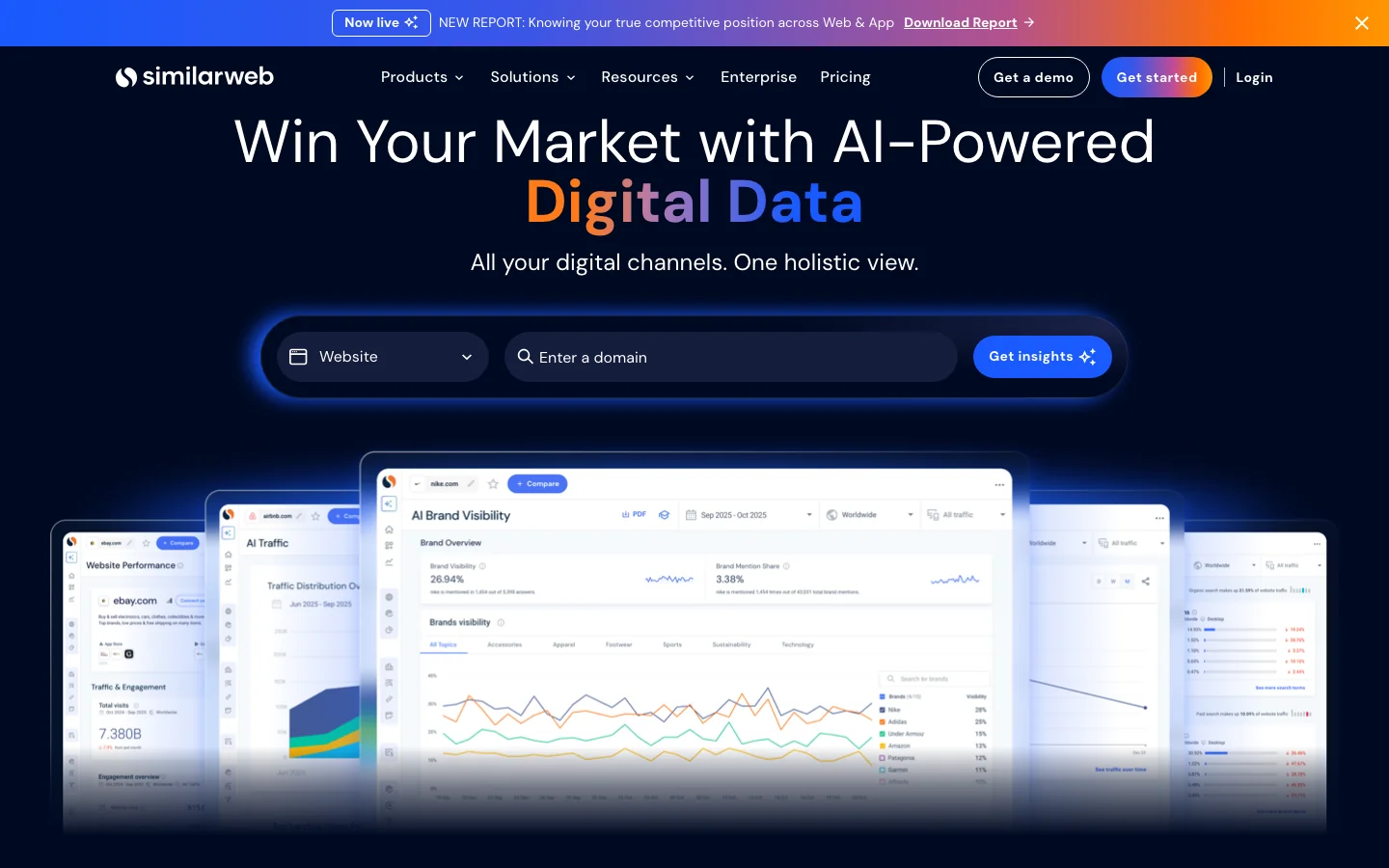
Similarweb builds its view on traffic. Its Citation Analysis shows every URL cited in the topics you track, which competitor pages are being cited, the exact Reddit and Quora threads in the answers, and an influence score for each domain and URL, on ChatGPT, Gemini, Perplexity and AI Mode.
The search data on those pages comes with the bundle. AEO Intelligence alone is $129 a month on monthly billing, with 150 tracked prompts; the $399 bundle adds search research, rank tracking, site audit and backlinks, and Similarweb's traffic and engagement estimates for any site.
Those estimates are modeled, so hold them against your own analytics for your own site before you trust them for a rival's.
- Citation Analysis: every cited URL in your tracked topics
- Competitor pages and Reddit and Quora threads cited
- Domain and URL influence scores
- AI Traffic: visits AI answers send to your site
- Traffic and backlinks for any site in the bundles
What Reddit says
I think it’s fine to use but take with a grain of salt. I’ve seen some really close and some way off
The trajectory was completely off.
Pros
- Every cited URL with an influence score
- AI referral traffic to your own site
- Rival traffic and backlinks in the same bundle
Cons
- Traffic figures are estimates that vary by site
- One user on each self-serve plan
- Backlinks start at the $399 bundle
Surfer
From the Cited Page to the Draft That Answers It
Surfer is strongest on the last step: what your team changes. AI Tracker shows which competitors are getting cited and the pages AI models reference most, and its Recommendations turn that into two lists, refreshed every Monday.
One is the highly cited sources that mention you negatively or not at all, ranked for outreach. The other is content ideas with a suggested title that open straight in the Content Editor, which Surfer's own help page suggests for recreating or outperforming the pages that get cited.
There is no link data here, so Surfer does not tell you why the cited page holds its place in Google. It tells you what to write instead, which is the work a content team already does each week.
Check the plan before you count on the AI side: Standard tracks 25 prompts on ChatGPT only, refreshed weekly; daily tracking across ChatGPT, Gemini, Perplexity and Google's AI Overviews starts at Pro. Google AI Mode is not named among its engines. Its homepage now carries the Positive name beside Surfer's own.
- AI Tracker: competitors cited and the most-referenced pages
- Recommendations: sources to get mentioned on, ranked
- Content ideas that open in the Content Editor
- Content optimization with WordPress and Google Docs integrations
- Daily refresh on Pro and up
What Reddit says
I currently think it’s the best, and with the Pro plan, I also get AI Tracker.
I will miss the direct integration to wordpress for blog posts but I'd rather save the cash for other tools.
Pros
- Cited sources turned into an outreach list and content ideas
- Writing and grading in the same tool
- Weekly recommendations with no setup beyond the prompts
Cons
- No link or traffic data on the cited pages
- ChatGPT only, weekly, on Standard
- Google AI Mode not named among its engines
Keyword.com
Google Rankings and AI Mode on One Cheap Meter
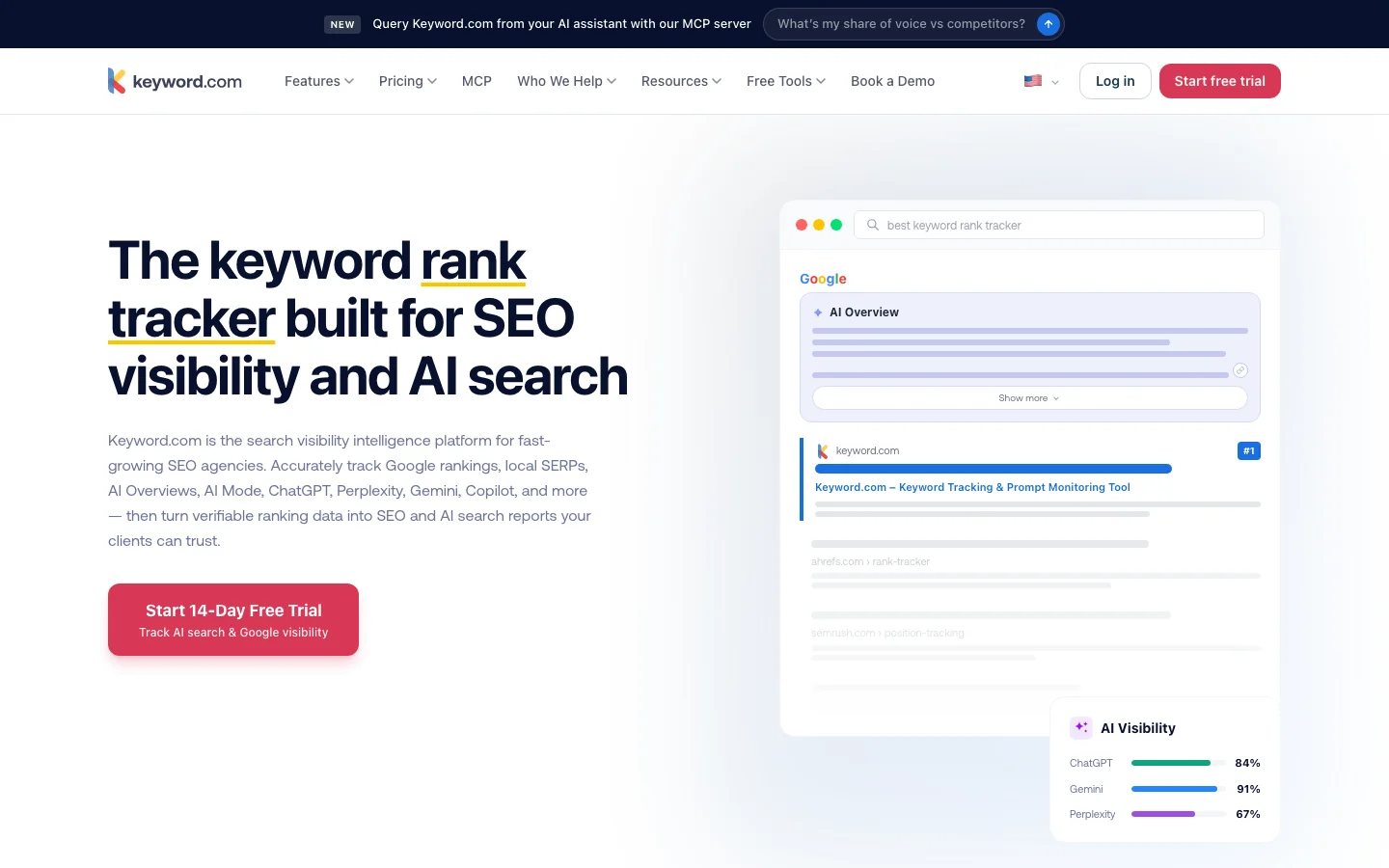
Keyword.com is a rank tracker that added AI tracking, and it prices the AI side by the run. Its AI Visibility plan compares you with competitors, shows which websites the AI engines reference in their answers, and covers Google AI Mode, AI Overviews, ChatGPT, Gemini, Perplexity and Copilot.
Its help page says the ChatGPT runs use an OpenAI model with web search.
A run is one question on one engine for one refresh, and a standard engine costs a quarter of a credit. One question asked daily on ChatGPT and AI Mode for a month is 60 runs, or 15 credits, inside the 20 credits that come with the $9.80 starting plan.
The 360 Degree plan puts Google rank tracking in the same account, so the citations and your Google rankings for the same topics sit in one account. Backlinks are not part of it.
Credits reset each billing cycle and do not roll over, and when they run out, refreshes pause. Independent discussion of Keyword.com on Reddit is thin this year; we found no user threads on its AI tracking to quote.
- AI Visibility: competitors, cited websites and sentiment
- Google AI Mode, AI Overviews, ChatGPT, Gemini, Perplexity, Copilot
- Pay by the run, 0.25 credits on standard engines
- Google rank tracking in the 360 Degree plan
- An API for AI visibility data
Pros
- The cheapest way here to ask both engines a few questions daily
- Rankings and AI citations in one account
- Hourly, daily, weekly or manual refresh per question
Cons
- No backlink data
- Refreshes pause when credits run out
- Little independent user discussion to go on
Clearscope
Content Grading With a Watch on ChatGPT and Gemini
Clearscope is a content optimization tool first, and its Query Tracking is a watch on two engines: ChatGPT and Gemini, per its pricing page.
You add your domain and up to five competitors, and each query shows your mention rate, a 90-day trend, the text of the three most recent answers, and a flag for queries where competitors are mentioned and you are not.
It also shows the web searches the AI platforms run to build their answers, which tells a writer what the answer went looking for.
Clearscope answers two of the questions this list asks: who got named, and what to write. The cited pages are not described on its pages, and there is no link data. Google AI Mode is not named either, which matters if your buyers search Google.
Reddit's recent talk about Clearscope is thin: this year it turns up as a name in lists of tools, rarely with a reason, so there is nothing we would quote.
- Query Tracking on ChatGPT and Gemini
- Up to five competitor domains per query
- The three most recent answers, verbatim
- A flag where competitors are mentioned and you are not
- Content grading, topic exploration and drafts
Pros
- The answer text itself, not only a score
- Writing tools built around the same queries
- Unlimited users on every plan
Cons
- Google AI Mode not named among its engines
- Cited pages not described
- No link or traffic data
Google Search Console
Your Own Pages in Google's AI Answers, Free
Google's Search Console help page dates the generative AI report's rollout to August 31, 2026. For any verified site, it shows link impressions in AI Overviews and AI Mode by page, country, date, and device, at no cost.
That is your own side of the picture: which of your pages Google's AI answers already show, measured by Google rather than estimated. It lists no questions, no rivals and no clicks in that report, and it sees only Google.
Use it as the baseline for your own pages. If a suite says your pages are cited in Google's AI answers and Search Console shows no AI impressions for those pages over the same weeks and country, trust Search Console about your own site and ask the vendor what it measured.
- Generative AI report: impressions in AI Overviews and AI Mode
- By page, country, date and device
- The Performance report, with AI traffic counted inside Web search
- URL Inspection and index coverage from Google's own index
What Reddit says
It can reveal which pages Google treats as useful sources even when clicks are limited.
I find it interesting to look at but not helpful.
Pros
- Google's own numbers for your own pages
- AI Overviews and AI Mode impressions page by page
- Free for any site you verify
Cons
- No queries or clicks in the AI report
- Your site only: no rivals, no cited pages
- Google only, no ChatGPT
The Cited Page's Search Record Is What You Pay For
Nearly every tool here tells you a rival was named. What separates them is the last column below: whether the tool knows anything about the cited page as a search result.
| Tool | Cited pages shown | The page's search data |
|---|---|---|
| GEO Agent by Qvery | sources per topic | none |
| Ahrefs | top cited pages | links, traffic, top pages |
| Semrush | Missing Sources, every cited page | links and search terms, in the bundles |
| SE Ranking | pages, by type | backlinks, in the other product |
| Similarweb | every cited URL | traffic; backlinks at $399 |
| Surfer | most-referenced pages | none |
| Keyword.com | cited websites | Google rankings |
| Clearscope | not described | none |
| Search Console | your own pages | your own impressions and clicks |
That last column matters for a software company because of what its buyers' answers cite. In our research on CRM and AI voice-agent buying questions, asked on ChatGPT and Google AI Mode in late August 2026, 74.00% of shortlist answers cited a comparison or best-of page.
In voice agents, 71.31% of the comparison pages those answers cited were written by companies selling something in or around the category. In CRM the split was closer: sellers wrote 46.60% and independent publishers 49.21%.
So the page an answer leaned on is often a rival's own comparison page. Its links and rankings do not tell you why the answer cited it; they tell you whether the page is strong in search as well, or only shows up inside the answer.
That changes the move. A page strong in both you would have to out-write and out-link; a weak page that gets cited anyway may be easier to join, by asking its author. A citation shows the page an answer points to, not what decided the deal, so read these as where to look first.
At $129 a month, the four plans below include 5 to 150 tracked questions. Engines and refresh schedules differ, so these allowances are not interchangeable.
What $129 a Month Buys in Tracked AI Questions
tracked AI questions
View the data
| Label | Value | Note |
|---|---|---|
| Similarweb AEO Intelligence | 150 | 150 tracked prompts, 1 user, $129 a month or $99 billed annually. |
| SE Ranking Core | 100 | 100 prompts tracked daily beside 2,000 tracked search terms. |
| Clearscope Essentials | 50 | 50 tracked queries on ChatGPT and Gemini. |
| Ahrefs Lite | 5 | 5 tracked AI prompts, checked daily on one platform; packages add more. |
If AI answers are the reason for the purchase, Ahrefs Lite's five prompts are a sample and the package is the real price; if the search data is the reason, those five are a bonus on a tool you were buying anyway.
A question list nobody updates measures last quarter's buyers. Our GEO Agent generates questions for your company and tracks the answers.
Brief an Agent to Prepare the Weekly Page Review
Give the agent a question list, named rivals, and one content owner. Each Monday, it should take the questions where rivals appeared, then retrieve the cited pages' links, rankings, and traffic through your licensed SEO suite's API.
Its brief should pair each question and rival with the page data and a proposed rewrite or outreach note. It should hand your content lead URLs to open, not read those sites automatically. The lead checks each page and approves any publication or contact.
How Qvery Prepares Your SaaS Content Review
We learn how your content lead chooses between rewriting a comparison page and asking another publisher to include your software. We use our GEO Agent to generate questions shaped by your software business and its competitors. ChatGPT and Google AI Mode are queried daily, with each run covering your chosen countries.
All responses remain available in full, citations included. You can see your visibility beside competitors and compare sentiment or share of voice, with country and topic breakdowns. The cited sources tell your content lead which pages to examine.
We handle the page work that follows. To prepare the recurring briefs, we give your company its own custom agent, attached to your SEO account and content systems. On autopilot, it prepares work that your content lead approves.
We deliver that first working review within two weeks, training your lead to inspect the drafts. Each week, we count how many review hours it saved and which briefing errors it prevented.
The useful starting point is your current question list.
Pick the Suite by the Job Your Team Does Each Week
Your team builds links and pitches roundups: Ahrefs, with the cited pages and their backlinks in one login and a prompt package past Lite's five.
Your marketing team already reports from Semrush: the Starter bundle at $199, for Missing Sources beside the backlink data it already uses.
You want the pages that cite rivals and not you, listed and ranked: SE Ranking with SE Visible, looking up each page's links in the other tab.
You size the category and watch rivals' traffic: Similarweb, and the $399 bundle if you want backlinks and an audit beside the citations.
Your team writes the pages: Surfer Pro, where cited sources become content ideas in the editor, or Clearscope if ChatGPT and Gemini cover your buyers.
You track Google rankings on a tight budget: Keyword.com, with a handful of daily questions on AI Mode and ChatGPT at a quarter credit a run.
No budget for another subscription this quarter: Search Console's generative AI report, which costs nothing and shows your own pages first.
Nobody has the hours for a weekly read: Qvery's GEO Agent writes and asks the questions, and our team does the page work as a service.
Before any of these goes on the budget, write one row for every SEO subscription the company pays for: the job it did this month, the person who did it, and the decision it changed. Two suites that both report a rival's traffic is up are one suite and a second opinion billed monthly.
A row with no job is the first thing to cut. Staff the unanswered buying questions before adding subscriptions, then look for repeated work elsewhere, such as passing new customers from sales to onboarding.
Frequently asked questions
Do we need a separate AI visibility tool if we already pay for Ahrefs or Semrush?
Ahrefs includes five tracked AI prompts on Lite and sells larger packages; Semrush bundles 50 daily prompts into its $199 Starter plan. Check whether your existing allowance covers your buyer questions before adding another subscription. Someone still needs to read the answers and assign the page work.
Is Google Search Console enough for a software company?
For your own pages in Google's AI answers, it is the free baseline: since August 31, 2026 its generative AI report shows how often your links appeared in AI Overviews and AI Mode, by page. It shows no questions, no rivals and nothing from ChatGPT, so it cannot tell you who took your seat.
How many buyer questions should we track?
Start with questions your sales team hears before a demo, covering distinct buying situations. Add competitor names where buyers use them, and match the list to the plan's allowance. Keep it manageable enough for one person to read the answers weekly.
Who in the company should own AI search visibility?
The person who owns the pages: usually the head of content or marketing. They decide whether a lost question gets a rewrite of your own page or a note to the author of the page that won. One owner and one weekly read beat a dashboard shared by five people.
Do SaaS buyers ask AI assistants for vendor shortlists?
Gartner surveyed 645 B2B buyers in August and September 2025: 45% used GenAI during a recent purchase, primarily for vendor and product information. The survey covered B2B buying generally, not just SaaS, and 69% preferred to validate AI insights with sales reps.
Can an AI agent do the weekly read for us?
An agent can prepare the review using your tracked questions and licensed SEO data. It pairs each cited page with its links, rankings, traffic, and a proposed rewrite or outreach note. Your content lead reads the page and decides what to publish or send.
Can one SEO suite replace two?
One suite may cover your search, competitor, and backlink research. Keep a second only when it does a job the first cannot, such as showing AI citations by page type. Write down the work each subscription supported this month before renewing it.
Why look at backlinks to a page an AI answer cites?
Backlinks and rankings show whether the cited page also has a search presence. They do not prove why an assistant cited it or whether the citation led to a purchase. Use them to decide which pages deserve a closer read.
Does a larger prompt allowance mean a better plan?
A prompt count alone leaves out the engines and refresh schedule. Ahrefs counts checks by platform, while Surfer Standard tracks ChatGPT weekly and Pro adds daily tracking across more engines. Compare the runs your question list needs before comparing allowances.
What happens when Keyword.com credits run out?
Refreshes pause until credits are available again, and unused credits do not roll over. One question checked daily on two standard engines for 30 days uses 60 runs, or 15 credits. Set the schedule against the allowance you buy.
Which tools turn citations into writing tasks?
Surfer turns frequently cited sources into outreach suggestions and content ideas that open in its editor. Clearscope combines query tracking with content grading, but its pages do not describe cited-page reporting. Neither supplies backlink data for that review.
What does Qvery do after measuring our AI visibility?
We work on the pages and sources the answers cite, and build a custom agent for the repeated briefing work in your own systems. We deliver a working version within two weeks and train the content lead, then count the review hours saved and errors avoided each week.