
On this page
If buyers see your company below its rivals in AI answers, your team needs to know which questions put you there before spending time changing pages.
We make the first entry, the GEO Agent, so read it as our pick. The others follow what their pages show about the order of names in answers and the cost of asking ChatGPT and Google AI Mode daily.
1. GEO Agent by Qvery: The Rivals Named in Your Place, Both Assistants Every Day
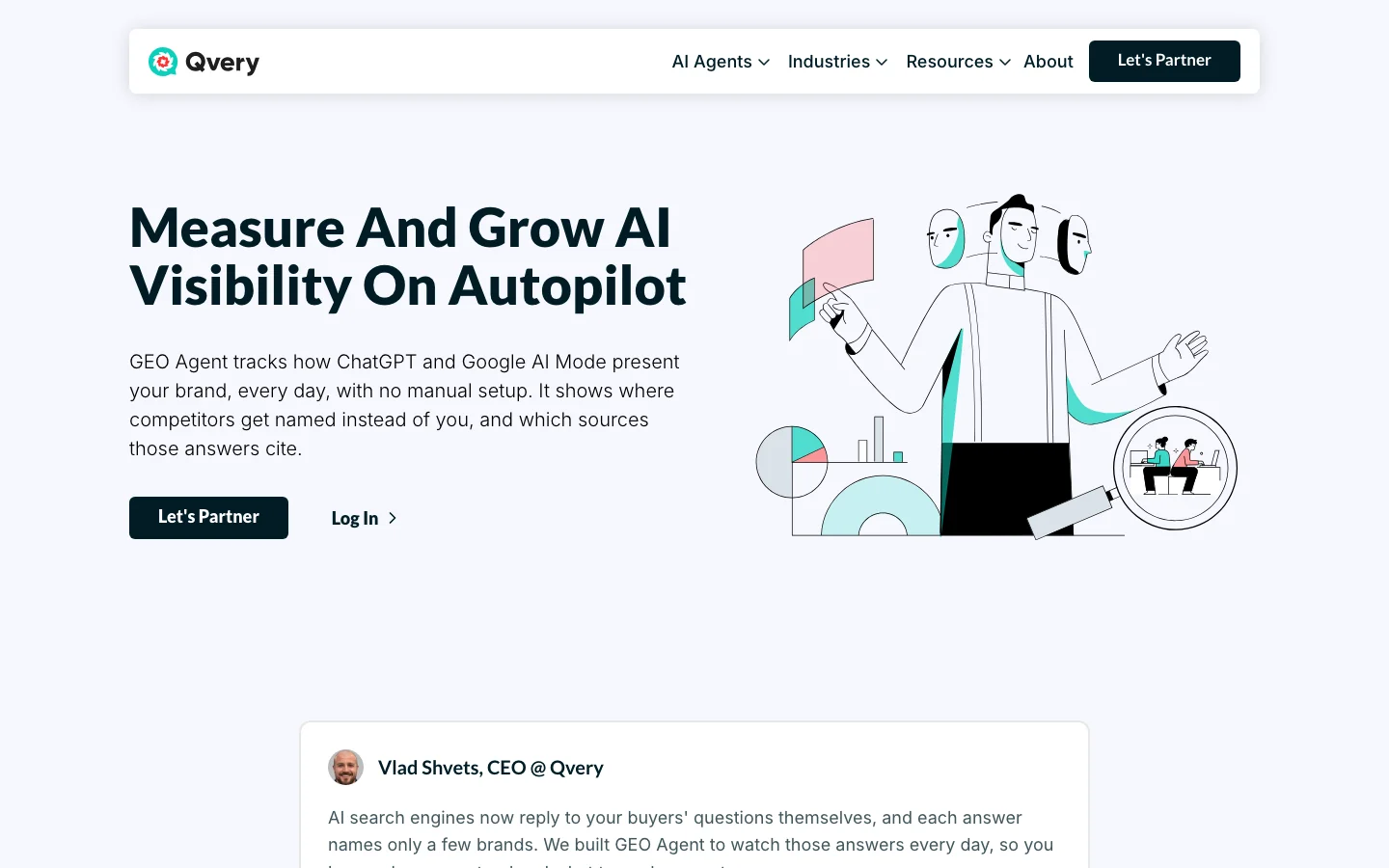
Our own product, the GEO Agent, prepares buyer questions using your company, its industry, and its competitors. It runs those questions daily in your chosen countries on ChatGPT and Google AI Mode, keeping the complete responses and their citations, the pages named as sources.
For the shortlist, the names an assistant gives, you see your visibility next to your competitors, by topic and by country. Share of voice shows how often you are named against rivals, and sentiment shows whether the answer speaks well of you.
You also see the questions where a competitor is named instead of you and the sources the assistants cite for your topics.
Qvery Assistant is built in: ask about the numbers in plain words, or have it add, edit or delete questions, start a run, or export a report.
The GEO Agent covers only ChatGPT and Google AI Mode. It shows where to work; your team decides what to publish. Price: not published.
We also do the work those answers point to, including correcting pages and building custom agents for recurring checks. That work is a service, quoted apart from the GEO Agent.
Pros
- Questions written for you
- Both engines daily on every question
- The fixing done by the same team, as a service
Cons
- Two engines only
- Price: not published
2. Nightwatch: Every Name in the Answer, in Order, Next to Your Google Rankings
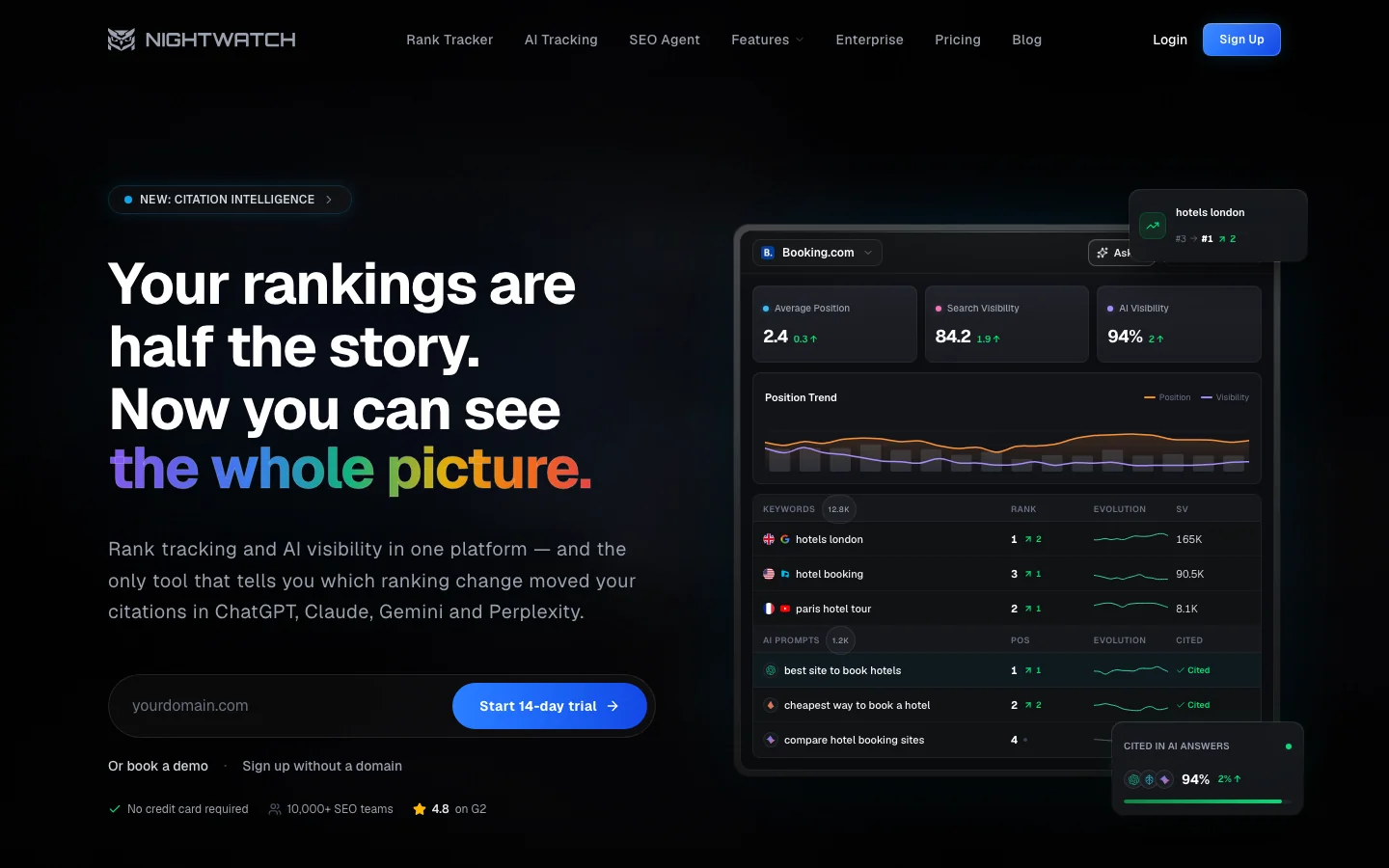
Nightwatch combines Google rank tracking with AI tracking. It lists each brand and its position in an answer, alongside sentiment and cited domains. You can open the full response.
Its Citation Intelligence ties those citations to the Google rankings of your pages, which suits a company whose marketing team already reports Google positions every week: one dashboard holds both.
Starter costs €79 a month, billed yearly, for 500 tracked search terms and 50 AI prompts, or questions, all checked daily. Each prompt runs on the one platform you set for it, so 50 prompts ask 25 questions on both ChatGPT and Google AI Mode. Every plan carries every AI platform Nightwatch tracks, with unlimited seats.
- Every brand named in each answer, with its position
- Sentiment, cited domains and the full response per prompt
- AI citations linked to the Google rankings of your pages
- ChatGPT, Claude, Gemini, Perplexity, Google AI Mode and AI Overviews on every plan
Independent discussion of Nightwatch's AI tracking is thin.
Pros
- Every name, in order, per prompt
- Rankings and AI answers in one place
- Unlimited seats
Cons
- One engine per prompt, so both engines halve the count
- 25 questions on both engines on Starter
- AI tracking is the newer half of the product
3. Peec AI: Your Position, the Sources That Skip You, and the Objections
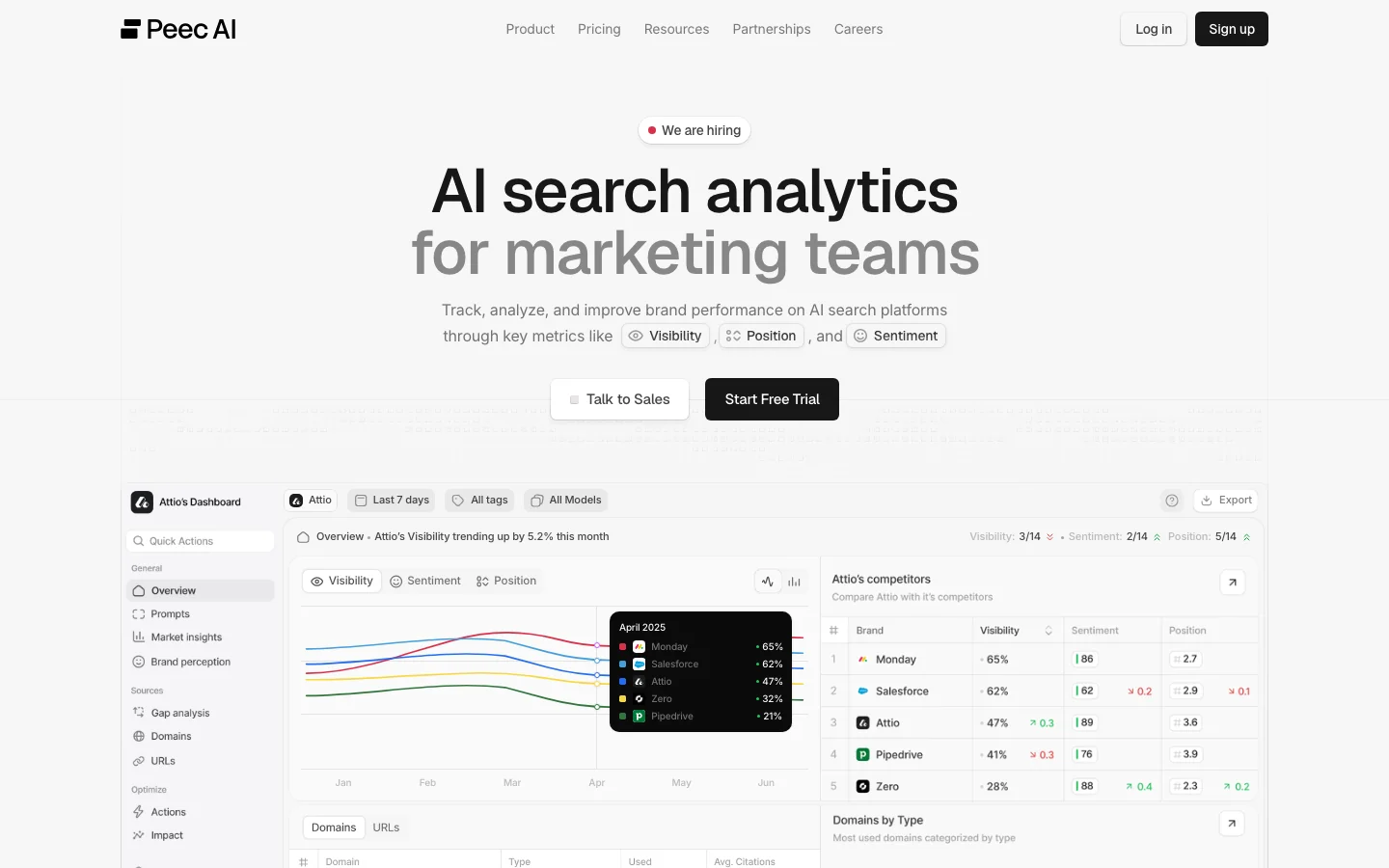
Peec reports visibility, position, sentiment and share of voice for every prompt, daily, against the competitors you track, which covers the shortlist directly.
Two features on its pricing page go further. A gap view lists the sources that often name your competitors but not you. Objections groups the recurring arguments AI raises against your brand and traces them to the pages behind them, which catches the caveats inside answers otherwise counted as positive.
Starter costs $95 a month for 50 prompts asked daily on three models, or assistants, you choose, ChatGPT and Google AI Mode among them, with unlimited users.
On Reddit, a marketer who tried Otterly and liked it found Peec AI better for research, because it shows where the brand could join the conversations behind the answers.
- Visibility, position, sentiment and share of voice per prompt, daily
- The sources that name competitors but not you
- Objections, traced to the pages behind them
- Answers checked for claims against facts you set
Pros
- Position and share of voice daily
- Objections traced to their pages
- Unlimited users
Cons
- Three models at a time below the custom plan
- 50 prompts on Starter
- One project on Starter
4. Rankscale: Credits Spent Question by Question, and the Searches Behind the Answer
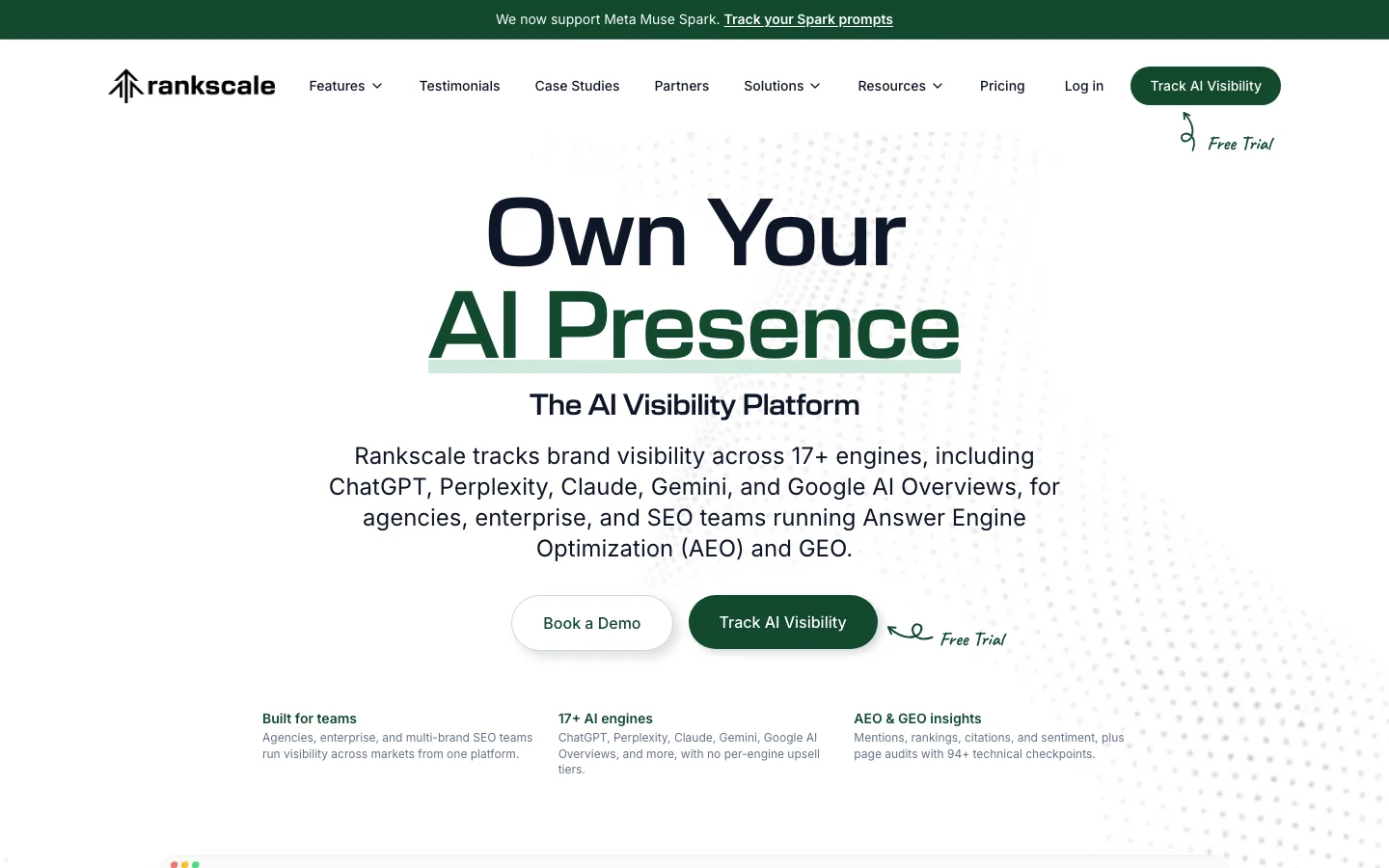
Rankscale sells credits rather than a fixed prompt count. Pro's 1,200 credits cover up to 4,800 answers a month, or about 80 daily questions on both ChatGPT and Google AI Mode. You can schedule quieter questions weekly.
For the shortlist it shows how you rank against competitors and which sources the answers cite. It also shows the searches an engine ran while answering, with the domains it looked at and dropped; Rankscale names ChatGPT, Perplexity, Claude and Copilot among the engines it reads them from.
- Visibility, rank and share of voice against competitors
- Citations and the sources box behind each answer
- The searches engines ran, the domains they probed, wins and losses
- A schedule per search term, hourly to monthly, and 50 page audits on Pro
G2 lists two reviews of Rankscale, too few to score.
Pros
- Pay per question and engine
- The searches behind the answer
- A schedule per question
Cons
- Credits take arithmetic
- No exports on Essentials
- Few G2 reviews so far
5. Knowatoa: The Questions Only Your Rivals Win, Google AI Mode From $59
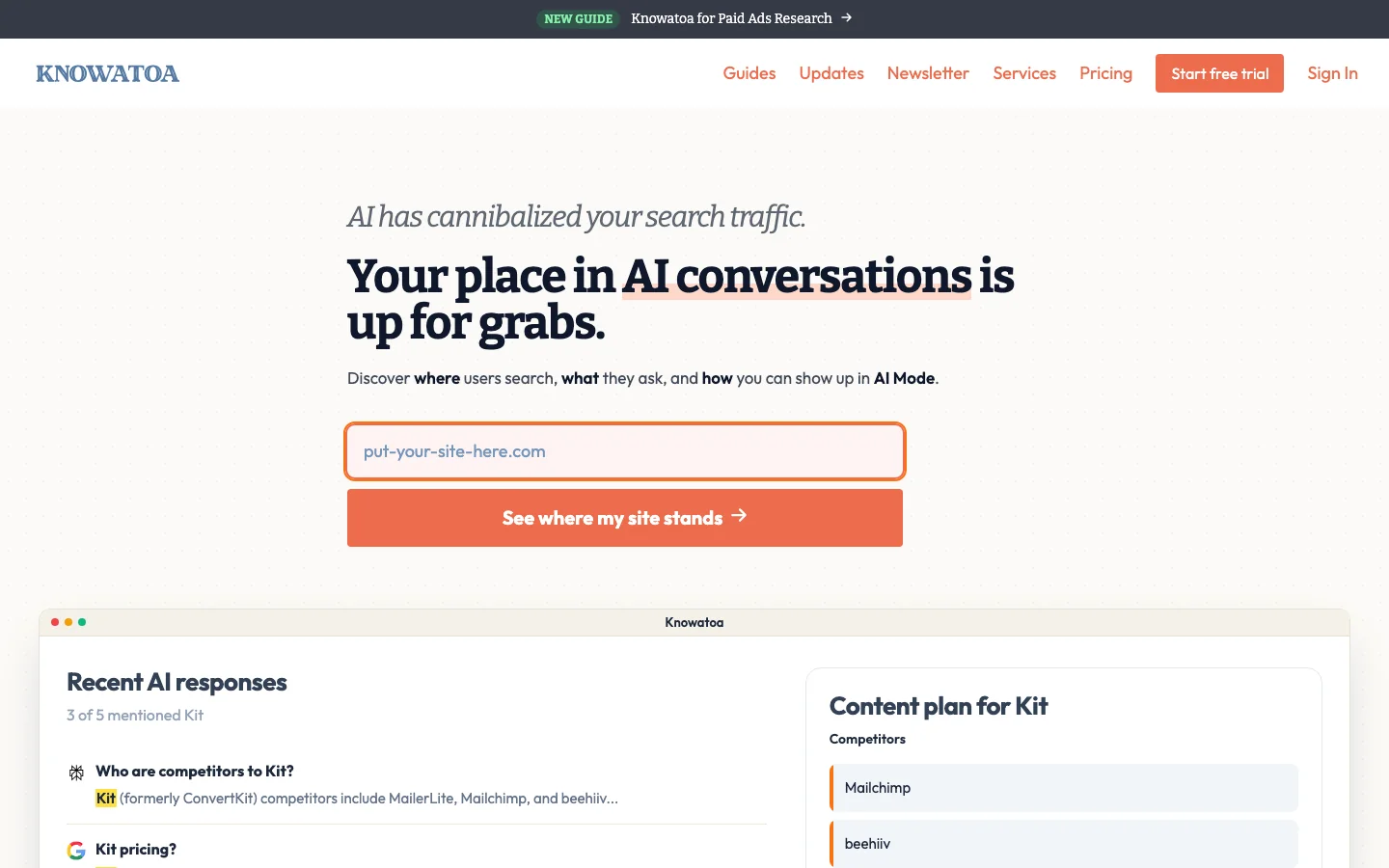
Knowatoa drafts the questions buyers are likely to ask, helps you pick the ones worth tracking, then splits them three ways: questions only a competitor wins, questions you share, and questions only you win. The first pile lists the questions where you are not on the shortlist at all.
Starter costs $59 a month and asks ChatGPT, Google AI Overviews and Google AI Mode, with competitor, citation and sentiment analysis and its two agents: Sam researches gaps and Connie drafts content, which you review and approve or let auto-approve at 10 AM.
Growth, at $199, adds the other four services it tracks. Neither plan's question allowance is printed on the pricing page.
- Likely questions generated, then picked with you
- Head to head: rival-only, shared and your-only questions
- Cited sites, sentiment alerts and a weekly digest of what changed
- Agents that research gaps and draft content for approval
G2 has no reviews of Knowatoa yet, and Reddit names it in tool lists without reviews of its use.
Pros
- Google AI Mode on the $59 plan
- Rival-only questions in one view
- Drafting agents from Starter
Cons
- Question limits not printed
- No G2 reviews yet
- Seven services only on Growth
6. Profound: Your Usual Place in the Answer and Wrong Claims, Google AI Mode on the Custom Plan
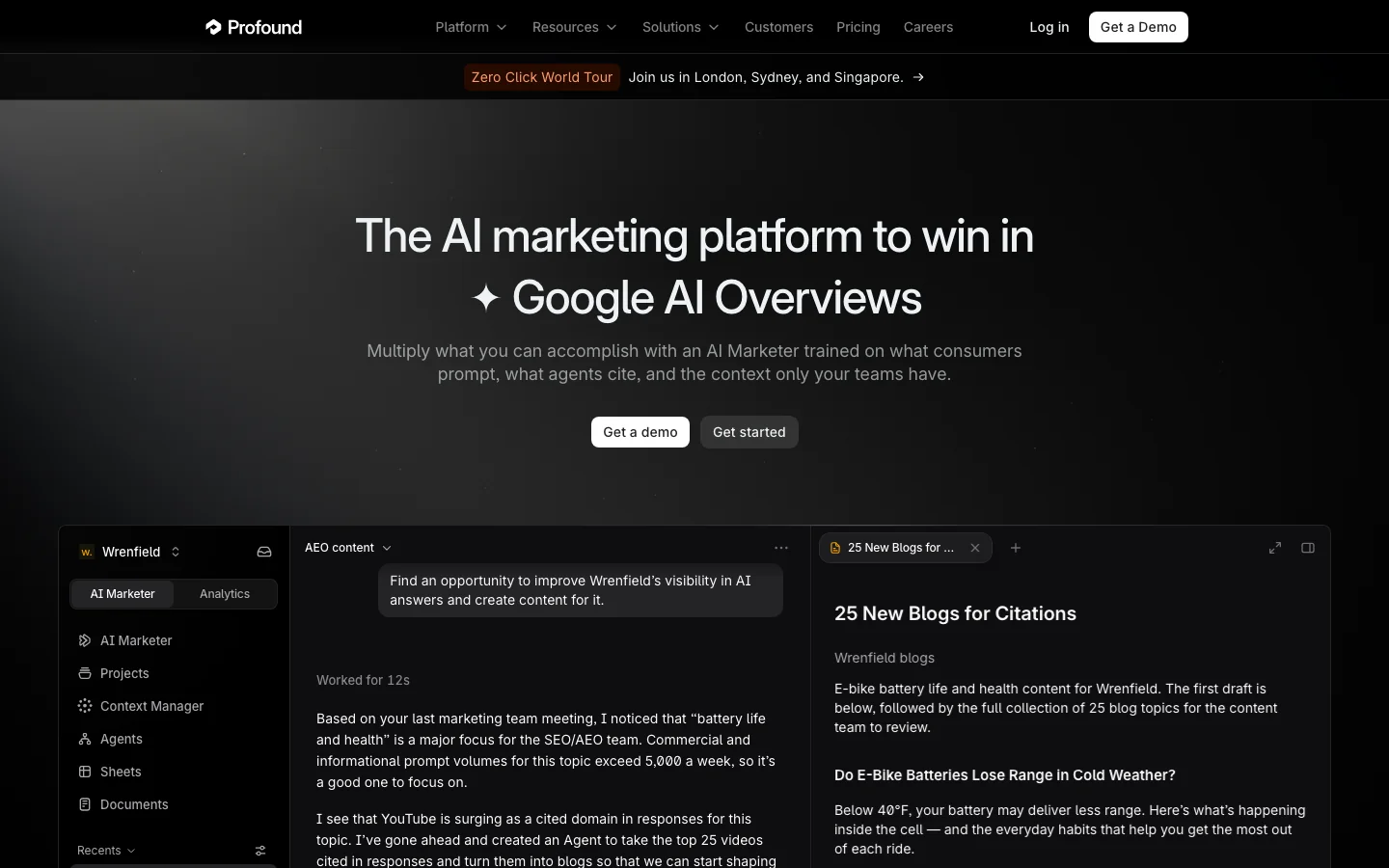
Profound turns the shortlist into an average-position score, where 1 means you are usually the first brand named, beside visibility and share of voice. Its sentiment reads themes in the answers (a mention of high cost pulls it down), and its fact check picks out wrong claims about you and the sources responsible.
The free trial asks 50 prompts a day for seven days on ChatGPT, Gemini and Google AI Overviews. Google AI Mode and up to nine engines come with the custom plan, priced by quote, together with its AI Marketer and agents for recurring marketing work.
- Average position, visibility and share of voice
- Sentiment themes drawn from the answers
- Wrong claims about you, with their sources
- AI Marketer and agents for recurring marketing work
Pros
- Position as a single score
- Wrong claims traced to sources
- Agents that draft as well as measure
Cons
- Google AI Mode only on the custom plan
- No published price
- The trial skips Google AI Mode
The Six Beside Otterly
Being named in an AI answer tells you little by itself. A tool earns its line in the budget by showing your place on the shortlist and who sits above you, question by question.
 Piotr BabelPartner @ Qvery
Ask ChatGPT the same buyer question twice and the order of names can change, so a single check says little about where you stand. Your place on the shortlist shows only when the same questions are asked daily on ChatGPT and Google AI Mode and the tool keeps each full answer. Before you buy, count the questions a plan asks on both engines each day: Nightwatch's 50 prompts on Starter, for example, cover 25 questions on both.
Otterly suits a team tracking a small set of buyer questions: $29 a month asks 15 questions a day on ChatGPT and other assistants, Google AI Mode is a $9 add-on, and page audits with recommendations come on the same plan.
Otterly with the $9 Google AI Mode add-on is a fair place to stay.
| Tool | Price for both engines | Questions a day on both | What it shows | Start with it if |
|---|---|---|---|---|
| Otterly (for reference) | $38 a month | 15 | Mentions and page audits | fifteen questions cover your buyers |
| GEO Agent by Qvery | Not published | Written for you | Rivals and cited sources | nobody has the hours to write the questions |
| Nightwatch | €79 a month, billed yearly | 25 | Names in order; Google rankings | your team already reports Google rankings |
| Peec AI | $95 a month | 50 | Position, sources, objections | you need the reasons as well as the order |
| Rankscale | $99 a month | About 80 | Rank and searches behind answers | your list is long and uneven |
| Knowatoa | $59 a month | Not printed | Rival-only and shared questions | you want the fix drafted |
| Profound | Quoted | Custom plan | Position and wrong claims | IT needs single sign-on and a security review |
 Vlad ShvetsPartner @ Qvery
A tracker earns its price only when someone acts on it, so budget the hours to fix pages before you compare plans. A report of rivals named above you changes nothing until the pages the answers cite are corrected. If your team has those hours, Otterly at $38 a month with Google AI Mode is enough and the savings go to the fixes; if it does not, pay for a tool that drafts them, Knowatoa from $59 a month, or have someone do the fixing with your team.
What Qvery Adds to a Tracker
At Qvery, we help companies turn an AI-answers report into fixes at lower cost, with custom AI agents that compare each month's report with what sales hears and draft the changes.
Qvery's agents check the facts in those pages against your records and send proposed corrections to your team; at first, nothing goes live until a person approves it.
For the daily record behind that review, our GEO Agent keeps the answers and their sources together.
Put Your Tracker Reports to Work
We begin with whoever reads your tracker reports today and how they pick the pages worth correcting, and you choose the reports, pages and company records the agents may open. Two weeks after they can open them, the agents are reading your own exports against those records.
After that, each new export comes back as a short worklist: the pages that misstate your company, the line that is wrong in each, and the correction the agents wrote up for your team to send.
Frequently asked questions
Will Otterly's Lite plan cover a company our size?
It can. Lite asks 15 questions a day for $29, or $38 with Google AI Mode. Count your buyer situations first: if each needs several questions on both engines, Standard ($189 for 100 prompts, plus $59 for Google AI Mode) or one of the plans above fits better.
Does the sentiment score matter?
A positive description does not tell you whether a buyer sees you first or fifth. Read the reasons behind the order; Peec groups objections against your brand, while Profound shows sentiment themes.
Can we switch from Otterly without losing our history?
An export preserves the old record but does not transfer its trend into another tool.
Will another tracker show us in the same place Otterly did?
Not always. AI answers can change even when the question stays the same, so expect the first weeks on a new tool to differ from Otterly's last ones.
Does buying a tracker mean it will publish corrections?
Do not assume that measurement includes publishing. The GEO Agent measures answers and points to sources; people decide what to change. Knowatoa separately offers drafting agents, with review and approval or an automatic approval setting.
Will adding colleagues make the tracker more expensive?
Not on Nightwatch or Peec AI: both include unlimited users on every plan, so another reader changes nothing on the bill.
Can one subscription cover several company websites?
Plans count it differently. Nightwatch's Starter covers 5 websites, while Peec's Starter covers 1 project, so several sites can push you up a plan before the question count does.
Do we need a higher plan to track another assistant?
Not always. Peec sells an extra model for $30 a month on Starter, and Nightwatch includes every platform it tracks on every plan.
Can a trial stand in for ongoing tracking?
The free options here are trials. Nightwatch lists 14 days and Profound 7, and Rankscale offers one on Pro, so the budget has to cover the paid plan that follows.
Are all the monthly prices billed month to month?
No. Nightwatch's €79 Starter and Rankscale's $17 Essentials are billed yearly, so both are monthly figures for an annual commitment.
Does a tracker know which facts about us are correct?
Only the facts you give it. Peec checks the claims in answers against facts you set, so your team keeps that reference list right.
Does being cited mean our brand was recommended?
No. Nightwatch reports the cited domains apart from the brands an answer names and their order: a cited page shows where the answer drew from, the brand list shows whether you were named.
Can we send reports outside the dashboard on the cheapest plan?
Not on every tool. Rankscale's Essentials has no exports, so a team that sends reports around needs a plan that downloads the data.
Is the advertised answer allowance a fixed monthly output?
No. Rankscale sells credits, and its 4,800 answers on Pro is the most those credits buy at a quarter credit a query, not a set number each month.
Can we read the wording behind a dashboard result?
On Nightwatch, yes: you can open the full response beside the brands, positions, tone and cited domains it detected.
Will a higher plan let us compare more countries?
Sometimes. Peec covers several countries on Advanced, so a company comparing markets may need that plan before it needs more questions.
Which tools ask both engines for the least money?
OtterlyAI's Lite with its $9 Google AI Mode add-on, $38 a month for 15 questions a day, and Knowatoa's Starter, $59 a month with Google AI Mode included, though Knowatoa does not print how many questions it holds.
Which tools draft the fixes as well as measure?
Knowatoa's agents research gaps and draft content you approve, or let approve itself at 10 AM, and Profound's AI Marketer agents research and write on its custom plan. The others measure and leave the work to your team.
