On this page
- A Peak Hour Costs Half Again as Much
- A Shift Planned on Averages Pays for Both Ends
- Qvery's Agents Plan Each Shift From Your Own Scans
- A Robot's Business Case Runs on the Same Numbers
- A Quarter of the Peak Overtime Is About $65,000 a Year
- The Agents Never Set Anyone's Pace
- We Start by Rebuilding Your Last Peak
- Frequently asked questions
A warehouse schedule is written days ahead, and the work shows up by the hour. Your supervisor staffs next week from last week's volume, the same week last year and whatever a client said on the phone.
When the orders land heavier, the same people stay late at time and a half and the staffing agency sends whoever it has. When they land lighter, people are paid to wait for a truck.
The paid week moves with the season, and it moves on the people already on your payroll.
The Warehouse Week Grows Into December
hours paid a week
View the data
| Label | Value |
|---|---|
| Jan 2024 | 37.7 hours |
| Feb 2024 | 37.2 hours |
| Mar 2024 | 37.9 hours |
| Apr 2024 | 37.7 hours |
| May 2024 | 37.7 hours |
| Jun 2024 | 38.7 hours |
| Jul 2024 | 39.7 hours |
| Aug 2024 | 39.4 hours |
| Sep 2024 | 39.0 hours |
| Oct 2024 | 39.2 hours |
| Nov 2024 | 40.2 hours |
| Dec 2024 | 41.2 hours |
| Jan 2025 | 37.5 hours |
| Feb 2025 | 37.3 hours |
| Mar 2025 | 37.7 hours |
| Apr 2025 | 37.4 hours |
| May 2025 | 37.4 hours |
| Jun 2025 | 38.4 hours |
| Jul 2025 | 39.1 hours |
| Aug 2025 | 39.5 hours |
| Sep 2025 | 38.5 hours |
| Oct 2025 | 38.7 hours |
| Nov 2025 | 39.6 hours |
| Dec 2025 | 40.7 hours |
Every hour past 40 in a week costs half again, by federal law. Part of that premium is the price of a schedule that guessed wrong, and that part can come down before anyone prices a robot, on data the building already records.
A Peak Hour Costs Half Again as Much
The three biggest floor jobs in warehousing, hand laborers, order pickers and forklift operators, averaged $22.51 an hour nationally in May 2025. The payroll costs that rise with pay, from Social Security to workers' compensation, add about 12% for these jobs.
| The hour | Cost | What it buys |
|---|---|---|
| An ordinary hour | $25.21 | An hour of work |
| An overtime hour, at time and a half | $37.82 | The same hour of work |
| An agency hour, at a 37.5% markup (our assumption) | $30.95 | An hour from someone who may not know the building |
| An hour spent waiting for a late truck | $25.21 | Nothing |
Our example building runs two shifts with 120 hourly associates. In a peak week, 80 of them work eight hours of overtime each, and the building runs that way about 12 weeks a year: the run-up to the holidays plus a few client promotions.
That's 7,680 hours a year paid at $37.82, or $290,458 in overtime alone, before a single agency invoice.
A shift that's short in the two hours before a carrier's pickup also misses the truck, and the next morning starts by re-staging what should have shipped.
A Shift Planned on Averages Pays for Both Ends
A spreadsheet plans the day, and the work arrives in blocks an average can't see.
- Orders that drop after lunch for a 4 o'clock carrier pickup, the time the truck leaves with or without them
- Inbound trucks that run hours behind their appointment
- Mondays and the day after a holiday, when attendance rarely looks like a Wednesday's
- A mixed-case order that takes far longer to pick than a full pallet of one item
- The two people trained on the reach truck, the forklift that stocks high racks, both off on a day full of pallets to put away
So the morning shift stands around waiting for trailers, and the afternoon shift stays late to clear the dock.
Closing that gap takes a plan that sees the work by the hour, priced in the time each task takes in your building, and nothing new on the floor.
Qvery's Agents Plan Each Shift From Your Own Scans
Your warehouse management system (WMS), the software that tracks every order and location in the building, already holds that record. Every pick, every pallet put away and every truck loaded is a scan with a time on it. The timeclock knows who's in and who's trained on what.
Every night, our agents read the next day's open orders with their carrier cutoffs, the inbound appointments, and the scans of the last few months. From those scans they learn how long each kind of task takes in your building: a case pick in aisle 30, a pallet into a high rack, a mixed-carton order.
Before a scan counts, the gaps come out: breaks, a picker waiting for a shelf to be restocked, a shared login. Then the agents turn tomorrow's orders into hours of work for each two-hour block of each shift, and set them against who's scheduled.
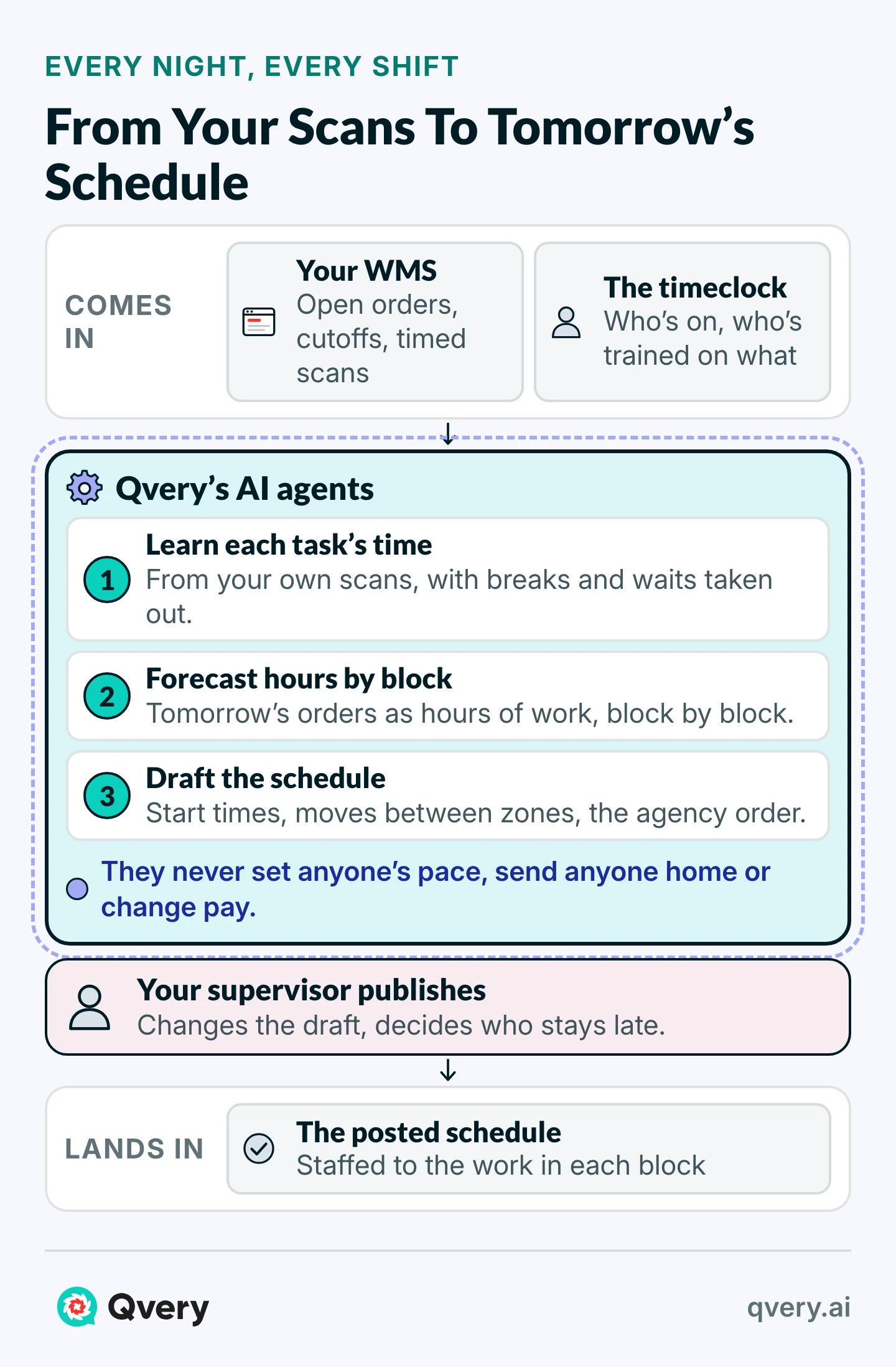
Your supervisor gets a draft by the start of the shift before. Tomorrow's two hours before the 4 o'clock pickup need about 71 hours of picking against 58 scheduled, while the first two hours of the morning have more people than work.
So the draft starts four pickers two hours later, moves three people from receiving to picking at one, and stops there. It shows the gap, the moves that close it, and what's left.
The same forecast runs two weeks out. When a peak week is coming, the agency order goes in days ahead, sized to the blocks that need it, instead of the afternoon before.
The supervisor publishes the schedule, changes it, or ignores it. If your WMS already has a labor module you use, the add-on that sets a time standard for each task, the agents start from its standards and add the forecast by block.
A Robot's Business Case Runs on the Same Numbers
The vendor's payback model needs task times, travel and the hours of work by block. If your building can't produce those, it can't check the vendor's numbers, only take them.
The people who've run these buildings say the same thing about the order: fix the process and the data, then automate.
Tips from Reddit
Practitioners on what comes before the robot
You will not benefit from robotics if you have poor data, poor SOPs and poor adherence to SOPs. Those need fixing first.
If your starting systems, information, and process are of poor quality you will just make a lot of mistakes faster with automation.
Automation helps, but only if you're improving a process that works well.
Bad data shows up first in the scans. If pickers scan a whole batch at the end, or two people share a login, the task times are wrong, and so is every plan built on them, a robot's included.
The agents' first weeks surface exactly that, zone by zone. And task times learned from a building's own history pay on their own: one peer-reviewed study that predicted picking times from a warehouse's past data and batched orders around them raised its daily picking capacity by 14.8%.
Planning first doesn't rule a robot out. It means that when one is priced, you're checking the payback against your own numbers.
A Quarter of the Peak Overtime Is About $65,000 a Year
The calculator starts from the example building: 80 associates on overtime in a peak week, 12 weeks a year, eight extra hours each, at $37.82 an overtime hour.
The agents take 25% of that overtime off, our assumption for the part that comes from the schedule rather than the volume: people idle in the morning and held late in the afternoon. The overtime the peak's volume needs stays in. Type your building's figures over ours.
Warehouse Shift Overtime ROI Calculator
What Peak Overtime Costs Your Warehouse, And What The Agents Take Off
Saved Per Year
$65,414
1,920 hours of overtime handed back, after $7,200 a year to run it
- Overtime Hours Handed Back
- 1,920 hours a year
- Agent Running Cost (Estimate)
- $600 a month
- Payback Per $10,000 Of Build
- 1.8 months
On these numbers, the agent takes 1,920 hours of overtime off your associates a year, saves $65,414 after its own running cost, and every $10,000 of the build is earned back in 1.8 months.
On that example, the agents hand back 1,920 overtime hours a year. They run for about $600 a month, so the building keeps $65,414 a year, and each $10,000 spent building them comes back in about 1.8 months of savings.
The calculator counts only the overtime. The hours paid in quiet weeks to people waiting on late trucks are money too, and agency workers booked days ahead are more often ones who've worked in your building. We measure both on your own scans before claiming either.
The Agents Never Set Anyone's Pace
At your size the law has a view on that last point. In California and New York, a warehouse employer with 100 or more employees at one site has to describe any quota to its workers in writing, and no quota may cut into meal or rest breaks.
The agents plan the building's hours and leave pace with your managers, where the law already puts it.
Which systems the agents may open, and where your data is processed, is written into the contract before they connect to anything. That contract comes with a data processing agreement from Qvery AI OÜ, an EU company.
We Start by Rebuilding Your Last Peak
Send us last season's WMS history with its scans, the timeclock export for the same weeks, and your carrier cutoffs.
We rebuild those weeks block by block: the hours of work the scans show against the hours you paid. Then we run the forecast on those same weeks and show you how far it was off, before it plans anything real.
About two weeks after your systems are connected, the agents draft real schedules, and your supervisors set them beside their own. Every week after, you see the overtime hours, the agency hours and the hours the plan handed back.
Frequently asked questions
Do we need a labor management system first?
No. A labor management system adds engineered time standards to your WMS, and it helps if you have one. The agents learn task times from the scans your WMS already records, so a building without one can start. If you run one, they read its standards and add the forecast by block.
How far ahead does the forecast see?
Two horizons. Two weeks out, for the agency order and the schedule you post. The night before, from the actual open orders, cutoffs and appointments, for tomorrow's moves. The night-before forecast is the sharper one, because the orders are real by then.
What if our scan data is messy?
It's common, and it's the first thing the agents show you. Batched scans, shared logins and tasks never closed show up as times that can't be true, listed by zone in the first weeks. Some fix in a day with a new rule on the floor. Until then, those tasks plan from your supervisor's estimate.
We're a 3PL with many clients in one building. Does it plan by client?
Yes. A third-party logistics provider (3PL) stores and ships for other companies, and each client's orders take their own time to pick and pack. The agents learn times per client and forecast each client's volume from its history and the forecasts it sends. Where you bill a client for labor, the plan shows its hours.
Will the agents set pick rates for our people?
No. They plan with the time each task takes on average in your building, never a target for a person. If your managers set quotas, those stay your managers' and fall under your state's rules: California and New York both require written quota descriptions at 100 employees a site.
Does it work with a union contract?
The agents follow the rules your contract sets: who's offered overtime first, minimum notice for a schedule change, seniority for start times. Those rules are written down once at the start and every draft is checked against them. Anything a draft can't fit inside them goes to the supervisor as a choice, not a change.
Can the agents book the temp agency?
They draft the order: how many people, which days, which blocks, and which skills. At first your supervisor sends it. Once you've decided it can go on its own, the agents send it to the agency in the format it takes, days earlier than a same-day call would.
What does it cost to run?
On the example, about $600 a month for one building: the nightly and two-week forecasts, the model use for the drafts, hosting and upkeep. It grows with the number of buildings, not the people on the floor. Building them is quoted once, as a fixed figure for an agreed result, before any work starts.
Will it replace our supervisors?
No. Supervisors still decide who works where, who goes home and who stays late. What changes is the start of their day: a draft built on the whole order book instead of a blank spreadsheet. The half hour or more some spend each shift tracking labor goes back to the floor.
What happens when the forecast is wrong?
It will be on some days. A truck nobody announced still shows up. The agents re-run the forecast when the order book changes during the day and flag the blocks that moved. Every miss is logged against what happened, and the misses that repeat tell us what to add to the forecast.
What about slotting?
Slotting, deciding where each item sits so the fast movers are close to the dock, is a separate job with its own case. The same scans show where pickers walk the longest, so the agents can list the worst items. Moving them stays your team's call, and it's priced on its own.
Does this help a building with one shift?
Yes, if the work inside the shift swings. Most of the savings come from the blocks within a shift: who starts when and who moves where at one. A single shift with a steady flow and no overtime has little to plan, and we'd tell you so after rebuilding your last peak.
How do we know the overtime came down?
We measure last peak's overtime hours and agency hours from your timeclock before anything changes, then the same way every week once the agents plan. You see the hours paid against the hours of work, block by block, next to the same weeks last year.
Should we still look at robots?
If your volume keeps growing, maybe. A robot vendor's payback is a claim about your task times and your hours by block. Once the agents have planned a season, you have those numbers, and you can check the vendor's case against your own building instead of its brochure.