
On this page
- Large Outsourcing Contracts Reached a Record $127.4 Billion in 2025
- Buyers Now Hand Over Legal, Tax and Front-Office Work
- Cost Is the Main Reason to Outsource for a Third of Buyers
- Buyers Expect AI Inside the Service, and Few See It in the Price Yet
- A Transition Runs on a Window the Contract Sets
- Transition Teams Name Poor Documentation or Data as Their First Blocker
- Where Qvery's Agents Write the Handover Guide
- Fewer Than Half Say Transitions Deliver What Was Promised
- Frequently asked questions
A new client's work reaches an outsourcing provider through a transition: a window set in the contract, in which the client's people explain how the work is done in handover sessions, and the provider's team turns that into the written procedures it will run by. When Iowa's Medicaid agency put its claims operations and systems out to bid, it would accept no more than $450,000 in transition costs from the winning contractor, not counting two system implementations priced separately.1
The value of large outsourcing contracts keeps growing, and buyers are buying results rather than hours, in work that increasingly needs judgment. That makes the takeover itself part of what a provider sells, and the readiness blocker transition teams name most often is poor process documentation or data on the client's side.
Large Outsourcing Contracts Reached a Record $127.4 Billion in 2025
ISG, a technology research and advisory firm, tracks every commercial outsourcing contract worth $5 million or more a year. In 2025 their combined annual value reached a record $127.4 billion, up 18%, the fastest growth since 2021.2 Most of it was cloud services, which rose 29% to $84.0 billion and now make up 66% of the total, from 60% a year earlier.2
Cloud Services Were Two Thirds of Large Outsourcing Contract Value in 2025
annual contract value, $ billions
Work priced by people grew slowly. Managed services, the contracts in which a provider runs a function for the client, grew 1.3% to a record $43.4 billion, the slowest since 2020, after averaging 5% a year for the three years before.2
Inside that, IT outsourcing rose 2.4%, engineering and research work 35%, and business process outsourcing (BPO, the back-office and contact center work) fell 14% to $7.3 billion.2
ISG's own summary of the year was that growth went to cloud, infrastructure, engineering and AI, while more traditional, labor-centric services remained under pressure.2
The number of deals held. ISG counted 2,954 managed services contracts, up 0.5%, and a record 2,058 of them were for new scope rather than restructured contracts, worth $29 billion.2 Deal durations grew 14%.2 BPO also turned in the fourth quarter, up 13% to $2.2 billion, and for 2026 ISG expects managed services to grow 2.1% and cloud services 20%.2
Gartner's forecast of worldwide IT spending shows the same split. IT services, $1,633 billion in 2027, grow 4.9%, while spending on data center systems grows 55.5%.5
IBPAP, the Philippines' industry body, reports an industry still growing and paying to retrain its people for automation, AI and more complex digital work.
Buyers Now Hand Over Legal, Tax and Front-Office Work
Deloitte's 2024 Global Outsourcing Survey asked more than 500 business and technology leaders, more than 150 of them in the C-suite, what they outsource.3 IT still leads the list, but it runs deep into work that needs judgment: legal at 68%, tax at 60%, finance at 54%.3
Legal Work Is Outsourced About as Often as Application Support
share of organizations outsourcing it
View the data
56% now outsource front-office functions such as sales, customer service and order fulfillment, and 46% outsource research and development, both about 10% more than in Deloitte's 2022 survey.3 They are buying results rather than hours: 67% use managed or operate services, up from 45% two years earlier, against 29% who still buy staff augmentation.3 And spend holds: 40% expect to raise their investment in third-party outsourcing, 20% plan to cut it.3
Two other surveys point the same way. In Clutch's survey of 517 US small business leaders with outsourcing experience, at companies under 250 employees, taken in December 2022, 83% planned to hold or raise their outsourcing spend in 2023, with new providers sought most in marketing (27%), IT (22%) and design (21%).7
Wipfli, a firm of advisors and accountants that sells outsourced finance and accounting services, found that 72% of the 360 executives it surveyed had outsourced, and 93% of the companies that had outsourced were satisfied with the experience.8 Clutch runs a marketplace of service providers and Wipfli sells outsourcing, so both have a stake in the answer.
In the managed services outlook KPMG publishes with HFS, 81% of companies want providers to be strategic collaborators rather than vendors, and three in four want help with new business models and technology.9
Cost Is the Main Reason to Outsource for a Third of Buyers
Deloitte has asked buyers for their main reason in three surveys running.
Among buyers of outcome-based services, it is 30%.3 Access to talent is now the first reason Deloitte's respondents give.3
For a provider that has sold the same work at a lower rate, this is the number to plan around. A buyer who comes for skills and results judges the first months on whether the work runs the way their own people ran it, and that puts the transition inside the sale.
Buyers Expect AI Inside the Service, and Few See It in the Price Yet
83% of Deloitte's respondents expect their providers to bring AI into how they deliver, and 92% use or plan to use AI in their own service delivery.3 The return has not reached most of them: fewer than half report productivity gains, and only 25% see lower costs from their vendors.3
Where AI is part of the outsourced service, satisfaction runs 7% higher, and 20% of organizations are already developing a strategy for managing AI and automation as a digital workforce.3
 Vlad ShvetsPartner @ Qvery
When most buyers expect AI inside the service and only a quarter see it in what they pay, the next renewal asks where the savings went. For a provider of this size I'd start with the work that eats the most hours before a client pays anything: the transition. It's also where an AI mistake is cheapest to catch, because your transition lead reads the guide before any client work runs on it.
A Transition Runs on a Window the Contract Sets
None of the studies here gives a typical length for a transition, because the contract sets it, and public contracts show the range.
| Who | What it sets |
|---|---|
| Federal Acquisition Regulation 52.237-3 (US federal service contracts) | Up to 90 days of phase-in and phase-out after the old contract ends10 |
| UK National Audit Office, IT service management (2026) | Six months of mobilization, from 2 November 2026, live service from 1 June 202711 |
| Iowa Medicaid claims and systems takeover (2018) | Plans in 15 business days, written procedures in 25 business days1 |
| Qantas and Accenture (announced 10 November 2026) | About 850 roles, first changes by mid-2027, phased over years12 |
Inside those windows, the people who know the work are still doing it. The federal clause wants a plan with a training program and a transfer date for each division of work, asks the outgoing contractor to keep as many people as practicable on the job to help the successor, and reimburses reasonable phase-in and phase-out costs.10
Buyers count the transition among their problems with outsourcing. 46% of Deloitte's respondents name poor vendor performance during transitions as a challenge, and 35% say budgeting extra time and effort for the transition phase is how they would get more from the next contract.3
Transition Teams Name Poor Documentation or Data as Their First Blocker
HFS Research, an analyst firm, studied transitions in 2025 with Infosys BPM, an outsourcing provider, asking 153 business and functional leaders at client companies and 152 transition leaders at providers and in-house service centers.4
Asked for the biggest readiness blockers they meet, the transition leaders put poor process documentation or data quality first, at 58%, ahead of unclear scope at 46% and the availability of the client's experts at 40%.4
Poor Documentation or Data Is the Readiness Blocker Transition Leaders Name Most
share of transition leaders
View the data
Only 13% of them rate clients highly mature; 49% say clients arrive partly ready, with some parts, documentation among them, stronger than others.4 The knowledge ends up theirs to keep: 58% say standardizing how knowledge is captured belongs to the team taking the work over, a provider or an in-house center, and 61% say keeping it after the work goes live does.4
The tools that could help are often fenced off, with 59% facing information security or privacy limits on what they may use.4
What Reddit says
People asked to hand their work to a provider
My partner spent 8 weeks "training" her replacement on some esoteric manufacturing information systems. Also prepared copious PowerPoint presentations. It was 90% standard SQL training with little relevance to the task, and 10% a very high level overview of the processes … The client did not renew the contract a year later.
I had 3 months to train them. … There was no way for me to give him the experience he needed to take over my job.
Knowledge transfer does not work. My assumption is that the only thing which could work a good documentation and workshops.
I read the 58% and the 40% as one problem seen from two sides. What the client wrote down is incomplete, and the person who could fill the gaps has a day job, so the gaps get filled in recorded sessions that someone on the provider's team has to listen back to and write up, inside a window that does not move.
Where Qvery's Agents Write the Handover Guide
At Qvery, we help outsourcing companies spend less taking over each new client, with custom AI agents that write the handover guide and list what to ask before launch.
None of these studies measures how much of a handover ends up missing from the written guide, and that step is where Qvery's agents work.
Each handover session is recorded as it is today, and the agents read it with the client's own process document beside it. They write the steps in order with the system used at each one, quote every exception, approval and judgment call the expert mentions with its time in the recording, and list where the session and the document disagree, or where a step has no owner.
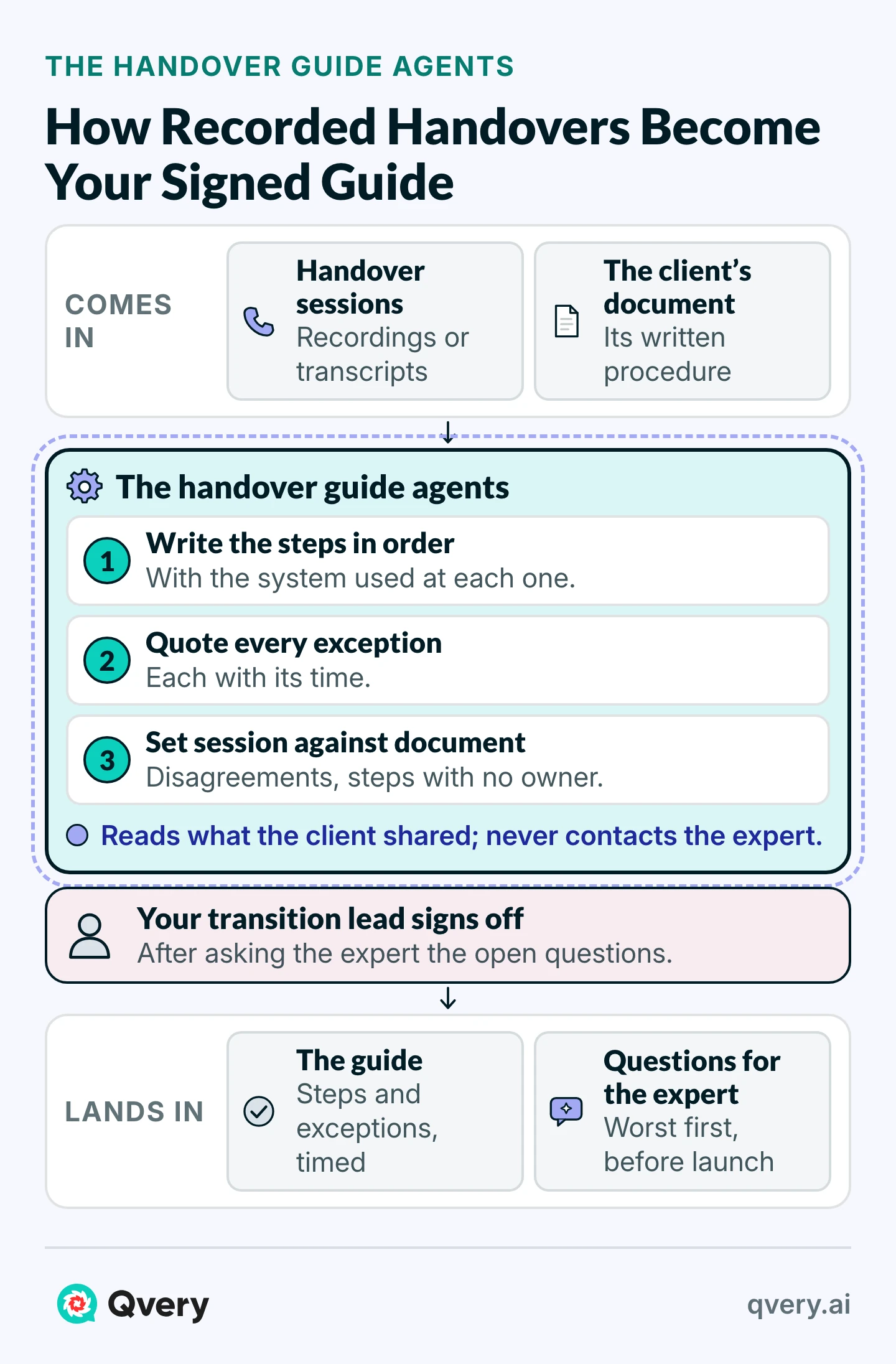
Your transition lead gets the guide and the questions, worst first, and signs the guide off before any client work runs on it. The agents never call a process ready, never fill in a step nobody explained and never contact the client's expert. They read only the recordings and documents the client has already shared with your team, and they log every action.
The first ones run within two weeks of access, and each week we count the hours handed back to your transition team.
 Piotr BabelPartner @ Qvery
The main path is the easy part of a handover; the client's expert walks through it first and well. What breaks the first week is the exception mentioned once, late in a session, or a limit the written procedure states differently. So our agents quote each exception with its time in the recording and put every disagreement with the document on a list your transition lead takes back to the expert before launch.
Run one of your own recorded handover sessions through the agents, or our sample session, and the guide and its questions come back to your work email.
Fewer Than Half Say Transitions Deliver What Was Promised
41% of the client-side leaders and 39% of the transition leaders in the HFS study say transitions meet value expectations.4 58% of the clients and 50% of the transition teams say ownership stays unclear across the work.4 And they disagree on speed: 66% of the clients and 93% of the transition leaders say the provider should show value within three months of kickoff.4
93% of Transition Leaders Expect Value Within Three Months, Against 66% of Clients
share agreeing
View the data
The clients are slow to prepare their own people, too: 52% say change management starts only after the transition is under way.4 And they doubt the method they are handed: only 13% find providers' transition playbooks relevant, while 89% expect a proven one.4
For a provider, the decision these numbers point to is where the first hours of a new contract go. The market keeps sending work that needs judgment, the window stays fixed and the client's documents arrive incomplete, so the guide your team writes in those weeks is the part of the transition you control.
Frequently asked questions
How big is the outsourcing market?
ISG's index of large contracts, those worth $5 million or more a year, put their combined annual value at a record $127.4 billion in 2025, up 18%.2 Managed services were $43.4 billion of that.2 Gartner forecasts IT services spending of $1,633 billion in 2027.5
Is business process outsourcing growing or shrinking?
In large contracts it fell 14% in 2025, to $7.3 billion, while IT outsourcing grew 2.4%.2 It recovered in the fourth quarter, up 13%.2 The Philippines grew its IT and business process export revenue 5% to more than $40 billion.6
What do companies outsource most?
In Deloitte's 2024 survey, IT infrastructure and cybersecurity, both at 77%, then new technologies such as generative AI at 75%, and data and analytics and application development at 72%.3 Legal (68%), tax (60%) and finance (54%) follow, and 56% outsource front-office work.3
Why do companies outsource?
Access to talent is now the first reason in Deloitte's survey.3 Cost savings were the main reason for 70% of organizations in 2020 and for 34% in 2024.3
What are the outsourcing trends for 2026?
ISG expects managed services to grow 2.1% and cloud services 20% in 2026.2 Buyers keep moving to outcome-based contracts, with 67% using managed or operate services.3 And 83% expect their providers to bring AI into the service.3
How is AI changing outsourcing?
Buyers expect it inside the service, but few see it in the price yet: only 25% report lower vendor costs.3 ISG says labor-centric services were under pressure in 2025 while cloud, engineering and AI work grew.2
How long does an outsourcing transition take?
The contract sets it, so it varies. US federal service contracts with the continuity clause allow up to 90 days of phase-in and phase-out after the old contract ends.10 The UK National Audit Office planned six months of mobilization for its IT service contract.11 Most client-side leaders want to see value within three months of kickoff.4
What is knowledge transfer in outsourcing?
It is the part of a transition in which the client's experts teach the provider's team how the work is done, usually in recorded sessions, and the team writes it into procedures. Iowa's Medicaid agency wanted a new contractor's written procedures within 25 business days of signing.1
Why do outsourcing transitions fail?
Transition leaders name poor process documentation or data quality (58%), unclear scope (46%) and the availability of the client's experts (40%) as their biggest readiness blockers.4 Both sides also say ownership stays unclear: 58% of client-side leaders and 50% of transition teams.4
Who owns the process documentation after a transition?
In HFS Research's 2025 study, 58% of transition leaders said standardizing knowledge capture belongs to the team taking the work over, and 61% said keeping the knowledge after the work goes live does. Checking that the transfer is complete was a shared job for 53%.4
How much does an outsourcing transition cost?
Public contracts show what one can cost. Iowa would accept no more than $450,000 in transition costs for its Medicaid systems takeover, two system implementations aside.1 US federal contracts with the continuity clause reimburse reasonable phase-in and phase-out costs.10 And 35% of Deloitte's respondents would budget extra time and effort for the transition phase.3
What should an outsourcing transition plan include?
US federal contracts require a plan with a training program and a date for transferring each division of work.10 Iowa's Medicaid takeover wanted transition plans within 15 business days of signing and written procedures within 25.1
What do clients expect in the first months of an outsourcing contract?
Value, quickly: 66% of client-side leaders and 93% of transition leaders say the provider should show it within three months of kickoff.4 Clients also want a proven method, with 89% expecting providers to bring a playbook, though only 13% find the ones they get relevant.4
Are companies satisfied with outsourcing?
Mostly. In Wipfli's survey, 93% of the companies that had outsourced were satisfied with the experience.8 In Deloitte's survey, satisfaction ran 7% higher where AI was part of the outsourced service.3 On transitions, 41% of client-side leaders in HFS Research's study say they meet value expectations.4
What is the difference between outsourcing and managed services?
Managed services are contracts in which a provider runs a whole function and answers for its results, rather than supplying people by the hour. In Deloitte's 2024 survey, 67% of buyers used managed or operate services, up from 45% two years earlier, and 29% still bought staff augmentation.3
Sources
- Iowa Department of Human Services: RFP MED-18-004, Takeover of Core Medicaid Management Information System Services: First Amendment (2018)
- Information Services Group (ISG): Global Technology Demand Reaches Record High in Q4, Fueled by AI, ISG Index Finds (2026)
- Deloitte: 2024 Global Outsourcing Survey: Multidimensional sourcing (2024)
- HFS Research with Infosys BPM: Fix the baton pass: Transitions will make or break enterprise models (2025)
- Gartner: Gartner Forecasts Worldwide IT Spending to Grow 15% in 2027, Totaling $7.35 Trillion (2026)
- Philippine Daily Inquirer, reporting the IT and Business Process Association of the Philippines (IBPAP): IT-business process management revenues top $40B in 2025 (2026)
- Clutch: Clutch Report Uncovers the Surge of Small Business Outsourcing (2023)
- Wipfli: Wipfli's outsourcing trends report (2024)
- KPMG: The Future of Outsourcing: Rethink Everything (2025)
- Federal Acquisition Regulation (US): 52.237-3 Continuity of Services (2026)
- UK National Audit Office, on Find a Tender: CPT_26_03 IT Service management (ITSM) (2026)
- Mediaweek, reporting Qantas: Qantas outsources 850 roles to Accenture in AI overhaul (2026)
