
On this page
A law firm of a few hundred people runs on its first- and second-year associates turning a partner's instruction into a first draft: the research memo, the discovery responses, the deposition summary, the medical chronology, the markup of the other side's contract.
Clients pay for those hours, and the same hours are how a law graduate becomes a lawyer you can put in front of a client.
Checking a Draft Is a Different Job From Writing It
A partner who signs a brief is trusting dozens of small claims they did not check themselves: this happened, according to that exhibit; the law is this, according to that case, at that page.
A first draft is a stack of those claims. Writing it produces them. Checking it means opening every source and confirming it says what the draft says it says, which is a different job from writing, and the one the partner is relying on.
An assistant is fast at the first job and unreliable at the second, and its mistakes look like correct work. Supervisors describe the same failure in juniors' AI drafts: real cases, cited for things they do not say.
| The task | What the agents draft | What a lawyer checks |
|---|---|---|
| Research memo | The issue, the authorities, the argument | Each case says what the memo says, at the page cited, and has not been overturned |
| Discovery responses | Answers and objections from the requests and the file | Each answer matches the client's documents; each objection is one the firm makes |
| Deposition summary | A page-and-line digest of the testimony | Each line matches the transcript at the page and line cited |
| Medical chronology | A dated list of treatment from the records | Each entry traces to a page of the records, and nothing is missing between visits |
| Contract edits | Proposed edits against the firm's positions | Each change follows the client's instructions, and untouched clauses still hold up |
In a law firm the sharper problem is that the checker is the most expensive person on the matter. If associates cannot check a draft, the check moves up to the partner who signs, where each hour is either billed at a partner's rate for an associate's task, which the client will question, or written off.
Drafting is one of the jobs where a firm this size loses lawyer hours. Our legal playbook prices three more: time entries written from memory, client updates written from scratch and court dates docketed by hand.
Associates Check the Agents' Drafts Claim by Claim
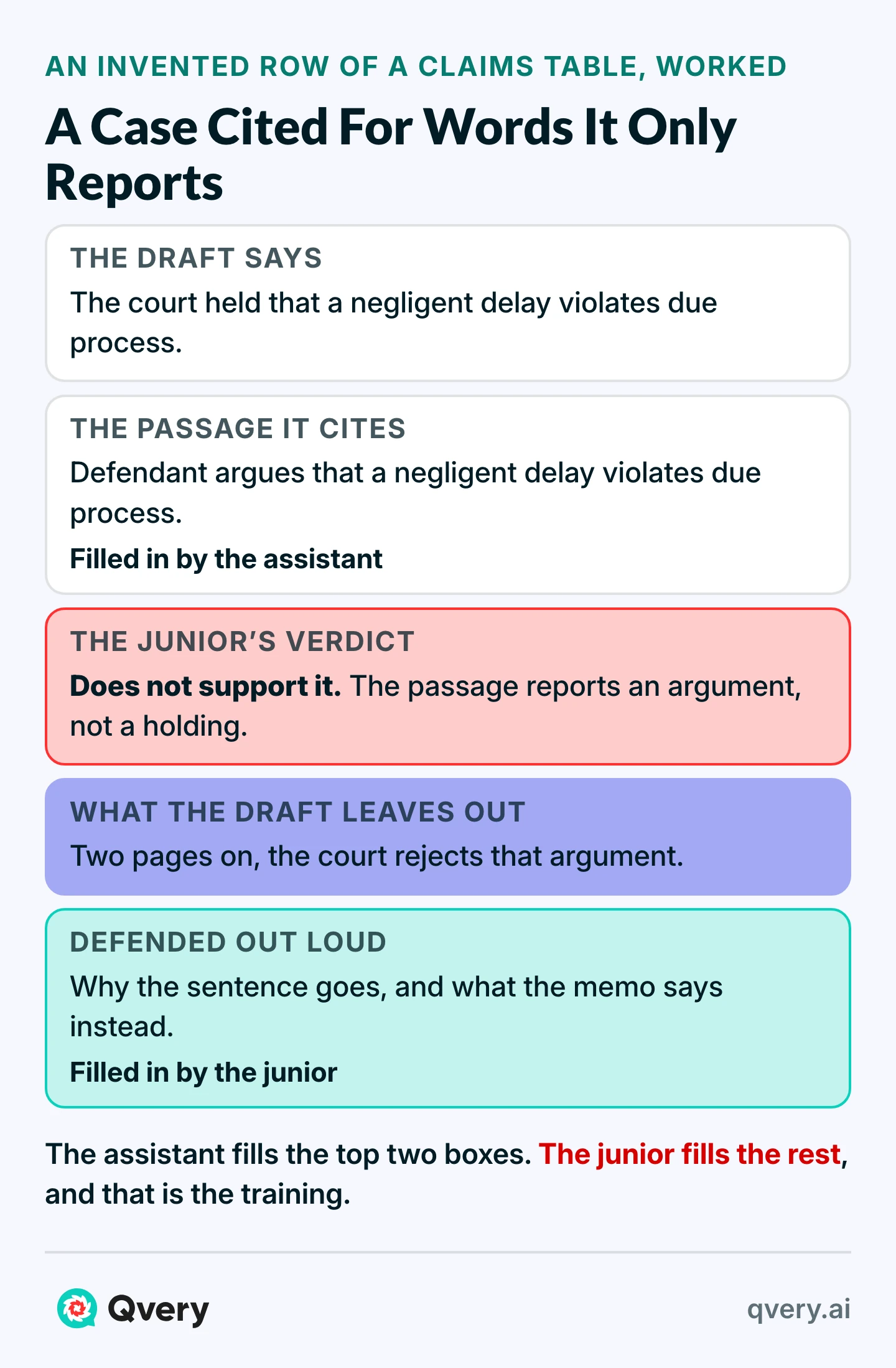
The agents draft from your own files: the pleadings, the discovery, the transcripts, the medical records, your earlier research memos. Every draft arrives with every statement in it laid beside the passage it rests on, the rows with no passage found first, and the verdict column left for the associate.
 Piotr BabelPartner @ Qvery
The failure I design the claims table around is the right page read wrong: a party's argument reported as the court's holding. A citation link can't catch that, so every row shows the passage itself, never a summary of it, beside the sentence that relies on it. The rows associates mark as unsupported are counted by matter type, and that count shows us where the agents read badly.
The associate opens every source to confirm the passage is there, writes a verdict on each row and what the draft leaves out.
You cannot evaluate a junior whose work is the assistant's. You can evaluate their verdicts.
The calculator prices the deposition summaries (a page-and-line digest of a witness's sworn testimony) for a firm of a few hundred people: ten associates at 1,800 hours, 7,200 of them on first drafts, about a quarter of that, some 1,800 hours, on summaries: about 9% of each associate's year on the calculator's 2,080-hour basis.
At about $265,500 a year each, the Bureau of Labor Statistics’ mean lawyer pay with benefits, which overstates a junior's pay, that is about $238,950 a year.
With the agents taking about 60% of it, the drafting with the associate's check counted back in, at about $500 a month to run, it costs about $101,580, saving about $137,370 a year and 1,123 hours; about 0.9 months of those savings covers each $10,000 spent building the agents.
 Vlad ShvetsPartner @ Qvery
Priced at associate rates, deposition summaries alone come to a saving of about $137,370 a year for ten associates. The bigger decision sits behind that number: whether next year's class is sized for drafting or for checking. Run the agents on one matter type for a quarter, count what your associates' verdicts catch, and size the class on that count rather than on anyone's forecast.
A partner rechecking what associates could not, at two hours a week, costs about $13,275 a year at that pay, the time the check beside each draft is there to cut. Each figure is our assumption, to replace with your own.
Deposition Summary ROI Calculator
What Drafting Deposition Summaries With Page And Line References And Checking Them Against The Transcript Costs You, And What An Agent Saves
Saved Per Year
$137,370
1,123 hours handed back, after $6,000 a year to run it
- Hours Handed Back
- 1,123 hours a year
- Agent Running Cost (Estimate)
- $500 a month
- Payback Per $10,000 Of Build
- 0.9 months
On these numbers, the agent saves $137,370 a year after its own running cost, and every $10,000 of the build is earned back in 0.9 months.
Freed hours are worth what the firm does with them: more matters, the checking moved to associates who have the hours, or a smaller class. The agents move hours; the class size stays the partners' call.
The agents run inside the systems your lawyers already use: the firm's document store, the research service it pays for, the matter's shared folder. They open only the matters they are assigned to, and every draft, with every source it cites, is logged against its matter.
What Your Associates Do in Month One With Qvery
It starts with a month of your associates' time entries and a few finished drafts, which show where the drafting hours go. Within two weeks of access the agents are drafting on one matter type, and we train the associates who check those drafts and the seniors who review their tables.
Each week the firm sees the drafting hours saved and the claims the associates' verdicts caught before a partner signed.
Frequently asked questions
Will AI replace lawyers?
Not the lawyer who signs. AI now writes much of a junior associate's first draft, but every draft still needs a lawyer who can tell a true statement of law from a plausible one. What shrinks is the drafting, not the need for that judgment.
Should we cut first-year hiring because of AI?
Not on large firms' forecasts. Measure the drafting the agents do on your matters for a quarter, add back the checking and the training, and cut only the hours left, never below the seniors you will need.
How accurate are AI legal research tools?
Not accurate enough to file unchecked. Their wrong answers read like competent work, a rule stated as good law with a citation to the case that overruled it. Every claim needs a lawyer's check.
Who is responsible when an AI draft is wrong?
The lawyer who signs it, and the partners who supervise. That is why the check belongs with an associate trained to do it, before the draft reaches the partner.
How long does it take to check an AI draft?
Long enough that it matters who does it. Checking means opening every source and confirming it says what the draft says, so it belongs with an associate who can do it, not with the partner who signs.
Can we bill clients for the hours AI saves?
Not under hourly billing: the bill carries the time spent, giving the agents the facts and checking their draft, not the hours the draft would have taken by hand. The checking is what is left to bill.
How should associates check AI drafts?
Claim by claim. Every statement of fact or law gets its source, the passage it rests on, and a verdict, and the associate opens every source rather than trusting the quoted passage.
What is a claims table?
Every statement in a draft beside the passage it rests on, with columns for the associate's verdict and for what the draft leaves out. The agents build the rows; the verdicts are the training.
Which junior tasks still teach legal judgment?
The ones where the junior decides something: whether a case supports the sentence it is cited for, what a case that cuts against the argument does to it, what the record holds that the draft ignores. On any issue new to the junior, write the first draft by hand, then compare it with the assistant's.
Should an associate be fired for one AI mistake?
Treat it the way you would treat any unchecked work: the problem is the missing check, not the tool. A mistake the associate disclosed and the review caught is a training moment. Hiding it, or putting client material into an unapproved tool, is a different conversation, and one for the supervising partner.
Which matter type should the agents start on?
One where the drafting hours are heavy and the source is a single set of documents. Deposition summaries fit: in our example they take about a quarter of the associates' first-draft hours, and every line can be checked against the transcript at the page and line cited.
When can a firm rely on AI drafts with lighter review?
For one matter type at a time, once the drafts there have needed little correction for two quarters and a senior's audit of a sample finds the drafts juniors passed are sound. Few corrections on their own can mean nobody looked hard.
Does our firm need a written AI policy?
Yes, and it can start with one sentence: which tools, with whose approval, and client material nowhere else. Associates can follow a rule that short, and supervisors can check it.
Do associates still learn if the agents draft?
Yes, if they write the first draft by hand on anything new to them and defend their verdicts on the rest. Deciding whether a case supports the sentence it is cited for is the judgment the partner relies on when they sign.
Where does client material go when the agents draft?
Nowhere outside the systems the firm already uses: the document store, the research service and the matter folder. Where it is processed is written into the agreement before the agents read a page, and Qvery AI OÜ, an EU company, signs a data processing agreement covering client files.