
On this page
- The Hours on the Proposal Are a Forecast Until the Agent's Record Confirms Them
- A Cut Made on the Forecast Is the Hardest Step to Take Back
- But the Work Does Shrink, and Paying People to Wait Costs Money
- A Hiring Freeze Collects the Saving at the Speed People Leave
- How Qvery Builds the Agent and Counts Its Hours Every Week
- Turn the Record Into Whole Jobs Before Anyone Talks About Cuts
- Frequently asked questions
When an AI agent goes live in one of your teams, say the billing desk, it arrives with a number: the hours it will save, from the vendor's proposal or your own builder's estimate.
Then comes the staffing question, and the arithmetic looks easy: if the agent takes 40% of the team's hours, the team can be 40% smaller. Get it wrong and the same desk pays: a backlog, overtime, and the people who knew the odd cases gone.
We build AI agents for companies of a few hundred people, and I'd answer that question differently.
Don't cut anyone on the strength of the proposal. Run the agent for a full cycle of the team's real work, a quarter for most back-office jobs, and count only what it finished that nobody had to redo.
Then take the saving out of your hiring plan first: leave jobs open as people leave that team, and offer its people the openings you were about to recruit for.
Cut only where the record adds up to whole jobs that departures won't absorb in time, and never the people who handle what the agent hands back.
The hours on a proposal are a forecast. Cutting jobs is the hardest step of a rollout to undo, and a hiring freeze is the easiest. And people leave every team, so a freeze collects much of the saving at the pace they go.
This page shows why the proposal is a forecast, what a wrong cut costs, how a freeze collects the saving, and how Qvery builds the agent with a weekly count to decide on.
If the business is shrinking for other reasons, decide on those numbers; the agent changes nothing about them.
The Hours on the Proposal Are a Forecast Until the Agent's Record Confirms Them
A proposal's hours are a multiplication: items a month, times the minutes the agent saves on each, at the error rate it showed on the documents it was tested on.
What your team gets back is smaller, by three things the multiplication leaves out: the minutes someone spends checking each output, the items that come back wrong and get done twice, and the exceptions the agent hands to a person, which were the slow ones to begin with.
The gap shows up where finance looks, once a vendor's hours are held up against payroll and revenue:
What Reddit says
the vendor says the team saved 3,200 hours over two quarters i looked at the numbers after that presentation and headcount hasn't changed, payroll hasn't changed revenue is flat
released hours only count if there's somewhere for them to go we had a team that supposedly saved 20 hours a week and nobody could tell me where those hours went
Did we save money? Not on paper. Did we generate additional revenue? Not related to this investment. What did happen is that our team was able to take on additional projects and technical work, outside of direct team responsibilities due to the time savings.
A study of Danish workers using AI chatbots, a lighter tool than an agent, found the same gap across 11 occupations: people reported saving about 3% of their hours, and the national registers showed no measurable change in their recorded hours or earnings.
Hours saved are capacity. They turn into money only when someone decides where they go: a backlog cleared, a check that never got done, a job you don't have to fill.
So count the agent the way your accountant would: the items it finished that nobody redid, confirmed in the system where they land (the payment released, the file closed), times the minutes each used to take, less the minutes people now spend checking it and fixing what it got wrong.
A two-week pilot tells you whether the agent works on your documents.
How many people the team needs takes a full cycle: three month-ends, a bad week of scans and the customers who always send the odd ones.
 Vlad ShvetsPartner @ Qvery
The number on the proposal is what the agent could save. The record is what it did, and only the record belongs in a conversation about people. So when a staffing plan arrives built on an agent's hours, ask which quarter of counted work it rests on. If the answer is the proposal or a two-week pilot, send it back, because the people who pay for a wrong guess are the ones on that team.
A Cut Made on the Forecast Is the Hardest Step to Take Back
In July 2025, Commonwealth Bank of Australia announced it would cut 45 customer-service jobs after putting an AI voice bot on its phone lines, which it said was bringing calls down.
The Finance Sector Union said the bank put the drop at 2,000 calls a week and wouldn't show the numbers behind it.
The union's members said the opposite was happening: calls were rising, the bank was offering overtime, and team leaders were answering phones.
In August the bank reversed. A spokesperson said its first assessment "did not adequately consider all relevant business considerations, and this error meant the roles were not redundant," and the bank apologized and offered the 45 their jobs back.
Klarna took the other route. In February 2024 it said its AI assistant was doing "the equivalent work of 700 full-time agents", a month after launch.
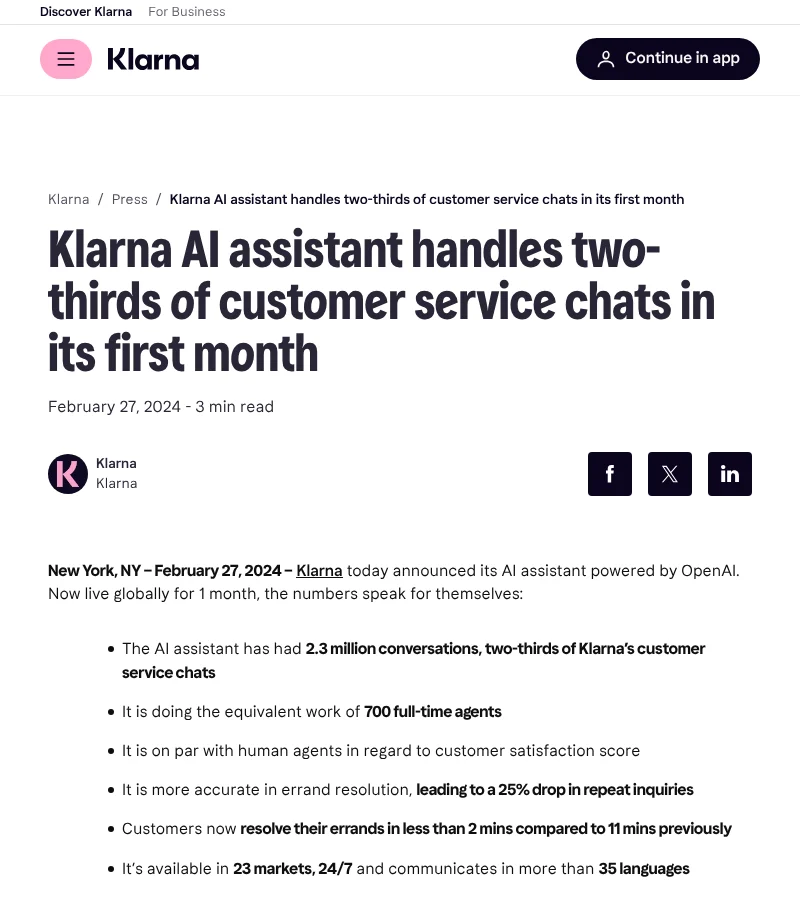
It had stopped hiring, its chief executive said in December 2024, and its workforce had shrunk 22%, mostly as people left.
In May 2025 he said cost had weighed too heavily in the plan: "what you end up having is lower quality," and Klarna began recruiting customer-service staff again.
Two cases set no base rate, and both companies are far bigger than yours. What they show is the price of each correction.
Klarna's was a recruiting drive, after a stretch of service its own chief executive called lower quality. The bank's was an apology, a dispute before Australia's workplace tribunal, and weeks in which 45 people didn't know whether they'd keep their jobs, and it was caught before anyone had left.
Once people have gone, what leaves with them is the work the agent doesn't do. The agent takes the routine items and hands back the rest: the page it can't read, the customer whose documents are always wrong, the file that needs someone who remembers last year's dispute.
The people who handle those sit on the same team a cut is drawn from, and in the week an agent goes live, nobody has a record yet of which ones they are.
But the Work Does Shrink, and Paying People to Wait Costs Money
C.H. Robinson's North American freight brokerage has 35.58% fewer employees than at the end of 2022, while its shipments per person rose more than 60%.
In ADP's payroll records for millions of U.S. workers through June 2026, Stanford's Erik Brynjolfsson, Bharat Chandar and Ruyu Chen find that employment of 22- to 25-year-olds in the jobs most exposed to AI stands 19% below where it would be had it kept pace with their less-exposed peers.
The authors call their findings descriptive, not proof of cause.
So every month you wait, the objection goes, you pay salaries for work that may already be gone.
In those payroll records, though, the gap comes mostly from hiring: fewer young people taken on in those jobs, not more people let go. Separation rates fell in exposed and unexposed jobs alike, and experienced workers in the most exposed jobs show no comparable gap.
That is how a hiring freeze works too. It has a cost, and the same study shows who pays it: young people who never get the job.
I'd still take that over a list of names drawn up on a forecast, and I'd keep hiring juniors into the work the agent leaves to people, because that's where your next exception handlers come from.
A Hiring Freeze Collects the Saving at the Speed People Leave
People leave teams on their own, at a pace you can look up in the Bureau of Labor Statistics' count of job turnover. Even finance and insurance, the slowest of these four industries, saw 15.6 quits for every 100 jobs in 2025.
People Quit and Companies Hire in All Four Industries, Every Year
per 100 jobs over the year
View the data
| Label | Quits | Hires |
|---|---|---|
| Finance and insurance | 15.6 | 25.2 |
| Real estate and rental and leasing | 19.2 | 31.2 |
| Transportation, warehousing, and utilities | 26.4 | 45.6 |
| Professional and business services | 27.6 | 55.2 |
Your own team's record of who left in the last two years is a better guide than these averages. In a small team nobody may leave for a long time; there, the openings elsewhere matter more than the freeze.
Freeze the job, not the person.
When someone leaves the team the agent works in, leave the job open, unless the person leaving is the one who handled the exceptions. That job you fill, which a freeze lets you do and a list of names to let go doesn't.
Meanwhile the rest of the company keeps hiring: at the 2025 rate in finance and insurance, a company of 200 fills about 50 jobs a year, and the ones that suit a loan processor come with someone who already knows your customers and systems.
Where it's been asked, companies using AI rarely let anyone go over it. Among the AI-using service firms in the New York Fed's August 2026 survey of New York and northern New Jersey:
Take one team: ten people who key and check loan documents at a lender. The agent's proposal says it takes 40% of their hours, and a quarter of counting confirms 20%, about two people's worth, once the checking and the redone files are in.
| When | Cut four on the proposal | Count for a quarter, then freeze hiring |
|---|---|---|
| Week one | Six people doing work that, it turns out, needs eight | Ten people, the agent running, every item counted |
| End of the quarter | Two people short: backlog, overtime, then two hires to train | A record: about two people's worth of hours saved |
| The year after | Two new people still learning the exceptions | Two jobs left open as two people leave or move to openings elsewhere |
| People laid off | Four, two of them needed | None |
| If the proposal had been right | Four salaries saved from week one | Four salaries for three more months, then a cut for what departures won't cover |
The wrong cut's price is yours to fill in: what it costs you to hire and train two people in that role, plus the months the team runs short.
How Qvery Builds the Agent and Counts Its Hours Every Week
Each week an agent of ours runs, we report the record this page asks for: the hours it handed back after the checking and the redone items, and the errors it stopped before a customer saw them, such as a figure keyed wrong or a file closed with a page missing.
The agent works through one team's routine items, say the loan documents your processors key and check, on autopilot in the systems that team already uses, so each item it finishes shows up there as a file closed or a payment released.
What it can't finish goes to whoever owns that kind of case, marked with why it stopped.
Every agent we build belongs to one company and one team. We start by timing the job as that team does it today, and by the end of the second week a first working version is handling its real documents. Then we train whoever checks its work and takes its handoffs.
It is the count your accountant would make, kept from the agent's first week.
Turn the Record Into Whole Jobs Before Anyone Talks About Cuts
So the week an agent goes live in one of your teams:
Write down the work it takes before it starts
Items a month, minutes on each, who does them, and the same count for your busiest week. Every later number is measured against this.
Tell the team the plan on day one
Nobody is cut while the agent proves itself, and jobs that open up on the team stay open until the record is in. The people you need most shouldn't have to guess.
Count for a full cycle of the work
A quarter for most back-office work, longer if your year has a peak season, counted the way your accountant would.
Freeze the team's open jobs and offer its people your openings first
Fill any job the team can't cover without, starting with whoever handled the exceptions.
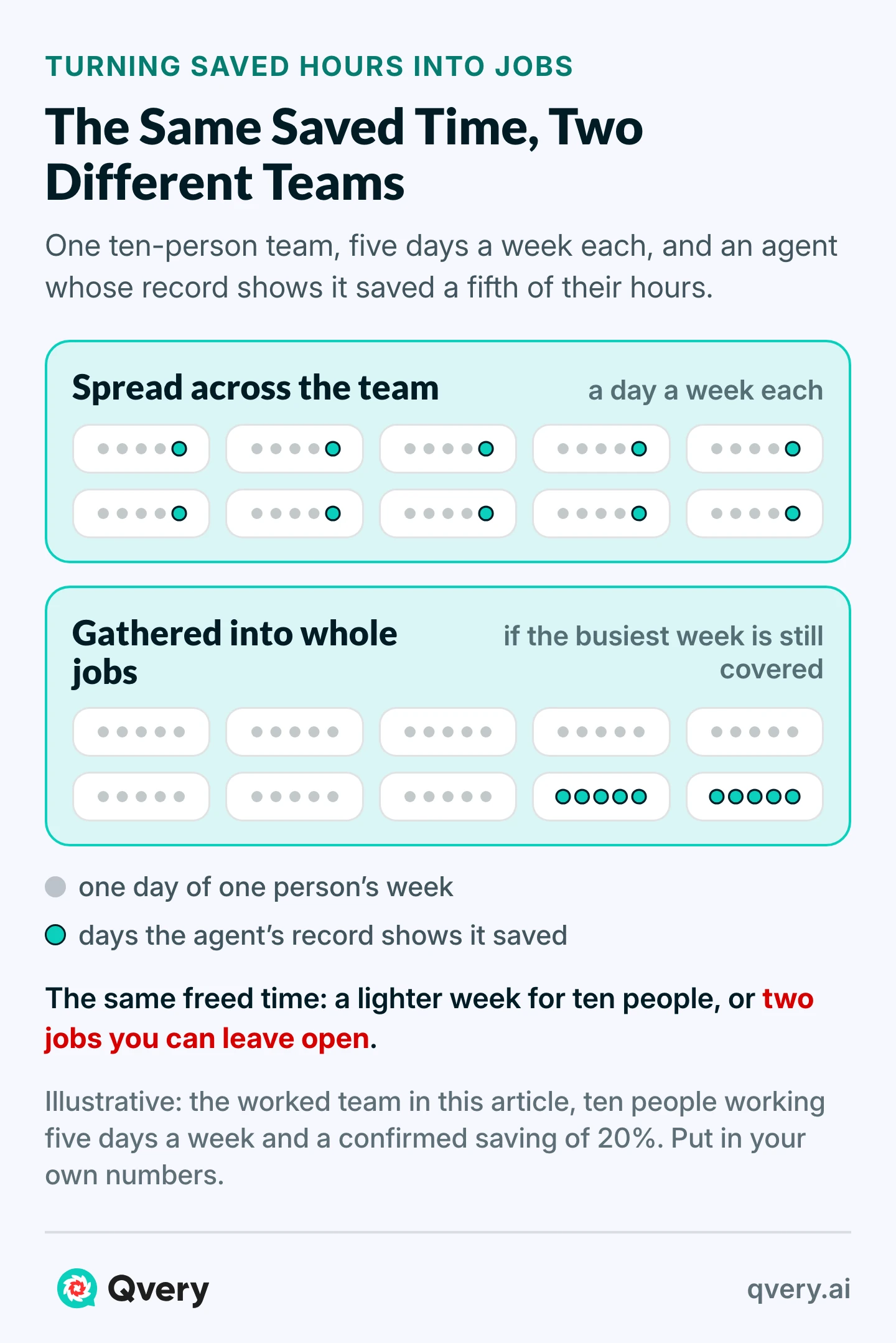
Turn hours into whole jobs in your busiest week
Hours spread thinly across ten people are a lighter week for each of them, not a role you can remove. Then check that the people left can still cover the exceptions, holidays and sick days.
Let departures do what they can
Set the whole jobs the record found against how many people left that team in the last two years. Cut only the difference that leavers and transfers won't close within a year.
Run it that way, and the conversation about the team's size starts from what the agent did instead of what its proposal said.
Frequently asked questions
Should we freeze hiring instead of cutting staff when we bring in an AI agent?
On the team the agent works in, yes. Leave jobs open as people leave, except the job of whoever handled the exceptions, and offer the team's people your openings elsewhere. Cut only on a full cycle of counted work, and only whole jobs that departures won't absorb.
Can we trust the hours saved on an AI vendor's proposal?
Treat them as a forecast. A proposal multiplies items a month by the minutes saved on each, at the error rate shown on test documents, and leaves out the minutes spent checking each output, the items done twice and the exceptions handed back to a person.
How do we prove an AI agent saved work before changing the size of a team?
Count the items it finished that nobody redid, confirmed in the system where they land, times the minutes each used to take, less the minutes people spent checking and fixing them. Compare that with the same count from before the agent started.
Why doesn't the time AI saves show up in payroll?
Hours saved are capacity, and they turn into money only when someone decides where they go, such as a backlog cleared or a job left unfilled. Danish workers using AI chatbots reported saving about 3% of their hours, yet the national registers showed no measurable change in their hours or earnings.
How long should an AI agent run before a staffing decision?
A full cycle of the work: for most back-office jobs a quarter, with its three month-ends and its odd customers, and longer if your year has a peak season. A two-week pilot shows whether the agent works on your documents, not how many people the team needs.
What should a team do with the time an AI agent frees up?
Give it a destination before the agent starts: the backlog, the checks nobody had time for, the exceptions the agent hands back, or an opening elsewhere in the company. If nobody can say where the hours went, they didn't turn into anything you can count.
What happens when a company cuts jobs for AI too early?
Commonwealth Bank of Australia announced 45 customer-service job cuts in July 2025 after putting an AI voice bot on its phones. Calls kept rising, its staff's union said, and in August the bank called its assessment an error, apologized and offered the 45 their jobs back.
What happened when Klarna froze hiring for AI?
Klarna said in February 2024 that its AI assistant did the equivalent work of 700 full-time agents, and by December 2024 its workforce had shrunk 22%, mostly as people left. In May 2025, citing lower quality, it began hiring customer-service staff again.
How fast does a hiring freeze absorb the work an AI agent takes?
At the pace people leave. In 2025 U.S. employers saw 15.6 quits for every 100 jobs in finance and insurance, by the Bureau of Labor Statistics' count: about 1.6 a year from a ten-person team. Your team's own record of the last two years is a better guide.
How many companies have let people go because of AI?
Few, where it has been asked. In the New York Fed's August 2026 surveys, 4% of AI-using service firms in New York and northern New Jersey had laid people off because of AI in the previous six months, 15% had hired fewer than they otherwise would, and 34% had retrained staff.
Who should never be cut when an AI agent goes live?
The people who handle what the agent hands back: the page it can't read, the customer whose documents are always wrong, the file that needs someone who remembers last year's dispute. If one of them leaves, fill the job.
When does cutting jobs after an AI agent make sense?
When a full cycle of counted work adds up to whole jobs in your busiest week, and departures and transfers won't close the difference within a year. Hours spread thinly across ten people are a lighter week for each of them, not a role you can remove.
How do we keep key people from leaving when an AI agent arrives?
Tell the team the plan on day one: nobody is cut while the agent proves itself, and the people who handle the exceptions are the ones the agent depends on. Then keep to it.
Will AI agents shrink our teams?
Some teams, over time. So far the shrinking has come mostly through hiring: a large study of U.S. payroll records finds fewer young people hired into the most AI-exposed jobs, not more people let go.
What does Qvery build for a back-office team?
A custom agent for one company's team, on autopilot inside the systems that team already uses, with a first working version within two weeks and training for the people who check it. Every week it runs, we report the hours it handed back after checking and the errors it stopped.