On this page
- The Largest Broker's Truck Brokerage Is a Third Smaller, and the Job Still Exists
- Each Desk Loses Different Work at a Different Speed
- Write Down the Highest Rate an Agent May Agree To Alone
- Plan Next Year's Hiring From the Tasks, Not the Desks
- The Agents Qvery Builds for Check Calls, Appointments, and PODs
- Count the Hours Your Reps Absorb and the Rate You Pay, Not Just Loads per Rep
- Inventory One Desk's Week Before the Hiring Plan Is Signed
- Frequently asked questions
Most of the people in a freight brokerage move information. Customer reps turn quote requests into quotes, carrier reps find trucks and agree rates, operations reps chase check calls, appointments and PODs, and the back office sets up carriers and bills the loads.
Every load repeats that work, so the desks grow with the freight, and so do the misses that cost money: a rate keyed wrong, a POD missing at billing, a missed pickup the customer hears about first.
The largest US broker reports its North American brokerage's staff every quarter, and its numbers answer the replacement question more narrowly than either side of the argument.
AI is taking hours out of every desk, at very different speeds, and enough hours shrink a desk. Whether that happens through hiring or through job cuts is the owner's call.
Make it task by task, and keep rate decisions and exceptions with named people.
This page splits each desk's work, writes the rate an agent may agree to alone, sizes next year's hiring from the tasks, and shows how Qvery builds custom AI agents that take tracking and paperwork off a desk.
The evidence is one company's numbers through a long freight downturn, and it credits its lean program as much as its agents.
The Largest Broker's Truck Brokerage Is a Third Smaller, and the Job Still Exists
C.H. Robinson's North American Surface Transportation segment, which brokers its truckload and LTL freight across North America, averaged 7,251 employees in the last quarter of 20221 and 4,671 in the second quarter of 2026:2 35.58% smaller in three and a half years.
C.H. Robinson's North American Brokerage Is a Third Smaller Than at the End of 2022
Average employees
The freight did not shrink with it.
In the second quarter of 2026 the segment moved about 1.5% more volume than a year earlier, with an average staff 11.58% smaller.2 By the company's own measure, shipments per person per day rose more than 60% since the end of 2022, and 15% in the past year.3
Its chief strategy and innovation officer describes hundreds of AI agents, each trained for one job in a shipment's life, and says that "humans remain in the loop where judgment, exception management, and customer nuance matter most."3
So the company kept the broker: each load takes less staff time, and the same freight runs on a smaller team.
The company does not separate how much of that is AI. It credits "the combination of our Lean operating model, industry-leading technology and the best logisticians", in a market where the Cass Freight Shipment Index fell year over year for 13 straight quarters.4
The government reads the job the same way.
Cargo and freight agents, the occupation whose reported job titles include freight broker,6 numbered 100,300 in 2025, and the Bureau of Labor Statistics projects 6.2% growth to 2035, against 3.5% for all occupations.5
MIT's Center for Transportation & Logistics puts that occupation among the most exposed to AI in transportation, and still finds no job with all of its tasks exposed.7
Exposed and growing at once is what a job looks like when it changes shape, though a national projection says nothing about the size of your operations desk.
Investors bet the other way for a day.
On February 12, 2026, broker shares fell after a former karaoke-machine maker worth about $6 million said its freight platform helped customers grow volumes by 300% to 400% without adding operations staff. C.H. Robinson was down as much as 24% that day.8
Two weeks later its chief executive said he expects consolidation, as smaller companies struggle to compete in a market that needs large-scale data.9
That is the risk for a brokerage of a few hundred people. Brokers are not disappearing; a competitor that runs each load with less staff time can price below you.
C.H. Robinson got its gain with more than 450 engineers and data scientists of its own.3 A brokerage your size will not have that, so the case below assumes about half its gain.
Each Desk Loses Different Work at a Different Speed
Every task on every desk falls in one of three columns:
| Desk | An agent does it | An agent prepares, a person decides | A person does it |
|---|---|---|---|
| Customer reps | Logs quote requests, sends status updates and ETAs | Drafts the quote from lane history | Prices a new lane or a large customer's bid; calls when a load fails |
| Carrier reps | Posts loads, answers "is it still available" | Shortlists carriers, makes the offer inside the rate limit | Agrees any rate above the limit; books a carrier new to you |
| Operations | Check calls, tracking updates, appointment requests, chasing PODs | Drafts the exception note and the customer's message | Settles exceptions: missed pickups, refused loads, detention disputes |
| Back office | Reads rate cons, BOLs and PODs into the TMS; matches carrier invoices | Prepares carrier setup and the customer invoice | Approves a new carrier; changes where a carrier gets paid |
Operations and the back office lose most of their day to the first column, from check calls to matching a carrier's invoice against its rate confirmation. Carrier reps lose the posting and the first offer, and keep the negotiation. Customer reps lose the least, because their hardest work is the customer.
One broker's delivery had all three: a warehouse out of stock that had confirmed the appointment, a driver an hour late, a crew off until 4pm, and a manager unreachable for 30 minutes. A person who could reach the customer settled it.
Every brokerage has loads like that each week, and they are why the third column never empties.
If your operations desk spends most of its day in the first column, the logistics playbook shows where agents take it first.
Write Down the Highest Rate an Agent May Agree To Alone
An agent negotiating with a carrier fails in a specific way: it cannot go above its ceiling, and it cannot tell a carrier who knows the lane from one who does not. Carriers notice.
What Reddit says
A broker and a carrier on AI agents at the booking call
My company implemented AI so carriers would be transferred to us once they agreed to the load details. Gradually, we noticed that carriers were asking to be transferred to a real person anyway... Over time, about 95% of those AI inbounds requested a transfer to a real person
We purposefully avoid booking loads with companies using ai call center 9.9 times out of 10.
In a loose market a hard ceiling costs little, because the next truck calls. In a tight one it costs capacity, and 2026 is tight: C.H. Robinson's truckload cost per mile, excluding fuel, was up 29.0% year over year in the second quarter, faster than the 25.5% rise in what it charged customers.2
So write the limit before any agent talks to a carrier: one lane at a time, from your own history, as a sentence someone could check.
For example: on a lane with at least 20 loads in the last 90 days, the agent may offer up to the lane's average buy rate and book up to 5% above it. Anything higher, any lane with less history, and any carrier new to you go to the broker who owns that lane.
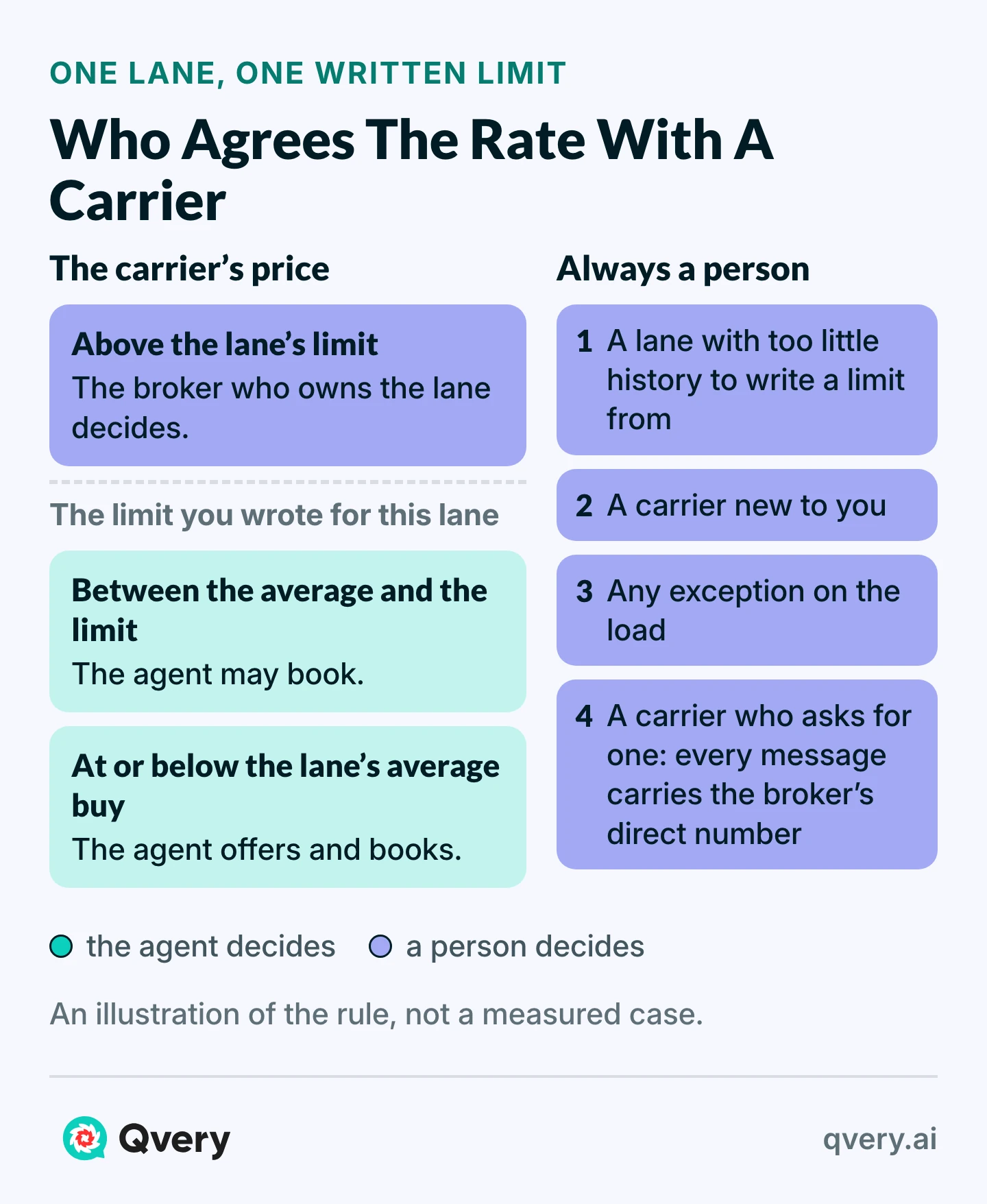
One more line keeps it safe: every message the agent sends carries the lane broker's name and direct number, so a carrier can reach a person at any point.
Plan Next Year's Hiring From the Tasks, Not the Desks
Now price it. Say your operations desk moves 600 loads a day and one rep handles 20, so the desk has 30 reps. The volume plan says 10% more freight next year.
Then say agents take the check calls, the appointment requests and the POD chasing, and a rep handles 26 loads a day instead of 20: a 30% gain, half the largest broker's.
| Today | Next year, no agents | Next year, agents on tracking and PODs | |
|---|---|---|---|
| Loads a day | 600 | 660 | 660 |
| Loads per rep a day | 20 | 20 | 26 |
| Reps the desk needs | 30 | 33 | 26 |
The desk needs 26 reps: seven below the plan and four below today. At the occupation's median wage of $52,260,5 seven seats are about $365,820 a year in wages alone.
Against that go the agents' running cost, their setup, and the hours your reps spend checking them.
That gap is the decision: hold the three hires the plan asked for.
Let the reps who leave in a normal year close the other four, and move the strongest of those who stay toward exceptions and carriers.
Letting people go before the agents have proven the hours bets your service on a pilot.
One task leaves the desk that no task list shows: training. The trade is learned on the job,5 on the check calls, status emails and paperwork that agents take first.
Keep a path: a new hire's first months go to exceptions beside a senior broker and to checking the agent's drafts, where the trade's judgment is on display.
The Agents Qvery Builds for Check Calls, Appointments, and PODs
The first column of the desk table is the work we build an agent for: the check calls, the appointment requests, the POD chasing, and every rate con and BOL read into the TMS.
It follows each load from booking to the filed POD on autopilot, in the shared inbox and the TMS your reps already use. What it cannot settle, a missed pickup, a refused load, a detention dispute, reaches the rep who owns the load, already written up.
Each agent is built for a single brokerage. We sit with its reps first, learning which customers want which updates and how the desk handles a late truck; a first working version runs on the desk's real loads within two weeks, and we train the reps who will run it.
Each week it reports the two numbers this page keeps asking for: rep hours handed back, after their corrections, and errors stopped before they cost money, from PODs missing at billing to appointments never requested.
The 26 in the table is our assumption; that weekly count replaces it with your desk's own.
Count the Hours Your Reps Absorb and the Rate You Pay, Not Just Loads per Rep
Loads per rep is the number that will tell you the plan worked, and it can say so while the plan is failing.
What Reddit says
Two brokers on what the load count hid
Every monthly meeting is a new record for "shipments per person per day", and meanwhile we've been in a hiring freeze that is making us as busy as we were in the first days after the pandemic shutdown.
KPI metrics based on load volume make it seem decent, but it bleeds us dry on carrier rates.
Count four things each week, against the month before the agents started:
- Hours per load, corrections, transfers and rework included, from your reps' time, not the agent's report.
- Your buy rate on steady lanes, against the market benchmark you already use.
- Carriers who walked away: the share of calls and emails where the carrier asked for a person, hung up or never answered.
- Exceptions per hundred loads, and who settled each one.
If loads per rep rise while hours per load do not fall, your reps are absorbing the agent's misses. If they rise while your buy rate climbs faster than the market, the agent is paying for its speed with your margin.
Inventory One Desk's Week Before the Hiring Plan Is Signed
Pick the desk with the most hires in next year's plan. A chat assistant your company has approved can read one rep's exported week of email with the TMS notes on their loads and list every task: how often it came up, its minutes, and its column in the desk table.
Correct the list with the rep, because the minutes are where an assistant guesses, then write that desk's hiring line from the first column's minutes, not from last year's loads per rep. The other desks can wait a quarter; the one with the most hires cannot.
Frequently asked questions
Will AI replace freight brokers?
Not the role, on current evidence. The largest US broker runs its North American brokerage with a third less staff than at the end of 2022, and the US government projects the occupation to grow 6.2% by 2035. AI replaces time on each load: tracking, paperwork and first offers.
How much smaller is C.H. Robinson's freight brokerage?
Its North American Surface Transportation segment averaged 7,251 employees in the last quarter of 2022 and 4,671 in the second quarter of 2026, 35.58% smaller, while volume grew about 1.5% year over year. The company credits its lean model, its technology and its people together, and does not say how much is AI.
Are freight broker jobs growing or shrinking?
Growing, nationally. Cargo and freight agents, the occupation that includes freight brokers, numbered 100,300 in 2025, and the Bureau of Labor Statistics projects 6.2% growth to 2035. MIT's transportation researchers rank the job among the most exposed to AI, yet find no job with all of its tasks exposed.
Will AI shrink a brokerage's operations team?
It can: when each load takes fewer hours, the same freight runs on a smaller desk. At C.H. Robinson, shipments per person per day rose more than 60% since the end of 2022. Whether that comes through job cuts or through hiring less is the owner's decision, and hiring less is the safer one.
Which freight brokerage tasks can AI take over first?
Check calls and tracking updates, appointment requests, chasing PODs, posting loads, and reading rate confirmations, BOLs and PODs into the TMS. Quotes and carrier offers come next, prepared by an agent and decided by a person.
Which brokerage work should stay with a person?
Any task that needs someone reached who is not answering, a choice between two bad options, or authority over money: pricing a new lane or a large customer's bid, a rate above the written limit, approving a new carrier, changing where a carrier gets paid, and settling missed pickups, refused loads and detention disputes.
Can AI negotiate freight rates with carriers?
Inside a written limit, yes: an agent can offer and book up to a ceiling you set per lane from your own history. Above it, on thin lanes, and with carriers new to you, a named broker decides, with their direct number on every message.
Do carriers accept AI agents on booking calls?
Many push back. One brokerage found that about 95% of the carriers its AI reached asked for a person, and removed the AI; some carriers say they avoid brokers who use AI call centers. Those are reports, not measured rates, but they argue for a broker's name and direct number on every agent message.
How should a brokerage plan next year's hiring around AI?
From the tasks, not the desks. In our worked case, a 600-load desk at 20 loads per rep needs 33 reps for 10% more freight, or 26 if agents lift each rep to 26 loads. Hold the three planned hires and let normal departures close the rest.
What should a brokerage measure once AI agents go live?
Four things each week, against the month before the agents started: hours per load with corrections, the buy rate on steady lanes against the market, the share of carriers who asked for a person or walked away, and exceptions per hundred loads. Loads per rep alone can rise while the plan fails.
How will new freight brokers learn the trade if AI takes the junior work?
Only if the brokerage plans for it. The trade is learned on the job, and the check calls, status emails and paperwork agents take first are what new brokers learned on. Give a new hire's first months to exceptions beside a senior broker and to checking the agent's drafts.
Can a smaller brokerage get the same gains as C.H. Robinson?
Probably not all of them. C.H. Robinson has more than 450 in-house engineers and data scientists and hundreds of agents, so our worked case assumes about half its gain. Its chief executive expects consolidation as smaller companies struggle to compete, which is the cost of waiting.
What should a brokerage do before buying an AI tool?
Inventory one desk's week: every task, how often, how long, and whether it changes a rate, a carrier, a customer commitment or a payment. The tasks an agent can do end to end, priced in minutes per load, show what a tool is worth and how many hires it saves.
What does Qvery build for a freight brokerage?
A custom AI agent for one brokerage that makes check calls, requests appointments, chases PODs and reads rate cons into the TMS on autopilot, and hands each exception to the rep who owns the load. A first version runs within two weeks; we train the reps and report hours saved and errors stopped weekly.
Sources
- C.H. Robinson: C.H. Robinson Reports 2023 Fourth Quarter Results (2024)
- C.H. Robinson: C.H. Robinson Reports 2026 Second Quarter Results (2026)
- Fortune: C.H. Robinson Worldwide Q2 2026 Earnings Call Transcript (2026)
- C.H. Robinson: C.H. Robinson Reports 2025 Fourth Quarter Results (2026)
- US Bureau of Labor Statistics: Occupational projections, 2025–35, and worker characteristics, 2025, Table 1.2 (2026)
- O*NET OnLine: 43-5011.00 Cargo and Freight Agents (2026)
- MIT Sloan School of Management: Which transportation workers will be most impacted by AI? (2025)
- The Guardian: Shares in trucking and logistics firms plunge after AI freight tool launch (2026)
- Reuters: C.H. Robinson CEO says AI will drive freight brokerage consolidation (2026)