On this page
- Decide Where Transcripts May Go Before Anyone Uploads One
- Start From the Certified Transcript and Check the Numbering First
- Ask for the Witness's Exact Words Beside Every Cite
- Read the Corrections, Conflicts and Silences Before the Summary
- Check Who Said What Before Anyone Relies on It
- Turn the Flags Into Questions for the Next Deposition
- Save It as the Firm's Method, Then Count the First Month
- Test It on Last Month's Deposition Before This Month's
- Frequently asked questions
Every deposition your firm takes turns into a summary: the testimony sorted by topic, each point tied to the page and line it came from, so a lawyer can cite it in a motion months later without rereading the transcript.
By hand, someone reads every page to build it. One insurance-defense paralegal says the carrier writes down anything billed past about 30 pages an hour, so a 120-page transcript is four hours before anyone argues anything.
An AI assistant reads the whole transcript in a few minutes now and returns the summary with its cites. On our clean test transcript, the cites came back right.
What still goes wrong is smaller and easier to miss: words in quotation marks the witness never said, and a "he" the witness never named given a name.
We ran the method on an invented deposition: the assistant manager of a grocery store, deposed in a slip-and-fall case, 21 pages built the way a court reporter delivers them, with the store's incident report and interrogatory answers as exhibits.
Every name, date and line in it is made up, and eight things in it are planted. We wrote the answer key before the first run.
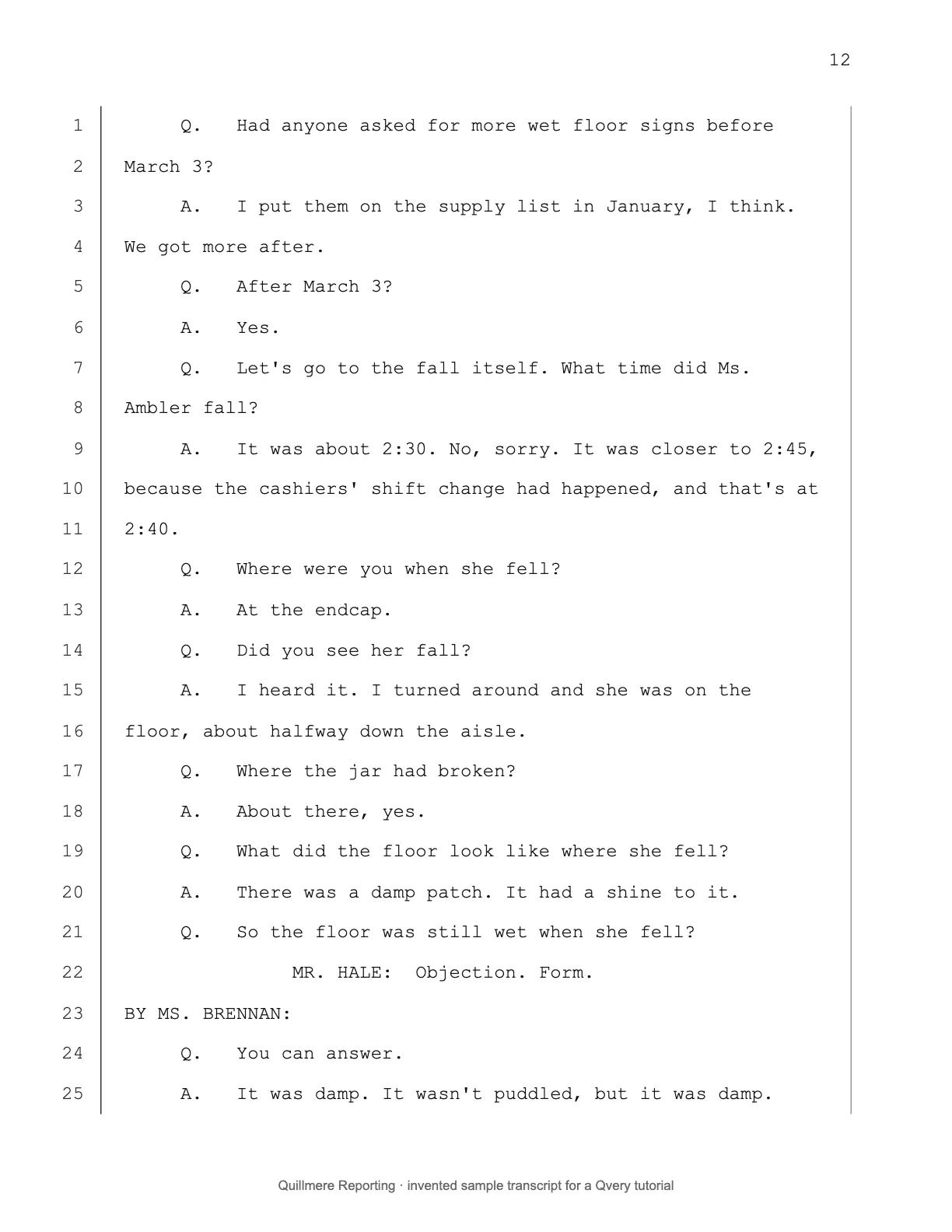
That is page 12 of the transcript and the 13th page of its PDF, an offset that matters in the second section below.
This page covers where transcripts may go, the check that proves the assistant reads the right numbers, the prompt, what each flag in the output means for the case, the check a person runs, and how to make it the firm's method. It runs on your own transcripts tomorrow.
Deposition summaries are the kind of job we build agents for at Qvery: one document type, the same check every time, and a lawyer who decides what to rely on.
This builds a page-line summary of one deposition's written transcript. It does not cover video depositions, designations for trial, or how summaries are filed in your document system.
Decide Where Transcripts May Go Before Anyone Uploads One
A deposition transcript is client material, so the first decision is which assistant plan may hold it, and the firm makes it on purpose and writes it down.
The ABA's ethics committee put the line where it belongs: before information relating to a representation goes into a tool that learns from it, the client's informed consent is required (Formal Opinion 512, 2024, the ABA's reading of the Model Rules; your state's bar may have its own).
For Claude, the plans split cleanly:
- Team and Enterprise: Anthropic says it does not use inputs or outputs from its commercial products to train its models by default.
- Free, Pro and Max: chats are used to improve Claude if the user allows it or a chat is flagged for safety review, with the switch under Settings, Privacy, Help Improve our AI models.
- Thumbs up or down: on any plan, rating an answer stores the entire conversation, transcript included, for up to five years. On Team and Enterprise plans an owner can turn rating off for everyone with the Rate chats setting.

Write the answer into the firm's AI policy in three lines: the plan transcripts may go into, who may upload them, and rating switched off.
Start From the Certified Transcript and Check the Numbering First
A page-line summary has one reference system: the page and line numbers printed on the certified transcript.
That is the system a brief cites, because a party supporting a fact must cite "particular parts of materials in the record, including depositions" (Federal Rule 56), and every line has a number: transcript format standards call for at least 25 numbered lines a page.
The file is the first place it breaks. When the certified PDF opens with a cover sheet from the reporting firm, as ours does, page 13 of the PDF holds page 12 of the transcript.
Claude's own help page tells users, when referring to pages, to use the PDF page numbers "as shown in your PDF viewer, not the page numbers printed on the document itself". For a transcript, that habit is backwards: the printed numbers are the ones a brief cites. So check before asking for anything else.
Open a new chat, attach the certified PDF, and paste this. Swap in two page and line spots from your own transcript that you can see on screen.
Before you summarize anything, check that you are reading the page and line numbers printed on this transcript, not the page numbers of the PDF file.

1. Quote, word for word, transcript page 12, lines 9 to 11, and transcript page 16, lines 20 to 22.
2. For each, tell me which page of the PDF file it is on.
3. Tell me how many lines each transcript page has.

Do not summarize yet.
What passing looks like: the words match what you see at those lines, and the answer names the offset. Ours came back with both passages exact and this line: "PDF page 1 is an unnumbered cover sheet, so every transcript page sits one PDF page later than its printed number."
If the quote comes from the wrong page, the assistant is counting PDF pages. Say so in the chat and run the check again before going on.
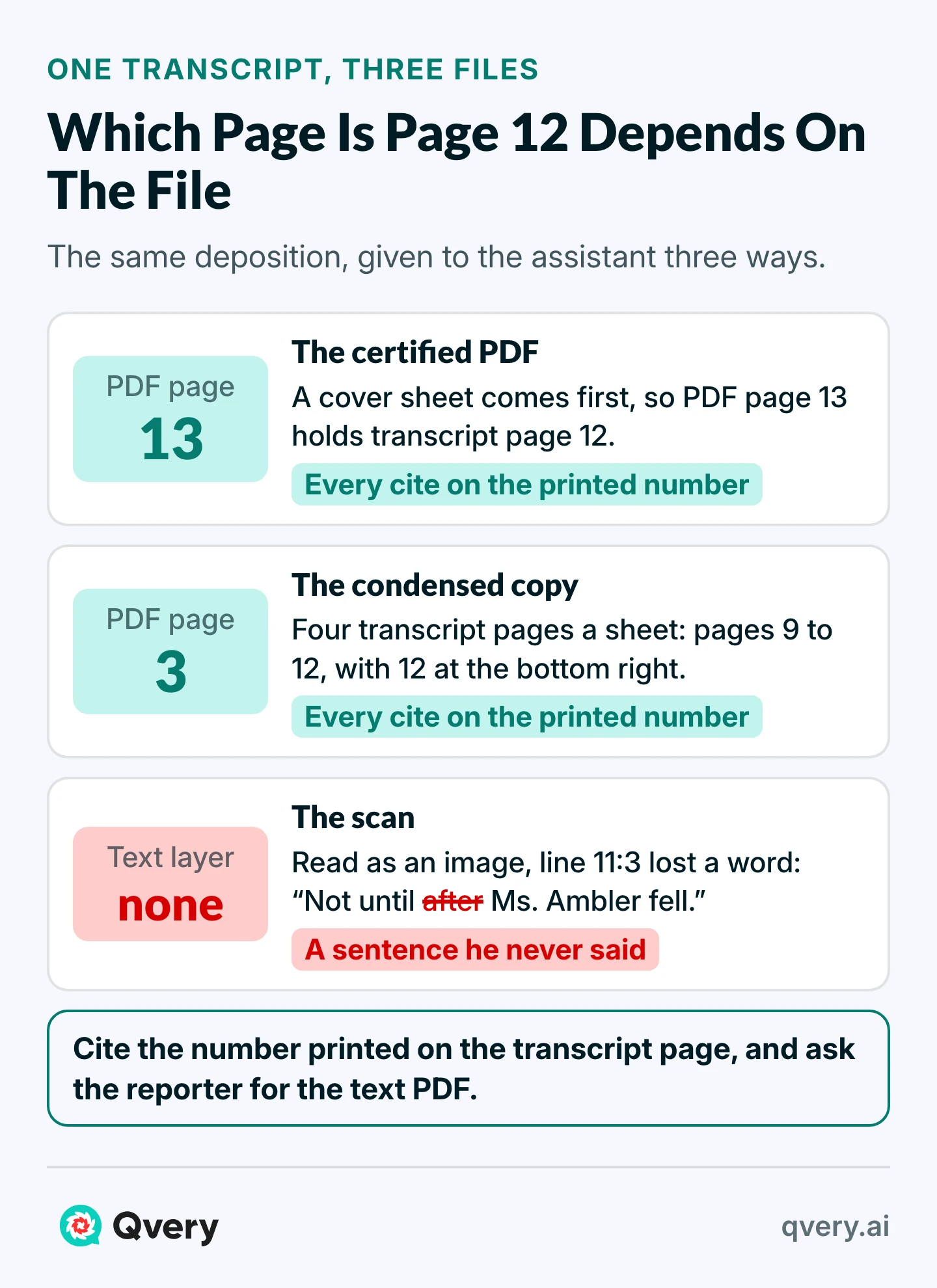
We gave the same transcript to the assistant three ways. The condensed copy, four transcript pages to a sheet, cost nothing: every cite still landed on the printed numbers.
The scan with no text layer cost one word, twice: the witness's "Not until after Ms. Ambler fell" came back as "Not until Ms. Ambler fell," a sentence he never said, about when the sign went out.
Ask the reporter for the text PDF. When a scan is all there is, check every quote that turns on a single word.
One more limit worth knowing: Claude reads text and visuals in PDFs of 100 pages or fewer and text only from 101 to 1000 pages. A long deposition is read as text, which is what a summary needs.
Our runs were on 21 pages, so make your first run on a long transcript your team has already summarized by hand.
Ask for the Witness's Exact Words Beside Every Cite
The obvious request is one line, and the summary it returns reads well:
Summarize this deposition transcript.It is readable, and on our transcript its cites were right. What it left a lawyer to discover:
| What a lawyer needs | What the one-line request returned |
|---|---|
| The witness's words for each point | Few quotations, two of them words he never said |
| Who said what | The unnamed "he" given the store manager's name |
| What the testimony does not cover | No topic list, so nothing marked missing |
Where the witness said "It was damp. It wasn't puddled, but it was damp," the summary quoted him as saying "damp, not puddled." And it wrote "Ostrander came by during the mopping. According to Petrakis, he said the store was out of the yellow signs", a name the transcript never attaches to that sentence.
The fix is a prompt that makes every point a lookup. Change the topics to your case's and keep the seven rules as they are.
You are preparing a deposition summary for a lawyer, who will check it against the transcript before relying on it.

Rules:
1. Cite every point to the page and line numbers printed on the transcript, in the form 12:9-11. Never use the page numbers of the PDF file.
2. For every point, copy the exact words you rely on from the transcript, in quotation marks. If you cannot quote it, leave it out.
3. Go through the topics below one at a time. If the testimony does not cover a topic, write "Not found in the transcript" and nothing else for that topic.
4. Report testimony as given. When the witness corrects an answer, changes it later in the deposition, or changes it on the errata sheet, show each version with its own cite. Do not decide which version is true.
5. When an answer is unclear, for example a "he" or "they" that could mean more than one person, say it is unclear. Do not pick a reading.
6. Note every objection and any instruction not to answer, with its cite. Never fill in an answer the witness did not give.
7. Compare the testimony with the exhibits I attached. List each place they disagree, with the transcript cite and the exhibit's own words.

Topics:
1. The witness: job, duties, training on spills
2. Floor inspections and the sweep log
3. The spill: when it was reported, who handled it, when the floor was mopped
4. Wet floor signs: whether one was out, and why not
5. The fall: time, what the witness saw, the condition of the floor
6. What happened after the fall, including photographs
7. The incident report
8. Camera footage
9. How long the store keeps camera footage
10. The plaintiff's own conduct
11. Earlier incidents and changes made afterward

Format: for each topic, a table with three columns: Point, Quote, Cite. After the topics, two short lists: "Corrections and conflicts" and "Unclear or unanswered".
Attach the transcript and the exhibits in the same chat and send it. Here is part of what came back for topic 4, as returned:
| Point | Quote | Cite |
|---|---|---|
| Sign before the mopping | "No. Not before." | 10:25-11:1 |
| Sign after the mopping | "Not until after Ms. Ambler fell." | 11:3 |
| Why not | "The two up front were by register four, and the others were in the back." | 11:5-6 |
| What was said (speaker given only as "He"; see the unclear list) | "He said we were out of the yellow signs up front, so just finish the aisle and keep an eye on it." | 11:11-12 |
| Earlier requests for more signs | "I put them on the supply list in January, I think. We got more after." | 12:3-4 |
And topic 9, which the transcript never reached: "Not found in the transcript."
How the two outputs differ, in our runs:
- Quotes: 142 to 174 of three words or more in each strict summary, against 7 in the one-line summary.
- Found word for word: all 776 quotes in the five strict summaries made from text PDFs; 5 of the one-line summary's 7.
- Topics: every one answered or marked "not found", against no topic list at all.
- Unclear answers: an "Unclear or unanswered" list in every strict summary, where four of the six caught the unnamed speaker; none in the one-line summary.
Read the Corrections, Conflicts and Silences Before the Summary
The two lists at the bottom are the most valuable part of the output. Each kind of flag means something different for the case, and the assistant's job ends at listing it:
- A correction inside one answer. The first number is on the record too: "It was about 2:30. No, sorry. It was closer to 2:45" (12:9-11). The lawyer cites the whole answer, never half of it.
- A correction after a break. The mopping was "I'd say 2:20" (10:24), then "closer to 2:35" after lunch (16:20-22). The witness had time to think, or to talk; the lawyer reads what was asked about the break (16:15-17) and decides whether to press.
- An errata change. "No, I didn't look at the cameras that day" (15:9) became "Yes, I reviewed the aisle 7 camera that afternoon with Dale Ostrander" (21:8-11). The original stays on the record, so both stay in the summary.
- Testimony against an exhibit. The incident report's "Wet floor sign in place" box is checked Yes; the testimony says no sign went out until after the fall (11:2-3, 14:12-20). The lawyer reads the exhibit's words and the witness's explanation before calling it a contradiction.
- An instruction not to answer. The question about the March 4 call with the legal department drew a privilege instruction and no answer (15:20-16:1). Nothing is filled in; the call's length and who was on it are what the record holds.
- A topic never reached. Footage retention: "Not found in the transcript." Nobody asked, so it goes on the next deposition's outline.
Two of those flags sit on one page of Exhibit 4, the store's incident report:
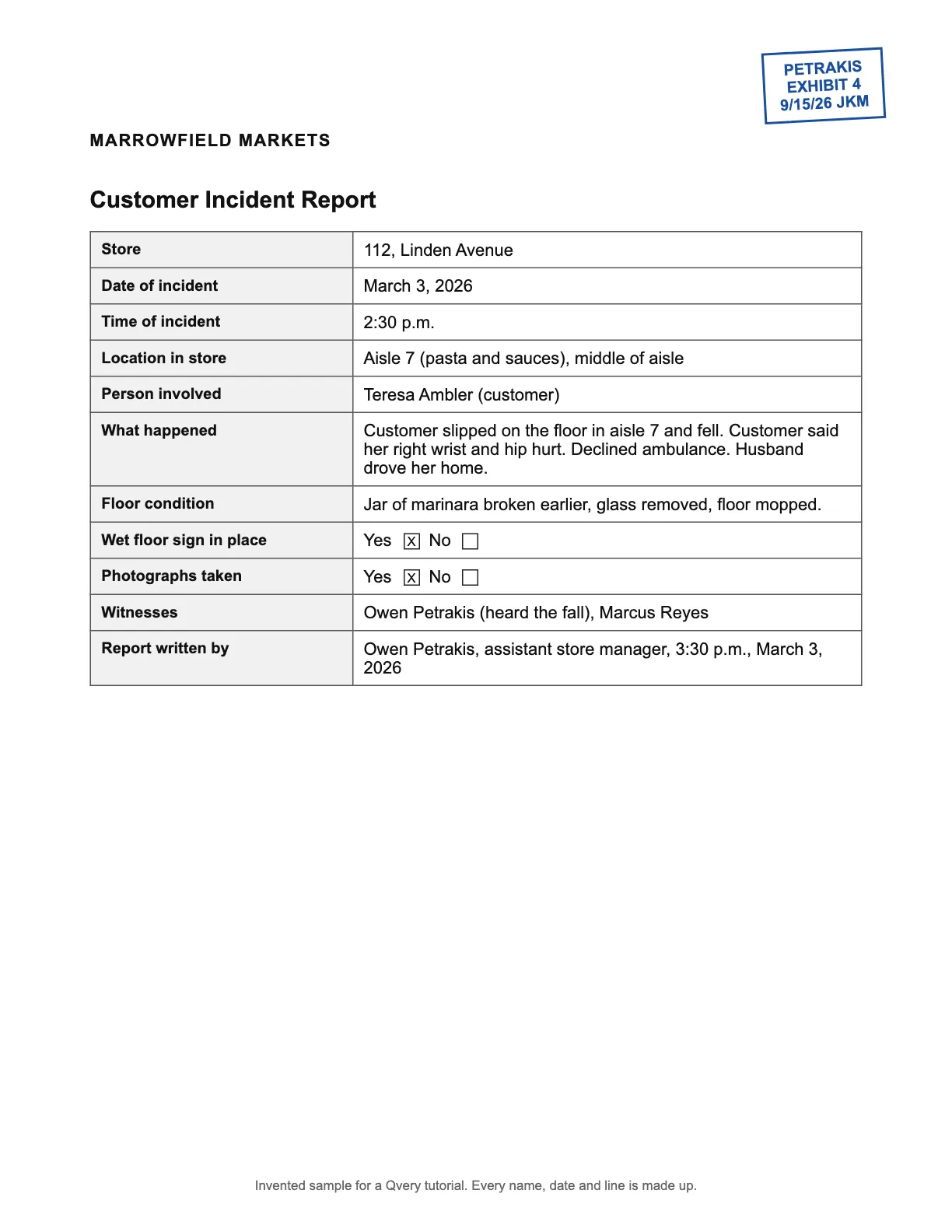
The sign box says Yes.
The witness says the sign went out after the fall and that he checked the box because the sign was there by the time he wrote the report (14:19-20). A summary that lists both, with his explanation, has done its job; what it means for the case is the lawyer's call.
The errata rule is federal: when review is requested, the deponent gets 30 days to review the transcript and sign a statement "listing the changes and the reasons for making them", and the reporter attaches it. A summary that shows only the new answer has lost the original, and every summary we ran kept both.
The people who already run AI summaries describe the same moves in their own words:
Tips from Reddit
Paralegals and lawyers on running AI summaries
I start with a few of the things I know I want summarized: background, the incident at issue, the before stuff and the after stuff.
I still review depos myself, but I've found it can do an ok job with "tell me the contradictions in this deposition/between these two depositions"
I have an LA check it for accuracy but that’s still much faster than creating from scratch.
I feel like verification eats into a good chunk of the time savings… but I’d still rather “review and correct” rather than “read and generate”
Check Who Said What Before Anyone Relies on It
Every summary got the corrections, the conflicts and the errata right. Where three of the seven failed was one sentence.
The witness, asked whether anyone told him to leave the signs in the back, answered "Dale came by while Marcus was mopping, and we talked about it", then: "He said we were out of the yellow signs up front, so just finish the aisle and keep an eye on it."
The transcript never names the speaker. It is also the sentence a lawyer would build an argument on, because it puts the decision on the store manager.
| Summary | Prompt | How it handled the "he" (11:11) |
|---|---|---|
| Claude Sonnet, run 1 | the summary prompt | flagged as unclear |
| Claude Sonnet, run 2 | the summary prompt | "What Mr. Ostrander said" |
| Claude Opus | the summary prompt | flagged as unclear |
| Gemini Flash | the summary prompt | "Store manager's instruction regarding wet floor signs" |
| Claude Sonnet | the one-line request | "According to Petrakis, he said", after naming Ostrander |
| Claude Sonnet, condensed copy | the summary prompt | flagged as unclear |
| Claude Sonnet, scanned copy | the summary prompt | flagged as unclear |
Two of the three failures came under a rule that said, in so many words, not to pick a reading. The quote beside the cite catches it: the words say "He," and a reader who checks the quote against the point sees the name was added.
So the check runs in this order, attribution first. Every point carries its quote, so each step is a lookup in the PDF rather than a reread of the testimony.
1. Every sentence that says who said or did something: read it against its quote. If the quote names nobody, the name must come from the question or answer around it, cited; otherwise the summary says "unclear".
2. Every quote: find it in the transcript PDF at its page and line. Words that are not there, or not at that line, go back.
3. Every correction and errata change: both versions present, each with its cite.
4. Every conflict with an exhibit: read the exhibit's own words beside the testimony.
5. Every "Not found in the transcript": search the transcript for the topic's words and the words a witness would use instead.
6. Every instruction not to answer: nothing filled in after it.
7. What is missing: read the transcript's index and exhibit list against the summary. A witness or exhibit there and absent here goes back.
How much of step 2 to do by hand, for good, is a question the ABA's opinion answers usefully.
A lawyer who has tested a tool on a smaller set of documents reviewed by hand, and found its summaries accurate, would not necessarily have to review the whole set by hand (the opinion's example is a set of contracts), and stays fully responsible either way.
So check every quote on the first transcripts, starting with two your team has already summarized, count what the check catches, and sample step 2 only once your own numbers show it clean. Every other step stays complete every time, because that is where judgment lives.
The fair objection is that checking an AI summary can take as long as reading the transcript. It can, when the summary paraphrases. With the witness's words beside every cite, the check is a lookup, not a reread.
Turn the Flags Into Questions for the Next Deposition
The lists at the bottom of the summary are the start of the next outline. In the same chat, after the summary, send this:
From your summary, take the two points a lawyer would most want to pin down at the next deposition: who said to leave the signs in the back, and what the camera footage shows. Draft follow-up questions for the deposition of the store manager, Dale Ostrander, on those two points. Give each question the transcript cite it follows from. Short, single-fact questions, the way a deposition outline is written.Ours came back with 57 questions, each tied to a cite. A few, as returned:
| Question, as returned | Its cite |
|---|---|
| Did you say "we were out of the yellow signs up front"? | 11:11 |
| Did you say "just finish the aisle and keep an eye on it"? | 11:11-12 |
| If you did not say those words, who did? | 11:11 ("He"). The speaker is not named. |
| Did you review the aisle 7 footage on March 3? | 21:8-11 |
| Does it show a wet floor sign in the aisle before the fall? | 10:25-11:3 |
| How long does the store keep camera footage? | none; 15:5-7 |
It did two things without being told: it marked the retention questions as having no transcript source, and it added a note to keep questions about the privileged call to its date, length and who was on it.
The assistant drafts; a lawyer decides. What is asked, what goes into a motion and anything sent to opposing counsel stay with the lawyer. A draft outline is the right thing to hand an assistant precisely because nothing happens until a person uses it.
Save It as the Firm's Method, Then Count the First Month
Once the prompt works, put it where everyone on the team runs the same one. In Claude, that is a project: create one for deposition summaries, click Set project instructions, and paste the seven rules and the format.
Claude uses those instructions in every chat in the project. Keep the topic list out of the instructions; it changes with every case, so paste it with the transcript.
Chats in a project do not share context unless it is in the project knowledge, so attach each transcript in its own chat, not to the project's knowledge, and one witness's testimony stays out of another's summary.
A chat that started outside the project can be moved in from the dropdown next to its name.
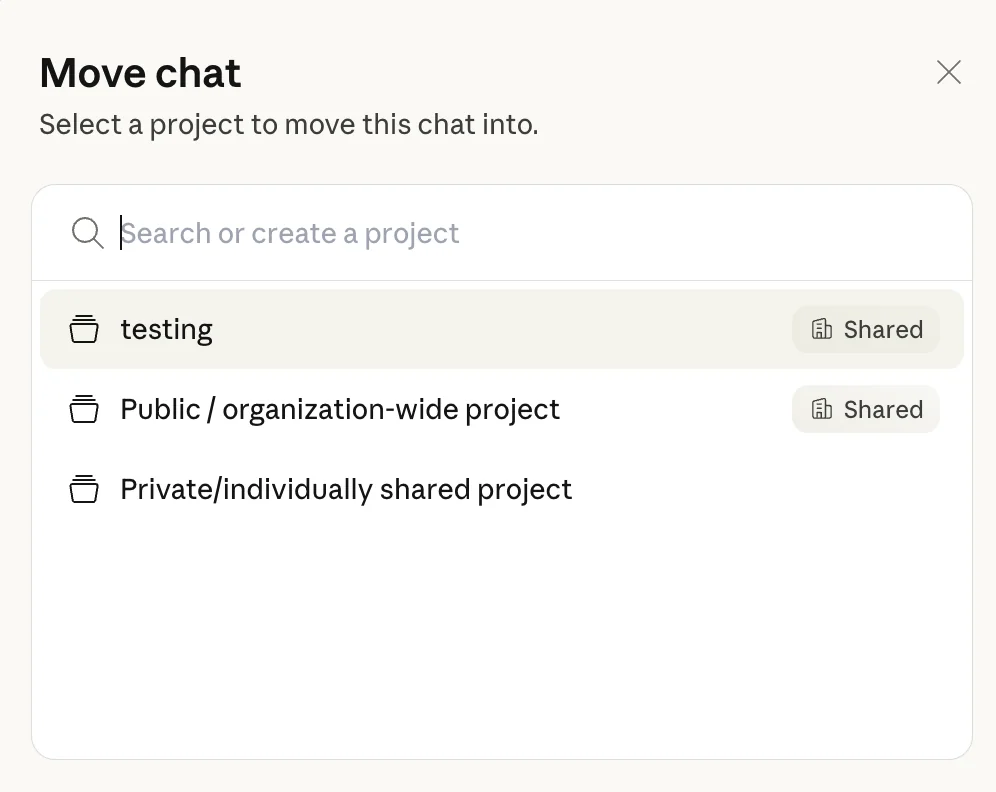
Then count, because the case for the method is your numbers, not ours. Here is the arithmetic with every input labeled:
| Line | Your number | An example (assumptions, labeled) |
|---|---|---|
| Depositions summarized a month | from your docket | 12 (assumption) |
| Average pages | from your transcripts | 150 (assumption) |
| Pages an hour by hand | from your timesheets | 30 (one paralegal's report of one carrier's cap) |
| Hours a month by hand | pages times depositions, divided by the hourly pace | 60 |
| Minutes per AI summary | from your runs | about 2 to 6 on our 21-page transcript; time your long ones |
| Hours a month on the check | from the first month | measure it; this is the number that decides |
| Errors the check caught | from the first month | count them by kind: words not said, wrong line, a name added |
The hours by hand, minus the minutes on the assistant and the hours on the check with its corrections, is the time the method gives back. The last line tells you whether the check is set at the right depth.
The same job is a natural agent once the tally holds. Here is its shape, as a proposal, not something we have built for anyone:
Pick Up the Certified Transcript
It starts when the court reporter's email with the transcript arrives, and saves the file to the matter.
Run the Summary Prompt
The seven rules, with the case's own topic list and the exhibits marked at the deposition.
Look Up Every Quote
Each quote is checked at its page and line, and any that fail are marked.
Hand Over the Flags
The summary and its lists go to the matter folder, to the paralegal who owns it.
Wait for a Lawyer
Nothing it produces is relied on, filed or sent until a lawyer has read the flags.
Count It Like the Tally
Minutes per transcript, and quotes that fail the lookup.
Set up the project and the tally first, so the agent runs a check your team has already proven on its own transcripts.
If summaries, medical records and the other reading in your litigation practice are where the hours go, our legal playbook walks through where agents pay off first in a law firm.
Test It on Last Month's Deposition Before This Month's
Take a deposition your team summarized by hand last month, run the method on it, and compare the two line by line, settling each difference against the transcript.
The ones the AI summary got wrong, out of every point it made, are your firm's own error rate, and they set how much of the check to do by hand from then on.
Frequently asked questions
How do I make an AI deposition summary cite page and line?
Tell it to cite the page and line numbers printed on the transcript, in the form 12:9-11, and never the PDF's page numbers, and to quote the witness's exact words beside every cite. Run the numbering check first: ask for the exact words at two spots you can see and confirm the page.
Can I trust an AI assistant to summarize a deposition?
Trust the cites once you have checked them. In our runs on a clean 21-page transcript every quote in the strict summaries from text PDFs was found word for word, but three of seven summaries named a speaker the witness never named. The summary is a draft a person checks; under ABA Formal Opinion 512 the lawyer stays fully responsible.
How long does an AI deposition summary take?
About two to six minutes per summary on our 21-page transcript, including reading the files. A longer transcript takes longer, and the check is the part to time on your own team.
What should I check before using an AI deposition summary?
Attribution first: every sentence that says who said or did something, against its quote. Then the quotes at their cites, both versions of every correction and errata change, each conflict against the exhibit's words, each "not found", and whatever the transcript's index lists that the summary leaves out.
What is a page-line deposition summary?
A summary of the testimony, usually by topic, where every point carries the page and line numbers of the transcript it came from, so a lawyer can cite it without rereading.
Is it safe to upload a deposition transcript to an AI assistant?
It depends on the plan and on the client's consent. Anthropic does not train on inputs to its commercial plans by default; personal plans have a setting; rating an answer stores the whole conversation for up to five years. ABA Formal Opinion 512 requires informed client consent before client information goes into a tool that learns from it.
What does an errata sheet change?
It records the witness's changes in form or substance after reading the transcript, with the reasons, and is attached by the reporter. The original answer stays on the record, so a summary shows both.