
On this page
A personal injury file starts as a stack of productions, the batches of records each provider sends: the ambulance run, the hospital's chart, the family doctor, a therapy clinic, an orthopedist, a pharmacy printout, and each provider's bills.
Before anyone can value the claim, someone turns that stack into the medical chronology: each visit after the incident in date order, what the record says, and the page it is on. The demand letter quotes it, and the settlement number is built on it.
What slips through comes back later:
- Another patient's note sent out with the demand.
- A gap in treatment nobody listed.
- A back strain from before the incident that the triage sheet says the client denied.
By hand, that is hours of a paralegal reading every page and typing every row, repeated with each new production, because records arrive from the providers over months.
At Qvery, we help personal injury firms put paralegals back on their cases, with custom AI agents that chart each new production and check every row against its page.
AI assistants read the whole stack in minutes now, and on our test file every run found every visit and cited the right page for each.
We expected the risk to be a visit left out. It was a visit filled in: one run, as polished as the rest, gave two therapy visits treatment details that appear on no page of the file.
Our test file is invented, every name and date in it: a client rear-ended at a red light, 42 pages from nine providers, laid out like real records and billed on the real claim forms.
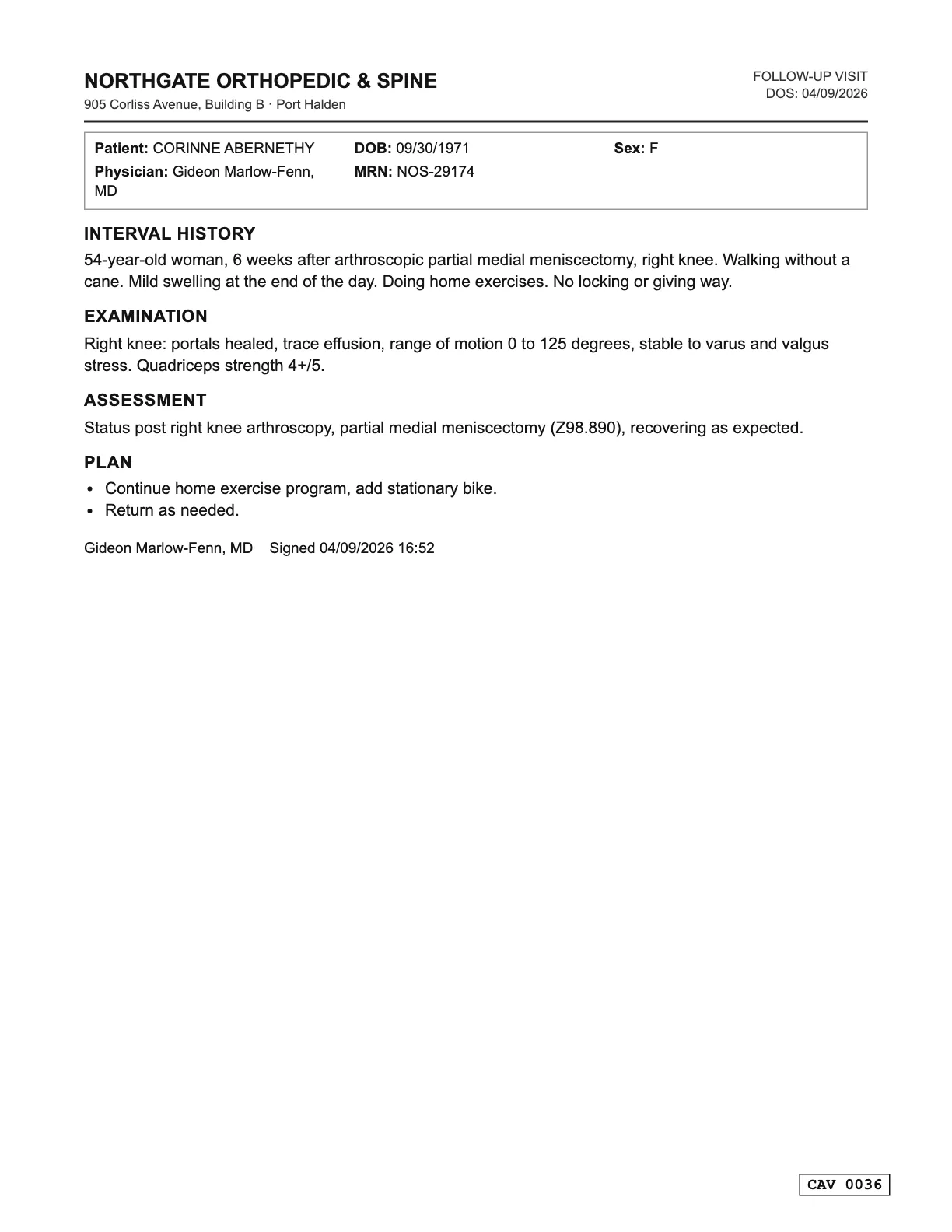
That is page 36: a knee follow-up for a different patient, Corinne Abernethy against our client's Corinne Abernathy-Vale, filed among her orthopedic notes on the day of her own visit. All eight runs pulled it out.
A One-Line Request Fills In What the Records Don't Say
Most people start with a one-line request that asks for a medical chronology and nothing else.
We ran that three times. Twice it caught what the strict rules caught (one of the two never listed the gap). Once, it did this:
| What the file holds | What that answer said |
|---|---|
| A ledger line billing therapy on 04/15, and no note for that day | Minutes of therapeutic exercise and manual therapy, copied from other visits' notes |
| The 04/01 note, unreadable | Minutes for three treatments, as if the note could be read |
| An injection billed by code, with no procedure note | "under fluoroscopic guidance", a word on none of the 42 pages |
Even the two good answers paraphrased where the record's words belong, changed shape from run to run, and added judgments that are a lawyer's or a medical expert's ("Treat its findings as unverified").
The rules our agents chart under answer each of those failures: one row per visit, the provider's own words, a stamped page on every row, and a bill with no record written as exactly that.
Under those rules, five runs out of five returned the same five columns, one row per visit, every row cited. Here are the therapy visit and the injection the one-line answer filled in, as one strict run returned them (the second row shortened where marked):
| Date of service | Provider | Record type | What the record says | Pages |
|---|---|---|---|---|
| 04/15/2026 | Cascade Physical Therapy | Bill only | Billed, no record in the file. Ledger lines: 97110 x 2 "Therapeutic exercise, each 15 min"; 97140 x 1 "Manual therapy, each 15 min". | CAV 0032 |
| 05/28/2026 | Summit Pain and Spine Associates, Victor Almstead, MD | Bill only (claim form) | Billed, no record in the file. [...] Two other providers describe this visit. [...] | CAV 0041; described at CAV 0037, 0020 |
The rules do not make every answer right: under them, one run dated the fax page without saying how, and four quotes were not word for word.
What they do is put each answer where a person can check it: a "billed, no record" row shows on its face, and a quote can be looked up on its page. The invented minutes in the one-line answer could only be caught by someone who already knew the ledger.
 Vlad ShvetsPartner @ Qvery
A chronology with two invented therapy visits looks exactly as finished as a correct one, and the demand letter quotes whichever one you send. So ask one question of any tool for this job, ours included: can a lawyer check each row in a minute, from the page it cites, the provider's own words, and a bill with no record marked as one? If checking a row takes as long as reading the page, no hours were saved.
What Happens When a Production Arrives
In a PI file, each new production means the whole routine again. Our agents run it on autopilot, in the matter's records folder and on the AI plan the firm approved for client medical records, while the paralegal who answers for the file keeps the decisions:
Starts
when a new production lands in the matter's records folder.
Does
stamps it with the next free numbers, indexes it, rebuilds the chronology under the same rules, reconciles against the stamp count and drafts the requests.
A person approves
every request before it goes out, and every flag before anyone acts on it.
The stamp is what every row hangs on: each page gets a number that never changes (ours run CAV 0001 to CAV 0042), so a row points at one page.
On our file the index alone, before any chronology existed, flagged four things: the other patient's page, a second copy of the emergency department's note, an unreadable fax and a therapy note repeated word for word under a new date.
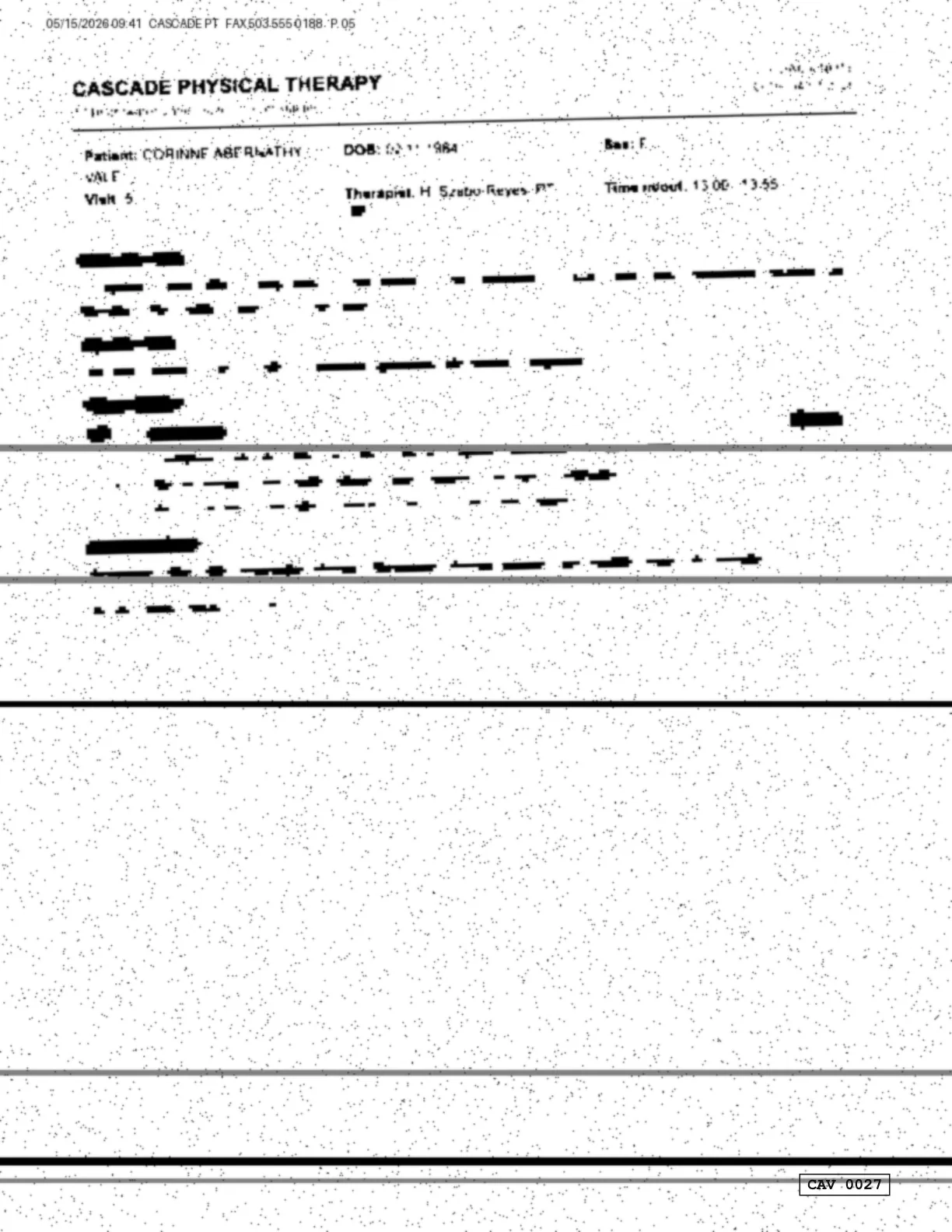
That is page 27, and every run said it could not be read. It stays marked unreadable, never guessed, until the provider sends a clean copy.
 Piotr BabelPartner @ Qvery
Every row the agents write has to survive one test: a paralegal opens the stamped page it cites and finds the words there. That is why they quote the provider instead of summarizing, and why a bill with no note behind it becomes a row that says billed, no record in the file. When they miss something, the count shows it: pages cited plus pages explained must equal the last stamp, and any shortfall goes back to the paralegal.
The Flags a Paralegal Sorts
Each chronology ends with the same three lists: gaps, records and bills that do not match, statements to check. Some flags are problems and some are not, and sorting them is the skilled part of the job now.
Another Patient's Page
Page 36, the other patient's knee note, came out of every run, the strict ones under "Not this patient", because the date of birth and chart number did not match.
It is a stranger's health information, and it must not leave the firm with your demand. The fix: pull it from the set, tell the provider, and ask for a corrected production.
Check it held: the corrected file's index lists CAV 0036 as withdrawn, no row cites it, and no other stamp moves. A stamp, once given, is never reused.
A Bill With No Record, and a Record With No Bill
| Visit | The record | The bill |
|---|---|---|
| 04/02, MRI | The radiologist's report (CAV 0040) | None; the imaging center's certification says it will "follow under separate cover" |
| 04/15, therapy | None | A ledger line (CAV 0032) |
| 05/28, injection | None; two later notes describe it | A claim form (CAV 0041) |
The record shows what was done and the bill shows what it cost, and the chronology should say which of the two is missing for each visit. The fix: request the missing half from each provider; the agents draft the request, and a lawyer decides what to ask for.
Check it held: when the pages arrive, "billed, no record in the file" leaves the row and the new pages join it.
A Gap in Treatment
The records show no visit from the last therapy session on 04/17 to the injection on 05/28: 41 days. Counted only from records with notes, it runs to the orthopedic visit on 06/18, 62 days, with a prescription refill on 05/01 inside it.
The fix: get the injection records, then ask the client about those weeks. The 06/18 note already says the pain "returned to 5/10 in late April and early May while back in the office full time".
Check it held: the next run's gap list gives each stretch with the documents on both sides, and says which dates rest on a bill alone.
History From Before the Incident
Two more pages sit beside them: a January 2025 follow-up that calls the strain improving, and an August 2025 checkup that found nothing in the back or neck.
The fix is the lawyer's. The rows stay in the providers' words, and the disagreement goes under "Statements to check".
Tips from Reddit
Paralegals on what a chronology has to catch
the most important thing I look for is inconsistencies (denies losing consciousness, then says they did lose consciousness), denying prior issues to their current MDs that are documented in previous medical records, pain complaints (10/10) inconsistent with injuries, that kind of thing.
Especially in personal injury, you want to look for previous medical histories, inconsistencies in the records, even BAC and drug levels in certain cases, and other stuff that AI generally doesn’t pick up on its own because it’s not looking for that.
Some flags are not problems: neck tenderness written as "C5-C7", "C5-C6" and "C4-C7" in three notes is three examiners on three days, and each row records what each one wrote.
Before a lawyer relies on the chronology, a paralegal looks up every quote on its cited page. A person reads each drafted request and sends it: nothing leaves the firm on the agents' word, and nothing touching a client's health records goes out unread.
That lookup is what a paralegal's hours become. Our assumptions: 4,000 pages of new productions a month, about 25 files at 160 pages, read and typed at 2 minutes a page by hand, and checked against the agents' rows at half a minute a page.
Paralegals and legal assistants earned a mean $33.51 an hour in May 2025, by the federal wage count, or about $47.87 once benefits are added; the agents' running cost is model usage of about 3 cents a page plus hosting and upkeep. Your own files go in here:
Medical Chronology ROI Calculator
What Each Page Of Medical Records Costs You To Chart, And With The Agents
Saved Per Year
$52,404
1,200 hours handed back, after $5,040 a year to run it
- Hours Handed Back
- 1,200 hours a year
- Agent Running Cost (Estimate)
- $420 a month
- Payback Per $10,000 Of Build
- 2.3 months
On these numbers, each page costs $0.50 instead of $1.60, the agent saves $52,404 a year after its own running cost, and every $10,000 of the build is earned back in 2.3 months.
At that volume a page costs $0.50 to chart instead of $1.60. The firm keeps $52,404 a year once the agents' running cost is paid, its paralegals get 1,200 hours back, and $10,000 of build comes back in 2.3 months.
What a stranger's page or an invented row would cost a demand is not in that number.
The folder your productions land in and the person who owns the flags are the first two things we settle with you.
The First Month on Your Own Files
We begin with how your firm runs today: how productions reach the firm, who stamps them, and which chronology format your lawyers read.
Two weeks after we have access, the agents chart two files your team already charted by hand, and your paralegals read the two chronologies row by row. Where they disagree, they open the page.
After that each new production is charted the day it lands, and each week your PI lead sees the paralegal hours handed back and what the checks stopped before a demand went out: a quote off its page, a page nobody explained, a detail no page supports.
Frequently asked questions
What is a medical chronology in a personal injury case?
A table of every visit after the incident in date order, with what each record says and the page it is on, built from the records and bills of every provider the client saw. The demand letter quotes it, and the settlement number is built on it.
Can AI build a medical chronology with page citations?
Yes. On our invented 42-page set, every run listed all 22 visits and cited a page holding each one. The risk is details the records don't support, and a prompt that requires the provider's own words and "billed, no record in the file" makes them visible.
What should each row of a medical chronology say?
The date of service, the provider, the kind of record, what the record says in the provider's own words (complaints, findings, diagnoses, treatment, work status and plan) and the stamped pages it comes from. One row per visit, in date order; a visit that appears on several sets of pages gets one row citing all of them.
Should a chronology include visits from before the accident?
Yes, each marked as before the incident. That is where a prior injury shows up, such as a back strain the family doctor recorded in 2024 that the emergency department's triage sheet says the client denied. Those visits usually have a record and no bill, which is not a problem: the bills in a claim file are for the treatment claimed.
Can AI find treatment gaps and missing records?
Yes, when the prompt asks for them. Our strict-prompt runs listed the 41-day gap after therapy, the injection billed with no record, the MRI with no bill and the therapy visit billed with no note. Whether a gap hurts the case is the lawyer's call.
What if another patient's records are in the file?
Pull the page, tell the provider and ask for a corrected production: it is a stranger's health information and must not leave the firm with your demand. Every one of our runs caught the misfiled page, because its date of birth and chart number did not match.
Which AI models did you test for medical chronologies?
Claude and Gemini, on the same invented file, eight runs in all, and both found every visit; we did not test ChatGPT. The one run that filled in treatment details no page holds was answering a one-line request. The rules mattered more than the model.
How long does an AI medical chronology take?
About eleven minutes of assistant time on our 42 pages. The checks and the sorting of flags take longer, and that total is the number to set against the hours a paralegal spends reading every page by hand.
Can AI draft the medical records requests?
Yes, once a lawyer has chosen what to ask for. On our file the reconciliation proposed about forty items across nine providers, from the injection's procedure note, which the case needs, to copies of prescriptions a chronology does not. The draft to the pain clinic used only what the clinic's own claim form says and named what it had left out, and a person reads and sends every request.
Is an AI medical chronology accurate enough to quote in a demand letter?
Only after a person has checked it. Every quote is looked up on its cited page, every stamped page is cited or explained against the firm's own count, and every flag is sorted by a person before a number goes into a demand.
Do different spinal levels in different notes mean the records conflict?
Not by themselves. Neck tenderness written as C5-C7, C5-C6 and C4-C7 in three notes is three examiners on three days, and each row records what each one wrote. An injection level that differs from the MRI finding is a question for the treating doctor or a medical expert, not something the chronology settles.