By
Vlad Shvets
Have AI Engines Already Settled Your SaaS Category's Top 5? Check Before You Try To Break In
Four project management brands made every run's top five in ChatGPT and Google AI Mode answers; in CRM, only two did. Check which your category looks like first.
Four project management brands made every run's top five in ChatGPT and Google AI Mode answers; in CRM, only two did. Check which your category looks like first.
Four project management brands made every run's top five in ChatGPT and Google AI Mode answers; in CRM, only two did. Check which your category looks like first.
Ask ChatGPT for the best tools in your SaaS category and you probably get the same handful of names you always get. If your product is not on that list, it is easy to assume the list is fixed.
In some categories it is close to fixed. In others it only looks that way from a single answer, and which of the two you are in decides how you try to get in.
So we asked the same unbranded recommendation questions for two categories, project management and CRM, five times over in September 2026 (three runs on ChatGPT, two on Google AI Mode), and kept the brands that made every run's top five.
The short version: in project management, four brands made the top five of every run: Asana, ClickUp, monday.com and Trello. In CRM, two did: HubSpot and Pipedrive. We set the bar in advance at three to five brands per category. Project management cleared it, and CRM missed it narrowly.
So before you plan how to break in, find out which of these your category looks like.
A core like project management's is a named set you can plan against. A core as thin as CRM's means one look does not settle the set. Throughout, these are brands named in the answer, not brands the answer recommended.
Four Project Management Brands and Two CRM Brands Made Every Run's Top Five
The test is simple enough to run yourself. Ask the same unbranded questions several times in both engines. In each run, take the five brands named in the most answers. Keep the ones that are there every time.
Here is what each run's top five held, listed alphabetically rather than by rank.
In project management, the runs held:
ChatGPT run 1: Asana, ClickUp, monday.com, Smartsheet, Trello
ChatGPT run 2: Asana, ClickUp, monday.com, Notion, Trello
ChatGPT run 3: Asana, ClickUp, monday.com, Salesforce, Trello
Google AI Mode run 1: Asana, ClickUp, monday.com, Notion, Trello
Google AI Mode run 2: Asana, ClickUp, monday.com, Notion, Trello
In CRM, they held:
ChatGPT run 1: Bigin by Zoho CRM, HubSpot, Pipedrive, Salesforce, Zoho CRM
ChatGPT run 2: HubSpot, Microsoft Dynamics 365, Pipedrive, Salesforce, Zoho CRM
ChatGPT run 3: Freshsales, HubSpot, Pipedrive, Salesforce, Zoho CRM
Google AI Mode run 1: Airtable, HubSpot, monday CRM, Pipedrive, Streak
Google AI Mode run 2: HubSpot, Less Annoying CRM, monday CRM, Pipedrive, Zoho CRM
In every run's top five: Asana, ClickUp, monday.com and Trello in project management, and HubSpot and Pipedrive in CRM. In at least three of the five, add Notion in project management, and Salesforce and Zoho CRM in CRM.
Our bar, set before we collected anything, was three to five brands in every run's top five, in each category. The prediction held for project management and not for CRM.
CRM's miss was narrow, and it is worth seeing exactly how.
In the first Google AI Mode run, Zoho CRM tied for fifth place and lost it on the alphabetical tie rule we fixed before collection. Some answers also named Salesforce's product as "Salesforce Sales Cloud", which our brand map counts as its own product.
Read either detail the other way and CRM gets a third brand in every run's top five.
We kept both rules as they were written before collection, so the result stands as registered.
Some brands made only one run's top five. In project management that was Smartsheet and Salesforce; in CRM, Bigin by Zoho CRM, Microsoft Dynamics 365, Freshsales, Streak, Airtable and Less Annoying CRM.
Any single run's top five can hold a brand that no other run put there, so one look at an AI shortlist is a sample, not the list.
That supports half of a common piece of tracking advice. Nathan Ojaokomo writes that "Good trackers run each prompt multiple times and report averaged results."
The repeat half holds up here. The averaging half is untested: we report which brands recur across runs, never an average, so nothing here shows an average is the right summary.
The same writer adds: "A tool that only tracks one platform gives you an incomplete picture."
The two engines' every-run sets did differ. In project management, ChatGPT's three runs shared Asana, ClickUp, monday.com and Trello, and Google AI Mode's two runs shared those four plus Notion. In CRM, ChatGPT's runs shared HubSpot, Pipedrive, Salesforce and Zoho CRM, and Google AI Mode's shared HubSpot, Pipedrive and monday CRM.
The overlap between the engines' sets (a Jaccard of 0.8 in project management and 0.4 in CRM) is descriptive only.
ChatGPT's set spans three runs and Google AI Mode's two, no engine difference was registered, and CRM's figure rests partly on that same tie. So this is consistent with reading both engines, and it is no basis for advice about either one.
For the category-level picture of how concentrated AI shortlists are, see how new SaaS products earn their first AI recommendations. For why answers move from run to run, see AI engine visibility for SaaS, and for why repeats belong in tracking, measuring ecommerce share of voice.
Being Named at All Is Not the Test
It is tempting to read a settled shortlist off how often answers name brands at all. That does not work.
Both engines pooled, 98.00% of project management answers named at least one brand, and 98.50% of CRM answers did. The ratio is 0.99, which we call equivalent.
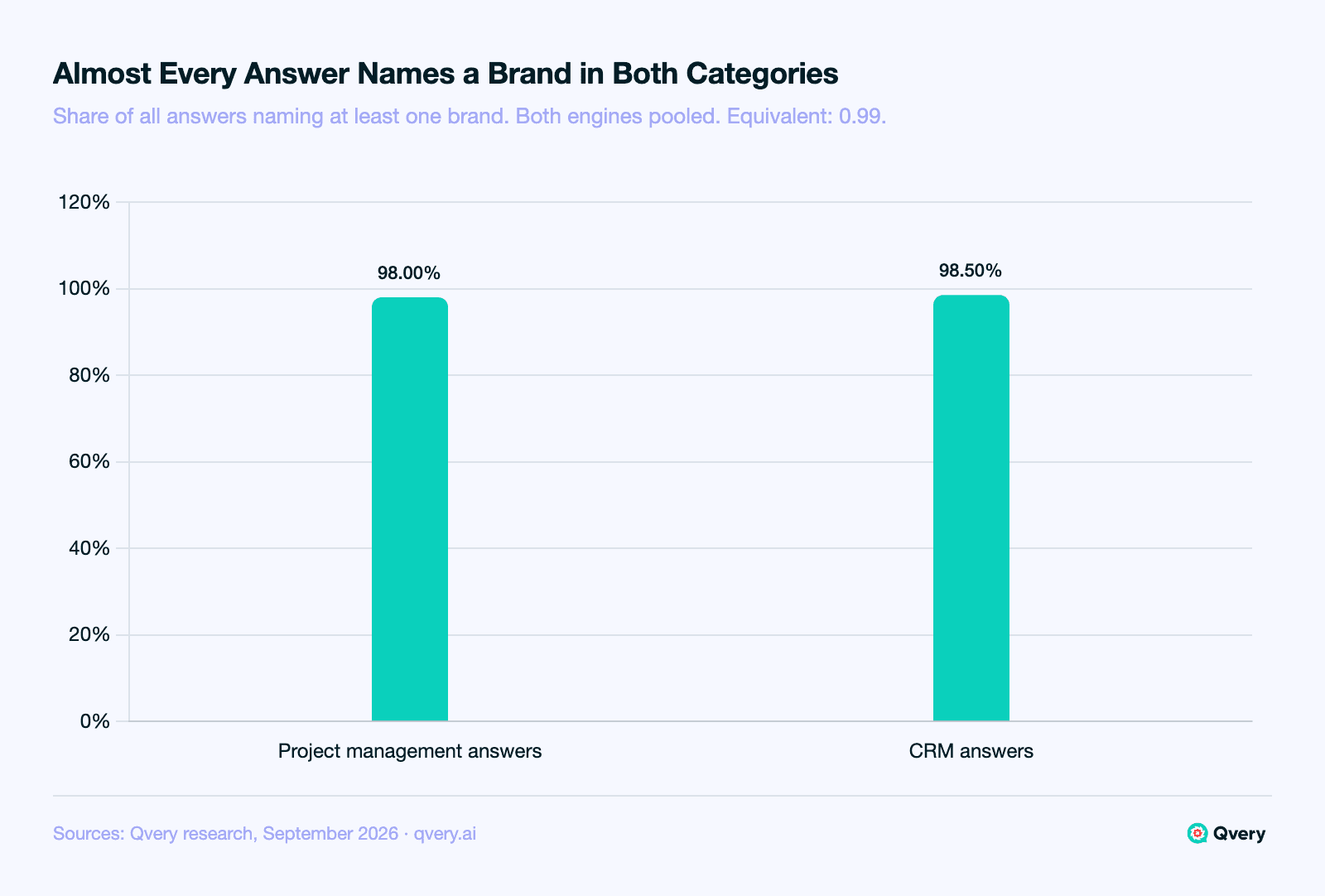
Almost every answer names brands in both categories, so asking whether the answer names anyone cannot tell you whether the shortlist is settled. The repeat test above can. This does not mean the two categories name the same brands.
Keep One Citation Audit List for Each Category
The brands are one half of the picture. The sites the answers cite are the other, and they split by category too.
For each category we built a list of domains, adding at each step the domain that covered the most answers not yet covered, until the list reached 80% of the answers that cited any source. The project management list runs to 24 domains and the CRM list to 13.
The domains that cover the first half of each category's answers that cited any source are the ones to audit first:
Project management: asana.com, youtube.com, clickup.com, gainsight.com, reddit.com, basecamp.com.
CRM: hubspot.com, reddit.com, help.salesforce.com.
The full 80% lists, in the order they were built:
Project management, 24 domains: asana.com, youtube.com, clickup.com, gainsight.com, reddit.com, basecamp.com, getjobber.com, microsoft.com, capterra.com, learn.g2.com, ones.com, pipedrive.com, salesforce.com, figsflow.com, followupboss.com, monday.com, process.st, captivateiq.com, celoxis.com, flowforma.com, g2.com, insurstein.com, sieva.co, softr.io.
CRM, 13 domains: hubspot.com, reddit.com, help.salesforce.com, youtube.com, conduyt.com, blog.hubspot.com, pipedrive.com, blog.salesflare.com, salesforce.com, monday.com, bigin.com, joblogic.com, lessannoyingcrm.com.
Then we swapped them. The CRM list covered 32.45% of the project management answers that cited any source. The project management list covered 51.03% of the CRM answers that cited any source.
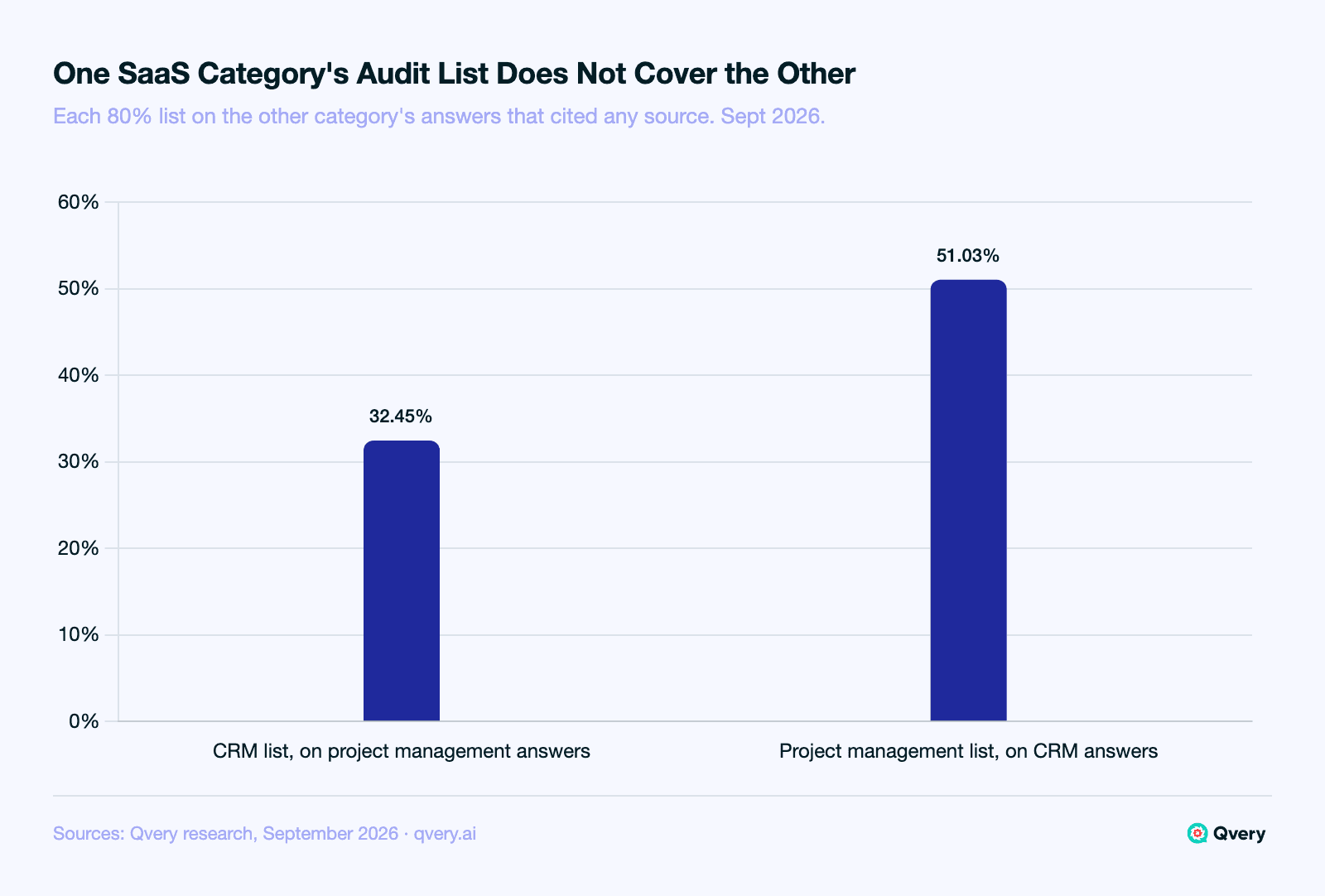
The lower of the two, 0.3245, is well under our 0.60 bar for one shared list, so each needs its own list.
Five domains sit on both lists: monday.com, pipedrive.com, reddit.com, salesforce.com and youtube.com. That overlap is description and decides nothing.
Coverage records which cited domains appeared with which answers. It says nothing about citation as a route into the top five.
SimpleTiger's advice is to stand out "…optimizing content & authority targeted at the layers of the buyer journey that match the search behavior of your unique customers." Separate lists fit the idea of scoping audit work by category. Whether optimizing content and authority changes which brands are named is something this data does not test.
The method for turning lists like these into a working audit is in how to run a citation gap analysis, and AI optimization tactics for B2B services found the same kind of separate-lists result on a different split.
What This Does Not Tell You About Getting In
This research tested whether a recurring set of named brands exists in two categories. It did not identify or test any action that gets a new product into one.
Routes in are their own questions, measured separately. For finding the conversations where your brand is missing, the method is in building mentions for SaaS brands.
Qvery Tracks Your Questions; the Recurrence Check Is Yours
Qvery runs your own questions every day, on ChatGPT and Google AI Mode, in 200+ countries. Set them up as the unbranded recommendation questions a buyer asks for each category you sell into; building tracking queries covers how, and you add and edit them through Qvery Assistant.
For each question, Qvery records your daily visibility, share of voice and average rank and captures every citation, tied to the query and engine that produced it.
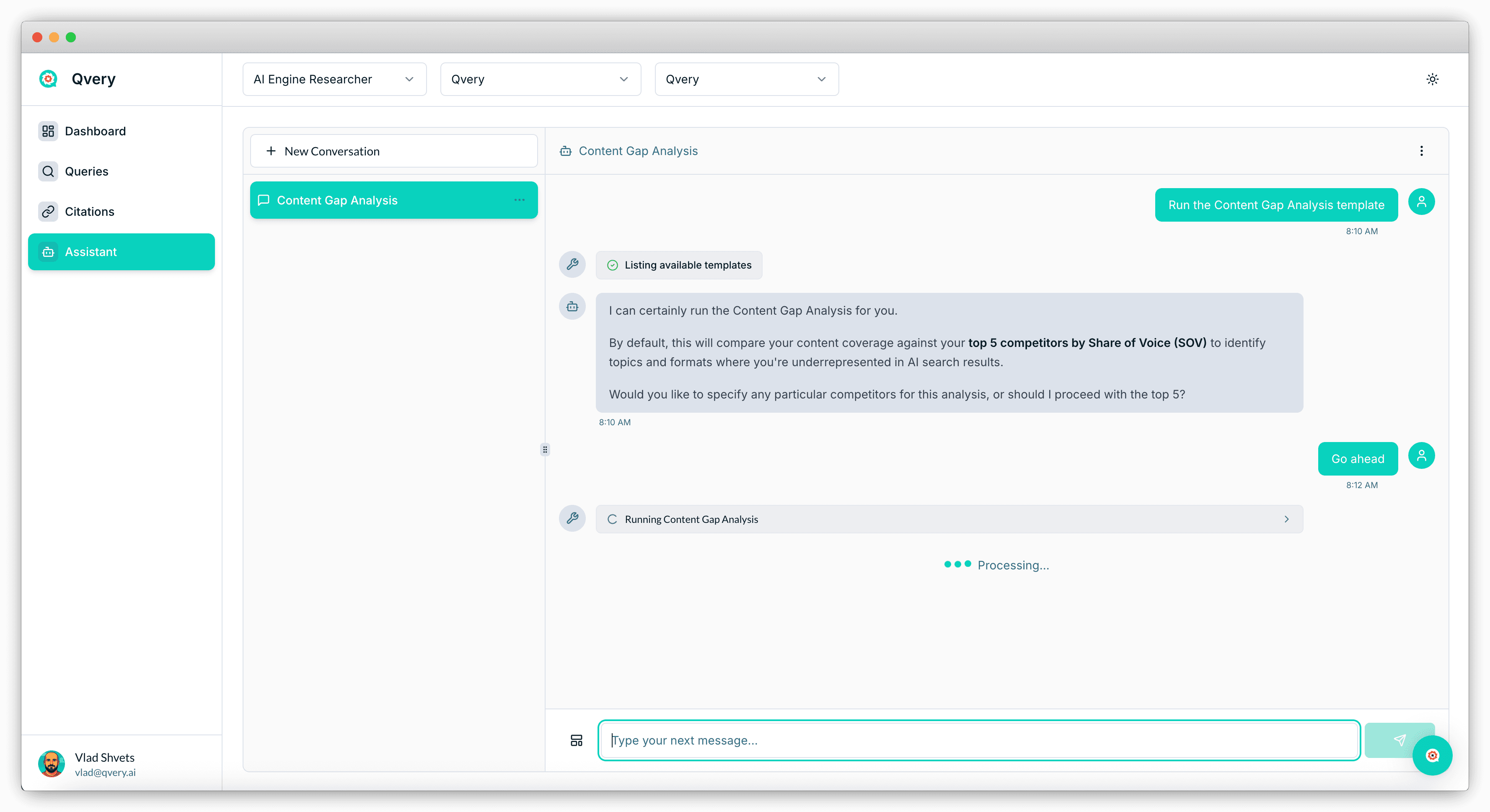
To ask instead of filter, open Qvery Assistant in the app and ask about your own data in plain language, for example which domains were cited for a question in each engine.
The rest is your own analysis, done by hand on those records:
The recurrence check. For each daily run, list the most visible brands among your own and the competitors you track, and keep the ones present every time.
The audit lists. Build each category's citation list from the captured citations, then check how much of the other category's answers that list covers.
Both are this post's research method, applied to your records. Qvery does not compute them for you. Its daily runs also let you read recurrence across days, which this research did not measure: its runs were repeated on one day.
Start a free 7-day trial of Qvery, no credit card required, and load your category's questions before you decide how to break in.
What This Evidence Cannot Settle
Two categories. Project management and CRM, as unbranded recommendation questions in four English-speaking countries. This describes these questions, not every SaaS category.
Same-day runs. All five runs per category were collected on the same day, so this is recurrence across runs, not stability over weeks or months.
Names only. Whether an answer recommended a brand could not be measured reliably, so every figure here counts brands named.
CRM's margin. CRM's result turned on a single tie and one product-line rule. Our brand map folds plan names into their brand and keeps named product lines apart.
Engine sets are descriptive. No engine difference was registered, the sets come from three runs against two, and a single Google AI Mode run is a noisy sample.
ChatGPT-weighted. Pooled figures carry three ChatGPT answers for every two from Google AI Mode.
Coverage is co-occurrence. It shows no route from citation to being named.
No route tested. This checks whether recurring named sets exist; it does not identify or test any action that gets a new product into them.
No earlier figures are compared or pooled.
Check Your Category Before You Plan
Run your category's unbranded recommendation questions several times in both ChatGPT and Google AI Mode, and list the brands in the top five every time.
If a core like project management's holds, plan against those named brands. If it is as thin as CRM's, one look does not settle the shortlist, so measure again before you plan. Keep one citation audit list for each category you sell into.
Ask ChatGPT for the best tools in your SaaS category and you probably get the same handful of names you always get. If your product is not on that list, it is easy to assume the list is fixed.
In some categories it is close to fixed. In others it only looks that way from a single answer, and which of the two you are in decides how you try to get in.
So we asked the same unbranded recommendation questions for two categories, project management and CRM, five times over in September 2026 (three runs on ChatGPT, two on Google AI Mode), and kept the brands that made every run's top five.
The short version: in project management, four brands made the top five of every run: Asana, ClickUp, monday.com and Trello. In CRM, two did: HubSpot and Pipedrive. We set the bar in advance at three to five brands per category. Project management cleared it, and CRM missed it narrowly.
So before you plan how to break in, find out which of these your category looks like.
A core like project management's is a named set you can plan against. A core as thin as CRM's means one look does not settle the set. Throughout, these are brands named in the answer, not brands the answer recommended.
Four Project Management Brands and Two CRM Brands Made Every Run's Top Five
The test is simple enough to run yourself. Ask the same unbranded questions several times in both engines. In each run, take the five brands named in the most answers. Keep the ones that are there every time.
Here is what each run's top five held, listed alphabetically rather than by rank.
In project management, the runs held:
ChatGPT run 1: Asana, ClickUp, monday.com, Smartsheet, Trello
ChatGPT run 2: Asana, ClickUp, monday.com, Notion, Trello
ChatGPT run 3: Asana, ClickUp, monday.com, Salesforce, Trello
Google AI Mode run 1: Asana, ClickUp, monday.com, Notion, Trello
Google AI Mode run 2: Asana, ClickUp, monday.com, Notion, Trello
In CRM, they held:
ChatGPT run 1: Bigin by Zoho CRM, HubSpot, Pipedrive, Salesforce, Zoho CRM
ChatGPT run 2: HubSpot, Microsoft Dynamics 365, Pipedrive, Salesforce, Zoho CRM
ChatGPT run 3: Freshsales, HubSpot, Pipedrive, Salesforce, Zoho CRM
Google AI Mode run 1: Airtable, HubSpot, monday CRM, Pipedrive, Streak
Google AI Mode run 2: HubSpot, Less Annoying CRM, monday CRM, Pipedrive, Zoho CRM
In every run's top five: Asana, ClickUp, monday.com and Trello in project management, and HubSpot and Pipedrive in CRM. In at least three of the five, add Notion in project management, and Salesforce and Zoho CRM in CRM.
Our bar, set before we collected anything, was three to five brands in every run's top five, in each category. The prediction held for project management and not for CRM.
CRM's miss was narrow, and it is worth seeing exactly how.
In the first Google AI Mode run, Zoho CRM tied for fifth place and lost it on the alphabetical tie rule we fixed before collection. Some answers also named Salesforce's product as "Salesforce Sales Cloud", which our brand map counts as its own product.
Read either detail the other way and CRM gets a third brand in every run's top five.
We kept both rules as they were written before collection, so the result stands as registered.
Some brands made only one run's top five. In project management that was Smartsheet and Salesforce; in CRM, Bigin by Zoho CRM, Microsoft Dynamics 365, Freshsales, Streak, Airtable and Less Annoying CRM.
Any single run's top five can hold a brand that no other run put there, so one look at an AI shortlist is a sample, not the list.
That supports half of a common piece of tracking advice. Nathan Ojaokomo writes that "Good trackers run each prompt multiple times and report averaged results."
The repeat half holds up here. The averaging half is untested: we report which brands recur across runs, never an average, so nothing here shows an average is the right summary.
The same writer adds: "A tool that only tracks one platform gives you an incomplete picture."
The two engines' every-run sets did differ. In project management, ChatGPT's three runs shared Asana, ClickUp, monday.com and Trello, and Google AI Mode's two runs shared those four plus Notion. In CRM, ChatGPT's runs shared HubSpot, Pipedrive, Salesforce and Zoho CRM, and Google AI Mode's shared HubSpot, Pipedrive and monday CRM.
The overlap between the engines' sets (a Jaccard of 0.8 in project management and 0.4 in CRM) is descriptive only.
ChatGPT's set spans three runs and Google AI Mode's two, no engine difference was registered, and CRM's figure rests partly on that same tie. So this is consistent with reading both engines, and it is no basis for advice about either one.
For the category-level picture of how concentrated AI shortlists are, see how new SaaS products earn their first AI recommendations. For why answers move from run to run, see AI engine visibility for SaaS, and for why repeats belong in tracking, measuring ecommerce share of voice.
Being Named at All Is Not the Test
It is tempting to read a settled shortlist off how often answers name brands at all. That does not work.
Both engines pooled, 98.00% of project management answers named at least one brand, and 98.50% of CRM answers did. The ratio is 0.99, which we call equivalent.
Almost every answer names brands in both categories, so asking whether the answer names anyone cannot tell you whether the shortlist is settled. The repeat test above can. This does not mean the two categories name the same brands.
Keep One Citation Audit List for Each Category
The brands are one half of the picture. The sites the answers cite are the other, and they split by category too.
For each category we built a list of domains, adding at each step the domain that covered the most answers not yet covered, until the list reached 80% of the answers that cited any source. The project management list runs to 24 domains and the CRM list to 13.
The domains that cover the first half of each category's answers that cited any source are the ones to audit first:
Project management: asana.com, youtube.com, clickup.com, gainsight.com, reddit.com, basecamp.com.
CRM: hubspot.com, reddit.com, help.salesforce.com.
The full 80% lists, in the order they were built:
Project management, 24 domains: asana.com, youtube.com, clickup.com, gainsight.com, reddit.com, basecamp.com, getjobber.com, microsoft.com, capterra.com, learn.g2.com, ones.com, pipedrive.com, salesforce.com, figsflow.com, followupboss.com, monday.com, process.st, captivateiq.com, celoxis.com, flowforma.com, g2.com, insurstein.com, sieva.co, softr.io.
CRM, 13 domains: hubspot.com, reddit.com, help.salesforce.com, youtube.com, conduyt.com, blog.hubspot.com, pipedrive.com, blog.salesflare.com, salesforce.com, monday.com, bigin.com, joblogic.com, lessannoyingcrm.com.
Then we swapped them. The CRM list covered 32.45% of the project management answers that cited any source. The project management list covered 51.03% of the CRM answers that cited any source.
The lower of the two, 0.3245, is well under our 0.60 bar for one shared list, so each needs its own list.
Five domains sit on both lists: monday.com, pipedrive.com, reddit.com, salesforce.com and youtube.com. That overlap is description and decides nothing.
Coverage records which cited domains appeared with which answers. It says nothing about citation as a route into the top five.
SimpleTiger's advice is to stand out "…optimizing content & authority targeted at the layers of the buyer journey that match the search behavior of your unique customers." Separate lists fit the idea of scoping audit work by category. Whether optimizing content and authority changes which brands are named is something this data does not test.
The method for turning lists like these into a working audit is in how to run a citation gap analysis, and AI optimization tactics for B2B services found the same kind of separate-lists result on a different split.
What This Does Not Tell You About Getting In
This research tested whether a recurring set of named brands exists in two categories. It did not identify or test any action that gets a new product into one.
Routes in are their own questions, measured separately. For finding the conversations where your brand is missing, the method is in building mentions for SaaS brands.
Qvery Tracks Your Questions; the Recurrence Check Is Yours
Qvery runs your own questions every day, on ChatGPT and Google AI Mode, in 200+ countries. Set them up as the unbranded recommendation questions a buyer asks for each category you sell into; building tracking queries covers how, and you add and edit them through Qvery Assistant.
For each question, Qvery records your daily visibility, share of voice and average rank and captures every citation, tied to the query and engine that produced it.
To ask instead of filter, open Qvery Assistant in the app and ask about your own data in plain language, for example which domains were cited for a question in each engine.
The rest is your own analysis, done by hand on those records:
The recurrence check. For each daily run, list the most visible brands among your own and the competitors you track, and keep the ones present every time.
The audit lists. Build each category's citation list from the captured citations, then check how much of the other category's answers that list covers.
Both are this post's research method, applied to your records. Qvery does not compute them for you. Its daily runs also let you read recurrence across days, which this research did not measure: its runs were repeated on one day.
Start a free 7-day trial of Qvery, no credit card required, and load your category's questions before you decide how to break in.
What This Evidence Cannot Settle
Two categories. Project management and CRM, as unbranded recommendation questions in four English-speaking countries. This describes these questions, not every SaaS category.
Same-day runs. All five runs per category were collected on the same day, so this is recurrence across runs, not stability over weeks or months.
Names only. Whether an answer recommended a brand could not be measured reliably, so every figure here counts brands named.
CRM's margin. CRM's result turned on a single tie and one product-line rule. Our brand map folds plan names into their brand and keeps named product lines apart.
Engine sets are descriptive. No engine difference was registered, the sets come from three runs against two, and a single Google AI Mode run is a noisy sample.
ChatGPT-weighted. Pooled figures carry three ChatGPT answers for every two from Google AI Mode.
Coverage is co-occurrence. It shows no route from citation to being named.
No route tested. This checks whether recurring named sets exist; it does not identify or test any action that gets a new product into them.
No earlier figures are compared or pooled.
Check Your Category Before You Plan
Run your category's unbranded recommendation questions several times in both ChatGPT and Google AI Mode, and list the brands in the top five every time.
If a core like project management's holds, plan against those named brands. If it is as thin as CRM's, one look does not settle the shortlist, so measure again before you plan. Keep one citation audit list for each category you sell into.
Ask ChatGPT for the best tools in your SaaS category and you probably get the same handful of names you always get. If your product is not on that list, it is easy to assume the list is fixed.
In some categories it is close to fixed. In others it only looks that way from a single answer, and which of the two you are in decides how you try to get in.
So we asked the same unbranded recommendation questions for two categories, project management and CRM, five times over in September 2026 (three runs on ChatGPT, two on Google AI Mode), and kept the brands that made every run's top five.
The short version: in project management, four brands made the top five of every run: Asana, ClickUp, monday.com and Trello. In CRM, two did: HubSpot and Pipedrive. We set the bar in advance at three to five brands per category. Project management cleared it, and CRM missed it narrowly.
So before you plan how to break in, find out which of these your category looks like.
A core like project management's is a named set you can plan against. A core as thin as CRM's means one look does not settle the set. Throughout, these are brands named in the answer, not brands the answer recommended.
Four Project Management Brands and Two CRM Brands Made Every Run's Top Five
The test is simple enough to run yourself. Ask the same unbranded questions several times in both engines. In each run, take the five brands named in the most answers. Keep the ones that are there every time.
Here is what each run's top five held, listed alphabetically rather than by rank.
In project management, the runs held:
ChatGPT run 1: Asana, ClickUp, monday.com, Smartsheet, Trello
ChatGPT run 2: Asana, ClickUp, monday.com, Notion, Trello
ChatGPT run 3: Asana, ClickUp, monday.com, Salesforce, Trello
Google AI Mode run 1: Asana, ClickUp, monday.com, Notion, Trello
Google AI Mode run 2: Asana, ClickUp, monday.com, Notion, Trello
In CRM, they held:
ChatGPT run 1: Bigin by Zoho CRM, HubSpot, Pipedrive, Salesforce, Zoho CRM
ChatGPT run 2: HubSpot, Microsoft Dynamics 365, Pipedrive, Salesforce, Zoho CRM
ChatGPT run 3: Freshsales, HubSpot, Pipedrive, Salesforce, Zoho CRM
Google AI Mode run 1: Airtable, HubSpot, monday CRM, Pipedrive, Streak
Google AI Mode run 2: HubSpot, Less Annoying CRM, monday CRM, Pipedrive, Zoho CRM
In every run's top five: Asana, ClickUp, monday.com and Trello in project management, and HubSpot and Pipedrive in CRM. In at least three of the five, add Notion in project management, and Salesforce and Zoho CRM in CRM.
Our bar, set before we collected anything, was three to five brands in every run's top five, in each category. The prediction held for project management and not for CRM.
CRM's miss was narrow, and it is worth seeing exactly how.
In the first Google AI Mode run, Zoho CRM tied for fifth place and lost it on the alphabetical tie rule we fixed before collection. Some answers also named Salesforce's product as "Salesforce Sales Cloud", which our brand map counts as its own product.
Read either detail the other way and CRM gets a third brand in every run's top five.
We kept both rules as they were written before collection, so the result stands as registered.
Some brands made only one run's top five. In project management that was Smartsheet and Salesforce; in CRM, Bigin by Zoho CRM, Microsoft Dynamics 365, Freshsales, Streak, Airtable and Less Annoying CRM.
Any single run's top five can hold a brand that no other run put there, so one look at an AI shortlist is a sample, not the list.
That supports half of a common piece of tracking advice. Nathan Ojaokomo writes that "Good trackers run each prompt multiple times and report averaged results."
The repeat half holds up here. The averaging half is untested: we report which brands recur across runs, never an average, so nothing here shows an average is the right summary.
The same writer adds: "A tool that only tracks one platform gives you an incomplete picture."
The two engines' every-run sets did differ. In project management, ChatGPT's three runs shared Asana, ClickUp, monday.com and Trello, and Google AI Mode's two runs shared those four plus Notion. In CRM, ChatGPT's runs shared HubSpot, Pipedrive, Salesforce and Zoho CRM, and Google AI Mode's shared HubSpot, Pipedrive and monday CRM.
The overlap between the engines' sets (a Jaccard of 0.8 in project management and 0.4 in CRM) is descriptive only.
ChatGPT's set spans three runs and Google AI Mode's two, no engine difference was registered, and CRM's figure rests partly on that same tie. So this is consistent with reading both engines, and it is no basis for advice about either one.
For the category-level picture of how concentrated AI shortlists are, see how new SaaS products earn their first AI recommendations. For why answers move from run to run, see AI engine visibility for SaaS, and for why repeats belong in tracking, measuring ecommerce share of voice.
Being Named at All Is Not the Test
It is tempting to read a settled shortlist off how often answers name brands at all. That does not work.
Both engines pooled, 98.00% of project management answers named at least one brand, and 98.50% of CRM answers did. The ratio is 0.99, which we call equivalent.
Almost every answer names brands in both categories, so asking whether the answer names anyone cannot tell you whether the shortlist is settled. The repeat test above can. This does not mean the two categories name the same brands.
Keep One Citation Audit List for Each Category
The brands are one half of the picture. The sites the answers cite are the other, and they split by category too.
For each category we built a list of domains, adding at each step the domain that covered the most answers not yet covered, until the list reached 80% of the answers that cited any source. The project management list runs to 24 domains and the CRM list to 13.
The domains that cover the first half of each category's answers that cited any source are the ones to audit first:
Project management: asana.com, youtube.com, clickup.com, gainsight.com, reddit.com, basecamp.com.
CRM: hubspot.com, reddit.com, help.salesforce.com.
The full 80% lists, in the order they were built:
Project management, 24 domains: asana.com, youtube.com, clickup.com, gainsight.com, reddit.com, basecamp.com, getjobber.com, microsoft.com, capterra.com, learn.g2.com, ones.com, pipedrive.com, salesforce.com, figsflow.com, followupboss.com, monday.com, process.st, captivateiq.com, celoxis.com, flowforma.com, g2.com, insurstein.com, sieva.co, softr.io.
CRM, 13 domains: hubspot.com, reddit.com, help.salesforce.com, youtube.com, conduyt.com, blog.hubspot.com, pipedrive.com, blog.salesflare.com, salesforce.com, monday.com, bigin.com, joblogic.com, lessannoyingcrm.com.
Then we swapped them. The CRM list covered 32.45% of the project management answers that cited any source. The project management list covered 51.03% of the CRM answers that cited any source.
The lower of the two, 0.3245, is well under our 0.60 bar for one shared list, so each needs its own list.
Five domains sit on both lists: monday.com, pipedrive.com, reddit.com, salesforce.com and youtube.com. That overlap is description and decides nothing.
Coverage records which cited domains appeared with which answers. It says nothing about citation as a route into the top five.
SimpleTiger's advice is to stand out "…optimizing content & authority targeted at the layers of the buyer journey that match the search behavior of your unique customers." Separate lists fit the idea of scoping audit work by category. Whether optimizing content and authority changes which brands are named is something this data does not test.
The method for turning lists like these into a working audit is in how to run a citation gap analysis, and AI optimization tactics for B2B services found the same kind of separate-lists result on a different split.
What This Does Not Tell You About Getting In
This research tested whether a recurring set of named brands exists in two categories. It did not identify or test any action that gets a new product into one.
Routes in are their own questions, measured separately. For finding the conversations where your brand is missing, the method is in building mentions for SaaS brands.
Qvery Tracks Your Questions; the Recurrence Check Is Yours
Qvery runs your own questions every day, on ChatGPT and Google AI Mode, in 200+ countries. Set them up as the unbranded recommendation questions a buyer asks for each category you sell into; building tracking queries covers how, and you add and edit them through Qvery Assistant.
For each question, Qvery records your daily visibility, share of voice and average rank and captures every citation, tied to the query and engine that produced it.
To ask instead of filter, open Qvery Assistant in the app and ask about your own data in plain language, for example which domains were cited for a question in each engine.
The rest is your own analysis, done by hand on those records:
The recurrence check. For each daily run, list the most visible brands among your own and the competitors you track, and keep the ones present every time.
The audit lists. Build each category's citation list from the captured citations, then check how much of the other category's answers that list covers.
Both are this post's research method, applied to your records. Qvery does not compute them for you. Its daily runs also let you read recurrence across days, which this research did not measure: its runs were repeated on one day.
Start a free 7-day trial of Qvery, no credit card required, and load your category's questions before you decide how to break in.
What This Evidence Cannot Settle
Two categories. Project management and CRM, as unbranded recommendation questions in four English-speaking countries. This describes these questions, not every SaaS category.
Same-day runs. All five runs per category were collected on the same day, so this is recurrence across runs, not stability over weeks or months.
Names only. Whether an answer recommended a brand could not be measured reliably, so every figure here counts brands named.
CRM's margin. CRM's result turned on a single tie and one product-line rule. Our brand map folds plan names into their brand and keeps named product lines apart.
Engine sets are descriptive. No engine difference was registered, the sets come from three runs against two, and a single Google AI Mode run is a noisy sample.
ChatGPT-weighted. Pooled figures carry three ChatGPT answers for every two from Google AI Mode.
Coverage is co-occurrence. It shows no route from citation to being named.
No route tested. This checks whether recurring named sets exist; it does not identify or test any action that gets a new product into them.
No earlier figures are compared or pooled.
Check Your Category Before You Plan
Run your category's unbranded recommendation questions several times in both ChatGPT and Google AI Mode, and list the brands in the top five every time.
If a core like project management's holds, plan against those named brands. If it is as thin as CRM's, one look does not settle the shortlist, so measure again before you plan. Keep one citation audit list for each category you sell into.
Ask ChatGPT for the best tools in your SaaS category and you probably get the same handful of names you always get. If your product is not on that list, it is easy to assume the list is fixed.
In some categories it is close to fixed. In others it only looks that way from a single answer, and which of the two you are in decides how you try to get in.
So we asked the same unbranded recommendation questions for two categories, project management and CRM, five times over in September 2026 (three runs on ChatGPT, two on Google AI Mode), and kept the brands that made every run's top five.
The short version: in project management, four brands made the top five of every run: Asana, ClickUp, monday.com and Trello. In CRM, two did: HubSpot and Pipedrive. We set the bar in advance at three to five brands per category. Project management cleared it, and CRM missed it narrowly.
So before you plan how to break in, find out which of these your category looks like.
A core like project management's is a named set you can plan against. A core as thin as CRM's means one look does not settle the set. Throughout, these are brands named in the answer, not brands the answer recommended.
Four Project Management Brands and Two CRM Brands Made Every Run's Top Five
The test is simple enough to run yourself. Ask the same unbranded questions several times in both engines. In each run, take the five brands named in the most answers. Keep the ones that are there every time.
Here is what each run's top five held, listed alphabetically rather than by rank.
In project management, the runs held:
ChatGPT run 1: Asana, ClickUp, monday.com, Smartsheet, Trello
ChatGPT run 2: Asana, ClickUp, monday.com, Notion, Trello
ChatGPT run 3: Asana, ClickUp, monday.com, Salesforce, Trello
Google AI Mode run 1: Asana, ClickUp, monday.com, Notion, Trello
Google AI Mode run 2: Asana, ClickUp, monday.com, Notion, Trello
In CRM, they held:
ChatGPT run 1: Bigin by Zoho CRM, HubSpot, Pipedrive, Salesforce, Zoho CRM
ChatGPT run 2: HubSpot, Microsoft Dynamics 365, Pipedrive, Salesforce, Zoho CRM
ChatGPT run 3: Freshsales, HubSpot, Pipedrive, Salesforce, Zoho CRM
Google AI Mode run 1: Airtable, HubSpot, monday CRM, Pipedrive, Streak
Google AI Mode run 2: HubSpot, Less Annoying CRM, monday CRM, Pipedrive, Zoho CRM
In every run's top five: Asana, ClickUp, monday.com and Trello in project management, and HubSpot and Pipedrive in CRM. In at least three of the five, add Notion in project management, and Salesforce and Zoho CRM in CRM.
Our bar, set before we collected anything, was three to five brands in every run's top five, in each category. The prediction held for project management and not for CRM.
CRM's miss was narrow, and it is worth seeing exactly how.
In the first Google AI Mode run, Zoho CRM tied for fifth place and lost it on the alphabetical tie rule we fixed before collection. Some answers also named Salesforce's product as "Salesforce Sales Cloud", which our brand map counts as its own product.
Read either detail the other way and CRM gets a third brand in every run's top five.
We kept both rules as they were written before collection, so the result stands as registered.
Some brands made only one run's top five. In project management that was Smartsheet and Salesforce; in CRM, Bigin by Zoho CRM, Microsoft Dynamics 365, Freshsales, Streak, Airtable and Less Annoying CRM.
Any single run's top five can hold a brand that no other run put there, so one look at an AI shortlist is a sample, not the list.
That supports half of a common piece of tracking advice. Nathan Ojaokomo writes that "Good trackers run each prompt multiple times and report averaged results."
The repeat half holds up here. The averaging half is untested: we report which brands recur across runs, never an average, so nothing here shows an average is the right summary.
The same writer adds: "A tool that only tracks one platform gives you an incomplete picture."
The two engines' every-run sets did differ. In project management, ChatGPT's three runs shared Asana, ClickUp, monday.com and Trello, and Google AI Mode's two runs shared those four plus Notion. In CRM, ChatGPT's runs shared HubSpot, Pipedrive, Salesforce and Zoho CRM, and Google AI Mode's shared HubSpot, Pipedrive and monday CRM.
The overlap between the engines' sets (a Jaccard of 0.8 in project management and 0.4 in CRM) is descriptive only.
ChatGPT's set spans three runs and Google AI Mode's two, no engine difference was registered, and CRM's figure rests partly on that same tie. So this is consistent with reading both engines, and it is no basis for advice about either one.
For the category-level picture of how concentrated AI shortlists are, see how new SaaS products earn their first AI recommendations. For why answers move from run to run, see AI engine visibility for SaaS, and for why repeats belong in tracking, measuring ecommerce share of voice.
Being Named at All Is Not the Test
It is tempting to read a settled shortlist off how often answers name brands at all. That does not work.
Both engines pooled, 98.00% of project management answers named at least one brand, and 98.50% of CRM answers did. The ratio is 0.99, which we call equivalent.
Almost every answer names brands in both categories, so asking whether the answer names anyone cannot tell you whether the shortlist is settled. The repeat test above can. This does not mean the two categories name the same brands.
Keep One Citation Audit List for Each Category
The brands are one half of the picture. The sites the answers cite are the other, and they split by category too.
For each category we built a list of domains, adding at each step the domain that covered the most answers not yet covered, until the list reached 80% of the answers that cited any source. The project management list runs to 24 domains and the CRM list to 13.
The domains that cover the first half of each category's answers that cited any source are the ones to audit first:
Project management: asana.com, youtube.com, clickup.com, gainsight.com, reddit.com, basecamp.com.
CRM: hubspot.com, reddit.com, help.salesforce.com.
The full 80% lists, in the order they were built:
Project management, 24 domains: asana.com, youtube.com, clickup.com, gainsight.com, reddit.com, basecamp.com, getjobber.com, microsoft.com, capterra.com, learn.g2.com, ones.com, pipedrive.com, salesforce.com, figsflow.com, followupboss.com, monday.com, process.st, captivateiq.com, celoxis.com, flowforma.com, g2.com, insurstein.com, sieva.co, softr.io.
CRM, 13 domains: hubspot.com, reddit.com, help.salesforce.com, youtube.com, conduyt.com, blog.hubspot.com, pipedrive.com, blog.salesflare.com, salesforce.com, monday.com, bigin.com, joblogic.com, lessannoyingcrm.com.
Then we swapped them. The CRM list covered 32.45% of the project management answers that cited any source. The project management list covered 51.03% of the CRM answers that cited any source.
The lower of the two, 0.3245, is well under our 0.60 bar for one shared list, so each needs its own list.
Five domains sit on both lists: monday.com, pipedrive.com, reddit.com, salesforce.com and youtube.com. That overlap is description and decides nothing.
Coverage records which cited domains appeared with which answers. It says nothing about citation as a route into the top five.
SimpleTiger's advice is to stand out "…optimizing content & authority targeted at the layers of the buyer journey that match the search behavior of your unique customers." Separate lists fit the idea of scoping audit work by category. Whether optimizing content and authority changes which brands are named is something this data does not test.
The method for turning lists like these into a working audit is in how to run a citation gap analysis, and AI optimization tactics for B2B services found the same kind of separate-lists result on a different split.
What This Does Not Tell You About Getting In
This research tested whether a recurring set of named brands exists in two categories. It did not identify or test any action that gets a new product into one.
Routes in are their own questions, measured separately. For finding the conversations where your brand is missing, the method is in building mentions for SaaS brands.
Qvery Tracks Your Questions; the Recurrence Check Is Yours
Qvery runs your own questions every day, on ChatGPT and Google AI Mode, in 200+ countries. Set them up as the unbranded recommendation questions a buyer asks for each category you sell into; building tracking queries covers how, and you add and edit them through Qvery Assistant.
For each question, Qvery records your daily visibility, share of voice and average rank and captures every citation, tied to the query and engine that produced it.
To ask instead of filter, open Qvery Assistant in the app and ask about your own data in plain language, for example which domains were cited for a question in each engine.
The rest is your own analysis, done by hand on those records:
The recurrence check. For each daily run, list the most visible brands among your own and the competitors you track, and keep the ones present every time.
The audit lists. Build each category's citation list from the captured citations, then check how much of the other category's answers that list covers.
Both are this post's research method, applied to your records. Qvery does not compute them for you. Its daily runs also let you read recurrence across days, which this research did not measure: its runs were repeated on one day.
Start a free 7-day trial of Qvery, no credit card required, and load your category's questions before you decide how to break in.
What This Evidence Cannot Settle
Two categories. Project management and CRM, as unbranded recommendation questions in four English-speaking countries. This describes these questions, not every SaaS category.
Same-day runs. All five runs per category were collected on the same day, so this is recurrence across runs, not stability over weeks or months.
Names only. Whether an answer recommended a brand could not be measured reliably, so every figure here counts brands named.
CRM's margin. CRM's result turned on a single tie and one product-line rule. Our brand map folds plan names into their brand and keeps named product lines apart.
Engine sets are descriptive. No engine difference was registered, the sets come from three runs against two, and a single Google AI Mode run is a noisy sample.
ChatGPT-weighted. Pooled figures carry three ChatGPT answers for every two from Google AI Mode.
Coverage is co-occurrence. It shows no route from citation to being named.
No route tested. This checks whether recurring named sets exist; it does not identify or test any action that gets a new product into them.
No earlier figures are compared or pooled.
Check Your Category Before You Plan
Run your category's unbranded recommendation questions several times in both ChatGPT and Google AI Mode, and list the brands in the top five every time.
If a core like project management's holds, plan against those named brands. If it is as thin as CRM's, one look does not settle the shortlist, so measure again before you plan. Keep one citation audit list for each category you sell into.

© 2026 Qvery AI OÜ