By
Vlad Shvets
AI Engine Visibility for SaaS: How To Become the #1 Recommended Brand
How SaaS companies can measure and grow their visibility across ChatGPT and Google AI Mode, step by step, with proprietary data from Qvery.
How SaaS companies can measure and grow their visibility across ChatGPT and Google AI Mode, step by step, with proprietary data from Qvery.
How SaaS companies can measure and grow their visibility across ChatGPT and Google AI Mode, step by step, with proprietary data from Qvery.
I'm Vlad, co-founder of Qvery. I've been doing GTM for SaaS companies for over a decade, from first 1,000 users to Series C, across creative software, cloud storage, fintech, and a dozen other verticals (the people who wrote blog posts about each marketing shift got to say "I told you so," which is its own reward.)
SaaS has been my whole career, and the reason we started Qvery is simple: AI search engines are becoming the primary way people find and evaluate software. The queries that used to go into Google are going into ChatGPT and Google AI Mode. The rules for getting recommended are completely different.
So here's what we're going to do: I'm going to walk you through how SaaS brands can measure and grow their AI engine visibility. With our own proprietary data, real strategies for each of the three pillars of AI engine visibility, and tips showing how to use Qvery to do it.
AI Search Is Probabilistic, Not Deterministic
Traditional search: you typed a query, got 10 blue links, position 3 was position 3 for everyone. Boring, but predictable.
AI search doesn't work that way. Ask ChatGPT "what's the best project management tool for startups" on Monday, you might get a different answer on Tuesday. There is no "position 3." There's a probability of being recommended. Think weather forecasting: 70% chance of your brand showing up, not a guaranteed spot.
AI search doesn't have rankings. It has probabilities. Your job is to shift those probabilities in your favor.
Our proprietary citation data at Qvery shows how different this is:
AI engine citations vs Google's organic top 10: only 13.9% overlap. 86% of what AI engines cite doesn't appear in Google's organic results.
ChatGPT's citation density dropped 41% in March 2026 alone, from 27.3 to 16.0 citations per response. That means fewer slots and fiercer competition for every mention.
The top 50 domains get roughly 20% of all citations. 124,000+ domains share the rest.
If you're only optimizing for traditional search, you're optimizing for the wrong game.
Step One: Measure Your AI Engine Visibility
You can't grow what you can't see. And the quality of measurement depends on the queries you're tracking.
Most people get stuck here. They guess which queries matter, spend hours building spreadsheet lists, then wonder if they're tracking the right things.
Sign up for Qvery, and our onboarding AI assistant handles the whole thing for you:
Looks at your website, understands your product category
Auto-generates Topics and Queries based on what it finds
No manual uploads. No persona configuration. No 47-step setup wizard.
You see visibility data in 30 minutes
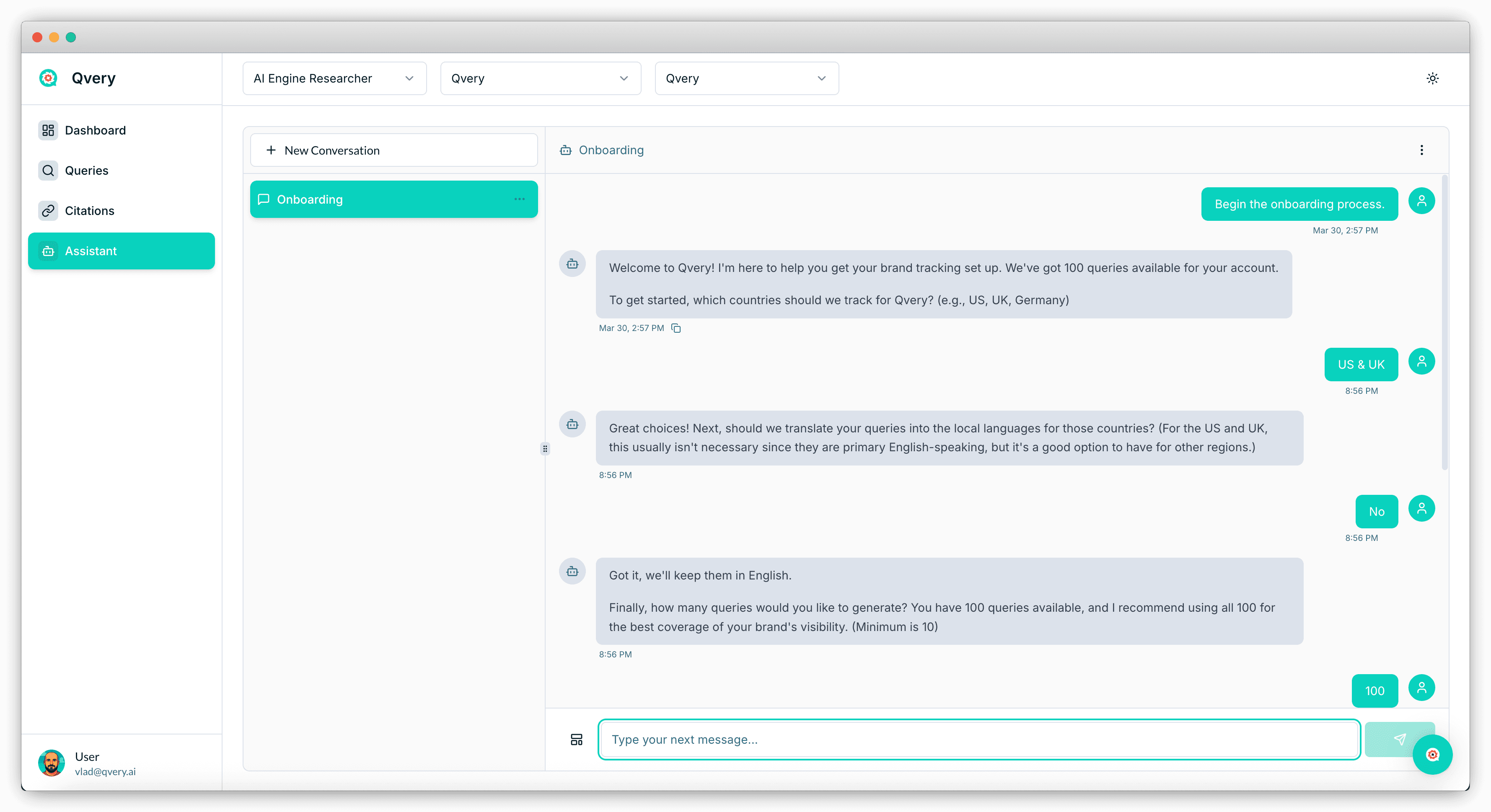
The Qvery Assistant also makes refining them dead simple:
"Add queries about project management for remote teams"
Remove irrelevant ones
Explore new topic clusters
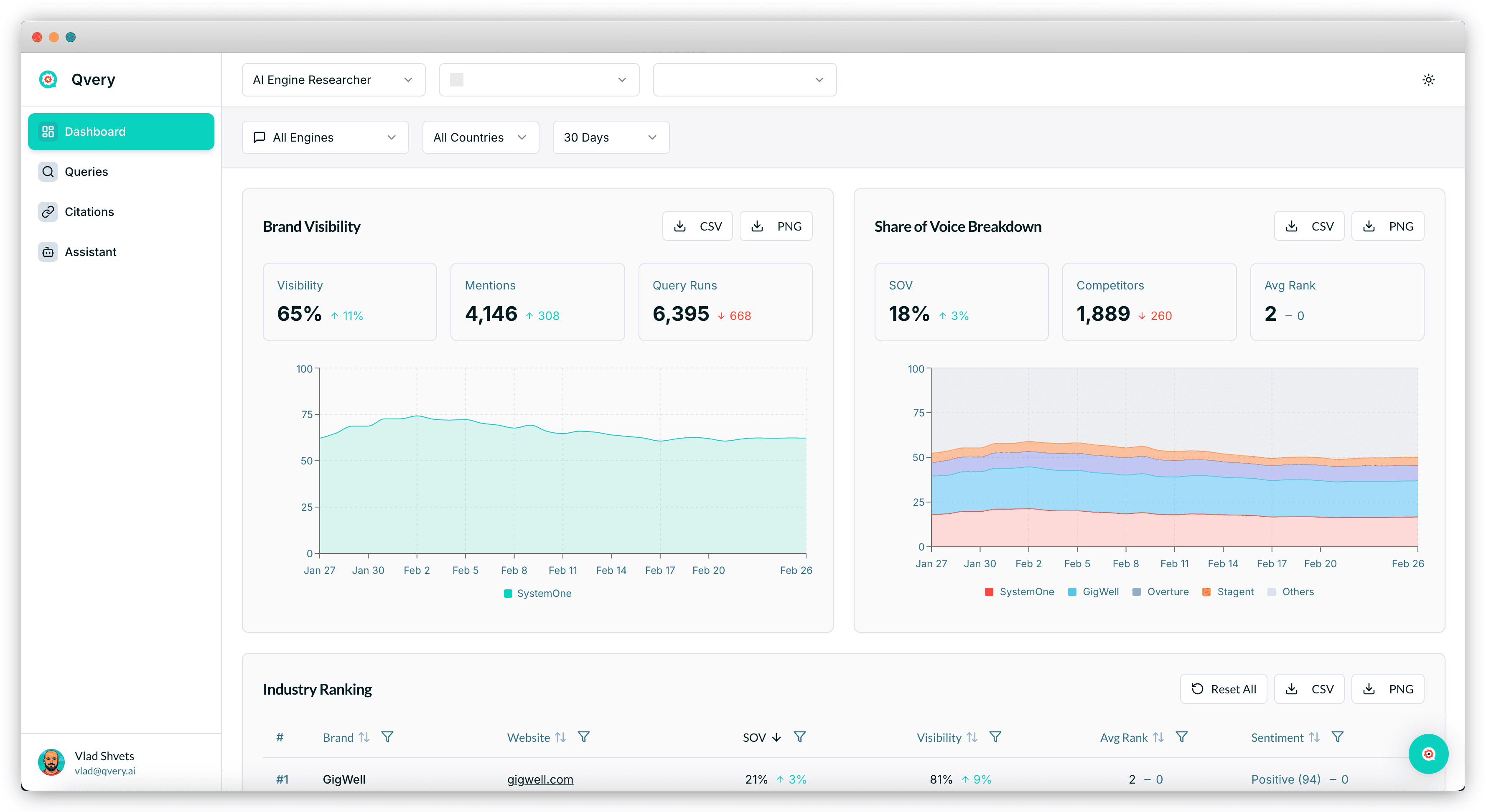
Once running, Qvery tracks three metrics:
Visibility: percentage of queries where your brand appears
Share of voice: how often you appear relative to competitors
Average rank: where in the citation list you show up
Pillar 1: Your Website Is Your Biggest Lever
87.75% of all AI engine citations point to brand websites, niche publications, and SaaS product sites. Not Reddit. Not Wikipedia. Not G2. Your own website is the single biggest factor in whether AI engines recommend you.
For SaaS companies, three things matter: landing pages, blog posts, and structured data.
Landing Pages: Be Specific About What You Do
If your homepage says "the all-in-one platform for modern teams," you're competing with every SaaS company that says the same thing. You'll lose to larger brands with more mentions and more training data behind that same bland positioning.
Tailor your messaging to the use cases where your product shines:
You won't get recommended for "best project management tool"
You will get recommended for "best project management tool for remote engineering teams"
These niche queries are where smaller SaaS brands win
Measure them on Qvery to know if it's working
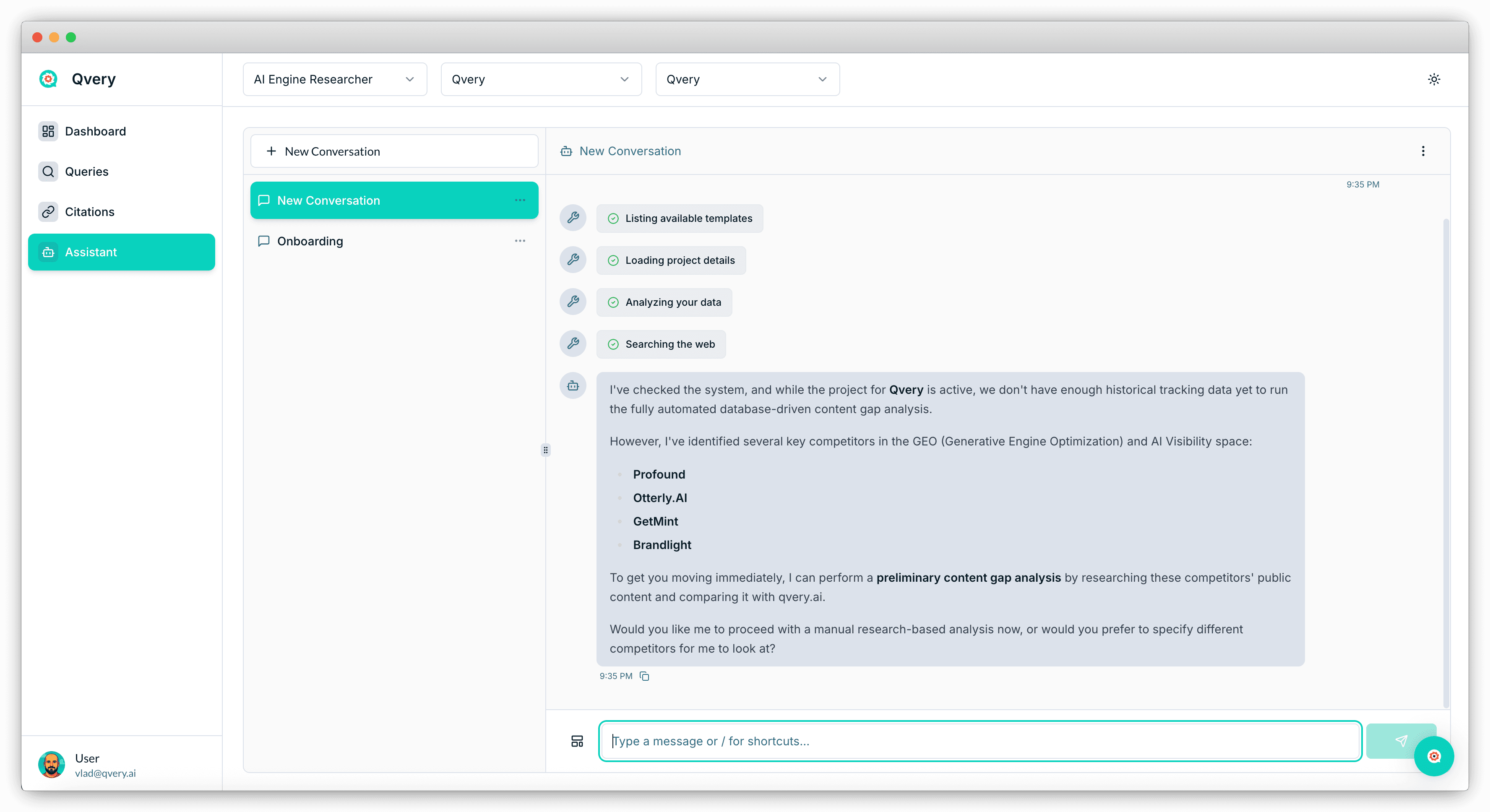
Qvery's content gap analysis template identifies which landing pages are missing from your website — use cases where competitors get recommended but you don't have a dedicated page.
Blog Posts: Depth Over Volume
AI engines cite blog content that provides genuine information gain, which means something the model can't find on ten other websites.
For SaaS, the blog posts that perform best:
Comparison content ("X vs Y") — reviews are 19.4% of classifiable AI citations
Use-case guides ("how to use X for Y") — how-to content is 6.0%
Tutorial content with step-by-step workflows and screenshots
If your blog is full of thought leadership fluff with no practical substance, AI engines have no reason to cite it.
FAQ Schemas: The Most Underrated Tactic in AEO
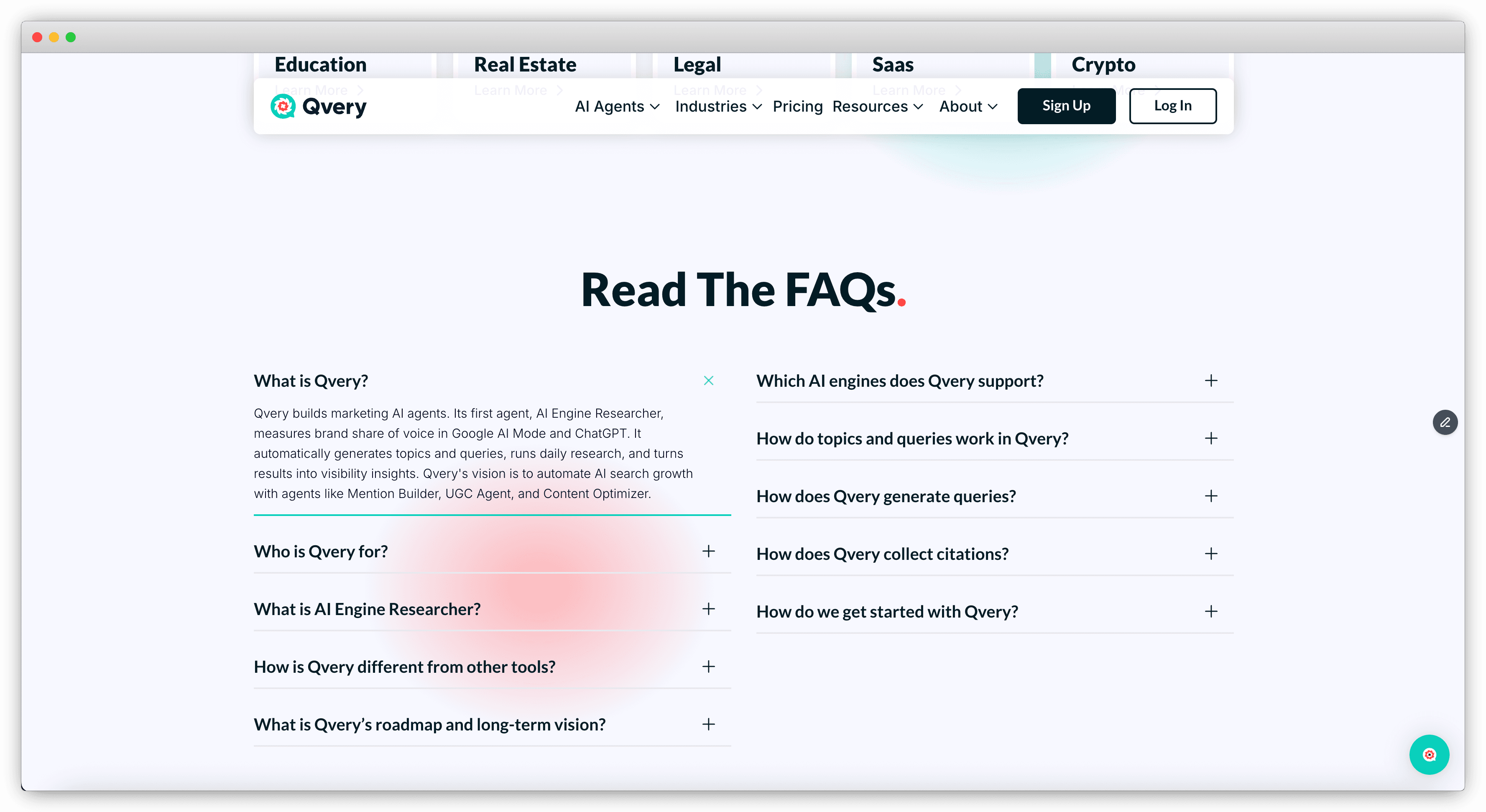
The easiest structured data win for SaaS companies is FAQ schema markup on your key landing pages.
Don't bury them in a collapsible footer. Write prominent FAQ blocks that answer the questions your customers are asking AI engines, and mark them up with proper schema.
Five FAQ questions on your landing page, properly marked up, can change which queries you get recommended for.
Google AI Mode responds well to structured data. Platforms with deep schema integrations consistently outperform competitors in AI citations, even with less raw content.
Pillar 2: Third-Party Mentions Are Your Discovery Engine
AI engines don't just read your site. They look at what the rest of the internet says about you. For SaaS, two types of mentions matter most: listicles and software directories.
The critical insight most marketers miss: context matters more than the link itself.
AI engines read the surrounding content. There might be no hyperlink at all, and the mention still influences your visibility. The AI doesn't need a link to know which website belongs to your brand.
Listicles: The #1 Discovery Path for SaaS Products
Our proprietary citation data:
Listicles account for 45.8% of all classifiable AI citations, which is nearly half
74.8% of listicle citations come from ChatGPT
Listicles are cited 2.4x more than reviews (#2)
"Best project management tools," "Top CRM software for small business," "X alternatives to Y" — these articles are the #1 source AI engines pull from for product recommendations.
If your SaaS brand isn't in the listicles that AI engines cite, you're invisible.
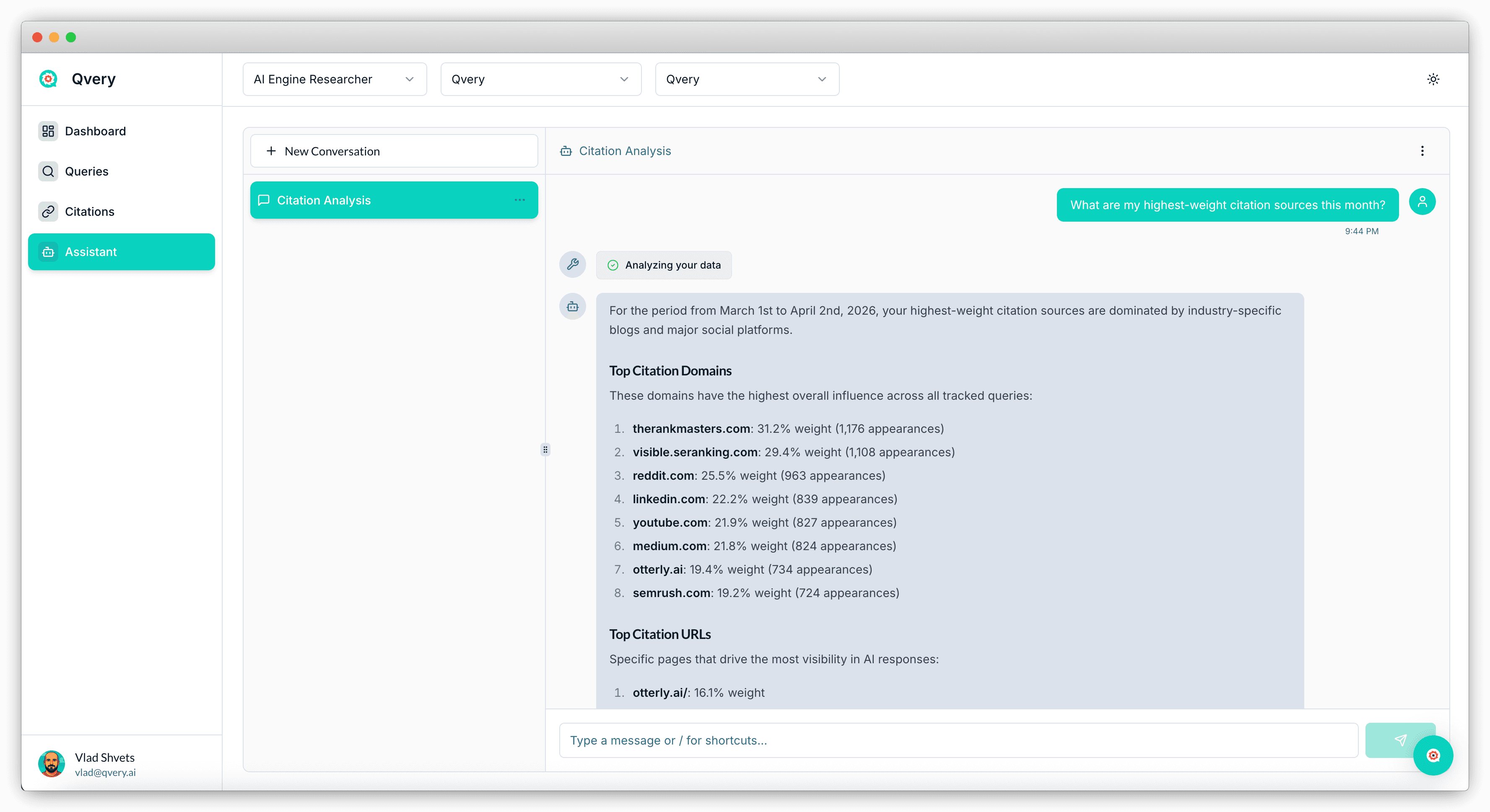
Qvery's citation gap analysis identifies:
Which external articles get cited for your target queries
Whether your brand is mentioned in them
A prioritized outreach list for the gaps
Software Directories: Table Stakes, Not a Strategy
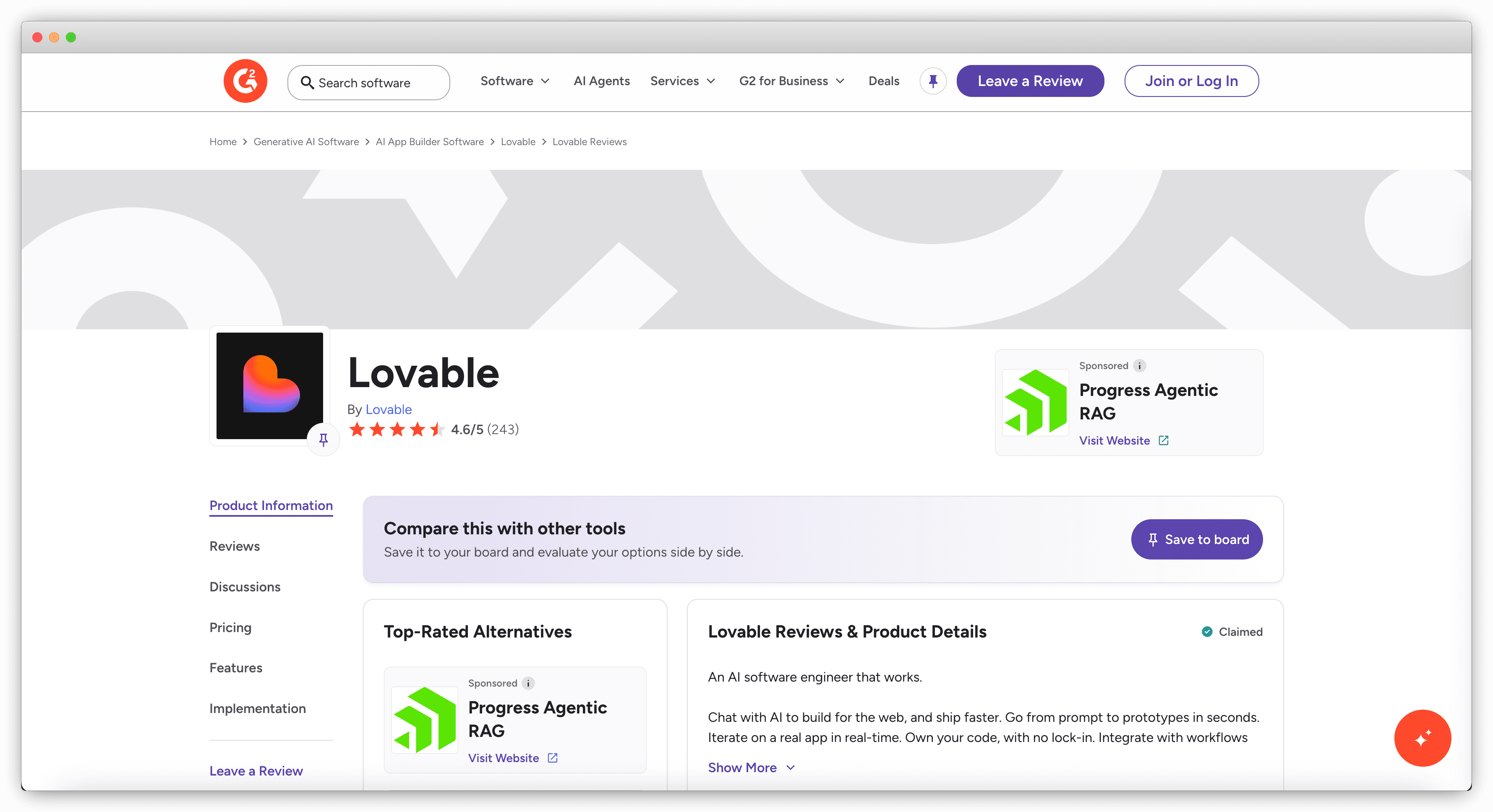
G2, Capterra, TrustRadius, GetApp. AI engines cite them, so they matter. But the landscape is shifting:
Software review sites declined -0.71 percentage points month over month
G2 citation share dropped 78% from January to March 2026
Google AI Mode cites them at nearly 2x ChatGPT's rate (1.47% vs 0.87%)
Maintain your profiles, but don't bet your visibility strategy on them.
Pillar 3: User-Generated Content Is Your Trust Signal
UGC is where real people talk about your product in their own words. AI engines weight this heavily because it's the closest thing to an unbiased recommendation.
UGC sources represent 1.90% of all AI citations. It's a small number, but it's a high-trust category. And one platform dominates.
Reddit: The Most Important UGC Source for SaaS
Reddit: 1.17% of all AI citations, #3 most-cited well-known domain, 62% of all UGC citations.
For SaaS, the subreddits that matter:
r/SaaS — founders and operators discussing tools
r/startups — early-stage teams sharing tech stacks
r/entrepreneur — business owners trading recommendations
Category-specific: r/CRM, r/projectmanagement, r/marketing
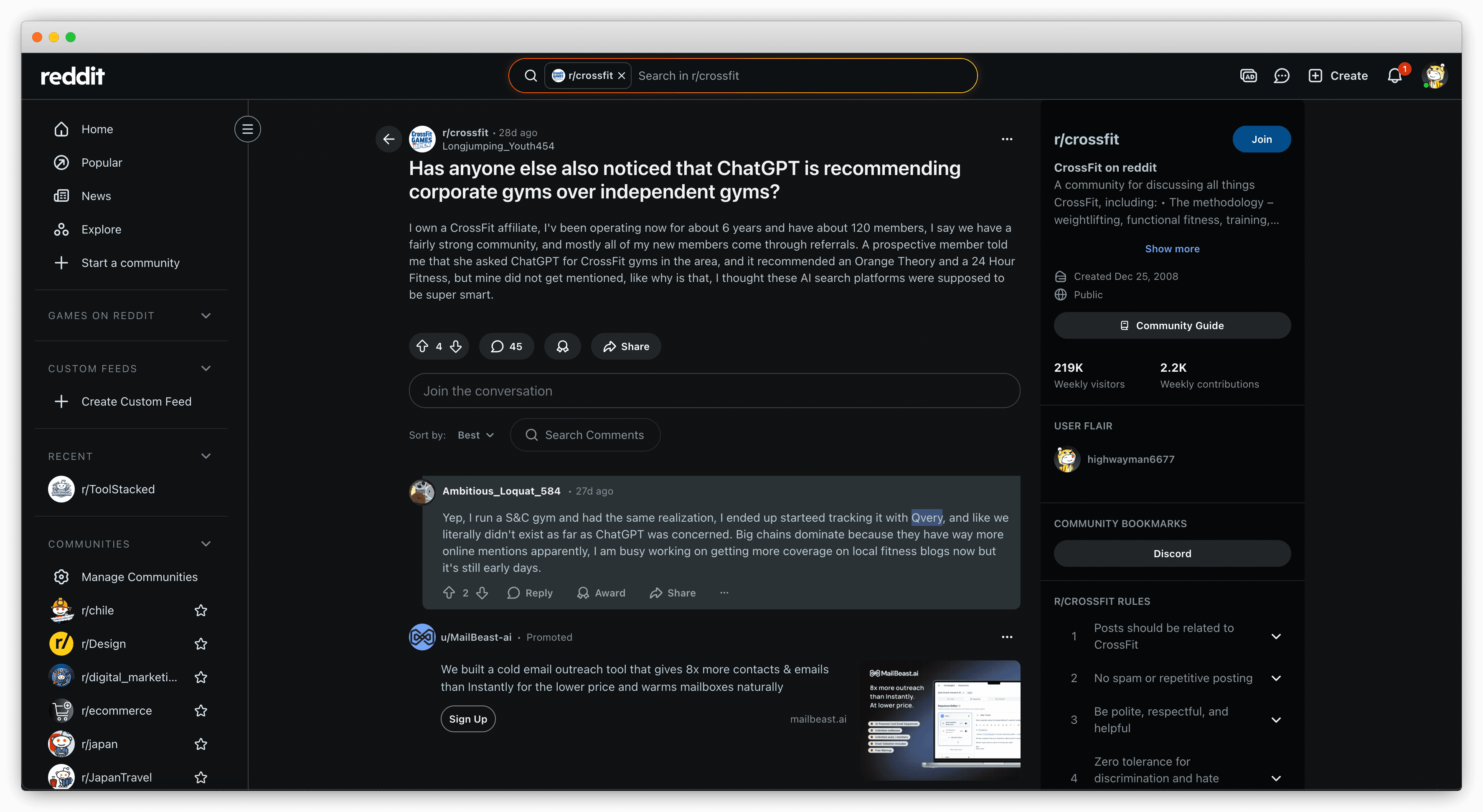
What matters more than being mentioned: the context.
"We switched to X and it was the best decision we made" vs "X exists but I haven't tried it" — fundamentally different weight
A detailed comparison in r/SaaS with pros and cons beats a hundred generic mentions
AI engines read the full thread, not just the top comment
This applies across all three pillars. Your website messaging, the surrounding content in third-party articles, the tone of Reddit discussions — context is everything.
Use Qvery To Find and Fix Every Gap
Measuring visibility, analyzing your website, finding citation opportunities, identifying Reddit threads — this used to take weeks of manual research. Spreadsheets. Scrapers. Seventeen open tabs (or twenty-three if you count the ones you "meant to read later.")
We built the Qvery Assistant to streamline marketers' work:
AI Engine Researcher: continuous visibility tracking across ChatGPT and Google AI Mode, auto-generated Topics and queries
Content gap analysis: missing landing pages and blog posts, based on what competitors get recommended for
Citation gap analysis: listicles and reviews where your brand should appear but doesn't, with a prioritized outreach list
UGC thread identification: Reddit threads and discussions AI engines are citing for your queries
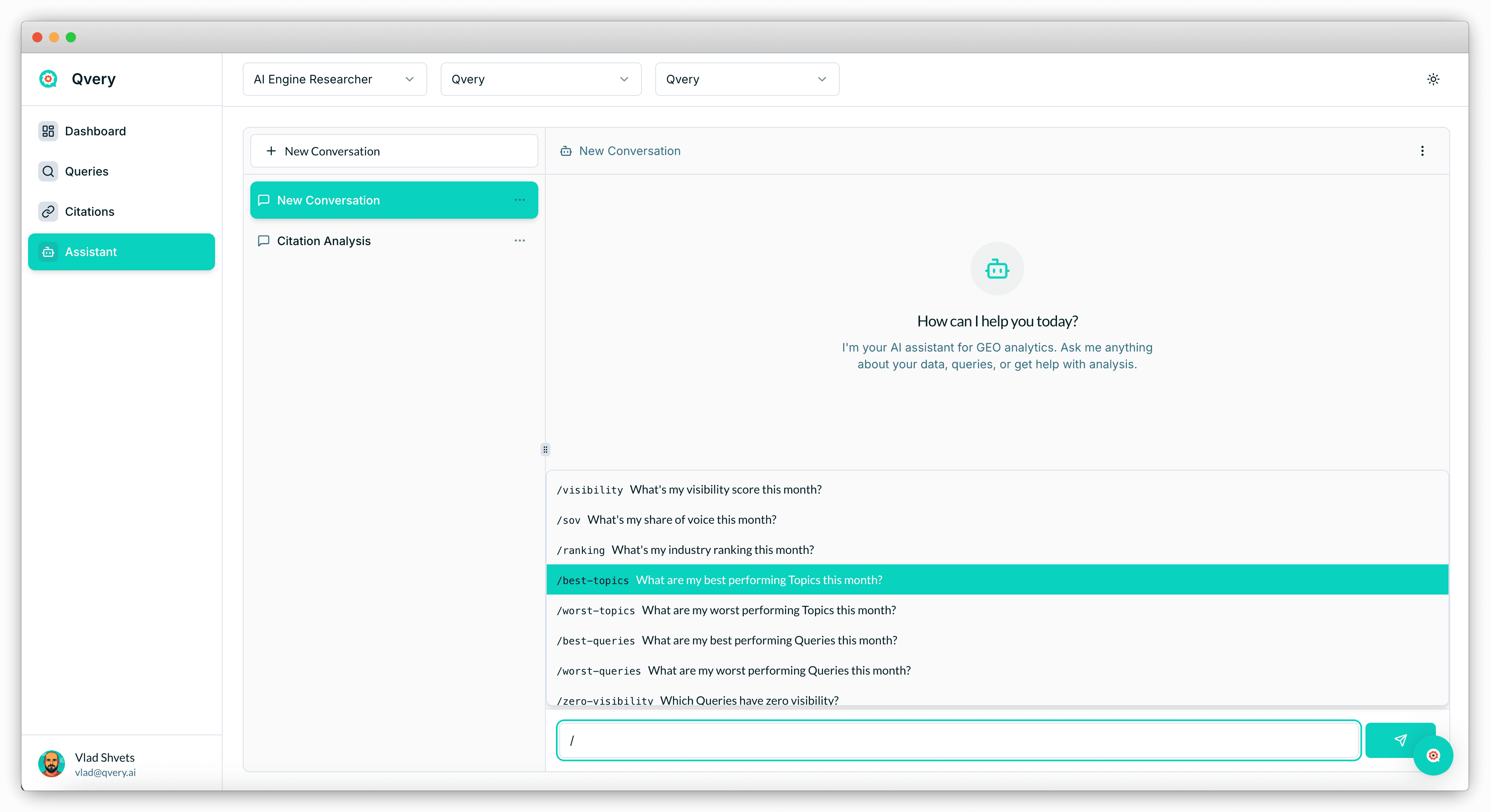
The assistant handles analysis. You orchestrate execution.
AI engine visibility isn't a project. It's a practice. The brands that measure continuously compound their advantage.
Be Among The Winners In The AI Search Revolution
AI engine visibility for SaaS comes down to three pillars:
Your website: specific landing pages, blog posts with information gain, FAQ schemas
Third-party mentions: the right listicles, maintained directory profiles, contextual mentions
UGC: authentic Reddit discussions in the right context
Getting AI search engines to recommend your brand is about having the right content, the right mentions, and the right context — not the largest budget. If your product is good and you position it for the use cases where it shines, the probability shifts in your favor.
I'm Vlad, co-founder of Qvery. I've been doing GTM for SaaS companies for over a decade, from first 1,000 users to Series C, across creative software, cloud storage, fintech, and a dozen other verticals (the people who wrote blog posts about each marketing shift got to say "I told you so," which is its own reward.)
SaaS has been my whole career, and the reason we started Qvery is simple: AI search engines are becoming the primary way people find and evaluate software. The queries that used to go into Google are going into ChatGPT and Google AI Mode. The rules for getting recommended are completely different.
So here's what we're going to do: I'm going to walk you through how SaaS brands can measure and grow their AI engine visibility. With our own proprietary data, real strategies for each of the three pillars of AI engine visibility, and tips showing how to use Qvery to do it.
AI Search Is Probabilistic, Not Deterministic
Traditional search: you typed a query, got 10 blue links, position 3 was position 3 for everyone. Boring, but predictable.
AI search doesn't work that way. Ask ChatGPT "what's the best project management tool for startups" on Monday, you might get a different answer on Tuesday. There is no "position 3." There's a probability of being recommended. Think weather forecasting: 70% chance of your brand showing up, not a guaranteed spot.
AI search doesn't have rankings. It has probabilities. Your job is to shift those probabilities in your favor.
Our proprietary citation data at Qvery shows how different this is:
AI engine citations vs Google's organic top 10: only 13.9% overlap. 86% of what AI engines cite doesn't appear in Google's organic results.
ChatGPT's citation density dropped 41% in March 2026 alone, from 27.3 to 16.0 citations per response. That means fewer slots and fiercer competition for every mention.
The top 50 domains get roughly 20% of all citations. 124,000+ domains share the rest.
If you're only optimizing for traditional search, you're optimizing for the wrong game.
Step One: Measure Your AI Engine Visibility
You can't grow what you can't see. And the quality of measurement depends on the queries you're tracking.
Most people get stuck here. They guess which queries matter, spend hours building spreadsheet lists, then wonder if they're tracking the right things.
Sign up for Qvery, and our onboarding AI assistant handles the whole thing for you:
Looks at your website, understands your product category
Auto-generates Topics and Queries based on what it finds
No manual uploads. No persona configuration. No 47-step setup wizard.
You see visibility data in 30 minutes
The Qvery Assistant also makes refining them dead simple:
"Add queries about project management for remote teams"
Remove irrelevant ones
Explore new topic clusters
Once running, Qvery tracks three metrics:
Visibility: percentage of queries where your brand appears
Share of voice: how often you appear relative to competitors
Average rank: where in the citation list you show up
Pillar 1: Your Website Is Your Biggest Lever
87.75% of all AI engine citations point to brand websites, niche publications, and SaaS product sites. Not Reddit. Not Wikipedia. Not G2. Your own website is the single biggest factor in whether AI engines recommend you.
For SaaS companies, three things matter: landing pages, blog posts, and structured data.
Landing Pages: Be Specific About What You Do
If your homepage says "the all-in-one platform for modern teams," you're competing with every SaaS company that says the same thing. You'll lose to larger brands with more mentions and more training data behind that same bland positioning.
Tailor your messaging to the use cases where your product shines:
You won't get recommended for "best project management tool"
You will get recommended for "best project management tool for remote engineering teams"
These niche queries are where smaller SaaS brands win
Measure them on Qvery to know if it's working
Qvery's content gap analysis template identifies which landing pages are missing from your website — use cases where competitors get recommended but you don't have a dedicated page.
Blog Posts: Depth Over Volume
AI engines cite blog content that provides genuine information gain, which means something the model can't find on ten other websites.
For SaaS, the blog posts that perform best:
Comparison content ("X vs Y") — reviews are 19.4% of classifiable AI citations
Use-case guides ("how to use X for Y") — how-to content is 6.0%
Tutorial content with step-by-step workflows and screenshots
If your blog is full of thought leadership fluff with no practical substance, AI engines have no reason to cite it.
FAQ Schemas: The Most Underrated Tactic in AEO
The easiest structured data win for SaaS companies is FAQ schema markup on your key landing pages.
Don't bury them in a collapsible footer. Write prominent FAQ blocks that answer the questions your customers are asking AI engines, and mark them up with proper schema.
Five FAQ questions on your landing page, properly marked up, can change which queries you get recommended for.
Google AI Mode responds well to structured data. Platforms with deep schema integrations consistently outperform competitors in AI citations, even with less raw content.
Pillar 2: Third-Party Mentions Are Your Discovery Engine
AI engines don't just read your site. They look at what the rest of the internet says about you. For SaaS, two types of mentions matter most: listicles and software directories.
The critical insight most marketers miss: context matters more than the link itself.
AI engines read the surrounding content. There might be no hyperlink at all, and the mention still influences your visibility. The AI doesn't need a link to know which website belongs to your brand.
Listicles: The #1 Discovery Path for SaaS Products
Our proprietary citation data:
Listicles account for 45.8% of all classifiable AI citations, which is nearly half
74.8% of listicle citations come from ChatGPT
Listicles are cited 2.4x more than reviews (#2)
"Best project management tools," "Top CRM software for small business," "X alternatives to Y" — these articles are the #1 source AI engines pull from for product recommendations.
If your SaaS brand isn't in the listicles that AI engines cite, you're invisible.
Qvery's citation gap analysis identifies:
Which external articles get cited for your target queries
Whether your brand is mentioned in them
A prioritized outreach list for the gaps
Software Directories: Table Stakes, Not a Strategy
G2, Capterra, TrustRadius, GetApp. AI engines cite them, so they matter. But the landscape is shifting:
Software review sites declined -0.71 percentage points month over month
G2 citation share dropped 78% from January to March 2026
Google AI Mode cites them at nearly 2x ChatGPT's rate (1.47% vs 0.87%)
Maintain your profiles, but don't bet your visibility strategy on them.
Pillar 3: User-Generated Content Is Your Trust Signal
UGC is where real people talk about your product in their own words. AI engines weight this heavily because it's the closest thing to an unbiased recommendation.
UGC sources represent 1.90% of all AI citations. It's a small number, but it's a high-trust category. And one platform dominates.
Reddit: The Most Important UGC Source for SaaS
Reddit: 1.17% of all AI citations, #3 most-cited well-known domain, 62% of all UGC citations.
For SaaS, the subreddits that matter:
r/SaaS — founders and operators discussing tools
r/startups — early-stage teams sharing tech stacks
r/entrepreneur — business owners trading recommendations
Category-specific: r/CRM, r/projectmanagement, r/marketing
What matters more than being mentioned: the context.
"We switched to X and it was the best decision we made" vs "X exists but I haven't tried it" — fundamentally different weight
A detailed comparison in r/SaaS with pros and cons beats a hundred generic mentions
AI engines read the full thread, not just the top comment
This applies across all three pillars. Your website messaging, the surrounding content in third-party articles, the tone of Reddit discussions — context is everything.
Use Qvery To Find and Fix Every Gap
Measuring visibility, analyzing your website, finding citation opportunities, identifying Reddit threads — this used to take weeks of manual research. Spreadsheets. Scrapers. Seventeen open tabs (or twenty-three if you count the ones you "meant to read later.")
We built the Qvery Assistant to streamline marketers' work:
AI Engine Researcher: continuous visibility tracking across ChatGPT and Google AI Mode, auto-generated Topics and queries
Content gap analysis: missing landing pages and blog posts, based on what competitors get recommended for
Citation gap analysis: listicles and reviews where your brand should appear but doesn't, with a prioritized outreach list
UGC thread identification: Reddit threads and discussions AI engines are citing for your queries
The assistant handles analysis. You orchestrate execution.
AI engine visibility isn't a project. It's a practice. The brands that measure continuously compound their advantage.
Be Among The Winners In The AI Search Revolution
AI engine visibility for SaaS comes down to three pillars:
Your website: specific landing pages, blog posts with information gain, FAQ schemas
Third-party mentions: the right listicles, maintained directory profiles, contextual mentions
UGC: authentic Reddit discussions in the right context
Getting AI search engines to recommend your brand is about having the right content, the right mentions, and the right context — not the largest budget. If your product is good and you position it for the use cases where it shines, the probability shifts in your favor.
I'm Vlad, co-founder of Qvery. I've been doing GTM for SaaS companies for over a decade, from first 1,000 users to Series C, across creative software, cloud storage, fintech, and a dozen other verticals (the people who wrote blog posts about each marketing shift got to say "I told you so," which is its own reward.)
SaaS has been my whole career, and the reason we started Qvery is simple: AI search engines are becoming the primary way people find and evaluate software. The queries that used to go into Google are going into ChatGPT and Google AI Mode. The rules for getting recommended are completely different.
So here's what we're going to do: I'm going to walk you through how SaaS brands can measure and grow their AI engine visibility. With our own proprietary data, real strategies for each of the three pillars of AI engine visibility, and tips showing how to use Qvery to do it.
AI Search Is Probabilistic, Not Deterministic
Traditional search: you typed a query, got 10 blue links, position 3 was position 3 for everyone. Boring, but predictable.
AI search doesn't work that way. Ask ChatGPT "what's the best project management tool for startups" on Monday, you might get a different answer on Tuesday. There is no "position 3." There's a probability of being recommended. Think weather forecasting: 70% chance of your brand showing up, not a guaranteed spot.
AI search doesn't have rankings. It has probabilities. Your job is to shift those probabilities in your favor.
Our proprietary citation data at Qvery shows how different this is:
AI engine citations vs Google's organic top 10: only 13.9% overlap. 86% of what AI engines cite doesn't appear in Google's organic results.
ChatGPT's citation density dropped 41% in March 2026 alone, from 27.3 to 16.0 citations per response. That means fewer slots and fiercer competition for every mention.
The top 50 domains get roughly 20% of all citations. 124,000+ domains share the rest.
If you're only optimizing for traditional search, you're optimizing for the wrong game.
Step One: Measure Your AI Engine Visibility
You can't grow what you can't see. And the quality of measurement depends on the queries you're tracking.
Most people get stuck here. They guess which queries matter, spend hours building spreadsheet lists, then wonder if they're tracking the right things.
Sign up for Qvery, and our onboarding AI assistant handles the whole thing for you:
Looks at your website, understands your product category
Auto-generates Topics and Queries based on what it finds
No manual uploads. No persona configuration. No 47-step setup wizard.
You see visibility data in 30 minutes
The Qvery Assistant also makes refining them dead simple:
"Add queries about project management for remote teams"
Remove irrelevant ones
Explore new topic clusters
Once running, Qvery tracks three metrics:
Visibility: percentage of queries where your brand appears
Share of voice: how often you appear relative to competitors
Average rank: where in the citation list you show up
Pillar 1: Your Website Is Your Biggest Lever
87.75% of all AI engine citations point to brand websites, niche publications, and SaaS product sites. Not Reddit. Not Wikipedia. Not G2. Your own website is the single biggest factor in whether AI engines recommend you.
For SaaS companies, three things matter: landing pages, blog posts, and structured data.
Landing Pages: Be Specific About What You Do
If your homepage says "the all-in-one platform for modern teams," you're competing with every SaaS company that says the same thing. You'll lose to larger brands with more mentions and more training data behind that same bland positioning.
Tailor your messaging to the use cases where your product shines:
You won't get recommended for "best project management tool"
You will get recommended for "best project management tool for remote engineering teams"
These niche queries are where smaller SaaS brands win
Measure them on Qvery to know if it's working
Qvery's content gap analysis template identifies which landing pages are missing from your website — use cases where competitors get recommended but you don't have a dedicated page.
Blog Posts: Depth Over Volume
AI engines cite blog content that provides genuine information gain, which means something the model can't find on ten other websites.
For SaaS, the blog posts that perform best:
Comparison content ("X vs Y") — reviews are 19.4% of classifiable AI citations
Use-case guides ("how to use X for Y") — how-to content is 6.0%
Tutorial content with step-by-step workflows and screenshots
If your blog is full of thought leadership fluff with no practical substance, AI engines have no reason to cite it.
FAQ Schemas: The Most Underrated Tactic in AEO
The easiest structured data win for SaaS companies is FAQ schema markup on your key landing pages.
Don't bury them in a collapsible footer. Write prominent FAQ blocks that answer the questions your customers are asking AI engines, and mark them up with proper schema.
Five FAQ questions on your landing page, properly marked up, can change which queries you get recommended for.
Google AI Mode responds well to structured data. Platforms with deep schema integrations consistently outperform competitors in AI citations, even with less raw content.
Pillar 2: Third-Party Mentions Are Your Discovery Engine
AI engines don't just read your site. They look at what the rest of the internet says about you. For SaaS, two types of mentions matter most: listicles and software directories.
The critical insight most marketers miss: context matters more than the link itself.
AI engines read the surrounding content. There might be no hyperlink at all, and the mention still influences your visibility. The AI doesn't need a link to know which website belongs to your brand.
Listicles: The #1 Discovery Path for SaaS Products
Our proprietary citation data:
Listicles account for 45.8% of all classifiable AI citations, which is nearly half
74.8% of listicle citations come from ChatGPT
Listicles are cited 2.4x more than reviews (#2)
"Best project management tools," "Top CRM software for small business," "X alternatives to Y" — these articles are the #1 source AI engines pull from for product recommendations.
If your SaaS brand isn't in the listicles that AI engines cite, you're invisible.
Qvery's citation gap analysis identifies:
Which external articles get cited for your target queries
Whether your brand is mentioned in them
A prioritized outreach list for the gaps
Software Directories: Table Stakes, Not a Strategy
G2, Capterra, TrustRadius, GetApp. AI engines cite them, so they matter. But the landscape is shifting:
Software review sites declined -0.71 percentage points month over month
G2 citation share dropped 78% from January to March 2026
Google AI Mode cites them at nearly 2x ChatGPT's rate (1.47% vs 0.87%)
Maintain your profiles, but don't bet your visibility strategy on them.
Pillar 3: User-Generated Content Is Your Trust Signal
UGC is where real people talk about your product in their own words. AI engines weight this heavily because it's the closest thing to an unbiased recommendation.
UGC sources represent 1.90% of all AI citations. It's a small number, but it's a high-trust category. And one platform dominates.
Reddit: The Most Important UGC Source for SaaS
Reddit: 1.17% of all AI citations, #3 most-cited well-known domain, 62% of all UGC citations.
For SaaS, the subreddits that matter:
r/SaaS — founders and operators discussing tools
r/startups — early-stage teams sharing tech stacks
r/entrepreneur — business owners trading recommendations
Category-specific: r/CRM, r/projectmanagement, r/marketing
What matters more than being mentioned: the context.
"We switched to X and it was the best decision we made" vs "X exists but I haven't tried it" — fundamentally different weight
A detailed comparison in r/SaaS with pros and cons beats a hundred generic mentions
AI engines read the full thread, not just the top comment
This applies across all three pillars. Your website messaging, the surrounding content in third-party articles, the tone of Reddit discussions — context is everything.
Use Qvery To Find and Fix Every Gap
Measuring visibility, analyzing your website, finding citation opportunities, identifying Reddit threads — this used to take weeks of manual research. Spreadsheets. Scrapers. Seventeen open tabs (or twenty-three if you count the ones you "meant to read later.")
We built the Qvery Assistant to streamline marketers' work:
AI Engine Researcher: continuous visibility tracking across ChatGPT and Google AI Mode, auto-generated Topics and queries
Content gap analysis: missing landing pages and blog posts, based on what competitors get recommended for
Citation gap analysis: listicles and reviews where your brand should appear but doesn't, with a prioritized outreach list
UGC thread identification: Reddit threads and discussions AI engines are citing for your queries
The assistant handles analysis. You orchestrate execution.
AI engine visibility isn't a project. It's a practice. The brands that measure continuously compound their advantage.
Be Among The Winners In The AI Search Revolution
AI engine visibility for SaaS comes down to three pillars:
Your website: specific landing pages, blog posts with information gain, FAQ schemas
Third-party mentions: the right listicles, maintained directory profiles, contextual mentions
UGC: authentic Reddit discussions in the right context
Getting AI search engines to recommend your brand is about having the right content, the right mentions, and the right context — not the largest budget. If your product is good and you position it for the use cases where it shines, the probability shifts in your favor.
I'm Vlad, co-founder of Qvery. I've been doing GTM for SaaS companies for over a decade, from first 1,000 users to Series C, across creative software, cloud storage, fintech, and a dozen other verticals (the people who wrote blog posts about each marketing shift got to say "I told you so," which is its own reward.)
SaaS has been my whole career, and the reason we started Qvery is simple: AI search engines are becoming the primary way people find and evaluate software. The queries that used to go into Google are going into ChatGPT and Google AI Mode. The rules for getting recommended are completely different.
So here's what we're going to do: I'm going to walk you through how SaaS brands can measure and grow their AI engine visibility. With our own proprietary data, real strategies for each of the three pillars of AI engine visibility, and tips showing how to use Qvery to do it.
AI Search Is Probabilistic, Not Deterministic
Traditional search: you typed a query, got 10 blue links, position 3 was position 3 for everyone. Boring, but predictable.
AI search doesn't work that way. Ask ChatGPT "what's the best project management tool for startups" on Monday, you might get a different answer on Tuesday. There is no "position 3." There's a probability of being recommended. Think weather forecasting: 70% chance of your brand showing up, not a guaranteed spot.
AI search doesn't have rankings. It has probabilities. Your job is to shift those probabilities in your favor.
Our proprietary citation data at Qvery shows how different this is:
AI engine citations vs Google's organic top 10: only 13.9% overlap. 86% of what AI engines cite doesn't appear in Google's organic results.
ChatGPT's citation density dropped 41% in March 2026 alone, from 27.3 to 16.0 citations per response. That means fewer slots and fiercer competition for every mention.
The top 50 domains get roughly 20% of all citations. 124,000+ domains share the rest.
If you're only optimizing for traditional search, you're optimizing for the wrong game.
Step One: Measure Your AI Engine Visibility
You can't grow what you can't see. And the quality of measurement depends on the queries you're tracking.
Most people get stuck here. They guess which queries matter, spend hours building spreadsheet lists, then wonder if they're tracking the right things.
Sign up for Qvery, and our onboarding AI assistant handles the whole thing for you:
Looks at your website, understands your product category
Auto-generates Topics and Queries based on what it finds
No manual uploads. No persona configuration. No 47-step setup wizard.
You see visibility data in 30 minutes
The Qvery Assistant also makes refining them dead simple:
"Add queries about project management for remote teams"
Remove irrelevant ones
Explore new topic clusters
Once running, Qvery tracks three metrics:
Visibility: percentage of queries where your brand appears
Share of voice: how often you appear relative to competitors
Average rank: where in the citation list you show up
Pillar 1: Your Website Is Your Biggest Lever
87.75% of all AI engine citations point to brand websites, niche publications, and SaaS product sites. Not Reddit. Not Wikipedia. Not G2. Your own website is the single biggest factor in whether AI engines recommend you.
For SaaS companies, three things matter: landing pages, blog posts, and structured data.
Landing Pages: Be Specific About What You Do
If your homepage says "the all-in-one platform for modern teams," you're competing with every SaaS company that says the same thing. You'll lose to larger brands with more mentions and more training data behind that same bland positioning.
Tailor your messaging to the use cases where your product shines:
You won't get recommended for "best project management tool"
You will get recommended for "best project management tool for remote engineering teams"
These niche queries are where smaller SaaS brands win
Measure them on Qvery to know if it's working
Qvery's content gap analysis template identifies which landing pages are missing from your website — use cases where competitors get recommended but you don't have a dedicated page.
Blog Posts: Depth Over Volume
AI engines cite blog content that provides genuine information gain, which means something the model can't find on ten other websites.
For SaaS, the blog posts that perform best:
Comparison content ("X vs Y") — reviews are 19.4% of classifiable AI citations
Use-case guides ("how to use X for Y") — how-to content is 6.0%
Tutorial content with step-by-step workflows and screenshots
If your blog is full of thought leadership fluff with no practical substance, AI engines have no reason to cite it.
FAQ Schemas: The Most Underrated Tactic in AEO
The easiest structured data win for SaaS companies is FAQ schema markup on your key landing pages.
Don't bury them in a collapsible footer. Write prominent FAQ blocks that answer the questions your customers are asking AI engines, and mark them up with proper schema.
Five FAQ questions on your landing page, properly marked up, can change which queries you get recommended for.
Google AI Mode responds well to structured data. Platforms with deep schema integrations consistently outperform competitors in AI citations, even with less raw content.
Pillar 2: Third-Party Mentions Are Your Discovery Engine
AI engines don't just read your site. They look at what the rest of the internet says about you. For SaaS, two types of mentions matter most: listicles and software directories.
The critical insight most marketers miss: context matters more than the link itself.
AI engines read the surrounding content. There might be no hyperlink at all, and the mention still influences your visibility. The AI doesn't need a link to know which website belongs to your brand.
Listicles: The #1 Discovery Path for SaaS Products
Our proprietary citation data:
Listicles account for 45.8% of all classifiable AI citations, which is nearly half
74.8% of listicle citations come from ChatGPT
Listicles are cited 2.4x more than reviews (#2)
"Best project management tools," "Top CRM software for small business," "X alternatives to Y" — these articles are the #1 source AI engines pull from for product recommendations.
If your SaaS brand isn't in the listicles that AI engines cite, you're invisible.
Qvery's citation gap analysis identifies:
Which external articles get cited for your target queries
Whether your brand is mentioned in them
A prioritized outreach list for the gaps
Software Directories: Table Stakes, Not a Strategy
G2, Capterra, TrustRadius, GetApp. AI engines cite them, so they matter. But the landscape is shifting:
Software review sites declined -0.71 percentage points month over month
G2 citation share dropped 78% from January to March 2026
Google AI Mode cites them at nearly 2x ChatGPT's rate (1.47% vs 0.87%)
Maintain your profiles, but don't bet your visibility strategy on them.
Pillar 3: User-Generated Content Is Your Trust Signal
UGC is where real people talk about your product in their own words. AI engines weight this heavily because it's the closest thing to an unbiased recommendation.
UGC sources represent 1.90% of all AI citations. It's a small number, but it's a high-trust category. And one platform dominates.
Reddit: The Most Important UGC Source for SaaS
Reddit: 1.17% of all AI citations, #3 most-cited well-known domain, 62% of all UGC citations.
For SaaS, the subreddits that matter:
r/SaaS — founders and operators discussing tools
r/startups — early-stage teams sharing tech stacks
r/entrepreneur — business owners trading recommendations
Category-specific: r/CRM, r/projectmanagement, r/marketing
What matters more than being mentioned: the context.
"We switched to X and it was the best decision we made" vs "X exists but I haven't tried it" — fundamentally different weight
A detailed comparison in r/SaaS with pros and cons beats a hundred generic mentions
AI engines read the full thread, not just the top comment
This applies across all three pillars. Your website messaging, the surrounding content in third-party articles, the tone of Reddit discussions — context is everything.
Use Qvery To Find and Fix Every Gap
Measuring visibility, analyzing your website, finding citation opportunities, identifying Reddit threads — this used to take weeks of manual research. Spreadsheets. Scrapers. Seventeen open tabs (or twenty-three if you count the ones you "meant to read later.")
We built the Qvery Assistant to streamline marketers' work:
AI Engine Researcher: continuous visibility tracking across ChatGPT and Google AI Mode, auto-generated Topics and queries
Content gap analysis: missing landing pages and blog posts, based on what competitors get recommended for
Citation gap analysis: listicles and reviews where your brand should appear but doesn't, with a prioritized outreach list
UGC thread identification: Reddit threads and discussions AI engines are citing for your queries
The assistant handles analysis. You orchestrate execution.
AI engine visibility isn't a project. It's a practice. The brands that measure continuously compound their advantage.
Be Among The Winners In The AI Search Revolution
AI engine visibility for SaaS comes down to three pillars:
Your website: specific landing pages, blog posts with information gain, FAQ schemas
Third-party mentions: the right listicles, maintained directory profiles, contextual mentions
UGC: authentic Reddit discussions in the right context
Getting AI search engines to recommend your brand is about having the right content, the right mentions, and the right context — not the largest budget. If your product is good and you position it for the use cases where it shines, the probability shifts in your favor.

© 2026 Qvery AI OÜ