By
Vlad Shvets
The Three Pillars of AI Engine Visibility (And Why the Old SEO Equation Is Dead)
The old SEO equation is dead. AI search engines run on three independent pillars: your website, third-party mentions, and UGC.
The old SEO equation is dead. AI search engines run on three independent pillars: your website, third-party mentions, and UGC.
The old SEO equation is dead. AI search engines run on three independent pillars: your website, third-party mentions, and UGC.
For 20 years, SEO had a formula.
Everyone knew it. Technical SEO as the foundation, pile on content, and multiply it all with backlinks. The more backlinks you had, the harder your content hit. It was predictable. It was grindable. And if you were patient enough to celebrate moving from position 8 to position 7 over three weeks, honestly, you deserved a trophy. (Stockholm syndrome is real.)
That formula is dead. Not dying, dead.
AI search engines don't match keywords to indexed pages. They don't serve you 10 blue links and wish you good luck. They understand your intent, decompose your query into dozens of sub-queries, retrieve passages from across the web, cross-reference sources, and generate a complete answer. All before you finish your coffee.
The old equation looked like this:
The Old SEO Equation: Visibility = Technical SEO + Content×Backlinks. Backlinks were the exponent. The more you built, the harder your content performed.
The new equation looks nothing like it:
The New Equation: AI Visibility = Your Website + Third-Party Mentions + UGC. Three independent pillars. Miss one, and the other two can't compensate.
Let me break down what changed, why it changed, and what you should actually do about it.
AI Search Doesn't Match Keywords. It Understands Intent.
Before we get to the pillars, you need to understand why the formula changed. This isn't a tweak to the algorithm. It's a fundamentally different architecture for how search works.
When you type something into ChatGPT or Google AI Mode, the search engine doesn't look for pages that match your words. It understands what you're actually trying to accomplish. Then it does something called query fan-out, breaking your single query into 8–10 parallel sub-queries, each approaching your question from a different angle.
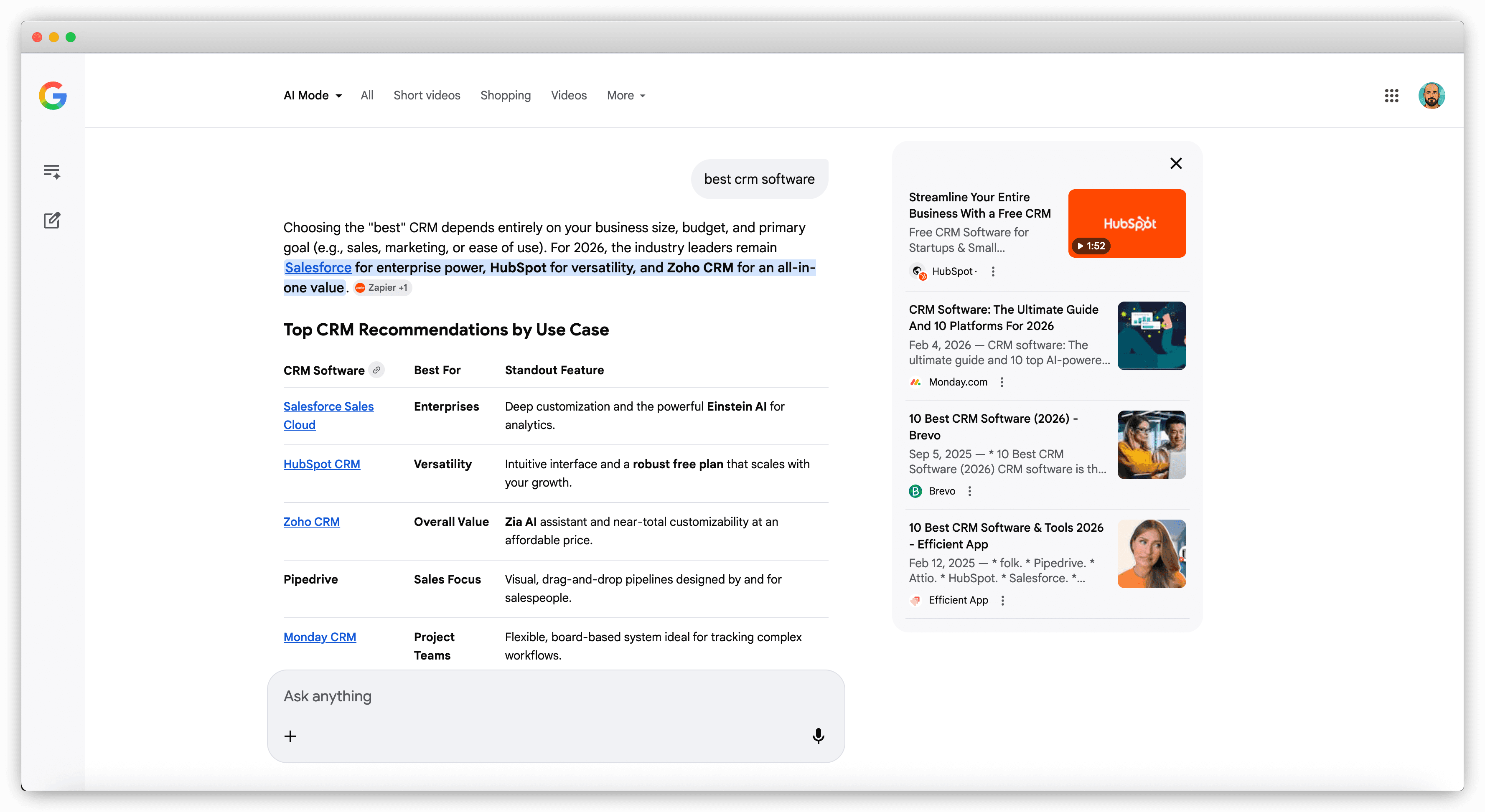
It's like asking one question and having the AI hire a research team of 10 analysts who each go investigate a slightly different aspect of your problem. Simultaneously. They come back, compare notes, and hand you one synthesized answer. (Your junior marketer could never.)
This means two people searching for the same thing using completely different words will get essentially the same answer. It's not about how the query is phrased. It's about the use case behind it.
It's not how the query is written. It's the use case behind the query. Two queries could use completely different words, have completely different lengths, and still be about the exact same thing. The search engine knows that. That's a fundamental shift from keyword matching to intent understanding.
The results are also probabilistic. They change daily based on your location, language, conversation history, and context. There are no fixed positions. No stable “rankings.” The same query run tomorrow might cite completely different sources.
This is why the old SEO equation doesn't work. You can't keyword-optimize your way into a system that doesn't think in keywords.
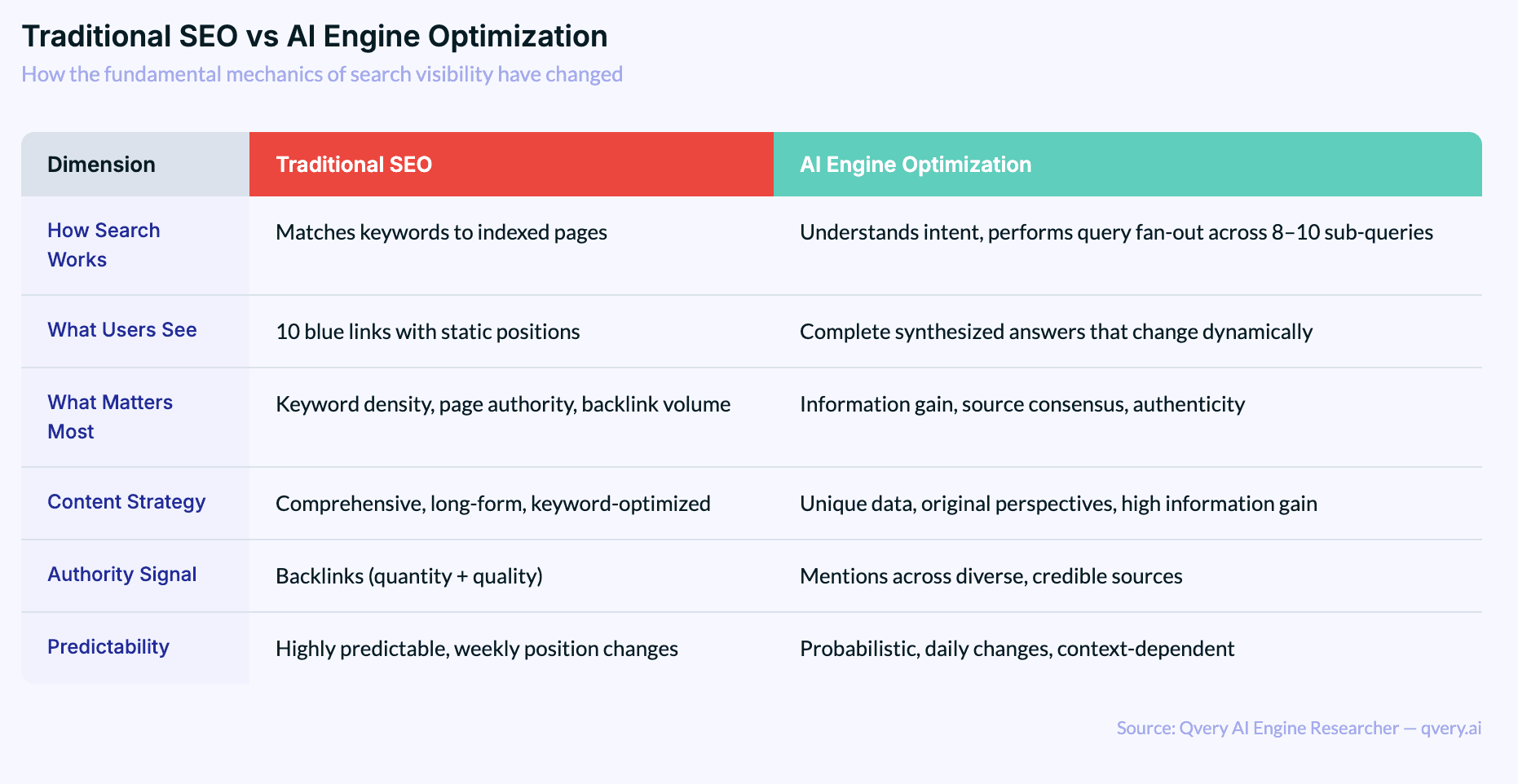
How Search Works: Traditional SEO matches keywords to indexed pages. AI Engine Optimization understands intent and performs query fan-out across 8–10 sub-queries.
What Users See: Traditional SEO shows 10 blue links with static positions. AI engines deliver complete synthesized answers that change dynamically.
What Matters Most: Traditional SEO rewards keyword density, page authority, and backlink volume. AI engines reward information gain, source consensus, and authenticity.
Content Strategy: Traditional SEO favors comprehensive, long-form, keyword-optimized content. AI engines favor unique data, original perspectives, and high information gain.
Authority Signal: Traditional SEO relies on backlinks (quantity + quality). AI engines look for mentions across diverse, credible sources.
Predictability: Traditional SEO is highly predictable with weekly position changes and slow climbs. AI engines are probabilistic, with daily changes and context-dependent results.
Pillar One: Your Website Still Matters (But Not the Way It Used To)
Your own website is still your single best opportunity to influence how AI search engines perceive your brand. That hasn't changed. What has changed completely is what “good content” means.
Five years ago, content strategy meant creating massive pages packed with comprehensive information. Skyscraper content was king: cover every angle, hit 3,000 words, earn some backlinks, and watch it slowly climb Google's rankings.
AI search engines don't care about comprehensive. They care about unique.
The concept is called information gain: content that the search engine cannot find anywhere else on the web. Real experiences. Original data. Case studies with actual numbers. Your unique perspective on why something works or doesn't. The kind of content that makes the AI engine stop and say: “This adds something new.”
Here's why this matters mechanically. AI search engines have two modes: answering from training data (stuff they already know) or performing a web search (when they need something fresh or specific). When they go to the web, they're spending valuable compute resources looking for something they don't already have. If your page says the same thing as 50 other pages, it's noise. If it says something genuinely different, it's signal.
Generic listicles, rewritten competitor content, and AI-generated filler have lost their weight in AI search engines. The bar has been raised, and it's not coming back down.
How To Measure Your Website's Pillar in Qvery
In Qvery, we track something we internally call owned domain weight: the percentage of all citations in your space that point to your own website. Open the Citations module, filter by your own domain, and check what share of total citations you own.
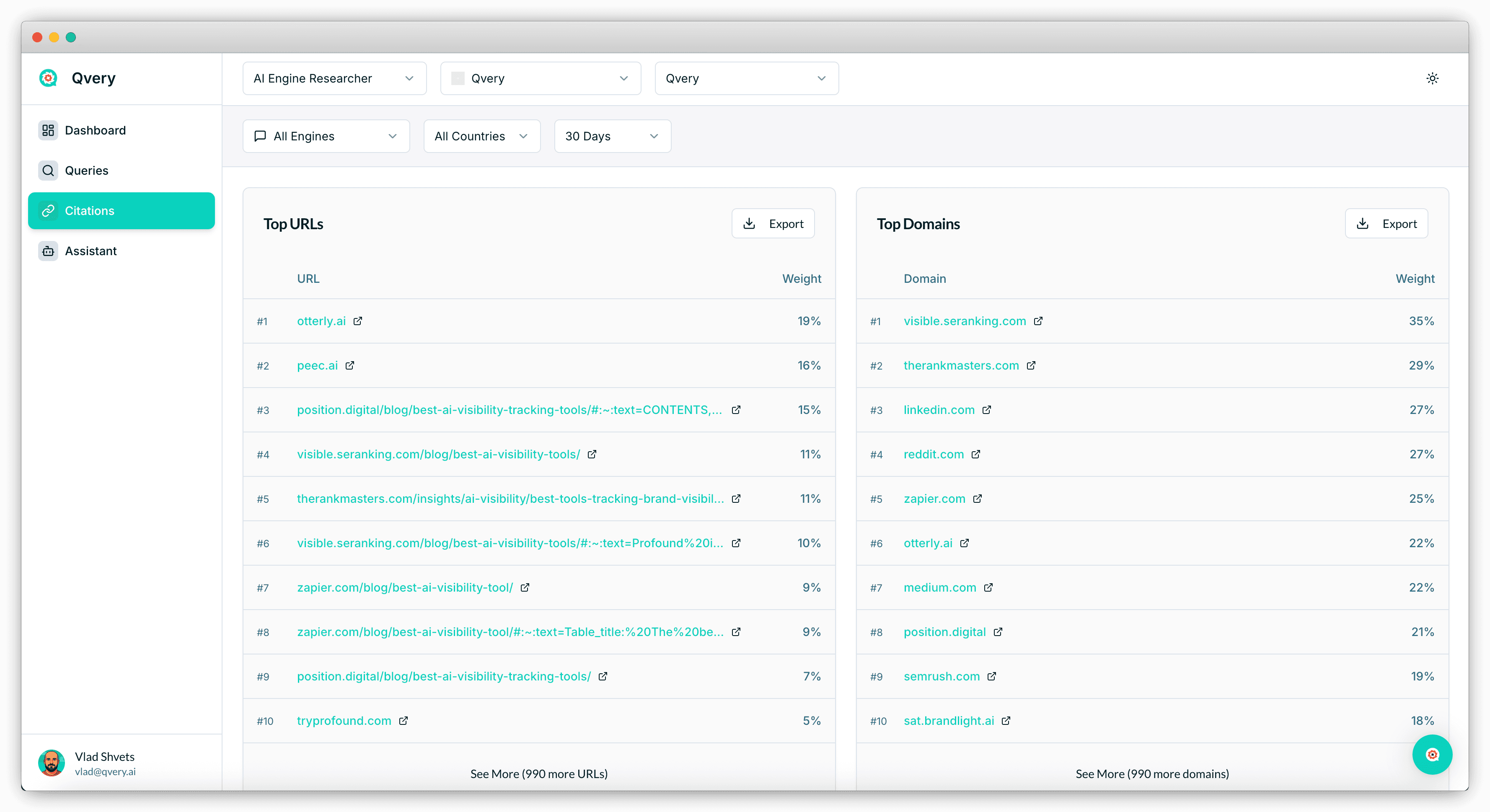
If your website accounts for, say, 10% of all citations pulled by AI engines in your space, that's actually a very strong number. Most brands sit well below that. If you're at 2–3%, your website content isn't generating enough information gain to be cited. You need to invest in original content: unique data, case studies, expert perspectives, and first-hand experiences that AI engines can't find anywhere else.
The key metric to watch: the trend of your owned citation share over time. As you publish higher-quality content, that number should climb. If it's flat or declining, the content you're creating isn't differentiated enough.
Pillar Two: Third-Party Mentions Build the Consensus
AI search engines don't just visit your website and take your word for it. They cross-reference. They check what other sources say about your brand, your product, your space, and then they triangulate a recommendation.
This is exactly what you used to do manually. Search Google, open five pages, compare recommendations, build a mental shortlist. AI engines automate that entire process. They visit multiple sources, check the consensus, and generate a recommendation based on it.
This is why being mentioned on industry blogs, software directories, comparison sites, review platforms, and even competitor pages is critical. Every mention on a credible external source is a vote of confidence that the AI engine factors into its answer.
Here's something most marketers overlook: it's in everyone's mutual interest to be cross-referenced. Even with competitors. If you and your competitor both clearly explain how you're different and which use cases each of you serves best, the market splits more transparently. Consumers get better information. AI engines get cleaner data to generate better recommendations. Everybody wins.
Building third-party mentions is relationship work: bloggers, affiliates, influencers, industry analysts. It requires genuine outreach, genuine value, and a willingness to be transparent about what your product does and doesn't do well. But every credible external mention compounds over time. AI search engines notice when multiple independent sources agree.
How To Measure Third-Party Mentions in Qvery
In Qvery's Citations module, you can see every external domain that AI engines cite when they discuss your space. Filter out your own domain and UGC sources. What's left is your third-party mention landscape.
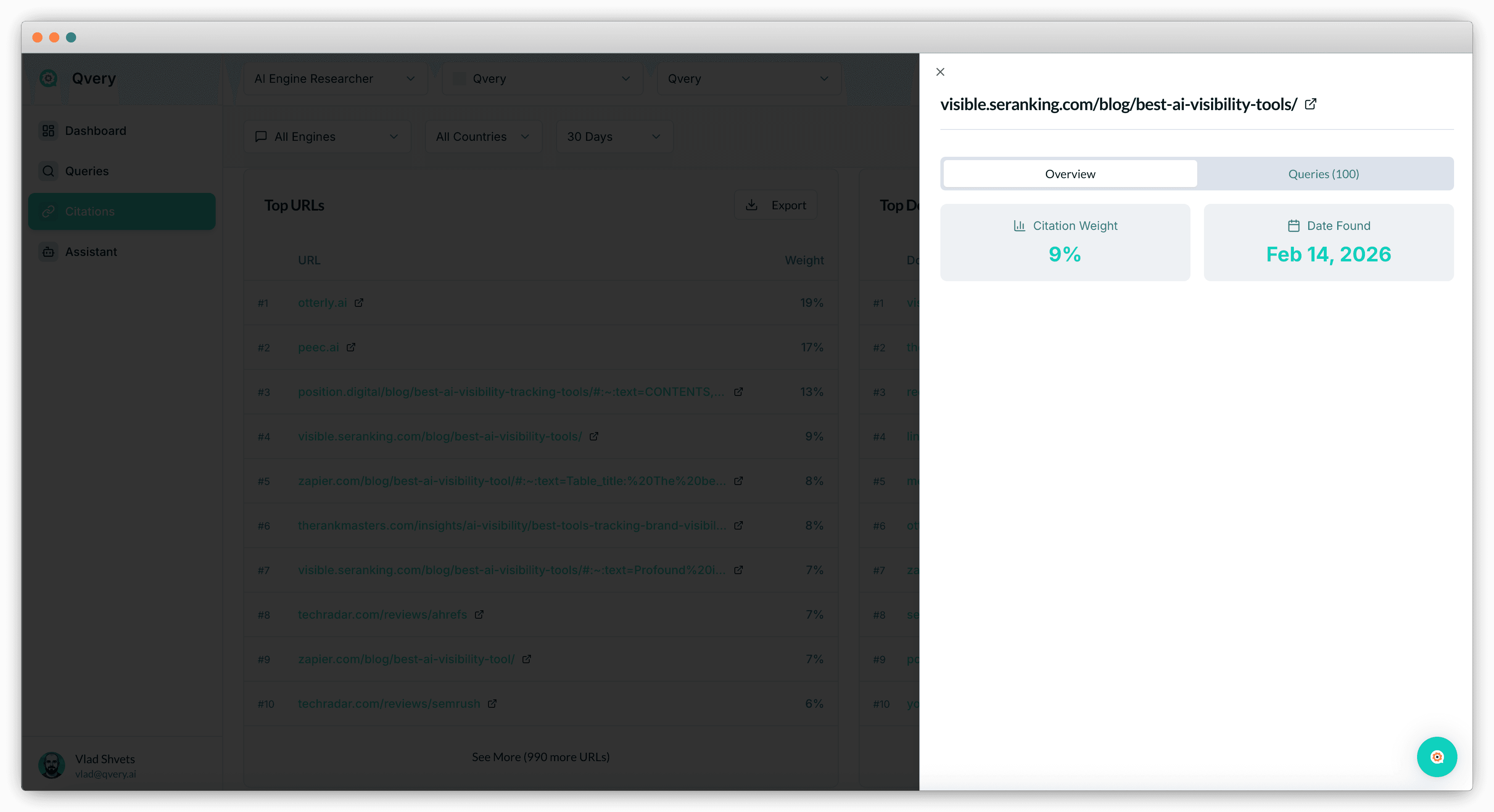
Look at two things. First, how many unique external domains cite your brand. If the answer is three, you have a mentions problem. If it's 30+, you're building consensus.
Second, which domains cite your competitors but not you. Those are your outreach targets: the blogs, directories, and comparison sites where your brand should be present but isn't.
Pillar Three: UGC Is the Authenticity Signal (And Reddit Runs It)
User-generated content is the third pillar, and arguably the most underestimated.
Both OpenAI and Google pull data from Reddit directly through the Reddit API. They know that people go to Reddit to share genuine, unfiltered recommendations. No PR teams. No content marketing spin. Just real humans talking about what actually works and what doesn't. For AI engines looking for authentic signal, Reddit is a gold mine.
Our data at Qvery confirms it. Reddit is the third most cited well-known domain on both platforms, behind only google.com and Wikipedia. Google AI Mode gives Reddit significantly higher placement when it does cite it (average position 10.15 vs. ChatGPT's 12.76).
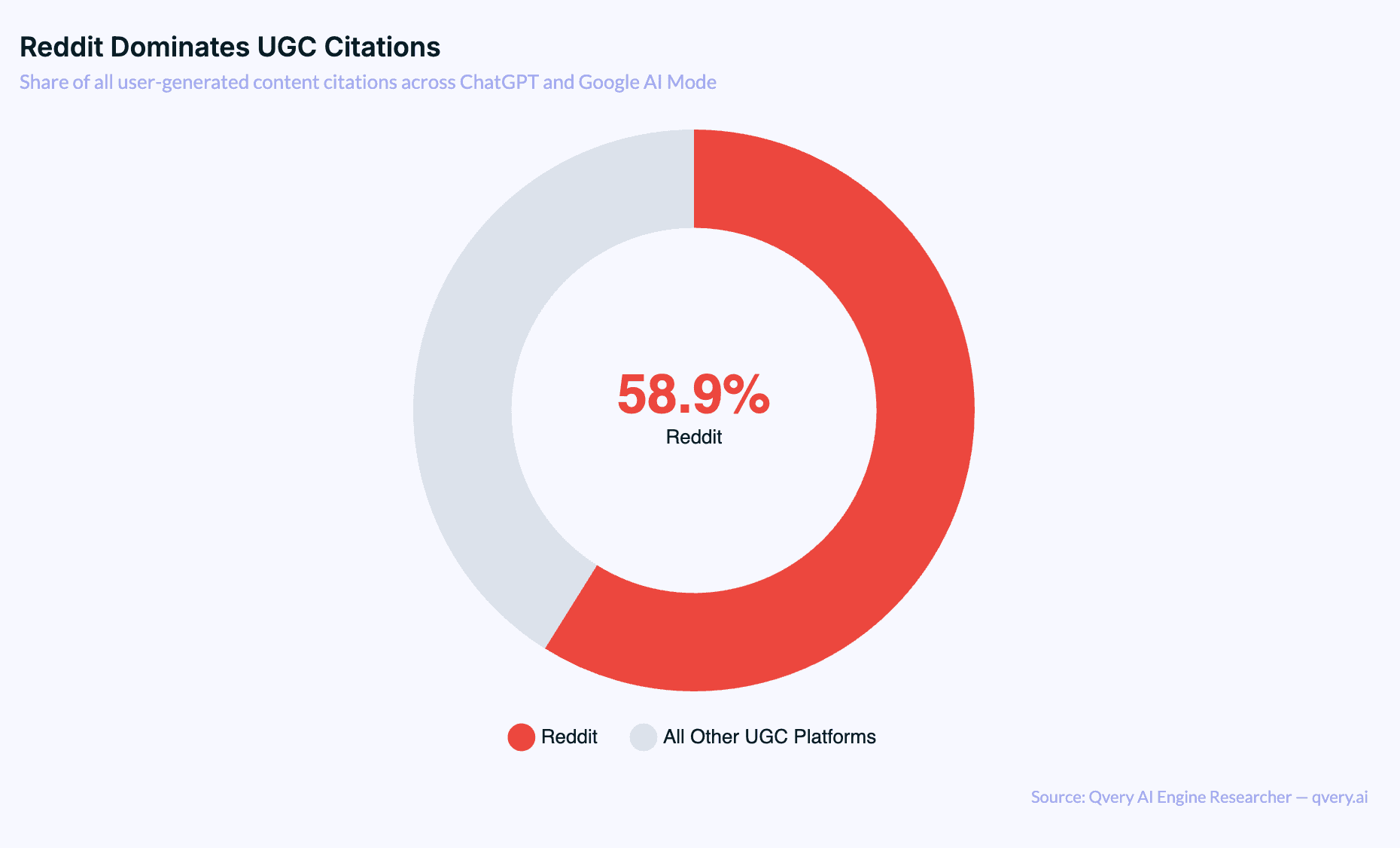
According to Qvery's proprietary citation data, Reddit accounts for 58.9% of all UGC citations across ChatGPT and Google AI Mode. Three out of every five UGC citations come from Reddit.
When you think about it, the number makes sense. Reddit has over 80 million weekly searchers. It's the largest collection of authentic, topical, user-generated recommendations on the internet. AI engines trust it precisely because it's messy, opinionated, and human.
The challenge for marketers is that Reddit mentions can't be manufactured. You can't run an ad campaign and expect it to show up in AI citations. (If only it were that easy.) To be constantly discussed on Reddit, you need a strong brand. You need genuine users who care enough to recommend you unprompted. You need to show up authentically in the communities where your customers already spend time.
This is a long game. But it's also the highest-leverage play for AI engine visibility.
How To Measure UGC in Qvery
The question to ask yourself: are people talking about your brand on Reddit right now? If the answer is no, or barely, that's your biggest growth opportunity. Not because Reddit is a marketing channel, but because it's the authenticity signal that AI engines rely on to validate whether a brand is genuinely used and recommended by real people.
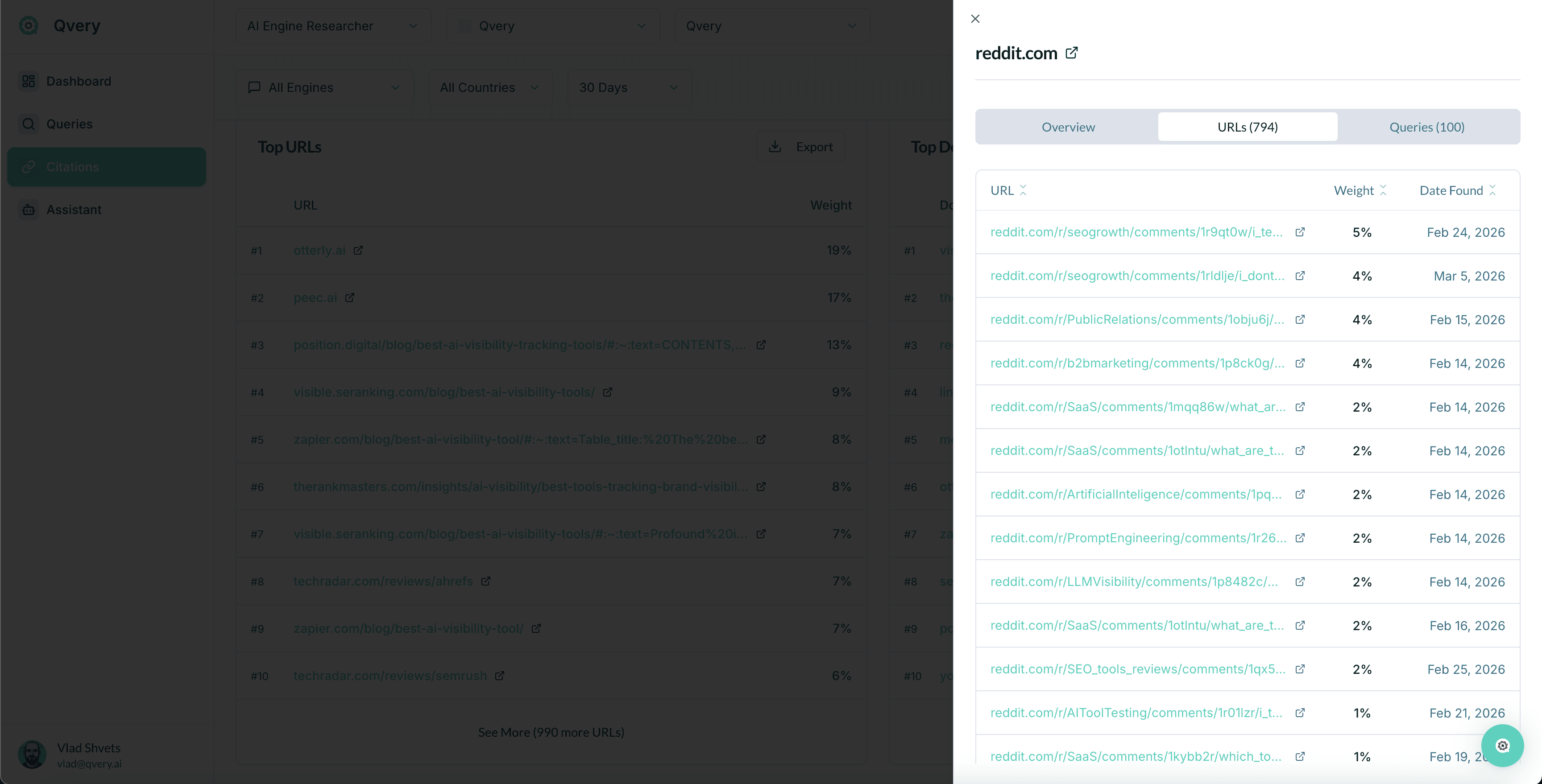
Qvery surfaces these UGC citations so you know exactly where you stand. You can check which competitors get mentioned on Reddit and which conversations your brand is absent from. That's your starting point for community engagement: not fake posts, but genuine participation in the spaces where your customers already talk.
Where Should You Invest? (Use Your Data to Decide)
The three pillars don't require equal investment from every brand. Your situation is different from your competitor's. The question isn't “which pillar matters most?” It's “which pillar is weakest for you right now?”
Here's how to diagnose it:
How strong is your website? Check your owned domain weight in Qvery's Citations module. If your own website constitutes less than 5% of citations in your space, you need more high-information-gain content.
Where are your third-party mentions? Compare your citation sources against competitors. If they're getting mentioned on 20 external domains and you're on 5, that's your outreach gap.
Are you getting UGC mentions? Filter citations by UGC sources. If Reddit barely knows you exist, no amount of website optimization will fill that gap. Invest in brand building and community engagement.
It doesn't matter which pillar is most important in theory. What matters is which one is weakest for your brand right now. That's where the biggest gains are.
SEO Is the Foundation. AI Visibility Is the Building.
Let me be clear: SEO isn't irrelevant. It's the foundation. Your website still needs solid technical architecture. You still need quality content. Backlinks still matter for domain authority and credibility.
But SEO alone won't make you visible in AI search engines. It's necessary, not sufficient.
Your website delivers information gain. Third-party mentions build consensus. UGC provides authenticity. No single pillar substitutes for the other two.
Google AI Mode is already live in over 200 countries. By the end of 2026, it will likely be the default search experience for most users. The brands that understand these three pillars, and invest in all of them, will be the ones getting recommended.
The ones still optimizing for position 7? They'll be optimizing for a search results page that fewer and fewer people will ever see.
For 20 years, SEO had a formula.
Everyone knew it. Technical SEO as the foundation, pile on content, and multiply it all with backlinks. The more backlinks you had, the harder your content hit. It was predictable. It was grindable. And if you were patient enough to celebrate moving from position 8 to position 7 over three weeks, honestly, you deserved a trophy. (Stockholm syndrome is real.)
That formula is dead. Not dying, dead.
AI search engines don't match keywords to indexed pages. They don't serve you 10 blue links and wish you good luck. They understand your intent, decompose your query into dozens of sub-queries, retrieve passages from across the web, cross-reference sources, and generate a complete answer. All before you finish your coffee.
The old equation looked like this:
The Old SEO Equation: Visibility = Technical SEO + Content×Backlinks. Backlinks were the exponent. The more you built, the harder your content performed.
The new equation looks nothing like it:
The New Equation: AI Visibility = Your Website + Third-Party Mentions + UGC. Three independent pillars. Miss one, and the other two can't compensate.
Let me break down what changed, why it changed, and what you should actually do about it.
AI Search Doesn't Match Keywords. It Understands Intent.
Before we get to the pillars, you need to understand why the formula changed. This isn't a tweak to the algorithm. It's a fundamentally different architecture for how search works.
When you type something into ChatGPT or Google AI Mode, the search engine doesn't look for pages that match your words. It understands what you're actually trying to accomplish. Then it does something called query fan-out, breaking your single query into 8–10 parallel sub-queries, each approaching your question from a different angle.
It's like asking one question and having the AI hire a research team of 10 analysts who each go investigate a slightly different aspect of your problem. Simultaneously. They come back, compare notes, and hand you one synthesized answer. (Your junior marketer could never.)
This means two people searching for the same thing using completely different words will get essentially the same answer. It's not about how the query is phrased. It's about the use case behind it.
It's not how the query is written. It's the use case behind the query. Two queries could use completely different words, have completely different lengths, and still be about the exact same thing. The search engine knows that. That's a fundamental shift from keyword matching to intent understanding.
The results are also probabilistic. They change daily based on your location, language, conversation history, and context. There are no fixed positions. No stable “rankings.” The same query run tomorrow might cite completely different sources.
This is why the old SEO equation doesn't work. You can't keyword-optimize your way into a system that doesn't think in keywords.
How Search Works: Traditional SEO matches keywords to indexed pages. AI Engine Optimization understands intent and performs query fan-out across 8–10 sub-queries.
What Users See: Traditional SEO shows 10 blue links with static positions. AI engines deliver complete synthesized answers that change dynamically.
What Matters Most: Traditional SEO rewards keyword density, page authority, and backlink volume. AI engines reward information gain, source consensus, and authenticity.
Content Strategy: Traditional SEO favors comprehensive, long-form, keyword-optimized content. AI engines favor unique data, original perspectives, and high information gain.
Authority Signal: Traditional SEO relies on backlinks (quantity + quality). AI engines look for mentions across diverse, credible sources.
Predictability: Traditional SEO is highly predictable with weekly position changes and slow climbs. AI engines are probabilistic, with daily changes and context-dependent results.
Pillar One: Your Website Still Matters (But Not the Way It Used To)
Your own website is still your single best opportunity to influence how AI search engines perceive your brand. That hasn't changed. What has changed completely is what “good content” means.
Five years ago, content strategy meant creating massive pages packed with comprehensive information. Skyscraper content was king: cover every angle, hit 3,000 words, earn some backlinks, and watch it slowly climb Google's rankings.
AI search engines don't care about comprehensive. They care about unique.
The concept is called information gain: content that the search engine cannot find anywhere else on the web. Real experiences. Original data. Case studies with actual numbers. Your unique perspective on why something works or doesn't. The kind of content that makes the AI engine stop and say: “This adds something new.”
Here's why this matters mechanically. AI search engines have two modes: answering from training data (stuff they already know) or performing a web search (when they need something fresh or specific). When they go to the web, they're spending valuable compute resources looking for something they don't already have. If your page says the same thing as 50 other pages, it's noise. If it says something genuinely different, it's signal.
Generic listicles, rewritten competitor content, and AI-generated filler have lost their weight in AI search engines. The bar has been raised, and it's not coming back down.
How To Measure Your Website's Pillar in Qvery
In Qvery, we track something we internally call owned domain weight: the percentage of all citations in your space that point to your own website. Open the Citations module, filter by your own domain, and check what share of total citations you own.
If your website accounts for, say, 10% of all citations pulled by AI engines in your space, that's actually a very strong number. Most brands sit well below that. If you're at 2–3%, your website content isn't generating enough information gain to be cited. You need to invest in original content: unique data, case studies, expert perspectives, and first-hand experiences that AI engines can't find anywhere else.
The key metric to watch: the trend of your owned citation share over time. As you publish higher-quality content, that number should climb. If it's flat or declining, the content you're creating isn't differentiated enough.
Pillar Two: Third-Party Mentions Build the Consensus
AI search engines don't just visit your website and take your word for it. They cross-reference. They check what other sources say about your brand, your product, your space, and then they triangulate a recommendation.
This is exactly what you used to do manually. Search Google, open five pages, compare recommendations, build a mental shortlist. AI engines automate that entire process. They visit multiple sources, check the consensus, and generate a recommendation based on it.
This is why being mentioned on industry blogs, software directories, comparison sites, review platforms, and even competitor pages is critical. Every mention on a credible external source is a vote of confidence that the AI engine factors into its answer.
Here's something most marketers overlook: it's in everyone's mutual interest to be cross-referenced. Even with competitors. If you and your competitor both clearly explain how you're different and which use cases each of you serves best, the market splits more transparently. Consumers get better information. AI engines get cleaner data to generate better recommendations. Everybody wins.
Building third-party mentions is relationship work: bloggers, affiliates, influencers, industry analysts. It requires genuine outreach, genuine value, and a willingness to be transparent about what your product does and doesn't do well. But every credible external mention compounds over time. AI search engines notice when multiple independent sources agree.
How To Measure Third-Party Mentions in Qvery
In Qvery's Citations module, you can see every external domain that AI engines cite when they discuss your space. Filter out your own domain and UGC sources. What's left is your third-party mention landscape.
Look at two things. First, how many unique external domains cite your brand. If the answer is three, you have a mentions problem. If it's 30+, you're building consensus.
Second, which domains cite your competitors but not you. Those are your outreach targets: the blogs, directories, and comparison sites where your brand should be present but isn't.
Pillar Three: UGC Is the Authenticity Signal (And Reddit Runs It)
User-generated content is the third pillar, and arguably the most underestimated.
Both OpenAI and Google pull data from Reddit directly through the Reddit API. They know that people go to Reddit to share genuine, unfiltered recommendations. No PR teams. No content marketing spin. Just real humans talking about what actually works and what doesn't. For AI engines looking for authentic signal, Reddit is a gold mine.
Our data at Qvery confirms it. Reddit is the third most cited well-known domain on both platforms, behind only google.com and Wikipedia. Google AI Mode gives Reddit significantly higher placement when it does cite it (average position 10.15 vs. ChatGPT's 12.76).
According to Qvery's proprietary citation data, Reddit accounts for 58.9% of all UGC citations across ChatGPT and Google AI Mode. Three out of every five UGC citations come from Reddit.
When you think about it, the number makes sense. Reddit has over 80 million weekly searchers. It's the largest collection of authentic, topical, user-generated recommendations on the internet. AI engines trust it precisely because it's messy, opinionated, and human.
The challenge for marketers is that Reddit mentions can't be manufactured. You can't run an ad campaign and expect it to show up in AI citations. (If only it were that easy.) To be constantly discussed on Reddit, you need a strong brand. You need genuine users who care enough to recommend you unprompted. You need to show up authentically in the communities where your customers already spend time.
This is a long game. But it's also the highest-leverage play for AI engine visibility.
How To Measure UGC in Qvery
The question to ask yourself: are people talking about your brand on Reddit right now? If the answer is no, or barely, that's your biggest growth opportunity. Not because Reddit is a marketing channel, but because it's the authenticity signal that AI engines rely on to validate whether a brand is genuinely used and recommended by real people.
Qvery surfaces these UGC citations so you know exactly where you stand. You can check which competitors get mentioned on Reddit and which conversations your brand is absent from. That's your starting point for community engagement: not fake posts, but genuine participation in the spaces where your customers already talk.
Where Should You Invest? (Use Your Data to Decide)
The three pillars don't require equal investment from every brand. Your situation is different from your competitor's. The question isn't “which pillar matters most?” It's “which pillar is weakest for you right now?”
Here's how to diagnose it:
How strong is your website? Check your owned domain weight in Qvery's Citations module. If your own website constitutes less than 5% of citations in your space, you need more high-information-gain content.
Where are your third-party mentions? Compare your citation sources against competitors. If they're getting mentioned on 20 external domains and you're on 5, that's your outreach gap.
Are you getting UGC mentions? Filter citations by UGC sources. If Reddit barely knows you exist, no amount of website optimization will fill that gap. Invest in brand building and community engagement.
It doesn't matter which pillar is most important in theory. What matters is which one is weakest for your brand right now. That's where the biggest gains are.
SEO Is the Foundation. AI Visibility Is the Building.
Let me be clear: SEO isn't irrelevant. It's the foundation. Your website still needs solid technical architecture. You still need quality content. Backlinks still matter for domain authority and credibility.
But SEO alone won't make you visible in AI search engines. It's necessary, not sufficient.
Your website delivers information gain. Third-party mentions build consensus. UGC provides authenticity. No single pillar substitutes for the other two.
Google AI Mode is already live in over 200 countries. By the end of 2026, it will likely be the default search experience for most users. The brands that understand these three pillars, and invest in all of them, will be the ones getting recommended.
The ones still optimizing for position 7? They'll be optimizing for a search results page that fewer and fewer people will ever see.
For 20 years, SEO had a formula.
Everyone knew it. Technical SEO as the foundation, pile on content, and multiply it all with backlinks. The more backlinks you had, the harder your content hit. It was predictable. It was grindable. And if you were patient enough to celebrate moving from position 8 to position 7 over three weeks, honestly, you deserved a trophy. (Stockholm syndrome is real.)
That formula is dead. Not dying, dead.
AI search engines don't match keywords to indexed pages. They don't serve you 10 blue links and wish you good luck. They understand your intent, decompose your query into dozens of sub-queries, retrieve passages from across the web, cross-reference sources, and generate a complete answer. All before you finish your coffee.
The old equation looked like this:
The Old SEO Equation: Visibility = Technical SEO + Content×Backlinks. Backlinks were the exponent. The more you built, the harder your content performed.
The new equation looks nothing like it:
The New Equation: AI Visibility = Your Website + Third-Party Mentions + UGC. Three independent pillars. Miss one, and the other two can't compensate.
Let me break down what changed, why it changed, and what you should actually do about it.
AI Search Doesn't Match Keywords. It Understands Intent.
Before we get to the pillars, you need to understand why the formula changed. This isn't a tweak to the algorithm. It's a fundamentally different architecture for how search works.
When you type something into ChatGPT or Google AI Mode, the search engine doesn't look for pages that match your words. It understands what you're actually trying to accomplish. Then it does something called query fan-out, breaking your single query into 8–10 parallel sub-queries, each approaching your question from a different angle.
It's like asking one question and having the AI hire a research team of 10 analysts who each go investigate a slightly different aspect of your problem. Simultaneously. They come back, compare notes, and hand you one synthesized answer. (Your junior marketer could never.)
This means two people searching for the same thing using completely different words will get essentially the same answer. It's not about how the query is phrased. It's about the use case behind it.
It's not how the query is written. It's the use case behind the query. Two queries could use completely different words, have completely different lengths, and still be about the exact same thing. The search engine knows that. That's a fundamental shift from keyword matching to intent understanding.
The results are also probabilistic. They change daily based on your location, language, conversation history, and context. There are no fixed positions. No stable “rankings.” The same query run tomorrow might cite completely different sources.
This is why the old SEO equation doesn't work. You can't keyword-optimize your way into a system that doesn't think in keywords.
How Search Works: Traditional SEO matches keywords to indexed pages. AI Engine Optimization understands intent and performs query fan-out across 8–10 sub-queries.
What Users See: Traditional SEO shows 10 blue links with static positions. AI engines deliver complete synthesized answers that change dynamically.
What Matters Most: Traditional SEO rewards keyword density, page authority, and backlink volume. AI engines reward information gain, source consensus, and authenticity.
Content Strategy: Traditional SEO favors comprehensive, long-form, keyword-optimized content. AI engines favor unique data, original perspectives, and high information gain.
Authority Signal: Traditional SEO relies on backlinks (quantity + quality). AI engines look for mentions across diverse, credible sources.
Predictability: Traditional SEO is highly predictable with weekly position changes and slow climbs. AI engines are probabilistic, with daily changes and context-dependent results.
Pillar One: Your Website Still Matters (But Not the Way It Used To)
Your own website is still your single best opportunity to influence how AI search engines perceive your brand. That hasn't changed. What has changed completely is what “good content” means.
Five years ago, content strategy meant creating massive pages packed with comprehensive information. Skyscraper content was king: cover every angle, hit 3,000 words, earn some backlinks, and watch it slowly climb Google's rankings.
AI search engines don't care about comprehensive. They care about unique.
The concept is called information gain: content that the search engine cannot find anywhere else on the web. Real experiences. Original data. Case studies with actual numbers. Your unique perspective on why something works or doesn't. The kind of content that makes the AI engine stop and say: “This adds something new.”
Here's why this matters mechanically. AI search engines have two modes: answering from training data (stuff they already know) or performing a web search (when they need something fresh or specific). When they go to the web, they're spending valuable compute resources looking for something they don't already have. If your page says the same thing as 50 other pages, it's noise. If it says something genuinely different, it's signal.
Generic listicles, rewritten competitor content, and AI-generated filler have lost their weight in AI search engines. The bar has been raised, and it's not coming back down.
How To Measure Your Website's Pillar in Qvery
In Qvery, we track something we internally call owned domain weight: the percentage of all citations in your space that point to your own website. Open the Citations module, filter by your own domain, and check what share of total citations you own.
If your website accounts for, say, 10% of all citations pulled by AI engines in your space, that's actually a very strong number. Most brands sit well below that. If you're at 2–3%, your website content isn't generating enough information gain to be cited. You need to invest in original content: unique data, case studies, expert perspectives, and first-hand experiences that AI engines can't find anywhere else.
The key metric to watch: the trend of your owned citation share over time. As you publish higher-quality content, that number should climb. If it's flat or declining, the content you're creating isn't differentiated enough.
Pillar Two: Third-Party Mentions Build the Consensus
AI search engines don't just visit your website and take your word for it. They cross-reference. They check what other sources say about your brand, your product, your space, and then they triangulate a recommendation.
This is exactly what you used to do manually. Search Google, open five pages, compare recommendations, build a mental shortlist. AI engines automate that entire process. They visit multiple sources, check the consensus, and generate a recommendation based on it.
This is why being mentioned on industry blogs, software directories, comparison sites, review platforms, and even competitor pages is critical. Every mention on a credible external source is a vote of confidence that the AI engine factors into its answer.
Here's something most marketers overlook: it's in everyone's mutual interest to be cross-referenced. Even with competitors. If you and your competitor both clearly explain how you're different and which use cases each of you serves best, the market splits more transparently. Consumers get better information. AI engines get cleaner data to generate better recommendations. Everybody wins.
Building third-party mentions is relationship work: bloggers, affiliates, influencers, industry analysts. It requires genuine outreach, genuine value, and a willingness to be transparent about what your product does and doesn't do well. But every credible external mention compounds over time. AI search engines notice when multiple independent sources agree.
How To Measure Third-Party Mentions in Qvery
In Qvery's Citations module, you can see every external domain that AI engines cite when they discuss your space. Filter out your own domain and UGC sources. What's left is your third-party mention landscape.
Look at two things. First, how many unique external domains cite your brand. If the answer is three, you have a mentions problem. If it's 30+, you're building consensus.
Second, which domains cite your competitors but not you. Those are your outreach targets: the blogs, directories, and comparison sites where your brand should be present but isn't.
Pillar Three: UGC Is the Authenticity Signal (And Reddit Runs It)
User-generated content is the third pillar, and arguably the most underestimated.
Both OpenAI and Google pull data from Reddit directly through the Reddit API. They know that people go to Reddit to share genuine, unfiltered recommendations. No PR teams. No content marketing spin. Just real humans talking about what actually works and what doesn't. For AI engines looking for authentic signal, Reddit is a gold mine.
Our data at Qvery confirms it. Reddit is the third most cited well-known domain on both platforms, behind only google.com and Wikipedia. Google AI Mode gives Reddit significantly higher placement when it does cite it (average position 10.15 vs. ChatGPT's 12.76).
According to Qvery's proprietary citation data, Reddit accounts for 58.9% of all UGC citations across ChatGPT and Google AI Mode. Three out of every five UGC citations come from Reddit.
When you think about it, the number makes sense. Reddit has over 80 million weekly searchers. It's the largest collection of authentic, topical, user-generated recommendations on the internet. AI engines trust it precisely because it's messy, opinionated, and human.
The challenge for marketers is that Reddit mentions can't be manufactured. You can't run an ad campaign and expect it to show up in AI citations. (If only it were that easy.) To be constantly discussed on Reddit, you need a strong brand. You need genuine users who care enough to recommend you unprompted. You need to show up authentically in the communities where your customers already spend time.
This is a long game. But it's also the highest-leverage play for AI engine visibility.
How To Measure UGC in Qvery
The question to ask yourself: are people talking about your brand on Reddit right now? If the answer is no, or barely, that's your biggest growth opportunity. Not because Reddit is a marketing channel, but because it's the authenticity signal that AI engines rely on to validate whether a brand is genuinely used and recommended by real people.
Qvery surfaces these UGC citations so you know exactly where you stand. You can check which competitors get mentioned on Reddit and which conversations your brand is absent from. That's your starting point for community engagement: not fake posts, but genuine participation in the spaces where your customers already talk.
Where Should You Invest? (Use Your Data to Decide)
The three pillars don't require equal investment from every brand. Your situation is different from your competitor's. The question isn't “which pillar matters most?” It's “which pillar is weakest for you right now?”
Here's how to diagnose it:
How strong is your website? Check your owned domain weight in Qvery's Citations module. If your own website constitutes less than 5% of citations in your space, you need more high-information-gain content.
Where are your third-party mentions? Compare your citation sources against competitors. If they're getting mentioned on 20 external domains and you're on 5, that's your outreach gap.
Are you getting UGC mentions? Filter citations by UGC sources. If Reddit barely knows you exist, no amount of website optimization will fill that gap. Invest in brand building and community engagement.
It doesn't matter which pillar is most important in theory. What matters is which one is weakest for your brand right now. That's where the biggest gains are.
SEO Is the Foundation. AI Visibility Is the Building.
Let me be clear: SEO isn't irrelevant. It's the foundation. Your website still needs solid technical architecture. You still need quality content. Backlinks still matter for domain authority and credibility.
But SEO alone won't make you visible in AI search engines. It's necessary, not sufficient.
Your website delivers information gain. Third-party mentions build consensus. UGC provides authenticity. No single pillar substitutes for the other two.
Google AI Mode is already live in over 200 countries. By the end of 2026, it will likely be the default search experience for most users. The brands that understand these three pillars, and invest in all of them, will be the ones getting recommended.
The ones still optimizing for position 7? They'll be optimizing for a search results page that fewer and fewer people will ever see.
For 20 years, SEO had a formula.
Everyone knew it. Technical SEO as the foundation, pile on content, and multiply it all with backlinks. The more backlinks you had, the harder your content hit. It was predictable. It was grindable. And if you were patient enough to celebrate moving from position 8 to position 7 over three weeks, honestly, you deserved a trophy. (Stockholm syndrome is real.)
That formula is dead. Not dying, dead.
AI search engines don't match keywords to indexed pages. They don't serve you 10 blue links and wish you good luck. They understand your intent, decompose your query into dozens of sub-queries, retrieve passages from across the web, cross-reference sources, and generate a complete answer. All before you finish your coffee.
The old equation looked like this:
The Old SEO Equation: Visibility = Technical SEO + Content×Backlinks. Backlinks were the exponent. The more you built, the harder your content performed.
The new equation looks nothing like it:
The New Equation: AI Visibility = Your Website + Third-Party Mentions + UGC. Three independent pillars. Miss one, and the other two can't compensate.
Let me break down what changed, why it changed, and what you should actually do about it.
AI Search Doesn't Match Keywords. It Understands Intent.
Before we get to the pillars, you need to understand why the formula changed. This isn't a tweak to the algorithm. It's a fundamentally different architecture for how search works.
When you type something into ChatGPT or Google AI Mode, the search engine doesn't look for pages that match your words. It understands what you're actually trying to accomplish. Then it does something called query fan-out, breaking your single query into 8–10 parallel sub-queries, each approaching your question from a different angle.
It's like asking one question and having the AI hire a research team of 10 analysts who each go investigate a slightly different aspect of your problem. Simultaneously. They come back, compare notes, and hand you one synthesized answer. (Your junior marketer could never.)
This means two people searching for the same thing using completely different words will get essentially the same answer. It's not about how the query is phrased. It's about the use case behind it.
It's not how the query is written. It's the use case behind the query. Two queries could use completely different words, have completely different lengths, and still be about the exact same thing. The search engine knows that. That's a fundamental shift from keyword matching to intent understanding.
The results are also probabilistic. They change daily based on your location, language, conversation history, and context. There are no fixed positions. No stable “rankings.” The same query run tomorrow might cite completely different sources.
This is why the old SEO equation doesn't work. You can't keyword-optimize your way into a system that doesn't think in keywords.
How Search Works: Traditional SEO matches keywords to indexed pages. AI Engine Optimization understands intent and performs query fan-out across 8–10 sub-queries.
What Users See: Traditional SEO shows 10 blue links with static positions. AI engines deliver complete synthesized answers that change dynamically.
What Matters Most: Traditional SEO rewards keyword density, page authority, and backlink volume. AI engines reward information gain, source consensus, and authenticity.
Content Strategy: Traditional SEO favors comprehensive, long-form, keyword-optimized content. AI engines favor unique data, original perspectives, and high information gain.
Authority Signal: Traditional SEO relies on backlinks (quantity + quality). AI engines look for mentions across diverse, credible sources.
Predictability: Traditional SEO is highly predictable with weekly position changes and slow climbs. AI engines are probabilistic, with daily changes and context-dependent results.
Pillar One: Your Website Still Matters (But Not the Way It Used To)
Your own website is still your single best opportunity to influence how AI search engines perceive your brand. That hasn't changed. What has changed completely is what “good content” means.
Five years ago, content strategy meant creating massive pages packed with comprehensive information. Skyscraper content was king: cover every angle, hit 3,000 words, earn some backlinks, and watch it slowly climb Google's rankings.
AI search engines don't care about comprehensive. They care about unique.
The concept is called information gain: content that the search engine cannot find anywhere else on the web. Real experiences. Original data. Case studies with actual numbers. Your unique perspective on why something works or doesn't. The kind of content that makes the AI engine stop and say: “This adds something new.”
Here's why this matters mechanically. AI search engines have two modes: answering from training data (stuff they already know) or performing a web search (when they need something fresh or specific). When they go to the web, they're spending valuable compute resources looking for something they don't already have. If your page says the same thing as 50 other pages, it's noise. If it says something genuinely different, it's signal.
Generic listicles, rewritten competitor content, and AI-generated filler have lost their weight in AI search engines. The bar has been raised, and it's not coming back down.
How To Measure Your Website's Pillar in Qvery
In Qvery, we track something we internally call owned domain weight: the percentage of all citations in your space that point to your own website. Open the Citations module, filter by your own domain, and check what share of total citations you own.
If your website accounts for, say, 10% of all citations pulled by AI engines in your space, that's actually a very strong number. Most brands sit well below that. If you're at 2–3%, your website content isn't generating enough information gain to be cited. You need to invest in original content: unique data, case studies, expert perspectives, and first-hand experiences that AI engines can't find anywhere else.
The key metric to watch: the trend of your owned citation share over time. As you publish higher-quality content, that number should climb. If it's flat or declining, the content you're creating isn't differentiated enough.
Pillar Two: Third-Party Mentions Build the Consensus
AI search engines don't just visit your website and take your word for it. They cross-reference. They check what other sources say about your brand, your product, your space, and then they triangulate a recommendation.
This is exactly what you used to do manually. Search Google, open five pages, compare recommendations, build a mental shortlist. AI engines automate that entire process. They visit multiple sources, check the consensus, and generate a recommendation based on it.
This is why being mentioned on industry blogs, software directories, comparison sites, review platforms, and even competitor pages is critical. Every mention on a credible external source is a vote of confidence that the AI engine factors into its answer.
Here's something most marketers overlook: it's in everyone's mutual interest to be cross-referenced. Even with competitors. If you and your competitor both clearly explain how you're different and which use cases each of you serves best, the market splits more transparently. Consumers get better information. AI engines get cleaner data to generate better recommendations. Everybody wins.
Building third-party mentions is relationship work: bloggers, affiliates, influencers, industry analysts. It requires genuine outreach, genuine value, and a willingness to be transparent about what your product does and doesn't do well. But every credible external mention compounds over time. AI search engines notice when multiple independent sources agree.
How To Measure Third-Party Mentions in Qvery
In Qvery's Citations module, you can see every external domain that AI engines cite when they discuss your space. Filter out your own domain and UGC sources. What's left is your third-party mention landscape.
Look at two things. First, how many unique external domains cite your brand. If the answer is three, you have a mentions problem. If it's 30+, you're building consensus.
Second, which domains cite your competitors but not you. Those are your outreach targets: the blogs, directories, and comparison sites where your brand should be present but isn't.
Pillar Three: UGC Is the Authenticity Signal (And Reddit Runs It)
User-generated content is the third pillar, and arguably the most underestimated.
Both OpenAI and Google pull data from Reddit directly through the Reddit API. They know that people go to Reddit to share genuine, unfiltered recommendations. No PR teams. No content marketing spin. Just real humans talking about what actually works and what doesn't. For AI engines looking for authentic signal, Reddit is a gold mine.
Our data at Qvery confirms it. Reddit is the third most cited well-known domain on both platforms, behind only google.com and Wikipedia. Google AI Mode gives Reddit significantly higher placement when it does cite it (average position 10.15 vs. ChatGPT's 12.76).
According to Qvery's proprietary citation data, Reddit accounts for 58.9% of all UGC citations across ChatGPT and Google AI Mode. Three out of every five UGC citations come from Reddit.
When you think about it, the number makes sense. Reddit has over 80 million weekly searchers. It's the largest collection of authentic, topical, user-generated recommendations on the internet. AI engines trust it precisely because it's messy, opinionated, and human.
The challenge for marketers is that Reddit mentions can't be manufactured. You can't run an ad campaign and expect it to show up in AI citations. (If only it were that easy.) To be constantly discussed on Reddit, you need a strong brand. You need genuine users who care enough to recommend you unprompted. You need to show up authentically in the communities where your customers already spend time.
This is a long game. But it's also the highest-leverage play for AI engine visibility.
How To Measure UGC in Qvery
The question to ask yourself: are people talking about your brand on Reddit right now? If the answer is no, or barely, that's your biggest growth opportunity. Not because Reddit is a marketing channel, but because it's the authenticity signal that AI engines rely on to validate whether a brand is genuinely used and recommended by real people.
Qvery surfaces these UGC citations so you know exactly where you stand. You can check which competitors get mentioned on Reddit and which conversations your brand is absent from. That's your starting point for community engagement: not fake posts, but genuine participation in the spaces where your customers already talk.
Where Should You Invest? (Use Your Data to Decide)
The three pillars don't require equal investment from every brand. Your situation is different from your competitor's. The question isn't “which pillar matters most?” It's “which pillar is weakest for you right now?”
Here's how to diagnose it:
How strong is your website? Check your owned domain weight in Qvery's Citations module. If your own website constitutes less than 5% of citations in your space, you need more high-information-gain content.
Where are your third-party mentions? Compare your citation sources against competitors. If they're getting mentioned on 20 external domains and you're on 5, that's your outreach gap.
Are you getting UGC mentions? Filter citations by UGC sources. If Reddit barely knows you exist, no amount of website optimization will fill that gap. Invest in brand building and community engagement.
It doesn't matter which pillar is most important in theory. What matters is which one is weakest for your brand right now. That's where the biggest gains are.
SEO Is the Foundation. AI Visibility Is the Building.
Let me be clear: SEO isn't irrelevant. It's the foundation. Your website still needs solid technical architecture. You still need quality content. Backlinks still matter for domain authority and credibility.
But SEO alone won't make you visible in AI search engines. It's necessary, not sufficient.
Your website delivers information gain. Third-party mentions build consensus. UGC provides authenticity. No single pillar substitutes for the other two.
Google AI Mode is already live in over 200 countries. By the end of 2026, it will likely be the default search experience for most users. The brands that understand these three pillars, and invest in all of them, will be the ones getting recommended.
The ones still optimizing for position 7? They'll be optimizing for a search results page that fewer and fewer people will ever see.

© 2026 Qvery AI OÜ