By
Vlad Shvets
AI Engine Citations vs Google Organic SERPs: Only 13.9% Overlap
We compared citations from ChatGPT and Google AI Mode against Google's organic top 10 across 922 queries. The overlap was 13.9%. Here's what that means.
We compared citations from ChatGPT and Google AI Mode against Google's organic top 10 across 922 queries. The overlap was 13.9%. Here's what that means.
We compared citations from ChatGPT and Google AI Mode against Google's organic top 10 across 922 queries. The overlap was 13.9%. Here's what that means.
When ChatGPT or Google AI Mode answers a query, they attach citations. Links to sources they pulled information from. When Google Search answers the same query, it shows organic results. Links ranked by its traditional algorithm.
We wanted to know: how much do these two lists overlap?
We took 922 queries that Qvery tracks across multiple industries, ran each one through ChatGPT, Google AI Mode, and Google Search. For every query, we compared the domains cited by each AI engine against the domains ranking in Google's organic top 10. One AI response versus one SERP fetch per query. Apples to apples.
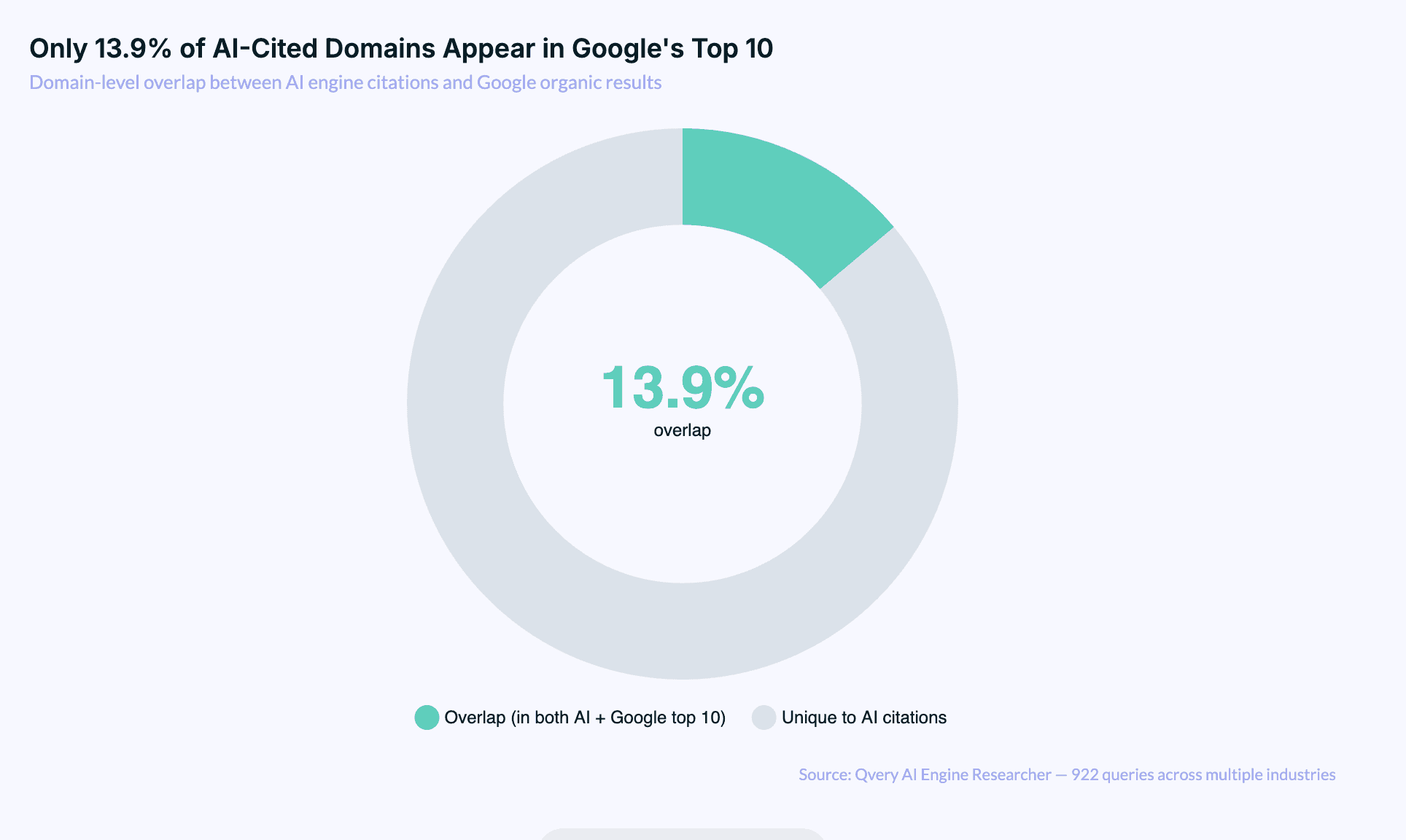
The overlap: 13.9%. Roughly 1 in 7 domains that AI engines cite also rank in Google's organic top 10 for the same query.
The other six out of seven? Google's organic algorithm either doesn't rank them or doesn't consider them top-10 material.
How We Ran The Study
Every comparison used a single execution. One ChatGPT response, one Google AI Mode response, one Google SERP fetch. No accumulation over months, no stacking historical citations against a single snapshot.
The comparison was at the domain level. If ChatGPT cited reddit.com/r/travel/some-thread and Google's #3 organic result was reddit.com/r/travel/different-thread, that counted as a match. We gave organic search every possible advantage.
The queries spanned industries: SaaS, travel, cybersecurity, forms, HR, finance, and more. These were real queries tracked by real companies through Qvery's AI Engine Researcher.
Google AI Mode Overlaps More With Organic Than ChatGPT Does
The 13.9% overall number hides a significant gap between the two engines.
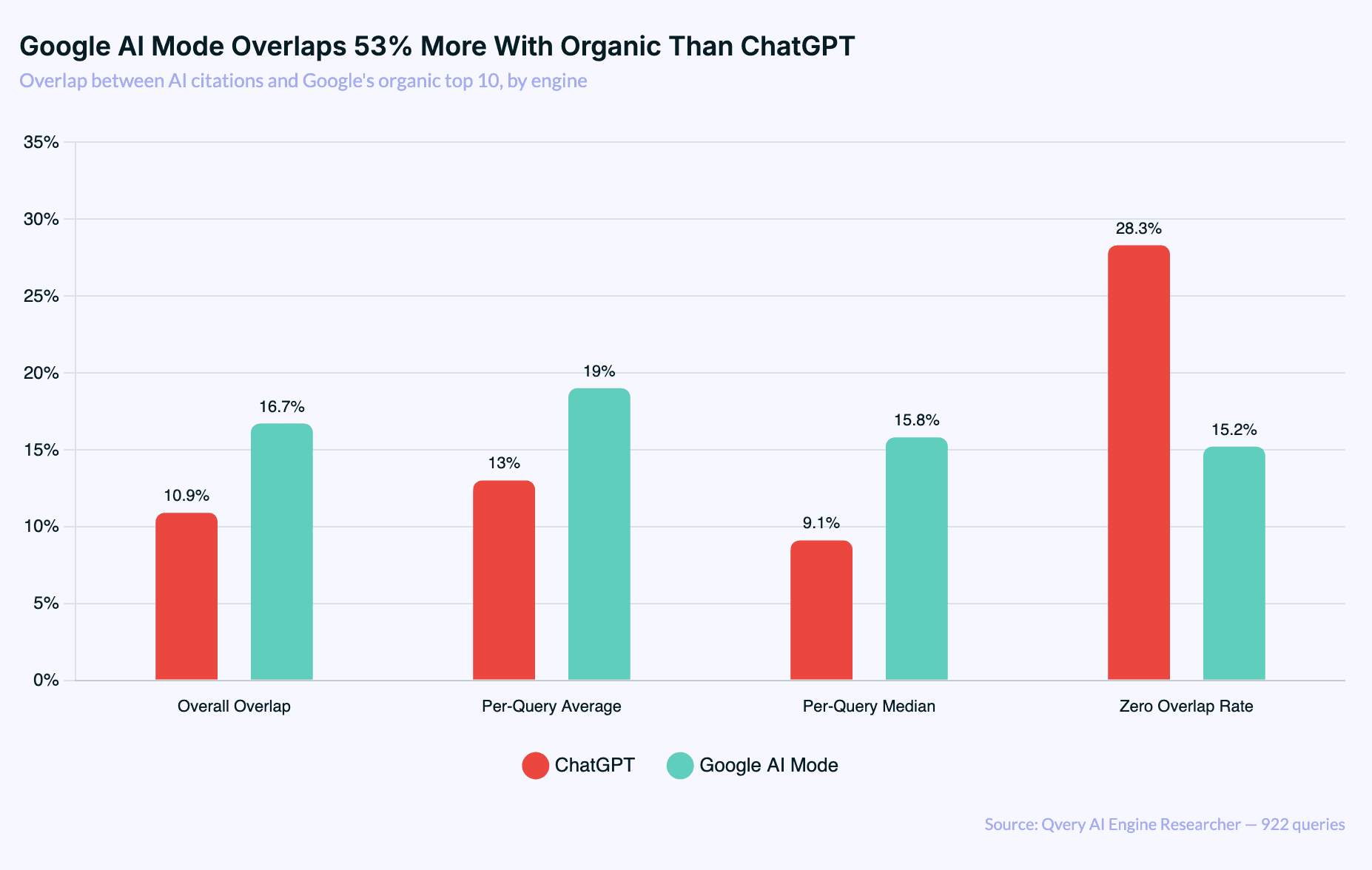
Google AI Mode: 16.7% overlap. Per-query average: 19.0%, median: 15.8%. Only 15.2% of queries had zero overlap between Google AI citations and Google organic results.
ChatGPT: 10.9% overlap. Per-query average: 13.0%, median: 9.1%. A full 28.3% of queries had zero overlap. Nearly 1 in 3 ChatGPT responses cited no domains from Google's organic top 10.
Google AI Mode's citation-to-organic overlap is 53% higher than ChatGPT's. That makes sense structurally. Google AI Mode has access to its own organic index and likely uses it as one input signal. But even within Google's own ecosystem, 83.3% of the domains it cites don't appear in its own organic top 10.
Google AI Mode overlaps with its own organic results 53% more than ChatGPT does. Same company, fundamentally different ranking logic.
Most Queries Show Very Little Overlap
Averages can mislead. The distribution tells a sharper story.
21% of query-engine pairs had exactly 0% overlap. Not a single cited domain matched any organic result.
43% had overlap under 10%. Only 16% exceeded 30%. For the majority of queries, AI citations and Google organic results pull from almost entirely different pools of sources.
A handful of high-overlap queries in travel and aggregator-heavy verticals pull the average up. For most queries, the real overlap is well below 13.9%.
The Reverse: Do Google Top 10 Results Get Cited by AI?
Flipping the question: if a domain ranks in Google's organic top 10, what are the chances an AI engine also cites it? 27.7%. Just over 1 in 4 organic results also appear as AI citations for the same query.
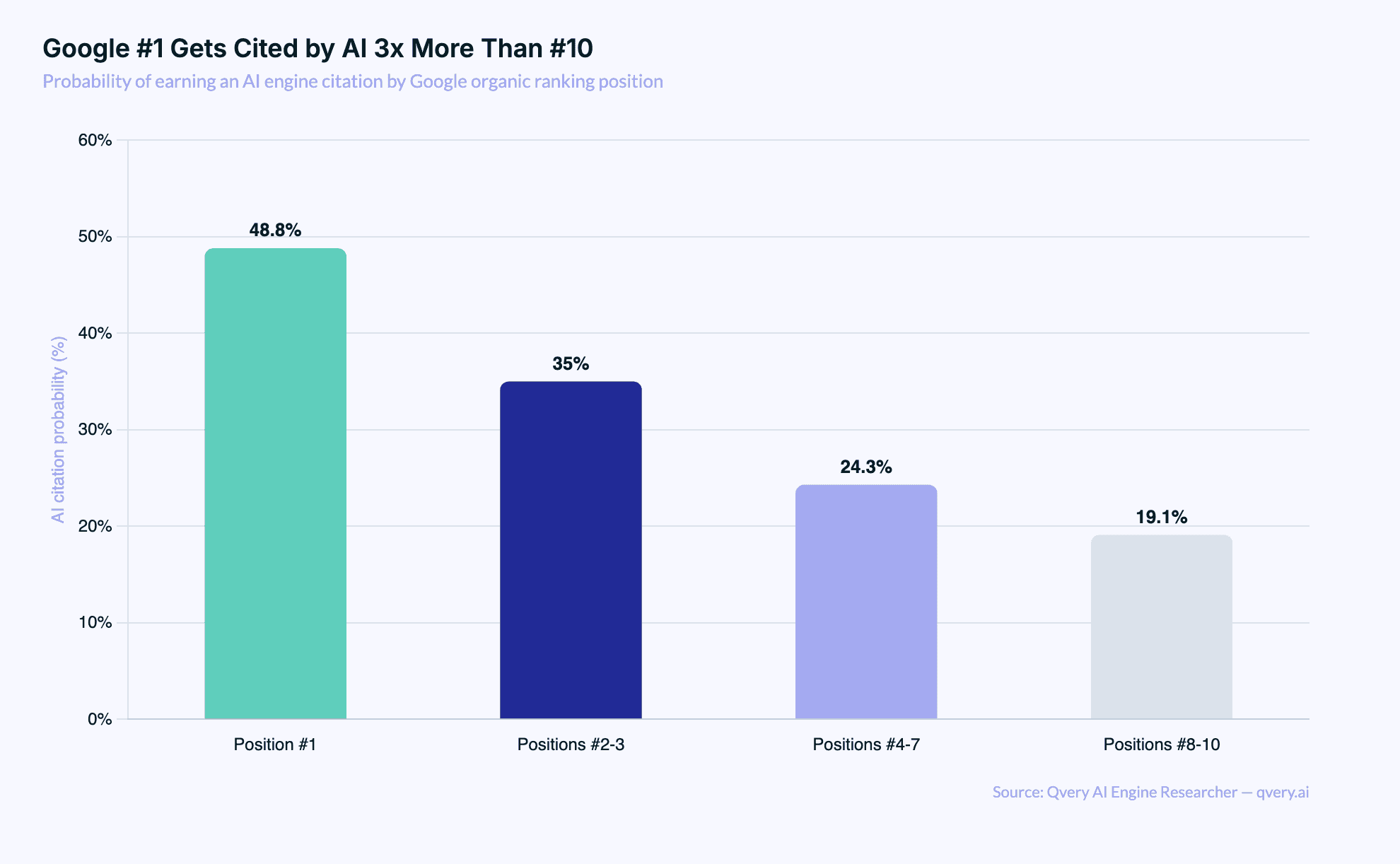
But position matters dramatically. A domain at Google position #1 has a 48.8% chance of being cited by an AI engine. At position #10, that drops to 17.3%.
Positions 1-3: 39.4% AI citation rate
Positions 4-7: 24.3%
Positions 8-10: 19.1%
The #1 organic result is nearly 3x more likely to earn an AI citation than the #10. Whatever signals push a domain to the top of organic (relevance, depth, authority) correlate with AI citation probability too. But even at #1, it's still a coin flip.
Reddit Bridges Both Worlds Better Than Any Other Domain
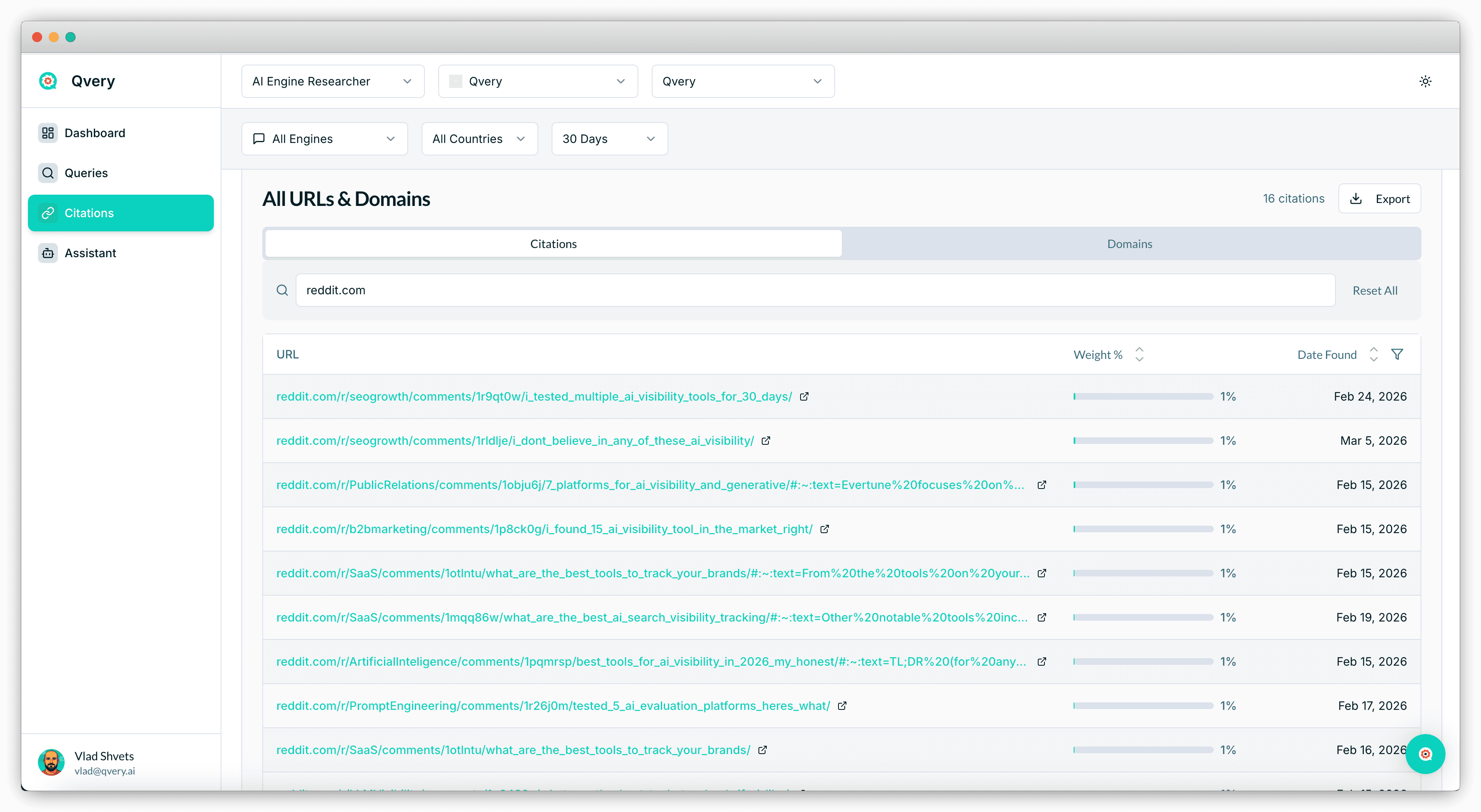
One domain consistently appears in both AI citations and Google organic: Reddit.
When an AI engine cites Reddit, there's a 78.5% chance that Reddit also appears in Google's organic top 10 for the same query. Nearly 4 out of 5 times, Reddit shows up in both.
The top bridging domains are all UGC and aggregation platforms:
reddit.com
tripadvisor.com
facebook.com
youtube.com
linkedin.com
Traditional editorial publishers barely appear. Your company blog lives in one world or the other. Reddit lives in both.
Your Industry Determines the Gap
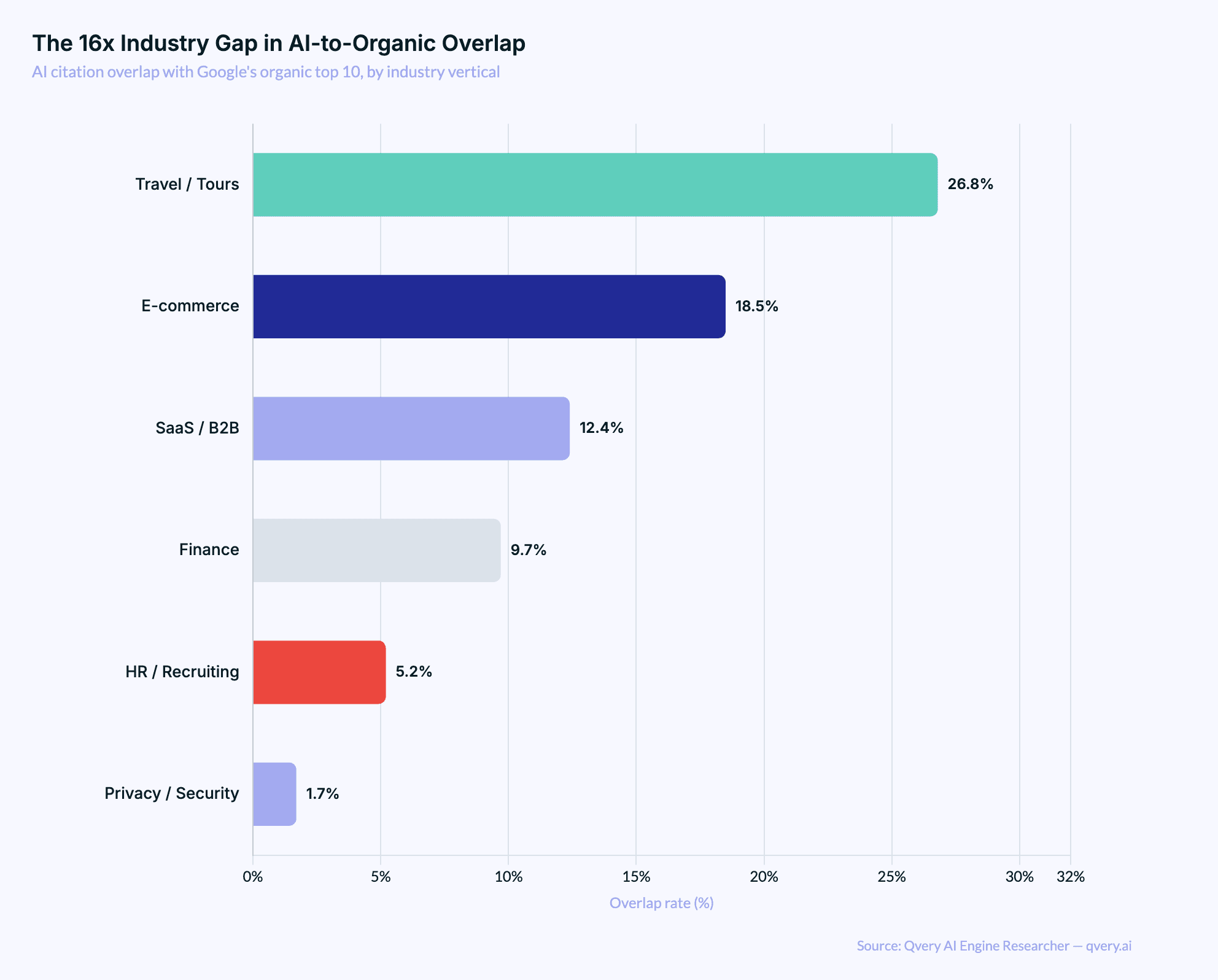
Not all verticals behave the same.
Travel/Tours: 26.8% overlap (highest). Aggregation platforms like TripAdvisor dominate both AI citations and organic results. When both systems lean on the same aggregators, overlap increases.
Privacy/Security: 1.7% overlap (lowest). AI engines surface specialized technical sources that don't rank organically. These niche publishers never invested in traditional search optimization. The AI cites them anyway.
The gap between highest and lowest vertical is nearly 16x. A travel brand's overlap looks nothing like a cybersecurity company's.
What This Means for Your Strategy
Run separate strategies for AI and organic. At 13.9% overlap, these are mostly different games. You need a dedicated AI visibility strategy alongside your organic efforts.
Invest in UGC and community presence. The domains that bridge both worlds are all user-generated content platforms. Authentic contributions on Reddit, review sites, and niche forums give you dual visibility.
Know your vertical's overlap rate. Travel brands (26.8%) can transfer some organic strategies. Technical SaaS or privacy companies (under 2%) get almost zero AI lift from organic optimization alone.
Optimize differently for each AI engine. ChatGPT and Google AI Mode overlap with organic at different rates (10.9% vs 16.7%) and reward different content types.
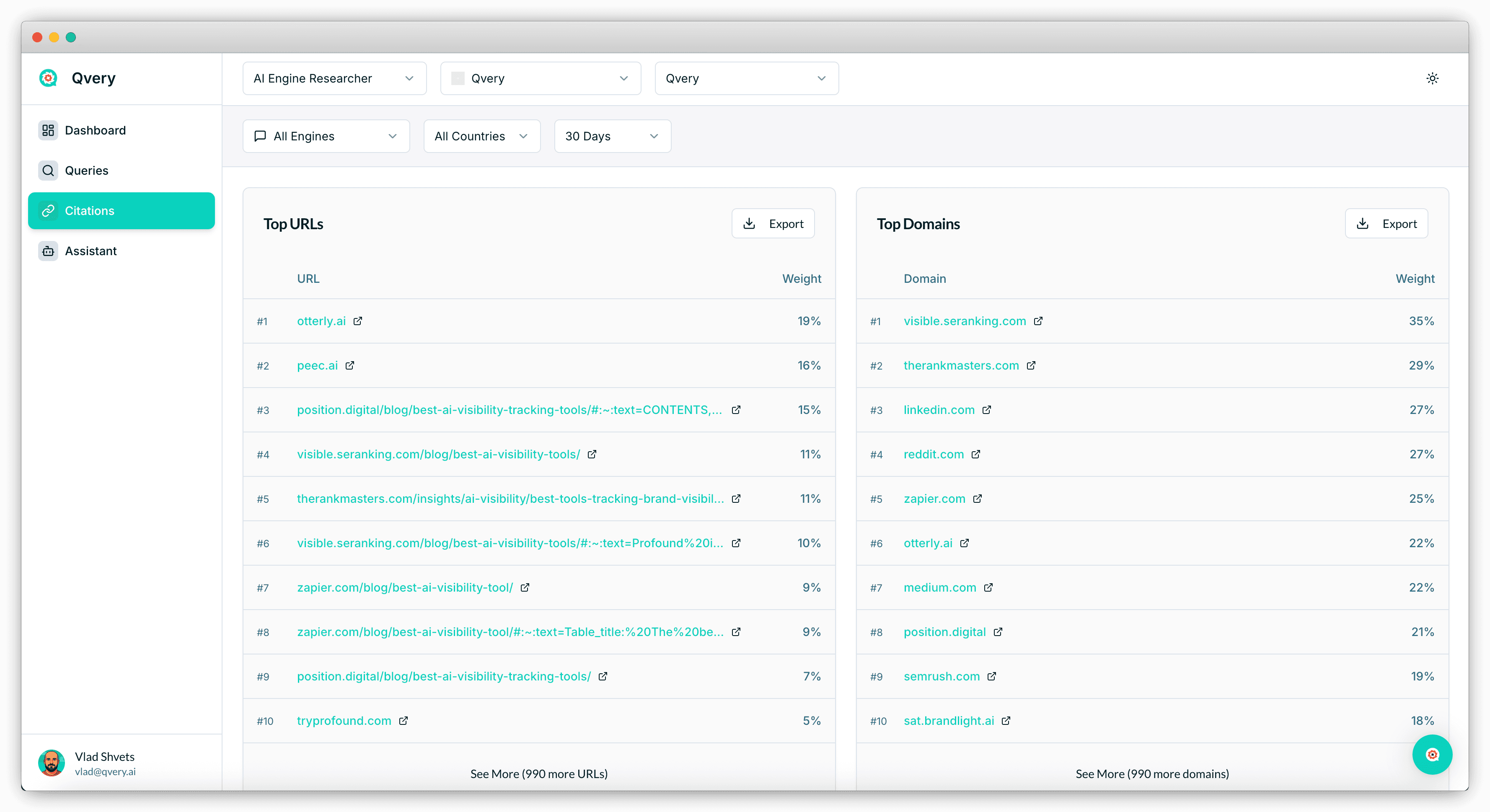
Measure what matters. Google Search Console doesn't track AI citations. Qvery's AI Engine Researcher tracks every citation your brand receives across ChatGPT and Google AI Mode, daily, in any country. You see which domains get cited instead of you, which queries trigger citations, and where the gaps are.
86.1% of AI-cited domains don't appear in Google's organic top 10. That's where the opportunity lives.
When ChatGPT or Google AI Mode answers a query, they attach citations. Links to sources they pulled information from. When Google Search answers the same query, it shows organic results. Links ranked by its traditional algorithm.
We wanted to know: how much do these two lists overlap?
We took 922 queries that Qvery tracks across multiple industries, ran each one through ChatGPT, Google AI Mode, and Google Search. For every query, we compared the domains cited by each AI engine against the domains ranking in Google's organic top 10. One AI response versus one SERP fetch per query. Apples to apples.
The overlap: 13.9%. Roughly 1 in 7 domains that AI engines cite also rank in Google's organic top 10 for the same query.
The other six out of seven? Google's organic algorithm either doesn't rank them or doesn't consider them top-10 material.
How We Ran The Study
Every comparison used a single execution. One ChatGPT response, one Google AI Mode response, one Google SERP fetch. No accumulation over months, no stacking historical citations against a single snapshot.
The comparison was at the domain level. If ChatGPT cited reddit.com/r/travel/some-thread and Google's #3 organic result was reddit.com/r/travel/different-thread, that counted as a match. We gave organic search every possible advantage.
The queries spanned industries: SaaS, travel, cybersecurity, forms, HR, finance, and more. These were real queries tracked by real companies through Qvery's AI Engine Researcher.
Google AI Mode Overlaps More With Organic Than ChatGPT Does
The 13.9% overall number hides a significant gap between the two engines.
Google AI Mode: 16.7% overlap. Per-query average: 19.0%, median: 15.8%. Only 15.2% of queries had zero overlap between Google AI citations and Google organic results.
ChatGPT: 10.9% overlap. Per-query average: 13.0%, median: 9.1%. A full 28.3% of queries had zero overlap. Nearly 1 in 3 ChatGPT responses cited no domains from Google's organic top 10.
Google AI Mode's citation-to-organic overlap is 53% higher than ChatGPT's. That makes sense structurally. Google AI Mode has access to its own organic index and likely uses it as one input signal. But even within Google's own ecosystem, 83.3% of the domains it cites don't appear in its own organic top 10.
Google AI Mode overlaps with its own organic results 53% more than ChatGPT does. Same company, fundamentally different ranking logic.
Most Queries Show Very Little Overlap
Averages can mislead. The distribution tells a sharper story.
21% of query-engine pairs had exactly 0% overlap. Not a single cited domain matched any organic result.
43% had overlap under 10%. Only 16% exceeded 30%. For the majority of queries, AI citations and Google organic results pull from almost entirely different pools of sources.
A handful of high-overlap queries in travel and aggregator-heavy verticals pull the average up. For most queries, the real overlap is well below 13.9%.
The Reverse: Do Google Top 10 Results Get Cited by AI?
Flipping the question: if a domain ranks in Google's organic top 10, what are the chances an AI engine also cites it? 27.7%. Just over 1 in 4 organic results also appear as AI citations for the same query.
But position matters dramatically. A domain at Google position #1 has a 48.8% chance of being cited by an AI engine. At position #10, that drops to 17.3%.
Positions 1-3: 39.4% AI citation rate
Positions 4-7: 24.3%
Positions 8-10: 19.1%
The #1 organic result is nearly 3x more likely to earn an AI citation than the #10. Whatever signals push a domain to the top of organic (relevance, depth, authority) correlate with AI citation probability too. But even at #1, it's still a coin flip.
Reddit Bridges Both Worlds Better Than Any Other Domain
One domain consistently appears in both AI citations and Google organic: Reddit.
When an AI engine cites Reddit, there's a 78.5% chance that Reddit also appears in Google's organic top 10 for the same query. Nearly 4 out of 5 times, Reddit shows up in both.
The top bridging domains are all UGC and aggregation platforms:
reddit.com
tripadvisor.com
facebook.com
youtube.com
linkedin.com
Traditional editorial publishers barely appear. Your company blog lives in one world or the other. Reddit lives in both.
Your Industry Determines the Gap
Not all verticals behave the same.
Travel/Tours: 26.8% overlap (highest). Aggregation platforms like TripAdvisor dominate both AI citations and organic results. When both systems lean on the same aggregators, overlap increases.
Privacy/Security: 1.7% overlap (lowest). AI engines surface specialized technical sources that don't rank organically. These niche publishers never invested in traditional search optimization. The AI cites them anyway.
The gap between highest and lowest vertical is nearly 16x. A travel brand's overlap looks nothing like a cybersecurity company's.
What This Means for Your Strategy
Run separate strategies for AI and organic. At 13.9% overlap, these are mostly different games. You need a dedicated AI visibility strategy alongside your organic efforts.
Invest in UGC and community presence. The domains that bridge both worlds are all user-generated content platforms. Authentic contributions on Reddit, review sites, and niche forums give you dual visibility.
Know your vertical's overlap rate. Travel brands (26.8%) can transfer some organic strategies. Technical SaaS or privacy companies (under 2%) get almost zero AI lift from organic optimization alone.
Optimize differently for each AI engine. ChatGPT and Google AI Mode overlap with organic at different rates (10.9% vs 16.7%) and reward different content types.
Measure what matters. Google Search Console doesn't track AI citations. Qvery's AI Engine Researcher tracks every citation your brand receives across ChatGPT and Google AI Mode, daily, in any country. You see which domains get cited instead of you, which queries trigger citations, and where the gaps are.
86.1% of AI-cited domains don't appear in Google's organic top 10. That's where the opportunity lives.
When ChatGPT or Google AI Mode answers a query, they attach citations. Links to sources they pulled information from. When Google Search answers the same query, it shows organic results. Links ranked by its traditional algorithm.
We wanted to know: how much do these two lists overlap?
We took 922 queries that Qvery tracks across multiple industries, ran each one through ChatGPT, Google AI Mode, and Google Search. For every query, we compared the domains cited by each AI engine against the domains ranking in Google's organic top 10. One AI response versus one SERP fetch per query. Apples to apples.
The overlap: 13.9%. Roughly 1 in 7 domains that AI engines cite also rank in Google's organic top 10 for the same query.
The other six out of seven? Google's organic algorithm either doesn't rank them or doesn't consider them top-10 material.
How We Ran The Study
Every comparison used a single execution. One ChatGPT response, one Google AI Mode response, one Google SERP fetch. No accumulation over months, no stacking historical citations against a single snapshot.
The comparison was at the domain level. If ChatGPT cited reddit.com/r/travel/some-thread and Google's #3 organic result was reddit.com/r/travel/different-thread, that counted as a match. We gave organic search every possible advantage.
The queries spanned industries: SaaS, travel, cybersecurity, forms, HR, finance, and more. These were real queries tracked by real companies through Qvery's AI Engine Researcher.
Google AI Mode Overlaps More With Organic Than ChatGPT Does
The 13.9% overall number hides a significant gap between the two engines.
Google AI Mode: 16.7% overlap. Per-query average: 19.0%, median: 15.8%. Only 15.2% of queries had zero overlap between Google AI citations and Google organic results.
ChatGPT: 10.9% overlap. Per-query average: 13.0%, median: 9.1%. A full 28.3% of queries had zero overlap. Nearly 1 in 3 ChatGPT responses cited no domains from Google's organic top 10.
Google AI Mode's citation-to-organic overlap is 53% higher than ChatGPT's. That makes sense structurally. Google AI Mode has access to its own organic index and likely uses it as one input signal. But even within Google's own ecosystem, 83.3% of the domains it cites don't appear in its own organic top 10.
Google AI Mode overlaps with its own organic results 53% more than ChatGPT does. Same company, fundamentally different ranking logic.
Most Queries Show Very Little Overlap
Averages can mislead. The distribution tells a sharper story.
21% of query-engine pairs had exactly 0% overlap. Not a single cited domain matched any organic result.
43% had overlap under 10%. Only 16% exceeded 30%. For the majority of queries, AI citations and Google organic results pull from almost entirely different pools of sources.
A handful of high-overlap queries in travel and aggregator-heavy verticals pull the average up. For most queries, the real overlap is well below 13.9%.
The Reverse: Do Google Top 10 Results Get Cited by AI?
Flipping the question: if a domain ranks in Google's organic top 10, what are the chances an AI engine also cites it? 27.7%. Just over 1 in 4 organic results also appear as AI citations for the same query.
But position matters dramatically. A domain at Google position #1 has a 48.8% chance of being cited by an AI engine. At position #10, that drops to 17.3%.
Positions 1-3: 39.4% AI citation rate
Positions 4-7: 24.3%
Positions 8-10: 19.1%
The #1 organic result is nearly 3x more likely to earn an AI citation than the #10. Whatever signals push a domain to the top of organic (relevance, depth, authority) correlate with AI citation probability too. But even at #1, it's still a coin flip.
Reddit Bridges Both Worlds Better Than Any Other Domain
One domain consistently appears in both AI citations and Google organic: Reddit.
When an AI engine cites Reddit, there's a 78.5% chance that Reddit also appears in Google's organic top 10 for the same query. Nearly 4 out of 5 times, Reddit shows up in both.
The top bridging domains are all UGC and aggregation platforms:
reddit.com
tripadvisor.com
facebook.com
youtube.com
linkedin.com
Traditional editorial publishers barely appear. Your company blog lives in one world or the other. Reddit lives in both.
Your Industry Determines the Gap
Not all verticals behave the same.
Travel/Tours: 26.8% overlap (highest). Aggregation platforms like TripAdvisor dominate both AI citations and organic results. When both systems lean on the same aggregators, overlap increases.
Privacy/Security: 1.7% overlap (lowest). AI engines surface specialized technical sources that don't rank organically. These niche publishers never invested in traditional search optimization. The AI cites them anyway.
The gap between highest and lowest vertical is nearly 16x. A travel brand's overlap looks nothing like a cybersecurity company's.
What This Means for Your Strategy
Run separate strategies for AI and organic. At 13.9% overlap, these are mostly different games. You need a dedicated AI visibility strategy alongside your organic efforts.
Invest in UGC and community presence. The domains that bridge both worlds are all user-generated content platforms. Authentic contributions on Reddit, review sites, and niche forums give you dual visibility.
Know your vertical's overlap rate. Travel brands (26.8%) can transfer some organic strategies. Technical SaaS or privacy companies (under 2%) get almost zero AI lift from organic optimization alone.
Optimize differently for each AI engine. ChatGPT and Google AI Mode overlap with organic at different rates (10.9% vs 16.7%) and reward different content types.
Measure what matters. Google Search Console doesn't track AI citations. Qvery's AI Engine Researcher tracks every citation your brand receives across ChatGPT and Google AI Mode, daily, in any country. You see which domains get cited instead of you, which queries trigger citations, and where the gaps are.
86.1% of AI-cited domains don't appear in Google's organic top 10. That's where the opportunity lives.
When ChatGPT or Google AI Mode answers a query, they attach citations. Links to sources they pulled information from. When Google Search answers the same query, it shows organic results. Links ranked by its traditional algorithm.
We wanted to know: how much do these two lists overlap?
We took 922 queries that Qvery tracks across multiple industries, ran each one through ChatGPT, Google AI Mode, and Google Search. For every query, we compared the domains cited by each AI engine against the domains ranking in Google's organic top 10. One AI response versus one SERP fetch per query. Apples to apples.
The overlap: 13.9%. Roughly 1 in 7 domains that AI engines cite also rank in Google's organic top 10 for the same query.
The other six out of seven? Google's organic algorithm either doesn't rank them or doesn't consider them top-10 material.
How We Ran The Study
Every comparison used a single execution. One ChatGPT response, one Google AI Mode response, one Google SERP fetch. No accumulation over months, no stacking historical citations against a single snapshot.
The comparison was at the domain level. If ChatGPT cited reddit.com/r/travel/some-thread and Google's #3 organic result was reddit.com/r/travel/different-thread, that counted as a match. We gave organic search every possible advantage.
The queries spanned industries: SaaS, travel, cybersecurity, forms, HR, finance, and more. These were real queries tracked by real companies through Qvery's AI Engine Researcher.
Google AI Mode Overlaps More With Organic Than ChatGPT Does
The 13.9% overall number hides a significant gap between the two engines.
Google AI Mode: 16.7% overlap. Per-query average: 19.0%, median: 15.8%. Only 15.2% of queries had zero overlap between Google AI citations and Google organic results.
ChatGPT: 10.9% overlap. Per-query average: 13.0%, median: 9.1%. A full 28.3% of queries had zero overlap. Nearly 1 in 3 ChatGPT responses cited no domains from Google's organic top 10.
Google AI Mode's citation-to-organic overlap is 53% higher than ChatGPT's. That makes sense structurally. Google AI Mode has access to its own organic index and likely uses it as one input signal. But even within Google's own ecosystem, 83.3% of the domains it cites don't appear in its own organic top 10.
Google AI Mode overlaps with its own organic results 53% more than ChatGPT does. Same company, fundamentally different ranking logic.
Most Queries Show Very Little Overlap
Averages can mislead. The distribution tells a sharper story.
21% of query-engine pairs had exactly 0% overlap. Not a single cited domain matched any organic result.
43% had overlap under 10%. Only 16% exceeded 30%. For the majority of queries, AI citations and Google organic results pull from almost entirely different pools of sources.
A handful of high-overlap queries in travel and aggregator-heavy verticals pull the average up. For most queries, the real overlap is well below 13.9%.
The Reverse: Do Google Top 10 Results Get Cited by AI?
Flipping the question: if a domain ranks in Google's organic top 10, what are the chances an AI engine also cites it? 27.7%. Just over 1 in 4 organic results also appear as AI citations for the same query.
But position matters dramatically. A domain at Google position #1 has a 48.8% chance of being cited by an AI engine. At position #10, that drops to 17.3%.
Positions 1-3: 39.4% AI citation rate
Positions 4-7: 24.3%
Positions 8-10: 19.1%
The #1 organic result is nearly 3x more likely to earn an AI citation than the #10. Whatever signals push a domain to the top of organic (relevance, depth, authority) correlate with AI citation probability too. But even at #1, it's still a coin flip.
Reddit Bridges Both Worlds Better Than Any Other Domain
One domain consistently appears in both AI citations and Google organic: Reddit.
When an AI engine cites Reddit, there's a 78.5% chance that Reddit also appears in Google's organic top 10 for the same query. Nearly 4 out of 5 times, Reddit shows up in both.
The top bridging domains are all UGC and aggregation platforms:
reddit.com
tripadvisor.com
facebook.com
youtube.com
linkedin.com
Traditional editorial publishers barely appear. Your company blog lives in one world or the other. Reddit lives in both.
Your Industry Determines the Gap
Not all verticals behave the same.
Travel/Tours: 26.8% overlap (highest). Aggregation platforms like TripAdvisor dominate both AI citations and organic results. When both systems lean on the same aggregators, overlap increases.
Privacy/Security: 1.7% overlap (lowest). AI engines surface specialized technical sources that don't rank organically. These niche publishers never invested in traditional search optimization. The AI cites them anyway.
The gap between highest and lowest vertical is nearly 16x. A travel brand's overlap looks nothing like a cybersecurity company's.
What This Means for Your Strategy
Run separate strategies for AI and organic. At 13.9% overlap, these are mostly different games. You need a dedicated AI visibility strategy alongside your organic efforts.
Invest in UGC and community presence. The domains that bridge both worlds are all user-generated content platforms. Authentic contributions on Reddit, review sites, and niche forums give you dual visibility.
Know your vertical's overlap rate. Travel brands (26.8%) can transfer some organic strategies. Technical SaaS or privacy companies (under 2%) get almost zero AI lift from organic optimization alone.
Optimize differently for each AI engine. ChatGPT and Google AI Mode overlap with organic at different rates (10.9% vs 16.7%) and reward different content types.
Measure what matters. Google Search Console doesn't track AI citations. Qvery's AI Engine Researcher tracks every citation your brand receives across ChatGPT and Google AI Mode, daily, in any country. You see which domains get cited instead of you, which queries trigger citations, and where the gaps are.
86.1% of AI-cited domains don't appear in Google's organic top 10. That's where the opportunity lives.

© 2026 Qvery AI OÜ