By
Vlad Shvets
The Double Jeopardy Law Applies to AI Search
Small brands get punished twice in AI search: fewer citations and less prominence. But our data shows the game is more winnable than traditional search ever was.
Small brands get punished twice in AI search: fewer citations and less prominence. But our data shows the game is more winnable than traditional search ever was.
Small brands get punished twice in AI search: fewer citations and less prominence. But our data shows the game is more winnable than traditional search ever was.
There's an empirical law in marketing science called Double Jeopardy. Coined by William McPhee in 1963 and later expanded by Andrew Ehrenberg, it says small brands are punished twice: they have fewer buyers, and the buyers they do have are less loyal. Byron Sharp made it famous in How Brands Grow, and it's been validated across virtually every product category, every market, every decade since.
It's like being the least popular kid at school who also happens to be terrible at dodgeball. Double punishment, zero upside.
I've been thinking about this in the context of AI search. The Double Jeopardy law applies here too — with one important twist that changes everything for underdog brands.
Small Brands Get Punished Twice in AI Search
In traditional marketing, Double Jeopardy works like this: Coca-Cola has more buyers than RC Cola. But it's worse than that — Coca-Cola's buyers also buy Coke more frequently. RC Cola has fewer customers who buy it less often.
The mechanism is straightforward. Larger brands have more mental availability (you think of them more often), more physical availability (you find them more easily), and more social proof (other people buy them, which makes you more comfortable buying them). All of this compounds.
In traditional search, the same dynamic played out. Brands with higher domain authority ranked higher. Higher rankings meant more clicks. More clicks meant more engagement signals. More signals meant even higher rankings. The rich got richer. The small stayed invisible on page seven.
AI Search Is Double Jeopardy on Steroids
AI search engines don't show you ten blue links. They recommend brands directly by name. When someone asks ChatGPT "what's the best project management tool?", it doesn't show a list of websites. It tells you which tools to use and why.
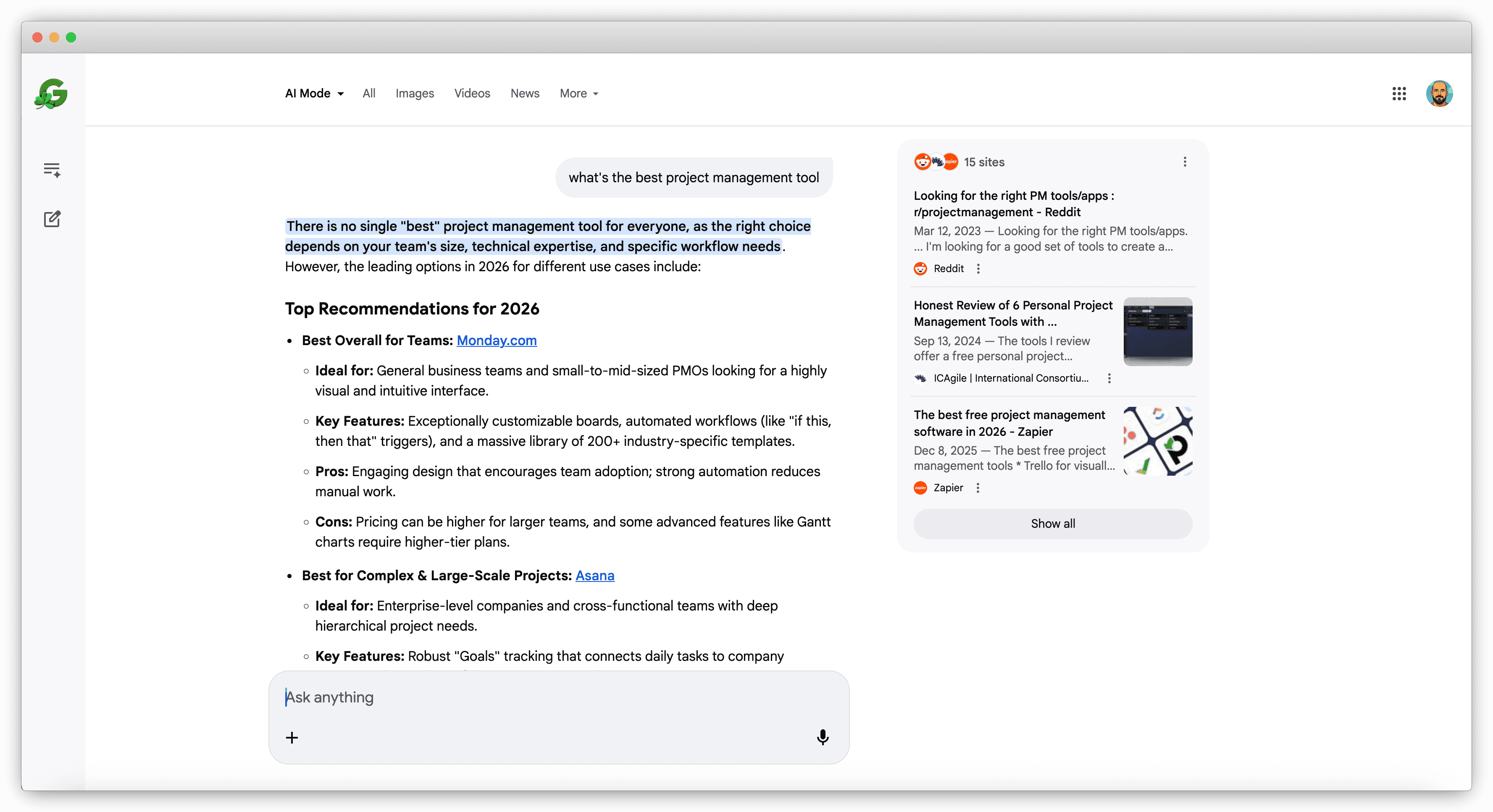
The AI agents behind these recommendations synthesize information from across the entire web: your website, third-party reviews, Reddit discussions, industry publications, product comparisons. When they synthesize all of that, the brands with the most content, the most mentions, the most reviews, and the strongest track record tend to win.
Big brands don't even need to try very hard. They've already accumulated decades of digital presence. Thousands of pages of content. Mentions on every review site. Reddit threads discussing them. (Some of those threads aren't even flattering, but it doesn't matter — the mention exists.)
In traditional search, you could be invisible and still exist. In AI search, if you're not recommended, you literally don't exist in the conversation.
For smaller brands, this feels like hitting a wall. How do you compete with a company that has 10,000 indexed pages when you have 47?
But Here's What the Data Actually Shows
This is where the Double Jeopardy story gets interesting — because the data tells a different story than you'd expect.
We analyzed citation links across ChatGPT and Google AI Mode at scale. Here's what our proprietary citation data revealed.
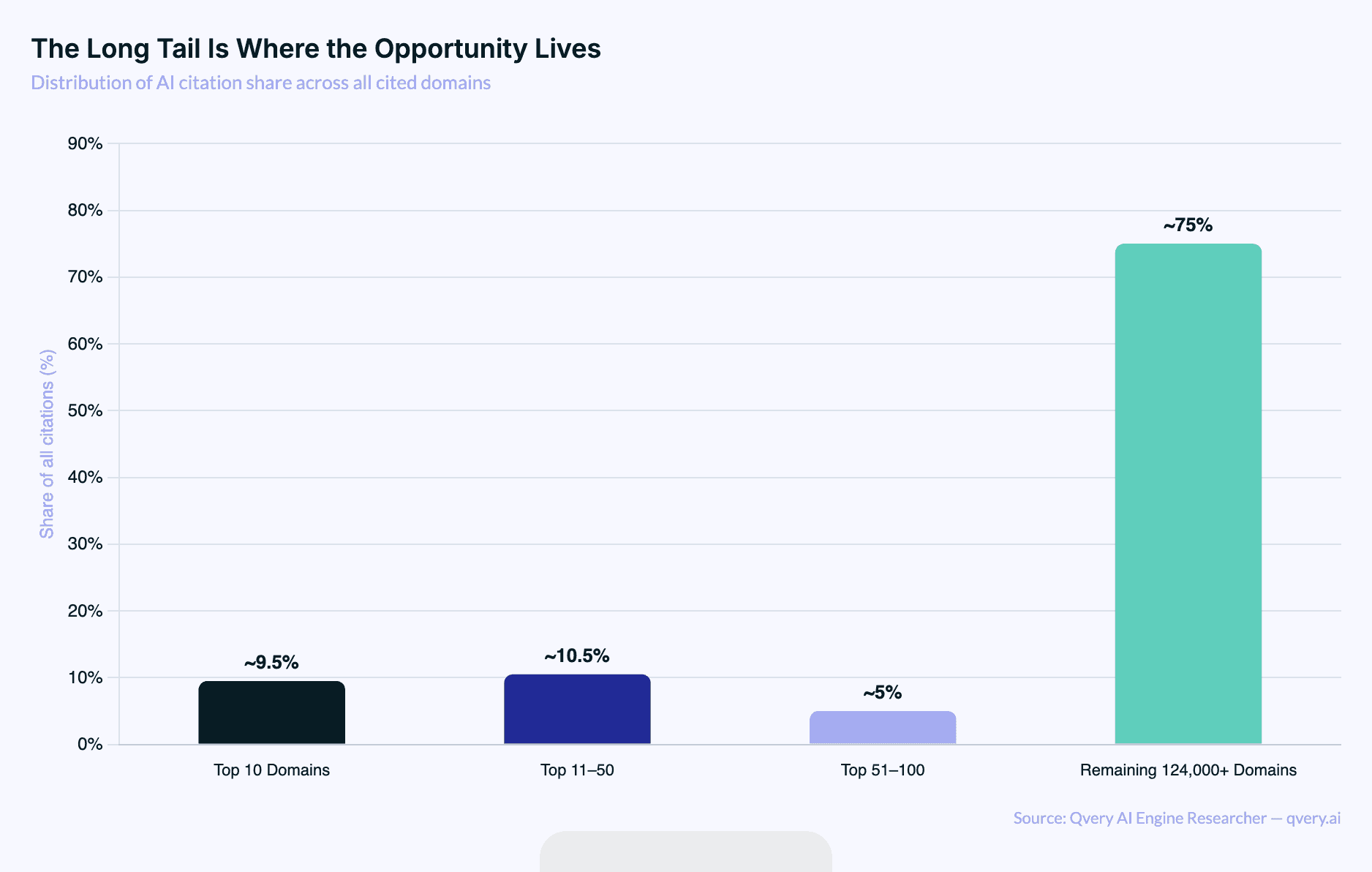
The top 50 most-cited domains account for roughly 20% of all citations. The remaining vast majority of domains share the other 80%. No single domain exceeds 3.3% of total citations. The top 10 universal domains together account for only about 9.5%.
And here's the number that should make every underdog pay attention: when we compared AI engine citations to Google's traditional organic top 10, the overlap was just 13.9%.
86.1% of domains cited by AI engines don't appear in Google's organic top 10 at all. The AI citation landscape is almost entirely separate from traditional search rankings.
That number breaks down by engine: ChatGPT shows 10.9% overlap with Google's top 10, while Google AI Mode shows 16.7%. Both are remarkably low. The brands winning in AI search are frequently not the same ones dominating traditional search results.
The reverse is equally telling: only 27.7% of Google's top 10 organic results also get cited by AI engines. And even being #1 in Google only gives you a 48.8% chance of being cited by an AI engine for the same query. A coin flip.
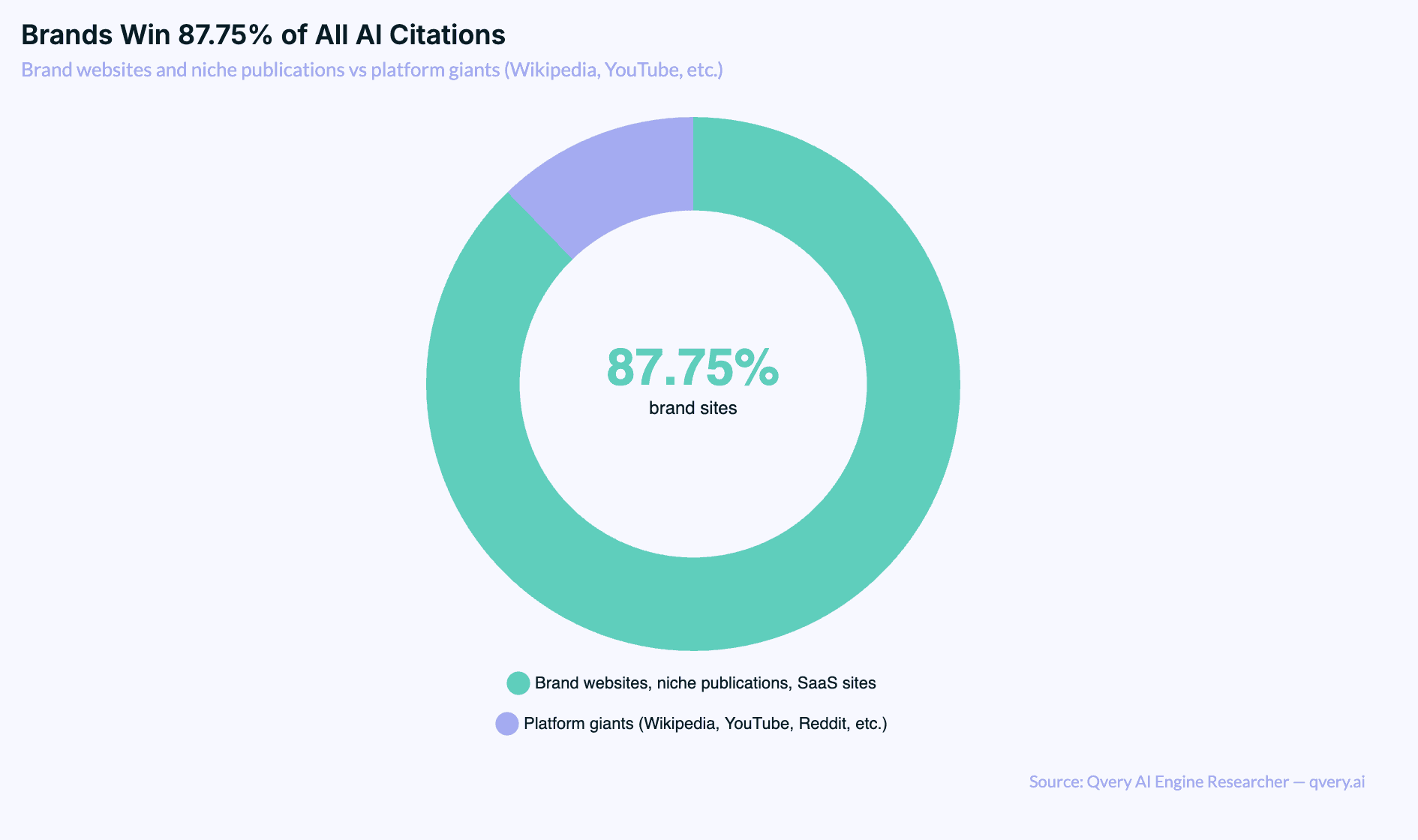
87.75% of all citations go to brand websites, niche publications, and SaaS sites — not platform giants like Wikipedia or YouTube. The brands themselves.
The One Platform That Bridges Both Worlds
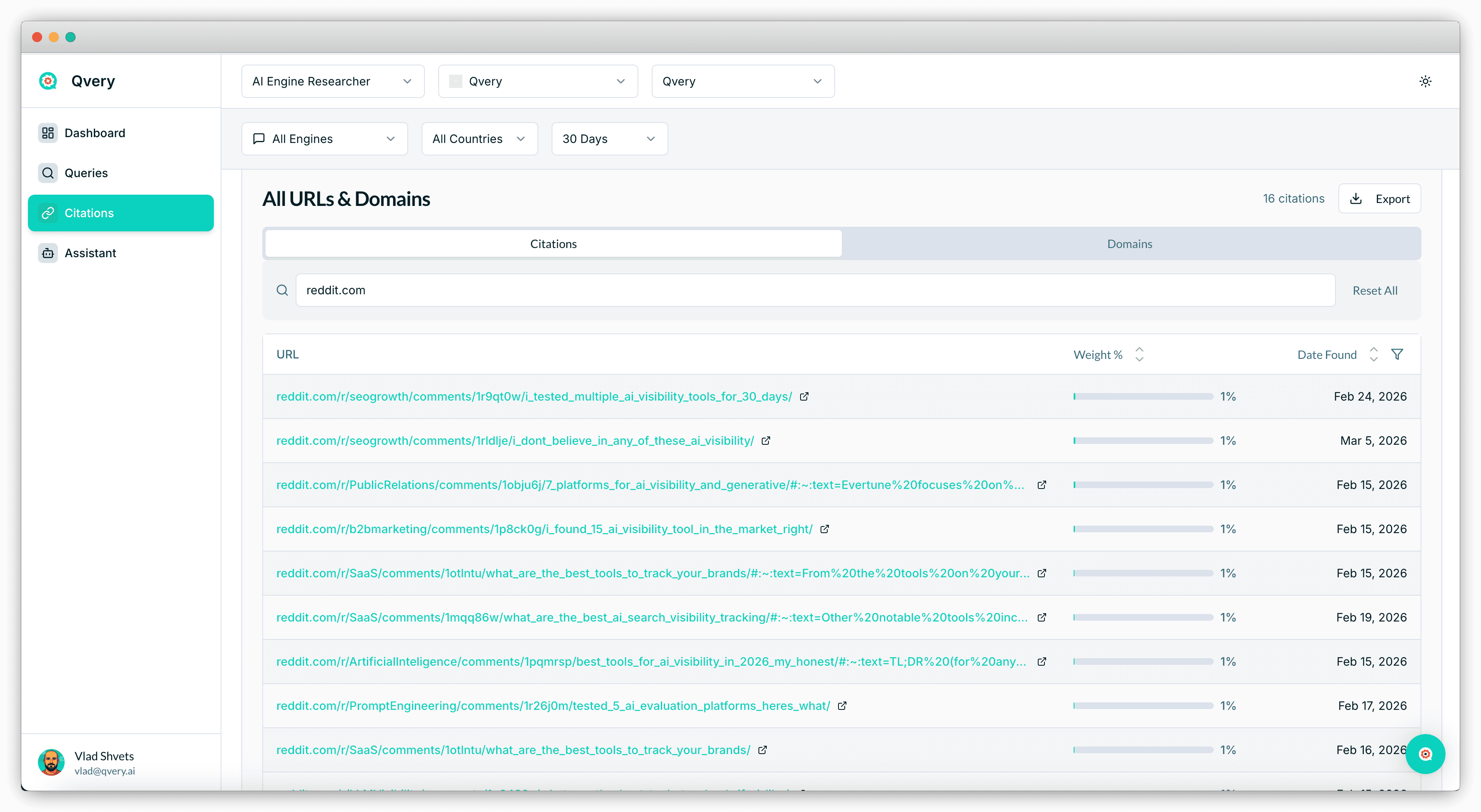
There's one notable exception to the AI-vs-Google divide: Reddit.
Reddit shows a 78.5% cross-platform overlap — meaning it appears in both AI citations and Google's organic results at a rate far higher than any other domain. It's the #1 bridging domain between traditional search and AI search.
This makes Reddit the single most important third-party platform for brands trying to build visibility across both paradigms simultaneously. We covered this extensively in our Reddit AI citation analysis.
AI Search Is More Meritocratic Than Traditional Search
This is the twist on Double Jeopardy that matters.
In traditional search, authority signals like domain rating, backlink count, and site age functioned like brand loyalty in consumer goods. They compounded over time and were nearly impossible for newcomers to overcome. Google's PageRank was essentially a popularity contest where the popular brands kept winning because they were popular.
AI search engines work differently. They don't just evaluate authority — they evaluate fit. When an AI agent processes a query like "best invoicing software for freelancers in Europe," it's not looking for the biggest brand. It's looking for the best answer to that specific question. A specialized invoicing tool built for European freelancers can absolutely beat QuickBooks for that query, if its content explains that fit clearly.
Traditional search: The biggest brands win most queries because authority compounds.
AI search: The best-fit brands win specific queries because context matters more than authority.
Double Jeopardy still exists in AI search. Big brands still appear in more responses overall. But the degree of punishment is significantly lower, and there's a clear path for smaller brands to break in. That path barely existed in traditional search.
The gap between "big brand advantage" and "small brand death sentence" is narrower in AI search than it's ever been in digital marketing.
The Underdog Playbook: Specialize or Disappear
If you're a smaller brand, the Double Jeopardy law in AI search isn't a death sentence. It's a strategic brief.
Stop competing for mainstream queries. The big players will win "best project management tool" nine times out of ten. That's their territory. Accept it and move on.
Find the queries where you should be the best answer. This is the niche exception to Double Jeopardy that Byron Sharp himself acknowledged. Brands with restricted distribution can escape the law by owning a specific segment completely. In AI search, your "restricted distribution" is your specialization.
Differentiate your messaging. AI engines are remarkably good at understanding what makes you different. If your messaging sounds like everyone else's, you'll be invisible. If it clearly articulates who you're for and why you're the best option for them, AI engines will pick that up.
Create content that demonstrates niche expertise. Not content that targets high-volume queries. Content that proves you understand a specific problem better than anyone else. Unique research, practitioner insights, detailed how-tos for your exact audience.
Build mentions where they matter. UGC platforms, industry-specific review sites, niche communities. When real people recommend you in the places your audience lives, AI engines notice. This is one of the three pillars of AI engine visibility.
Monitor your share of voice. You can't improve what you can't measure. Track which brands the AI engines recommend for your target queries, and figure out what they're doing that you're not.
How to Actually Track This
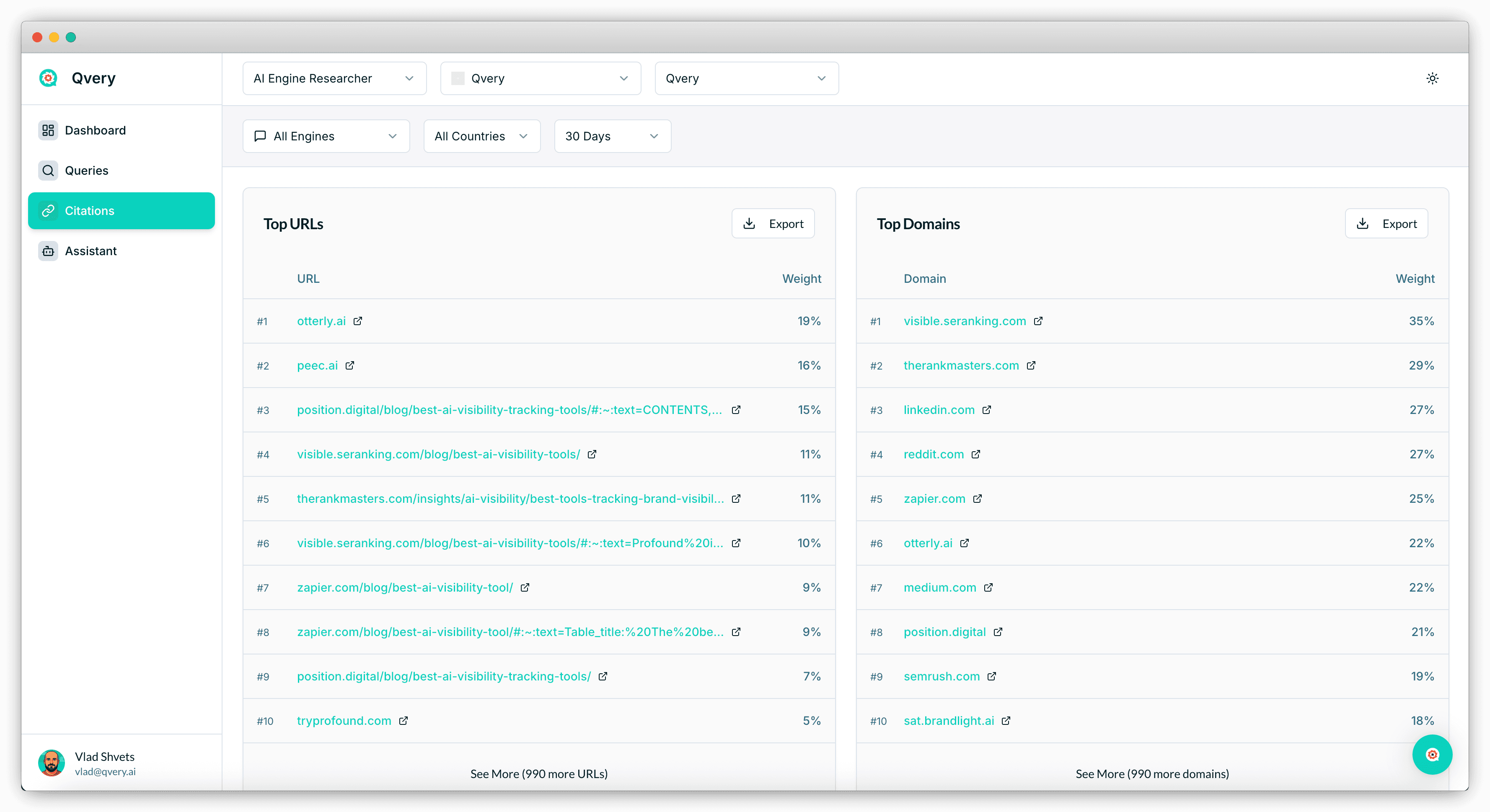
This is exactly the problem we built Qvery's AI Engine Researcher to solve. It tracks your brand's visibility across ChatGPT and Google AI Mode continuously — auto-generates the queries that matter for your product category, monitors which brands get recommended, and shows you your share of voice against competitors.
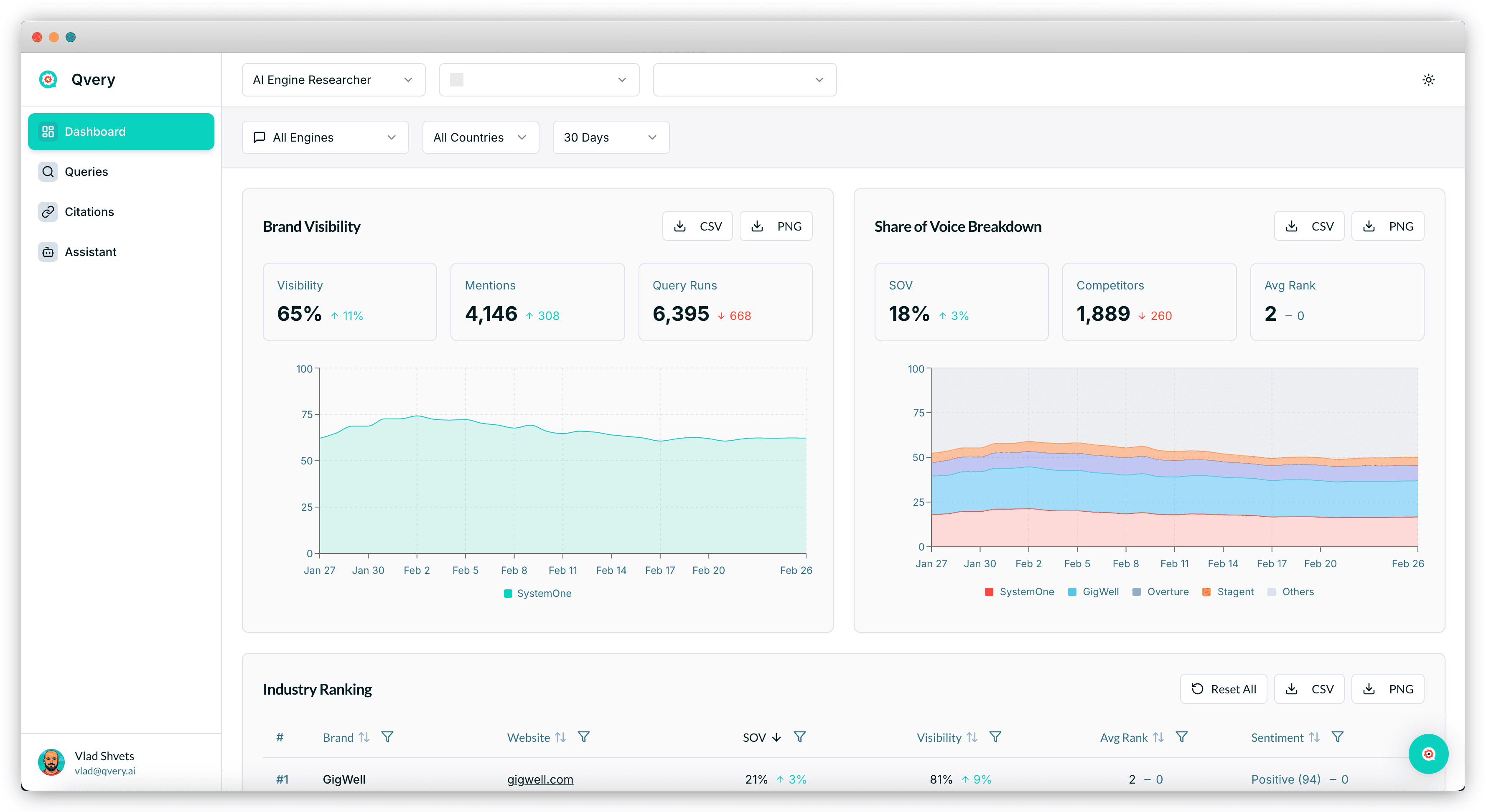
Sign up, enter your brand information, and within 30 minutes you'll see exactly where you stand vs your competitors.
In a world where AI search is genuinely more meritocratic than what came before, the opportunity to carve out your own share of the market is worth more than it's ever been.
There's an empirical law in marketing science called Double Jeopardy. Coined by William McPhee in 1963 and later expanded by Andrew Ehrenberg, it says small brands are punished twice: they have fewer buyers, and the buyers they do have are less loyal. Byron Sharp made it famous in How Brands Grow, and it's been validated across virtually every product category, every market, every decade since.
It's like being the least popular kid at school who also happens to be terrible at dodgeball. Double punishment, zero upside.
I've been thinking about this in the context of AI search. The Double Jeopardy law applies here too — with one important twist that changes everything for underdog brands.
Small Brands Get Punished Twice in AI Search
In traditional marketing, Double Jeopardy works like this: Coca-Cola has more buyers than RC Cola. But it's worse than that — Coca-Cola's buyers also buy Coke more frequently. RC Cola has fewer customers who buy it less often.
The mechanism is straightforward. Larger brands have more mental availability (you think of them more often), more physical availability (you find them more easily), and more social proof (other people buy them, which makes you more comfortable buying them). All of this compounds.
In traditional search, the same dynamic played out. Brands with higher domain authority ranked higher. Higher rankings meant more clicks. More clicks meant more engagement signals. More signals meant even higher rankings. The rich got richer. The small stayed invisible on page seven.
AI Search Is Double Jeopardy on Steroids
AI search engines don't show you ten blue links. They recommend brands directly by name. When someone asks ChatGPT "what's the best project management tool?", it doesn't show a list of websites. It tells you which tools to use and why.
The AI agents behind these recommendations synthesize information from across the entire web: your website, third-party reviews, Reddit discussions, industry publications, product comparisons. When they synthesize all of that, the brands with the most content, the most mentions, the most reviews, and the strongest track record tend to win.
Big brands don't even need to try very hard. They've already accumulated decades of digital presence. Thousands of pages of content. Mentions on every review site. Reddit threads discussing them. (Some of those threads aren't even flattering, but it doesn't matter — the mention exists.)
In traditional search, you could be invisible and still exist. In AI search, if you're not recommended, you literally don't exist in the conversation.
For smaller brands, this feels like hitting a wall. How do you compete with a company that has 10,000 indexed pages when you have 47?
But Here's What the Data Actually Shows
This is where the Double Jeopardy story gets interesting — because the data tells a different story than you'd expect.
We analyzed citation links across ChatGPT and Google AI Mode at scale. Here's what our proprietary citation data revealed.
The top 50 most-cited domains account for roughly 20% of all citations. The remaining vast majority of domains share the other 80%. No single domain exceeds 3.3% of total citations. The top 10 universal domains together account for only about 9.5%.
And here's the number that should make every underdog pay attention: when we compared AI engine citations to Google's traditional organic top 10, the overlap was just 13.9%.
86.1% of domains cited by AI engines don't appear in Google's organic top 10 at all. The AI citation landscape is almost entirely separate from traditional search rankings.
That number breaks down by engine: ChatGPT shows 10.9% overlap with Google's top 10, while Google AI Mode shows 16.7%. Both are remarkably low. The brands winning in AI search are frequently not the same ones dominating traditional search results.
The reverse is equally telling: only 27.7% of Google's top 10 organic results also get cited by AI engines. And even being #1 in Google only gives you a 48.8% chance of being cited by an AI engine for the same query. A coin flip.
87.75% of all citations go to brand websites, niche publications, and SaaS sites — not platform giants like Wikipedia or YouTube. The brands themselves.
The One Platform That Bridges Both Worlds
There's one notable exception to the AI-vs-Google divide: Reddit.
Reddit shows a 78.5% cross-platform overlap — meaning it appears in both AI citations and Google's organic results at a rate far higher than any other domain. It's the #1 bridging domain between traditional search and AI search.
This makes Reddit the single most important third-party platform for brands trying to build visibility across both paradigms simultaneously. We covered this extensively in our Reddit AI citation analysis.
AI Search Is More Meritocratic Than Traditional Search
This is the twist on Double Jeopardy that matters.
In traditional search, authority signals like domain rating, backlink count, and site age functioned like brand loyalty in consumer goods. They compounded over time and were nearly impossible for newcomers to overcome. Google's PageRank was essentially a popularity contest where the popular brands kept winning because they were popular.
AI search engines work differently. They don't just evaluate authority — they evaluate fit. When an AI agent processes a query like "best invoicing software for freelancers in Europe," it's not looking for the biggest brand. It's looking for the best answer to that specific question. A specialized invoicing tool built for European freelancers can absolutely beat QuickBooks for that query, if its content explains that fit clearly.
Traditional search: The biggest brands win most queries because authority compounds.
AI search: The best-fit brands win specific queries because context matters more than authority.
Double Jeopardy still exists in AI search. Big brands still appear in more responses overall. But the degree of punishment is significantly lower, and there's a clear path for smaller brands to break in. That path barely existed in traditional search.
The gap between "big brand advantage" and "small brand death sentence" is narrower in AI search than it's ever been in digital marketing.
The Underdog Playbook: Specialize or Disappear
If you're a smaller brand, the Double Jeopardy law in AI search isn't a death sentence. It's a strategic brief.
Stop competing for mainstream queries. The big players will win "best project management tool" nine times out of ten. That's their territory. Accept it and move on.
Find the queries where you should be the best answer. This is the niche exception to Double Jeopardy that Byron Sharp himself acknowledged. Brands with restricted distribution can escape the law by owning a specific segment completely. In AI search, your "restricted distribution" is your specialization.
Differentiate your messaging. AI engines are remarkably good at understanding what makes you different. If your messaging sounds like everyone else's, you'll be invisible. If it clearly articulates who you're for and why you're the best option for them, AI engines will pick that up.
Create content that demonstrates niche expertise. Not content that targets high-volume queries. Content that proves you understand a specific problem better than anyone else. Unique research, practitioner insights, detailed how-tos for your exact audience.
Build mentions where they matter. UGC platforms, industry-specific review sites, niche communities. When real people recommend you in the places your audience lives, AI engines notice. This is one of the three pillars of AI engine visibility.
Monitor your share of voice. You can't improve what you can't measure. Track which brands the AI engines recommend for your target queries, and figure out what they're doing that you're not.
How to Actually Track This
This is exactly the problem we built Qvery's AI Engine Researcher to solve. It tracks your brand's visibility across ChatGPT and Google AI Mode continuously — auto-generates the queries that matter for your product category, monitors which brands get recommended, and shows you your share of voice against competitors.
Sign up, enter your brand information, and within 30 minutes you'll see exactly where you stand vs your competitors.
In a world where AI search is genuinely more meritocratic than what came before, the opportunity to carve out your own share of the market is worth more than it's ever been.
There's an empirical law in marketing science called Double Jeopardy. Coined by William McPhee in 1963 and later expanded by Andrew Ehrenberg, it says small brands are punished twice: they have fewer buyers, and the buyers they do have are less loyal. Byron Sharp made it famous in How Brands Grow, and it's been validated across virtually every product category, every market, every decade since.
It's like being the least popular kid at school who also happens to be terrible at dodgeball. Double punishment, zero upside.
I've been thinking about this in the context of AI search. The Double Jeopardy law applies here too — with one important twist that changes everything for underdog brands.
Small Brands Get Punished Twice in AI Search
In traditional marketing, Double Jeopardy works like this: Coca-Cola has more buyers than RC Cola. But it's worse than that — Coca-Cola's buyers also buy Coke more frequently. RC Cola has fewer customers who buy it less often.
The mechanism is straightforward. Larger brands have more mental availability (you think of them more often), more physical availability (you find them more easily), and more social proof (other people buy them, which makes you more comfortable buying them). All of this compounds.
In traditional search, the same dynamic played out. Brands with higher domain authority ranked higher. Higher rankings meant more clicks. More clicks meant more engagement signals. More signals meant even higher rankings. The rich got richer. The small stayed invisible on page seven.
AI Search Is Double Jeopardy on Steroids
AI search engines don't show you ten blue links. They recommend brands directly by name. When someone asks ChatGPT "what's the best project management tool?", it doesn't show a list of websites. It tells you which tools to use and why.
The AI agents behind these recommendations synthesize information from across the entire web: your website, third-party reviews, Reddit discussions, industry publications, product comparisons. When they synthesize all of that, the brands with the most content, the most mentions, the most reviews, and the strongest track record tend to win.
Big brands don't even need to try very hard. They've already accumulated decades of digital presence. Thousands of pages of content. Mentions on every review site. Reddit threads discussing them. (Some of those threads aren't even flattering, but it doesn't matter — the mention exists.)
In traditional search, you could be invisible and still exist. In AI search, if you're not recommended, you literally don't exist in the conversation.
For smaller brands, this feels like hitting a wall. How do you compete with a company that has 10,000 indexed pages when you have 47?
But Here's What the Data Actually Shows
This is where the Double Jeopardy story gets interesting — because the data tells a different story than you'd expect.
We analyzed citation links across ChatGPT and Google AI Mode at scale. Here's what our proprietary citation data revealed.
The top 50 most-cited domains account for roughly 20% of all citations. The remaining vast majority of domains share the other 80%. No single domain exceeds 3.3% of total citations. The top 10 universal domains together account for only about 9.5%.
And here's the number that should make every underdog pay attention: when we compared AI engine citations to Google's traditional organic top 10, the overlap was just 13.9%.
86.1% of domains cited by AI engines don't appear in Google's organic top 10 at all. The AI citation landscape is almost entirely separate from traditional search rankings.
That number breaks down by engine: ChatGPT shows 10.9% overlap with Google's top 10, while Google AI Mode shows 16.7%. Both are remarkably low. The brands winning in AI search are frequently not the same ones dominating traditional search results.
The reverse is equally telling: only 27.7% of Google's top 10 organic results also get cited by AI engines. And even being #1 in Google only gives you a 48.8% chance of being cited by an AI engine for the same query. A coin flip.
87.75% of all citations go to brand websites, niche publications, and SaaS sites — not platform giants like Wikipedia or YouTube. The brands themselves.
The One Platform That Bridges Both Worlds
There's one notable exception to the AI-vs-Google divide: Reddit.
Reddit shows a 78.5% cross-platform overlap — meaning it appears in both AI citations and Google's organic results at a rate far higher than any other domain. It's the #1 bridging domain between traditional search and AI search.
This makes Reddit the single most important third-party platform for brands trying to build visibility across both paradigms simultaneously. We covered this extensively in our Reddit AI citation analysis.
AI Search Is More Meritocratic Than Traditional Search
This is the twist on Double Jeopardy that matters.
In traditional search, authority signals like domain rating, backlink count, and site age functioned like brand loyalty in consumer goods. They compounded over time and were nearly impossible for newcomers to overcome. Google's PageRank was essentially a popularity contest where the popular brands kept winning because they were popular.
AI search engines work differently. They don't just evaluate authority — they evaluate fit. When an AI agent processes a query like "best invoicing software for freelancers in Europe," it's not looking for the biggest brand. It's looking for the best answer to that specific question. A specialized invoicing tool built for European freelancers can absolutely beat QuickBooks for that query, if its content explains that fit clearly.
Traditional search: The biggest brands win most queries because authority compounds.
AI search: The best-fit brands win specific queries because context matters more than authority.
Double Jeopardy still exists in AI search. Big brands still appear in more responses overall. But the degree of punishment is significantly lower, and there's a clear path for smaller brands to break in. That path barely existed in traditional search.
The gap between "big brand advantage" and "small brand death sentence" is narrower in AI search than it's ever been in digital marketing.
The Underdog Playbook: Specialize or Disappear
If you're a smaller brand, the Double Jeopardy law in AI search isn't a death sentence. It's a strategic brief.
Stop competing for mainstream queries. The big players will win "best project management tool" nine times out of ten. That's their territory. Accept it and move on.
Find the queries where you should be the best answer. This is the niche exception to Double Jeopardy that Byron Sharp himself acknowledged. Brands with restricted distribution can escape the law by owning a specific segment completely. In AI search, your "restricted distribution" is your specialization.
Differentiate your messaging. AI engines are remarkably good at understanding what makes you different. If your messaging sounds like everyone else's, you'll be invisible. If it clearly articulates who you're for and why you're the best option for them, AI engines will pick that up.
Create content that demonstrates niche expertise. Not content that targets high-volume queries. Content that proves you understand a specific problem better than anyone else. Unique research, practitioner insights, detailed how-tos for your exact audience.
Build mentions where they matter. UGC platforms, industry-specific review sites, niche communities. When real people recommend you in the places your audience lives, AI engines notice. This is one of the three pillars of AI engine visibility.
Monitor your share of voice. You can't improve what you can't measure. Track which brands the AI engines recommend for your target queries, and figure out what they're doing that you're not.
How to Actually Track This
This is exactly the problem we built Qvery's AI Engine Researcher to solve. It tracks your brand's visibility across ChatGPT and Google AI Mode continuously — auto-generates the queries that matter for your product category, monitors which brands get recommended, and shows you your share of voice against competitors.
Sign up, enter your brand information, and within 30 minutes you'll see exactly where you stand vs your competitors.
In a world where AI search is genuinely more meritocratic than what came before, the opportunity to carve out your own share of the market is worth more than it's ever been.
There's an empirical law in marketing science called Double Jeopardy. Coined by William McPhee in 1963 and later expanded by Andrew Ehrenberg, it says small brands are punished twice: they have fewer buyers, and the buyers they do have are less loyal. Byron Sharp made it famous in How Brands Grow, and it's been validated across virtually every product category, every market, every decade since.
It's like being the least popular kid at school who also happens to be terrible at dodgeball. Double punishment, zero upside.
I've been thinking about this in the context of AI search. The Double Jeopardy law applies here too — with one important twist that changes everything for underdog brands.
Small Brands Get Punished Twice in AI Search
In traditional marketing, Double Jeopardy works like this: Coca-Cola has more buyers than RC Cola. But it's worse than that — Coca-Cola's buyers also buy Coke more frequently. RC Cola has fewer customers who buy it less often.
The mechanism is straightforward. Larger brands have more mental availability (you think of them more often), more physical availability (you find them more easily), and more social proof (other people buy them, which makes you more comfortable buying them). All of this compounds.
In traditional search, the same dynamic played out. Brands with higher domain authority ranked higher. Higher rankings meant more clicks. More clicks meant more engagement signals. More signals meant even higher rankings. The rich got richer. The small stayed invisible on page seven.
AI Search Is Double Jeopardy on Steroids
AI search engines don't show you ten blue links. They recommend brands directly by name. When someone asks ChatGPT "what's the best project management tool?", it doesn't show a list of websites. It tells you which tools to use and why.
The AI agents behind these recommendations synthesize information from across the entire web: your website, third-party reviews, Reddit discussions, industry publications, product comparisons. When they synthesize all of that, the brands with the most content, the most mentions, the most reviews, and the strongest track record tend to win.
Big brands don't even need to try very hard. They've already accumulated decades of digital presence. Thousands of pages of content. Mentions on every review site. Reddit threads discussing them. (Some of those threads aren't even flattering, but it doesn't matter — the mention exists.)
In traditional search, you could be invisible and still exist. In AI search, if you're not recommended, you literally don't exist in the conversation.
For smaller brands, this feels like hitting a wall. How do you compete with a company that has 10,000 indexed pages when you have 47?
But Here's What the Data Actually Shows
This is where the Double Jeopardy story gets interesting — because the data tells a different story than you'd expect.
We analyzed citation links across ChatGPT and Google AI Mode at scale. Here's what our proprietary citation data revealed.
The top 50 most-cited domains account for roughly 20% of all citations. The remaining vast majority of domains share the other 80%. No single domain exceeds 3.3% of total citations. The top 10 universal domains together account for only about 9.5%.
And here's the number that should make every underdog pay attention: when we compared AI engine citations to Google's traditional organic top 10, the overlap was just 13.9%.
86.1% of domains cited by AI engines don't appear in Google's organic top 10 at all. The AI citation landscape is almost entirely separate from traditional search rankings.
That number breaks down by engine: ChatGPT shows 10.9% overlap with Google's top 10, while Google AI Mode shows 16.7%. Both are remarkably low. The brands winning in AI search are frequently not the same ones dominating traditional search results.
The reverse is equally telling: only 27.7% of Google's top 10 organic results also get cited by AI engines. And even being #1 in Google only gives you a 48.8% chance of being cited by an AI engine for the same query. A coin flip.
87.75% of all citations go to brand websites, niche publications, and SaaS sites — not platform giants like Wikipedia or YouTube. The brands themselves.
The One Platform That Bridges Both Worlds
There's one notable exception to the AI-vs-Google divide: Reddit.
Reddit shows a 78.5% cross-platform overlap — meaning it appears in both AI citations and Google's organic results at a rate far higher than any other domain. It's the #1 bridging domain between traditional search and AI search.
This makes Reddit the single most important third-party platform for brands trying to build visibility across both paradigms simultaneously. We covered this extensively in our Reddit AI citation analysis.
AI Search Is More Meritocratic Than Traditional Search
This is the twist on Double Jeopardy that matters.
In traditional search, authority signals like domain rating, backlink count, and site age functioned like brand loyalty in consumer goods. They compounded over time and were nearly impossible for newcomers to overcome. Google's PageRank was essentially a popularity contest where the popular brands kept winning because they were popular.
AI search engines work differently. They don't just evaluate authority — they evaluate fit. When an AI agent processes a query like "best invoicing software for freelancers in Europe," it's not looking for the biggest brand. It's looking for the best answer to that specific question. A specialized invoicing tool built for European freelancers can absolutely beat QuickBooks for that query, if its content explains that fit clearly.
Traditional search: The biggest brands win most queries because authority compounds.
AI search: The best-fit brands win specific queries because context matters more than authority.
Double Jeopardy still exists in AI search. Big brands still appear in more responses overall. But the degree of punishment is significantly lower, and there's a clear path for smaller brands to break in. That path barely existed in traditional search.
The gap between "big brand advantage" and "small brand death sentence" is narrower in AI search than it's ever been in digital marketing.
The Underdog Playbook: Specialize or Disappear
If you're a smaller brand, the Double Jeopardy law in AI search isn't a death sentence. It's a strategic brief.
Stop competing for mainstream queries. The big players will win "best project management tool" nine times out of ten. That's their territory. Accept it and move on.
Find the queries where you should be the best answer. This is the niche exception to Double Jeopardy that Byron Sharp himself acknowledged. Brands with restricted distribution can escape the law by owning a specific segment completely. In AI search, your "restricted distribution" is your specialization.
Differentiate your messaging. AI engines are remarkably good at understanding what makes you different. If your messaging sounds like everyone else's, you'll be invisible. If it clearly articulates who you're for and why you're the best option for them, AI engines will pick that up.
Create content that demonstrates niche expertise. Not content that targets high-volume queries. Content that proves you understand a specific problem better than anyone else. Unique research, practitioner insights, detailed how-tos for your exact audience.
Build mentions where they matter. UGC platforms, industry-specific review sites, niche communities. When real people recommend you in the places your audience lives, AI engines notice. This is one of the three pillars of AI engine visibility.
Monitor your share of voice. You can't improve what you can't measure. Track which brands the AI engines recommend for your target queries, and figure out what they're doing that you're not.
How to Actually Track This
This is exactly the problem we built Qvery's AI Engine Researcher to solve. It tracks your brand's visibility across ChatGPT and Google AI Mode continuously — auto-generates the queries that matter for your product category, monitors which brands get recommended, and shows you your share of voice against competitors.
Sign up, enter your brand information, and within 30 minutes you'll see exactly where you stand vs your competitors.
In a world where AI search is genuinely more meritocratic than what came before, the opportunity to carve out your own share of the market is worth more than it's ever been.

© 2026 Qvery AI OÜ