By
Vlad Shvets
YouTube AI Citations: Google Loves It, ChatGPT Ignores It
YouTube accounts for 0.73% of AI citations. Google AI Mode cites it at 2x the rate of ChatGPT and ranks it 15 positions higher. Here's why.
YouTube accounts for 0.73% of AI citations. Google AI Mode cites it at 2x the rate of ChatGPT and ranks it 15 positions higher. Here's why.
YouTube accounts for 0.73% of AI citations. Google AI Mode cites it at 2x the rate of ChatGPT and ranks it 15 positions higher. Here's why.
We've been tracking AI engine citations across ChatGPT and Google AI Mode through Qvery's AI Engine Researcher. When we dug into how each engine treats YouTube as a citation source, the findings were stark.
YouTube accounts for 0.73% of all AI engine citations. For the world's second most-visited website and the largest video library ever assembled, that's a rough number. But the overall percentage hides a structural split. Google AI Mode cites YouTube at nearly double the rate of ChatGPT, ranks it 15 positions higher on average, and links directly to specific video timestamps. ChatGPT has never once placed a YouTube video in its top citation position.
YouTube Is the Fourth Most-Cited Social Platform
Among social and UGC platforms, YouTube sits in fourth place by citation share:
Wikipedia: 1.25%
Reddit: 1.17%
X/Twitter: 0.76%
YouTube: 0.73%
LinkedIn: 0.70%
Medium: 0.59%
Facebook: 0.58%
Instagram: 0.41%
TikTok: 0.01%
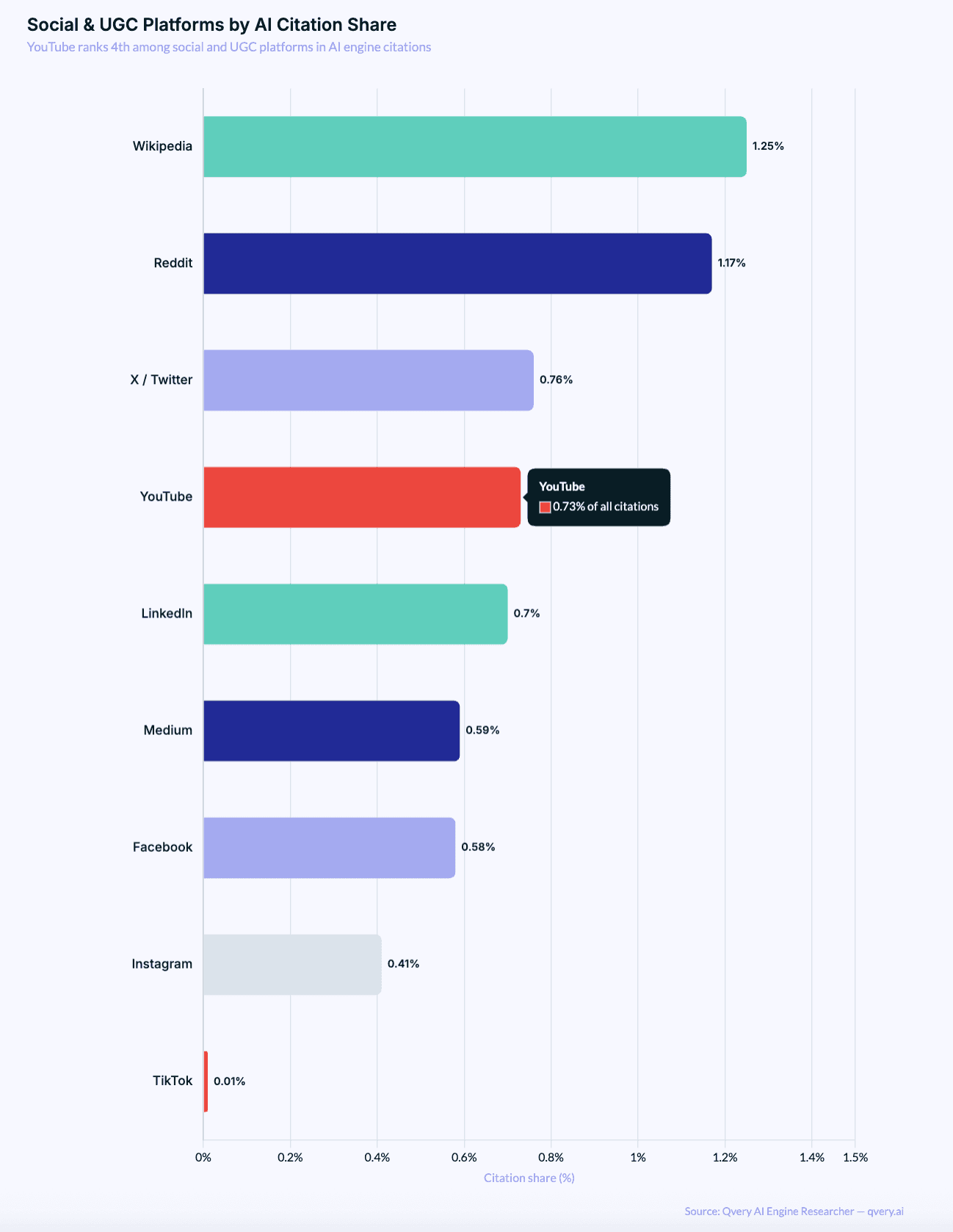
YouTube gets fewer citations than X. It gets roughly the same as LinkedIn. TikTok, with approximately one billion monthly active users, sits at 0.01%. (Apparently AI engines aren't ready for dance tutorials as source material.)
If you want the full Reddit story, we wrote an entire post about why Reddit dominates AI search visibility.
Google AI Mode vs ChatGPT: Two Different Realities
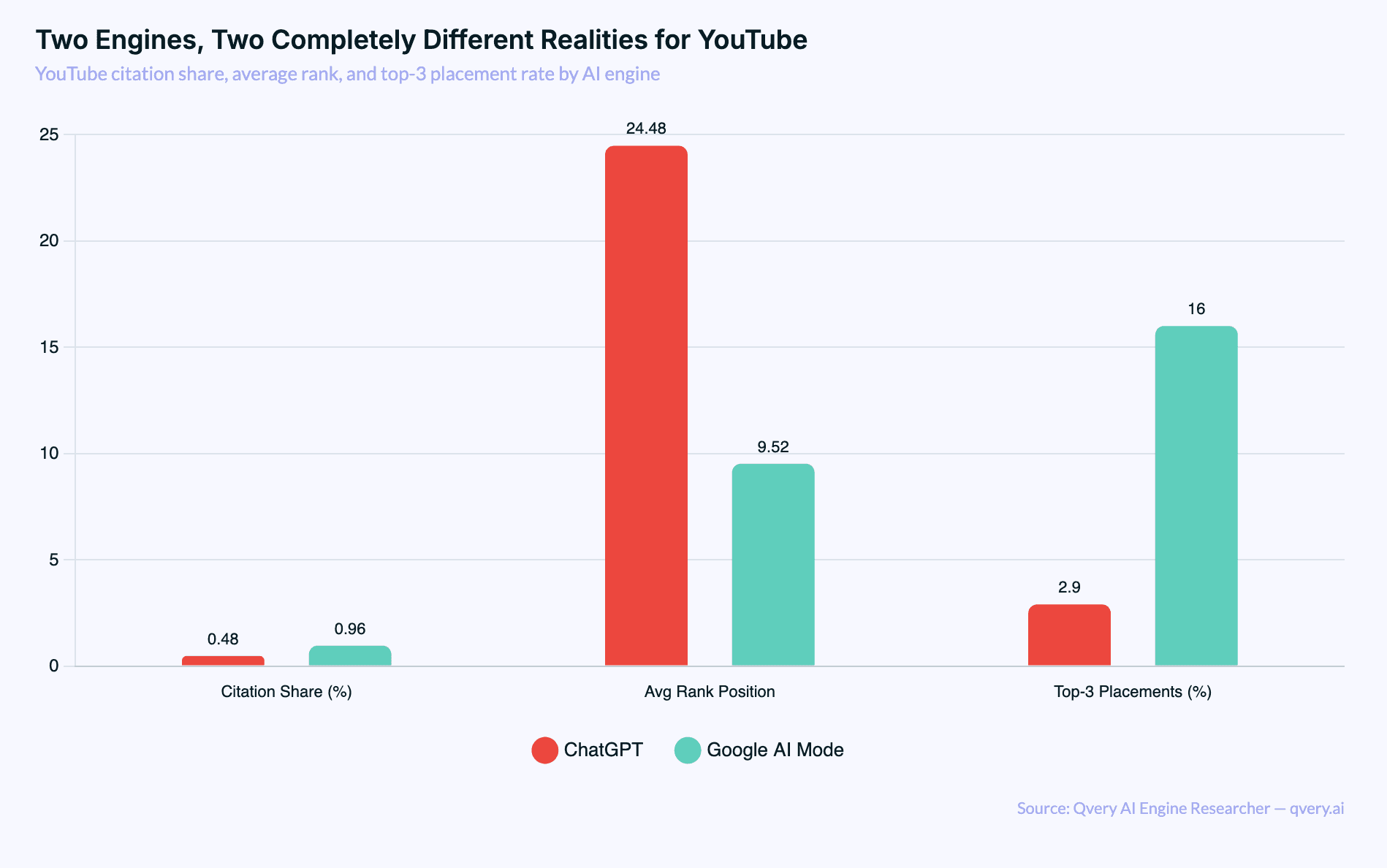
Here's the split that makes YouTube unlike any other platform in our data:
Google AI Mode: 0.96% citation share. Average rank: 9.52. Top-3 appearances: 16.0% of its YouTube citations.
ChatGPT: 0.48% citation share. Average rank: 24.48. Top-3 appearances: 2.9% of its YouTube citations. Rank-1 appearances: 0%.
When Google AI Mode cites YouTube, it places it in the top 10 on average. When ChatGPT cites YouTube, it buries it around position 25. That's the difference between being on the first page of recommendations and being in the appendix nobody reads.
Google AI Mode produces 68.7% of all YouTube citations across both engines. ChatGPT accounts for the remaining third, but treats video content as a last resort when text sources run out.
YouTube isn't one citation source. It's two completely different citation sources depending on which AI engine you ask.
Google owns YouTube. Google AI Mode has deep access to YouTube's transcript data, engagement metrics, and content graph. ChatGPT has none of that. It sees YouTube URLs the same way it sees any other link, and it clearly prefers text-based sources it can parse natively.
This engine-specific behavior is one of the reasons we believe AI engine visibility has three distinct pillars, not one.
Google AI Mode Links to Timestamps. ChatGPT Can't.
This finding reveals a fundamental architectural difference between the two engines.
Of Google AI Mode's YouTube citations, 31.8% include timestamp parameters. These aren't links to a video's homepage. They're links to the exact moment in the video that answers the query.
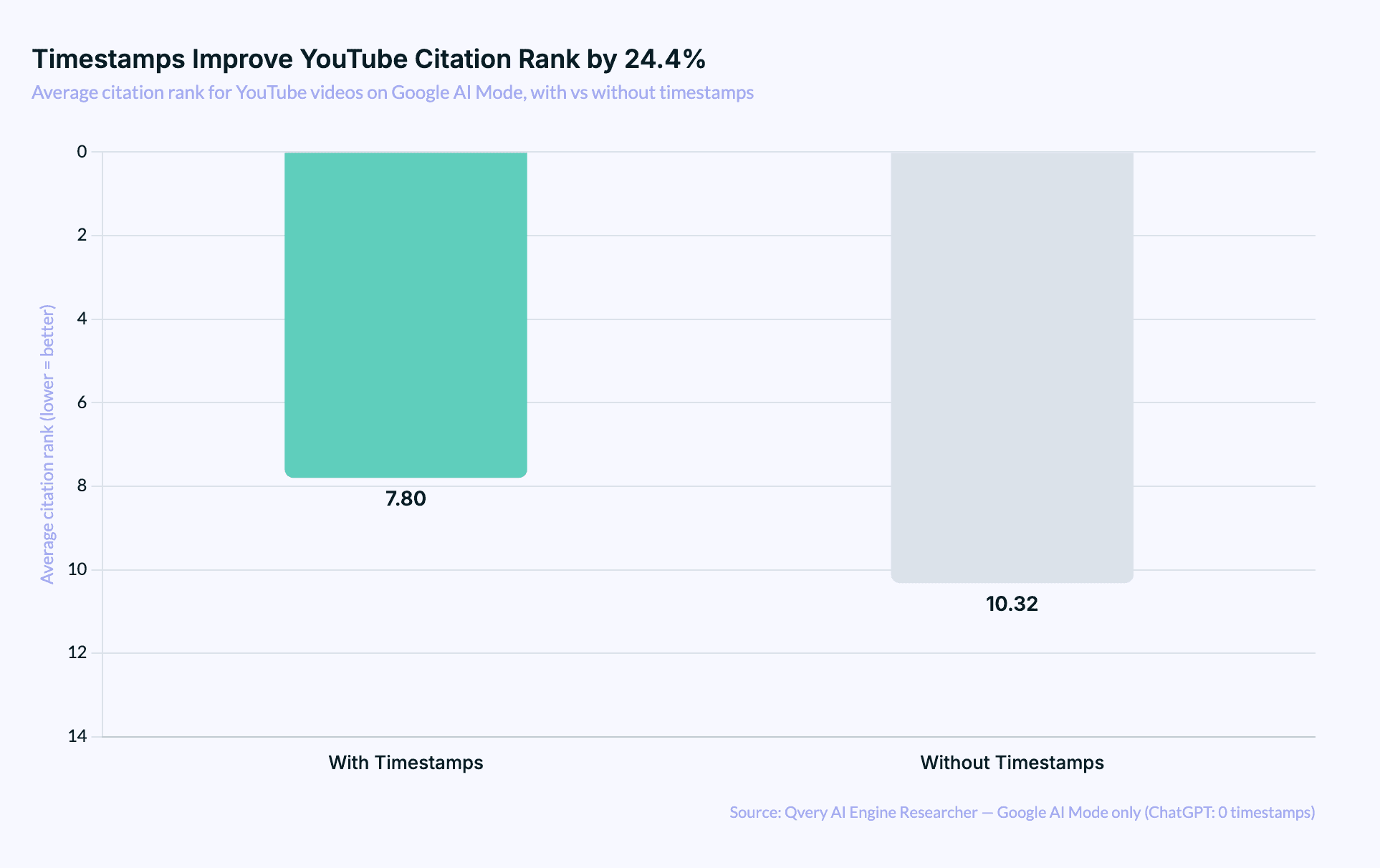
Timestamped citations rank significantly higher:
Timestamped YouTube citations: Average rank 7.80
Non-timestamped YouTube citations: Average rank 10.32
That's a 24.4% improvement in citation position from timestamps alone.
ChatGPT's timestamp count? Zero. Across every single YouTube citation in our data.
This isn't just a YouTube quirk. It reflects how these engines fundamentally work. Google AI Mode does passage-level retrieval. It reads video transcripts, identifies the specific passage that answers a query, and links directly to that moment. It treats video content the same way it treats text: find the relevant passage, cite it precisely.
ChatGPT doesn't do passage-level retrieval on video content. It can process text at the passage level (which is why it's effective with articles and Reddit threads), but it can't parse video transcripts the same way. When it cites YouTube, it links to the full video URL with no positional context. It knows a video is relevant but can't point to where in the video the answer lives.
This architectural gap explains the rank difference too. Google AI Mode can confidently place a YouTube citation high because it knows exactly which passage it's citing. ChatGPT, unable to verify the specific content within a video, hedges by ranking it lower.
Visual Industries Get 3x More YouTube Citations
YouTube citation share isn't distributed evenly across industries. Some verticals see rates 10x higher than others.
Citation rates across industries in our data (anonymized):
Design and prototyping tools: 1.84%
Visual content and presentations: 1.74%
Cloud storage and privacy: 1.15%
Language learning and education: 0.98%
Ad tech and monetization: 0.88%
AI and marketing technology: 0.69%
E-commerce platforms: 0.56%
Revenue intelligence: 0.49%
Event management: 0.48%
HR and employer-of-record: 0.44%
Insurance: 0.30%
Travel experiences: 0.18%
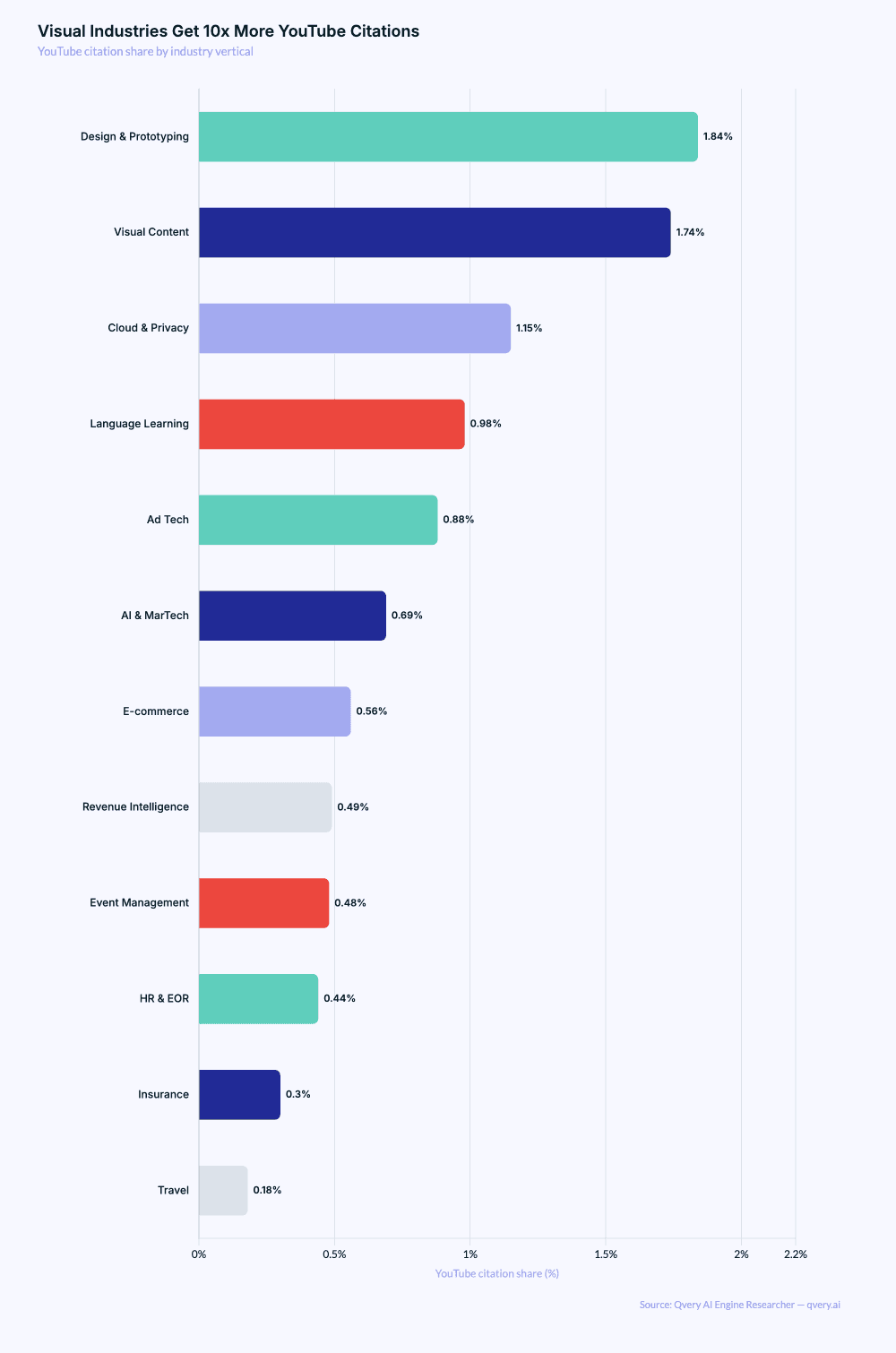
The pattern: industries where the product is inherently visual or where demonstrations matter get significantly more YouTube citations. If your product does something you can show, YouTube is a more valuable citation channel. If your product is an insurance policy or a travel booking, YouTube citations are nearly nonexistent.
Each unique YouTube video that earns a citation averages 2.66 citations, slightly higher than Reddit's 2.54 per unique page. Individual videos that earn citations tend to earn them repeatedly. This concentration is consistent with the double jeopardy pattern we found across AI search, where already-visible brands compound their advantage.
How to Get Your YouTube Content Cited
The videos that AI engines cite aren't the most polished or the most expensive to produce. They're the ones that genuinely answer the question better than anything else available. That's the starting point. Everything below is secondary to creating content that's actually worth citing.
Create Genuinely Useful Content First
AI engines cite YouTube videos for the same reason they cite any source: because the content answers a specific question with depth and authority. Before thinking about timestamps or descriptions, ask: does this video teach something that no other video on YouTube covers this well? If the answer is no, the optimization won't save it.
The videos that earn the most citations in our data are tutorials and how-tos (13.9% of cited content), listicle and best-of comparisons (16.1%), and reviews (9.9%). These formats work because they're structured around answering real questions, not around being entertaining.
Structure Your Videos for Machine Understanding
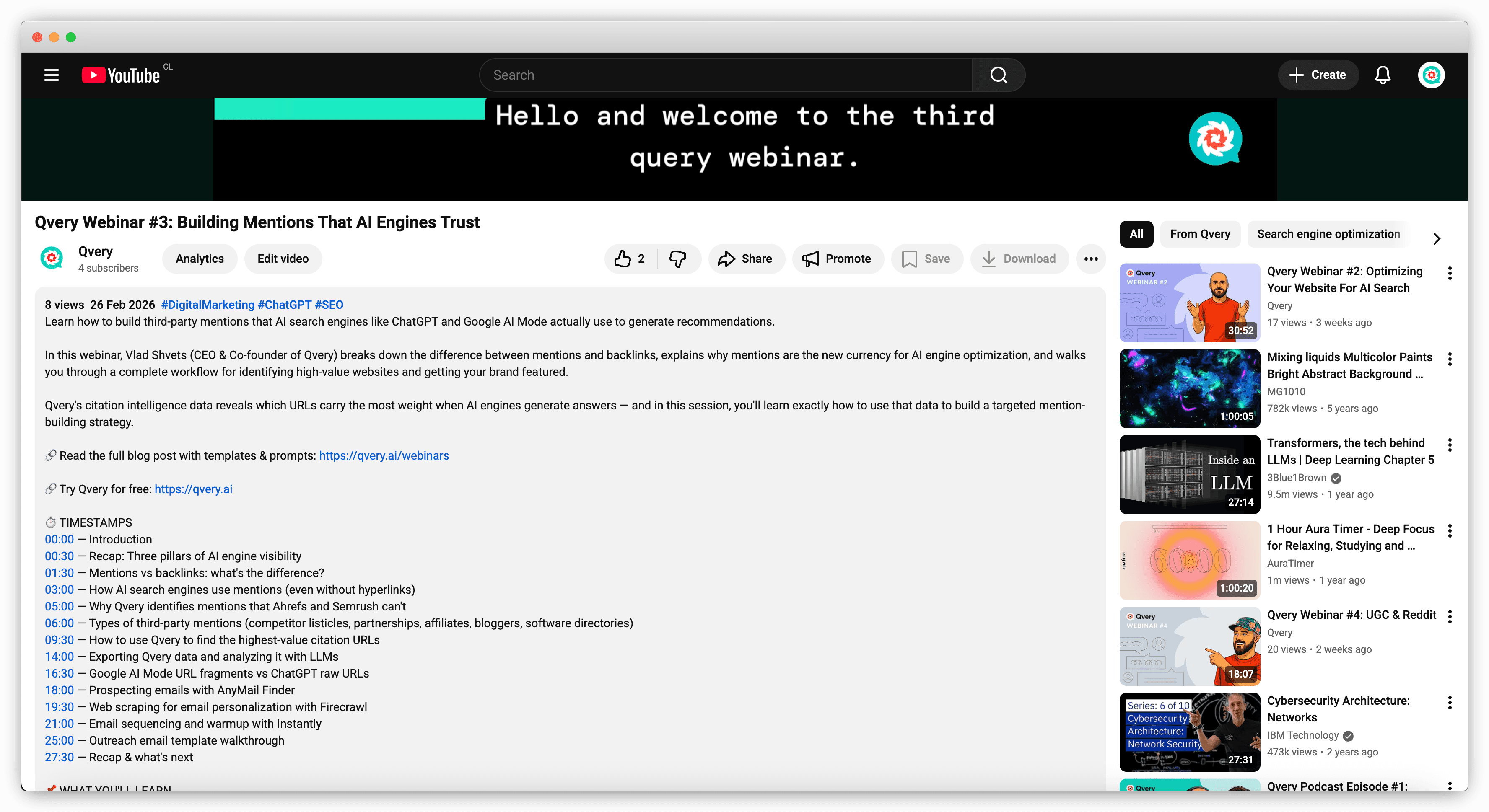
Once you have genuinely useful content, make it easy for AI engines to find the right moments. Add timestamps and chapters to every video. Google AI Mode links to specific timestamps 31.8% of the time, and those citations rank 24% higher. Break your videos into clearly labeled sections that mirror how people actually ask questions.
Write video descriptions as structured summaries, not dumping grounds for social links. State who the video is for, what problem it solves, and what key points it covers. This is the text layer AI engines parse to understand your content.
Build Topical Authority, Not a Random Collection
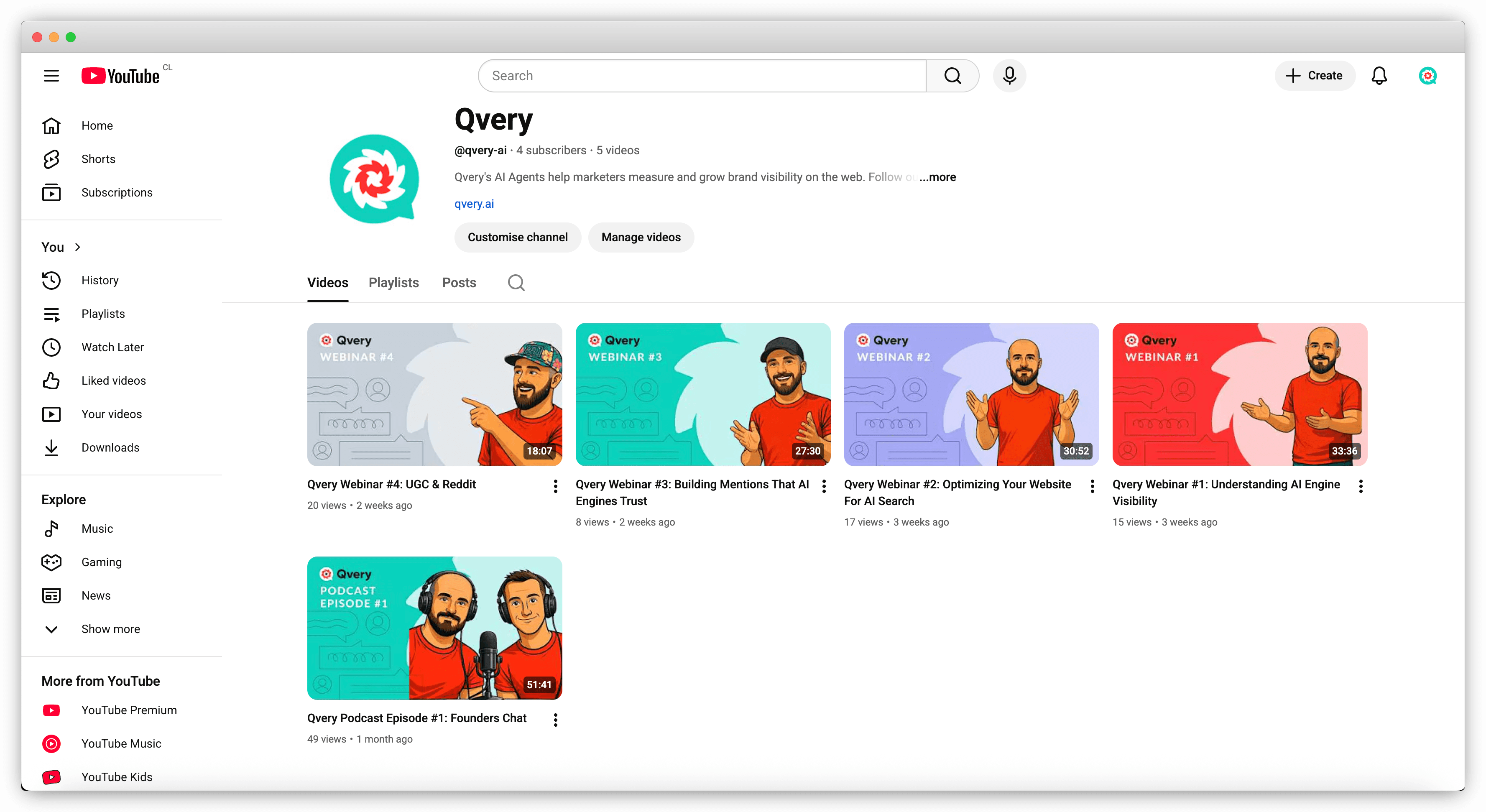
Sporadic uploads don't build authority. Create video series around specific topics, connected via playlists. This mirrors the content cluster approach that works for text-based AEO, and it gives AI engines more signals to associate your channel with a specific topic.
When your presenter naturally speaks the actual queries your audience types into AI engines, you give the transcript layer direct query-to-content alignment. Not robotically repeating phrases. Just talking about the topic the way your audience talks about it.
The principle is simple: create content worth citing, then make it easy for machines to understand. The content quality comes first. The optimization is a multiplier on something that's already good.
How Qvery Tracks YouTube Citations
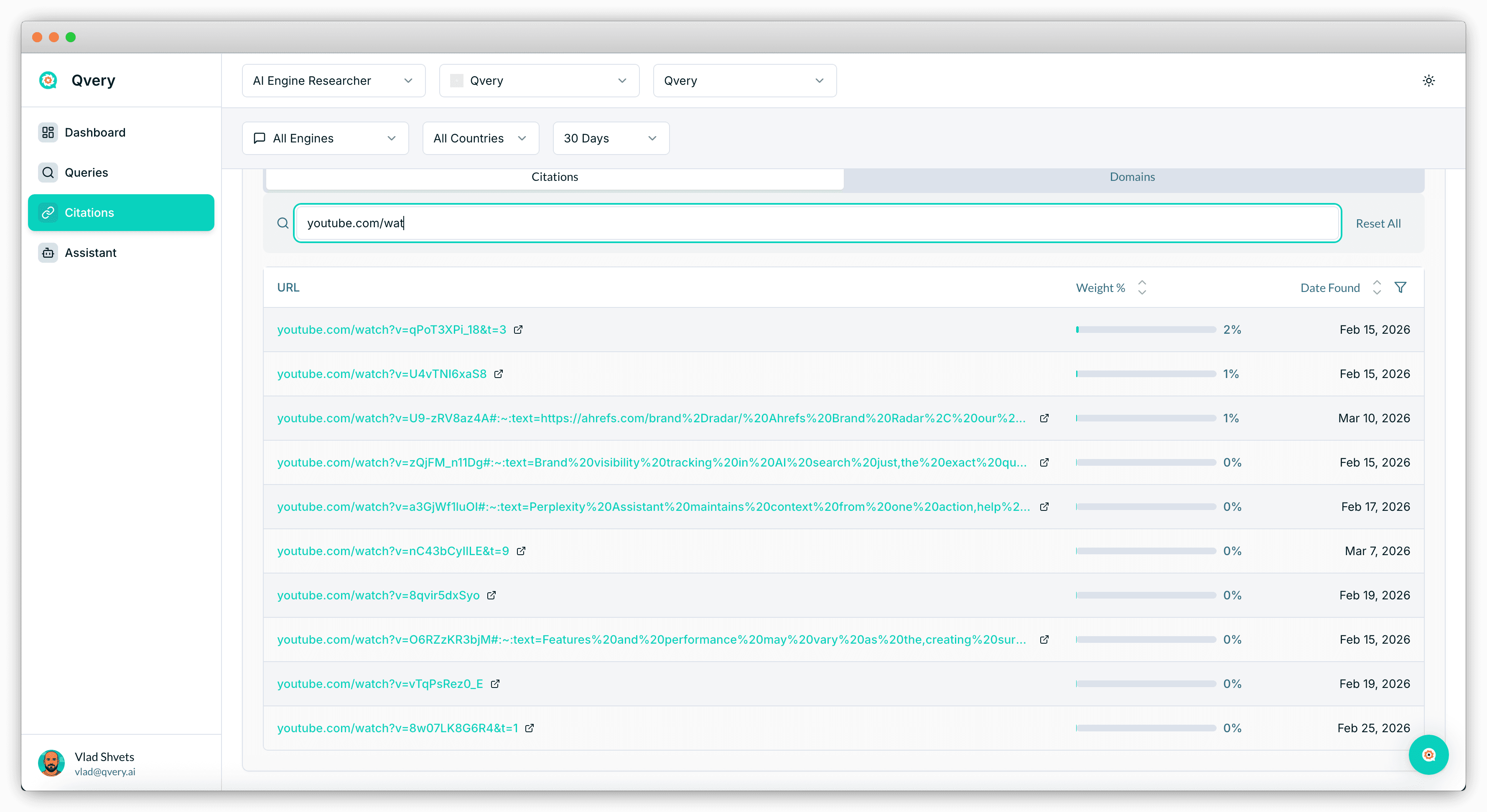
In the Citations module, filter by domain to isolate YouTube citations. You'll see which specific videos are being cited by ChatGPT and Google AI Mode for your queries, their rank positions, and how YouTube compares to other citation sources in your space.
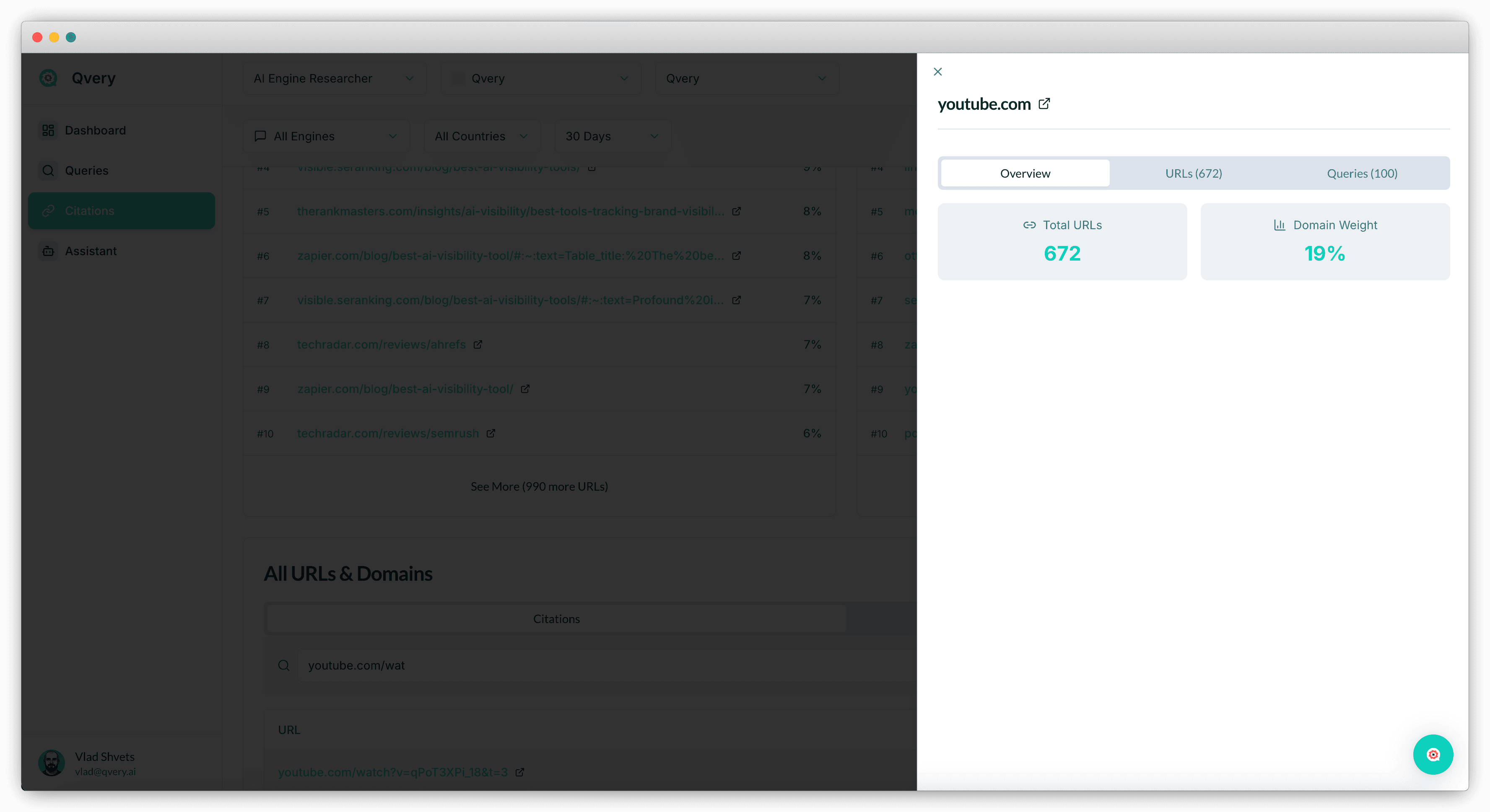
The AI Engine Researcher tracks this automatically across every query execution. The data updates with every run, so you can monitor whether your YouTube content is gaining or losing citation share over time.
This is particularly useful for industry comparison. If you're in a visual product category where YouTube citations run at 1.5-2%, there's meaningful opportunity. If you're in insurance or travel where it runs at 0.2-0.3%, your optimization budget is better spent on other citation sources.
YouTube Still Matters
Your audience isn't exclusively on Google AI Mode or exclusively on ChatGPT. They're using both. YouTube may underperform on one engine today, but the platform still sits in the top five most-cited domains across the board. That's not something to ignore.
The brands that will win AI video search aren't the ones uploading the most content. They're the ones creating videos that genuinely answer questions better than anything else available. Videos where the depth of the explanation, the clarity of the demonstration, or the honesty of the review makes them the obvious source to cite.
Follow the tips above. Create something worth watching. The citations will follow.
We've been tracking AI engine citations across ChatGPT and Google AI Mode through Qvery's AI Engine Researcher. When we dug into how each engine treats YouTube as a citation source, the findings were stark.
YouTube accounts for 0.73% of all AI engine citations. For the world's second most-visited website and the largest video library ever assembled, that's a rough number. But the overall percentage hides a structural split. Google AI Mode cites YouTube at nearly double the rate of ChatGPT, ranks it 15 positions higher on average, and links directly to specific video timestamps. ChatGPT has never once placed a YouTube video in its top citation position.
YouTube Is the Fourth Most-Cited Social Platform
Among social and UGC platforms, YouTube sits in fourth place by citation share:
Wikipedia: 1.25%
Reddit: 1.17%
X/Twitter: 0.76%
YouTube: 0.73%
LinkedIn: 0.70%
Medium: 0.59%
Facebook: 0.58%
Instagram: 0.41%
TikTok: 0.01%
YouTube gets fewer citations than X. It gets roughly the same as LinkedIn. TikTok, with approximately one billion monthly active users, sits at 0.01%. (Apparently AI engines aren't ready for dance tutorials as source material.)
If you want the full Reddit story, we wrote an entire post about why Reddit dominates AI search visibility.
Google AI Mode vs ChatGPT: Two Different Realities
Here's the split that makes YouTube unlike any other platform in our data:
Google AI Mode: 0.96% citation share. Average rank: 9.52. Top-3 appearances: 16.0% of its YouTube citations.
ChatGPT: 0.48% citation share. Average rank: 24.48. Top-3 appearances: 2.9% of its YouTube citations. Rank-1 appearances: 0%.
When Google AI Mode cites YouTube, it places it in the top 10 on average. When ChatGPT cites YouTube, it buries it around position 25. That's the difference between being on the first page of recommendations and being in the appendix nobody reads.
Google AI Mode produces 68.7% of all YouTube citations across both engines. ChatGPT accounts for the remaining third, but treats video content as a last resort when text sources run out.
YouTube isn't one citation source. It's two completely different citation sources depending on which AI engine you ask.
Google owns YouTube. Google AI Mode has deep access to YouTube's transcript data, engagement metrics, and content graph. ChatGPT has none of that. It sees YouTube URLs the same way it sees any other link, and it clearly prefers text-based sources it can parse natively.
This engine-specific behavior is one of the reasons we believe AI engine visibility has three distinct pillars, not one.
Google AI Mode Links to Timestamps. ChatGPT Can't.
This finding reveals a fundamental architectural difference between the two engines.
Of Google AI Mode's YouTube citations, 31.8% include timestamp parameters. These aren't links to a video's homepage. They're links to the exact moment in the video that answers the query.
Timestamped citations rank significantly higher:
Timestamped YouTube citations: Average rank 7.80
Non-timestamped YouTube citations: Average rank 10.32
That's a 24.4% improvement in citation position from timestamps alone.
ChatGPT's timestamp count? Zero. Across every single YouTube citation in our data.
This isn't just a YouTube quirk. It reflects how these engines fundamentally work. Google AI Mode does passage-level retrieval. It reads video transcripts, identifies the specific passage that answers a query, and links directly to that moment. It treats video content the same way it treats text: find the relevant passage, cite it precisely.
ChatGPT doesn't do passage-level retrieval on video content. It can process text at the passage level (which is why it's effective with articles and Reddit threads), but it can't parse video transcripts the same way. When it cites YouTube, it links to the full video URL with no positional context. It knows a video is relevant but can't point to where in the video the answer lives.
This architectural gap explains the rank difference too. Google AI Mode can confidently place a YouTube citation high because it knows exactly which passage it's citing. ChatGPT, unable to verify the specific content within a video, hedges by ranking it lower.
Visual Industries Get 3x More YouTube Citations
YouTube citation share isn't distributed evenly across industries. Some verticals see rates 10x higher than others.
Citation rates across industries in our data (anonymized):
Design and prototyping tools: 1.84%
Visual content and presentations: 1.74%
Cloud storage and privacy: 1.15%
Language learning and education: 0.98%
Ad tech and monetization: 0.88%
AI and marketing technology: 0.69%
E-commerce platforms: 0.56%
Revenue intelligence: 0.49%
Event management: 0.48%
HR and employer-of-record: 0.44%
Insurance: 0.30%
Travel experiences: 0.18%
The pattern: industries where the product is inherently visual or where demonstrations matter get significantly more YouTube citations. If your product does something you can show, YouTube is a more valuable citation channel. If your product is an insurance policy or a travel booking, YouTube citations are nearly nonexistent.
Each unique YouTube video that earns a citation averages 2.66 citations, slightly higher than Reddit's 2.54 per unique page. Individual videos that earn citations tend to earn them repeatedly. This concentration is consistent with the double jeopardy pattern we found across AI search, where already-visible brands compound their advantage.
How to Get Your YouTube Content Cited
The videos that AI engines cite aren't the most polished or the most expensive to produce. They're the ones that genuinely answer the question better than anything else available. That's the starting point. Everything below is secondary to creating content that's actually worth citing.
Create Genuinely Useful Content First
AI engines cite YouTube videos for the same reason they cite any source: because the content answers a specific question with depth and authority. Before thinking about timestamps or descriptions, ask: does this video teach something that no other video on YouTube covers this well? If the answer is no, the optimization won't save it.
The videos that earn the most citations in our data are tutorials and how-tos (13.9% of cited content), listicle and best-of comparisons (16.1%), and reviews (9.9%). These formats work because they're structured around answering real questions, not around being entertaining.
Structure Your Videos for Machine Understanding
Once you have genuinely useful content, make it easy for AI engines to find the right moments. Add timestamps and chapters to every video. Google AI Mode links to specific timestamps 31.8% of the time, and those citations rank 24% higher. Break your videos into clearly labeled sections that mirror how people actually ask questions.
Write video descriptions as structured summaries, not dumping grounds for social links. State who the video is for, what problem it solves, and what key points it covers. This is the text layer AI engines parse to understand your content.
Build Topical Authority, Not a Random Collection
Sporadic uploads don't build authority. Create video series around specific topics, connected via playlists. This mirrors the content cluster approach that works for text-based AEO, and it gives AI engines more signals to associate your channel with a specific topic.
When your presenter naturally speaks the actual queries your audience types into AI engines, you give the transcript layer direct query-to-content alignment. Not robotically repeating phrases. Just talking about the topic the way your audience talks about it.
The principle is simple: create content worth citing, then make it easy for machines to understand. The content quality comes first. The optimization is a multiplier on something that's already good.
How Qvery Tracks YouTube Citations
In the Citations module, filter by domain to isolate YouTube citations. You'll see which specific videos are being cited by ChatGPT and Google AI Mode for your queries, their rank positions, and how YouTube compares to other citation sources in your space.
The AI Engine Researcher tracks this automatically across every query execution. The data updates with every run, so you can monitor whether your YouTube content is gaining or losing citation share over time.
This is particularly useful for industry comparison. If you're in a visual product category where YouTube citations run at 1.5-2%, there's meaningful opportunity. If you're in insurance or travel where it runs at 0.2-0.3%, your optimization budget is better spent on other citation sources.
YouTube Still Matters
Your audience isn't exclusively on Google AI Mode or exclusively on ChatGPT. They're using both. YouTube may underperform on one engine today, but the platform still sits in the top five most-cited domains across the board. That's not something to ignore.
The brands that will win AI video search aren't the ones uploading the most content. They're the ones creating videos that genuinely answer questions better than anything else available. Videos where the depth of the explanation, the clarity of the demonstration, or the honesty of the review makes them the obvious source to cite.
Follow the tips above. Create something worth watching. The citations will follow.
We've been tracking AI engine citations across ChatGPT and Google AI Mode through Qvery's AI Engine Researcher. When we dug into how each engine treats YouTube as a citation source, the findings were stark.
YouTube accounts for 0.73% of all AI engine citations. For the world's second most-visited website and the largest video library ever assembled, that's a rough number. But the overall percentage hides a structural split. Google AI Mode cites YouTube at nearly double the rate of ChatGPT, ranks it 15 positions higher on average, and links directly to specific video timestamps. ChatGPT has never once placed a YouTube video in its top citation position.
YouTube Is the Fourth Most-Cited Social Platform
Among social and UGC platforms, YouTube sits in fourth place by citation share:
Wikipedia: 1.25%
Reddit: 1.17%
X/Twitter: 0.76%
YouTube: 0.73%
LinkedIn: 0.70%
Medium: 0.59%
Facebook: 0.58%
Instagram: 0.41%
TikTok: 0.01%
YouTube gets fewer citations than X. It gets roughly the same as LinkedIn. TikTok, with approximately one billion monthly active users, sits at 0.01%. (Apparently AI engines aren't ready for dance tutorials as source material.)
If you want the full Reddit story, we wrote an entire post about why Reddit dominates AI search visibility.
Google AI Mode vs ChatGPT: Two Different Realities
Here's the split that makes YouTube unlike any other platform in our data:
Google AI Mode: 0.96% citation share. Average rank: 9.52. Top-3 appearances: 16.0% of its YouTube citations.
ChatGPT: 0.48% citation share. Average rank: 24.48. Top-3 appearances: 2.9% of its YouTube citations. Rank-1 appearances: 0%.
When Google AI Mode cites YouTube, it places it in the top 10 on average. When ChatGPT cites YouTube, it buries it around position 25. That's the difference between being on the first page of recommendations and being in the appendix nobody reads.
Google AI Mode produces 68.7% of all YouTube citations across both engines. ChatGPT accounts for the remaining third, but treats video content as a last resort when text sources run out.
YouTube isn't one citation source. It's two completely different citation sources depending on which AI engine you ask.
Google owns YouTube. Google AI Mode has deep access to YouTube's transcript data, engagement metrics, and content graph. ChatGPT has none of that. It sees YouTube URLs the same way it sees any other link, and it clearly prefers text-based sources it can parse natively.
This engine-specific behavior is one of the reasons we believe AI engine visibility has three distinct pillars, not one.
Google AI Mode Links to Timestamps. ChatGPT Can't.
This finding reveals a fundamental architectural difference between the two engines.
Of Google AI Mode's YouTube citations, 31.8% include timestamp parameters. These aren't links to a video's homepage. They're links to the exact moment in the video that answers the query.
Timestamped citations rank significantly higher:
Timestamped YouTube citations: Average rank 7.80
Non-timestamped YouTube citations: Average rank 10.32
That's a 24.4% improvement in citation position from timestamps alone.
ChatGPT's timestamp count? Zero. Across every single YouTube citation in our data.
This isn't just a YouTube quirk. It reflects how these engines fundamentally work. Google AI Mode does passage-level retrieval. It reads video transcripts, identifies the specific passage that answers a query, and links directly to that moment. It treats video content the same way it treats text: find the relevant passage, cite it precisely.
ChatGPT doesn't do passage-level retrieval on video content. It can process text at the passage level (which is why it's effective with articles and Reddit threads), but it can't parse video transcripts the same way. When it cites YouTube, it links to the full video URL with no positional context. It knows a video is relevant but can't point to where in the video the answer lives.
This architectural gap explains the rank difference too. Google AI Mode can confidently place a YouTube citation high because it knows exactly which passage it's citing. ChatGPT, unable to verify the specific content within a video, hedges by ranking it lower.
Visual Industries Get 3x More YouTube Citations
YouTube citation share isn't distributed evenly across industries. Some verticals see rates 10x higher than others.
Citation rates across industries in our data (anonymized):
Design and prototyping tools: 1.84%
Visual content and presentations: 1.74%
Cloud storage and privacy: 1.15%
Language learning and education: 0.98%
Ad tech and monetization: 0.88%
AI and marketing technology: 0.69%
E-commerce platforms: 0.56%
Revenue intelligence: 0.49%
Event management: 0.48%
HR and employer-of-record: 0.44%
Insurance: 0.30%
Travel experiences: 0.18%
The pattern: industries where the product is inherently visual or where demonstrations matter get significantly more YouTube citations. If your product does something you can show, YouTube is a more valuable citation channel. If your product is an insurance policy or a travel booking, YouTube citations are nearly nonexistent.
Each unique YouTube video that earns a citation averages 2.66 citations, slightly higher than Reddit's 2.54 per unique page. Individual videos that earn citations tend to earn them repeatedly. This concentration is consistent with the double jeopardy pattern we found across AI search, where already-visible brands compound their advantage.
How to Get Your YouTube Content Cited
The videos that AI engines cite aren't the most polished or the most expensive to produce. They're the ones that genuinely answer the question better than anything else available. That's the starting point. Everything below is secondary to creating content that's actually worth citing.
Create Genuinely Useful Content First
AI engines cite YouTube videos for the same reason they cite any source: because the content answers a specific question with depth and authority. Before thinking about timestamps or descriptions, ask: does this video teach something that no other video on YouTube covers this well? If the answer is no, the optimization won't save it.
The videos that earn the most citations in our data are tutorials and how-tos (13.9% of cited content), listicle and best-of comparisons (16.1%), and reviews (9.9%). These formats work because they're structured around answering real questions, not around being entertaining.
Structure Your Videos for Machine Understanding
Once you have genuinely useful content, make it easy for AI engines to find the right moments. Add timestamps and chapters to every video. Google AI Mode links to specific timestamps 31.8% of the time, and those citations rank 24% higher. Break your videos into clearly labeled sections that mirror how people actually ask questions.
Write video descriptions as structured summaries, not dumping grounds for social links. State who the video is for, what problem it solves, and what key points it covers. This is the text layer AI engines parse to understand your content.
Build Topical Authority, Not a Random Collection
Sporadic uploads don't build authority. Create video series around specific topics, connected via playlists. This mirrors the content cluster approach that works for text-based AEO, and it gives AI engines more signals to associate your channel with a specific topic.
When your presenter naturally speaks the actual queries your audience types into AI engines, you give the transcript layer direct query-to-content alignment. Not robotically repeating phrases. Just talking about the topic the way your audience talks about it.
The principle is simple: create content worth citing, then make it easy for machines to understand. The content quality comes first. The optimization is a multiplier on something that's already good.
How Qvery Tracks YouTube Citations
In the Citations module, filter by domain to isolate YouTube citations. You'll see which specific videos are being cited by ChatGPT and Google AI Mode for your queries, their rank positions, and how YouTube compares to other citation sources in your space.
The AI Engine Researcher tracks this automatically across every query execution. The data updates with every run, so you can monitor whether your YouTube content is gaining or losing citation share over time.
This is particularly useful for industry comparison. If you're in a visual product category where YouTube citations run at 1.5-2%, there's meaningful opportunity. If you're in insurance or travel where it runs at 0.2-0.3%, your optimization budget is better spent on other citation sources.
YouTube Still Matters
Your audience isn't exclusively on Google AI Mode or exclusively on ChatGPT. They're using both. YouTube may underperform on one engine today, but the platform still sits in the top five most-cited domains across the board. That's not something to ignore.
The brands that will win AI video search aren't the ones uploading the most content. They're the ones creating videos that genuinely answer questions better than anything else available. Videos where the depth of the explanation, the clarity of the demonstration, or the honesty of the review makes them the obvious source to cite.
Follow the tips above. Create something worth watching. The citations will follow.
We've been tracking AI engine citations across ChatGPT and Google AI Mode through Qvery's AI Engine Researcher. When we dug into how each engine treats YouTube as a citation source, the findings were stark.
YouTube accounts for 0.73% of all AI engine citations. For the world's second most-visited website and the largest video library ever assembled, that's a rough number. But the overall percentage hides a structural split. Google AI Mode cites YouTube at nearly double the rate of ChatGPT, ranks it 15 positions higher on average, and links directly to specific video timestamps. ChatGPT has never once placed a YouTube video in its top citation position.
YouTube Is the Fourth Most-Cited Social Platform
Among social and UGC platforms, YouTube sits in fourth place by citation share:
Wikipedia: 1.25%
Reddit: 1.17%
X/Twitter: 0.76%
YouTube: 0.73%
LinkedIn: 0.70%
Medium: 0.59%
Facebook: 0.58%
Instagram: 0.41%
TikTok: 0.01%
YouTube gets fewer citations than X. It gets roughly the same as LinkedIn. TikTok, with approximately one billion monthly active users, sits at 0.01%. (Apparently AI engines aren't ready for dance tutorials as source material.)
If you want the full Reddit story, we wrote an entire post about why Reddit dominates AI search visibility.
Google AI Mode vs ChatGPT: Two Different Realities
Here's the split that makes YouTube unlike any other platform in our data:
Google AI Mode: 0.96% citation share. Average rank: 9.52. Top-3 appearances: 16.0% of its YouTube citations.
ChatGPT: 0.48% citation share. Average rank: 24.48. Top-3 appearances: 2.9% of its YouTube citations. Rank-1 appearances: 0%.
When Google AI Mode cites YouTube, it places it in the top 10 on average. When ChatGPT cites YouTube, it buries it around position 25. That's the difference between being on the first page of recommendations and being in the appendix nobody reads.
Google AI Mode produces 68.7% of all YouTube citations across both engines. ChatGPT accounts for the remaining third, but treats video content as a last resort when text sources run out.
YouTube isn't one citation source. It's two completely different citation sources depending on which AI engine you ask.
Google owns YouTube. Google AI Mode has deep access to YouTube's transcript data, engagement metrics, and content graph. ChatGPT has none of that. It sees YouTube URLs the same way it sees any other link, and it clearly prefers text-based sources it can parse natively.
This engine-specific behavior is one of the reasons we believe AI engine visibility has three distinct pillars, not one.
Google AI Mode Links to Timestamps. ChatGPT Can't.
This finding reveals a fundamental architectural difference between the two engines.
Of Google AI Mode's YouTube citations, 31.8% include timestamp parameters. These aren't links to a video's homepage. They're links to the exact moment in the video that answers the query.
Timestamped citations rank significantly higher:
Timestamped YouTube citations: Average rank 7.80
Non-timestamped YouTube citations: Average rank 10.32
That's a 24.4% improvement in citation position from timestamps alone.
ChatGPT's timestamp count? Zero. Across every single YouTube citation in our data.
This isn't just a YouTube quirk. It reflects how these engines fundamentally work. Google AI Mode does passage-level retrieval. It reads video transcripts, identifies the specific passage that answers a query, and links directly to that moment. It treats video content the same way it treats text: find the relevant passage, cite it precisely.
ChatGPT doesn't do passage-level retrieval on video content. It can process text at the passage level (which is why it's effective with articles and Reddit threads), but it can't parse video transcripts the same way. When it cites YouTube, it links to the full video URL with no positional context. It knows a video is relevant but can't point to where in the video the answer lives.
This architectural gap explains the rank difference too. Google AI Mode can confidently place a YouTube citation high because it knows exactly which passage it's citing. ChatGPT, unable to verify the specific content within a video, hedges by ranking it lower.
Visual Industries Get 3x More YouTube Citations
YouTube citation share isn't distributed evenly across industries. Some verticals see rates 10x higher than others.
Citation rates across industries in our data (anonymized):
Design and prototyping tools: 1.84%
Visual content and presentations: 1.74%
Cloud storage and privacy: 1.15%
Language learning and education: 0.98%
Ad tech and monetization: 0.88%
AI and marketing technology: 0.69%
E-commerce platforms: 0.56%
Revenue intelligence: 0.49%
Event management: 0.48%
HR and employer-of-record: 0.44%
Insurance: 0.30%
Travel experiences: 0.18%
The pattern: industries where the product is inherently visual or where demonstrations matter get significantly more YouTube citations. If your product does something you can show, YouTube is a more valuable citation channel. If your product is an insurance policy or a travel booking, YouTube citations are nearly nonexistent.
Each unique YouTube video that earns a citation averages 2.66 citations, slightly higher than Reddit's 2.54 per unique page. Individual videos that earn citations tend to earn them repeatedly. This concentration is consistent with the double jeopardy pattern we found across AI search, where already-visible brands compound their advantage.
How to Get Your YouTube Content Cited
The videos that AI engines cite aren't the most polished or the most expensive to produce. They're the ones that genuinely answer the question better than anything else available. That's the starting point. Everything below is secondary to creating content that's actually worth citing.
Create Genuinely Useful Content First
AI engines cite YouTube videos for the same reason they cite any source: because the content answers a specific question with depth and authority. Before thinking about timestamps or descriptions, ask: does this video teach something that no other video on YouTube covers this well? If the answer is no, the optimization won't save it.
The videos that earn the most citations in our data are tutorials and how-tos (13.9% of cited content), listicle and best-of comparisons (16.1%), and reviews (9.9%). These formats work because they're structured around answering real questions, not around being entertaining.
Structure Your Videos for Machine Understanding
Once you have genuinely useful content, make it easy for AI engines to find the right moments. Add timestamps and chapters to every video. Google AI Mode links to specific timestamps 31.8% of the time, and those citations rank 24% higher. Break your videos into clearly labeled sections that mirror how people actually ask questions.
Write video descriptions as structured summaries, not dumping grounds for social links. State who the video is for, what problem it solves, and what key points it covers. This is the text layer AI engines parse to understand your content.
Build Topical Authority, Not a Random Collection
Sporadic uploads don't build authority. Create video series around specific topics, connected via playlists. This mirrors the content cluster approach that works for text-based AEO, and it gives AI engines more signals to associate your channel with a specific topic.
When your presenter naturally speaks the actual queries your audience types into AI engines, you give the transcript layer direct query-to-content alignment. Not robotically repeating phrases. Just talking about the topic the way your audience talks about it.
The principle is simple: create content worth citing, then make it easy for machines to understand. The content quality comes first. The optimization is a multiplier on something that's already good.
How Qvery Tracks YouTube Citations
In the Citations module, filter by domain to isolate YouTube citations. You'll see which specific videos are being cited by ChatGPT and Google AI Mode for your queries, their rank positions, and how YouTube compares to other citation sources in your space.
The AI Engine Researcher tracks this automatically across every query execution. The data updates with every run, so you can monitor whether your YouTube content is gaining or losing citation share over time.
This is particularly useful for industry comparison. If you're in a visual product category where YouTube citations run at 1.5-2%, there's meaningful opportunity. If you're in insurance or travel where it runs at 0.2-0.3%, your optimization budget is better spent on other citation sources.
YouTube Still Matters
Your audience isn't exclusively on Google AI Mode or exclusively on ChatGPT. They're using both. YouTube may underperform on one engine today, but the platform still sits in the top five most-cited domains across the board. That's not something to ignore.
The brands that will win AI video search aren't the ones uploading the most content. They're the ones creating videos that genuinely answer questions better than anything else available. Videos where the depth of the explanation, the clarity of the demonstration, or the honesty of the review makes them the obvious source to cite.
Follow the tips above. Create something worth watching. The citations will follow.

© 2026 Qvery AI OÜ