By
Vlad Shvets
Mentions Are the New Backlinks for SaaS
For SaaS, AI engines recommend the brands named in the listicles, comparisons, and Reddit threads they read. Here's how to find your mention gaps and close them.
For SaaS, AI engines recommend the brands named in the listicles, comparisons, and Reddit threads they read. Here's how to find your mention gaps and close them.
For SaaS, AI engines recommend the brands named in the listicles, comparisons, and Reddit threads they read. Here's how to find your mention gaps and close them.
Most SaaS marketers I talk to are still grinding on a backlink spreadsheet the size of a small phone book. Meanwhile a buyer opens ChatGPT, types "best CRM for small agencies," and the engine reads back three listicles their competitor is named in and they aren't. That gap, not the spreadsheet, decides the recommendation now.
The link you spent six months earning from a domain-rating-72 publication does almost nothing for whether an AI engine recommends your SaaS product.
What moves an AI recommendation is whether your name sits inside the listicles, comparison posts, and Reddit threads the engine reads.
The reflex is to run mention-building like a link-building campaign, counting referring domains while a competitor gets quietly named inside the "best project management tools" roundups, and that mention is what the engine reads back. The brands AI engines name are the brands present in the third-party content those engines synthesize, and for SaaS that content has a very specific shape.
In SaaS, Reddit and Listicles Carry More Weight Than Anywhere Else
When someone asks an AI engine for a software recommendation, the engine doesn't crawl the web live and rank 10 blue links. It synthesizes what it already trusts: your own site, a handful of editorial listicles, a few review or directory pages, and the community threads where real users argue about what works. For SaaS specifically, that synthesis leans hard on two things, curated lists and community opinion, because that's how humans shop for software.
A backlink only proves someone vouched for you. What gets you recommended by name is whether the engine read your product inside the content it summarizes for that specific job. Take two competing CRMs: one has a wall of DR-50 links, the other is named in every "best CRM for small agencies" listicle. The one named in the listicle gets recommended. The link earns the other CRM nothing in that answer. Earning DR-50 links to win an AI recommendation is like polishing your resume for a job that hires off the group chat.
In SaaS the shortlist is built before the buyer ever reaches your site. If your name isn't in the roundups and threads, you were cut before you knew there was a list.
Reddit Gets Cited in SaaS Queries 34% Above Average, and Listicles Skew Hard to ChatGPT
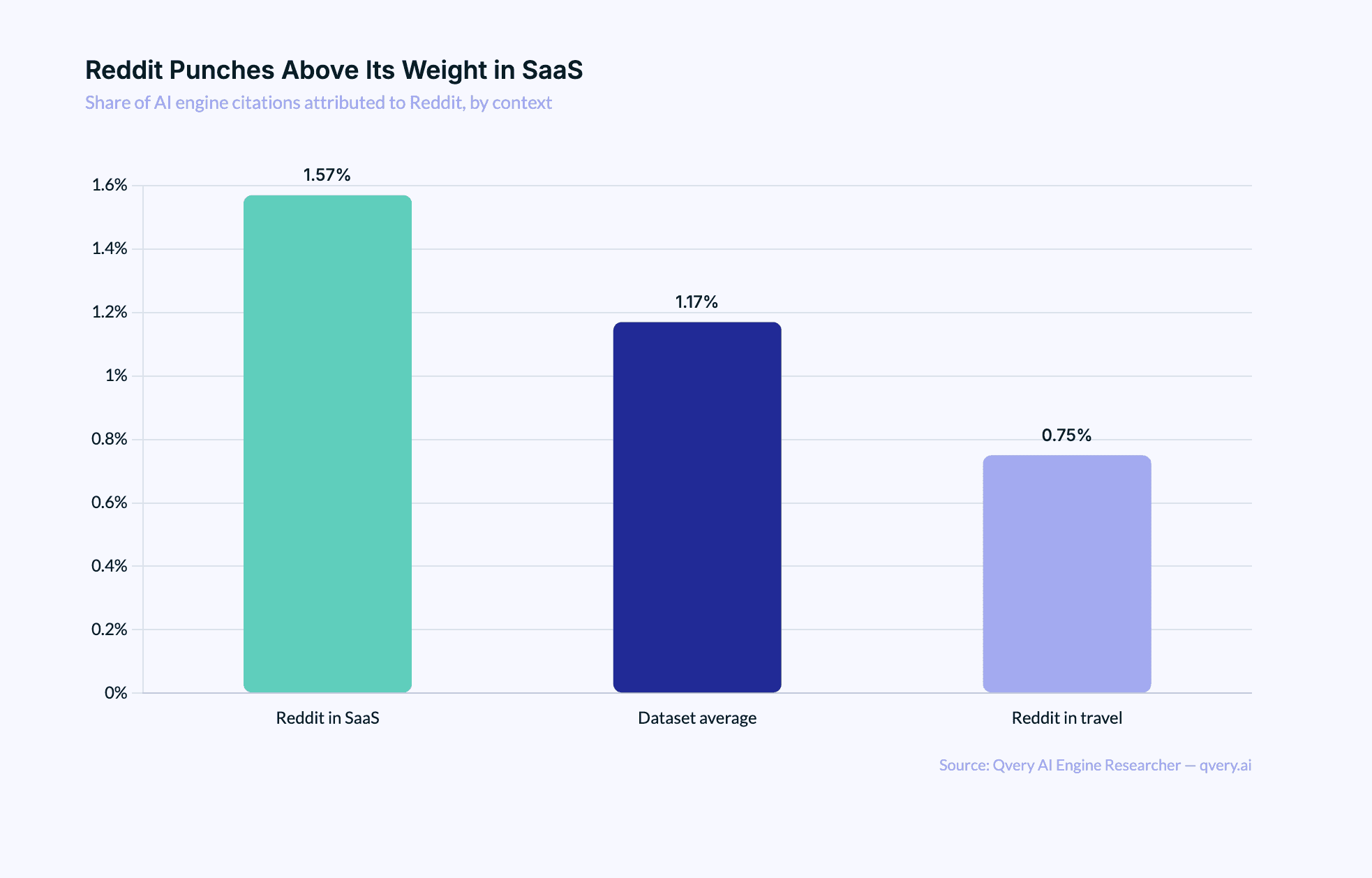
Across millions of AI citations on ChatGPT and Google AI Mode since January 2026, the pattern for SaaS is consistent. Reddit accounts for 1.57% of all citations within SaaS queries, which is 34% above the dataset-wide average of 1.17% and makes it the #3 most-cited domain in SaaS.
For context, Reddit in travel sits at 0.75%, so a software buyer's AI answer leans on Reddit roughly 2.1x harder than a traveler's does. People sanity-check a $50k software contract against an anonymous stranger on Reddit, and the engines read that thread too. When we ran the gap analysis for a SaaS partner, the thing moving their visibility wasn't links, it was getting named in the three roundups their top competitor already owned.
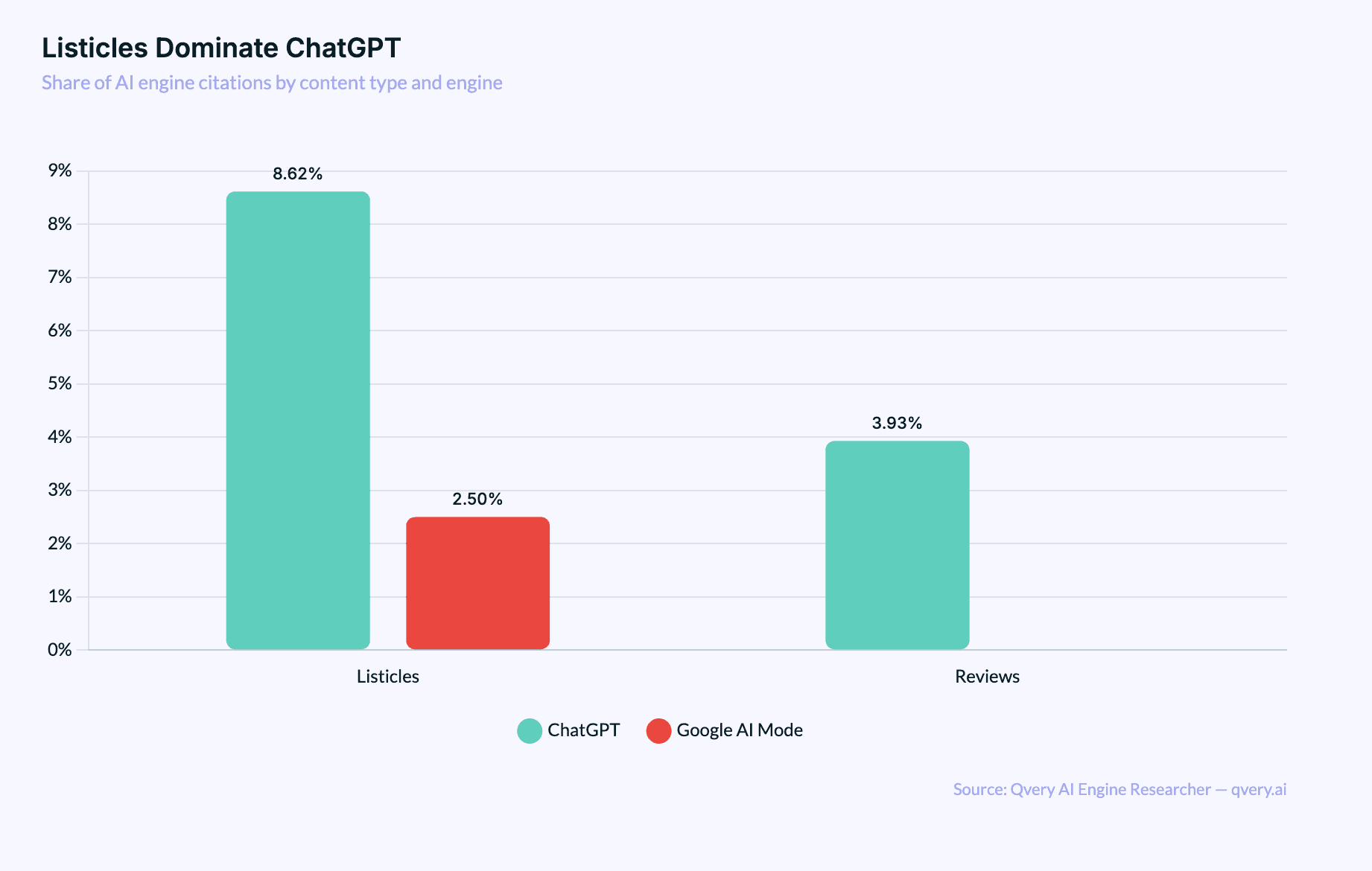
Listicles are the other half of the SaaS pattern, and they skew hard to one engine. Listicles make up 8.62% of all ChatGPT citations versus 2.50% on Google AI Mode, a 3.4x skew. Stack listicles and reviews together and they account for 12.49% of every ChatGPT citation. If your product is missing from the roundups, that gap costs you most on ChatGPT, the engine that leans on lists hardest, but it cuts your visibility on both engines, so getting named in the lists is a play that lifts you everywhere, not a single-engine bet.
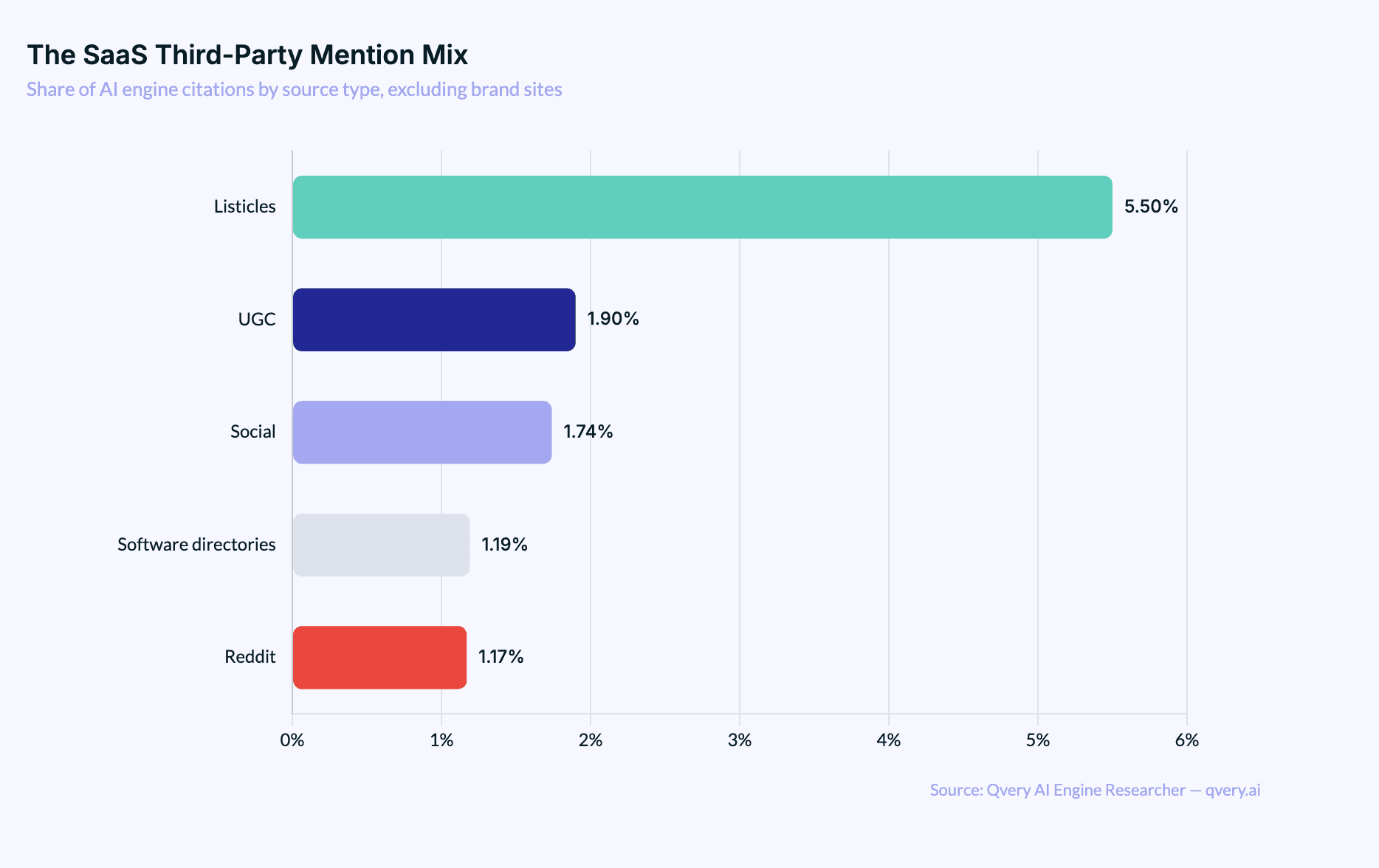
The mention surface is also wider and flatter than people expect. 46.5% of cited domains are cited exactly once, which means the long tail is real and a single well-placed mention in a niche post genuinely counts. UGC overall is 1.90% of all citations and social is 1.74%, both modest but durable. Meanwhile the thing marketers used to lean on, software review and directory sites, is shrinking. The combined review and directory category sits at 1.19% of citations and is declining, with G2 alone down 78% from January to March. As the directory floor drops out, editorial and community mentions absorb the weight.
Your Mention Gap Is a List You Can Pull in Minutes
You can't build mentions you can't see, and most marketers are guessing. Qvery tracks your visibility across ChatGPT and Google AI Mode daily and captures every source the engines cite when your category comes up. The Citations view is where the mention work starts: it lists every cited source with its domain, URL, and citation weight, and Qvery automatically tags each one based on the URL.
Open the source-type breakdown to see your mention mix. Each citation is auto-tagged across two dimensions, website type (Reddit, Media Publication, Software Review Site, your own site, and more) and article type (Listicle, Review, How-To, Discussion), so you can read in seconds whether your presence comes from roundups, community threads, or your own site, and how much citation weight each type pulls.
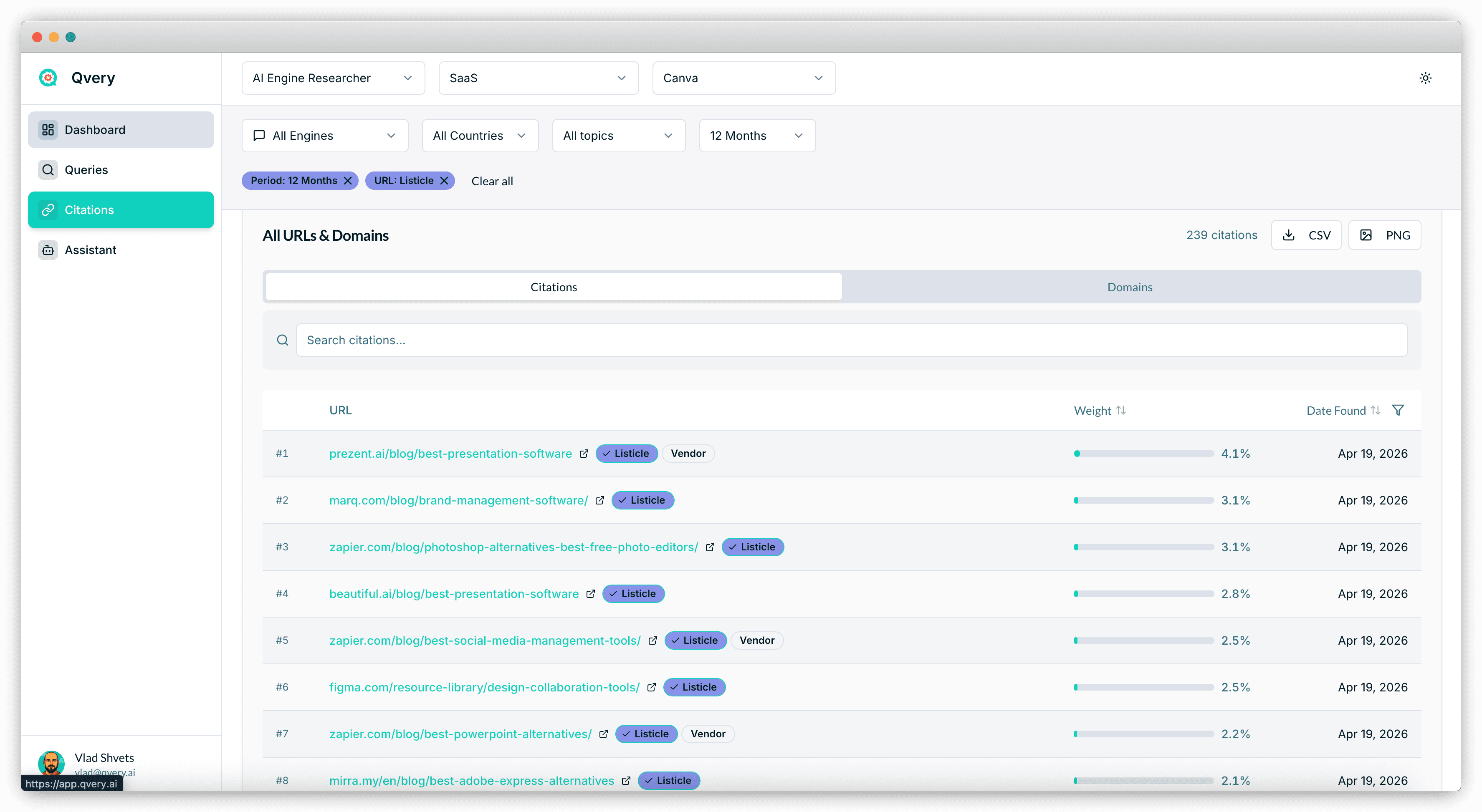
The competitor comparison is where the gaps surface. Run your brand against a rival and Qvery shows the listicles and roundups that cite the competitor but not you, down to the specific "best [your category] tools" posts and the subreddits where your buyers compare options. That list is your literal mention gap: the exact roundups and comparison pages where the engine already learned about them and never learned about you.
To turn that into a worklist, filter the Citations view to listicle and roundup URLs and sort by citation weight, highest first. The top of that list is where outreach effort pays back fastest, because it's the content the engines are already reading most. From there you can ask the Qvery Assistant for your top-weighted citation sources and export the ranked list, then hand your outreach team a prioritized target file.
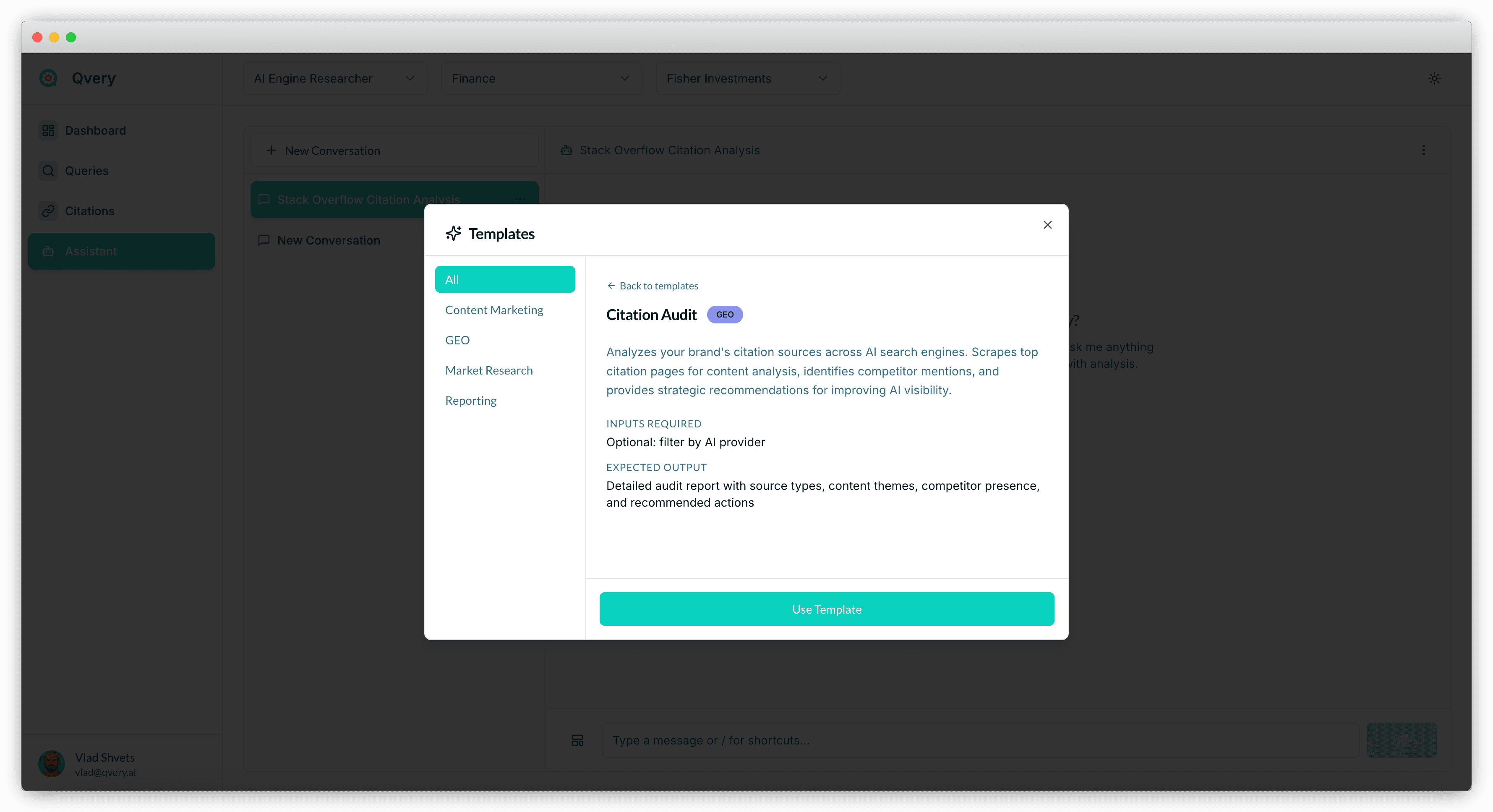
Closing the Gap Comes Down to Listicles, Reddit, and Comparison Pages
Once you can see the gap, the work is mostly outreach with a point of view. None of this is a growth hack, and anyone selling you one for AI mentions is selling you a way to get filtered out.
Get into the listicles. Pull your highest-weight listicle gaps from the competitor comparison, then pitch those editors a real product angle instead of a press release. Offer a free seat so the writer can run an honest review. The goal is your product name sitting inside the list the engine reads.
Earn organic Reddit mentions. Reddit is the #3 most-cited domain in SaaS, and organic mentions there are hard to fake. Show up in the subreddits where your buyers argue about tooling, answer questions without pasting your URL into every reply, and let the recommendations come from people who aren't you. Astroturfing gets detected and downvoted, and the screenshot of it is a worse outcome than silence.
Turn customers into mentions. Every integration you ship is a co-marketing post waiting to happen, and every customer who loves you is a review or a Reddit comment you didn't have to write. These are the cheapest mentions you'll ever earn because the goodwill already exists.
Build comparison pages. When a buyer asks an engine "X vs Y" or "alternatives to X," a well-built comparison page on your own domain becomes a source the engine can cite. Brand and niche sites are 87.75% of all citations, so this is the one mention surface you fully control.
Measure mention share. Referring-domain counts don't predict recommendations. What predicts them is how much of your category's cited content includes you, by source type, versus your competitors, and that's the number Qvery is built to show you.
The First Move Is Always Opening the Data
The SaaS brands pulling ahead in AI answers aren't outspending anyone. They figured out which three roundups and two subreddits their category gets read from, got their name into them, and stopped optimizing the other forty. The data points to the same two surfaces every time.
Listicles ChatGPT leans on: the roundups and comparisons that surface across your category's queries, where being named is the whole game.
Reddit threads buyers read: the subreddit discussions they trust before they buy, where one honest mention outweighs a quarter of ad spend. The comparison pages on your own domain sit on top of both.
I'm not going to pretend the playbook is fully written, because AI search changes faster than anyone can publish about it. So go pull the list. Find the exact roundups and threads where your competitor is named and you aren't, then go get named.
Most SaaS marketers I talk to are still grinding on a backlink spreadsheet the size of a small phone book. Meanwhile a buyer opens ChatGPT, types "best CRM for small agencies," and the engine reads back three listicles their competitor is named in and they aren't. That gap, not the spreadsheet, decides the recommendation now.
The link you spent six months earning from a domain-rating-72 publication does almost nothing for whether an AI engine recommends your SaaS product.
What moves an AI recommendation is whether your name sits inside the listicles, comparison posts, and Reddit threads the engine reads.
The reflex is to run mention-building like a link-building campaign, counting referring domains while a competitor gets quietly named inside the "best project management tools" roundups, and that mention is what the engine reads back. The brands AI engines name are the brands present in the third-party content those engines synthesize, and for SaaS that content has a very specific shape.
In SaaS, Reddit and Listicles Carry More Weight Than Anywhere Else
When someone asks an AI engine for a software recommendation, the engine doesn't crawl the web live and rank 10 blue links. It synthesizes what it already trusts: your own site, a handful of editorial listicles, a few review or directory pages, and the community threads where real users argue about what works. For SaaS specifically, that synthesis leans hard on two things, curated lists and community opinion, because that's how humans shop for software.
A backlink only proves someone vouched for you. What gets you recommended by name is whether the engine read your product inside the content it summarizes for that specific job. Take two competing CRMs: one has a wall of DR-50 links, the other is named in every "best CRM for small agencies" listicle. The one named in the listicle gets recommended. The link earns the other CRM nothing in that answer. Earning DR-50 links to win an AI recommendation is like polishing your resume for a job that hires off the group chat.
In SaaS the shortlist is built before the buyer ever reaches your site. If your name isn't in the roundups and threads, you were cut before you knew there was a list.
Reddit Gets Cited in SaaS Queries 34% Above Average, and Listicles Skew Hard to ChatGPT
Across millions of AI citations on ChatGPT and Google AI Mode since January 2026, the pattern for SaaS is consistent. Reddit accounts for 1.57% of all citations within SaaS queries, which is 34% above the dataset-wide average of 1.17% and makes it the #3 most-cited domain in SaaS.
For context, Reddit in travel sits at 0.75%, so a software buyer's AI answer leans on Reddit roughly 2.1x harder than a traveler's does. People sanity-check a $50k software contract against an anonymous stranger on Reddit, and the engines read that thread too. When we ran the gap analysis for a SaaS partner, the thing moving their visibility wasn't links, it was getting named in the three roundups their top competitor already owned.
Listicles are the other half of the SaaS pattern, and they skew hard to one engine. Listicles make up 8.62% of all ChatGPT citations versus 2.50% on Google AI Mode, a 3.4x skew. Stack listicles and reviews together and they account for 12.49% of every ChatGPT citation. If your product is missing from the roundups, that gap costs you most on ChatGPT, the engine that leans on lists hardest, but it cuts your visibility on both engines, so getting named in the lists is a play that lifts you everywhere, not a single-engine bet.
The mention surface is also wider and flatter than people expect. 46.5% of cited domains are cited exactly once, which means the long tail is real and a single well-placed mention in a niche post genuinely counts. UGC overall is 1.90% of all citations and social is 1.74%, both modest but durable. Meanwhile the thing marketers used to lean on, software review and directory sites, is shrinking. The combined review and directory category sits at 1.19% of citations and is declining, with G2 alone down 78% from January to March. As the directory floor drops out, editorial and community mentions absorb the weight.
Your Mention Gap Is a List You Can Pull in Minutes
You can't build mentions you can't see, and most marketers are guessing. Qvery tracks your visibility across ChatGPT and Google AI Mode daily and captures every source the engines cite when your category comes up. The Citations view is where the mention work starts: it lists every cited source with its domain, URL, and citation weight, and Qvery automatically tags each one based on the URL.
Open the source-type breakdown to see your mention mix. Each citation is auto-tagged across two dimensions, website type (Reddit, Media Publication, Software Review Site, your own site, and more) and article type (Listicle, Review, How-To, Discussion), so you can read in seconds whether your presence comes from roundups, community threads, or your own site, and how much citation weight each type pulls.
The competitor comparison is where the gaps surface. Run your brand against a rival and Qvery shows the listicles and roundups that cite the competitor but not you, down to the specific "best [your category] tools" posts and the subreddits where your buyers compare options. That list is your literal mention gap: the exact roundups and comparison pages where the engine already learned about them and never learned about you.
To turn that into a worklist, filter the Citations view to listicle and roundup URLs and sort by citation weight, highest first. The top of that list is where outreach effort pays back fastest, because it's the content the engines are already reading most. From there you can ask the Qvery Assistant for your top-weighted citation sources and export the ranked list, then hand your outreach team a prioritized target file.
Closing the Gap Comes Down to Listicles, Reddit, and Comparison Pages
Once you can see the gap, the work is mostly outreach with a point of view. None of this is a growth hack, and anyone selling you one for AI mentions is selling you a way to get filtered out.
Get into the listicles. Pull your highest-weight listicle gaps from the competitor comparison, then pitch those editors a real product angle instead of a press release. Offer a free seat so the writer can run an honest review. The goal is your product name sitting inside the list the engine reads.
Earn organic Reddit mentions. Reddit is the #3 most-cited domain in SaaS, and organic mentions there are hard to fake. Show up in the subreddits where your buyers argue about tooling, answer questions without pasting your URL into every reply, and let the recommendations come from people who aren't you. Astroturfing gets detected and downvoted, and the screenshot of it is a worse outcome than silence.
Turn customers into mentions. Every integration you ship is a co-marketing post waiting to happen, and every customer who loves you is a review or a Reddit comment you didn't have to write. These are the cheapest mentions you'll ever earn because the goodwill already exists.
Build comparison pages. When a buyer asks an engine "X vs Y" or "alternatives to X," a well-built comparison page on your own domain becomes a source the engine can cite. Brand and niche sites are 87.75% of all citations, so this is the one mention surface you fully control.
Measure mention share. Referring-domain counts don't predict recommendations. What predicts them is how much of your category's cited content includes you, by source type, versus your competitors, and that's the number Qvery is built to show you.
The First Move Is Always Opening the Data
The SaaS brands pulling ahead in AI answers aren't outspending anyone. They figured out which three roundups and two subreddits their category gets read from, got their name into them, and stopped optimizing the other forty. The data points to the same two surfaces every time.
Listicles ChatGPT leans on: the roundups and comparisons that surface across your category's queries, where being named is the whole game.
Reddit threads buyers read: the subreddit discussions they trust before they buy, where one honest mention outweighs a quarter of ad spend. The comparison pages on your own domain sit on top of both.
I'm not going to pretend the playbook is fully written, because AI search changes faster than anyone can publish about it. So go pull the list. Find the exact roundups and threads where your competitor is named and you aren't, then go get named.
Most SaaS marketers I talk to are still grinding on a backlink spreadsheet the size of a small phone book. Meanwhile a buyer opens ChatGPT, types "best CRM for small agencies," and the engine reads back three listicles their competitor is named in and they aren't. That gap, not the spreadsheet, decides the recommendation now.
The link you spent six months earning from a domain-rating-72 publication does almost nothing for whether an AI engine recommends your SaaS product.
What moves an AI recommendation is whether your name sits inside the listicles, comparison posts, and Reddit threads the engine reads.
The reflex is to run mention-building like a link-building campaign, counting referring domains while a competitor gets quietly named inside the "best project management tools" roundups, and that mention is what the engine reads back. The brands AI engines name are the brands present in the third-party content those engines synthesize, and for SaaS that content has a very specific shape.
In SaaS, Reddit and Listicles Carry More Weight Than Anywhere Else
When someone asks an AI engine for a software recommendation, the engine doesn't crawl the web live and rank 10 blue links. It synthesizes what it already trusts: your own site, a handful of editorial listicles, a few review or directory pages, and the community threads where real users argue about what works. For SaaS specifically, that synthesis leans hard on two things, curated lists and community opinion, because that's how humans shop for software.
A backlink only proves someone vouched for you. What gets you recommended by name is whether the engine read your product inside the content it summarizes for that specific job. Take two competing CRMs: one has a wall of DR-50 links, the other is named in every "best CRM for small agencies" listicle. The one named in the listicle gets recommended. The link earns the other CRM nothing in that answer. Earning DR-50 links to win an AI recommendation is like polishing your resume for a job that hires off the group chat.
In SaaS the shortlist is built before the buyer ever reaches your site. If your name isn't in the roundups and threads, you were cut before you knew there was a list.
Reddit Gets Cited in SaaS Queries 34% Above Average, and Listicles Skew Hard to ChatGPT
Across millions of AI citations on ChatGPT and Google AI Mode since January 2026, the pattern for SaaS is consistent. Reddit accounts for 1.57% of all citations within SaaS queries, which is 34% above the dataset-wide average of 1.17% and makes it the #3 most-cited domain in SaaS.
For context, Reddit in travel sits at 0.75%, so a software buyer's AI answer leans on Reddit roughly 2.1x harder than a traveler's does. People sanity-check a $50k software contract against an anonymous stranger on Reddit, and the engines read that thread too. When we ran the gap analysis for a SaaS partner, the thing moving their visibility wasn't links, it was getting named in the three roundups their top competitor already owned.
Listicles are the other half of the SaaS pattern, and they skew hard to one engine. Listicles make up 8.62% of all ChatGPT citations versus 2.50% on Google AI Mode, a 3.4x skew. Stack listicles and reviews together and they account for 12.49% of every ChatGPT citation. If your product is missing from the roundups, that gap costs you most on ChatGPT, the engine that leans on lists hardest, but it cuts your visibility on both engines, so getting named in the lists is a play that lifts you everywhere, not a single-engine bet.
The mention surface is also wider and flatter than people expect. 46.5% of cited domains are cited exactly once, which means the long tail is real and a single well-placed mention in a niche post genuinely counts. UGC overall is 1.90% of all citations and social is 1.74%, both modest but durable. Meanwhile the thing marketers used to lean on, software review and directory sites, is shrinking. The combined review and directory category sits at 1.19% of citations and is declining, with G2 alone down 78% from January to March. As the directory floor drops out, editorial and community mentions absorb the weight.
Your Mention Gap Is a List You Can Pull in Minutes
You can't build mentions you can't see, and most marketers are guessing. Qvery tracks your visibility across ChatGPT and Google AI Mode daily and captures every source the engines cite when your category comes up. The Citations view is where the mention work starts: it lists every cited source with its domain, URL, and citation weight, and Qvery automatically tags each one based on the URL.
Open the source-type breakdown to see your mention mix. Each citation is auto-tagged across two dimensions, website type (Reddit, Media Publication, Software Review Site, your own site, and more) and article type (Listicle, Review, How-To, Discussion), so you can read in seconds whether your presence comes from roundups, community threads, or your own site, and how much citation weight each type pulls.
The competitor comparison is where the gaps surface. Run your brand against a rival and Qvery shows the listicles and roundups that cite the competitor but not you, down to the specific "best [your category] tools" posts and the subreddits where your buyers compare options. That list is your literal mention gap: the exact roundups and comparison pages where the engine already learned about them and never learned about you.
To turn that into a worklist, filter the Citations view to listicle and roundup URLs and sort by citation weight, highest first. The top of that list is where outreach effort pays back fastest, because it's the content the engines are already reading most. From there you can ask the Qvery Assistant for your top-weighted citation sources and export the ranked list, then hand your outreach team a prioritized target file.
Closing the Gap Comes Down to Listicles, Reddit, and Comparison Pages
Once you can see the gap, the work is mostly outreach with a point of view. None of this is a growth hack, and anyone selling you one for AI mentions is selling you a way to get filtered out.
Get into the listicles. Pull your highest-weight listicle gaps from the competitor comparison, then pitch those editors a real product angle instead of a press release. Offer a free seat so the writer can run an honest review. The goal is your product name sitting inside the list the engine reads.
Earn organic Reddit mentions. Reddit is the #3 most-cited domain in SaaS, and organic mentions there are hard to fake. Show up in the subreddits where your buyers argue about tooling, answer questions without pasting your URL into every reply, and let the recommendations come from people who aren't you. Astroturfing gets detected and downvoted, and the screenshot of it is a worse outcome than silence.
Turn customers into mentions. Every integration you ship is a co-marketing post waiting to happen, and every customer who loves you is a review or a Reddit comment you didn't have to write. These are the cheapest mentions you'll ever earn because the goodwill already exists.
Build comparison pages. When a buyer asks an engine "X vs Y" or "alternatives to X," a well-built comparison page on your own domain becomes a source the engine can cite. Brand and niche sites are 87.75% of all citations, so this is the one mention surface you fully control.
Measure mention share. Referring-domain counts don't predict recommendations. What predicts them is how much of your category's cited content includes you, by source type, versus your competitors, and that's the number Qvery is built to show you.
The First Move Is Always Opening the Data
The SaaS brands pulling ahead in AI answers aren't outspending anyone. They figured out which three roundups and two subreddits their category gets read from, got their name into them, and stopped optimizing the other forty. The data points to the same two surfaces every time.
Listicles ChatGPT leans on: the roundups and comparisons that surface across your category's queries, where being named is the whole game.
Reddit threads buyers read: the subreddit discussions they trust before they buy, where one honest mention outweighs a quarter of ad spend. The comparison pages on your own domain sit on top of both.
I'm not going to pretend the playbook is fully written, because AI search changes faster than anyone can publish about it. So go pull the list. Find the exact roundups and threads where your competitor is named and you aren't, then go get named.
Most SaaS marketers I talk to are still grinding on a backlink spreadsheet the size of a small phone book. Meanwhile a buyer opens ChatGPT, types "best CRM for small agencies," and the engine reads back three listicles their competitor is named in and they aren't. That gap, not the spreadsheet, decides the recommendation now.
The link you spent six months earning from a domain-rating-72 publication does almost nothing for whether an AI engine recommends your SaaS product.
What moves an AI recommendation is whether your name sits inside the listicles, comparison posts, and Reddit threads the engine reads.
The reflex is to run mention-building like a link-building campaign, counting referring domains while a competitor gets quietly named inside the "best project management tools" roundups, and that mention is what the engine reads back. The brands AI engines name are the brands present in the third-party content those engines synthesize, and for SaaS that content has a very specific shape.
In SaaS, Reddit and Listicles Carry More Weight Than Anywhere Else
When someone asks an AI engine for a software recommendation, the engine doesn't crawl the web live and rank 10 blue links. It synthesizes what it already trusts: your own site, a handful of editorial listicles, a few review or directory pages, and the community threads where real users argue about what works. For SaaS specifically, that synthesis leans hard on two things, curated lists and community opinion, because that's how humans shop for software.
A backlink only proves someone vouched for you. What gets you recommended by name is whether the engine read your product inside the content it summarizes for that specific job. Take two competing CRMs: one has a wall of DR-50 links, the other is named in every "best CRM for small agencies" listicle. The one named in the listicle gets recommended. The link earns the other CRM nothing in that answer. Earning DR-50 links to win an AI recommendation is like polishing your resume for a job that hires off the group chat.
In SaaS the shortlist is built before the buyer ever reaches your site. If your name isn't in the roundups and threads, you were cut before you knew there was a list.
Reddit Gets Cited in SaaS Queries 34% Above Average, and Listicles Skew Hard to ChatGPT
Across millions of AI citations on ChatGPT and Google AI Mode since January 2026, the pattern for SaaS is consistent. Reddit accounts for 1.57% of all citations within SaaS queries, which is 34% above the dataset-wide average of 1.17% and makes it the #3 most-cited domain in SaaS.
For context, Reddit in travel sits at 0.75%, so a software buyer's AI answer leans on Reddit roughly 2.1x harder than a traveler's does. People sanity-check a $50k software contract against an anonymous stranger on Reddit, and the engines read that thread too. When we ran the gap analysis for a SaaS partner, the thing moving their visibility wasn't links, it was getting named in the three roundups their top competitor already owned.
Listicles are the other half of the SaaS pattern, and they skew hard to one engine. Listicles make up 8.62% of all ChatGPT citations versus 2.50% on Google AI Mode, a 3.4x skew. Stack listicles and reviews together and they account for 12.49% of every ChatGPT citation. If your product is missing from the roundups, that gap costs you most on ChatGPT, the engine that leans on lists hardest, but it cuts your visibility on both engines, so getting named in the lists is a play that lifts you everywhere, not a single-engine bet.
The mention surface is also wider and flatter than people expect. 46.5% of cited domains are cited exactly once, which means the long tail is real and a single well-placed mention in a niche post genuinely counts. UGC overall is 1.90% of all citations and social is 1.74%, both modest but durable. Meanwhile the thing marketers used to lean on, software review and directory sites, is shrinking. The combined review and directory category sits at 1.19% of citations and is declining, with G2 alone down 78% from January to March. As the directory floor drops out, editorial and community mentions absorb the weight.
Your Mention Gap Is a List You Can Pull in Minutes
You can't build mentions you can't see, and most marketers are guessing. Qvery tracks your visibility across ChatGPT and Google AI Mode daily and captures every source the engines cite when your category comes up. The Citations view is where the mention work starts: it lists every cited source with its domain, URL, and citation weight, and Qvery automatically tags each one based on the URL.
Open the source-type breakdown to see your mention mix. Each citation is auto-tagged across two dimensions, website type (Reddit, Media Publication, Software Review Site, your own site, and more) and article type (Listicle, Review, How-To, Discussion), so you can read in seconds whether your presence comes from roundups, community threads, or your own site, and how much citation weight each type pulls.
The competitor comparison is where the gaps surface. Run your brand against a rival and Qvery shows the listicles and roundups that cite the competitor but not you, down to the specific "best [your category] tools" posts and the subreddits where your buyers compare options. That list is your literal mention gap: the exact roundups and comparison pages where the engine already learned about them and never learned about you.
To turn that into a worklist, filter the Citations view to listicle and roundup URLs and sort by citation weight, highest first. The top of that list is where outreach effort pays back fastest, because it's the content the engines are already reading most. From there you can ask the Qvery Assistant for your top-weighted citation sources and export the ranked list, then hand your outreach team a prioritized target file.
Closing the Gap Comes Down to Listicles, Reddit, and Comparison Pages
Once you can see the gap, the work is mostly outreach with a point of view. None of this is a growth hack, and anyone selling you one for AI mentions is selling you a way to get filtered out.
Get into the listicles. Pull your highest-weight listicle gaps from the competitor comparison, then pitch those editors a real product angle instead of a press release. Offer a free seat so the writer can run an honest review. The goal is your product name sitting inside the list the engine reads.
Earn organic Reddit mentions. Reddit is the #3 most-cited domain in SaaS, and organic mentions there are hard to fake. Show up in the subreddits where your buyers argue about tooling, answer questions without pasting your URL into every reply, and let the recommendations come from people who aren't you. Astroturfing gets detected and downvoted, and the screenshot of it is a worse outcome than silence.
Turn customers into mentions. Every integration you ship is a co-marketing post waiting to happen, and every customer who loves you is a review or a Reddit comment you didn't have to write. These are the cheapest mentions you'll ever earn because the goodwill already exists.
Build comparison pages. When a buyer asks an engine "X vs Y" or "alternatives to X," a well-built comparison page on your own domain becomes a source the engine can cite. Brand and niche sites are 87.75% of all citations, so this is the one mention surface you fully control.
Measure mention share. Referring-domain counts don't predict recommendations. What predicts them is how much of your category's cited content includes you, by source type, versus your competitors, and that's the number Qvery is built to show you.
The First Move Is Always Opening the Data
The SaaS brands pulling ahead in AI answers aren't outspending anyone. They figured out which three roundups and two subreddits their category gets read from, got their name into them, and stopped optimizing the other forty. The data points to the same two surfaces every time.
Listicles ChatGPT leans on: the roundups and comparisons that surface across your category's queries, where being named is the whole game.
Reddit threads buyers read: the subreddit discussions they trust before they buy, where one honest mention outweighs a quarter of ad spend. The comparison pages on your own domain sit on top of both.
I'm not going to pretend the playbook is fully written, because AI search changes faster than anyone can publish about it. So go pull the list. Find the exact roundups and threads where your competitor is named and you aren't, then go get named.
© 2026 Qvery AI OÜ