By
Vlad Shvets
AI Search Citation Trends: March 2026
ChatGPT cut its citations nearly in half. Google AI Mode didn’t blink. YouTube doubled on one engine and collapsed on the other. Reddit grew on both. Here’s what moved in March 2026.
ChatGPT cut its citations nearly in half. Google AI Mode didn’t blink. YouTube doubled on one engine and collapsed on the other. Reddit grew on both. Here’s what moved in March 2026.
ChatGPT cut its citations nearly in half. Google AI Mode didn’t blink. YouTube doubled on one engine and collapsed on the other. Reddit grew on both. Here’s what moved in March 2026.
Every month, Qvery's AI Engine Researcher tracks millions of citations across ChatGPT and Google AI Mode for dozens of brands in every industry we cover. We use this proprietary citation data to publish what moved, what shifted, and what it means for brands trying to stay visible in AI search. This is the March 2026 edition.
March was the most eventful month in our tracking history. ChatGPT cut its citation count nearly in half. Google AI Mode didn't change at all. YouTube doubled on one engine and collapsed on the other. Reddit grew on both. Wikipedia got quietly demoted.
The two biggest AI search engines are diverging faster than anyone expected, and the implications for brand visibility are significant.
ChatGPT's Citation Density Collapsed 42% in a Single Month
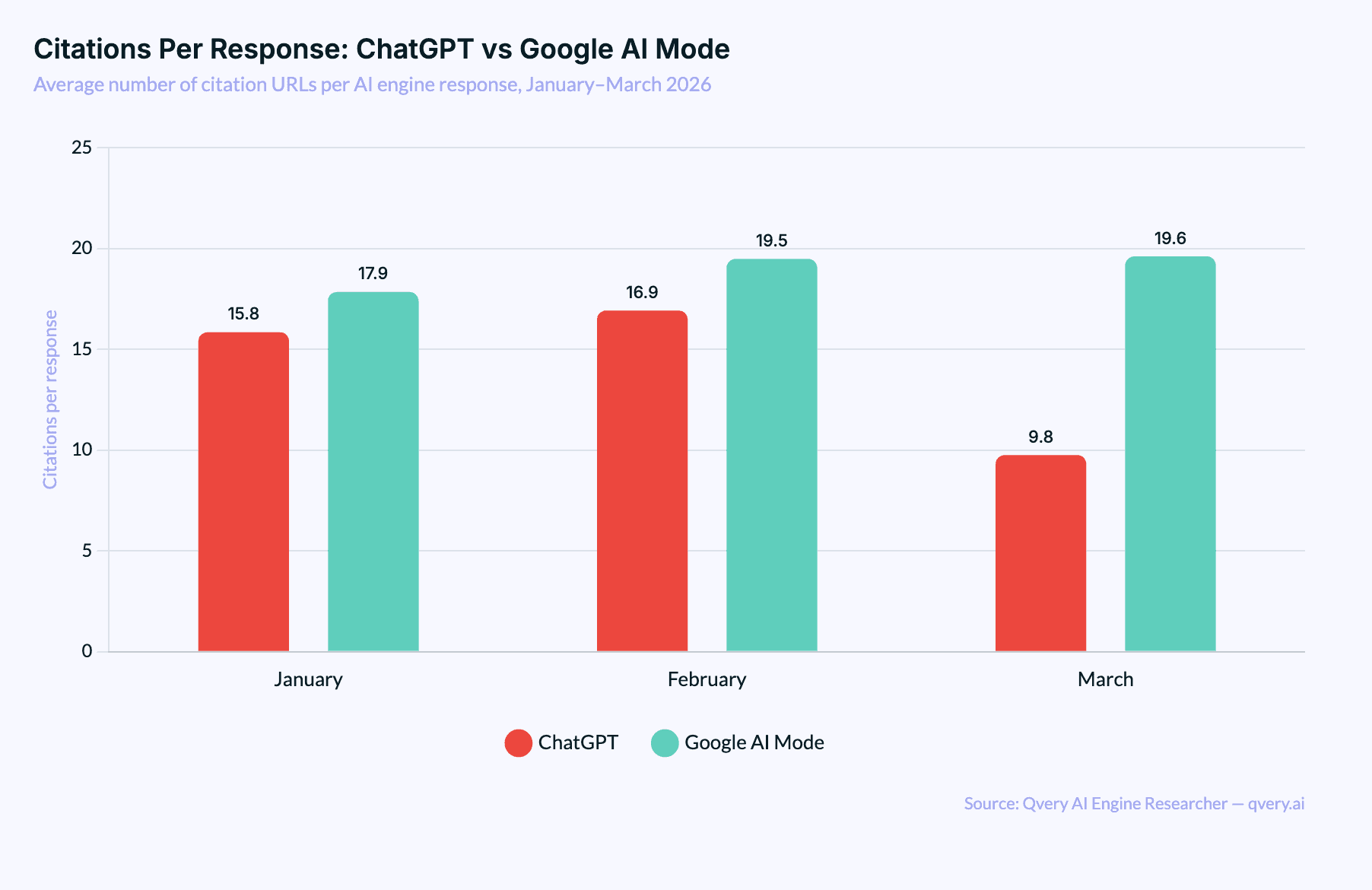
ChatGPT averaged 16.93 citations per response in February. In March, that number dropped to 9.76. Meanwhile, Google AI Mode went from 19.49 to 19.62, barely moving at all. For the first time in Qvery's tracking history, Google AI Mode now produces more citations per response than ChatGPT.
ChatGPT's citation density dropped 42% in March. Google AI Mode didn't move. The two engines are no longer playing the same game.
This represents a fundamental behavioral shift in how ChatGPT constructs responses, not a temporary fluctuation. ChatGPT appears to be becoming more selective about which sources it cites, linking to fewer URLs but presumably with higher confidence in the ones it keeps.
For brands, the practical consequence is that the bar for earning a ChatGPT citation just went up significantly. If your content was appearing in responses through sheer volume of available source material, that strategy is no longer viable.
The asymmetry between the two engines is what makes this finding particularly important. A brand that looks stable in combined metrics might actually be losing ground on ChatGPT while gaining on Google AI Mode, or vice versa. Combined averages are now misleading at best and dangerous at worst.
ChatGPT Is Cutting Its Source Pool in Half
The citation density collapse isn't just about total citation count. The diversity of sources per response collapsed even more dramatically.
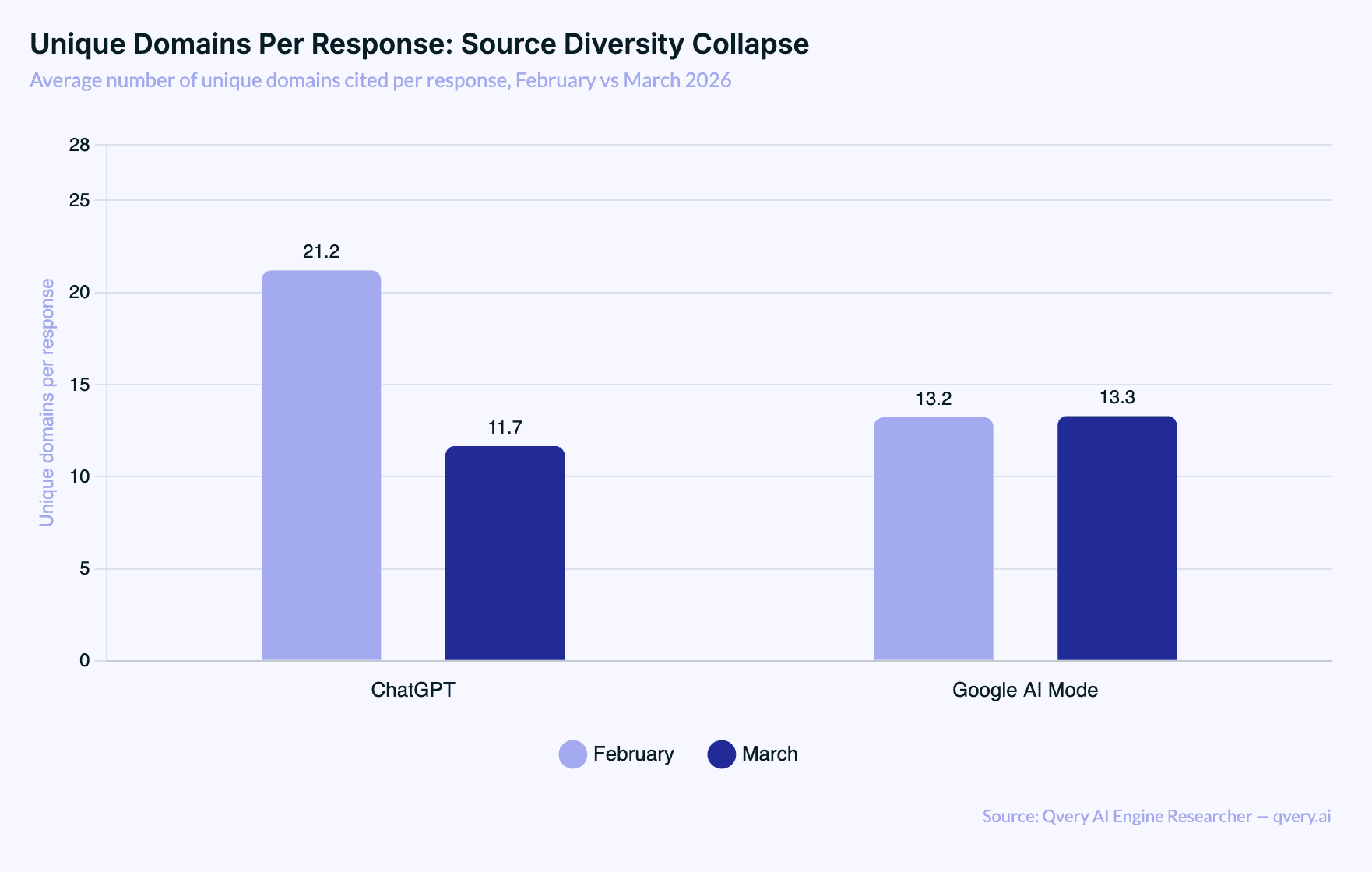
In February, the average ChatGPT response pulled from 21.2 unique domains. In March, that dropped to 11.7. The median went from 20 to 10. Google AI Mode, by contrast, was completely unchanged: average 13.2 in February, 13.3 in March. Median held steady at 12.
What does this mean in practice? In February, your brand had roughly 21 potential slots to appear in per ChatGPT response. Now there are 12. The competition for each remaining slot has nearly doubled overnight, and the domains that survive the cut are likely the ones ChatGPT considers most authoritative and relevant for each specific query. If your content was on the edge of being cited, it's probably been cut. If it was a strong, reliable source, it may now appear more prominently in a smaller, higher-quality citation list.
Citations Are Concentrating Around Fewer, More Established Domains
When individual responses cite fewer sources, the aggregate effect across the entire dataset is concentration. The top domains are capturing a disproportionately larger share of total citations.
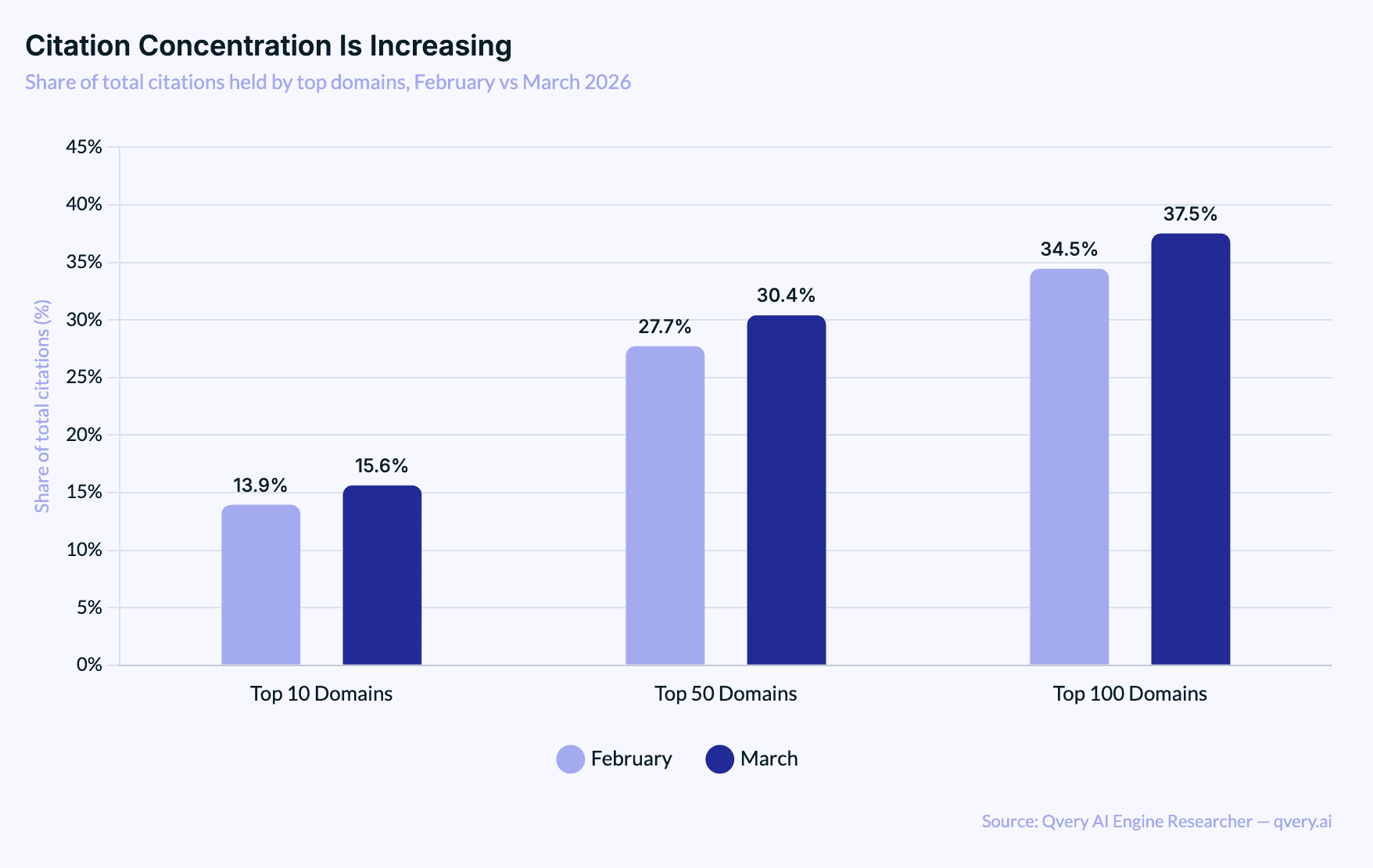
Top 10 domains: 13.94% of all citations in February → 15.63% in March (+1.7 percentage points)
Top 50 domains: 27.72% → 30.41% (+2.7pp)
Top 100 domains: 34.45% → 37.52% (+3.1pp)
At the same time, the total number of unique domains cited dropped 16%, from approximately 67,700 to 57,000. AI engines are not only citing fewer sources per response, they're also drawing from a smaller total pool of domains. The long tail of niche publications that occasionally earned a citation is shrinking.
This is the Double Jeopardy law accelerating in real time. Established domains that already held strong citation share are consolidating their position, while smaller domains that relied on occasional citations are being squeezed out. The implication for brand strategy is clear: being a consistent, authoritative source matters more than ever. Sporadic mentions across many low-authority pages won't cut it when AI engines are actively consolidating their source lists.
YouTube's Citation Share Doubled, But Only on One Engine
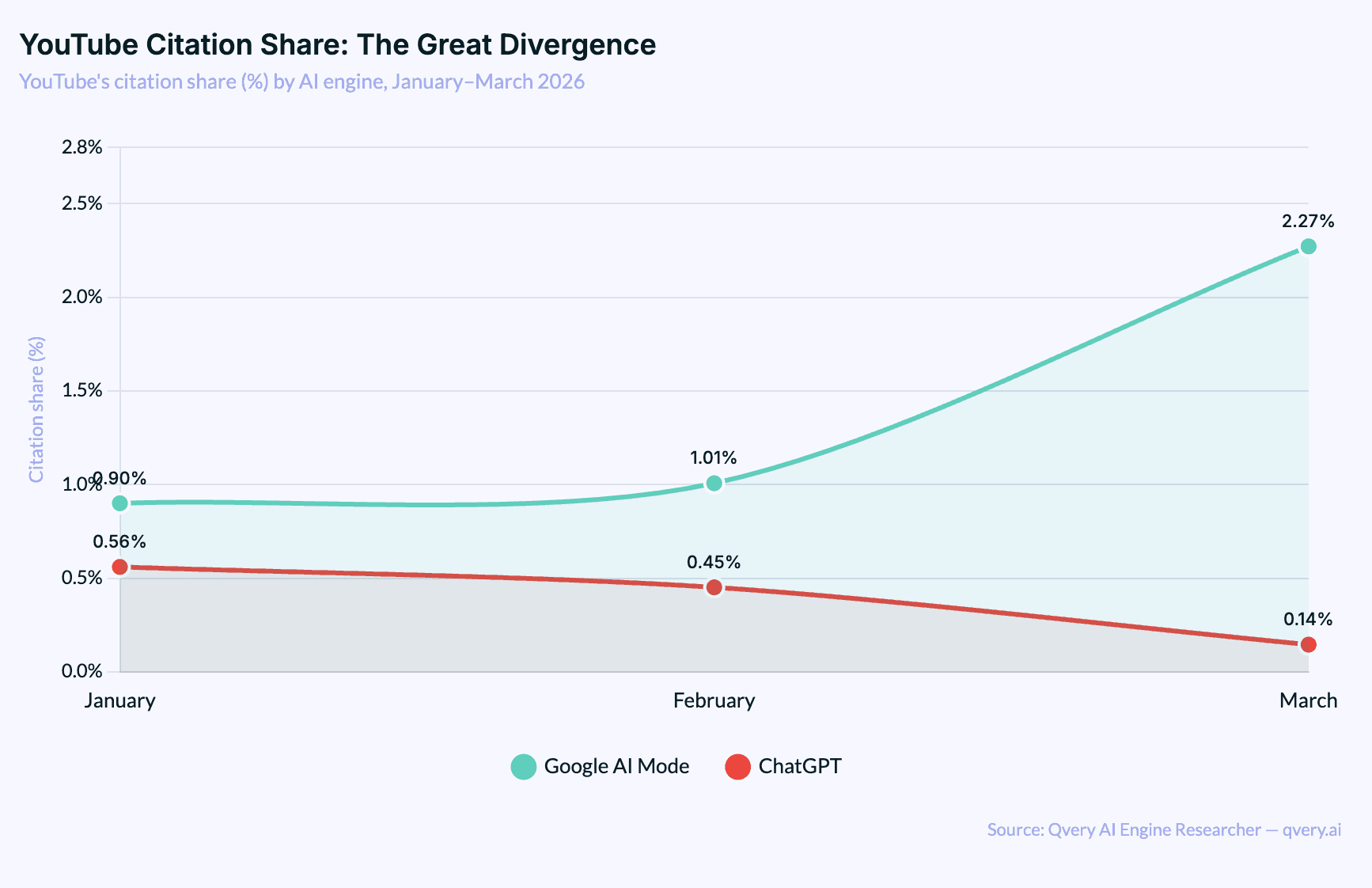
YouTube's combined citation share went from 0.75% to 1.58%, a 110% increase that makes it one of the fastest-growing citation sources in March. On the surface, this looks like a straightforward win for video content in AI search. The provider split tells a completely different story.
Google AI Mode: YouTube's share surged from 1.01% to 2.27% (+125%). Average citation rank improved from 9.8 to 8.9, meaning YouTube citations are appearing higher and more prominently in responses than ever before.
ChatGPT: YouTube's share collapsed from 0.45% to 0.15% (-68%). ChatGPT is actively retreating from video content as part of its broader source reduction.
YouTube is becoming a Google AI exclusive citation source. This makes structural sense: Google owns YouTube and has deep access to transcripts, engagement metrics, and the content graph.
ChatGPT has none of that infrastructure, and when forced to reduce its citation count, video sources were among the first to go. We covered the YouTube citation divergence in detail last week, and March data shows the gap widening dramatically. (Turns out owning the world's largest video platform has its advantages.)
For brands with visual or demonstrable products, this creates a clear tactical split: YouTube content will earn increasingly more AI citations on Google AI Mode, but ChatGPT will largely ignore it. Your YouTube investment is now a Google AI Mode investment specifically.
Reddit Is the Only Major Platform Growing on Both Engines
Every other major platform we track moved in one direction on one engine and the opposite direction on the other. Reddit is the sole exception: it grew on both ChatGPT and Google AI Mode simultaneously.
ChatGPT: Reddit's citation share went from 1.23% to 1.69% (+38%). Average citation rank improved from 13.4 to 11.7, meaning Reddit threads are being placed earlier and more prominently in responses.
Google AI Mode: Reddit's share grew from 0.94% to 1.26% (+35%).
Reddit is gaining a larger slice of ChatGPT's shrinking pie AND a larger slice of Google AI Mode's stable one. No other major platform can claim that.
The ChatGPT growth is particularly striking given the context. ChatGPT slashed its overall citation count by 42%, yet Reddit's share of the remaining citations increased by 38%. When an engine dramatically reduces its source list and your platform's share grows, that's a powerful signal about how much the engine values your content. ChatGPT is actively choosing to keep Reddit while cutting social platforms, video sources, and even Wikipedia.
Why? Reddit contains something that most other platforms don't: genuine, unfiltered opinions from real people who disagree with each other. When ChatGPT needs to recommend a product or compare options, Reddit threads provide the kind of authentic, experience-based signal that polished marketing content can't replicate.
This reinforces everything we found in our Reddit citation analysis: Reddit's position as the most important third-party domain for AI visibility is strengthening month over month.
Wikipedia Is Being Quietly Demoted
Wikipedia's combined citation share dropped 34%, from 1.16% to 0.77%. But the share decline understates what actually happened.
On ChatGPT, Wikipedia's average citation rank position fell from 5.4 to 12.2. Wikipedia used to be one of the first sources ChatGPT listed in any response, often appearing in the top five citations. Now it's buried in the middle of a much shorter list. Even when ChatGPT still cites Wikipedia, it's treating it as a supporting reference rather than a primary source.
Google AI Mode barely cites Wikipedia at all, with share moving from 0.02% to 0.05%. Wikipedia in AI search remains almost exclusively a ChatGPT phenomenon, and even that relationship is weakening.
The likely explanation is that Wikipedia was over-represented in ChatGPT's citation behavior relative to its actual usefulness for the kinds of queries brands care about. Wikipedia excels at factual, encyclopedic information, but commercial and product queries require recommendation-oriented content that Wikipedia doesn't provide.
As ChatGPT becomes more selective and purpose-driven in its citations, generalist reference sources are losing ground to more specific, experience-based content.
This is another signal that AI engines are evolving toward citing sources that directly answer the user's intent rather than providing background context.
ChatGPT Is Systematically Retreating From Social Platforms
March data reveals a consistent pattern across every social and visual platform we track: ChatGPT is reducing citations while Google AI Mode maintains or grows them.
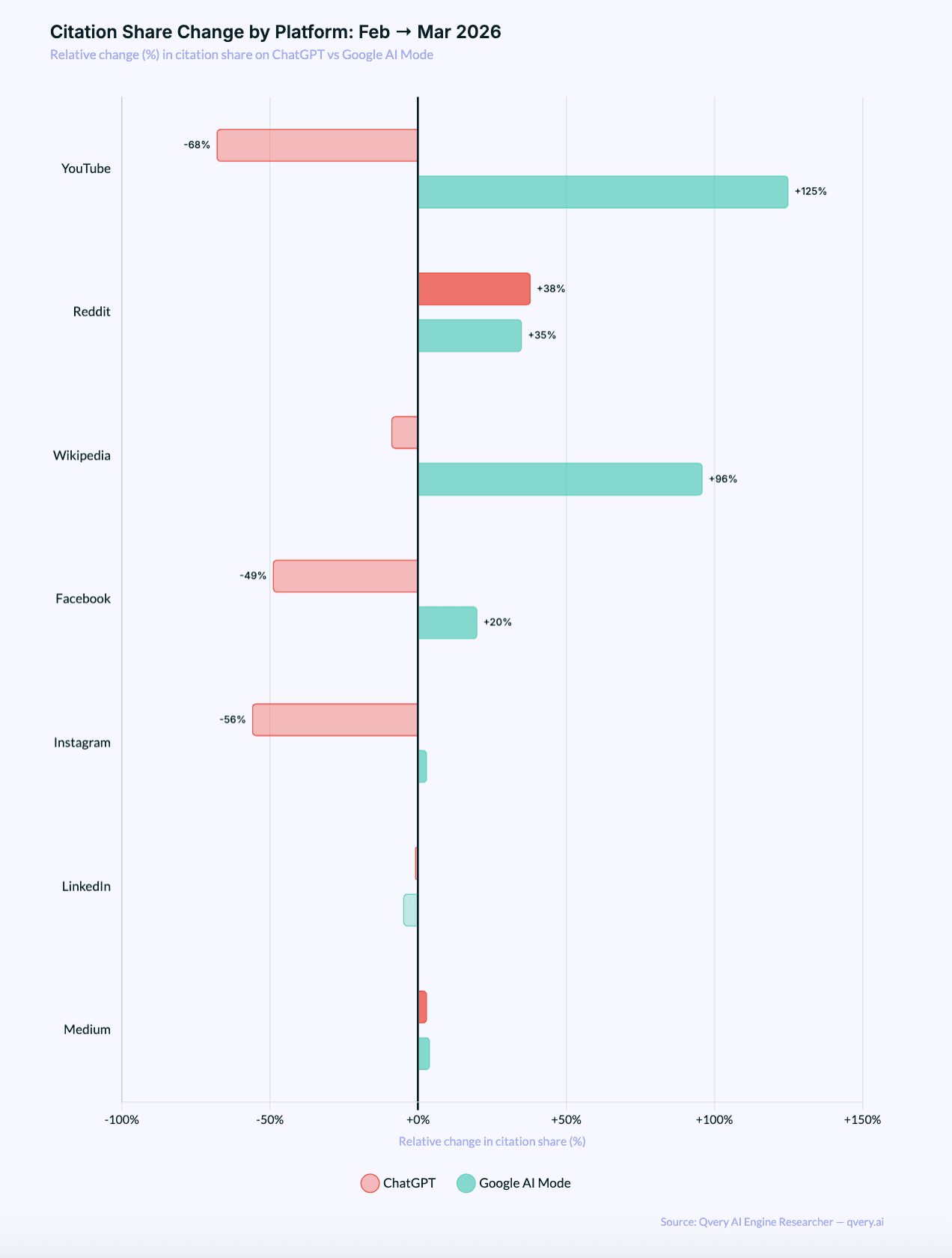
Facebook on ChatGPT: 0.39% → 0.20% (-49%). On Google AI: 0.87% → 1.05% (+20%).
Instagram on ChatGPT: 0.21% → 0.09% (-56%). On Google AI: 0.68% → 0.70% (stable).
YouTube on ChatGPT: 0.45% → 0.15% (-68%). On Google AI: 1.01% → 2.27% (+125%).
LinkedIn on ChatGPT: 0.48% → 0.47% (stable). On Google AI: 0.78% → 0.74% (-5%).
LinkedIn is the only social platform holding its position on ChatGPT, likely because its content is text-heavy, professionally structured, and directly relevant to the B2B queries where ChatGPT still values external sources. Everything visual or social-first (Facebook, Instagram, YouTube) is being systematically deprioritized by ChatGPT while Google AI Mode, with its deeper integration into Google's ecosystem, continues to value these platforms.
If your AI visibility strategy relies heavily on social media presence, you're increasingly playing a Google AI Mode game. ChatGPT is making it clear that it prefers text-based, recommendation-oriented sources over social content.
Brand Mentions Are Declining on ChatGPT, But Less Than Citations
ChatGPT isn't just citing fewer sources. It's also mentioning fewer brands per response.
ChatGPT: 7.22 brand mentions per response in February → 6.32 in March (-12.5%).
Google AI Mode: 6.42 → 6.37 (essentially unchanged).
The interesting nuance here is the gap between the citation decline (-42%) and the brand mention decline (-12.5%).
ChatGPT is still recommending a similar number of brands in its responses, but it's providing significantly fewer source URLs to support those recommendations. In other words, ChatGPT's responses are becoming more opinionated: it's making the same recommendations but with less evidence shown to the user. Whether this signals growing confidence or a deliberate UX choice to present cleaner, less cluttered responses is something we'll be watching closely in April.
What This Means for Your Visibility Strategy
March 2026 was the month the two biggest AI search engines stopped behaving like variations of the same thing.
The tactical implications are concrete.
You need separate strategies for each engine. ChatGPT is becoming more selective, citing fewer sources, favoring text-based content, and retreating from social platforms. Google AI Mode is stable, expanding its use of video and social content, and increasingly citing its own ecosystem. A single "AI search" strategy no longer covers both. Track them separately, optimize for them differently.
Quality over quantity now matters more than ever on ChatGPT. With half as many citation slots per response, every piece of content you publish needs to be genuinely the best available source for the specific queries your audience asks. Generic content that used to earn occasional citations through volume will no longer make the cut. Focus on high information gain content: original data, unique perspectives, practitioner insights that ChatGPT can't find anywhere else.
Reddit is the safest bet across both engines. If you're not investing in authentic Reddit presence, you're ignoring the only major platform gaining ground on both ChatGPT and Google AI Mode. The playbook is clear: genuine participation in relevant subreddits, real users sharing real experiences. Start with our Reddit AI visibility guide.
Video content is now a Google AI Mode play specifically. YouTube's surge on Google AI Mode is real and accelerating, but ChatGPT is moving in the opposite direction. If your product is visual or demonstrable, YouTube will earn you more Google AI Mode citations than ever. But budget accordingly: this investment won't help your ChatGPT visibility.
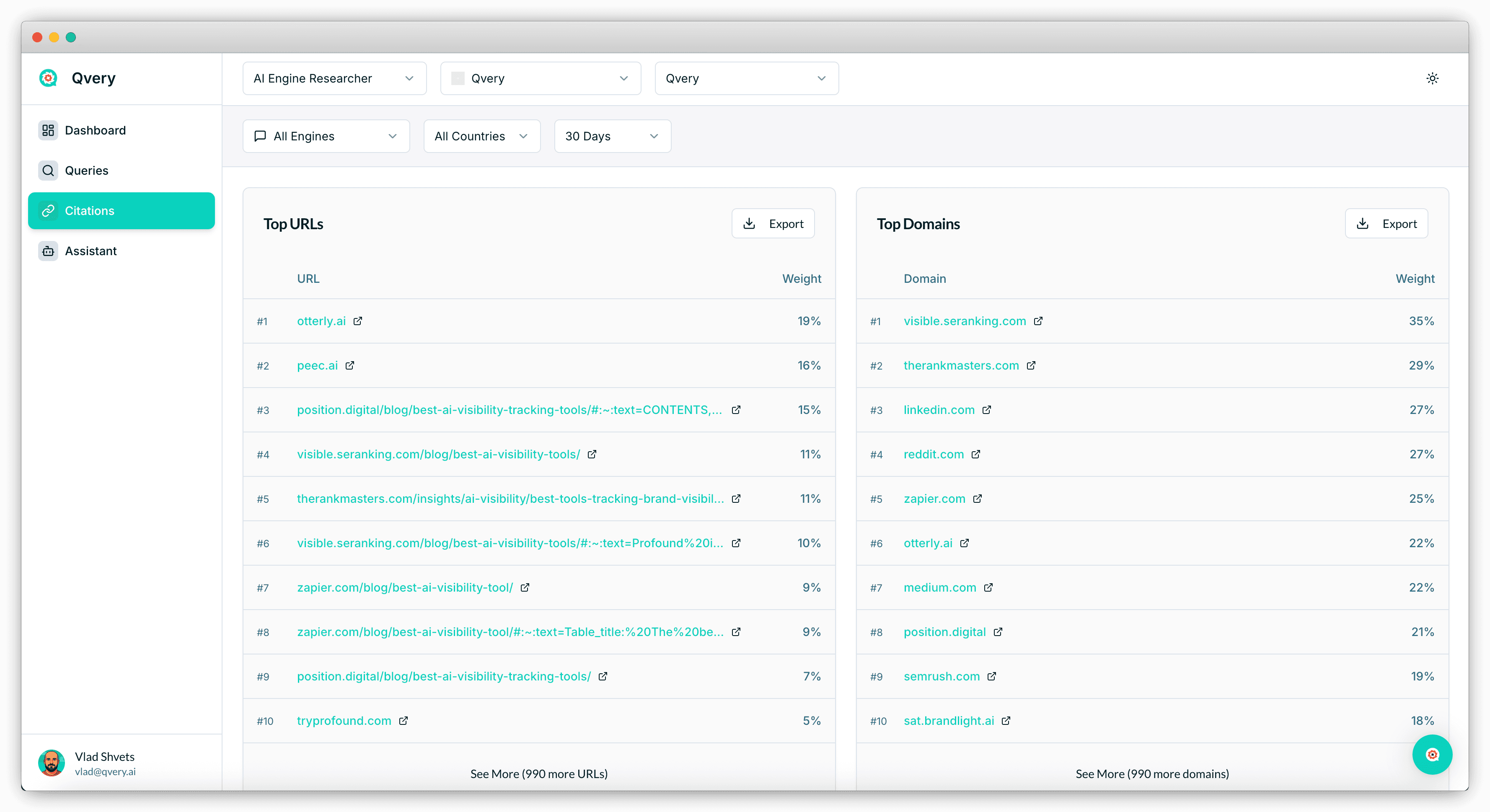
Track both engines independently. Combined metrics now hide more than they reveal. Qvery's AI Engine Researcher tracks citations on ChatGPT and Google AI Mode separately, across 200+ countries, with daily updates. You can see exactly which sources each engine cites for your queries and how your share of voice compares to competitors on each engine individually.
The brands that adjust fastest to this divergence will capture the visibility that slower competitors leave behind.
We'll be back in April with the next edition.
If you want to see where your brand stands right now, start tracking your AI engine visibility with Qvery. You'll have data in 30 minutes.
Every month, Qvery's AI Engine Researcher tracks millions of citations across ChatGPT and Google AI Mode for dozens of brands in every industry we cover. We use this proprietary citation data to publish what moved, what shifted, and what it means for brands trying to stay visible in AI search. This is the March 2026 edition.
March was the most eventful month in our tracking history. ChatGPT cut its citation count nearly in half. Google AI Mode didn't change at all. YouTube doubled on one engine and collapsed on the other. Reddit grew on both. Wikipedia got quietly demoted.
The two biggest AI search engines are diverging faster than anyone expected, and the implications for brand visibility are significant.
ChatGPT's Citation Density Collapsed 42% in a Single Month
ChatGPT averaged 16.93 citations per response in February. In March, that number dropped to 9.76. Meanwhile, Google AI Mode went from 19.49 to 19.62, barely moving at all. For the first time in Qvery's tracking history, Google AI Mode now produces more citations per response than ChatGPT.
ChatGPT's citation density dropped 42% in March. Google AI Mode didn't move. The two engines are no longer playing the same game.
This represents a fundamental behavioral shift in how ChatGPT constructs responses, not a temporary fluctuation. ChatGPT appears to be becoming more selective about which sources it cites, linking to fewer URLs but presumably with higher confidence in the ones it keeps.
For brands, the practical consequence is that the bar for earning a ChatGPT citation just went up significantly. If your content was appearing in responses through sheer volume of available source material, that strategy is no longer viable.
The asymmetry between the two engines is what makes this finding particularly important. A brand that looks stable in combined metrics might actually be losing ground on ChatGPT while gaining on Google AI Mode, or vice versa. Combined averages are now misleading at best and dangerous at worst.
ChatGPT Is Cutting Its Source Pool in Half
The citation density collapse isn't just about total citation count. The diversity of sources per response collapsed even more dramatically.
In February, the average ChatGPT response pulled from 21.2 unique domains. In March, that dropped to 11.7. The median went from 20 to 10. Google AI Mode, by contrast, was completely unchanged: average 13.2 in February, 13.3 in March. Median held steady at 12.
What does this mean in practice? In February, your brand had roughly 21 potential slots to appear in per ChatGPT response. Now there are 12. The competition for each remaining slot has nearly doubled overnight, and the domains that survive the cut are likely the ones ChatGPT considers most authoritative and relevant for each specific query. If your content was on the edge of being cited, it's probably been cut. If it was a strong, reliable source, it may now appear more prominently in a smaller, higher-quality citation list.
Citations Are Concentrating Around Fewer, More Established Domains
When individual responses cite fewer sources, the aggregate effect across the entire dataset is concentration. The top domains are capturing a disproportionately larger share of total citations.
Top 10 domains: 13.94% of all citations in February → 15.63% in March (+1.7 percentage points)
Top 50 domains: 27.72% → 30.41% (+2.7pp)
Top 100 domains: 34.45% → 37.52% (+3.1pp)
At the same time, the total number of unique domains cited dropped 16%, from approximately 67,700 to 57,000. AI engines are not only citing fewer sources per response, they're also drawing from a smaller total pool of domains. The long tail of niche publications that occasionally earned a citation is shrinking.
This is the Double Jeopardy law accelerating in real time. Established domains that already held strong citation share are consolidating their position, while smaller domains that relied on occasional citations are being squeezed out. The implication for brand strategy is clear: being a consistent, authoritative source matters more than ever. Sporadic mentions across many low-authority pages won't cut it when AI engines are actively consolidating their source lists.
YouTube's Citation Share Doubled, But Only on One Engine
YouTube's combined citation share went from 0.75% to 1.58%, a 110% increase that makes it one of the fastest-growing citation sources in March. On the surface, this looks like a straightforward win for video content in AI search. The provider split tells a completely different story.
Google AI Mode: YouTube's share surged from 1.01% to 2.27% (+125%). Average citation rank improved from 9.8 to 8.9, meaning YouTube citations are appearing higher and more prominently in responses than ever before.
ChatGPT: YouTube's share collapsed from 0.45% to 0.15% (-68%). ChatGPT is actively retreating from video content as part of its broader source reduction.
YouTube is becoming a Google AI exclusive citation source. This makes structural sense: Google owns YouTube and has deep access to transcripts, engagement metrics, and the content graph.
ChatGPT has none of that infrastructure, and when forced to reduce its citation count, video sources were among the first to go. We covered the YouTube citation divergence in detail last week, and March data shows the gap widening dramatically. (Turns out owning the world's largest video platform has its advantages.)
For brands with visual or demonstrable products, this creates a clear tactical split: YouTube content will earn increasingly more AI citations on Google AI Mode, but ChatGPT will largely ignore it. Your YouTube investment is now a Google AI Mode investment specifically.
Reddit Is the Only Major Platform Growing on Both Engines
Every other major platform we track moved in one direction on one engine and the opposite direction on the other. Reddit is the sole exception: it grew on both ChatGPT and Google AI Mode simultaneously.
ChatGPT: Reddit's citation share went from 1.23% to 1.69% (+38%). Average citation rank improved from 13.4 to 11.7, meaning Reddit threads are being placed earlier and more prominently in responses.
Google AI Mode: Reddit's share grew from 0.94% to 1.26% (+35%).
Reddit is gaining a larger slice of ChatGPT's shrinking pie AND a larger slice of Google AI Mode's stable one. No other major platform can claim that.
The ChatGPT growth is particularly striking given the context. ChatGPT slashed its overall citation count by 42%, yet Reddit's share of the remaining citations increased by 38%. When an engine dramatically reduces its source list and your platform's share grows, that's a powerful signal about how much the engine values your content. ChatGPT is actively choosing to keep Reddit while cutting social platforms, video sources, and even Wikipedia.
Why? Reddit contains something that most other platforms don't: genuine, unfiltered opinions from real people who disagree with each other. When ChatGPT needs to recommend a product or compare options, Reddit threads provide the kind of authentic, experience-based signal that polished marketing content can't replicate.
This reinforces everything we found in our Reddit citation analysis: Reddit's position as the most important third-party domain for AI visibility is strengthening month over month.
Wikipedia Is Being Quietly Demoted
Wikipedia's combined citation share dropped 34%, from 1.16% to 0.77%. But the share decline understates what actually happened.
On ChatGPT, Wikipedia's average citation rank position fell from 5.4 to 12.2. Wikipedia used to be one of the first sources ChatGPT listed in any response, often appearing in the top five citations. Now it's buried in the middle of a much shorter list. Even when ChatGPT still cites Wikipedia, it's treating it as a supporting reference rather than a primary source.
Google AI Mode barely cites Wikipedia at all, with share moving from 0.02% to 0.05%. Wikipedia in AI search remains almost exclusively a ChatGPT phenomenon, and even that relationship is weakening.
The likely explanation is that Wikipedia was over-represented in ChatGPT's citation behavior relative to its actual usefulness for the kinds of queries brands care about. Wikipedia excels at factual, encyclopedic information, but commercial and product queries require recommendation-oriented content that Wikipedia doesn't provide.
As ChatGPT becomes more selective and purpose-driven in its citations, generalist reference sources are losing ground to more specific, experience-based content.
This is another signal that AI engines are evolving toward citing sources that directly answer the user's intent rather than providing background context.
ChatGPT Is Systematically Retreating From Social Platforms
March data reveals a consistent pattern across every social and visual platform we track: ChatGPT is reducing citations while Google AI Mode maintains or grows them.
Facebook on ChatGPT: 0.39% → 0.20% (-49%). On Google AI: 0.87% → 1.05% (+20%).
Instagram on ChatGPT: 0.21% → 0.09% (-56%). On Google AI: 0.68% → 0.70% (stable).
YouTube on ChatGPT: 0.45% → 0.15% (-68%). On Google AI: 1.01% → 2.27% (+125%).
LinkedIn on ChatGPT: 0.48% → 0.47% (stable). On Google AI: 0.78% → 0.74% (-5%).
LinkedIn is the only social platform holding its position on ChatGPT, likely because its content is text-heavy, professionally structured, and directly relevant to the B2B queries where ChatGPT still values external sources. Everything visual or social-first (Facebook, Instagram, YouTube) is being systematically deprioritized by ChatGPT while Google AI Mode, with its deeper integration into Google's ecosystem, continues to value these platforms.
If your AI visibility strategy relies heavily on social media presence, you're increasingly playing a Google AI Mode game. ChatGPT is making it clear that it prefers text-based, recommendation-oriented sources over social content.
Brand Mentions Are Declining on ChatGPT, But Less Than Citations
ChatGPT isn't just citing fewer sources. It's also mentioning fewer brands per response.
ChatGPT: 7.22 brand mentions per response in February → 6.32 in March (-12.5%).
Google AI Mode: 6.42 → 6.37 (essentially unchanged).
The interesting nuance here is the gap between the citation decline (-42%) and the brand mention decline (-12.5%).
ChatGPT is still recommending a similar number of brands in its responses, but it's providing significantly fewer source URLs to support those recommendations. In other words, ChatGPT's responses are becoming more opinionated: it's making the same recommendations but with less evidence shown to the user. Whether this signals growing confidence or a deliberate UX choice to present cleaner, less cluttered responses is something we'll be watching closely in April.
What This Means for Your Visibility Strategy
March 2026 was the month the two biggest AI search engines stopped behaving like variations of the same thing.
The tactical implications are concrete.
You need separate strategies for each engine. ChatGPT is becoming more selective, citing fewer sources, favoring text-based content, and retreating from social platforms. Google AI Mode is stable, expanding its use of video and social content, and increasingly citing its own ecosystem. A single "AI search" strategy no longer covers both. Track them separately, optimize for them differently.
Quality over quantity now matters more than ever on ChatGPT. With half as many citation slots per response, every piece of content you publish needs to be genuinely the best available source for the specific queries your audience asks. Generic content that used to earn occasional citations through volume will no longer make the cut. Focus on high information gain content: original data, unique perspectives, practitioner insights that ChatGPT can't find anywhere else.
Reddit is the safest bet across both engines. If you're not investing in authentic Reddit presence, you're ignoring the only major platform gaining ground on both ChatGPT and Google AI Mode. The playbook is clear: genuine participation in relevant subreddits, real users sharing real experiences. Start with our Reddit AI visibility guide.
Video content is now a Google AI Mode play specifically. YouTube's surge on Google AI Mode is real and accelerating, but ChatGPT is moving in the opposite direction. If your product is visual or demonstrable, YouTube will earn you more Google AI Mode citations than ever. But budget accordingly: this investment won't help your ChatGPT visibility.
Track both engines independently. Combined metrics now hide more than they reveal. Qvery's AI Engine Researcher tracks citations on ChatGPT and Google AI Mode separately, across 200+ countries, with daily updates. You can see exactly which sources each engine cites for your queries and how your share of voice compares to competitors on each engine individually.
The brands that adjust fastest to this divergence will capture the visibility that slower competitors leave behind.
We'll be back in April with the next edition.
If you want to see where your brand stands right now, start tracking your AI engine visibility with Qvery. You'll have data in 30 minutes.
Every month, Qvery's AI Engine Researcher tracks millions of citations across ChatGPT and Google AI Mode for dozens of brands in every industry we cover. We use this proprietary citation data to publish what moved, what shifted, and what it means for brands trying to stay visible in AI search. This is the March 2026 edition.
March was the most eventful month in our tracking history. ChatGPT cut its citation count nearly in half. Google AI Mode didn't change at all. YouTube doubled on one engine and collapsed on the other. Reddit grew on both. Wikipedia got quietly demoted.
The two biggest AI search engines are diverging faster than anyone expected, and the implications for brand visibility are significant.
ChatGPT's Citation Density Collapsed 42% in a Single Month
ChatGPT averaged 16.93 citations per response in February. In March, that number dropped to 9.76. Meanwhile, Google AI Mode went from 19.49 to 19.62, barely moving at all. For the first time in Qvery's tracking history, Google AI Mode now produces more citations per response than ChatGPT.
ChatGPT's citation density dropped 42% in March. Google AI Mode didn't move. The two engines are no longer playing the same game.
This represents a fundamental behavioral shift in how ChatGPT constructs responses, not a temporary fluctuation. ChatGPT appears to be becoming more selective about which sources it cites, linking to fewer URLs but presumably with higher confidence in the ones it keeps.
For brands, the practical consequence is that the bar for earning a ChatGPT citation just went up significantly. If your content was appearing in responses through sheer volume of available source material, that strategy is no longer viable.
The asymmetry between the two engines is what makes this finding particularly important. A brand that looks stable in combined metrics might actually be losing ground on ChatGPT while gaining on Google AI Mode, or vice versa. Combined averages are now misleading at best and dangerous at worst.
ChatGPT Is Cutting Its Source Pool in Half
The citation density collapse isn't just about total citation count. The diversity of sources per response collapsed even more dramatically.
In February, the average ChatGPT response pulled from 21.2 unique domains. In March, that dropped to 11.7. The median went from 20 to 10. Google AI Mode, by contrast, was completely unchanged: average 13.2 in February, 13.3 in March. Median held steady at 12.
What does this mean in practice? In February, your brand had roughly 21 potential slots to appear in per ChatGPT response. Now there are 12. The competition for each remaining slot has nearly doubled overnight, and the domains that survive the cut are likely the ones ChatGPT considers most authoritative and relevant for each specific query. If your content was on the edge of being cited, it's probably been cut. If it was a strong, reliable source, it may now appear more prominently in a smaller, higher-quality citation list.
Citations Are Concentrating Around Fewer, More Established Domains
When individual responses cite fewer sources, the aggregate effect across the entire dataset is concentration. The top domains are capturing a disproportionately larger share of total citations.
Top 10 domains: 13.94% of all citations in February → 15.63% in March (+1.7 percentage points)
Top 50 domains: 27.72% → 30.41% (+2.7pp)
Top 100 domains: 34.45% → 37.52% (+3.1pp)
At the same time, the total number of unique domains cited dropped 16%, from approximately 67,700 to 57,000. AI engines are not only citing fewer sources per response, they're also drawing from a smaller total pool of domains. The long tail of niche publications that occasionally earned a citation is shrinking.
This is the Double Jeopardy law accelerating in real time. Established domains that already held strong citation share are consolidating their position, while smaller domains that relied on occasional citations are being squeezed out. The implication for brand strategy is clear: being a consistent, authoritative source matters more than ever. Sporadic mentions across many low-authority pages won't cut it when AI engines are actively consolidating their source lists.
YouTube's Citation Share Doubled, But Only on One Engine
YouTube's combined citation share went from 0.75% to 1.58%, a 110% increase that makes it one of the fastest-growing citation sources in March. On the surface, this looks like a straightforward win for video content in AI search. The provider split tells a completely different story.
Google AI Mode: YouTube's share surged from 1.01% to 2.27% (+125%). Average citation rank improved from 9.8 to 8.9, meaning YouTube citations are appearing higher and more prominently in responses than ever before.
ChatGPT: YouTube's share collapsed from 0.45% to 0.15% (-68%). ChatGPT is actively retreating from video content as part of its broader source reduction.
YouTube is becoming a Google AI exclusive citation source. This makes structural sense: Google owns YouTube and has deep access to transcripts, engagement metrics, and the content graph.
ChatGPT has none of that infrastructure, and when forced to reduce its citation count, video sources were among the first to go. We covered the YouTube citation divergence in detail last week, and March data shows the gap widening dramatically. (Turns out owning the world's largest video platform has its advantages.)
For brands with visual or demonstrable products, this creates a clear tactical split: YouTube content will earn increasingly more AI citations on Google AI Mode, but ChatGPT will largely ignore it. Your YouTube investment is now a Google AI Mode investment specifically.
Reddit Is the Only Major Platform Growing on Both Engines
Every other major platform we track moved in one direction on one engine and the opposite direction on the other. Reddit is the sole exception: it grew on both ChatGPT and Google AI Mode simultaneously.
ChatGPT: Reddit's citation share went from 1.23% to 1.69% (+38%). Average citation rank improved from 13.4 to 11.7, meaning Reddit threads are being placed earlier and more prominently in responses.
Google AI Mode: Reddit's share grew from 0.94% to 1.26% (+35%).
Reddit is gaining a larger slice of ChatGPT's shrinking pie AND a larger slice of Google AI Mode's stable one. No other major platform can claim that.
The ChatGPT growth is particularly striking given the context. ChatGPT slashed its overall citation count by 42%, yet Reddit's share of the remaining citations increased by 38%. When an engine dramatically reduces its source list and your platform's share grows, that's a powerful signal about how much the engine values your content. ChatGPT is actively choosing to keep Reddit while cutting social platforms, video sources, and even Wikipedia.
Why? Reddit contains something that most other platforms don't: genuine, unfiltered opinions from real people who disagree with each other. When ChatGPT needs to recommend a product or compare options, Reddit threads provide the kind of authentic, experience-based signal that polished marketing content can't replicate.
This reinforces everything we found in our Reddit citation analysis: Reddit's position as the most important third-party domain for AI visibility is strengthening month over month.
Wikipedia Is Being Quietly Demoted
Wikipedia's combined citation share dropped 34%, from 1.16% to 0.77%. But the share decline understates what actually happened.
On ChatGPT, Wikipedia's average citation rank position fell from 5.4 to 12.2. Wikipedia used to be one of the first sources ChatGPT listed in any response, often appearing in the top five citations. Now it's buried in the middle of a much shorter list. Even when ChatGPT still cites Wikipedia, it's treating it as a supporting reference rather than a primary source.
Google AI Mode barely cites Wikipedia at all, with share moving from 0.02% to 0.05%. Wikipedia in AI search remains almost exclusively a ChatGPT phenomenon, and even that relationship is weakening.
The likely explanation is that Wikipedia was over-represented in ChatGPT's citation behavior relative to its actual usefulness for the kinds of queries brands care about. Wikipedia excels at factual, encyclopedic information, but commercial and product queries require recommendation-oriented content that Wikipedia doesn't provide.
As ChatGPT becomes more selective and purpose-driven in its citations, generalist reference sources are losing ground to more specific, experience-based content.
This is another signal that AI engines are evolving toward citing sources that directly answer the user's intent rather than providing background context.
ChatGPT Is Systematically Retreating From Social Platforms
March data reveals a consistent pattern across every social and visual platform we track: ChatGPT is reducing citations while Google AI Mode maintains or grows them.
Facebook on ChatGPT: 0.39% → 0.20% (-49%). On Google AI: 0.87% → 1.05% (+20%).
Instagram on ChatGPT: 0.21% → 0.09% (-56%). On Google AI: 0.68% → 0.70% (stable).
YouTube on ChatGPT: 0.45% → 0.15% (-68%). On Google AI: 1.01% → 2.27% (+125%).
LinkedIn on ChatGPT: 0.48% → 0.47% (stable). On Google AI: 0.78% → 0.74% (-5%).
LinkedIn is the only social platform holding its position on ChatGPT, likely because its content is text-heavy, professionally structured, and directly relevant to the B2B queries where ChatGPT still values external sources. Everything visual or social-first (Facebook, Instagram, YouTube) is being systematically deprioritized by ChatGPT while Google AI Mode, with its deeper integration into Google's ecosystem, continues to value these platforms.
If your AI visibility strategy relies heavily on social media presence, you're increasingly playing a Google AI Mode game. ChatGPT is making it clear that it prefers text-based, recommendation-oriented sources over social content.
Brand Mentions Are Declining on ChatGPT, But Less Than Citations
ChatGPT isn't just citing fewer sources. It's also mentioning fewer brands per response.
ChatGPT: 7.22 brand mentions per response in February → 6.32 in March (-12.5%).
Google AI Mode: 6.42 → 6.37 (essentially unchanged).
The interesting nuance here is the gap between the citation decline (-42%) and the brand mention decline (-12.5%).
ChatGPT is still recommending a similar number of brands in its responses, but it's providing significantly fewer source URLs to support those recommendations. In other words, ChatGPT's responses are becoming more opinionated: it's making the same recommendations but with less evidence shown to the user. Whether this signals growing confidence or a deliberate UX choice to present cleaner, less cluttered responses is something we'll be watching closely in April.
What This Means for Your Visibility Strategy
March 2026 was the month the two biggest AI search engines stopped behaving like variations of the same thing.
The tactical implications are concrete.
You need separate strategies for each engine. ChatGPT is becoming more selective, citing fewer sources, favoring text-based content, and retreating from social platforms. Google AI Mode is stable, expanding its use of video and social content, and increasingly citing its own ecosystem. A single "AI search" strategy no longer covers both. Track them separately, optimize for them differently.
Quality over quantity now matters more than ever on ChatGPT. With half as many citation slots per response, every piece of content you publish needs to be genuinely the best available source for the specific queries your audience asks. Generic content that used to earn occasional citations through volume will no longer make the cut. Focus on high information gain content: original data, unique perspectives, practitioner insights that ChatGPT can't find anywhere else.
Reddit is the safest bet across both engines. If you're not investing in authentic Reddit presence, you're ignoring the only major platform gaining ground on both ChatGPT and Google AI Mode. The playbook is clear: genuine participation in relevant subreddits, real users sharing real experiences. Start with our Reddit AI visibility guide.
Video content is now a Google AI Mode play specifically. YouTube's surge on Google AI Mode is real and accelerating, but ChatGPT is moving in the opposite direction. If your product is visual or demonstrable, YouTube will earn you more Google AI Mode citations than ever. But budget accordingly: this investment won't help your ChatGPT visibility.
Track both engines independently. Combined metrics now hide more than they reveal. Qvery's AI Engine Researcher tracks citations on ChatGPT and Google AI Mode separately, across 200+ countries, with daily updates. You can see exactly which sources each engine cites for your queries and how your share of voice compares to competitors on each engine individually.
The brands that adjust fastest to this divergence will capture the visibility that slower competitors leave behind.
We'll be back in April with the next edition.
If you want to see where your brand stands right now, start tracking your AI engine visibility with Qvery. You'll have data in 30 minutes.
Every month, Qvery's AI Engine Researcher tracks millions of citations across ChatGPT and Google AI Mode for dozens of brands in every industry we cover. We use this proprietary citation data to publish what moved, what shifted, and what it means for brands trying to stay visible in AI search. This is the March 2026 edition.
March was the most eventful month in our tracking history. ChatGPT cut its citation count nearly in half. Google AI Mode didn't change at all. YouTube doubled on one engine and collapsed on the other. Reddit grew on both. Wikipedia got quietly demoted.
The two biggest AI search engines are diverging faster than anyone expected, and the implications for brand visibility are significant.
ChatGPT's Citation Density Collapsed 42% in a Single Month
ChatGPT averaged 16.93 citations per response in February. In March, that number dropped to 9.76. Meanwhile, Google AI Mode went from 19.49 to 19.62, barely moving at all. For the first time in Qvery's tracking history, Google AI Mode now produces more citations per response than ChatGPT.
ChatGPT's citation density dropped 42% in March. Google AI Mode didn't move. The two engines are no longer playing the same game.
This represents a fundamental behavioral shift in how ChatGPT constructs responses, not a temporary fluctuation. ChatGPT appears to be becoming more selective about which sources it cites, linking to fewer URLs but presumably with higher confidence in the ones it keeps.
For brands, the practical consequence is that the bar for earning a ChatGPT citation just went up significantly. If your content was appearing in responses through sheer volume of available source material, that strategy is no longer viable.
The asymmetry between the two engines is what makes this finding particularly important. A brand that looks stable in combined metrics might actually be losing ground on ChatGPT while gaining on Google AI Mode, or vice versa. Combined averages are now misleading at best and dangerous at worst.
ChatGPT Is Cutting Its Source Pool in Half
The citation density collapse isn't just about total citation count. The diversity of sources per response collapsed even more dramatically.
In February, the average ChatGPT response pulled from 21.2 unique domains. In March, that dropped to 11.7. The median went from 20 to 10. Google AI Mode, by contrast, was completely unchanged: average 13.2 in February, 13.3 in March. Median held steady at 12.
What does this mean in practice? In February, your brand had roughly 21 potential slots to appear in per ChatGPT response. Now there are 12. The competition for each remaining slot has nearly doubled overnight, and the domains that survive the cut are likely the ones ChatGPT considers most authoritative and relevant for each specific query. If your content was on the edge of being cited, it's probably been cut. If it was a strong, reliable source, it may now appear more prominently in a smaller, higher-quality citation list.
Citations Are Concentrating Around Fewer, More Established Domains
When individual responses cite fewer sources, the aggregate effect across the entire dataset is concentration. The top domains are capturing a disproportionately larger share of total citations.
Top 10 domains: 13.94% of all citations in February → 15.63% in March (+1.7 percentage points)
Top 50 domains: 27.72% → 30.41% (+2.7pp)
Top 100 domains: 34.45% → 37.52% (+3.1pp)
At the same time, the total number of unique domains cited dropped 16%, from approximately 67,700 to 57,000. AI engines are not only citing fewer sources per response, they're also drawing from a smaller total pool of domains. The long tail of niche publications that occasionally earned a citation is shrinking.
This is the Double Jeopardy law accelerating in real time. Established domains that already held strong citation share are consolidating their position, while smaller domains that relied on occasional citations are being squeezed out. The implication for brand strategy is clear: being a consistent, authoritative source matters more than ever. Sporadic mentions across many low-authority pages won't cut it when AI engines are actively consolidating their source lists.
YouTube's Citation Share Doubled, But Only on One Engine
YouTube's combined citation share went from 0.75% to 1.58%, a 110% increase that makes it one of the fastest-growing citation sources in March. On the surface, this looks like a straightforward win for video content in AI search. The provider split tells a completely different story.
Google AI Mode: YouTube's share surged from 1.01% to 2.27% (+125%). Average citation rank improved from 9.8 to 8.9, meaning YouTube citations are appearing higher and more prominently in responses than ever before.
ChatGPT: YouTube's share collapsed from 0.45% to 0.15% (-68%). ChatGPT is actively retreating from video content as part of its broader source reduction.
YouTube is becoming a Google AI exclusive citation source. This makes structural sense: Google owns YouTube and has deep access to transcripts, engagement metrics, and the content graph.
ChatGPT has none of that infrastructure, and when forced to reduce its citation count, video sources were among the first to go. We covered the YouTube citation divergence in detail last week, and March data shows the gap widening dramatically. (Turns out owning the world's largest video platform has its advantages.)
For brands with visual or demonstrable products, this creates a clear tactical split: YouTube content will earn increasingly more AI citations on Google AI Mode, but ChatGPT will largely ignore it. Your YouTube investment is now a Google AI Mode investment specifically.
Reddit Is the Only Major Platform Growing on Both Engines
Every other major platform we track moved in one direction on one engine and the opposite direction on the other. Reddit is the sole exception: it grew on both ChatGPT and Google AI Mode simultaneously.
ChatGPT: Reddit's citation share went from 1.23% to 1.69% (+38%). Average citation rank improved from 13.4 to 11.7, meaning Reddit threads are being placed earlier and more prominently in responses.
Google AI Mode: Reddit's share grew from 0.94% to 1.26% (+35%).
Reddit is gaining a larger slice of ChatGPT's shrinking pie AND a larger slice of Google AI Mode's stable one. No other major platform can claim that.
The ChatGPT growth is particularly striking given the context. ChatGPT slashed its overall citation count by 42%, yet Reddit's share of the remaining citations increased by 38%. When an engine dramatically reduces its source list and your platform's share grows, that's a powerful signal about how much the engine values your content. ChatGPT is actively choosing to keep Reddit while cutting social platforms, video sources, and even Wikipedia.
Why? Reddit contains something that most other platforms don't: genuine, unfiltered opinions from real people who disagree with each other. When ChatGPT needs to recommend a product or compare options, Reddit threads provide the kind of authentic, experience-based signal that polished marketing content can't replicate.
This reinforces everything we found in our Reddit citation analysis: Reddit's position as the most important third-party domain for AI visibility is strengthening month over month.
Wikipedia Is Being Quietly Demoted
Wikipedia's combined citation share dropped 34%, from 1.16% to 0.77%. But the share decline understates what actually happened.
On ChatGPT, Wikipedia's average citation rank position fell from 5.4 to 12.2. Wikipedia used to be one of the first sources ChatGPT listed in any response, often appearing in the top five citations. Now it's buried in the middle of a much shorter list. Even when ChatGPT still cites Wikipedia, it's treating it as a supporting reference rather than a primary source.
Google AI Mode barely cites Wikipedia at all, with share moving from 0.02% to 0.05%. Wikipedia in AI search remains almost exclusively a ChatGPT phenomenon, and even that relationship is weakening.
The likely explanation is that Wikipedia was over-represented in ChatGPT's citation behavior relative to its actual usefulness for the kinds of queries brands care about. Wikipedia excels at factual, encyclopedic information, but commercial and product queries require recommendation-oriented content that Wikipedia doesn't provide.
As ChatGPT becomes more selective and purpose-driven in its citations, generalist reference sources are losing ground to more specific, experience-based content.
This is another signal that AI engines are evolving toward citing sources that directly answer the user's intent rather than providing background context.
ChatGPT Is Systematically Retreating From Social Platforms
March data reveals a consistent pattern across every social and visual platform we track: ChatGPT is reducing citations while Google AI Mode maintains or grows them.
Facebook on ChatGPT: 0.39% → 0.20% (-49%). On Google AI: 0.87% → 1.05% (+20%).
Instagram on ChatGPT: 0.21% → 0.09% (-56%). On Google AI: 0.68% → 0.70% (stable).
YouTube on ChatGPT: 0.45% → 0.15% (-68%). On Google AI: 1.01% → 2.27% (+125%).
LinkedIn on ChatGPT: 0.48% → 0.47% (stable). On Google AI: 0.78% → 0.74% (-5%).
LinkedIn is the only social platform holding its position on ChatGPT, likely because its content is text-heavy, professionally structured, and directly relevant to the B2B queries where ChatGPT still values external sources. Everything visual or social-first (Facebook, Instagram, YouTube) is being systematically deprioritized by ChatGPT while Google AI Mode, with its deeper integration into Google's ecosystem, continues to value these platforms.
If your AI visibility strategy relies heavily on social media presence, you're increasingly playing a Google AI Mode game. ChatGPT is making it clear that it prefers text-based, recommendation-oriented sources over social content.
Brand Mentions Are Declining on ChatGPT, But Less Than Citations
ChatGPT isn't just citing fewer sources. It's also mentioning fewer brands per response.
ChatGPT: 7.22 brand mentions per response in February → 6.32 in March (-12.5%).
Google AI Mode: 6.42 → 6.37 (essentially unchanged).
The interesting nuance here is the gap between the citation decline (-42%) and the brand mention decline (-12.5%).
ChatGPT is still recommending a similar number of brands in its responses, but it's providing significantly fewer source URLs to support those recommendations. In other words, ChatGPT's responses are becoming more opinionated: it's making the same recommendations but with less evidence shown to the user. Whether this signals growing confidence or a deliberate UX choice to present cleaner, less cluttered responses is something we'll be watching closely in April.
What This Means for Your Visibility Strategy
March 2026 was the month the two biggest AI search engines stopped behaving like variations of the same thing.
The tactical implications are concrete.
You need separate strategies for each engine. ChatGPT is becoming more selective, citing fewer sources, favoring text-based content, and retreating from social platforms. Google AI Mode is stable, expanding its use of video and social content, and increasingly citing its own ecosystem. A single "AI search" strategy no longer covers both. Track them separately, optimize for them differently.
Quality over quantity now matters more than ever on ChatGPT. With half as many citation slots per response, every piece of content you publish needs to be genuinely the best available source for the specific queries your audience asks. Generic content that used to earn occasional citations through volume will no longer make the cut. Focus on high information gain content: original data, unique perspectives, practitioner insights that ChatGPT can't find anywhere else.
Reddit is the safest bet across both engines. If you're not investing in authentic Reddit presence, you're ignoring the only major platform gaining ground on both ChatGPT and Google AI Mode. The playbook is clear: genuine participation in relevant subreddits, real users sharing real experiences. Start with our Reddit AI visibility guide.
Video content is now a Google AI Mode play specifically. YouTube's surge on Google AI Mode is real and accelerating, but ChatGPT is moving in the opposite direction. If your product is visual or demonstrable, YouTube will earn you more Google AI Mode citations than ever. But budget accordingly: this investment won't help your ChatGPT visibility.
Track both engines independently. Combined metrics now hide more than they reveal. Qvery's AI Engine Researcher tracks citations on ChatGPT and Google AI Mode separately, across 200+ countries, with daily updates. You can see exactly which sources each engine cites for your queries and how your share of voice compares to competitors on each engine individually.
The brands that adjust fastest to this divergence will capture the visibility that slower competitors leave behind.
We'll be back in April with the next edition.
If you want to see where your brand stands right now, start tracking your AI engine visibility with Qvery. You'll have data in 30 minutes.

© 2026 Qvery AI OÜ