By
Vlad Shvets
How to Generate LLM Tracking Queries Without Doing It by Hand
We ran the same buying questions bare and with one real constraint attached. The source rates barely moved; the source roster changed rooms. What that means for building a tracking query set, and how to generate one instead of guessing.
We ran the same buying questions bare and with one real constraint attached. The source rates barely moved; the source roster changed rooms. What that means for building a tracking query set, and how to generate one instead of guessing.
We ran the same buying questions bare and with one real constraint attached. The source rates barely moved; the source roster changed rooms. What that means for building a tracking query set, and how to generate one instead of guessing.
Somewhere right now a marketer is setting up AI visibility tracking for the first time, staring at an empty query list. The tool wants questions. The marketer has a spreadsheet of guesses: some autocomplete scrapings, three phrasings of "best [category] software", and a hunch about what buyers type into ChatGPT at 11pm.
The most thorough guide in the category teaches 17 ways to mine these by hand.
So before writing this tutorial, we measured the thing the guides skip: we ran the same buying questions twice, once bare and once with a single real-world constraint attached, and compared what the answers were built from.
The short version: phrasing moves the source rates less than you fear, and the source roster more than you expect. Which means a tracking set needs breadth and paired variants more than it needs 17 research methods, and that is exactly the kind of set worth generating instead of hand-writing.
The boundary up front: this is a snapshot, direction rather than census.
Manual Prompt Research Is a Guessing Game With a Monthly Expiry
The manual playbook goes like this: mine autocomplete, read support tickets, interview sales, borrow competitor guesses, brainstorm personas. A week later you have 40 queries and a spreadsheet you are proud of.
The problem is not the week. The problem is that the set is a photograph of your assumptions, and both sides of it move. Your buyers change how they phrase things, and the answers change what they are built from without asking your permission.
A hand-built tracking set does not fail loudly. It just keeps measuring the questions you guessed in March.
There is also a subtler failure: nobody hand-builds variants. Once you have typed "best CRM software", typing "best CRM for a five-person sales team" feels redundant. The data below says it is anything but.
Two Phrasings of the Same Question, Answered From Different Rooms
Across a targeted set of paired bare and one-constraint buying questions we ran on ChatGPT and Google AI Mode in August 2026 (US-weighted, with a UK, Canadian, and Australian mix), the rates barely moved. Across the 20 most-present sources, the median gap between the two phrasings was 2.8 points, and not one of the 20 moved 10 points or more.
Then the divergent half: each phrasing's own leader board shared just three of its top ten sources with the other.
The bare questions ("best ecommerce platform") ran on review and roundup publishers: TechRadar, Tom's Guide, TechRepublic, G2, NerdWallet. The one-constraint questions ("best ecommerce platform for a store doing under $10k a month") ran on vendor domains: HubSpot, Shopify, Squarespace, Wix, WooCommerce, Zoom.
Add one real constraint to a buying question and the answer walks out of the review press and into the vendors' own documentation.
Both facts matter to a query set. The sources you already track keep their rates whichever phrasing you use. But if you only track bare heads, there is a whole room of sources, the vendor layer answering constrained questions, that your report never sees.
One absence worth naming: no community platform, Reddit and Quora and YouTube included, made either leader board. In automotive and travel answers Reddit is the most-cited domain in our data; here the community layer did not reach the leading sources on either phrasing.
If your tracking set exists partly to watch Reddit, these buying questions are not the ones doing that work.
The Concentration Curves Say Your Head Queries Are a Fair Proxy
The third read is the shape of each leader board, and the two shapes are nearly the same.
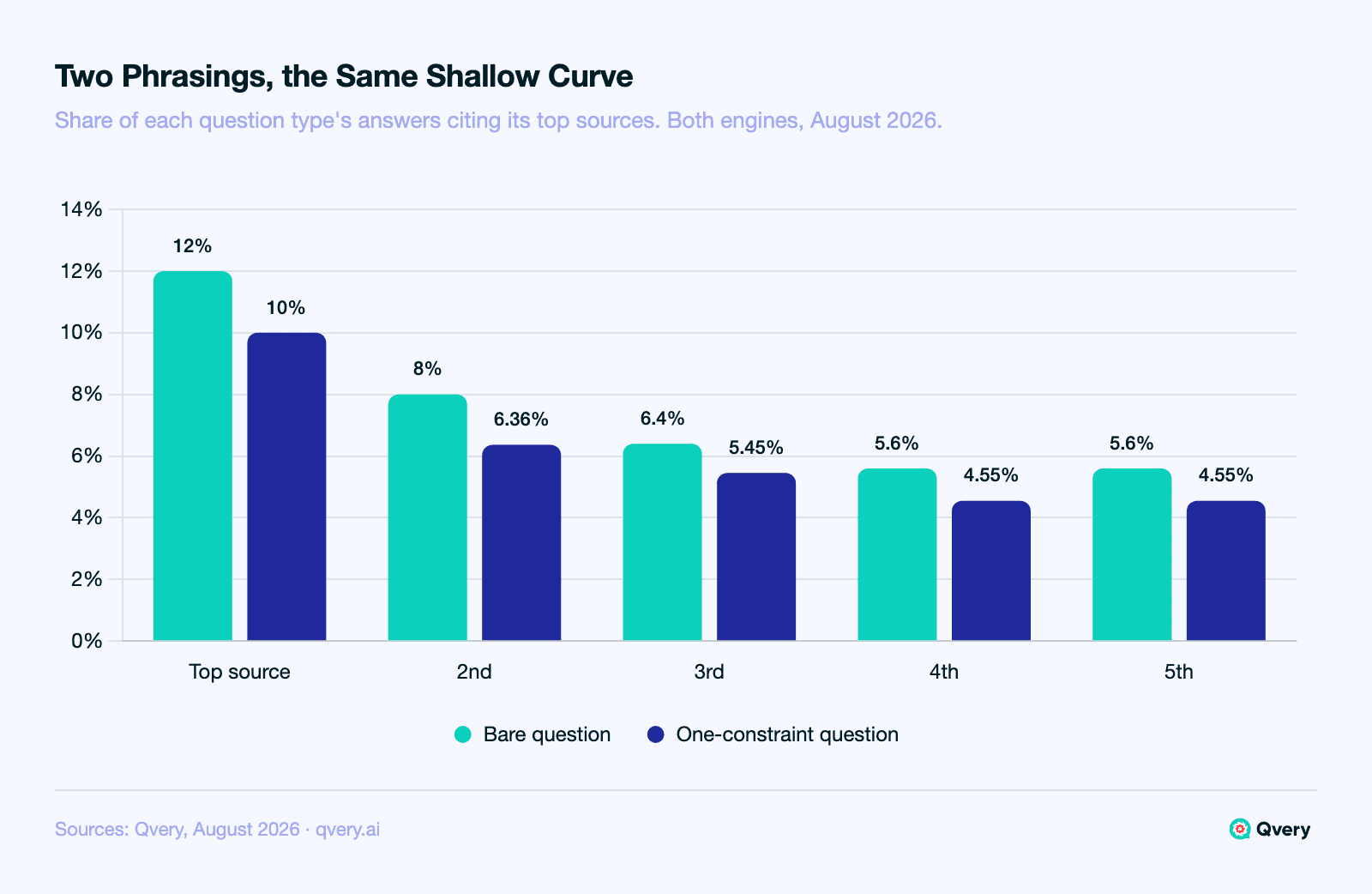
The most-present external source behind the bare questions was in 12.00% of their answers; behind the constrained ones, 10.00%. By the fifth-ranked source both curves are under 6%. Two decays, same shallow slope.
Two things follow. First, no single source owns these answers: even the leader appears in roughly one answer in eight, so a "track the one money query and watch the one big source" plan is reading noise.
Second, since the curves match, your bare head queries are a fair proxy for how concentrated your category's answers are. The reason to add constrained twins is the roster, not the shape.
(One plumbing note: a large share of Google AI Mode's citations route through Google's own redirect domain. We treat that as the engine's plumbing, not a source, and it is excluded from the chart.)
What a Tracking Set Needs, Given That
The pattern informs the design; it does not prove that any design change moves your visibility. With that said, here is how we would spend a query budget:
Breadth of categories over depth of phrasings. The rates are stable across phrasing, so the tenth rewording of one question buys you almost nothing a share of voice report can use. A new category, buyer job, or use case buys you a new set of answers.
One constraint twin per head query. Pair "best [category]" with the single constraint your real buyer adds: the budget, the team size, the integration. That is the cheapest way to make the vendor layer visible in your tracking, and it is the variant nobody builds by hand.
Both engines, always. The two engines assemble answers differently across our verticals; a set that runs on one is half a set.
A schedule, not a session. The set has to re-run without a person rebuilding it, because the answers it measures do not hold still.
Do all four by hand and you have recreated a part-time job. Which is the actual argument for generation.
Let Qvery Generate the Set, Then Edit It Like a Person
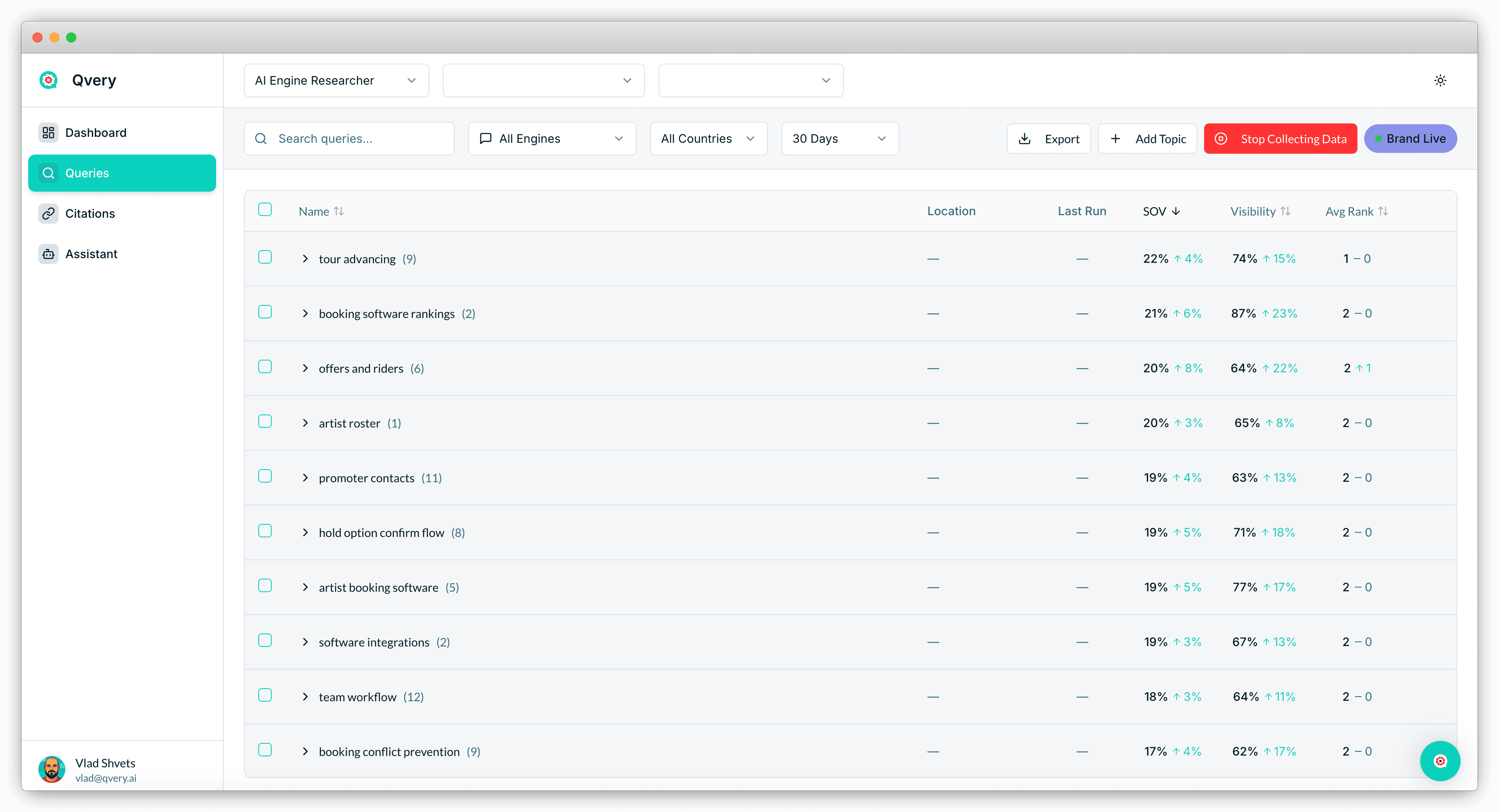
In Qvery, the query set is generated, not assembled. At onboarding, Qvery reads your product and generates the topics and the queries under them for you; they arrive grouped, country-tagged, and ready to run.
Then you do the part only you can do, in plain language. Open the Assistant and edit the set the way you would brief a colleague: add the two questions only your sales calls surface, delete the topic that is not your market, add the constrained twins for your three core categories. Add, edit, delete, one sentence each.
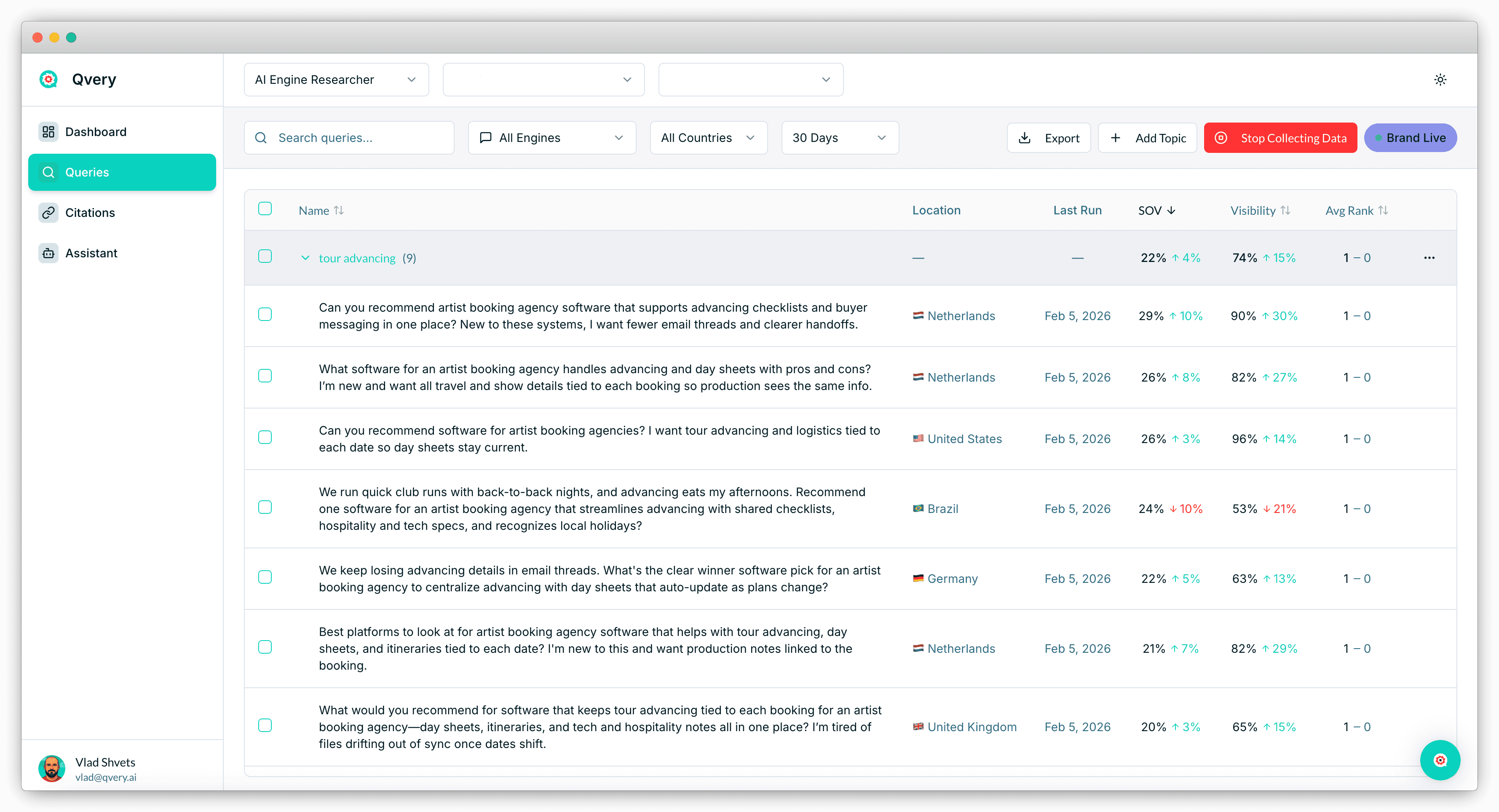
From there the set runs daily on ChatGPT and Google AI Mode, with every citation captured and tied to the query and engine that produced it, so the roster problem above becomes visible instead of theoretical: when the vendor layer answers your constrained questions, you see it in Citations, per query.
The limit: Qvery does not sit in your sales calls. The generated set is the breadth; the two or three questions only your reps hear still come from you, and the Assistant is where you add them.
The set you were planning to hand-build this quarter is shorter work than the spreadsheet: sign up for Qvery, let the free 7-day trial generate your first set, and spend your editing time on the twins and the sales-call questions instead of the guessing.
Start here this week: write the 10 bare head questions for your categories, then give each one its real-world twin. If the second column feels tedious, you have just met the reason this job belongs to a generator.
Somewhere right now a marketer is setting up AI visibility tracking for the first time, staring at an empty query list. The tool wants questions. The marketer has a spreadsheet of guesses: some autocomplete scrapings, three phrasings of "best [category] software", and a hunch about what buyers type into ChatGPT at 11pm.
The most thorough guide in the category teaches 17 ways to mine these by hand.
So before writing this tutorial, we measured the thing the guides skip: we ran the same buying questions twice, once bare and once with a single real-world constraint attached, and compared what the answers were built from.
The short version: phrasing moves the source rates less than you fear, and the source roster more than you expect. Which means a tracking set needs breadth and paired variants more than it needs 17 research methods, and that is exactly the kind of set worth generating instead of hand-writing.
The boundary up front: this is a snapshot, direction rather than census.
Manual Prompt Research Is a Guessing Game With a Monthly Expiry
The manual playbook goes like this: mine autocomplete, read support tickets, interview sales, borrow competitor guesses, brainstorm personas. A week later you have 40 queries and a spreadsheet you are proud of.
The problem is not the week. The problem is that the set is a photograph of your assumptions, and both sides of it move. Your buyers change how they phrase things, and the answers change what they are built from without asking your permission.
A hand-built tracking set does not fail loudly. It just keeps measuring the questions you guessed in March.
There is also a subtler failure: nobody hand-builds variants. Once you have typed "best CRM software", typing "best CRM for a five-person sales team" feels redundant. The data below says it is anything but.
Two Phrasings of the Same Question, Answered From Different Rooms
Across a targeted set of paired bare and one-constraint buying questions we ran on ChatGPT and Google AI Mode in August 2026 (US-weighted, with a UK, Canadian, and Australian mix), the rates barely moved. Across the 20 most-present sources, the median gap between the two phrasings was 2.8 points, and not one of the 20 moved 10 points or more.
Then the divergent half: each phrasing's own leader board shared just three of its top ten sources with the other.
The bare questions ("best ecommerce platform") ran on review and roundup publishers: TechRadar, Tom's Guide, TechRepublic, G2, NerdWallet. The one-constraint questions ("best ecommerce platform for a store doing under $10k a month") ran on vendor domains: HubSpot, Shopify, Squarespace, Wix, WooCommerce, Zoom.
Add one real constraint to a buying question and the answer walks out of the review press and into the vendors' own documentation.
Both facts matter to a query set. The sources you already track keep their rates whichever phrasing you use. But if you only track bare heads, there is a whole room of sources, the vendor layer answering constrained questions, that your report never sees.
One absence worth naming: no community platform, Reddit and Quora and YouTube included, made either leader board. In automotive and travel answers Reddit is the most-cited domain in our data; here the community layer did not reach the leading sources on either phrasing.
If your tracking set exists partly to watch Reddit, these buying questions are not the ones doing that work.
The Concentration Curves Say Your Head Queries Are a Fair Proxy
The third read is the shape of each leader board, and the two shapes are nearly the same.
The most-present external source behind the bare questions was in 12.00% of their answers; behind the constrained ones, 10.00%. By the fifth-ranked source both curves are under 6%. Two decays, same shallow slope.
Two things follow. First, no single source owns these answers: even the leader appears in roughly one answer in eight, so a "track the one money query and watch the one big source" plan is reading noise.
Second, since the curves match, your bare head queries are a fair proxy for how concentrated your category's answers are. The reason to add constrained twins is the roster, not the shape.
(One plumbing note: a large share of Google AI Mode's citations route through Google's own redirect domain. We treat that as the engine's plumbing, not a source, and it is excluded from the chart.)
What a Tracking Set Needs, Given That
The pattern informs the design; it does not prove that any design change moves your visibility. With that said, here is how we would spend a query budget:
Breadth of categories over depth of phrasings. The rates are stable across phrasing, so the tenth rewording of one question buys you almost nothing a share of voice report can use. A new category, buyer job, or use case buys you a new set of answers.
One constraint twin per head query. Pair "best [category]" with the single constraint your real buyer adds: the budget, the team size, the integration. That is the cheapest way to make the vendor layer visible in your tracking, and it is the variant nobody builds by hand.
Both engines, always. The two engines assemble answers differently across our verticals; a set that runs on one is half a set.
A schedule, not a session. The set has to re-run without a person rebuilding it, because the answers it measures do not hold still.
Do all four by hand and you have recreated a part-time job. Which is the actual argument for generation.
Let Qvery Generate the Set, Then Edit It Like a Person
In Qvery, the query set is generated, not assembled. At onboarding, Qvery reads your product and generates the topics and the queries under them for you; they arrive grouped, country-tagged, and ready to run.
Then you do the part only you can do, in plain language. Open the Assistant and edit the set the way you would brief a colleague: add the two questions only your sales calls surface, delete the topic that is not your market, add the constrained twins for your three core categories. Add, edit, delete, one sentence each.
From there the set runs daily on ChatGPT and Google AI Mode, with every citation captured and tied to the query and engine that produced it, so the roster problem above becomes visible instead of theoretical: when the vendor layer answers your constrained questions, you see it in Citations, per query.
The limit: Qvery does not sit in your sales calls. The generated set is the breadth; the two or three questions only your reps hear still come from you, and the Assistant is where you add them.
The set you were planning to hand-build this quarter is shorter work than the spreadsheet: sign up for Qvery, let the free 7-day trial generate your first set, and spend your editing time on the twins and the sales-call questions instead of the guessing.
Start here this week: write the 10 bare head questions for your categories, then give each one its real-world twin. If the second column feels tedious, you have just met the reason this job belongs to a generator.
Somewhere right now a marketer is setting up AI visibility tracking for the first time, staring at an empty query list. The tool wants questions. The marketer has a spreadsheet of guesses: some autocomplete scrapings, three phrasings of "best [category] software", and a hunch about what buyers type into ChatGPT at 11pm.
The most thorough guide in the category teaches 17 ways to mine these by hand.
So before writing this tutorial, we measured the thing the guides skip: we ran the same buying questions twice, once bare and once with a single real-world constraint attached, and compared what the answers were built from.
The short version: phrasing moves the source rates less than you fear, and the source roster more than you expect. Which means a tracking set needs breadth and paired variants more than it needs 17 research methods, and that is exactly the kind of set worth generating instead of hand-writing.
The boundary up front: this is a snapshot, direction rather than census.
Manual Prompt Research Is a Guessing Game With a Monthly Expiry
The manual playbook goes like this: mine autocomplete, read support tickets, interview sales, borrow competitor guesses, brainstorm personas. A week later you have 40 queries and a spreadsheet you are proud of.
The problem is not the week. The problem is that the set is a photograph of your assumptions, and both sides of it move. Your buyers change how they phrase things, and the answers change what they are built from without asking your permission.
A hand-built tracking set does not fail loudly. It just keeps measuring the questions you guessed in March.
There is also a subtler failure: nobody hand-builds variants. Once you have typed "best CRM software", typing "best CRM for a five-person sales team" feels redundant. The data below says it is anything but.
Two Phrasings of the Same Question, Answered From Different Rooms
Across a targeted set of paired bare and one-constraint buying questions we ran on ChatGPT and Google AI Mode in August 2026 (US-weighted, with a UK, Canadian, and Australian mix), the rates barely moved. Across the 20 most-present sources, the median gap between the two phrasings was 2.8 points, and not one of the 20 moved 10 points or more.
Then the divergent half: each phrasing's own leader board shared just three of its top ten sources with the other.
The bare questions ("best ecommerce platform") ran on review and roundup publishers: TechRadar, Tom's Guide, TechRepublic, G2, NerdWallet. The one-constraint questions ("best ecommerce platform for a store doing under $10k a month") ran on vendor domains: HubSpot, Shopify, Squarespace, Wix, WooCommerce, Zoom.
Add one real constraint to a buying question and the answer walks out of the review press and into the vendors' own documentation.
Both facts matter to a query set. The sources you already track keep their rates whichever phrasing you use. But if you only track bare heads, there is a whole room of sources, the vendor layer answering constrained questions, that your report never sees.
One absence worth naming: no community platform, Reddit and Quora and YouTube included, made either leader board. In automotive and travel answers Reddit is the most-cited domain in our data; here the community layer did not reach the leading sources on either phrasing.
If your tracking set exists partly to watch Reddit, these buying questions are not the ones doing that work.
The Concentration Curves Say Your Head Queries Are a Fair Proxy
The third read is the shape of each leader board, and the two shapes are nearly the same.
The most-present external source behind the bare questions was in 12.00% of their answers; behind the constrained ones, 10.00%. By the fifth-ranked source both curves are under 6%. Two decays, same shallow slope.
Two things follow. First, no single source owns these answers: even the leader appears in roughly one answer in eight, so a "track the one money query and watch the one big source" plan is reading noise.
Second, since the curves match, your bare head queries are a fair proxy for how concentrated your category's answers are. The reason to add constrained twins is the roster, not the shape.
(One plumbing note: a large share of Google AI Mode's citations route through Google's own redirect domain. We treat that as the engine's plumbing, not a source, and it is excluded from the chart.)
What a Tracking Set Needs, Given That
The pattern informs the design; it does not prove that any design change moves your visibility. With that said, here is how we would spend a query budget:
Breadth of categories over depth of phrasings. The rates are stable across phrasing, so the tenth rewording of one question buys you almost nothing a share of voice report can use. A new category, buyer job, or use case buys you a new set of answers.
One constraint twin per head query. Pair "best [category]" with the single constraint your real buyer adds: the budget, the team size, the integration. That is the cheapest way to make the vendor layer visible in your tracking, and it is the variant nobody builds by hand.
Both engines, always. The two engines assemble answers differently across our verticals; a set that runs on one is half a set.
A schedule, not a session. The set has to re-run without a person rebuilding it, because the answers it measures do not hold still.
Do all four by hand and you have recreated a part-time job. Which is the actual argument for generation.
Let Qvery Generate the Set, Then Edit It Like a Person
In Qvery, the query set is generated, not assembled. At onboarding, Qvery reads your product and generates the topics and the queries under them for you; they arrive grouped, country-tagged, and ready to run.
Then you do the part only you can do, in plain language. Open the Assistant and edit the set the way you would brief a colleague: add the two questions only your sales calls surface, delete the topic that is not your market, add the constrained twins for your three core categories. Add, edit, delete, one sentence each.
From there the set runs daily on ChatGPT and Google AI Mode, with every citation captured and tied to the query and engine that produced it, so the roster problem above becomes visible instead of theoretical: when the vendor layer answers your constrained questions, you see it in Citations, per query.
The limit: Qvery does not sit in your sales calls. The generated set is the breadth; the two or three questions only your reps hear still come from you, and the Assistant is where you add them.
The set you were planning to hand-build this quarter is shorter work than the spreadsheet: sign up for Qvery, let the free 7-day trial generate your first set, and spend your editing time on the twins and the sales-call questions instead of the guessing.
Start here this week: write the 10 bare head questions for your categories, then give each one its real-world twin. If the second column feels tedious, you have just met the reason this job belongs to a generator.
Somewhere right now a marketer is setting up AI visibility tracking for the first time, staring at an empty query list. The tool wants questions. The marketer has a spreadsheet of guesses: some autocomplete scrapings, three phrasings of "best [category] software", and a hunch about what buyers type into ChatGPT at 11pm.
The most thorough guide in the category teaches 17 ways to mine these by hand.
So before writing this tutorial, we measured the thing the guides skip: we ran the same buying questions twice, once bare and once with a single real-world constraint attached, and compared what the answers were built from.
The short version: phrasing moves the source rates less than you fear, and the source roster more than you expect. Which means a tracking set needs breadth and paired variants more than it needs 17 research methods, and that is exactly the kind of set worth generating instead of hand-writing.
The boundary up front: this is a snapshot, direction rather than census.
Manual Prompt Research Is a Guessing Game With a Monthly Expiry
The manual playbook goes like this: mine autocomplete, read support tickets, interview sales, borrow competitor guesses, brainstorm personas. A week later you have 40 queries and a spreadsheet you are proud of.
The problem is not the week. The problem is that the set is a photograph of your assumptions, and both sides of it move. Your buyers change how they phrase things, and the answers change what they are built from without asking your permission.
A hand-built tracking set does not fail loudly. It just keeps measuring the questions you guessed in March.
There is also a subtler failure: nobody hand-builds variants. Once you have typed "best CRM software", typing "best CRM for a five-person sales team" feels redundant. The data below says it is anything but.
Two Phrasings of the Same Question, Answered From Different Rooms
Across a targeted set of paired bare and one-constraint buying questions we ran on ChatGPT and Google AI Mode in August 2026 (US-weighted, with a UK, Canadian, and Australian mix), the rates barely moved. Across the 20 most-present sources, the median gap between the two phrasings was 2.8 points, and not one of the 20 moved 10 points or more.
Then the divergent half: each phrasing's own leader board shared just three of its top ten sources with the other.
The bare questions ("best ecommerce platform") ran on review and roundup publishers: TechRadar, Tom's Guide, TechRepublic, G2, NerdWallet. The one-constraint questions ("best ecommerce platform for a store doing under $10k a month") ran on vendor domains: HubSpot, Shopify, Squarespace, Wix, WooCommerce, Zoom.
Add one real constraint to a buying question and the answer walks out of the review press and into the vendors' own documentation.
Both facts matter to a query set. The sources you already track keep their rates whichever phrasing you use. But if you only track bare heads, there is a whole room of sources, the vendor layer answering constrained questions, that your report never sees.
One absence worth naming: no community platform, Reddit and Quora and YouTube included, made either leader board. In automotive and travel answers Reddit is the most-cited domain in our data; here the community layer did not reach the leading sources on either phrasing.
If your tracking set exists partly to watch Reddit, these buying questions are not the ones doing that work.
The Concentration Curves Say Your Head Queries Are a Fair Proxy
The third read is the shape of each leader board, and the two shapes are nearly the same.
The most-present external source behind the bare questions was in 12.00% of their answers; behind the constrained ones, 10.00%. By the fifth-ranked source both curves are under 6%. Two decays, same shallow slope.
Two things follow. First, no single source owns these answers: even the leader appears in roughly one answer in eight, so a "track the one money query and watch the one big source" plan is reading noise.
Second, since the curves match, your bare head queries are a fair proxy for how concentrated your category's answers are. The reason to add constrained twins is the roster, not the shape.
(One plumbing note: a large share of Google AI Mode's citations route through Google's own redirect domain. We treat that as the engine's plumbing, not a source, and it is excluded from the chart.)
What a Tracking Set Needs, Given That
The pattern informs the design; it does not prove that any design change moves your visibility. With that said, here is how we would spend a query budget:
Breadth of categories over depth of phrasings. The rates are stable across phrasing, so the tenth rewording of one question buys you almost nothing a share of voice report can use. A new category, buyer job, or use case buys you a new set of answers.
One constraint twin per head query. Pair "best [category]" with the single constraint your real buyer adds: the budget, the team size, the integration. That is the cheapest way to make the vendor layer visible in your tracking, and it is the variant nobody builds by hand.
Both engines, always. The two engines assemble answers differently across our verticals; a set that runs on one is half a set.
A schedule, not a session. The set has to re-run without a person rebuilding it, because the answers it measures do not hold still.
Do all four by hand and you have recreated a part-time job. Which is the actual argument for generation.
Let Qvery Generate the Set, Then Edit It Like a Person
In Qvery, the query set is generated, not assembled. At onboarding, Qvery reads your product and generates the topics and the queries under them for you; they arrive grouped, country-tagged, and ready to run.
Then you do the part only you can do, in plain language. Open the Assistant and edit the set the way you would brief a colleague: add the two questions only your sales calls surface, delete the topic that is not your market, add the constrained twins for your three core categories. Add, edit, delete, one sentence each.
From there the set runs daily on ChatGPT and Google AI Mode, with every citation captured and tied to the query and engine that produced it, so the roster problem above becomes visible instead of theoretical: when the vendor layer answers your constrained questions, you see it in Citations, per query.
The limit: Qvery does not sit in your sales calls. The generated set is the breadth; the two or three questions only your reps hear still come from you, and the Assistant is where you add them.
The set you were planning to hand-build this quarter is shorter work than the spreadsheet: sign up for Qvery, let the free 7-day trial generate your first set, and spend your editing time on the twins and the sales-call questions instead of the guessing.
Start here this week: write the 10 bare head questions for your categories, then give each one its real-world twin. If the second column feels tedious, you have just met the reason this job belongs to a generator.

© 2026 Qvery AI OÜ